
If explicit costs equal $40,000, implicit costs equal $95,000, and accounting profit
equals $23,000, it follows that total revenue equals __________ and economic profit
equals __________.
a. $75,000; $17,000
b. $63,000; -$72,000
c. $68,000; $25,000
d. $22,000; -$68,000
e. There is not enough information given to answer this question.
Which of the following is not correct about contestable markets?
a. There is easy entry into and costless exit from the market.
b. New firms entering the market can produce the product at the same cost as current
firms.
c. Firms exiting the market can easily dispose of their fixed assets by selling them
elsewhere.
d. Firms already in the market have technological advantages.
e. b and c

The higher the opportunity cost of attending college,
a. the more likely an individual will go to college.
b. the more economics classes an individual will take at college.
c. the fewer economics classes an individual will take at college.
d. the less likely an individual will go to college.
“As additional units of a variable input are added to a fixed input, eventually the
marginal physical product of the variable input will decline.” This is a statement of the
a. law of supply.
b. average-marginal rule.
c. law of diminishing marginal utility.
d. law of diminishing marginal returns.
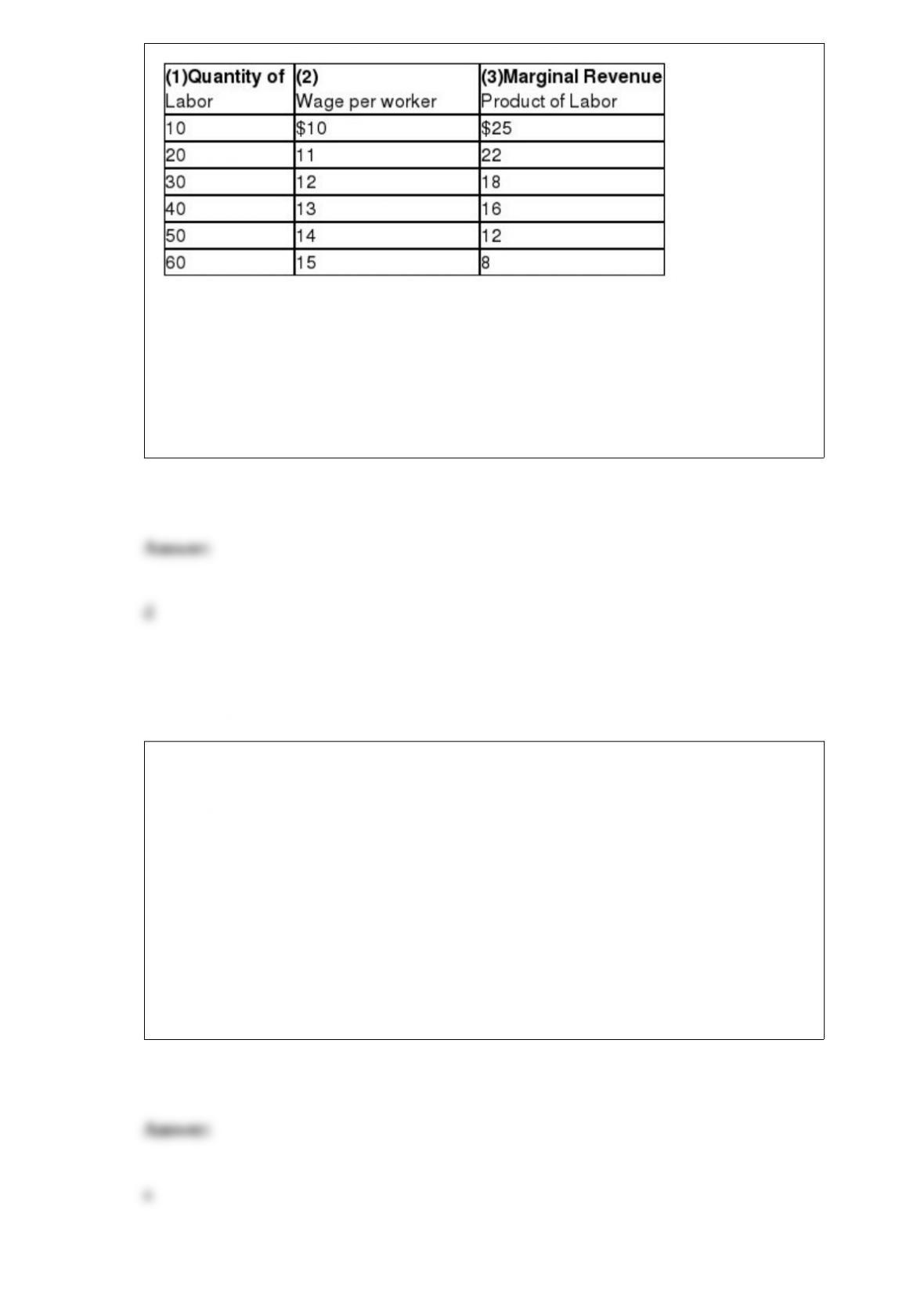
Refer to Exhibit 28-7. As the firm increases employment from 50 to 60 workers, by
how much does total labor cost increase?
Exhibit 28-7
a. $160
b. $40
c. $60
d. $200
What does it mean if a person makes a “decision at the margin”?
a. The person compares additional benefits and additional costs when deciding what to
do.
b. The person weighs the good against the bad and then decides what to do.
c. The person is more likely to say yes than to say no.
d. The person compares marginal benefits and total costs and then decides what to do.
e. The person makes a decision based on a condition.

Accounting profit is always greater than or equal to economic profit.
a. True
b. False
Public choice theorists insist that when a person goes from public to private
employment, his or her motivations __________ while the institutional arrangements
shaping his or her actions __________.
a. remain the same; change
b. remain the same; also remain the same
c. change; also change
d. change; remain the same
The monopolist’s demand curve is
a. upward sloping.
b. perfectly elastic.
c. perfectly inelastic.
d. downward sloping.

If the marginal utility of X is negative, then the last unit of X is
a. a bad
b. a normal good
c. an inferior good
d. not subject to the law of diminishing marginal utility
According to the traditional theory of marginal utility as presented in the textbook, as
more units of a good are acquired, the consumer’s marginal utility
a. always continues to rise.
b. diminishes.
c. remains constant.
d. may diminish at first, but it must eventually rise.
e. may rise at first, but it must eventually become constant.

Demand for a given good is elastic, which means that the percentage change in
__________ is greater than the percentage change in __________.
a. quantity demanded; income
b. quantity demanded; price
c. price; quantity demanded
d. income; price
e. none of the above
Major U.S. exports include automobiles and aircraft.
a. True
b. False
Refer to Exhibit 38-4.If the closing price of Greenco’s stock on the previous day was
$48.10, what value goes in blank (B)?
Exhibit 38-4

a. $47.35
b. $48.85
c. $45.85
d. $47.85
e. There is not enough information given to answer this question.
The act that was passed in an attempt to decrease the failure rate of small businesses by
protecting them from the competition of large and growing chain stores was the
a. Wheeler-Lea Act.
b. Robinson-Patman Act.
c. Celler-Kefauver Antimerger Act.
d. Clayton Act.
e. Sherman Act.

If government regulators guarantee that a natural monopoly will earn normal profits,
then
a. the monopolist has little or no incentive to hold down its costs.
b. the monopolist has a sharp incentive to hold down its costs so as to increase profits.
c. the monopolist will probably try its best to maintain its costs at the current level.
d. it is impossible to determine the monopolist’s incentives regarding costs before the
firm actually incurs some changes in its costs.
There are 30 students in a class. The average grade for the first 29 students is 87. The
grade of the remaining student is 84. Given this student’s grade, the average grade of the
30-student class will be
a. 87.
b. higher than 87.
c. lower than 87.
d. 84.

Suppose you are eating slices of pizza and after consuming the first slice you receive 14
utils of total utility, after the second you receive 22 utils of total utility, and after the
third 25 utils of total utility. Then
a. the law of diminishing marginal utility is not applicable because your total utility is
increasing instead of diminishing.
b. your total utility is 61 utils.
c. your total utility is 25 utils, and the marginal utility of the first slice is 8 utils (22 –
14).
d. your total utility is 25 utils, and the marginal utility of the third slice is 3 utils.
Between two wages, an individual’s supply curve of labor will be upward sloping if the
individual’s substitution effect outweighs the income effect between those two wages.
a. True
b. False
Currently an economy is producing (at a point on its production possibilities frontier)

100 units of good X and the opportunity cost of producing 1X is 3Y. If good X is
produced at increasing opportunity costs, then when the economy produces 120 units of
good X (on the same PPF) the opportunity cost of producing 1Y (not 1X) could be
a. 1/4X.
b. 1/3X.
c. 1/2X.
d. 1X.
e. none of the above
Marginal factor cost (MFC) is
a. the additional cost incurred by employing an additional factor unit.
b. the additional output generated by employing an additional factor unit.
c. equal to factor price for a factor price taker.
d. a and c
e. b and c
In the median voter model, we assume that

a. voters will vote for the friendlier of two candidates.
b. voters will vote for the candidate who comes closer to matching their views.
c. the candidate who occupies the far right has a better chance of winning the election
than the candidate who occupies the far left.
d. there are three candidates running for the same office.
e. b and c