Archives: Quiz
ECON A 754 Final
A competitive market economy is unlikely to provide an efficient quantity of some public goods because: a. only the government has the vast resources necessary to produce public goods. b. the nature of public goods makes it difficult for producers […]
ECON 566 Quiz
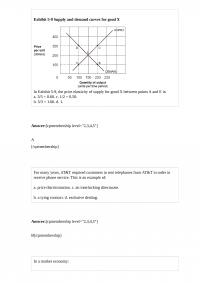
Exhibit 5-9 Supply and demand curves for good X In Exhibit 5-9, the price elasticity of supply for good X between points A and E is: a. 3/5 = 0.60. c. 1/2 = 0.50. b. 5/3 = 1.66. d. 1. […]
BUS 764 Quiz
An economic model is useful only if it: a. contains no positive statements. b. captures all the complexities of reality. c. yields accurate predictions. d. has both macro- and microeconomic applications. Under which one of the following market structures are […]
BUS 627
All things equal, the price elasticity of supply: a. will be greater in the short run than in the long run. b. will be greater in the long run than in the short run. c. is the same for the […]
ECB 210 Midterm 1
As a result of a kinked demand curve, the price: a. fluctuates. c. settles at the kink. b. falls below the kink. d. rises above the kink. Which of the following statements is true about the total utility provided by […]
ECB 513 Test 1
If we observe a decrease in the price of a good and a decrease in the amount of the good bought and sold, this could be explained by a(an): a. increase in the supply of the good. c. decrease in […]
MicroEconomic 210
Using the midpoints formula, what would be price elasticity of demand for a gallbladder operation if the number of operations fell from 6,000 to 4,000 per week after its price increased from $6,000 to $10,000? a. 0.25. c. 0.80. b. […]
ECON A 282 Test
Which of the following events would increase the price elasticity of demand for Chicago Bears tickets that sell at a price of $20? a. b and c. b. The Bears are having a successful season. c. The visiting team is […]
ECON A 611 Midterm
A price floor (support price) set above equilibrium: a. is a minimum legal price set by government above equilibrium. b. causes the quantity supplied to exceed the quantity demanded. c. creates a surplus. d. can represent the effect of a […]
ECON A 806 Final
Product differentiation makes the demand for a monopolistically competitive firm’s product: a. perfectly elastic. c. more inelastic than for a monopoly. b. more elastic than for a monopoly. d. perfectly inelastic. Suppose a monopolist’s demand curve lies below its average […]
BUS 400 Quiz 1
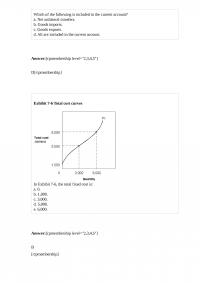
Which of the following is included in the current account? a. Net unilateral transfers. b. Goods imports. c. Goods exports. d. All are included in the current account. Exhibit 7-6 Total cost curves In Exhibit 7-6, the total fixed cost […]
BUS 199 Exhibit 101 A monopolistic
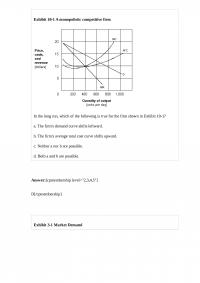
Exhibit 10-1 A monopolistic competitive firm In the long run, which of the following is true for the firm shown in Exhibit 10-1? a. The firm’s demand curve shifts leftward. b. The firm’s average total cost curve shifts upward. c. […]
MicroEconomic 155
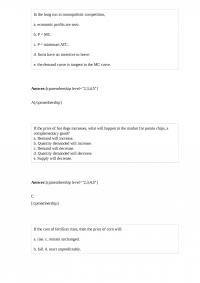
In the long run in monopolistic competition, a. economic profits are zero. b. P = MC. c. P = minimum ATC. d. firms have an incentive to leave. e. the demand curve is tangent to the MC curve. If the […]
BUS 375 Quiz 3
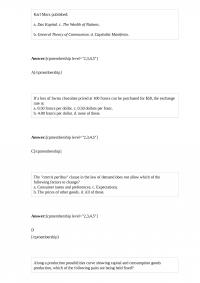
Karl Marx published: a. Das Kapital. c. The Wealth of Nations. b. General Theory of Communism. d. Capitalist Manifesto. If a box of Swiss chocolate priced at 100 francs can be purchased for $50, the exchange rate is: a. 0.50 […]
ECON 300 Quiz 3
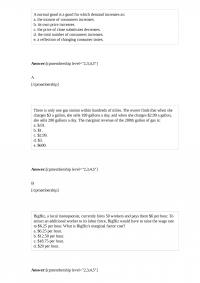
A normal good is a good for which demand increases as: a. the income of consumers increases. b. its own price increases. c. the price of close substitutes decreases. d. the total number of consumers increases. e. a reflection of […]
ECON E 318
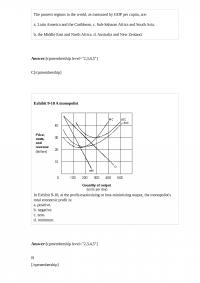
The poorest regions in the world, as measured by GDP per capita, are: a. Latin America and the Caribbean. c. Sub-Saharan Africa and South Asia. b. the Middle East and North Africa. d. Australia and New Zealand. Exhibit 9-10 A […]
MicroEconomic 294 Economics is
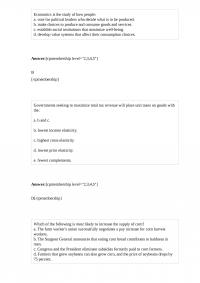
Economics is the study of how people: a. vote for political leaders who decide what is to be produced. b. make choices to produce and consume goods and services. c. establish social institutions that maximize well-being. d. develop value systems […]
ECB 638 Midterm
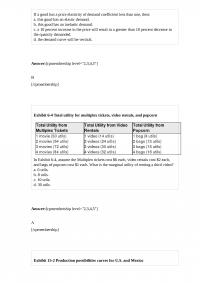
If a good has a price elasticity of demand coefficient less than one, then: a. this good has an elastic demand. b. this good has an inelastic demand. c. a 10 percent increase in the price will result in a […]
MicroEconomic 473 Quiz 2
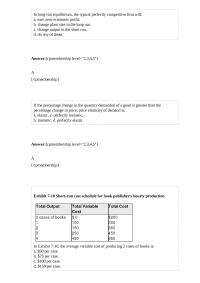
In long-run equilibrium, the typical perfectly competitive firm will: a. earn zero economic profit. b. change plant size in the long run. c. change output in the short run. d. do any of these. If the percentage change in the […]
ECON A 475
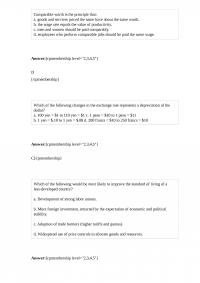
Comparable worth is the principle that: a. goods and services priced the same have about the same worth. b. the wage rate equals the value of productivity. c. men and women should be paid comparably. d. employees who perform comparable […]
BUS 528 Final
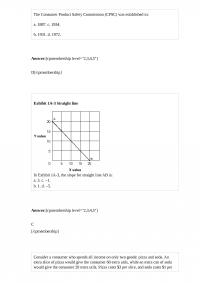
The Consumer Product Safety Commission (CPSC) was established in: a. 1887. c. 1934. b. 1931. d. 1972. Exhibit 1A-3 Straight line In Exhibit 1A-3, the slope for straight line AB is: a. 3. c. 1. b. 1. d. 5. Answer: […]
ECB 370
When a perfectly competitive firm or a monopolistically competitive firm is making zero economic profit, a. no firms will want to enter or exit. b. some firms will want to leave. c. some firms will want to enter. d. market […]
Economics 411 Midterm 1
Competitive firms X, Y, and Z meet in secret and agree to charge the same price. The U.S. Justice Department discovers this agreement and would most likely file charges under the: a. Clayton Act. b. Federal Trade Commission Act. c. […]
BUS 689
Which of the following is true of a perfectly competitive market? a. If economic profits are earned then the price will fall over time. b. In long-run equilibrium P = MR = SRMC = SRATC = LRAC. c. A constant-cost […]
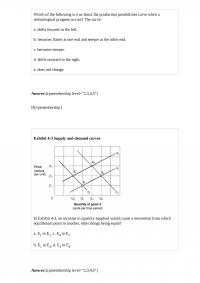
ECON A 426 Homework
Which of the following is true about the production possibilities curve when a technological progress occurs? The curve: a. shifts inwards to the left. b. becomes flatter at one end and steeper at the other end. c. becomes steeper. d. […]
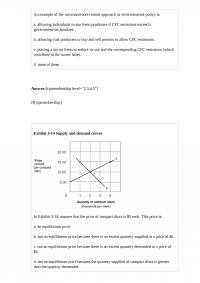
Economics 760
An example of the command-and-control approach to environmental policy is: a. allowing individuals to sue freon producers if CFC emissions exceed a government-set standard. b. allowing coal producers to buy and sell permits to allow CFC emissions. c. placing a […]
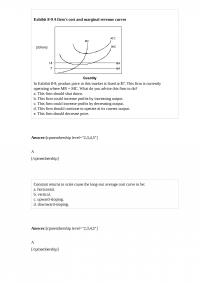
BUS 113 Midterm 1
Exhibit 8-9 A firm’s cost and marginal revenue curves In Exhibit 8-9, product price in this market is fixed at $7. This firm is currently operating where MR = MC. What do you advise this firm to do? a. This […]
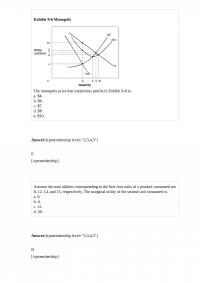
ECON 672 Quiz 3
Exhibit 9-6 Monopoly The monopoly price that maximizes profits in Exhibit 9-6 is: a. $4. b. $6. c. $7. d. $8. e. $10. Assume the total utilities corresponding to the first four units of a product consumed are 8, 12, […]
ECON A 367 Test 1
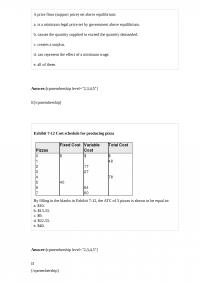
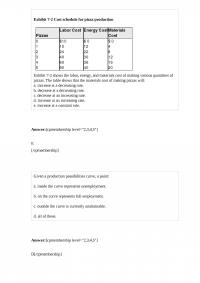
Exhibit 7-2 Cost schedule for pizza production Exhibit 7-2 shows the labor, energy, and materials cost of making various quantities of pizzas. The table shows that the materials cost of making pizzas will: a. increase at a decreasing rate. b. […]
Economics 217 Midterm
Farmers can choose to produce eggs or milk. If there is an increase in the price of milk then what will be the effect in the egg market? a. The quantity of eggs demanded will increase. b. Egg demand will […]
ECB 881 Exhibit 151 Production
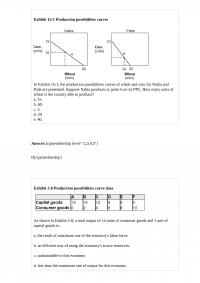
Exhibit 15-1 Production possibilities curves In Exhibit 15-1, the production possibilities curves of wheat and corn for Nabia and Pada are presented. Suppose Nabia produces at point A on its PPC. How many units of wheat is the country able […]
MicroEconomic 372 Quiz
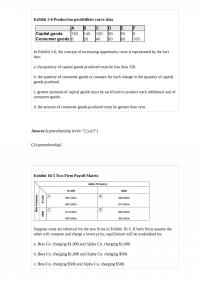
Exhibit 2-6 Production possibilities curve data In Exhibit 2-6, the concept of increasing opportunity costs is represented by the fact that: a. the quantity of capital goods produced must be less than 150. b. the quantity of consumer goods is […]
ECON 117 Quiz
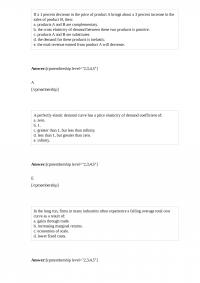
If a 1 percent decrease in the price of product A brings about a 3 percent increase in the sales of product B, then: a. products A and B are complementary. b. the cross elasticity of demand between these two […]
MicroEconomic 800
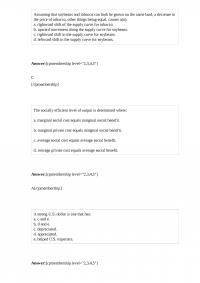
Assuming that soybeans and tobacco can both be grown on the same land, a decrease in the price of tobacco, other things being equal, causes a(n): a. rightward shift of the supply curve for tobacco. b. upward movement along the […]
MicroEconomic 867 Test
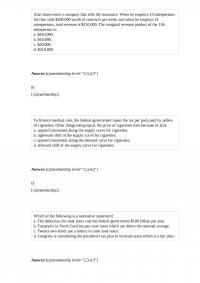
Alan Jones owns a company that sells life insurance. When he employs 10 salespersons his firm sells $200,000 worth of contracts per week, and when he employs 11 salespersons, total revenue is $210,000. The marginal revenue product of the 11th […]
Economics 137 Quiz
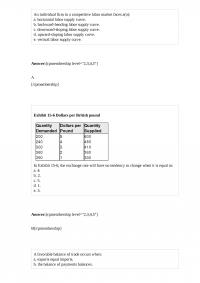
An individual firm in a competitive labor market faces a(n): a. horizontal labor supply curve. b. backward-bending labor supply curve. c. downward-sloping labor supply curve. d. upward-sloping labor supply curve. e. vertical labor supply curve. Exhibit 15-6 Dollars per British […]
ECON 336
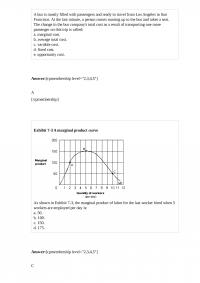
A bus is mostly filled with passengers and ready to travel from Los Angeles to San Francisco. At the last minute, a person comes running up to the bus and takes a seat. The change in the bus company’s total […]
BUS 737 Quiz The labor supply
The labor supply curve facing an individual employer in a perfectly competitive labor market is: a. upward sloping. b. downward sloping. c. horizontal. d. greater than MFC. e. the MRP curve. Excluding foreign competition, which of the following is an […]
BUS 301
What type of economic analysis is limited to testable, verifiable statements? a. Macroeconomics. c. Positive economics. b. Entrepreneurial economics. d. Normative economics. Starting in 1964, the U.S. government has defined the poverty line as income at or below ________ the […]
MicroEconomic 415 Test 1
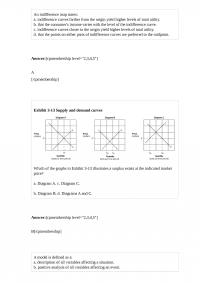
An indifference map states: a. indifference curves farther from the origin yield higher levels of total utility. b. that the consumer’s income varies with the level of the indifference curve. c. indifference curves closer to the origin yield higher levels […]
MicroEconomic 446 Midterm 1
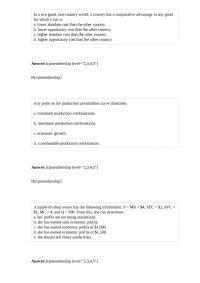
In a two good, two-country world, a country has a comparative advantage in any good for which it has a: a. lower absolute cost than the other country. b. lower opportunity cost than the other country. c. higher absolute cost […]
MicroEconomic 204 Test 1
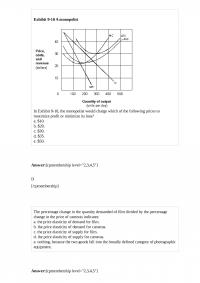
Exhibit 9-10 A monopolist In Exhibit 9-10, the monopolist would charge which of the following prices to maximize profit or minimize its loss? a. $10. b. $20. c. $30. d. $35. e. $50. The percentage change in the quantity demanded […]
BUS 248
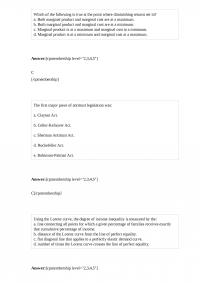
Which of the following is true at the point where diminishing returns set in? a. Both marginal product and marginal cost are at a maximum. b. Both marginal product and marginal cost are at a minimum. c. Marginal product is […]
ECON E 481 Quiz 2
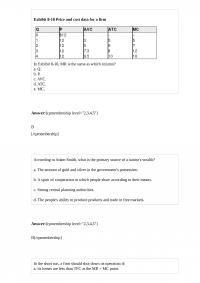
Exhibit 8-10 Price and cost data for a firm In Exhibit 8-10, MR is the same as which column? a. Q. b. P. c. AVC. d. ATC. e. MC. According to Adam Smith, what is the primary source of a […]
ECON 253 Quiz 3
Which of the following would be illegal under the Robinson-Patman Act? a. Ford and General Motors meet to fix the price of cars. b. Computer makers form a cartel. c. General Mills and Kelloggs decide to merge. d. Exxon sells […]
MicroEconomic 625 Midterm 1
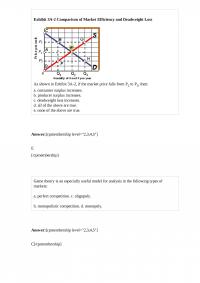
Exhibit 3A-2 Comparison of Market Efficiency and Deadweight Loss As shown in Exhibit 3A-2, if the market price falls from P2 to P3, then: a. consumer surplus increases. b. producer surplus increases. c. deadweight loss increases. d. all of the […]
Economics 717 Quiz 1
The importance of the Federal Trade Commission Act of 1914 is that it: a. set up an independent antitrust agency with the power to bring court cases. b. strengthened the law against mergers. c. strengthened the law against price discrimination. […]
ECON A 175 Test 1
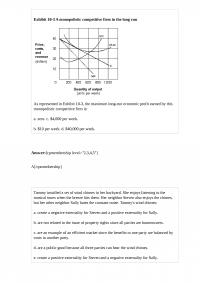
Exhibit 10-3 A monopolistic competitive firm in the long run As represented in Exhibit 10-3, the maximum long-run economic profit earned by this monopolistic competitive firm is: a. zero. c. $4,000 per week. b. $10 per week. d. $40,000 per […]
BUS 197 Quiz
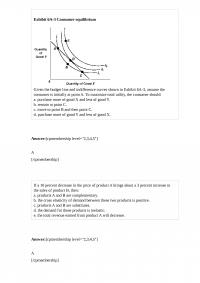
Exhibit 6A-3 Consumer equilibrium Given the budget line and indifference curves shown in Exhibit 6A-3, assume the consumer is initially at point A. To maximize total utility, the consumer should: a. purchase more of good X and less of good […]
MicroEconomic 115 Homework
The long-run equilibrium condition for perfect competition is: a. P = AVC = MR = MC. b. P = ATC = MR = MC. c. Q = AVC = MR = MC. d. Q = ATC = MR = MC. […]