Archives: Quiz
Economics 509 Quiz 2
The best number of workers for any employer to hire is that quantity in which: a. the marginal revenue product equals the marginal factor cost. b. the marginal revenue product exceeds the marginal factor cost. c. total costs are minimized. […]
BUS 132 Midterm 1
A farm can produce 10,000 bushels of wheat per year with 5 workers and 13,000 bushels with 6 workers. The marginal product of the sixth worker for this farm is: a. 10,000 bushels. b. 3,000 bushels. c. 500 bushels. d. […]
ECON 608 Midterm
Consumer surplus is the: a. amount by which the quantity supplied of a good exceeds the quantity demanded of a good. b. measure of consumes’ willingness to buy a good plus the price of the good. c. measure of how […]
ECON A 610 Test 2
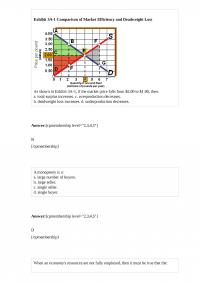
Exhibit 3A-1 Comparison of Market Efficiency and Deadweight Loss As shown in Exhibit 3A-1, if the market price falls from $2.00 to $1.00, then: a. total surplus increases. c. overproduction decreases. b. deadweight loss increases. d. underproduction decreases. A monopsony […]
ECON E 231 Midterm
If an economy’s population grows at 3 percent and real GDP grows at 3 percent, then: a. per capita real GDP is declining. b. the economy’s standard of living is increasing. c. per capita real GDP is negative. d. per […]
ECON E 680 Quiz 3
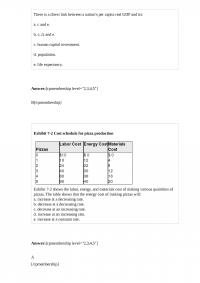
There is a direct link between a nation’s per capita real GDP and its: a. c and e. b. c, d, and e. c. human capital investment. d. population. e. life expectancy. Exhibit 7-2 Cost schedule for pizza production Exhibit […]
ECON E 687 Test
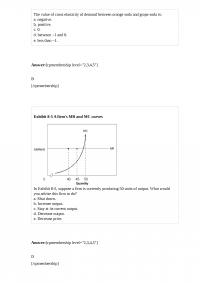
The value of cross elasticity of demand between orange soda and grape soda is: a. negative. b. positive. c. 0. d. between 1 and 0. e. less than 1. Exhibit 8-5 A firm’s MR and MC curves In Exhibit 8-5, […]
ECON A 166 Quiz
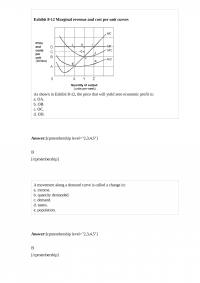
Exhibit 8-12 Marginal revenue and cost per unit curves As shown in Exhibit 8-12, the price that will yield zero economic profit is: a. OA. b. OB. c. OC. d. OD. A movement along a demand curve is called a […]
ECON 523 Midterm 1
“An increase in the federal minimum wage will provide a living wage for the working poor” is: a. a statement of positive economics. c. a tautology. b. a fallacy of composition. d. a statement of normative economics. Suppose that an […]
ECON A 372 Final
The marginal utilities associated with the first 4 units of consumption of good Y are 10, 12, 9, and 7, respectively. What is the total utility associated with the third unit? a. 3. b. 9. c. 25. d. 31. e. […]
ECB 549 Test
Suppose a monopolist and a perfectly competitive firm have the same cost curves. The monopolistic firm would: a. charge a lower price than the perfectly competitive firm. b. charge a higher price than the perfectly competitive firm. c. charge the […]
ECB 878 Test 1
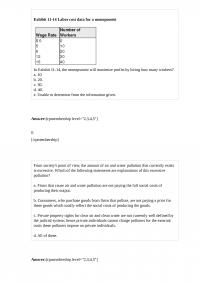
Exhibit 11-14 Labor cost data for a monopsonist In Exhibit 11-14, the monopsonist will maximize profits by hiring how many workers? a. 10. b. 20. c. 30. d. 40. e. Unable to determine from the information given. From society’s point […]
MicroEconomic 284 Midterm 2
As one moves down a straight-line, down-sloping demand curve, price elasticity will: a. change from elastic, to unit elastic, then to inelastic. b. remain the same between any two points. c. change from inelastic, to elastic, then to unit elastic. […]
ECB 519 Midterm Exhibit 104
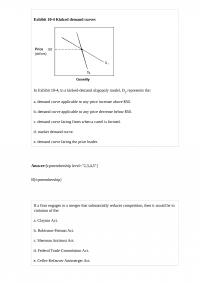
Exhibit 10-4 Kinked demand curves In Exhibit 10-4, in a kinked-demand oligopoly model, D2 represents the: a. demand curve applicable to any price increase above $50. b. demand curve applicable to any price decrease below $50. c. demand curve facing […]
ECON E 843 Test
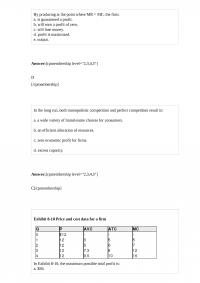
By producing at the point where MR = MC, the firm: a. is guaranteed a profit. b. will earn a profit of zero. c. will lose money. d. profit is maximized. e. output. In the long run, both monopolistic competition […]
ECON 536 Quiz 1
If the first four units of a good consumed have marginal utilities of 8, 4, 2, and 1, respectively, this trend is an indication of the: a. law of consumer equilibrium. b. law of diminishing marginal utility. c. law of […]
ECON 549 Test
Sam quits his job as an airline pilot and opens his own pilot training school. He was earning $40,000 as a pilot. He withdraws $10,000 from his savings where he was earning 6 percent interest and uses the money in […]
ECON A 117
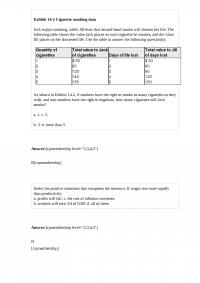
Exhibit 14-2 Cigarette smoking data Jack enjoys smoking, while Jill fears that second-hand smoke will shorten her life. The following table shows the value Jack places on each cigarette he smokes, and the value Jill places on her shortened life. […]
MicroEconomic 575 Midterm 2
An example of a price ceiling would be: a. a ration coupon. b. a guarantee of a target price for farm products. c. parity pricing. d. rent control. e. the soil bank program. Externalities are unintended costs or benefits that […]
ECON 221 Midterm
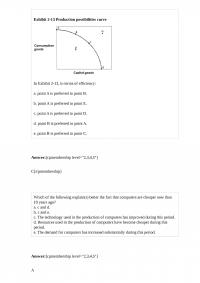
Exhibit 2-13 Production possibilities curve In Exhibit 2-13, in terms of efficiency: a. point A is preferred to point B. b. point A is preferred to point E. c. point A is preferred to point D. d. point B is […]
ECON A 749
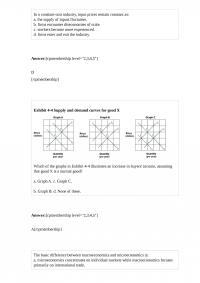
In a constant-cost industry, input prices remain constant as: a. the supply of inputs fluctuates. b. firms encounter diseconomies of scale. c. workers become more experienced. d. firms enter and exit the industry. Exhibit 4-4 Supply and demand curves for […]
BUS 858 Quiz
An increase in the equilibrium price of Japanese yen per dollar could be caused by a(n): a. increase in the general level of prices in Japan. b. increase in the U.S. demand for domestically-built automobiles. c. decrease in the U.S. […]
ECON 684 Quiz 3
What country is our largest trading partner, as measured by exports and imports? a. Japan. d. Canada. b. The United Kingdom. e. Mexico. c. China. In Europe during the 14th century, the Black Plague killed 24 million people or close […]
ECON 617
Which of the following is most likely to help the residents of a nation produce more goods and services and achieve higher income levels? a. Higher tax rates. b. A higher rate of investment. c. A smaller trade sector. d. […]
Economics 421
The demand curve any monopolist uses in making output decisions is: a. the same as the demand curve facing a perfectly competitive firm. b. vertical, because there are no close substitutes for its product. c. horizontal, because there are no […]
ECB 363 Homework
An example of price discrimination is the price charged for: a. troll dolls. b. college admission. c. textbooks. d. diamonds. Statistics on families below the poverty line may be overstated because: a. the poor are primarily children who soon will […]
ECON A 619 Quiz 2
Which of the following might increase the supply curve of labor? a. Elimination of discrimination against blacks. b. Elimination of discrimination against females. c. Easing licensing requirements. d. All of these. Which of the following is an explicit cost? a. […]
ECON E 218 Midterm 2
A monopolist will operate in the short run if which of the following is above average variable cost? a. Marginal cost. b. Marginal revenue. c. Price. d. All of these. There are apartments in Chicago whose rooftops overlook Wrigley Field. […]
ECON A 147
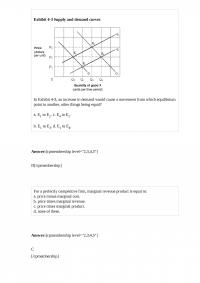
Exhibit 4-3 Supply and demand curves In Exhibit 4-3, an increase in demand would cause a movement from which equilibrium point to another, other things being equal? a. E1 to E2. c. E4 to E1. b. E1 to E3. d. […]
ECB 885 Quiz
Some people believe that employees should be paid the same wages when their jobs, although different, require similar levels of education, training, experience, and responsibility. This principle is known as: a. the equal-pay-for-equal work doctrine. b. Lorenz equivalence. c. marginal […]
BUS 648 Midterm
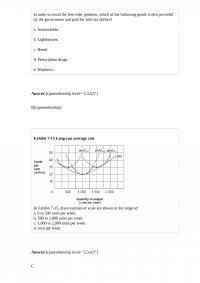
In order to avoid the free-rider problem, which of the following goods is best provided by the government and paid for with tax dollars? a. Automobiles. b. Lighthouses. c. Bread. d. Prescription drugs. e. Windows. Exhibit 7-15 Long-run average cost […]
Economics 422 Midterm 1
A limit on the quantity of a good that may be imported in a given time period is called: a. an embargo. c. a quota. b. a tariff. d. dumping. The law of demand indicates that as the price of […]
ECON A 880 Quiz 2
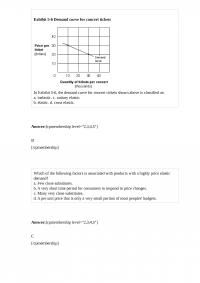
Exhibit 5-6 Demand curve for concert tickets In Exhibit 5-6, the demand curve for concert tickets shown above is classified as: a. inelastic. c. unitary elastic. b. elastic. d. cross elastic. Which of the following factors is associated with products […]
ECB 547 Quiz 2
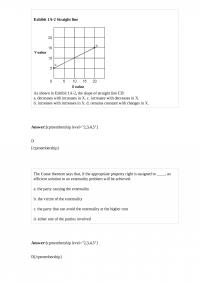
Exhibit 1A-2 Straight line As shown in Exhibit 1A-2, the slope of straight line CD: a. decreases with increases in X. c. increases with decreases in X. b. increases with increases in X. d. remains constant with changes in X. […]
BUS 465 Quiz 1
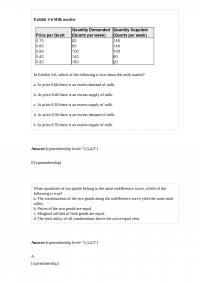
Exhibit 3-6 Milk market In Exhibit 3-6, which of the following is true about the milk market? a. At price 0.60 there is an excess demand of milk. b. At price 0.40 there is an excess supply of milk. c. […]
ECON 652 Midterm 2
Absolute advantage is the ability of a country to produce a good with ________ than another country. a. a lower opportunity cost b. a higher opportunity cost c. fewer resources d. more resources A consumer buys only food and clothing. […]
ECB 800
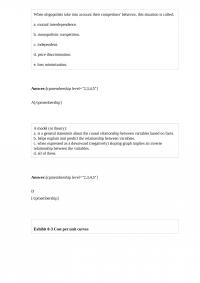
When oligopolists take into account their competitors’ behavior, this situation is called: a. mutual interdependence. b. monopolistic competition. c. independent. d. price discrimination. e. loss minimization. A model (or theory): a. is a general statement about the causal relationship between […]
ECON A 780 Midterm 2
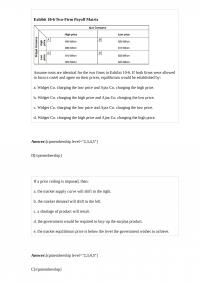
Exhibit 10-6 Two-Firm Payoff Matrix Assume costs are identical for the two firms in Exhibit 10-6. If both firms were allowed to form a cartel and agree on their prices, equilibrium would be established by: a. Widget Co. charging the […]
BUS 593 The horizontal summation
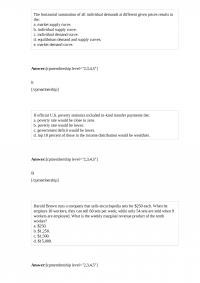
The horizontal summation of all individual demands at different given prices results in the: a. market supply curve. b. individual supply curve. c. individual demand curve. d. equilibrium demand and supply curves. e. market demand curve. If official U.S. poverty […]
BUS 640 Final
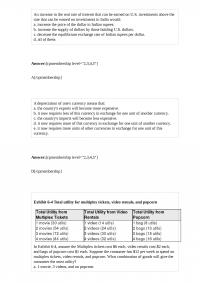
An increase in the real rate of interest that can be earned on U.S. investments above the rate that can be earned on investments in India would: a. increase the price of the dollar in Indian rupees. b. increase the […]
ECB 277 Test
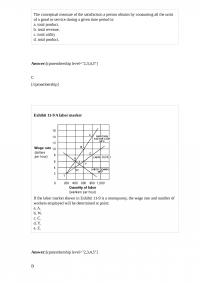
The conceptual measure of the satisfaction a person obtains by consuming all the units of a good or service during a given time period is: a. total product. b. total revenue. c. total utility d. total product. Exhibit 11-9 A […]
ECON E 634 Homework
When the consumption of a good generates an external benefit: a. the private benefit consumers receive from the good will be higher than the true social benefit. b. too much of the good will tend to be produced from the […]
ECB 577 Test
For which of the following medical goods or services is the income elasticity of demand largest? a. Emergency services after a car accident. b. Measles shots. c. Physical examinations for life insurance applications. d. Medical tests to diagnose specific symptoms. […]
BUS 159
Which of the following statements concerning the supply of labor is true? a. The wage rate has no effect on the supply of labor. b. The labor supply curve is downward sloping. c. The supply of labor is determined by […]
Economics 750 Quiz 2
For a monopolist with a downward-sloping demand curve, a. the coefficient of price elasticity of demand is infinite. b. the coefficient of price elasticity of demand is zero. c. as price increases, marginal revenue decreases. d. as price decreases, marginal […]
MicroEconomic 395 Quiz 1
Which of the following is often called the “Antimerger Act”? a. Clayton Act. b. Robinson-Patman Act. c. Sherman Antitrust Act. d. Federal Trade Commission Act. e. Celler-Kefauver Act. If we observe a decrease in the price of a good and […]
ECON A 667 Homework
The environmental approach found in the Clean Air Act of 1990 is: a. marketable pollution permits. c. command-and-control regulation. b. price caps. d. a thousand points of light. The costs of an economic activity borne by the producers are: a. […]
MicroEconomic 421 Quiz 2
Under both perfect competition and monopoly, a firm: a. is a price taker. b. maximizes profit by setting marginal cost equal to marginal revenue. c. will shut down in the short-run if price falls short of average total cost. d. […]
BUS 801 Midterm 2
A horizontal merger is one in which the merging firms: a. are about the same size. b. produce the same good in the same industry. c. will control greater than 50 percent of the market. d. have never directly competed […]
ECON 504 Midterm
Along the elastic range of a demand curve, a decrease in price causes: a. no change in total revenue. b. a decrease in total revenue. c. an increase in total revenue. d. an unpredictable change in total revenue. The price-taker […]