Archives: Quiz
BUS 84608
Holding the price of a firm’s output constant, if the marginal product of labor increases A) the marginal revenue product of labor decreases. B) the marginal revenue product of labor also increases. C) the marginal products of other inputs also […]
MicroEconomic 80132
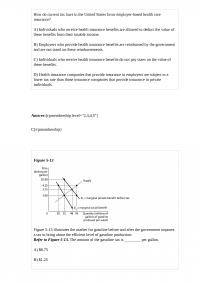
How do current tax laws in the United States favor employer-based health care insurance? A) Individuals who receive health insurance benefits are allowed to deduct the value of these benefits from their taxable income. B) Employers who provide health insurance […]
ECON E 72717
The costs in time and other resources that parties incur in the process of agreeing to and carrying out an exchange of goods or services are called A) exchange costs. B) implicit costs. C) transactions costs. D) selling costs. Assume […]
Economics 61774
Allocative efficiency best explains ________, and productive efficiency best explains ________. A) how something will be produced; when something will be produced B) when something will be produced; why something will be produced C) why something will be produced; what […]
ECB 85452
Crystal inc. is a multifaceted company that deals with the mining, cutting, and selling of diamonds. It gives distributors and suppliers access to its database to place orders or restock inventories electronically and automatically. Which of the following is the […]
ECON 87452
Price discrimination A) is the practice of charging different prices to different customers based on a seller’s personal preferences and prejudices. B) is the practice of charging different prices to different customers based on the different costs of supplying the […]
Economics 67143
Which of the following is an example of a way in which a firm in oligopoly can escape the prisoner’s dilemma? A) producing more of its product B) advertising that it will match its rival’s price C) reneging on a […]
ECON A 45166
All Gini coefficients must lie between 0 and 1. The lower the value A) the more unequal the income distribution. B) the closer the income distribution is to being equal. C) the greater the degree of poverty. D) the lower […]
BUS 58787
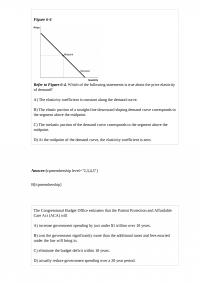
Figure 6-4 Refer to Figure 6-4. Which of the following statements is true about the price elasticity of demand? A) The elasticity coefficient is constant along the demand curve. B) The elastic portion of a straight-line downward sloping demand curve […]
MicroEconomic 29475
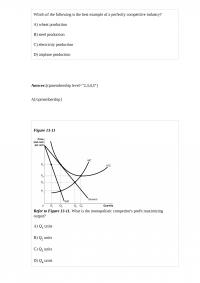
Which of the following is the best example of a perfectly competitive industry? A) wheat production B) steel production C) electricity production D) airplane production Figure 13-11 Refer to Figure 13-11. What is the monopolistic competitor’s profit maximizing output? A) […]
ECON 15024
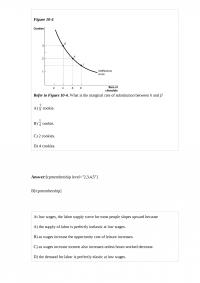
Figure 10-4 Refer to Figure 10-4. What is the marginal rate of substitution between h and j? A) cookie. B) cookie. C) 2 cookies. D) 4 cookies. At low wages, the labor supply curve for most people slopes upward because […]
ECON 74161
The marginal productivity theory of income distribution states that A) as more and more units of labor are added to a fixed quantity of capital, eventually labor’s contribution to a firm’s income will decrease. B) income distribution is determined by […]
MicroEconomic 72228
Laura’s Pizza Place incurs $800,000 per year in explicit costs and $100,000 in implicit costs. The restaurant earns $1.3 million in revenues. Based on this information, what is accounting profit for Laura’s Pizza Place? A) $200,000 B) $400,000 C) $500,000 […]
Economics 33380
The first important law regulating monopolies in the United States was A) the Grant Act, which was passed in 1890. B) the Clayton Act, which was passed in 1890. C) the Sherman Act, which was passed in 1890. D) the […]
Economics 22585
The marginal productivity theory of income distribution was developed by A) Edward Lazear. B) George Akerlof. C) William Stanley Jevons. D) John Bates Clark. If Dawson prefers pizza to hamburgers and hamburgers to hot dogs, then if preferences are transitive […]
MicroEconomic 63646
The U.S. government’s focus on supply reduction efforts in its “war on drugs” has been relatively unsuccessful at addressing illegal drug use. Some economists believe that a successful anti-drug program must concentrate on reducing demand; for example, through drug education […]
ECON A 98540
A public franchise A) is a corporation that is owned by stockholders. B) results from ownership of a key raw material. C) is a government designation that a private firm is the only legal producer of a good or service. […]
ECB 59491
BHP Billiton is a Canadian company that owns mines in Canada that A) produce nickel. After World War II, BHP Billiton began to compete with another Canadian firm, the International Nickel Company. This competition eventually ended International Nickel’s monopoly in […]
MicroEconomic 49414
If the paint on your house was eaten away by the fumes from a factory nearby and you hired a lawyer to sue the polluting firm, your legal fees would be considered A) external costs. B) transaction costs. C) marginal […]
ECB 96248
If a natural monopoly regulatory commission sets a price where marginal cost is equal to demand A) the firm would earn monopoly profits. B) economic efficiency would not be achieved. C) the firm would incur a loss. D) the firm […]
ECON E 24878
Assuming zero transaction cost, if your local grocer buys oranges at a low price from an orchard and resells them to you at a higher price, then the grocer’s revenue minus costs is known as A) arbitrage profits. B) transactions […]
ECON 65135
Many economists believe that when the federal government establishes an agency to regulate a particular industry, the regulated firms try to influence the agency even if these actions do not benefit the public. Economists refer to this result of government […]
ECB 76279
A firm that is the only seller of a good or service that does not have a close substitute is called A) a monopoly. B) an oligopolist. C) a market maker. D) a price maker. Consumers have to make tradeoffs […]
ECON 79950
In January, buyers of gold expect that the price of gold will rise in February. What happens in the gold market in January, holding all else constant? A) The supply curve shifts to the right. B) The demand curve shifts […]
ECB 95752
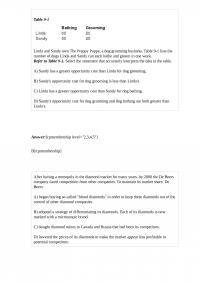
Table 9-1 Linda and Sandy own The Preppy Puppy, a dog grooming business. Table 9-1 lists the number of dogs Linda and Sandy can each bathe and groom in one week. Refer to Table 9-1. Select the statement that accurately […]
BUS 99277
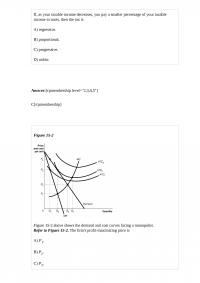
If, as your taxable income decreases, you pay a smaller percentage of your taxable income in taxes, then the tax is A) regressive. B) proportional. C) progressive. D) unfair. Figure 15-2 Figure 15-2 above shows the demand and cost curves […]
ECON A 55232
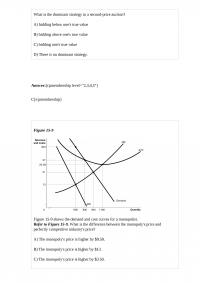
What is the dominant strategy in a second-price auction? A) bidding below one’s true value B) bidding above one’s true value C) bidding one’s true value D) There is no dominant strategy. Figure 15-9 Figure 15-9 shows the demand and […]
MicroEconomic 89861
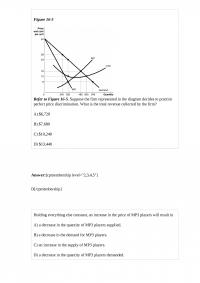
Figure 16-5 Refer to Figure 16-5. Suppose the firm represented in the diagram decides to practice perfect price discrimination. What is the total revenue collected by the firm? A) $6,720 B) $7,680 C) $10,240 D) $13,440 Holding everything else constant, […]
ECON 88681
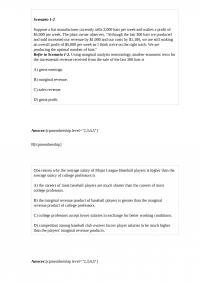
Scenario 1-2 Suppose a hat manufacturer currently sells 2,000 hats per week and makes a profit of $5,000 per week. The plant owner observes, “Although the last 300 hats we produced and sold increased our revenue by $1,000 and our […]
MicroEconomic 38616
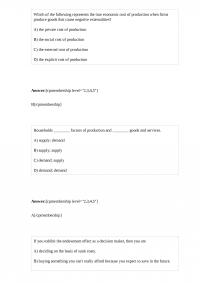
Which of the following represents the true economic cost of production when firms produce goods that cause negative externalities? A) the private cost of production B) the social cost of production C) the external cost of production D) the explicit […]
ECON E 79801
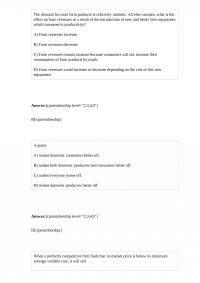
The demand for most farm products is relatively inelastic. All else constant, what is the effect on farm revenues as a result of the introduction of new and better farm equipment which increases in productivity? A) Farm revenues increase. B) […]
MicroEconomic 10611
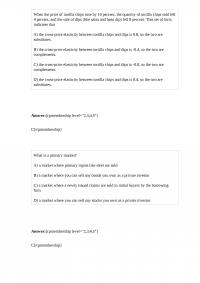
When the price of tortilla chips rose by 10 percent, the quantity of tortilla chips sold fell 4 percent, and the sale of dips (like salsa and bean dip) fell 8 percent. This set of facts indicates that A) the […]
BUS 16085
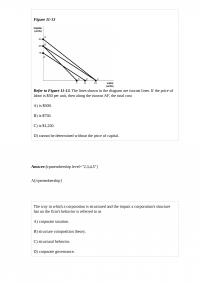
Figure 11-13 Refer to Figure 11-13. The lines shown in the diagram are isocost lines. If the price of labor is $50 per unit, then along the isocost AF, the total cost A) is $500. B) is $750. C) is […]
ECON E 61583
Marginal utility can be A) negative. B) zero. C) positive. D) positive, negative or zero. A perfectly competitive firm in a constant-cost industry produces 3,000 units of a good at a total cost of $36,000. The prevailing market price is […]
ECON E 69778
One reason Starbucks experienced a decline in sales in the late 2000s is because A) the product they offered was becoming less differentiated from their competitors’ products. B) the coffeehouse market transitioned from being monopolistically competitive to perfectly competitive. C) […]
ECON A 40113
Psychologists Daniel Kahneman and Amos Tversky conducted the following experiments by asking a sample of people the following questions: Scenario A: “Imagine that you have decided to see a play and paid the admission price of $10 per ticket. As […]
ECON 74179
When a firm produces 50,000 units of output, its total cost equals $6.5 million. When it increases its production to 70,000 units of output, its total cost increases to $9.4 million. Within this range, the marginal cost of an additional […]
ECON 46341
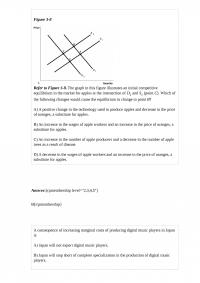
Figure 3-8 Refer to Figure 3-8. The graph in this figure illustrates an initial competitive equilibrium in the market for apples at the intersection of D2 and S1 (point C). Which of the following changes would cause the equilibrium to […]
ECON A 57404
Max Shreck, an accountant, quit his $80,000-a-year job and bought an existing tattoo parlor from its previous owner, Sylvia Sidney. The lease has five years remaining and requires a monthly payment of $4,000. Max’s explicit cost amounts to $3,000 per […]
ECON E 68620
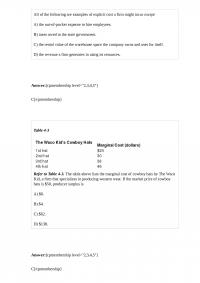
All of the following are examples of explicit cost a firm might incur except A) the out-of-pocket expense to hire employees. B) taxes owed to the state government. C) the rental value of the warehouse space the company owns and […]
BUS 50722
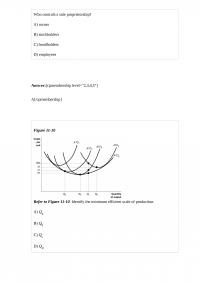
Who controls a sole proprietorship? A) owner B) stockholders C) bondholders D) employees Figure 11-10 Refer to Figure 11-10. Identify the minimum efficient scale of production. A) Qa B) Qb C) Qc D) Qd Answer: A Which of the following […]
ECON E 58264
Natural monopolies in the United States are generally regulated by A) the Federal Trade Commission. B) the Department of Justice. C) local or state regulatory commissions. D) the Department of Commerce. All of the following would be considered explicit costs […]
ECON E 76755
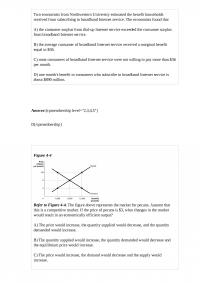
Two economists from Northwestern University estimated the benefit households received from subscribing to broadband Internet service. The economists found that A) the consumer surplus from dial-up Internet service exceeded the consumer surplus from broadband Internet service. B) the average consumer […]
ECON 22829
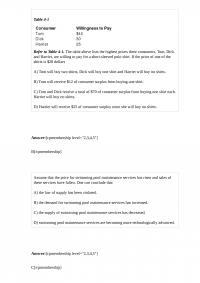
Table 4-1 Refer to Table 4-1. The table above lists the highest prices three consumers, Tom, Dick and Harriet, are willing to pay for a short-sleeved polo shirt. If the price of one of the shirts is $28 dollars A) […]
ECON 31387
If price exceeds average variable cost but is less than average total cost, a firm A) should further differentiate its product. B) should stay in business for a while longer until its fixed costs expire. C) is making some profit […]
ECB 87142
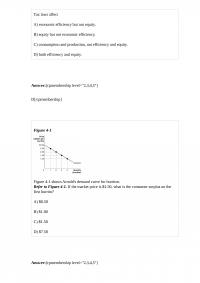
Tax laws affect A) economic efficiency but not equity. B) equity but not economic efficiency. C) consumption and production, not efficiency and equity. D) both efficiency and equity. Figure 4-1 Figure 4-1 shows Arnold’s demand curve for burritos. Refer to […]
BUS 81634
Consider the market for pilots. What is likely to happen to the equilibrium wage and quantity of pilots if the government enforces a lower mandatory retirement age, say from age 65 to age 62? A) The equilibrium wage and the […]
ECON E 71049
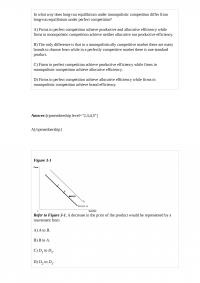
In what way does long-run equilibrium under monopolistic competition differ from long-run equilibrium under perfect competition? A) Firms in perfect competition achieve productive and allocative efficiency while firms in monopolistic competition achieve neither allocative nor productive efficiency. B) The only […]
ECON E 70247
As women’s wages have risen relative to men’s wages, the opportunity cost to women of doing housework has ________ than has the opportunity cost to men. A) increased less B) increased more C) decreased more D) decreased less Which of […]
ECON E 38911
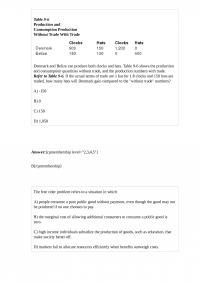
Table 9-6 Production and Consumption Production Without Trade With Trade Denmark and Belize can produce both clocks and hats. Table 9-6 shows the production and consumption quantities without trade, and the production numbers with trade. Refer to Table 9-6. If […]