
The U.S. government’s focus on supply reduction efforts in its “war on drugs” has been
relatively unsuccessful at addressing illegal drug use. Some economists believe that a
successful anti-drug program must concentrate on reducing demand; for example,
through drug education and voluntary treatment programs for addicts.
a. Suppose the price elasticity of demand for cocaine is -0.5. What will happen to the
equilibrium price, quantity and total revenue from cocaine sales if the government
succeeds in its efforts to reduce demand? What is likely to happen to the incentive to
sell cocaine?
b. Suppose the government continues to concentrate its efforts on supply reduction and
is able to reduce the supply of cocaine. As a result of the reduction in supply the price
of cocaine increases by 25 percent. If the price elasticity of demand is -0.5, what is
likely to happen to the incentive to sell cocaine?
c. Based on your answers, explain why one approach might be preferred over the other.
Figure 15-2
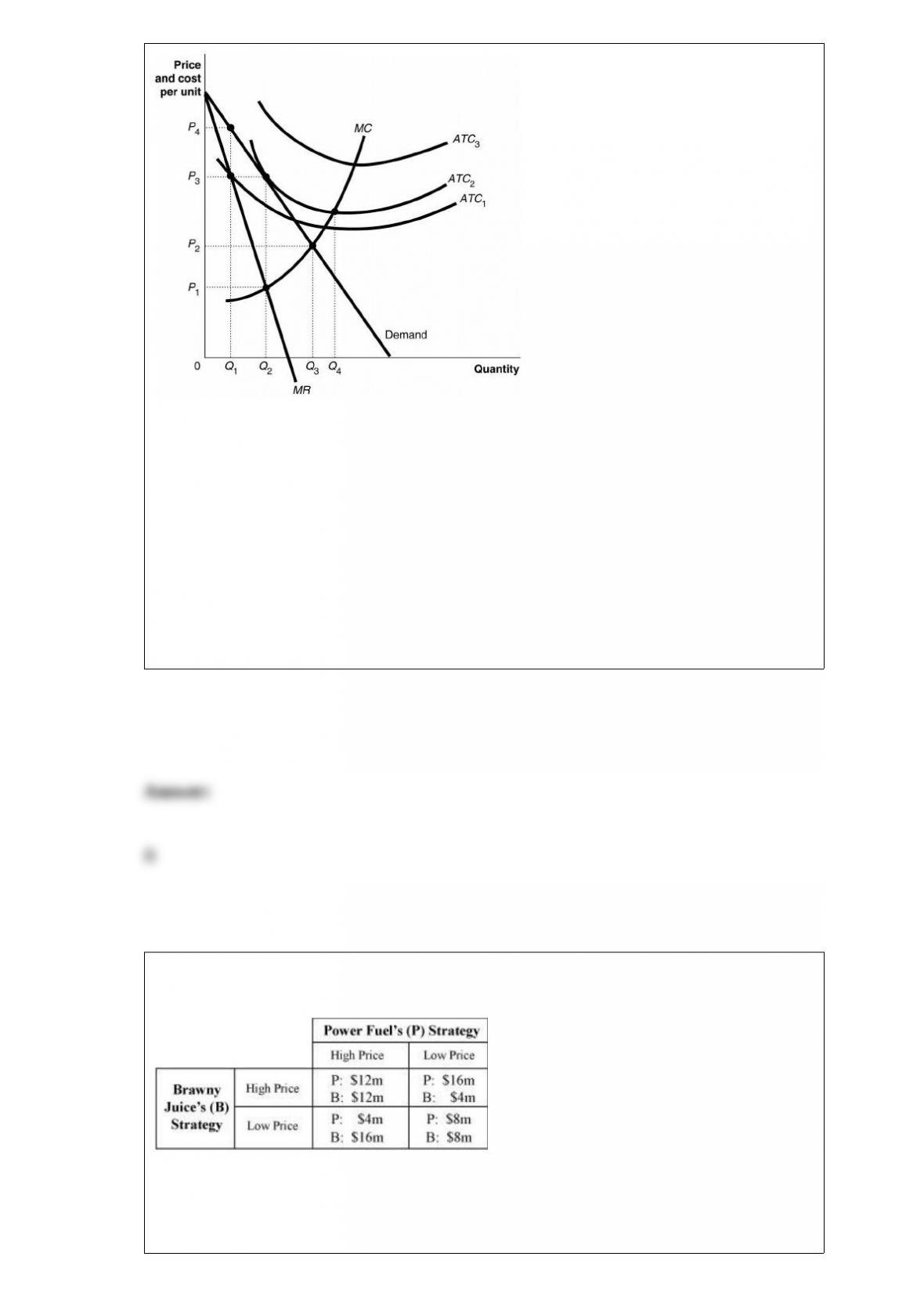
Figure 15-2 above shows the demand and cost curves facing a monopolist.
Refer to Figure 15-2. If the firm’s average total cost curve is ATC2, the firm will
A) suffer a loss.
B) break even.
C) make a profit.
D) face competition.
Table 14-8
Two rival oligopolists in the athletic supplements industry, the Power Fuel Company
and the Brawny Juice Company, have to decide on their pricing strategy. Each can
choose either a high price or a low price. Table 14-8 shows the payoff matrix with the
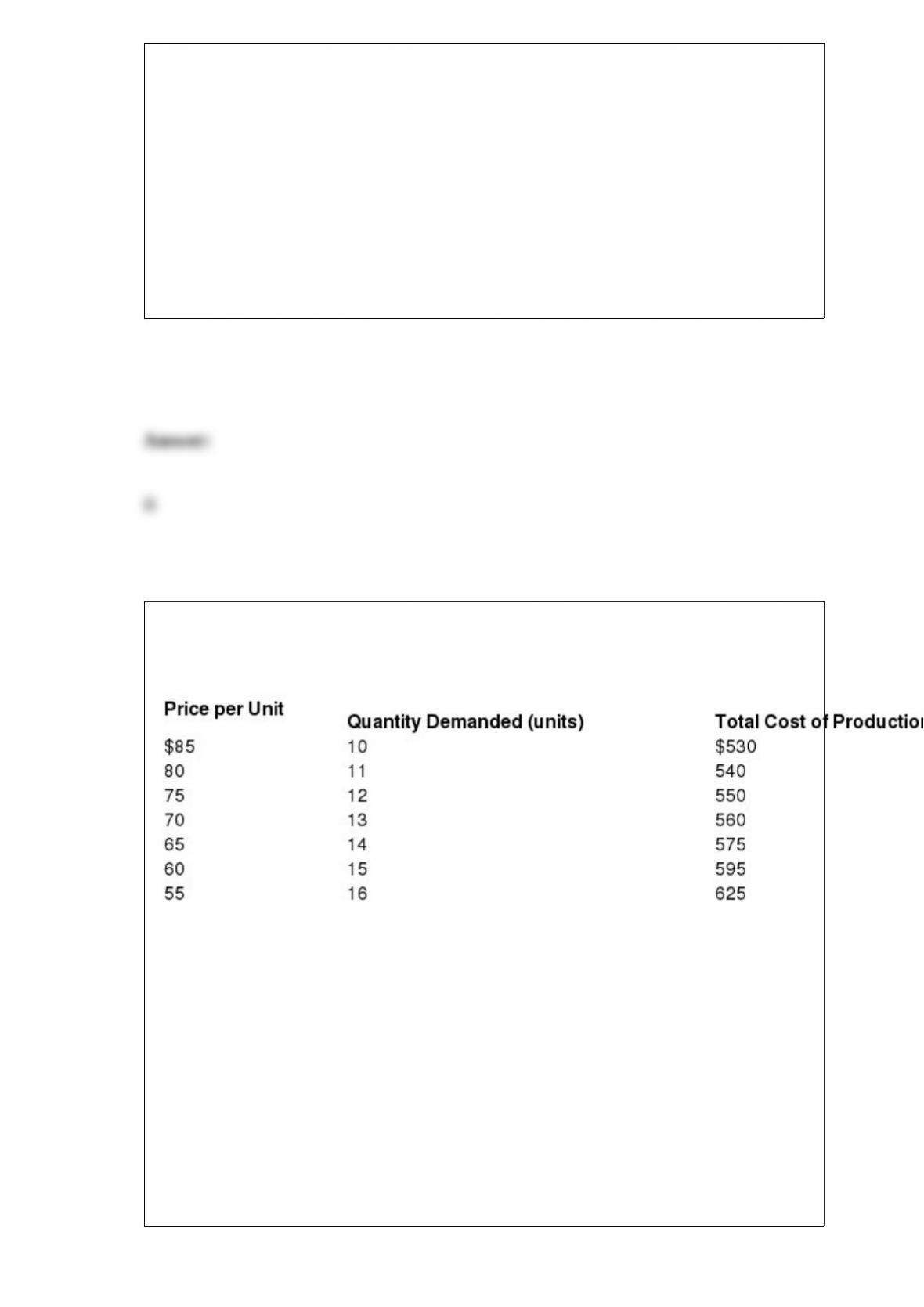
profits that each firm can expect to earn depending on the pricing strategy it adopts.
Refer to Table 14-8. If Brawny Juice selects a high price, what is Power Fuel’s best
strategy and what will Power Fuel earn as a result of this strategy?
A) Power Fuel will select a low price and earn $8 million.
B) Power Fuel will select a low price and earn $16 million.
C) Power Fuel will select a high price and earn $12 million.
D) Power Fuel will select a high price and earn $16 million.
Table 15-1
A monopoly producer of foreign language translation software faces a demand and cost
structure as given in Table 15-1.
Refer to Table 15-1. What is the firm’s profit-maximizing output and what is the price
charged to sell this output?
A) P = $85; Q = 10
B) P = $80; Q = 11
C) P = $70; Q = 13
D) P = $65; Q = 14

If 50 units are sold at a price of $20 and 80 units are sold at a price of $15, what is the
absolute value of the price elasticity of demand? Use the midpoint formula.
A) 0.17
B) 0.62
C) 1.62
D) 5
Which of the following must a firm in a market economy do today to succeed?
A) Produce the goods and services that consumers want at a lower cost than consumers
themselves can produce.
B) Organize the factors of production into a functioning, efficient unit.
C) Have access to sufficient funds.
D) Market firms today must do all of these things.
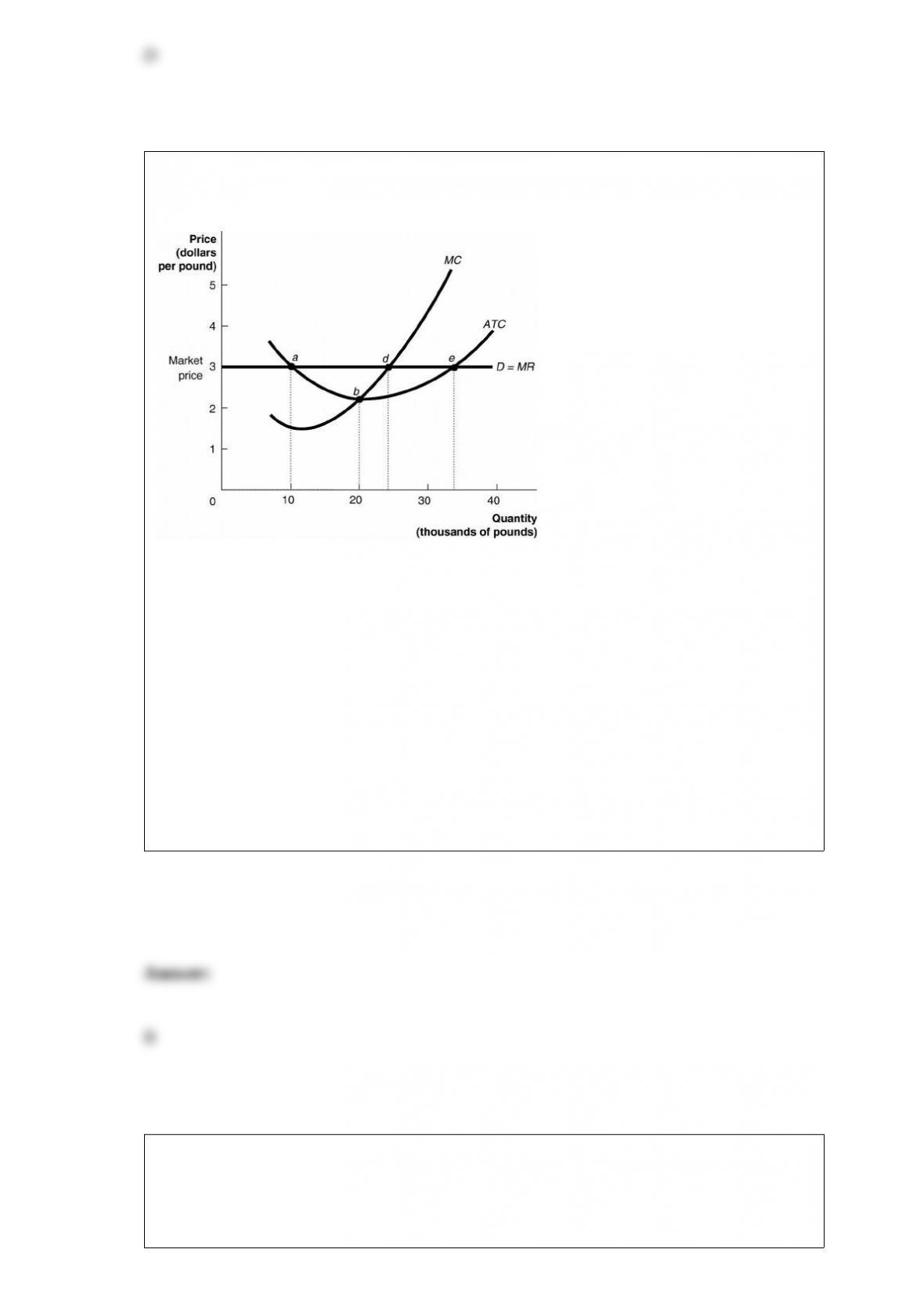
Figure 12-6
Figure 12-6 shows the demand, marginal cost (MC) and average total cost (ATC) curves
for Jason’s House of Apples.
Refer to Figure 12-6. Jason is currently producing 20 thousand pounds of apples. To
maximize his profit Jason should
A) keep production at 20 thousand pounds.
B) increase production to the output rate indicated by point d.
C) increase production to the output rate indicated by point e.
D) decrease production to the output rate indicated by point a.
Which type of businesses earns the majority of revenues in the United States?
A) corporations

B) partnerships
C) sole proprietorships
D) none of these
Article Summary
Starting as a Chicago antique store that sold sandwiches on the side, Potbelly has grown
from this 1977 beginning into a company which today operates approximately 300
sandwich shops in the United States. In October 2013, Potbelly sold stock for the first
time through an initial public offering (IPO), with shares jumping in price from the
initial offering price of $14 to more than $32 on the same day. Since 2011, Potbelly has
seen an increase in in both sales and revenue, and earned a profit of $2.8 million in the
first half of 2013.
Source: Matt Krantz, “Potbelly IPO shares more than double on open,” USA Today,
October 4, 2013.
When Potbelly sold stock to the public in its IPO, it did so through the NASDAQ
market. This was an example of Potbelly raising funds through
A) reinvesting retained earnings.
B) a financial intermediary.
C) dividend reinvestment.
D) a financial market.
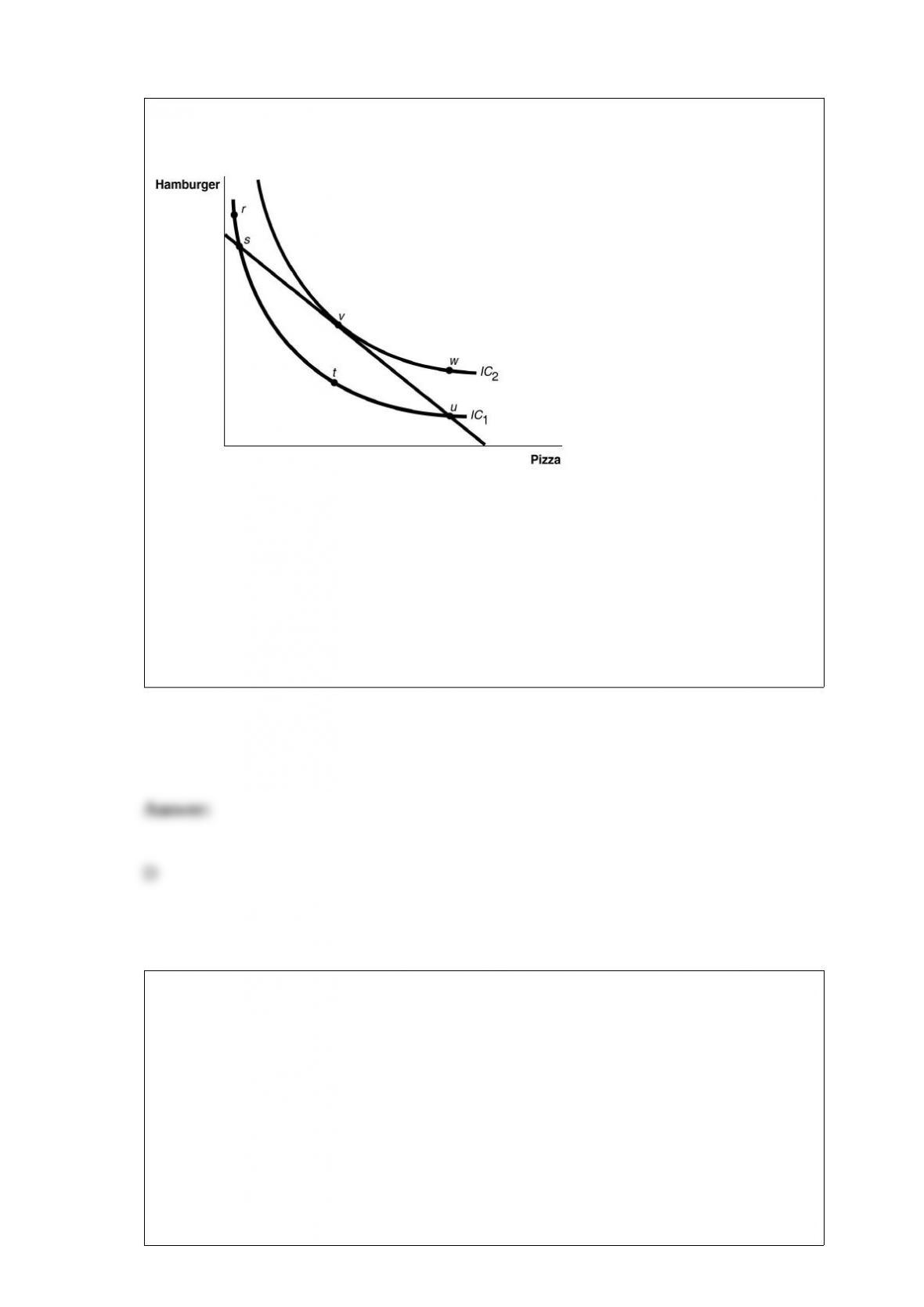
Figure 10-5
Refer to Figure 10-5. The consumer can afford consumption bundles
A) r, s, t and u.
B) r, s, v and u.
C) s, v and u only.
D) s, v, t and u.
If the price of steel increases drastically, the quantity of steel demanded by the building
industry will fall significantly over the long run because
A) buyers of steel are more sensitive to a price change if they have more time to adjust
to the price change.
B) buyers of steel are less sensitive to a price change if they have more time to adjust to
the price change.
C) sales revenue in the building industry will fall sharply.

D) profits will fall by a greater amount in the long run than in the short run.
According to census figures and the Congressional Budget Office, the number of people
aged 65 and older is projected to ________ and the number of uninsured people is
projected to ________ by the year 2020.
A) increase; increase
B) decrease; increase
C) increase; decrease
D) decrease; decrease
Figure 18-7
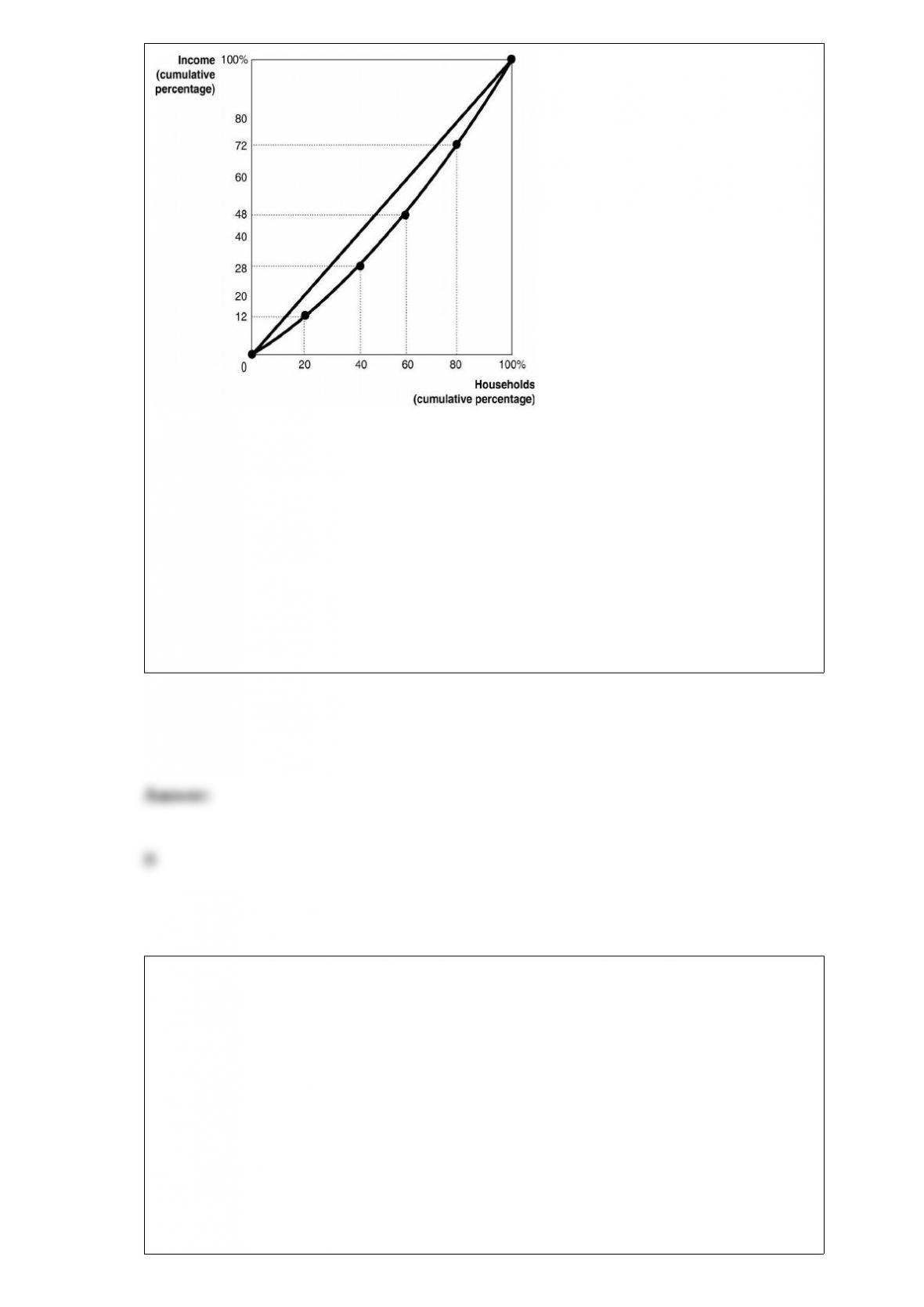
Figure 18-7 shows the Lorenz curve for a hypothetical country.
Refer to Figure 18-7. The second lowest 20 percent of households
A) earn 12 percent of the society’s total income.
B) earn 16 percent of the society’s total income.
C) earn 28 percent of the society’s total income.
D) earn 40 percent of the society’s total income.
The Herfindahl-Hirschman Index is one factor used to determine whether a merger
between two firms should be allowed. Which of the following statements regarding the
value of the Index for a given industry is true?
A) If a merger would result in an Index value less than 1,000, the merger would not be
challenged.
B) If a merger would result in an Index value of 1,000 or more, the industry would be
considered a monopoly and the merger would be challenged.
C) If a merger resulted in an Index of between 1,000 and 1,800, the industry would be
considered competitive and the merger would not be challenged.

D) If a merger would increase the Index by 100, the industry would be considered a
monopoly and the merger would be challenged.
Assume that Anne has $300 to spend on DVDs and CDs. Her optimal consumption of
DVDs and CDs is illustrated by a tangency between a budget line and an indifference
curve. Now assume that the price of CDs rises but the price of DVDs falls. How can
you show that Anne is made better off by these price changes?
A) Show that the price changes shift Anne’s budget line outward; the budget line is
tangent to a higher indifference curve.
B) Show that the price changes move Anne along her budget line to a higher
indifference curve.
C) Show that Anne can afford to buy the optimal combination of DVDs and CDs at
their original prices; then show that Anne can now reach a higher indifference curve.
D) Show that Anne can now afford to buy more DVDs, which give her greater utility
than CDs.
Table 9-6
Production and
Consumption Production
Without Trade With Trade
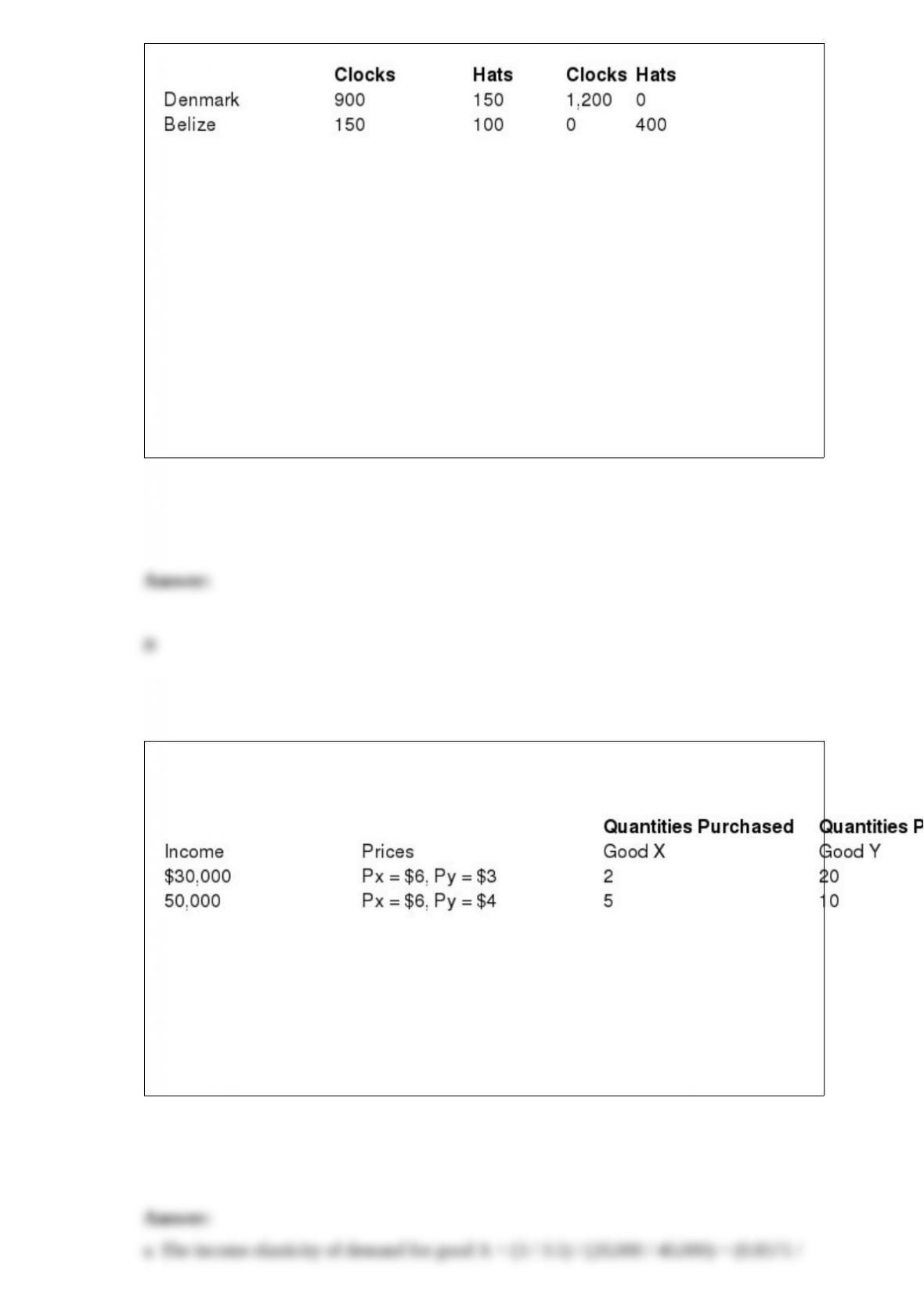
Denmark and Belize can produce both clocks and hats. Table 9-6 shows the production
and consumption quantities without trade, and the production numbers with trade.
Refer to Table 9-6. Prior to trade, what was the opportunity cost to produce 1 clock in
Belize?
A) 1/6 of a hat
B) 2/3 of a hat
C) 1.5 hats
D) 6 hats
Table 6-6
Refer to Table 6-6.
a. Using the information in the table, calculate the income elasticity of demand for good
X and characterize the good. Use the midpoint formula.
b. Can you calculate the income elasticity of demand for good Y? If you can, show your
calculation and characterize the good. If you cannot, explain why.
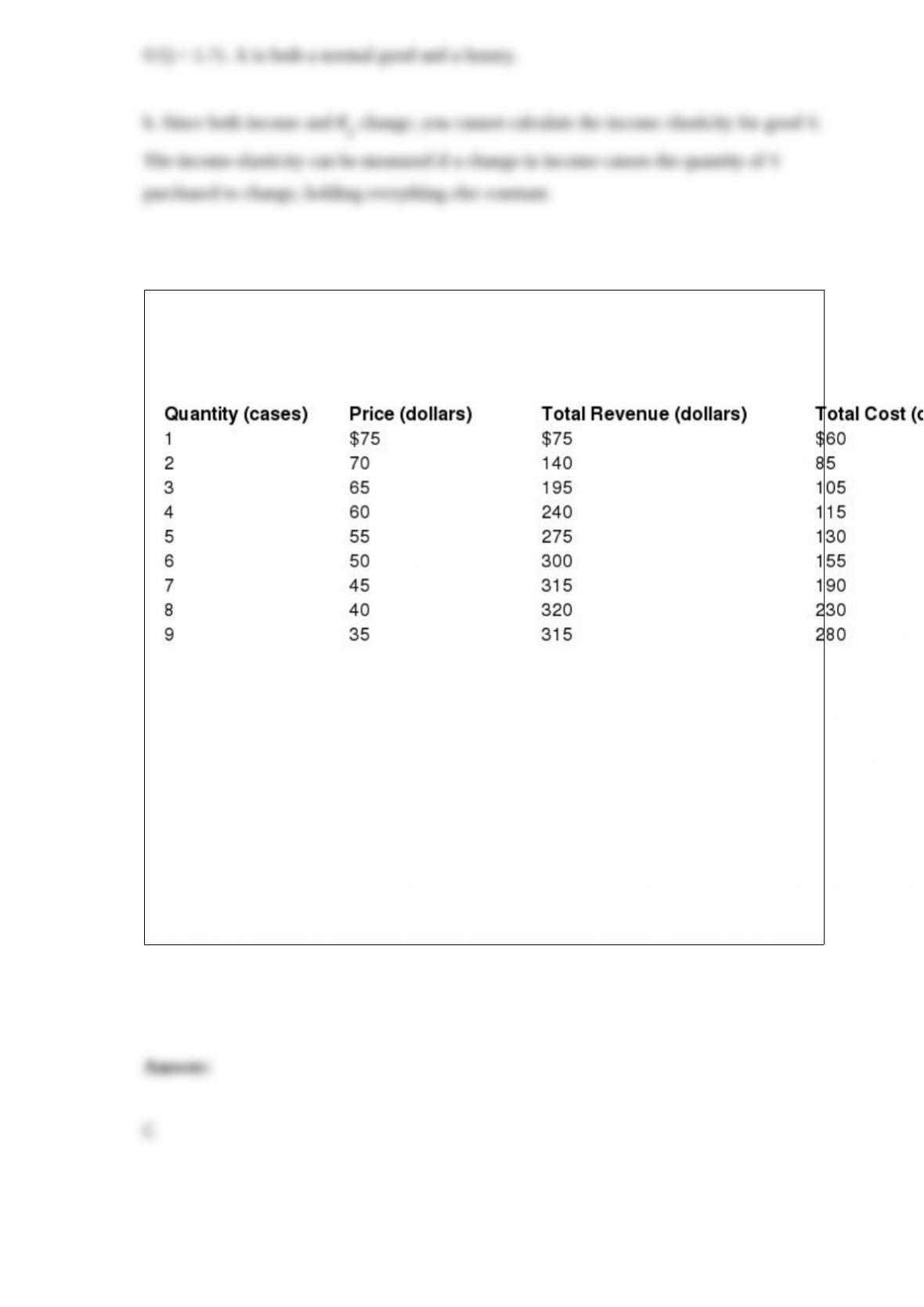
Table 13-2
Eco Energy is a monopolistically competitive producer of a sports beverage called
Power On. Table 13-2 shows the firm’s demand and cost schedules.
Refer to Table 13-2. What is Eco Energy’s profit?
A) $125
B) $140
C) $145
D) $150

A perfectly competitive firm’s supply curve is its
A) marginal cost curve.
B) marginal cost curve above its minimum average total cost.
C) marginal cost curve above its minimum average variable cost.
D) marginal cost curve above its minimum average fixed cost.
Economists argue that the level of pollution should be
A) reduced completely to zero because by definition, it is a negative external effect.
B) ignored because it has always been present since the beginning of history.
C) reduced to the point where the marginal benefit of pollution reduction is equal to the
marginal cost of pollution reduction to society.
D) best determined by elected officials who can speak on behalf of the public.
Which of the following is a normative economic statement?
A) The price of wheat is too low.
B) The current low price of wheat is the result of increased worldwide supply.

C) When the price of wheat falls, the quantity of wheat purchased rises.
D) When the price of wheat falls, the cost of wheat-based products falls.
Positive technological change in the production of LCD televisions caused the price of
LCD televisions to fall. Holding everything else constant, how would this affect the
market for Blu-ray players (a complement to LCD televisions)?
A) The supply of Blu-ray players would increase and the equilibrium price of Blu-ray
players would decrease.
B) The demand for Blu-ray players would increase and the equilibrium price of Blu-ray
players would increase.
C) The demand for Blu-ray players would decrease because consumers could afford to
buy fewer LCD televisions and Blu-ray players.
D) The demand for Blu-ray players would increase and the equilibrium price of Blu-ray
players would decrease.
When the coupon rate on newly issued bonds decreases relative to older, outstanding
bonds, what happens?
A) The market price of the older bond falls in the secondary market.
B) The market price of the older bond rises in the secondary market.
C) Older bonds can still be sold at their face value.
D) Older bonds will sell for more than their face value.
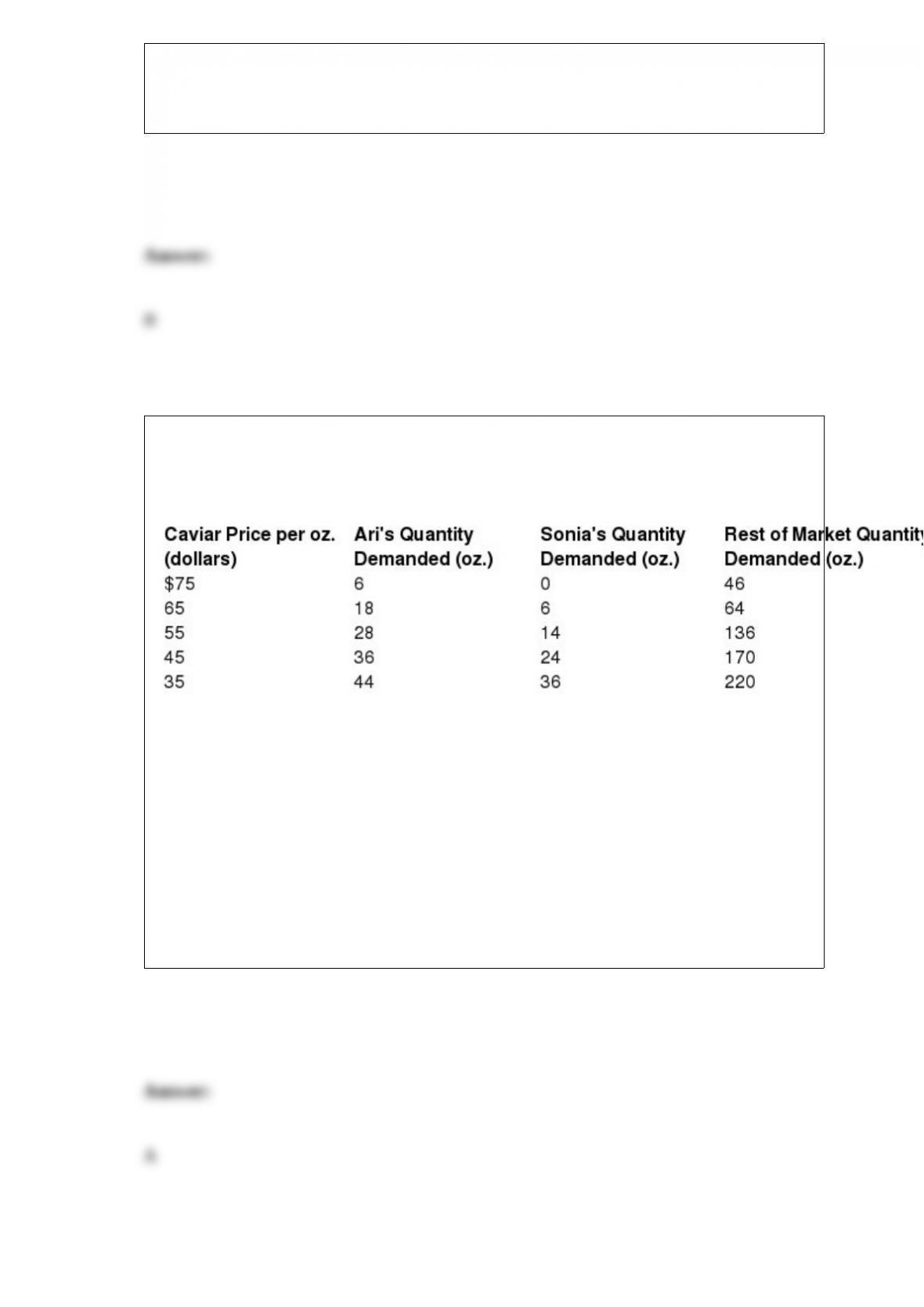
Table 3-2
Refer to Table 3-2. The table above shows the demand schedules for caviar of two
individuals (Ari and Sonia) and the rest of the market. If the price of caviar rises from
$65 to $75, the market quantity demanded would
A) decrease by 36 oz.
B) increase by 52 oz.
C) increase by 36 oz.
D) decrease by 52 oz.
If four workers can produce 18 chairs a day and five can produce 20 chairs a day, the
marginal product of the fifth worker is
A) 2 chairs.
B) 3 chairs.
C) 4 chairs.
D) 38 chairs.
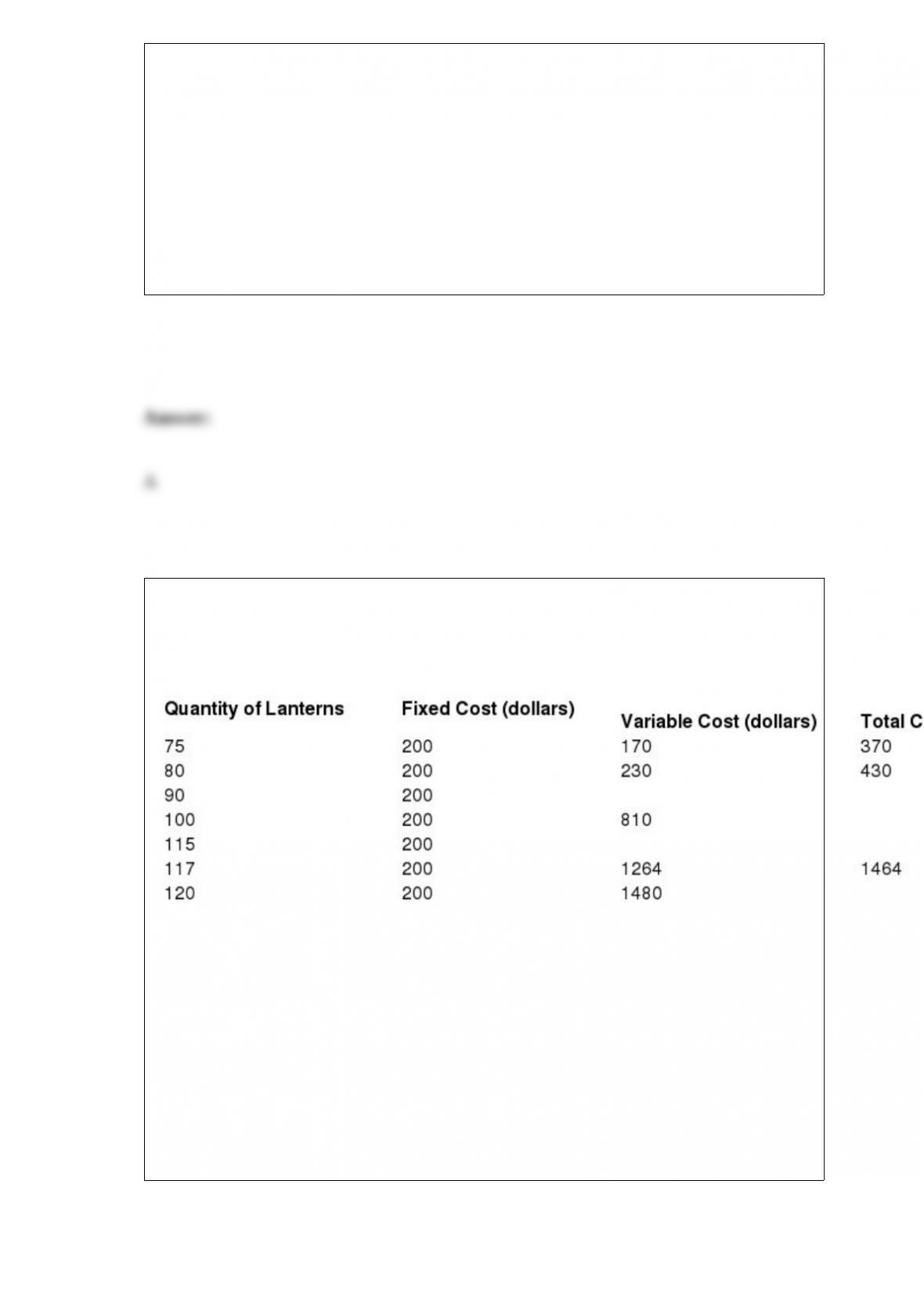
Table 11-7
Table 11-7 shows cost data for Lotus Lanterns, a producer of whimsical night lights.
Refer to Table 11-7. What is the average variable cost per unit of production when the
firm produces 90 lanterns?
A) $490
B) $33.67
C) $7.67
D) $5.44

“The price of compact fluorescent light bulbs fell because of improvements in
production technology. As a result, the demand for incandescent light bulbs decreased.
This caused the price of incandescent light bulbs to fall; as the price of incandescent
light bulbs fell the demand for incandescent light bulbs decreased even further.”
Evaluate this statement.
A) The statement is false. A decrease in the price of compact fluorescent light bulbs
would decrease the demand for incandescent light bulbs, but a decrease in the price of
incandescent light bulbs would not cause the demand for incandescent light bulbs to
decrease.
B) The statement is false because the demand for incandescent light bulbs would
increase as the price of compact fluorescent light bulbs fell.
C) The statement is false because compact fluorescent light bulbs producers would not
reduce their prices as a result of improvements in technology; doing so would reduce
their profits.
D) The statement is false because it confuses the law of demand with the law of supply.
Economists often analyze the interaction of individuals and firms in markets.
Economists also examine the actions of individuals and firms as they attempt to use
government to make themselves better off at the expense of others, a process that is
referred to as
A) rent seeking.
B) logrolling.
C) government failure.
D) the public choice initiative.
The income effect of a price change refers to
A) the change in demand that occurs when consumer income changes.
B) the change in the quantity demanded that results from a change in price, making the
good more or less expensive relative to other goods, holding everything else constant.
C) the change in demand that occurs when both income and price change.
D) the change in the quantity demanded of a good that results from the effect of a
change in price on consumer purchasing power, holding everything else constant.
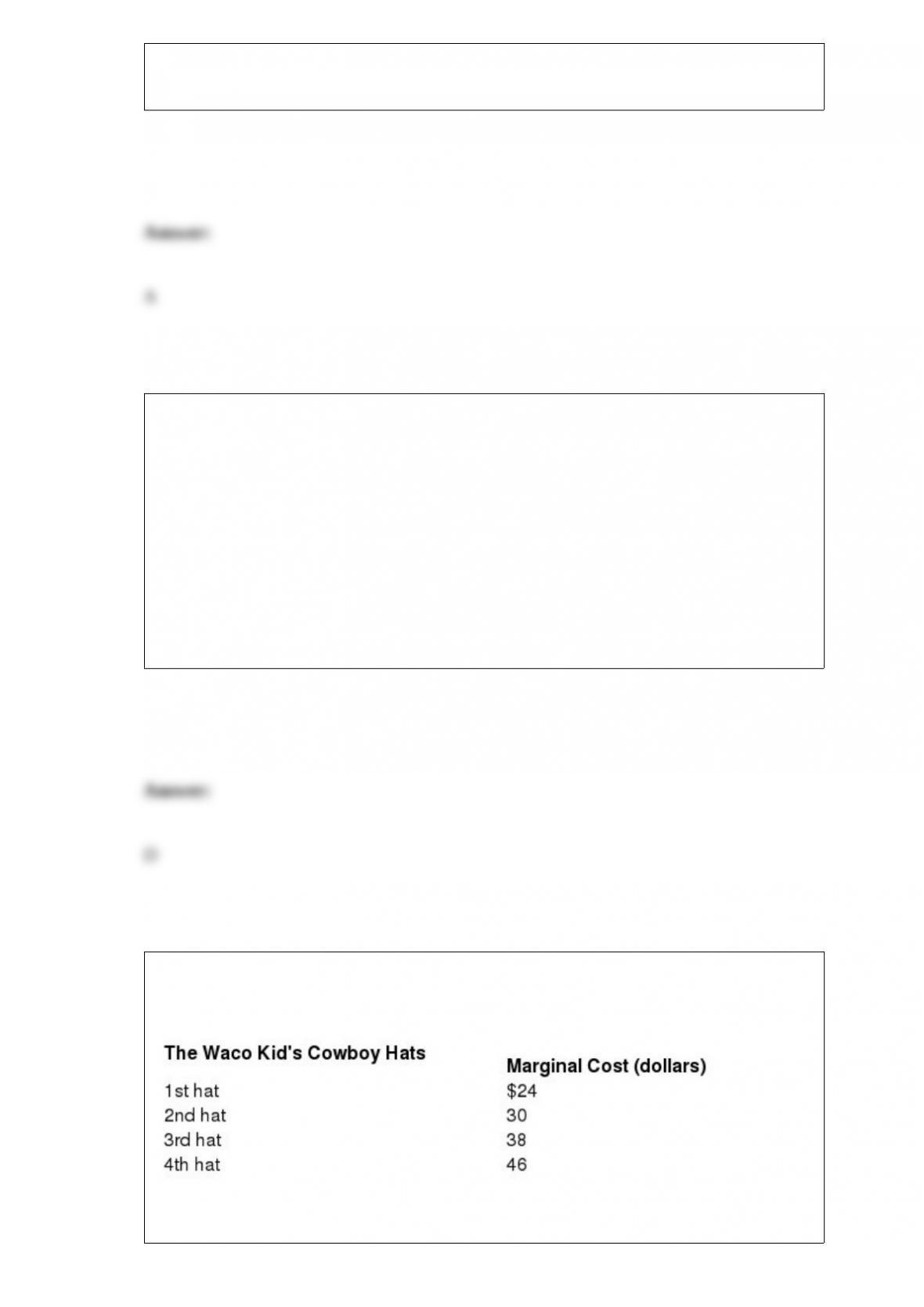
Table 4-3
Refer to Table 4-3. The table above lists the marginal cost of cowboy hats by The Waco
Kid, a firm that specializes in producing western wear. If the market price of cowboy
hats is $35, The Waco Kid will produce
A) 1 hat.
B) 2 hats.
C) 3 hats.
D) 4 hats.
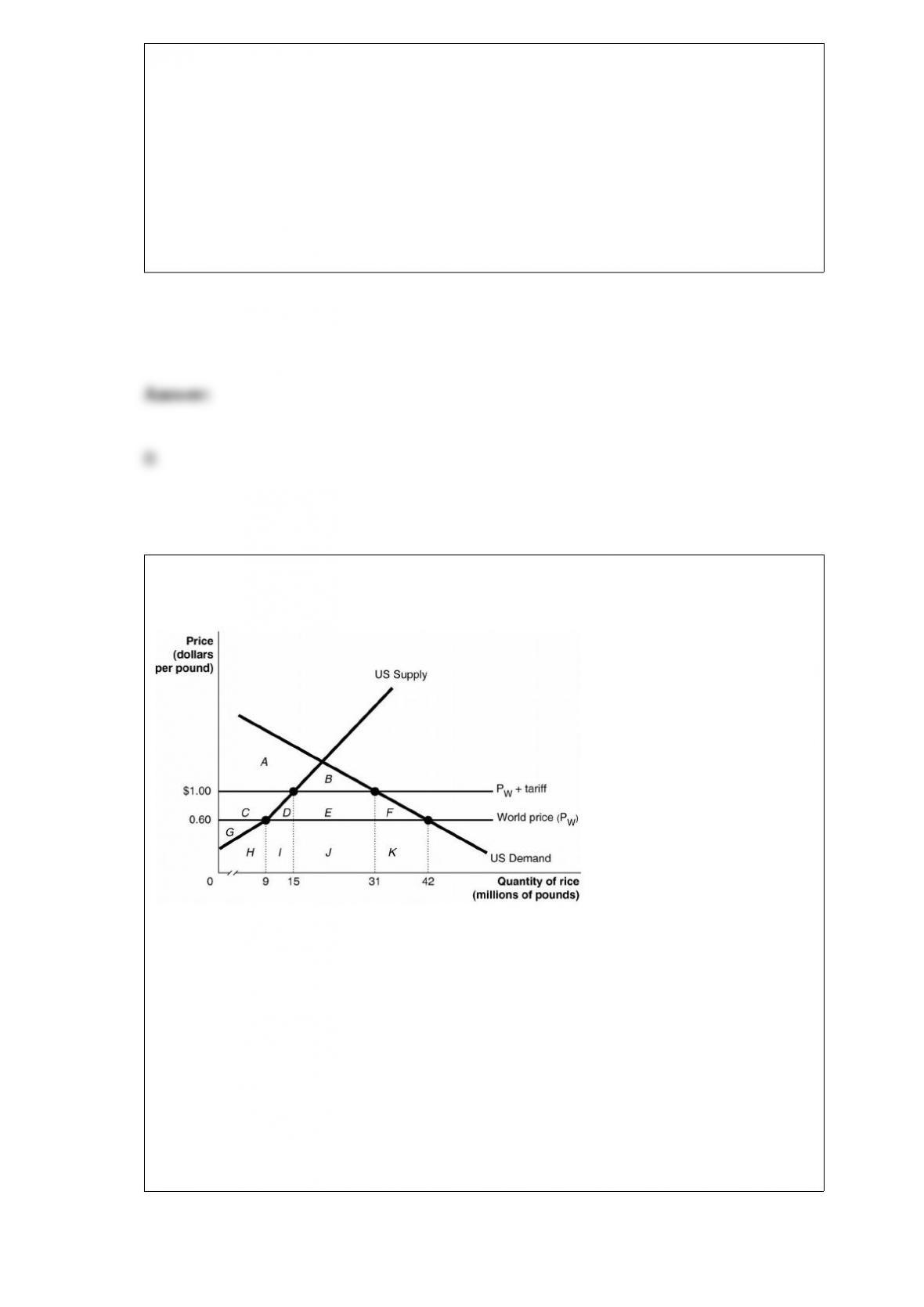
Figure 9-2
Suppose the U.S. government imposes a $0.40 per pound tariff on rice imports. Figure
9-2 shows the impact of this tariff.
Refer to Figure 9-2. With the tariff in place, the United States produces
A) 9 million pounds of rice.
B) 15 million pounds of rice.
C) 31 million pounds of rice.
D) 42 million pounds of rice.
Following the tariff imposed on Chinese tires, some businesspeople correctly argued
that the U.S. tariff would result in
A) China retaliating by raising tariffs on some U.S. exports.
B) China halting the sale of all products in the United States.
C) U.S. firms never being able to meet the demand for U.S.-produced tires.
D) the government demanding price cuts from U.S. tire manufacturers.
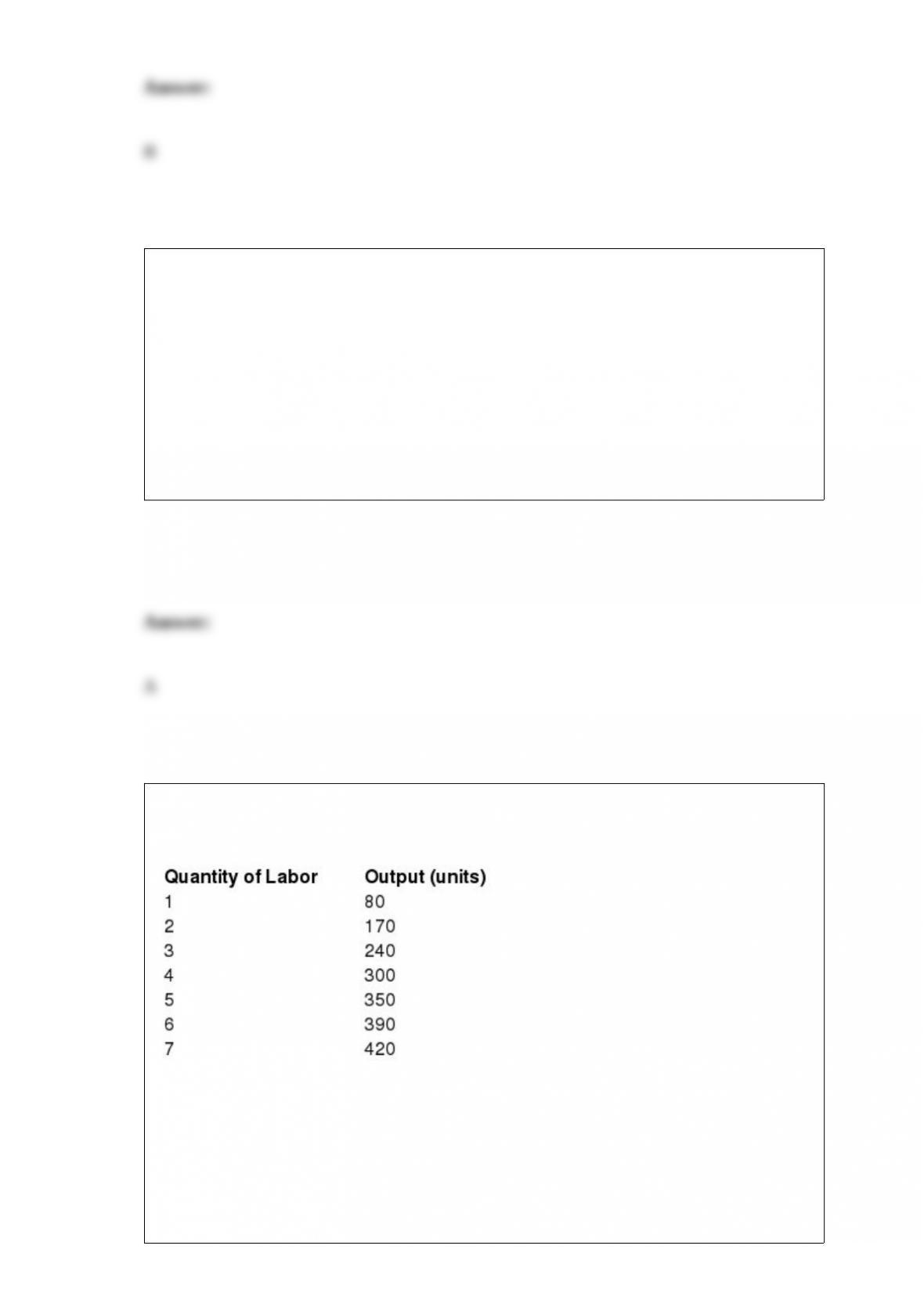
Table 17-1
Refer to Table 17-1. Suppose the output price is $3. If the firm represented in the table
is maximizing its profit by hiring six workers, what is the wage rate?
A) $120
B) $65
C) $40
D) There is insufficient information to answer the question.
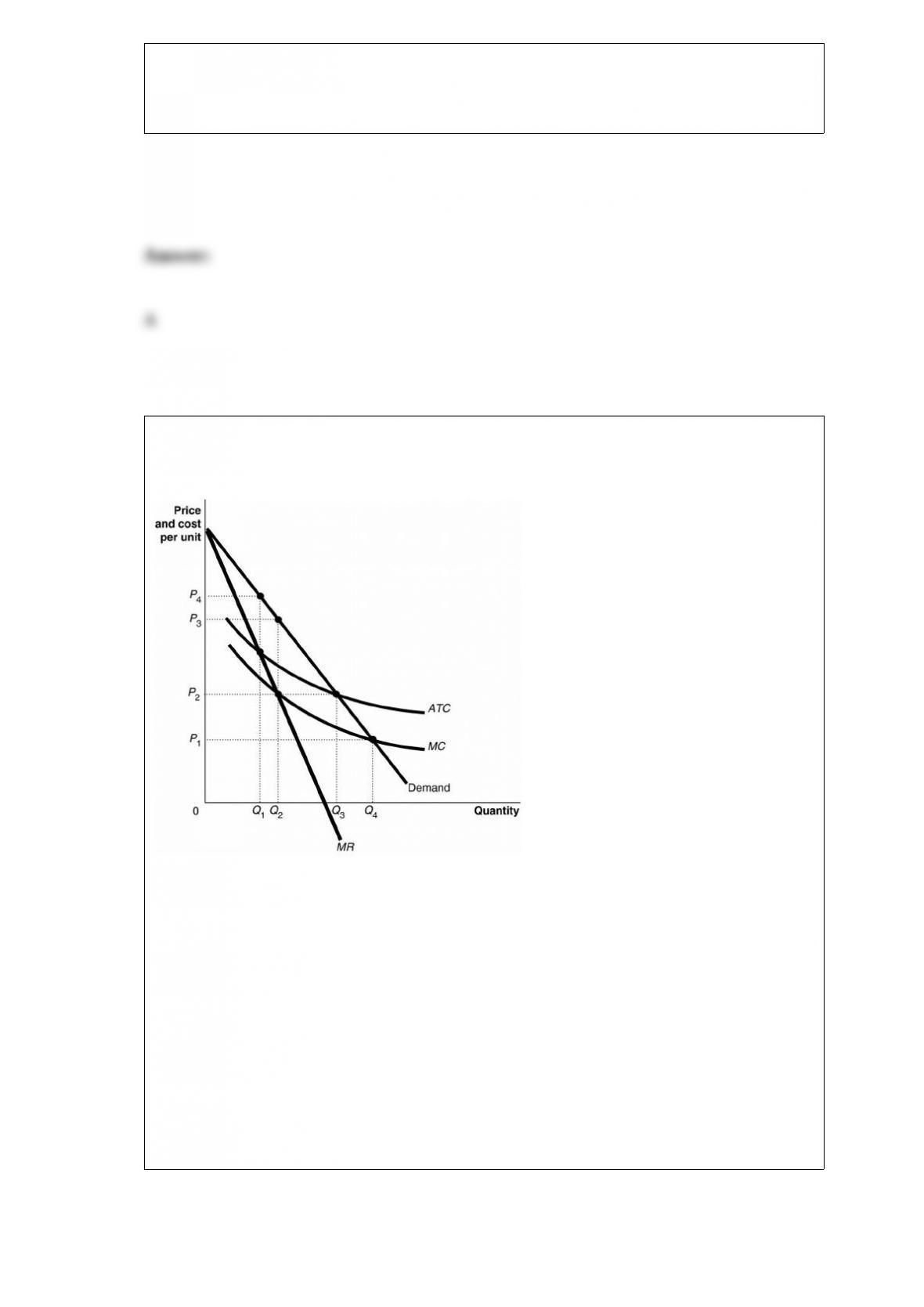
Figure 15-15
Figure 15-15 shows the cost and demand curves for the Erickson Power Company.
Refer to Figure 15-15. What is the economically efficient output level and what is the
price at that level?
A) Q4, P1
B) Q3, P2
C) Q2, P2
D) Q2, P3