
Which of the following represents the true economic cost of production when firms
produce goods that cause negative externalities?
A) the private cost of production
B) the social cost of production
C) the external cost of production
D) the explicit cost of production
Households ________ factors of production and ________ goods and services.
A) supply; demand
B) supply; supply
C) demand; supply
D) demand; demand
If you exhibit the endowment effect as a decision maker, then you are
A) deciding on the basis of sunk costs.
B) buying something you can’t really afford because you expect to save in the future.

C) ignoring non-monetary opportunity costs.
D) consuming based on celebrity endorsements.
If a firm shuts down it
A) will suffer a loss equal to its fixed costs.
B) will produce nothing but must pay its variable costs.
C) will produce nothing but must pay its fixed and variable costs.
D) will earn enough revenue to cover its variable costs but not all of its fixed costs.
Economists Gary Becker and Kevin Murphy are associated with which of the
following?
A) the discovery of the first example of a Giffen good
B) They have argued that social factors are not important in explaining the choices
consumers make.
C) Consumers appear to receive utility from consuming goods they believe are popular.
D) They discovered that price changes have both income and substitution effects.

Soo Jin shares a one-bedroom apartment with her classmate. Her share of the rent is
$700 per month. She is considering moving to a studio apartment which she will not
have to share with anyone. The studio apartment rents for $950 per month. Recently,
you ran into Soo Jin on campus and she tells you that she has moved into the studio
apartment. Soo Jin is as rational as any other person. As an economics major, you
rightly conclude that
A) Soo Jin did not have a choice; her roommate was a slob.
B) Soo Jin figures that the additional benefit of having her own place (as opposed to
sharing) is at least $250.
C) Soo Jin figures that the benefit of having her own place (as opposed to sharing) is at
least $950.
D) the cost of having one’s own space outweighs the benefits.
Figure 2-1
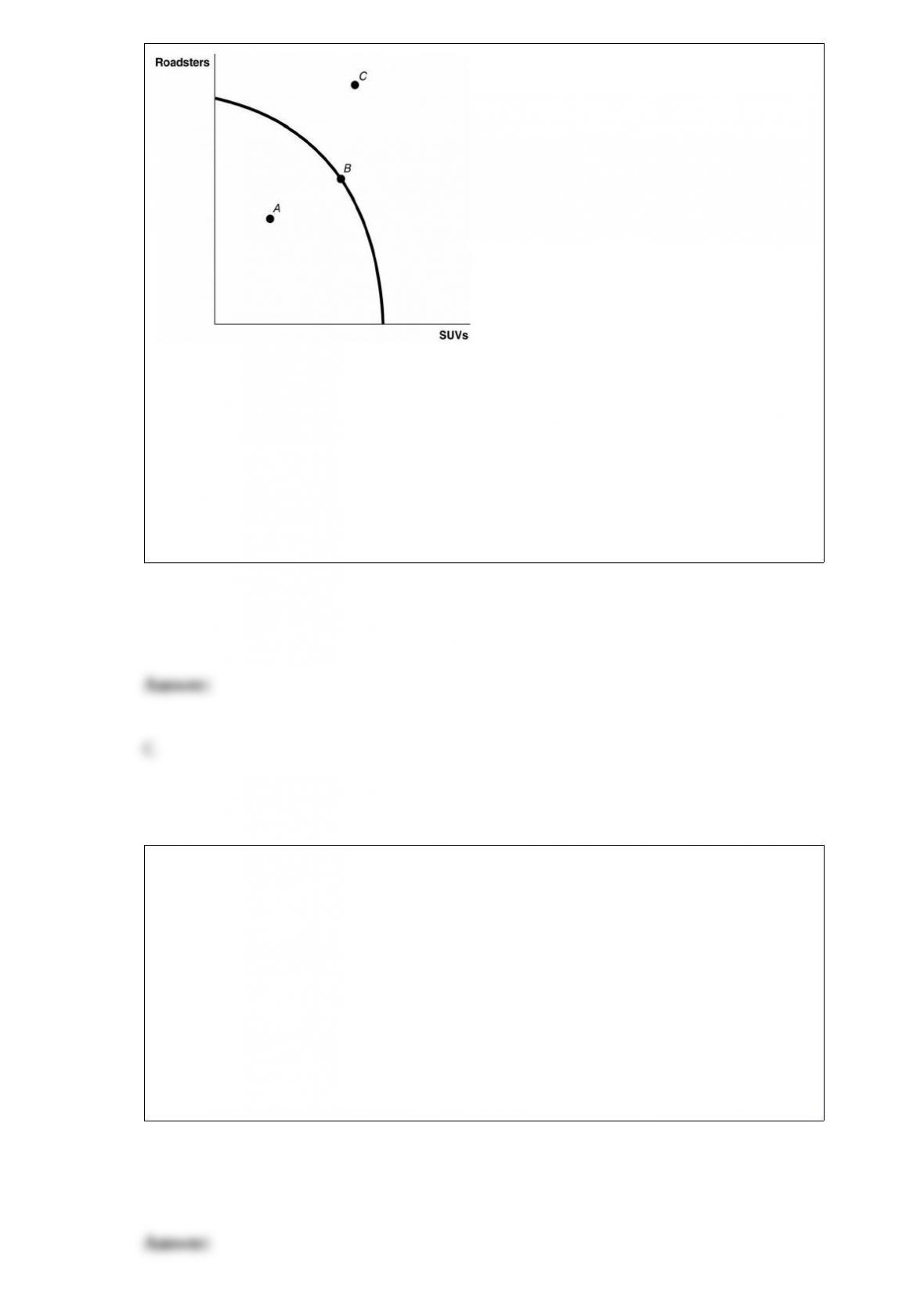
Refer to Figure 2-1. Point A is
A) technically efficient.
B) unattainable with current resources.
C) inefficient in that not all resources are being used.
D) the equilibrium output combination.
The United States Post Office
A) faces no competition for its mail services.
B) has a monopoly in the provision of first-class mail service.
C) can safely ignore the prices for mail services charges by its rivals such as FedEx and
UPS.
D) is an example of a monopoly that results from the ownership of a key resource: first
class mail service.
Calling long distance is often more expensive on weekdays between 8 am and 5 pm
than in the evening hours. Why is this the case?
A) Telephone companies hope to discourage customers from calling long distance
during the day to keep their labor costs down.
B) The cost of making long-distance connections is higher during the day than in the
evenings.
C) Businesses who must call suppliers or customers during business hours have few
alternatives and therefore have an inelastic demand during the workday compared to
after-work hours.
D) Increasingly, businesses who must call suppliers or customers during business hours
resort to the internet, thereby reducing demand for long-distance calls. To make up for
this fall in demand, telephone companies charge higher rates.
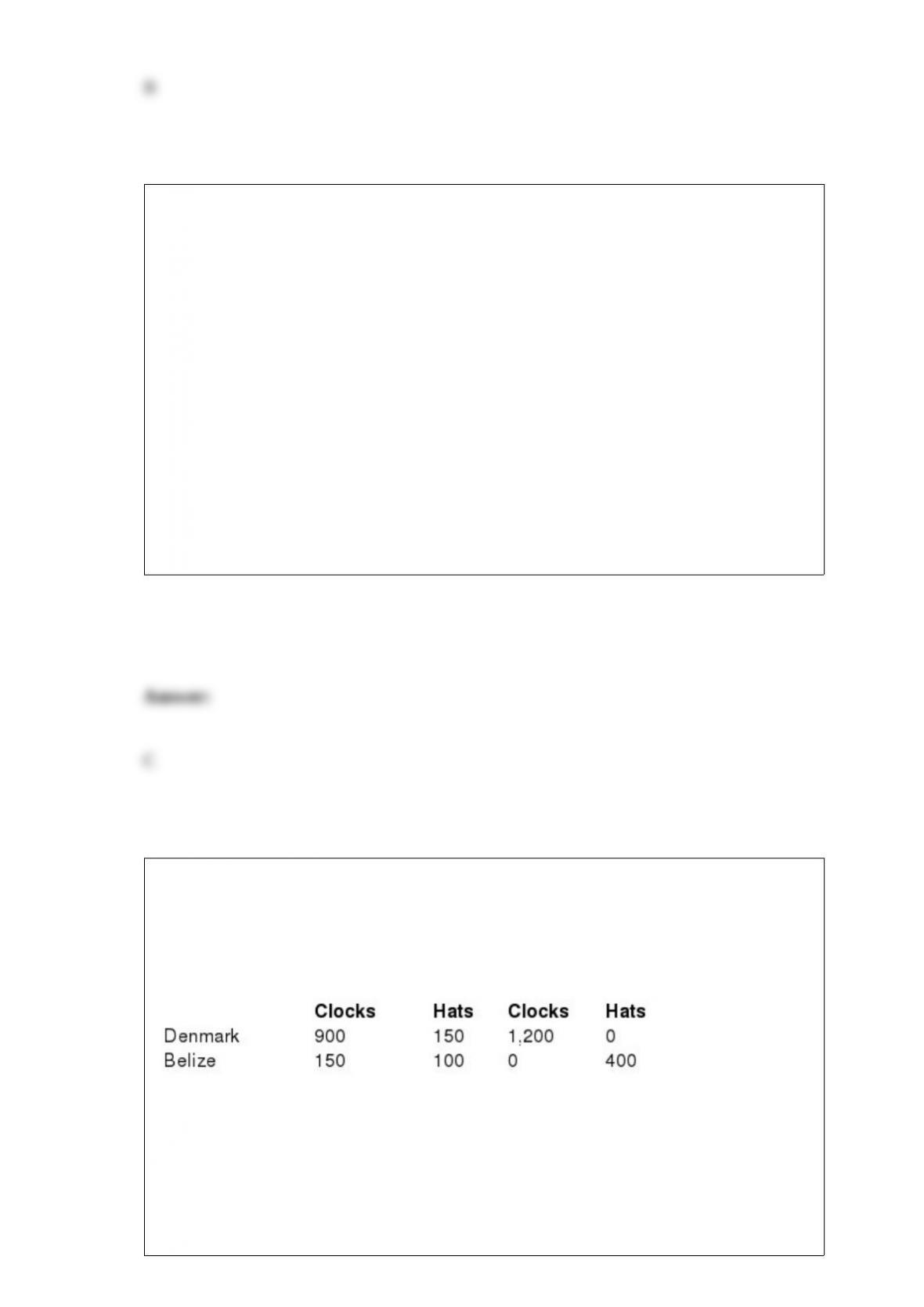
Table 9-6
Production and
Consumption Production
Without Trade With Trade
Denmark and Belize can produce both clocks and hats. Table 9-6 shows the production
and consumption quantities without trade, and the production numbers with trade.
Refer to Table 9-6. If the actual terms of trade are 1 hat for 1.8 clocks and 150 hats are
traded, how many hats will Belize consume?
A) 100

B) 130
C) 250
D) 400
Voluntary exchange ________ economic efficiency because neither the buyer nor the
seller would agree to a trade unless ________.
A) increases; they both benefit
B) increases; only one party benefits
C) decreases; neither benefit
D) decreases; they both benefit
Suppose a decrease in the supply of paper results in an increase in revenue. This
indicates that
A) the demand for paper is inelastic.
B) the demand for paper is elastic.
C) the supply of paper is inelastic.
D) the supply of paper is elastic.
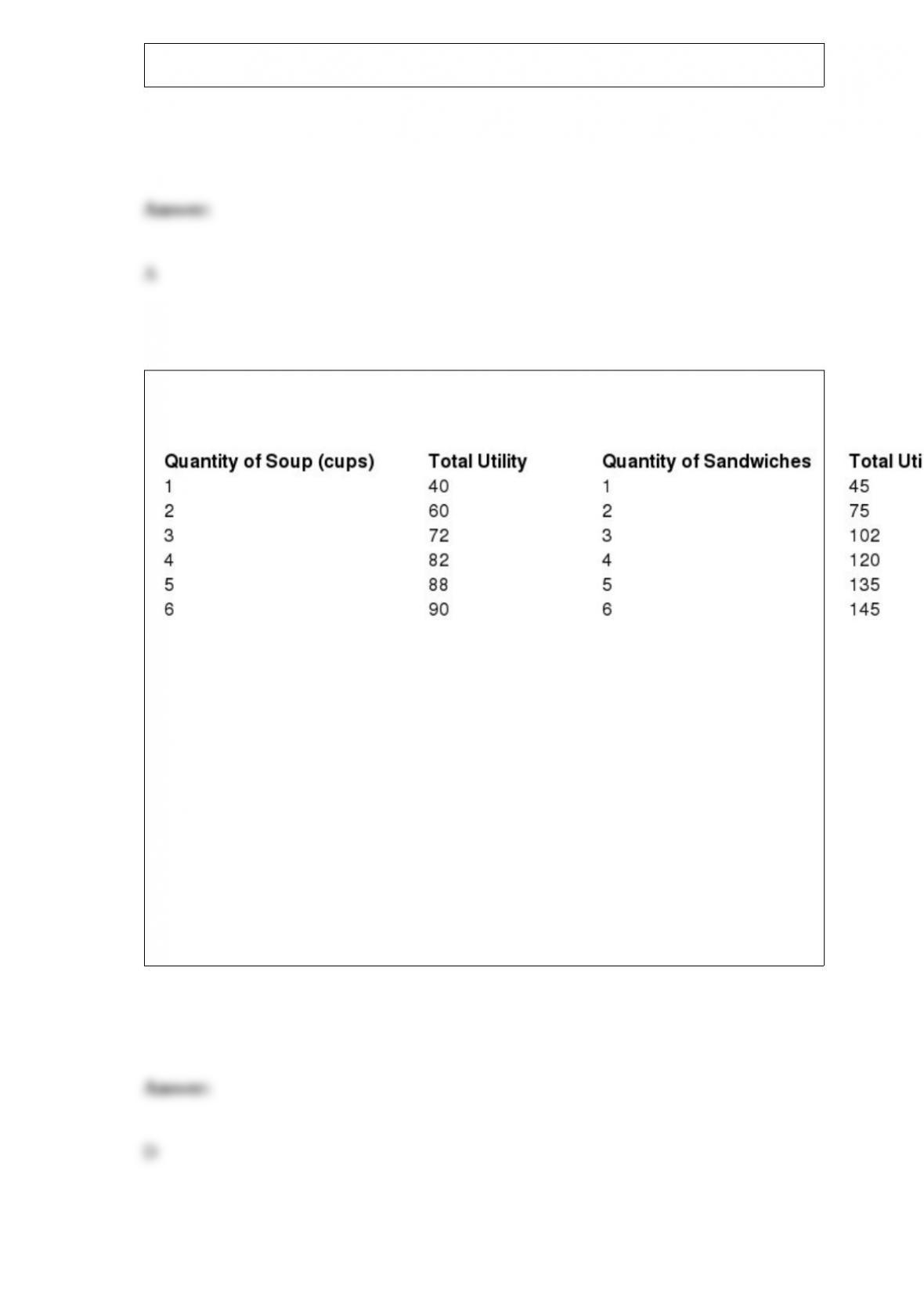
Table 10-2
Table 10-2 above shows Keira’s utility from soup and sandwiches. The price of soup is
$2 per cup and the price of a sandwich is $3. Keira has $18 to spend on these two
goods.
Refer to Table 10-2. What is Keira’s marginal utility per dollar spent on the third cup of
soup?
A) 72 units of utility
B) 36 units of utility
C) 12 units of utility
D) 6 units of utility
All of the following are disadvantages of cost-plus pricing except
A) It ignores the price elasticity of demand: for example, it may be possible to increase
profits by raising or lowering price.
B) If the industry comprises identical firms (with identical costs), markups could be
consistent among firms leading to no one firm having a competitive edge in terms of
price.
C) Allocating and apportioning business overheads to individual products could be
somewhat arbitrary.
D) The business has less incentive to cut or control costs: if costs increase, then selling
prices increase. Consequently, this might further erode a firm’s competitiveness.
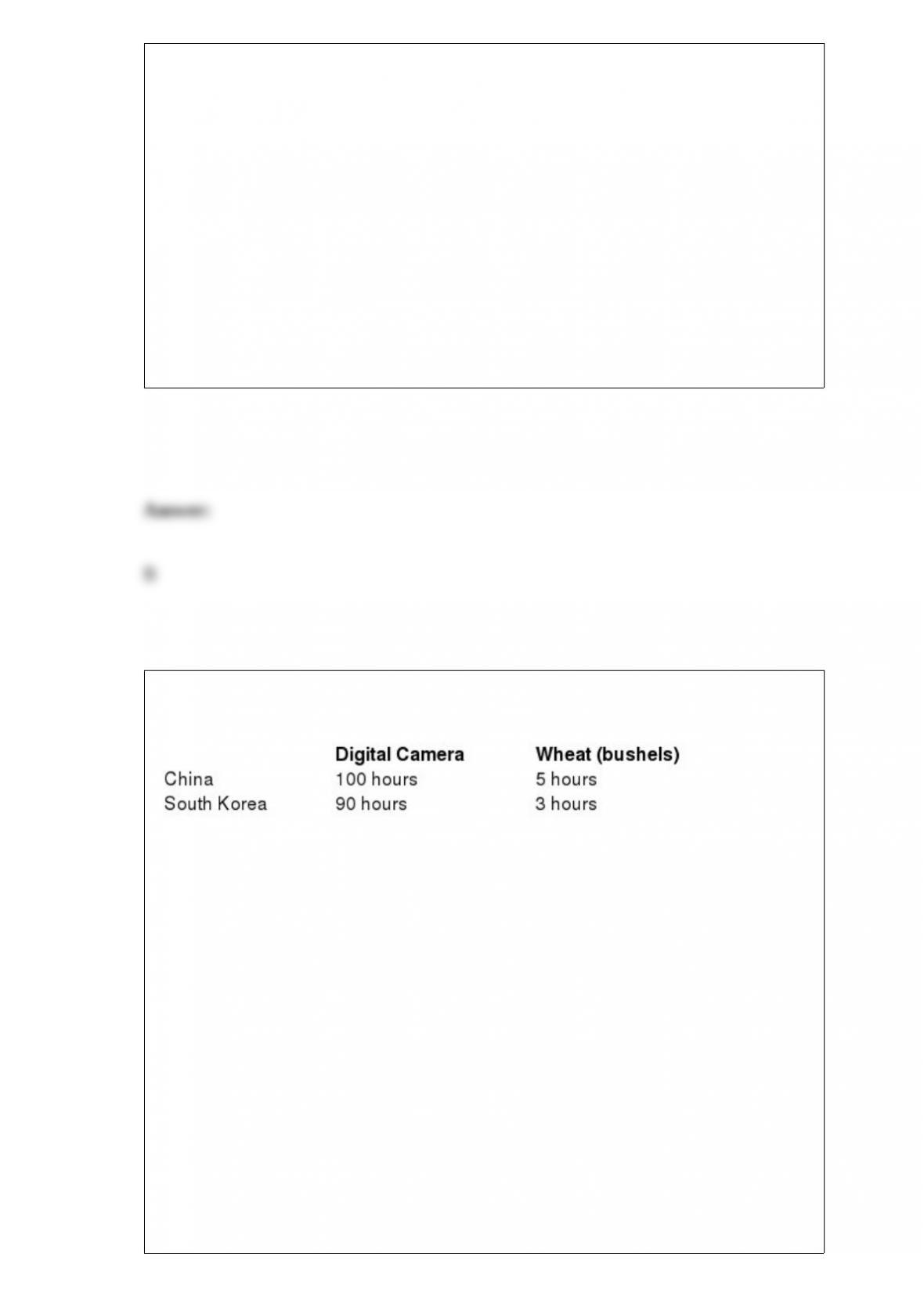
Table 2-12
Refer to Table 2-12. This table shows the number of labor hours required to produce a
digital cameras and a bushel of wheat in China and South Korea.
a. Which country has an absolute advantage in the production of digital cameras?
b. Which country has an absolute advantage in the production of wheat?
c. What is China’s opportunity cost of producing one digital camera?
d. What is South Korea’s opportunity cost of producing one digital camera?
e. What is China’s opportunity cost of producing one pound of wheat?
f. What is South Korea’s opportunity cost of producing one pound of what?
g. If each country specializes in the production of the product in which it has a
comparative advantage, who should produce digital cameras?
h. If each country specializes in the production of the product in which it has a
comparative advantage, who should produce wheat?
In the circular flow model, producers
A) sell goods and services in the input market.
B) and households spend earnings from resource sales on goods and services in the
factor market.
C) hire resources sold by households in the factor market.
D) spend earnings from resource sales on goods and services in the product market.

A ________ curve shows the marginal cost of producing one more unit of a good or
service.
A) demand
B) supply
C) production possibilities
D) marginal benefit
If you own a $1,000 face value bond with one year remaining to maturity and a 3
percent coupon rate and new bonds are paying 14 percent, what is the most you can get
for your old bond?
A) $903.51
B) $997.19
C) $1,000
D) $1,140
Table 2-7

Table 2-7 shows the output per month of two people, Fred and Barney. They can either
devote their time to making pogo sticks or making unicycles.
Refer to Table 2-7. What is Barney’s opportunity cost of making a unicycle?
A) 1/2 pogo stick
B) 2 pogo sticks
C) 1.75 unicycles
D) 2.8 pogo sticks
In economics, choices must be made because we live in a world of
A) unemployment.
B) scarcity.
C) greed.
D) unlimited resources.

Which of the following statements about the importance of trade to the U.S. economy is
true?
A) Since 1950, both exports and imports have steadily decreased as a fraction of U.S.
gross domestic product.
B) Overall, about 80 percent of U.S. manufacturing jobs depend directly or indirectly
on exports.
C) The United States is the second largest exporter in the world.
D) The U.S. economy is highly dependent on international trade for growth in its gross
domestic product.
A firm chooses its profit-maximizing quantity of capital by
A) comparing the marginal revenue product of capital with the rental price of capital.
B) comparing the price of capital with the price of labor.
C) examining the total cost of capital equipment.
D) determining the rate at which the firm can borrow funds to purchase plant and
equipment.
Figure 12-2
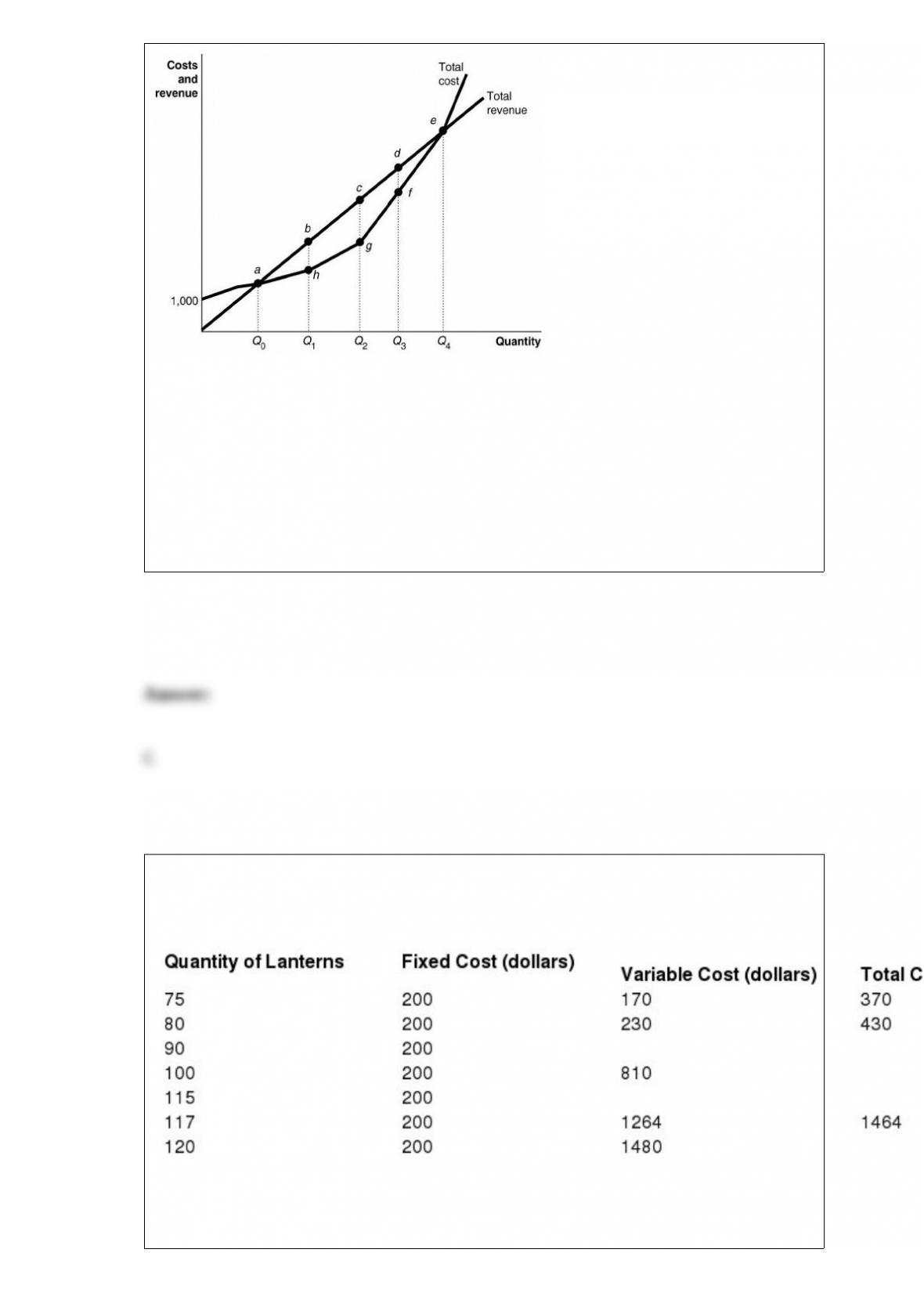
Refer to Figure 12-2. Why is the total revenue curve a ray from the origin?
A) because revenue increases at an increasing rate
B) because revenue increases at a decreasing rate
C) because the firm can sell its product at a constant price
D) because the firm must lower its price to sell more
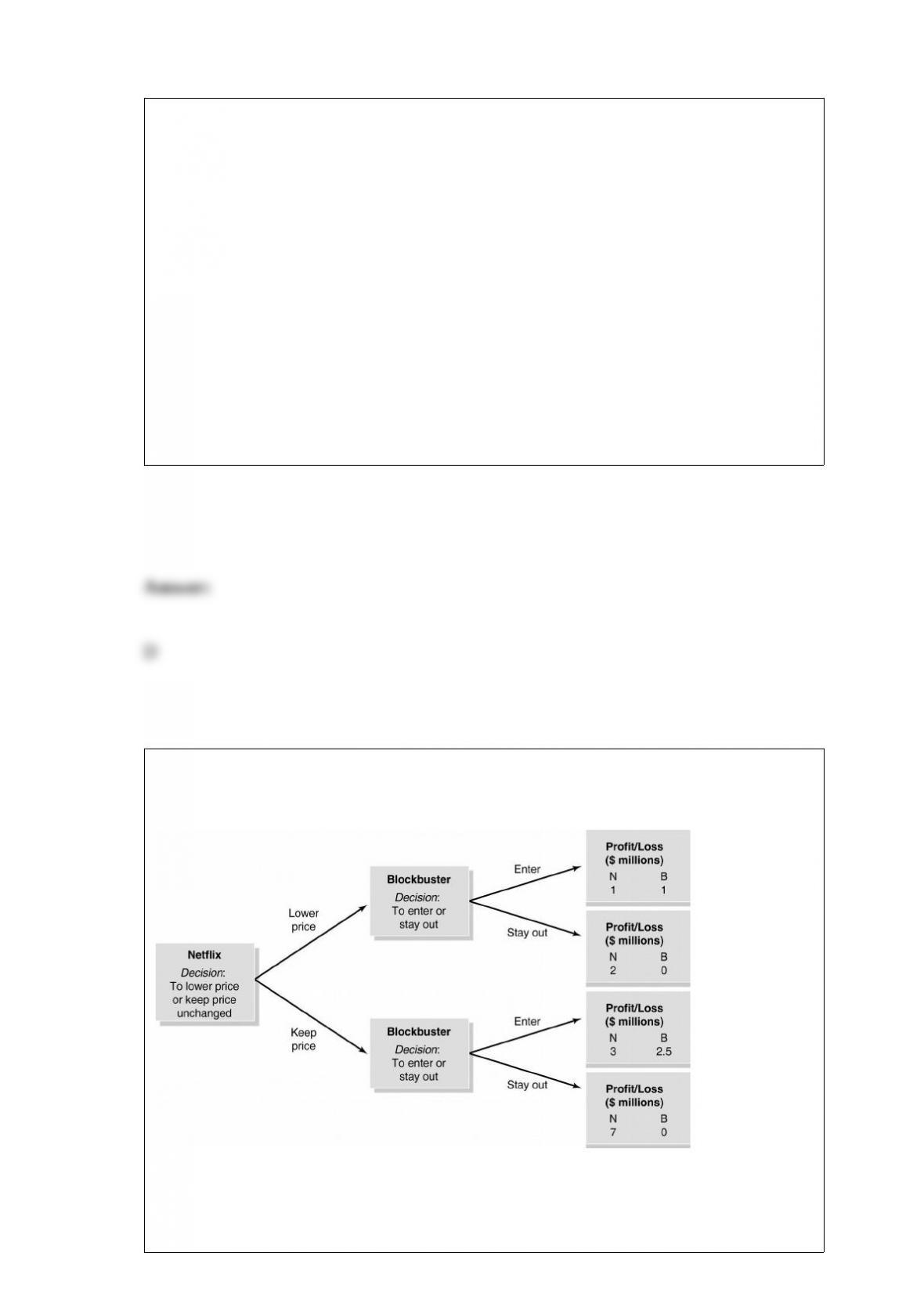
Table 11-7
Table 11-7 shows cost data for Lotus Lanterns, a producer of whimsical night lights.
Refer to Table 11-7. What is the variable cost of production when the firm produces 115

lanterns?
A) $1,556
B) $1,157
C) $956
D) $10.05
Article Summary
Starting as a Chicago antique store that sold sandwiches on the side, Potbelly has grown
from this 1977 beginning into a company which today operates approximately 300
sandwich shops in the United States. In October 2013, Potbelly sold stock for the first
time through an initial public offering (IPO), with shares jumping in price from the
initial offering price of $14 to more than $32 on the same day. Since 2011, Potbelly has
seen an increase in in both sales and revenue, and earned a profit of $2.8 million in the
first half of 2013.
Source: Matt Krantz, “Potbelly IPO shares more than double on open,” USA Today,
October 4, 2013.
When Potbelly sold stock to the public in its IPO, it did so through the NASDAQ
market. This was an example of Potbelly using ________ to raise funds.
A) indirect finance
B) direct finance
C) bonds
D) corporate governance

A decrease in the equilibrium price for a product will result
A) when the quantity demanded for the product exceeds the quantity supplied.
B) when there is a decrease in supply and a decrease in demand for the product.
C) when there is an increase in supply and a decrease in demand for the product.
D) when there is a decrease in demand and a decrease in the number of firms producing
the product.
Tanesha sells homemade candles over the Internet. Her annual revenue is $64,000 per
year, the explicit costs of her business are $17,000, and the opportunity costs of her
business are $22,000. What is her economic profit?
A) $17,000
B) $25,000
C) $42,000
D) $47,000
Research has shown that most economic profits from selling a prescription drug are
eliminated 20 years after the drug is first offered for sale. The main reason for the
elimination of profits is
A) after 20 years most people who have taken the drug have passed away or are cured
of the illness the drug was intended to treat.
B) firms sell their patent rights to other firms so that they can concentrate on finding
drugs to treat new illnesses.
C) the quantity demanded of the drug has increased enough that the demand becomes
inelastic and revenue falls.
D) after 20 years patent protection is ended and other firms can produce less expensive
generic versions of the drug.
Figure 14-5
A few years ago Netflix (N) pioneered an online DVD rental service. Blockbuster (B), a
brick and mortar DVD/video rental company, waited until Netflix had been in business
for over a year before deciding whether to establish its own online rental service. At this

point, Netflix had to decide whether or not to lower its subscription price in order to
deter Blockbuster’s entry into the market. Figure 14-5 shows the decision tree for the
Netflix-Blockbuster entry game.
Refer to Figure 14-5. Does it make sense for Netflix to lower its price in order to deter
Blockbuster’s entry into the online DVD rental market?
A) Yes, because Netflix stands to make a profit of $7 million by lowering its price and
keeping Blockbuster out of the market.
B) No, because Netflix will make a higher profit by keeping its subscription price
unchanged, whether Blockbuster enters the market or not.
C) Yes, because it is always profitable to remain a monopoly.
D) No, because Blockbuster will enter the market regardless of Netflix’s decision about
its subscription price.
Who controls a partnership?
A) the owners
B) stockholders
C) bondholders
D) employees