
Figure 3-8
Refer to Figure 3-8. The graph in this figure illustrates an initial competitive
equilibrium in the market for apples at the intersection of D2 and S1 (point C). Which of
the following changes would cause the equilibrium to change to point B?
A) A positive change in the technology used to produce apples and decrease in the price
of oranges, a substitute for apples.
B) An increase in the wages of apple workers and an increase in the price of oranges, a
substitute for apples.
C) An increase in the number of apple producers and a decrease in the number of apple
trees as a result of disease.
D) A decrease in the wages of apple workers and an increase in the price of oranges, a
substitute for apples.
A consequence of increasing marginal costs of producing digital music players in Japan
is
A) Japan will not export digital music players.
B) Japan will stop short of complete specialization in the production of digital music
players.

C) Japan will import digital music players from countries that don’t experience
increasing marginal costs.
D) Japan will likely impose trade restrictions on imported digital music players.
If diminishing marginal returns have already set in for Golden Lark Woodworks, and
the marginal product of the 6th carpenter is 8 chairs, then the marginal product of the
7th carpenter is
A) negative.
B) less than 8 chairs.
C) more than 8 chairs.
D) zero.
Many firms use technology to gather information on the preferences of consumers and
their responses to changes in prices. This information is then used to adjust prices of the
firms’ goods and services. This practice is called
A) price discovery.
B) empirical research.
C) yield management.
D) econometrics.
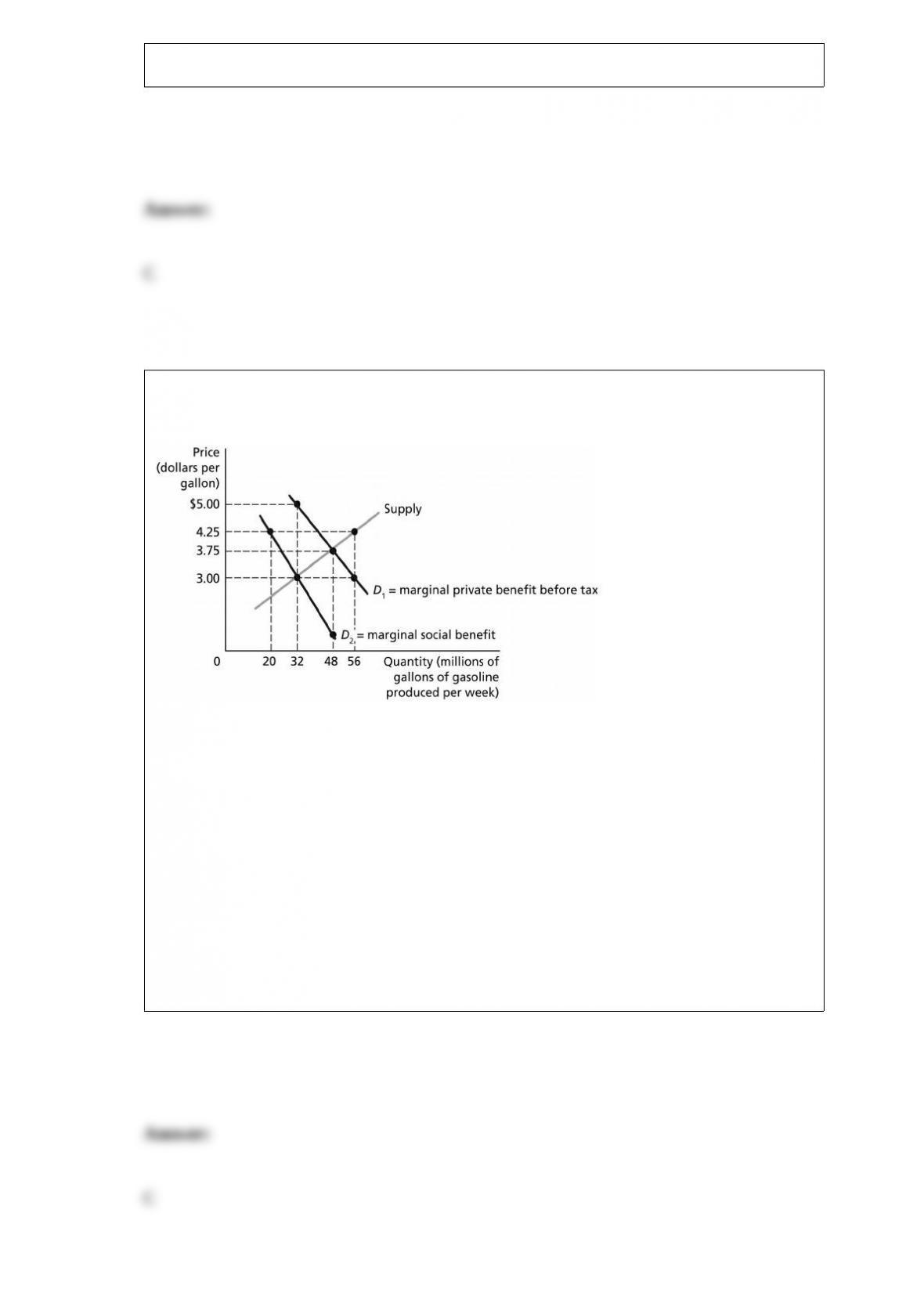
Figure 5-13
Figure 5-13 illustrates the market for gasoline before and after the government imposes
a tax to bring about the efficient level of gasoline production.
Refer to Figure 5-13. The market equilibrium quantity of gasoline is ________ million
gallons per month.
A) 20
B) 32
C) 48
D) 56

Jennifer Borts moves her office from the premises she rents at a local mall to her home.
As a result of this move
A) Jennifer’s explicit costs fall and her implicit costs rise.
B) Jennifer’s total costs fall.
C) Jennifer’s implicit costs fall.
D) Jennifer’s opportunity costs fall.
If a firm faces a downward-sloping demand curve
A) the demand for its product must be inelastic.
B) it can control both price and quantity sold.
C) it must reduce its price to sell more units.
D) it will always make a profit.
Global warming refers to the effect of global pollutants such as carbon dioxide on
climates on the earth. Climate-induced changes in temperatures affect, among other
things, agriculture. Which of the following is a reason why policymakers are still
debating if this problem should be addressed and how it should be addressed?
A) Scientists agree about the damage caused by carbon emissions but disagree about the
methods of reducing emissions.
B) The marginal cost of reducing carbon emissions is known with certainly but the
marginal benefit from reduction is not known with certainty.
C) The marginal cost of reducing carbon emissions is not known with certainly but the
marginal benefit from reduction is known with certainty.
D) There is much disagreement about all aspects of the problem: how much carbon
emissions contribute to damage from climate change which in turn informs the benefits
from reduction, and what methods to use which in turn determines the cost of reduction.
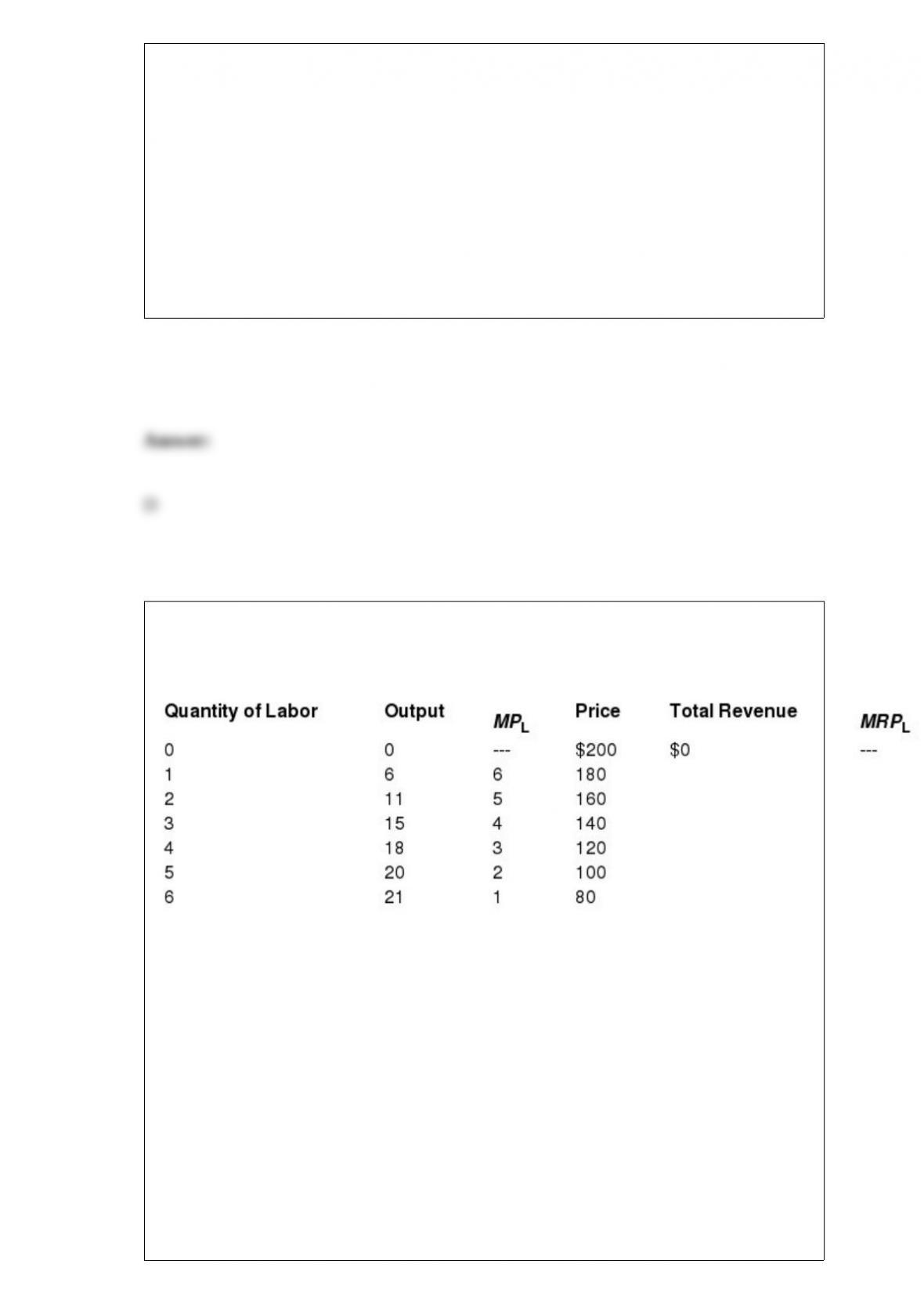
Table 17-4
Table 17-4 lists data for the production of Apple iPods. Apple is assumed to be a price
maker, so to increase its sales of iPods the firm must lower its price. MPL and MRPL
refer to the marginal product of labor and the marginal revenue product of labor,
respectively.
Refer to Table 17-4. What are the price and quantity of workers that result in the
maximum amount of profit Apple would earn from selling iPods?
A) $140; 2
B) $160; 2
C) $140; 3

D) $180; 1
Corporate governance involves the way in which
A) the government nationalizes corporations.
B) the government licenses corporations.
C) a corporation is subject to government regulations.
D) a corporation is structured.
________ is a problem that occurs when one concludes that a change in variable X
caused a change in variable Y when in actual fact, it is a change in variable Y that
caused a change in variable X.
A) The omitted variable
B) The positive-to-negative relationship
C) Reverse causality
D) Nonlinear slope
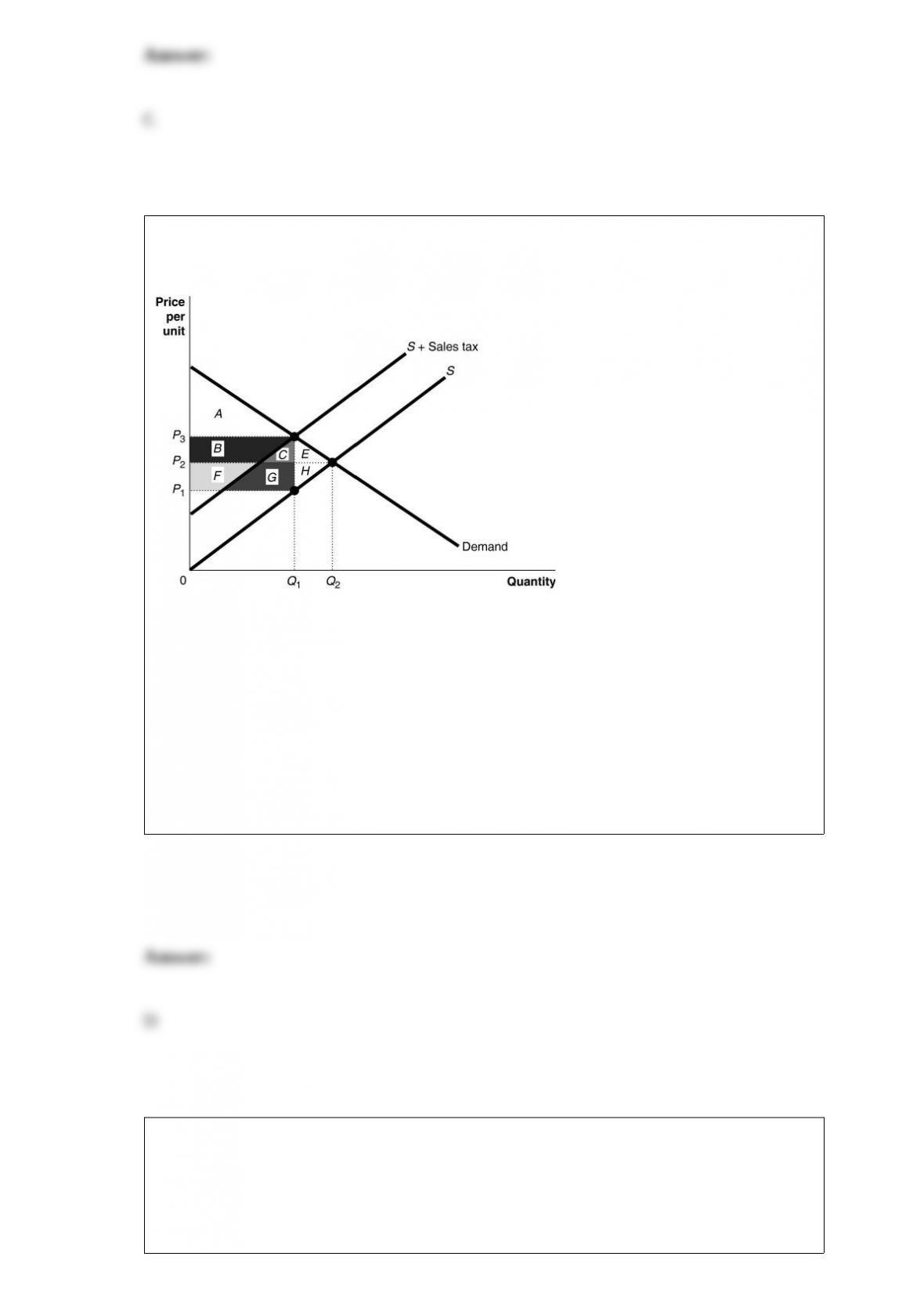
Figure 18-1
Refer to Figure 18-1. The sales tax revenue collected by the government is represented
by the area
A) B+C.
B) F+G.
C) E+H.
D) B+C+F+G.
As a result of globalization, Argonia finds that its national borders are becoming less
relevant. This indicates that Argonia is undergoing ________.
A) denationalization

B) standardization
C) reorganization
D) internationalization
“A competitive market achieves economic efficiency by maximizing the sum of
consumer surplus and producer surplus.” This statement
A) is true only if there are positive externalities in production in the market.
B) is true only if there are no negative externalities in the market.
C) is true only if there are no positive or negative externalities in the market.
D) is true in theory, but economic efficiency cannot be achieved in a real market.
The poverty rate is defined as the percentage of the
A) labor force that is poor according to the federal government’s definition of poverty.
B) population that is exempt from paying federal income taxes.
C) population who qualify to receive welfare payments and food stamps.
D) population that is poor according to the federal government’s definition of poverty.

The marginal product of labor is
A) the payment made to workers for their contribution to the output they produce.
B) equal to the demand for labor.
C) the change in a firm’s revenue as a result of hiring one more worker.
D) the additional output a firm produces as a result of hiring one more worker.
Vinny consumes tacos and chicken wings. To keep his utility constant, he must
consume more tacos if he consumes fewer chicken wings. This means that
A) Vinny’s indifference curve for tacos and chicken wings must have a negative slope.
B) the prices Vinny pays for tacos and chicken wings are always the same.
C) Vinny’s marginal utility from each good must be constant along his convex
indifference curves for tacos and chicken wings.
D) Vinny’s marginal rate of substitution must be constant along his indifference curves
for tacos and chicken wings.
A monopolistically competitive firm is producing an output level where marginal
revenue is greater than marginal cost. What should this firm do to increase its profit or
reduce its losses?
A) The firm should raise its price.
B) The firm should decrease its fixed costs.
C) The firm should increase its implicit costs.
D) The firm should lower its price.
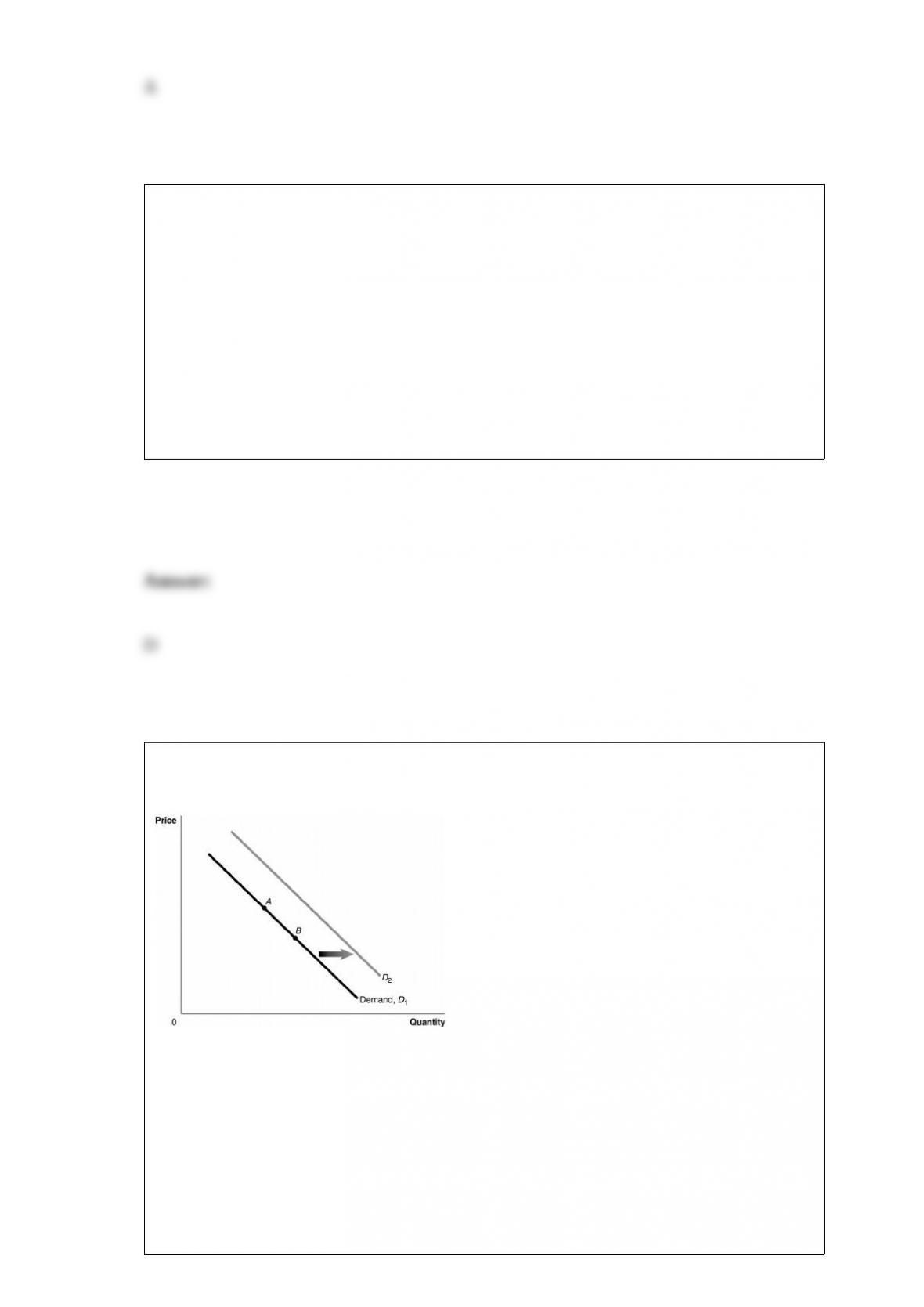
Figure 3-1
Refer to Figure 3-1. If the product represented is an inferior good, an increase in
income would be represented by a movement from
A) A to B.
B) B to A.
C) D1 to D2.

D) D2 to D1.
In 18th century Europe, governments gave guilds legal authority to limit production of
goods. Did this authority obstruct or improve the market mechanism and how?
A) It improved the market mechanism by making it more efficient because the guilds
were able to quickly identify and rectify any market shortages and surpluses.
B) It improved the market mechanism because the government’s actions provided the
correct set of signals to the market so that producers can adjust their output to better
meet the needs of consumers.
C) It obstructed the market mechanism because the guild’s actions prevented the forces
of demand and supply from coordinating the self-interested decisions of producers and
consumers.
D) It obstructed the market mechanism because with one more party having to
coordinate activities (the guilds) there were delays in getting the products to consumers.
Figure 6-10
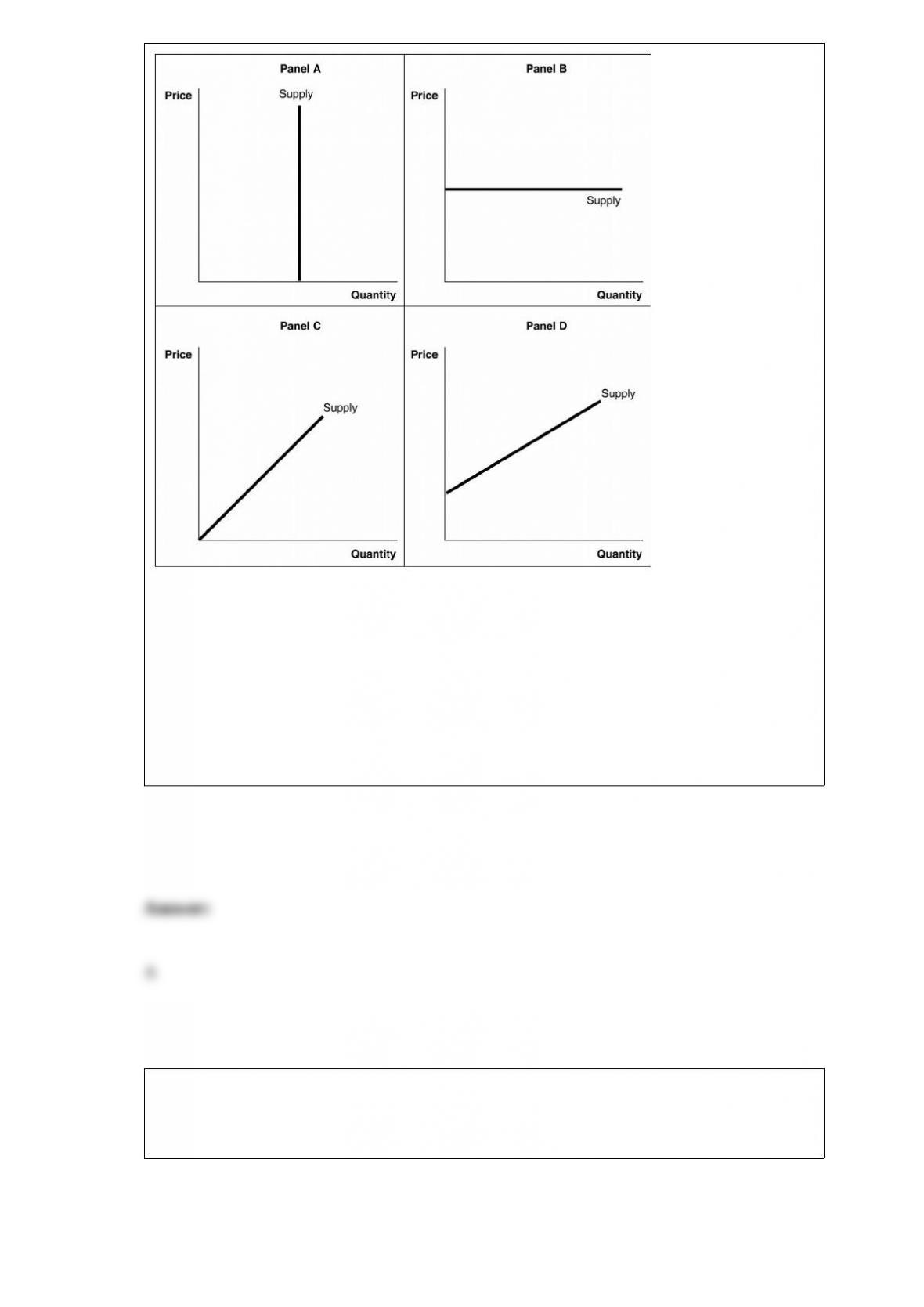
Refer to Figure 6-10. A perfectly inelastic supply curve is shown in
A) Panel A.
B) Panel B.
C) Panel C.
D) Panel D.
Refer to Table 10-5
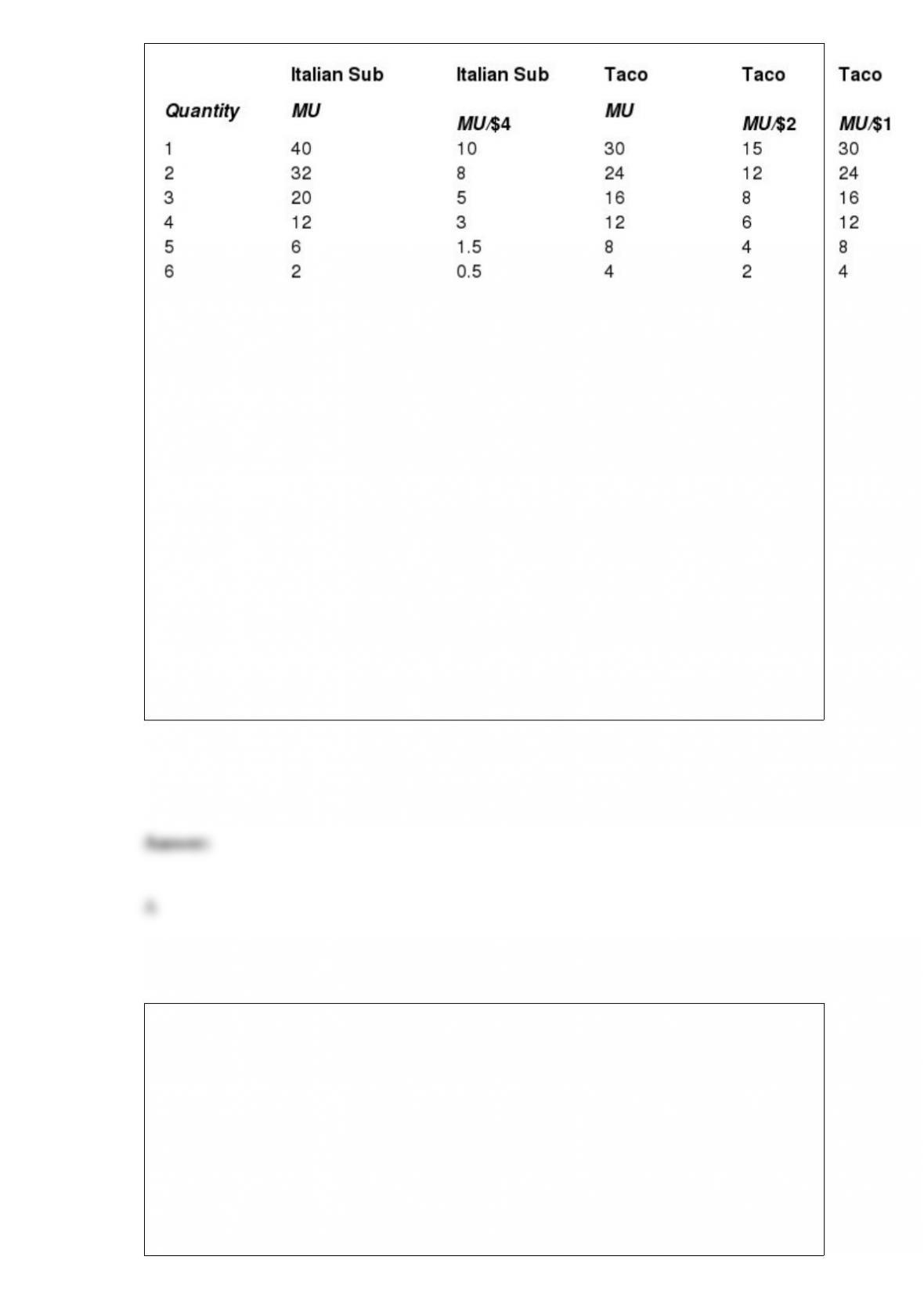
which lists the values of Harry Taber’s marginal utility and marginal utility per dollar
for Italian submarine (sub) sandwiches and tacos. Assume that the price of the sub
sandwiches is $4 and the price of tacos is $2. When Harry’s income is $14 he buys two
Italian sub sandwiches and three tacos. The last column lists the values of the marginal
utility per dollar for tacos when the price of tacos decreases to $1. Complete this
statement: As a result of the change in price, the marginal utility of each taco Harry
consumes increases and
A) the substitution effect of the price change will cause Harry to buy more tacos and
fewer subs.
B) the substitution effect of the price change will cause Harry to buy more tacos if they
are a normal good, and fewer tacos if they are an inferior good.
C) the substitution effect will cause Harry to buy another sub because his purchasing
power has increased.
D) the substitution effect will cause Harry to buy fewer tacos.
Consider a demand curve that has a constant elasticity value of 0. What happens to
quantity demanded and total revenue when price increases?
A) The quantity demanded and total revenue remain the same.
B) The quantity demanded does not change but total revenue increases.
C) The quantity demanded and total revenue fall to zero.
D) The quantity demanded does not change but total revenue decreases.

A perfectly competitive industry achieves allocative efficiency because
A) goods and services are produced at the lowest possible cost.
B) goods and services are produced up to the point where the last unit provides a
marginal benefit to consumers equal to the marginal cost of producing it.
C) it produces where market price equals marginal production cost.
D) firms carry production surpluses.
Stan owns a software design business. He does not have time to expand his office space
or redesign the layout of his office. He can increase the amount of work he does by
working more hours, asking his current employees to work more hours, or hiring more
employees. The relationship between Stan’s inputs and the maximum output his firm
can produce is called his
A) long-run production function.
B) production possibilities frontier.
C) short-run production function.
D) cost function.

Which of the following is an example of a factor that a firm’s owners and managers can
control in making the firm successful?
A) the ability to produce the product at a lower cost
B) changing consumer tastes
C) a rise in the price of a key input, for example, a rise in the price of oil leads to higher
energy costs
D) the number of competitors in the market
Which of the following does not hold true for a perfectly competitive firm in long-run
equilibrium?
A) Its economic profit will be zero.
B) It will minimize average total cost.
C) It will charge a price equal to marginal cost.
D) Marginal cost will be minimized.

The financial success of the movies The Lion King and Toy Story led to
A) a decrease in the salaries of animators and an increase in the number of animators
used to produce films.
B) an increase in demand for actors to play roles in animated films.
C) the Disney studio’s attempt to buy Pixar Animation Studios.
D) a reduction in the price of computers and software relative to the price of labor
(animators) used to produce animated films.
You have a bond that pays $60 per year in coupon payments. Which of the following
would result in an increase in the price of your bond?
A) Coupon payments on newly-issued bonds rise to $80 per year.
B) The likelihood that the firm issuing your bond will default on debt increases.
C) The price of a share of stock in the company falls.
D) Coupon payments on newly-issued bonds fall to $50 per year.
Jill Johnson owns a pizzeria. She currently produces 10,000 pizzas per month at a total
cost of $500. If she produced one more pizza her total cost rises to $500.11. What does
this tell us about Jill’s marginal cost of producing pizzas?
A) The marginal cost of producing pizzas is constant.
B) The marginal cost of producing pizzas is falling.
C) The marginal cost of producing pizzas cannot be determined without more
information.
D) The marginal cost of producing pizzas is rising.
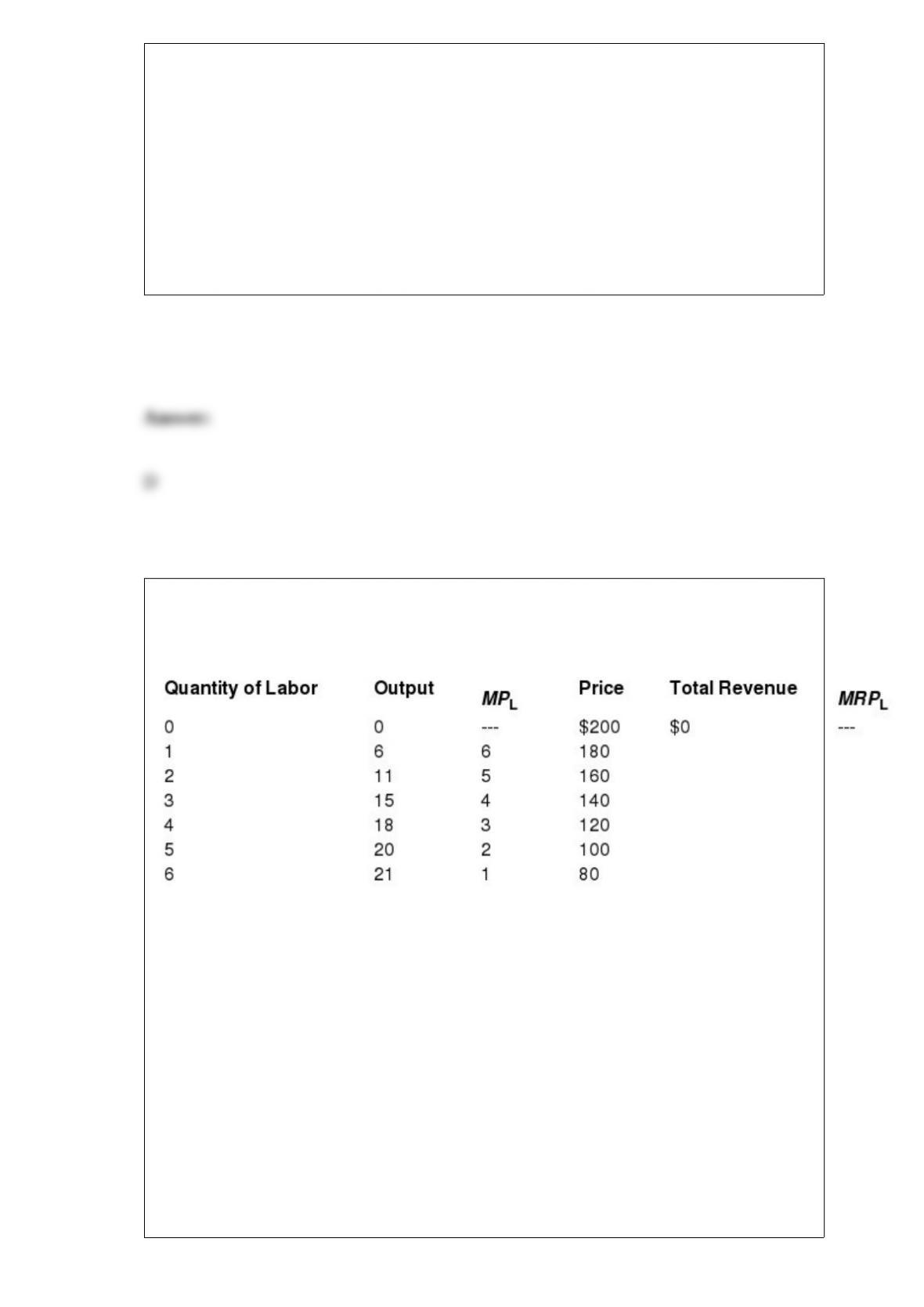
Table 17-4
Table 17-4 lists data for the production of Apple iPods. Apple is assumed to be a price
maker, so to increase its sales of iPods the firm must lower its price. MPL and MRPL
refer to the marginal product of labor and the marginal revenue product of labor,
respectively.
Refer to Table 17-4. What are the price and quantity of workers that result in the
maximum amount of revenue Apple would earn from selling iPods?
A) $180; 1
B) $140; 2
C) $120; 2
D) $120; 4

Which government agency publishes four-firm concentration ratios?
A) the Economic Council
B) the Federal Reserve System
C) the U.S. Bureau of the Census
D) the Treasury Department