
A firm that is the only seller of a good or service that does not have a close substitute is
called
A) a monopoly.
B) an oligopolist.
C) a market maker.
D) a price maker.
Consumers have to make tradeoffs in deciding what to consume because
A) not all goods give them the same amount of satisfaction.
B) the prices of goods vary.
C) they are limited by a budget constraint.
D) there are not enough of all goods produced.
Countries that engage in trade will tend to specialize in the production of goods and
services in which they have ________ and will ________ these goods and services.
A) a comparative advantage; import
B) an absolute advantage; export

C) a comparative advantage; export
D) an absolute advantage; import
Suppose the governor of California has proposed increasing toll rates on California’s
toll roads, and has presented two possible scenarios to implement these increases.
Following are projected data for the two scenarios for the California toll roads:
Scenario 1: Toll rate in 2012: $10.00. Toll rate in 2016: $22.50
For every 100 cars using the toll roads in 2012, only 81.6 cars will use the toll roads in
2016.
Scenario 2: Toll rate in 2012: $10.00. Toll rate in 2016: $17.50
For every 100 cars using the toll roads in 2012, only 96.2 cars will use the toll roads in
2016.
a. Using the midpoint formula, calculate the price elasticity of demand for Scenario 1
and Scenario 2.
b. Assume 10,000 cars use California toll roads every day in 2012. What would be the
daily total revenue received for each scenario in 2012 and in 2016?
c. Is demand under Scenario 1 and under Scenario 2 price elastic, inelastic, or unit
elastic. Briefly explain.
(For above questions, assume that nothing other than the toll change occurs during the
time frame listed that would affect consumer demand.)
One goal a firm tries to achieve when it advertises a product is to
A) make the demand curve for the product more elastic.
B) shift the demand curve for the product to the left.
C) make the demand curve for the product unitary elastic.
D) make the demand curve for the product more inelastic.
If we have information about workers’ marginal products, then total and average
product can be found by
A) dividing marginal costs by the number of workers.
B) multiplying the average marginal product times the number of workers.
C) summing the marginal values to find the total and multiplying it times the number of
workers to get the average.
D) summing the marginal values to find the total and dividing it by the number of
workers to get the average.
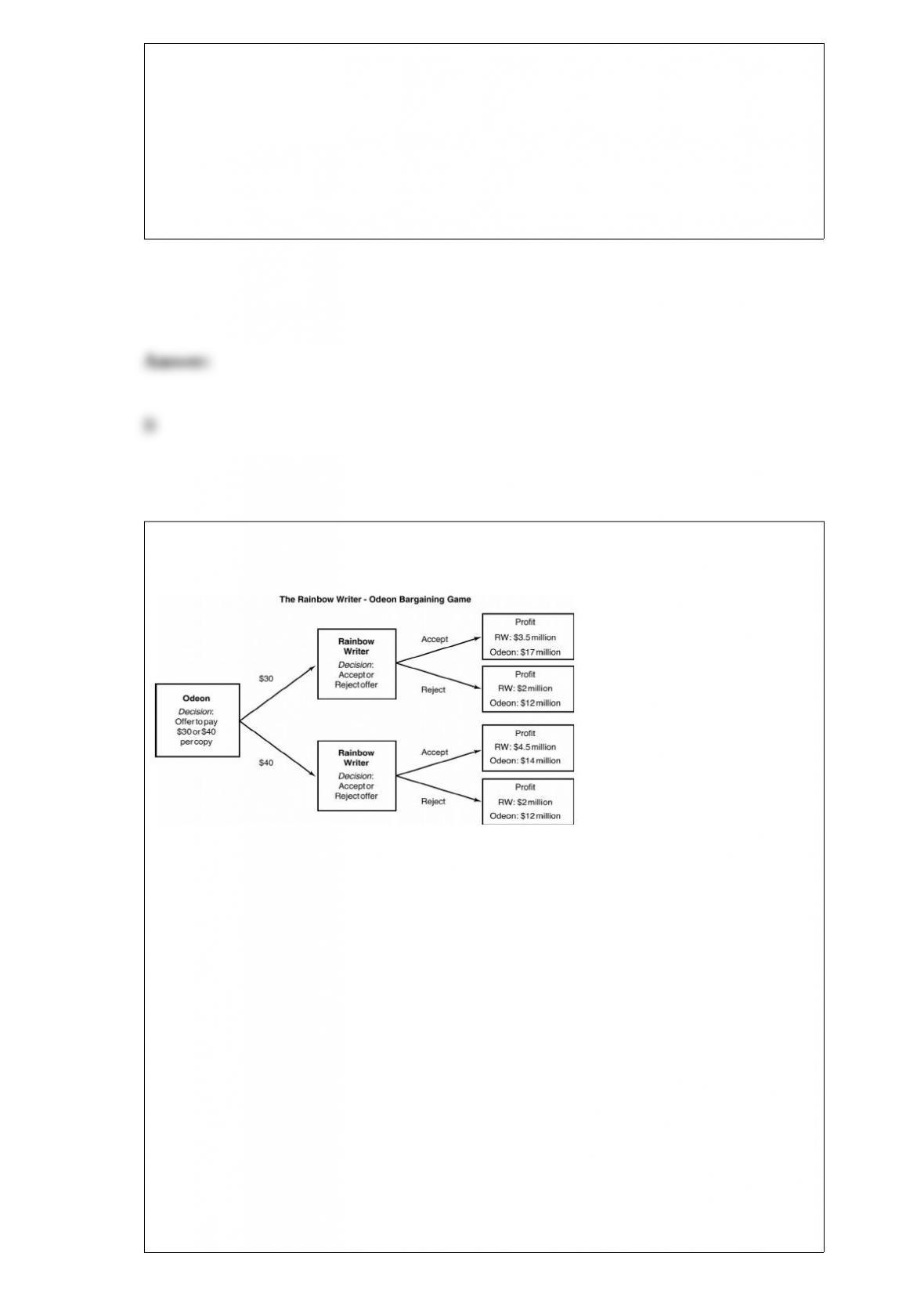
Figure 6-12
Refer to Figure 6-12. The diagram shows two supply curves, SA and SB. As price rises
from P0 to P1, which supply curve is more elastic?
A) SA
B) SB
C) They are equally inelastic.
D) They are equally elastic.
Figure 14-4
Rainbow Writer (RW) is a small online company selling a highly rated software
package for printing color labels directly onto CDs. The firm currently earns a profit of
$2 million per year selling its package exclusively on its Web site. Odeon, the producer
of the most popular software package for editing and burning CDs and DVDs, has
expressed interest in bundling Rainbow Writer’s product into its own package. Odeon
expects that bundling would further boost its sales and allow it to sell the new bundled
product at a higher price, thus raising its profits beyond its current profit of $12 million.
Figure 14-4 shows the decision tree for the Rainbow Writer-Odeon bargaining game.
Refer to Figure 14-4. What is the equilibrium outcome in this game and is this a
subgame-perfect equilibrium?
A) In the equilibrium, neither offer is accepted as Rainbow Writer holds out for a better
deal. The two rejection outcomes are subgame-perfect equilibria.
B) In the equilibrium, Odeon offers $40 per copy of the software package and is
accepted but this is not a subgame-perfect equilibrium.

C) Either offer of $30 or $40 per copy of the software package is accepted and these
two equilibria are subgame-perfect equilibria.
D) Either offer of $30 or $40 per copy of the software package is accepted but these are
not are subgame-perfect equilibria.
“For a given supply curve, the excess burden of a tax will be greater when the demand
for a product is less elastic than when the demand is more elastic.” This statement is
A) correct.
B) incorrect because the incidence of the tax, not the burden of the tax, is affected by
the elasticity of demand.
C) incorrect. When demand is less elastic, the burden of the tax is smaller than when the
demand is more elastic.
D) incorrect. The statement confuses demand with quantity demanded.
The marginal product of labor is calculated using the formula
A) L/Q.
B) ΔL/ΔQ.
C) ΔQ/ΔL.
D) Q/L.
Figure 5-1
Figure 5-1 shows a market with an externality. The current market equilibrium output of
Q1 is not the economically efficient output. The economically efficient output is Q2.
Refer to Figure 5-1. Suppose the current market equilibrium output of Q1 is not the
economically efficient output because of an externality. The economically efficient
output is Q2. In that case, the diagram shows
A) the effect of a positive externality in the production of a good.
B) the effect of a negative externality in the production of a good.
C) the effect of an external cost imposed on a producer.
D) the effect of an external benefit such as a subsidy granted to consumers of a good.

The present value of $300 received 5 years in the future would be calculated as which
of the following when the interest rate is 5%?
A) 300/(1.5)5
B) 300/(1.05)5
C) 300 1.5 5
D) 5.05/300
Adhira buys chocolates and almonds. She has 3 bars of chocolates and 4 bags of
almonds. The marginal utility of the third chocolate bar is 18 units of utility and the
marginal utility from the fourth bag of almonds is also 18. Is Adhira maximizing her
utility?
A) Yes, the marginal utility from the last unit of each good is equal.
B) No, she must buy 1 more chocolate bar to equate her quantities of the two goods.
C) No, she must buy cut back to 3 bags of almonds to equate her quantities of the two
goods.
D) No, without information on her income and the prices of the two goods, we cannot
answer the question.

The U.S. government has frequently used a “command and control” approach in dealing
with pollution. Which of the following describes this approach?
A) The government uses taxes in order to internalize the externalities caused by
pollution.
B) The government uses subsidies to encourage firms to use new technology that
reduces pollution.
C) The government imposes quantitative limits on the amount of pollution firms are
allowed to generate.
D) The government distributes information to consumers and producers on how to
reduce pollution.
Congressman Flack votes for a program that will benefit the constituents of
Congressman Walpole. The public choice model suggests that Flack’s vote is best
explained by which of the following?
A) rational ignorance
B) party loyalty
C) logrolling
D) the voting paradox

Which of the following would cause both the equilibrium price and equilibrium
quantity of cotton (assume that cotton is a normal good) to increase?
A) an increase in consumer income
B) a drought that sharply reduces cotton output
C) a decrease in consumer income
D) unusually good weather that results in a bumper crop of cotton
A monopoly is a seller of a product
A) with many substitutes.
B) without a close substitute.
C) with a perfectly inelastic demand.
D) without a well-defined demand curve.
Maurice Allais, Reinhard Selten and Vernon Smith all were awarded the Nobel Prize in
Economics in part because
A) of their work with experimental economics.
B) they discovered the first example of a Giffen good.
C) of their work on the substitution and income effects of price changes.
D) they proved that external economies would lead to market failure.
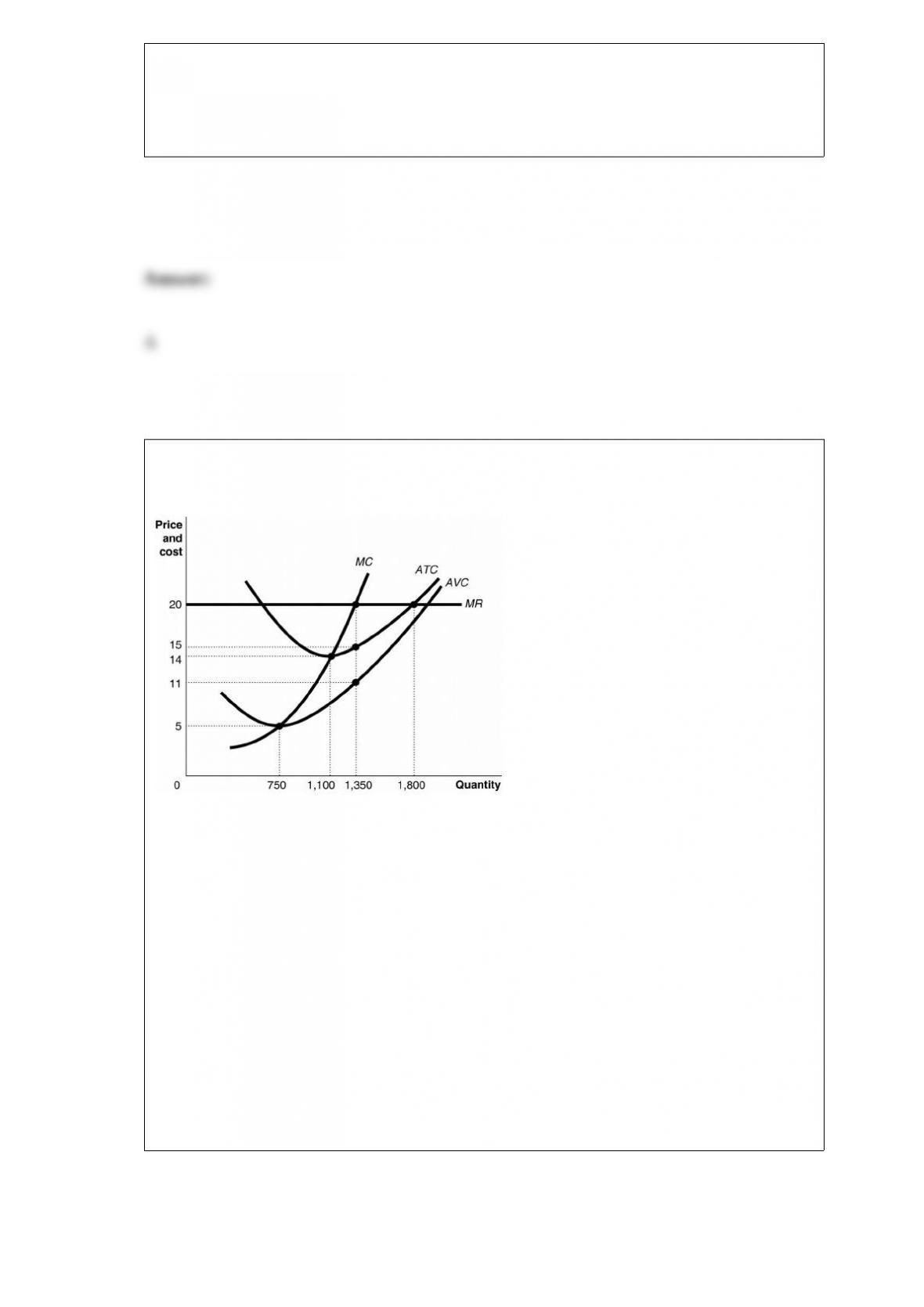
Figure 12-5
Figure 12-5 shows cost and demand curves facing a typical firm in a constant-cost,
perfectly competitive industry.
Refer to Figure 12-5. The figure shows the cost structure of a firm in a perfectly
competitive market. If the firm’s fixed cost increases by $1,000 due to a new
environmental regulation, what happens to its profit-maximizing output level?
A) It increases.
B) It decreases.
C) It remains the same.
D) It could increase, decrease or remain constant, depending on whether the firm is able
to cut costs somewhere else.

For each surfboard that Australia produces, it gives up the opportunity to make 25
boomerangs. New Zealand can produce 1 surfboard for every 15 boomerangs it
produces. Which of the following is true about the comparative advantage between the
two countries?
A) Australia has the comparative advantage in surfboards.
B) Australia has the comparative advantage in boomerangs.
C) New Zealand has the comparative advantage in surfboards and boomerangs.
D) New Zealand has the comparative advantage in boomerangs.
A perfectly competitive firm’s short-run supply curve is
A) upward sloping and is the portion of the marginal cost curve that lies above the
average total cost curve.
B) upward sloping and is the portion of the marginal cost curve that lies above the
average variable cost curve.
C) perfectly elastic at the market price.
D) horizontal at the minimum average total cost.

Along a downward sloping, linear demand curve, total revenue is the greatest
A) where demand is normal.
B) where demand is the most inelastic.
C) where demand is the most elastic.
D) where demand is unit-elastic.
If a monopolistically competitive firm lowers its price and, as a result, its total revenue
decreases then
A) the output effect of the price change was less than the price effect.
B) the output effect of the price change was greater than the price effect.
C) the firm’s demand curve must have decreased.
D) the substitution effect of the price change was greater than the income effect.
You are given the following market data for Venus automobiles in Saturnia.

Demand: P = 200 – 0.25Q
Supply: P = 130 + 0.10Q
where P = Price and Q = Quantity.
a. Calculate the equilibrium price and quantity.
b. Calculate the consumer surplus in this market.
c. Calculate the producer surplus in this market.
In the United States, consumers usually pay ________ than the true cost of medical
treatment because of ________.
A) more; adverse selection
B) more; rising insurance premiums
C) less; third-party payers
D) less; rising insurance deductibles

In theory, in the long run, monopolistically competitive firms earns zero profits.
However, in reality there are some ways by which a firm can avoid losing profits.
Which of the following is one such way?
A) gradually increase the mark up on the goods produced
B) lower the price of its products to expand its market share
C) identify new markets and develop products precisely for those markets
D) find a market niche and keep it as narrow as possible so as to prevent other
producers from entering this market segment
Recent research has shown that the first firm to enter a market often does not have a
long-term advantage over later entrants into the market. An example that has been used
to illustrate this is
A) McDonald’s entry into the high-end coffee market.
B) Xerox, which became a generic term for making photocopies.
C) Abercrombie and Fitch, which was the first clothing company to market to young
men.
D) the introduction of the first ballpoint pen in 1945.
The demand curve for the monopoly’s product is

A) the market demand for the product.
B) more elastic than the market demand for the product.
C) more inelastic than the market demand for the product.
D) undefined.
A Gini coefficient of ________ means that an income distribution is perfectly equal and
a Gini coefficient of ________ means the income distribution is perfectly unequal.
A) 0; 1
B) 1; 0
C) 0, 100
D) 100, 0
A decrease in the demand for incandescent light bulbs due to changes in consumer
tastes, accompanied by a decrease in the supply of incandescent light bulbs as a result
of government restrictions, will result in
A) a decrease in the equilibrium quantity of incandescent light bulbs and no change in
the equilibrium price.

B) a decrease in the equilibrium price of incandescent light bulbs and no change in the
equilibrium quantity.
C) a decrease in the equilibrium price of incandescent light bulbs; the equilibrium
quantity may increase or decrease.
D) a decrease in the equilibrium quantity of incandescent light bulbs; the equilibrium
price may increase or decrease.