Who controls a sole proprietorship?
A) owner
B) stockholders
C) bondholders
D) employees
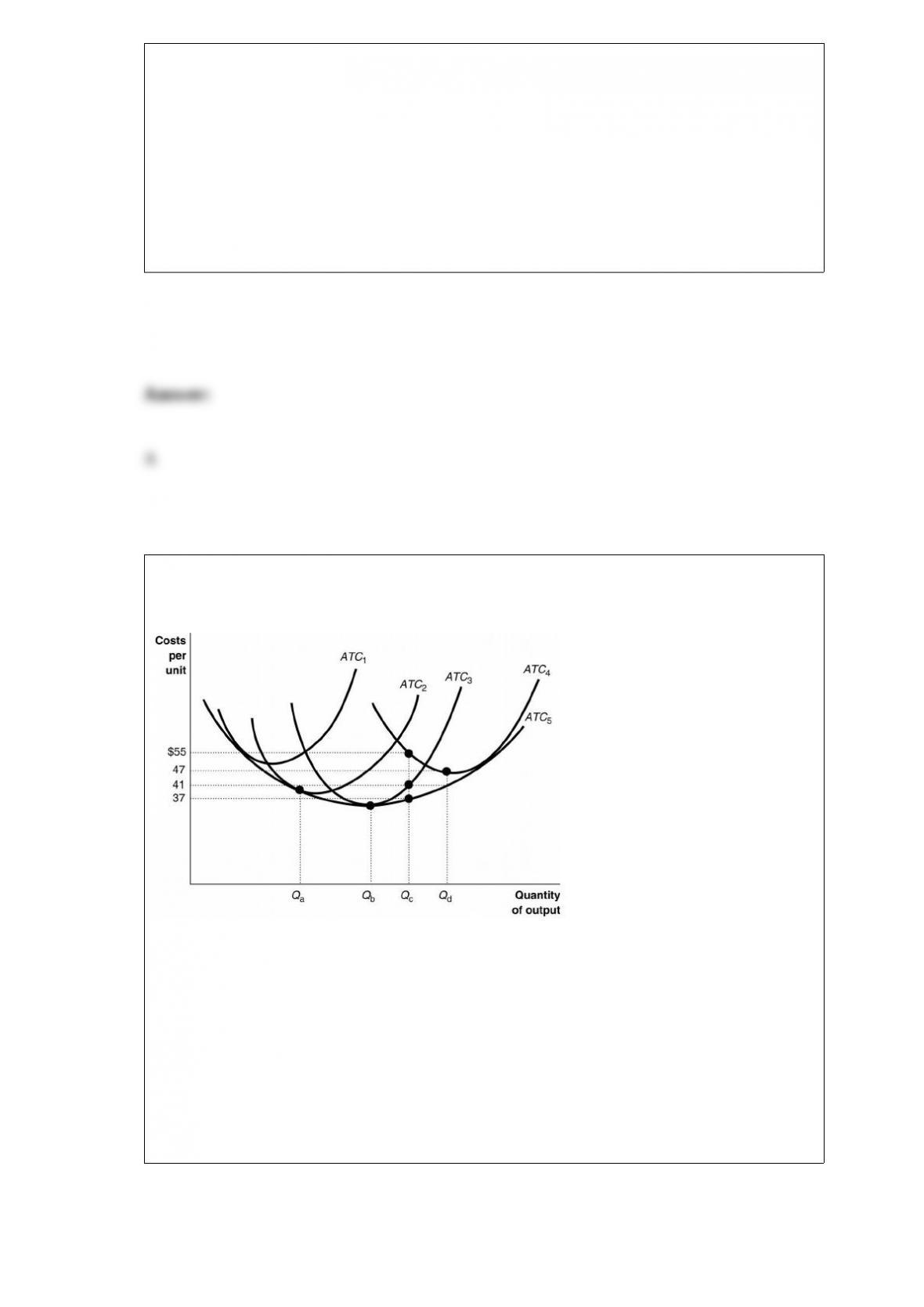
Figure 11-10
Refer to Figure 11-10. Identify the minimum efficient scale of production.
A) Qa
B) Qb
C) Qc
D) Qd
Which of the following would explain why economic profit might be less than
accounting profit?
A) A firm’s net income is less than its accounting profit.
B) A firm has only explicit costs.
C) A firm’s net income is greater than its accounting profit.
D) A firm has implicit costs as well as explicit costs.
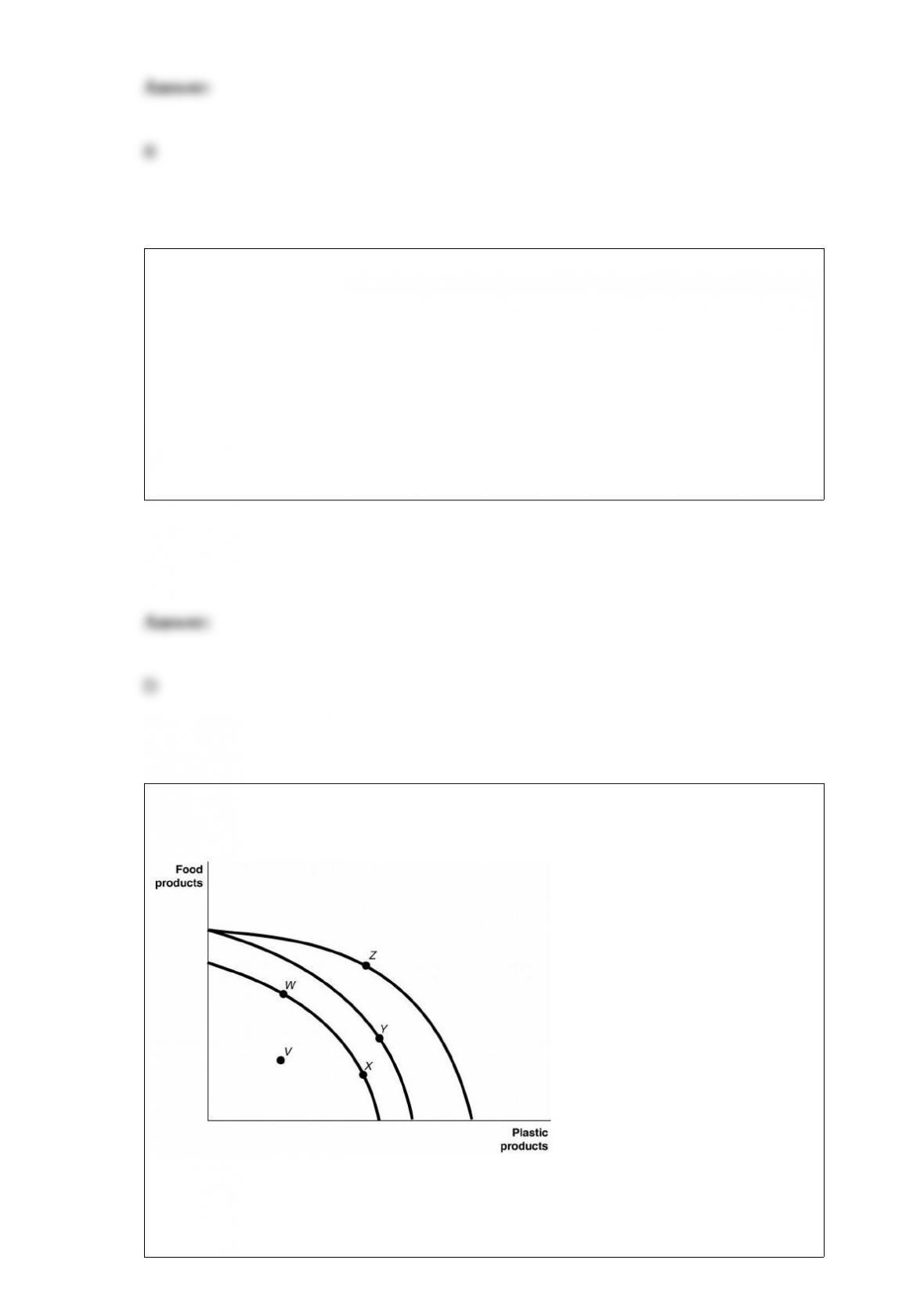
Figure 2-4
Figure 2-4 shows various points on three different production possibilities frontiers for
a nation.
Refer to Figure 2-4. Consider the following events:
a. an increase in the patent protection period to 30 years
b. an increase of a nation’s capital stock
c. an improved property rights system
Which of the events listed above could cause a movement from V to W?
A) a only
B) a and b only
C) a and c only
D) b and c only
E) a, b, and c
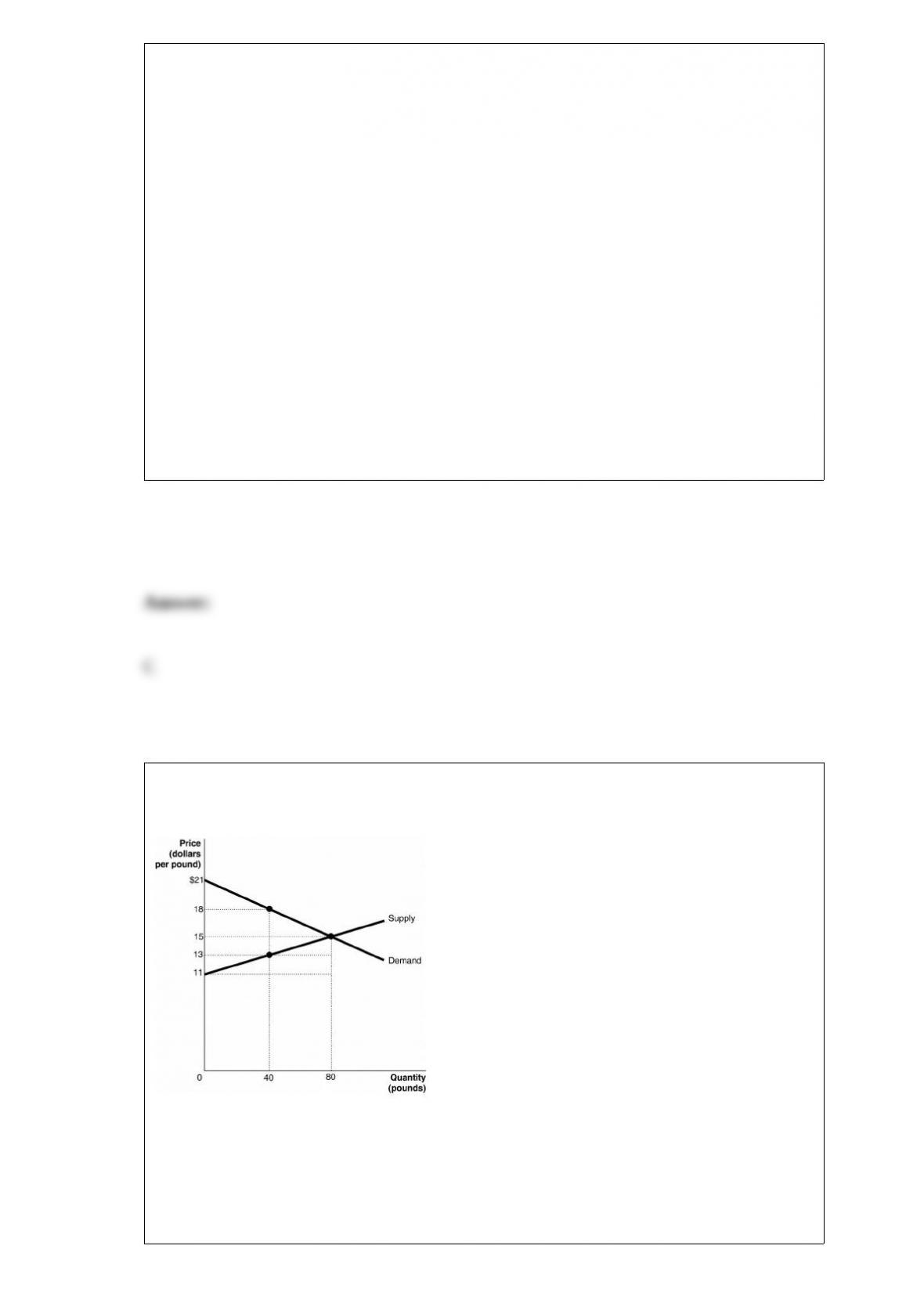
Figure 4-3
Figure 4-3 shows the market for tiger shrimp. The market is initially in equilibrium at a
price of $15 and a quantity of 80. Now suppose producers decide to cut output to 40in
order to raise the price to $18.
Refer to Figure 4-3. What is the value of consumer surplus at a price of $18?

A) $60
B) $120
C) $180
D) $240
During a study session for an economics exam with three other students, Peter Daltry
commented on an example of a consumer who had to decide the on number of slices of
pizza and cups of Coca-Cola he would consume. Peter explained that “To maximize his
utility this consumer must equate the marginal utility per dollar for pizza and
Coca-Cola.” Was Peter’s analysis correct?
A) Peter described one of the conditions necessary for utility maximization. The
consumer also must equate the marginal utility of pizza and the marginal utility of cups
of Coca-Cola.
B) Peter’s statement is correct.
C) Peter’s statement is correct but we must also assume that the consumer is rational.
D) Peter describes one of the conditions necessary for utility maximization. The second
condition is that total spending on both goods must equal the amount available to be
spent.
The law of demand implies, holding everything else constant, that
A) as the price of bagels increases, the quantity of bagels demanded will decrease.
B) as the price of bagels increases, the demand for bagels will decrease.
C) as the price of bagels increases, the quantity of bagels demanded will increase.
D) as the price of bagels increases, the demand for bagels will increase.
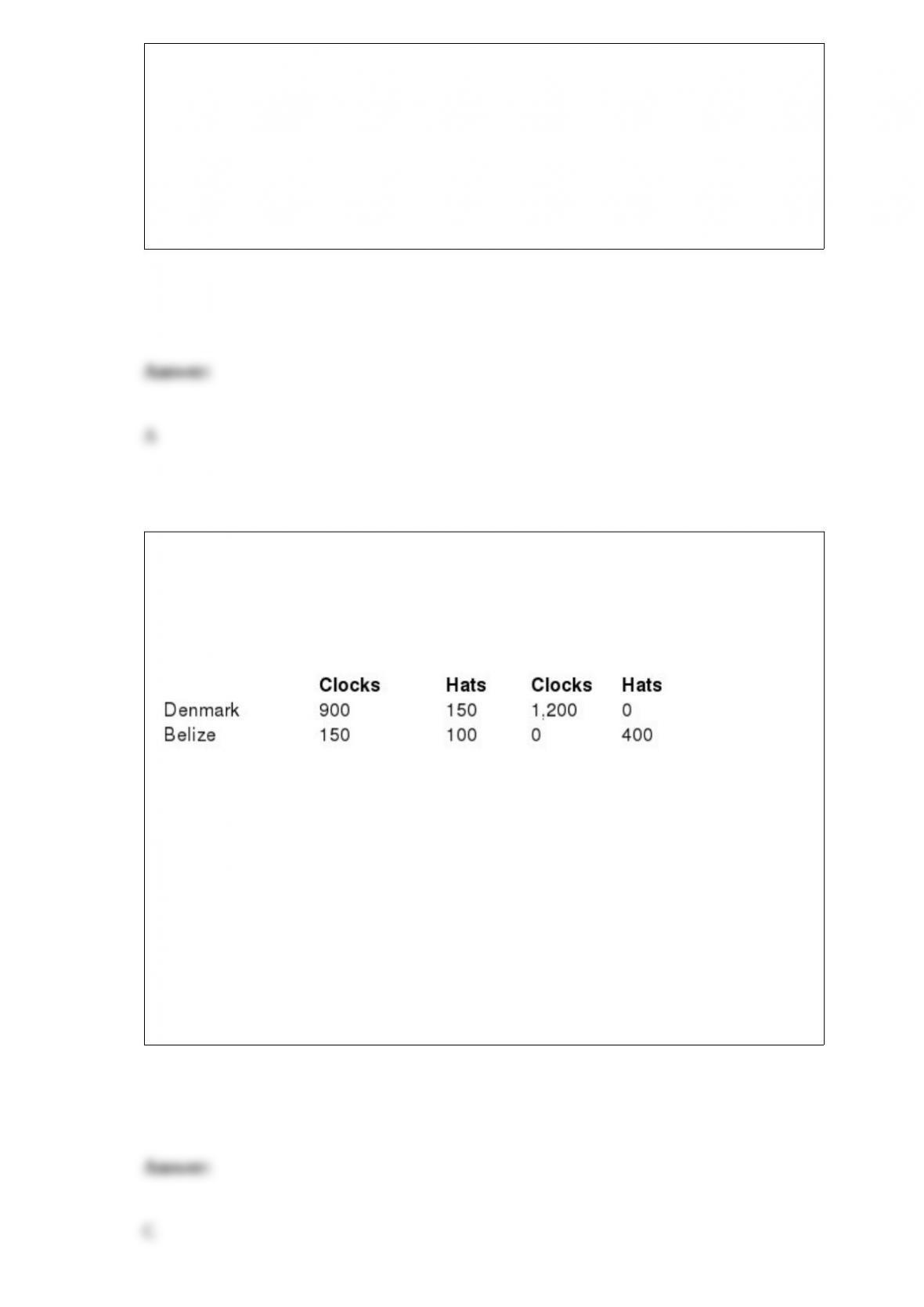
Table 9-6
Production and
Consumption Production
Without Trade With Trade
Denmark and Belize can produce both clocks and hats. Table 9-6 shows the production
and consumption quantities without trade, and the production numbers with trade.
Refer to Table 9-6. If the actual terms of trade are 1 hat for 1.8 clocks and 150 hats are
traded, how many hats will Belize gain compared to the “without trade” numbers?
A) -100
B) 0
C) 150
D) 250
One result of the financial meltdown of the late 2000s was that mortgage institutions
________ and ________ were brought under direct control of the government.
A) Fannie Mae; Freddie Mac
B) Glass Steagall; Sarbanes Oxley
C) Goldman Sachs; Morgan Stanley
D) Lehman Brothers; FDIC
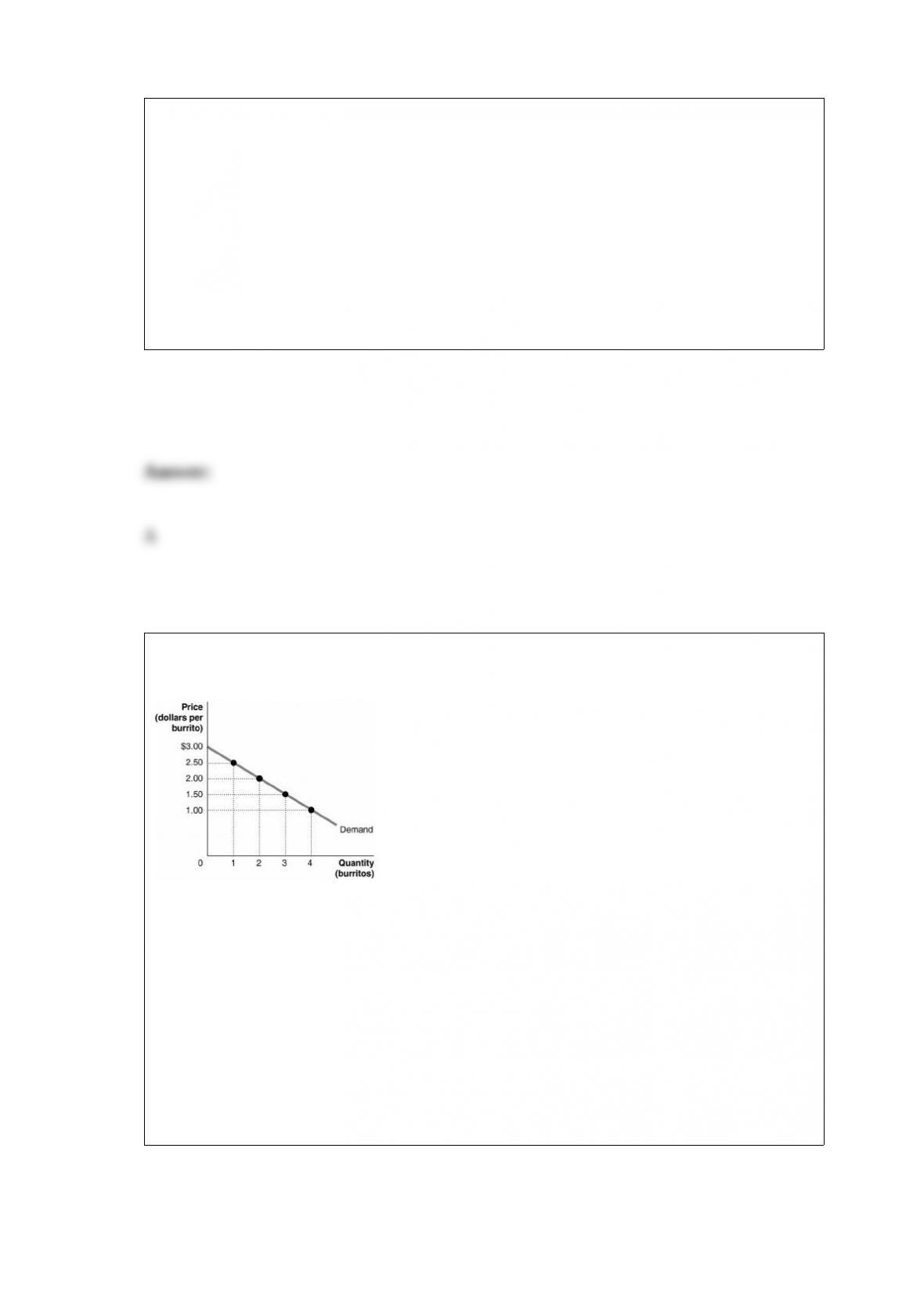
Figure 4-1
Figure 4-1 shows Arnold’s demand curve for burritos.
Refer to Figure 4-1. If the market price is $2.00, what is Arnold’s consumer surplus?
A) $0.50
B) $1.00
C) $1.50
D) $3.00

Trade between countries that is without restrictions is called
A) unobstructed commerce.
B) unabated trade.
C) free trade.
D) unencumbered trade.
Income elasticity measures
A) how a good’s quantity demanded responds to change in the goods price.
B) how a good’s quantity demanded responds to change in the price of another good.
C) how a good’s quantity demanded responds to change in buyers’ incomes.
D) how a good’s quantity demanded responds to producers’ incomes.

Which of the following statements is true?
A) Japan is more dependent on foreign trade than is the United States.
B) Imports and exports account for over one-half of the GDP of Belgium.
C) France is the leading exporting country, accounting for 10 percent of total world
exports.
D) Because the cost of labor used on farms is so high, the United States exports very
little of its wheat, rice and corn crops.
Vipsana’s Gyros House sells gyros. The cost of ingredients (pita, meat, spices, etc.) to
make a gyro is $2.00. Vipsana pays her employees $60 per day. She also incurs a fixed
cost of $120 per day. Calculate Vipsana’s variable cost per day when she produces 50
gyros using two workers?
A) $100
B) $124.40
C) $220
D) $240
Which of the following statements refers to rent seeking?
A) “Laws passed by the federal government often provide benefits for a small number
of individuals. These individuals, in turn, have an incentive to contribute to the
campaigns of politicians who pass these laws.”
B) “The federal government should spend more money on programs that help low
income citizens and less money on national defense.”
C) “The role of the federal government in the U.S. economy grew significantly after the
Great Depression. Government spending and taxes are a much greater proportion of
total income today than they were in 1929.”
D) “There is an opportunity cost whenever the federal government spends tax revenue.
For example, an additional $1 billion spent on national defense means there will be less
revenue for highway construction and maintenance or some other program.”
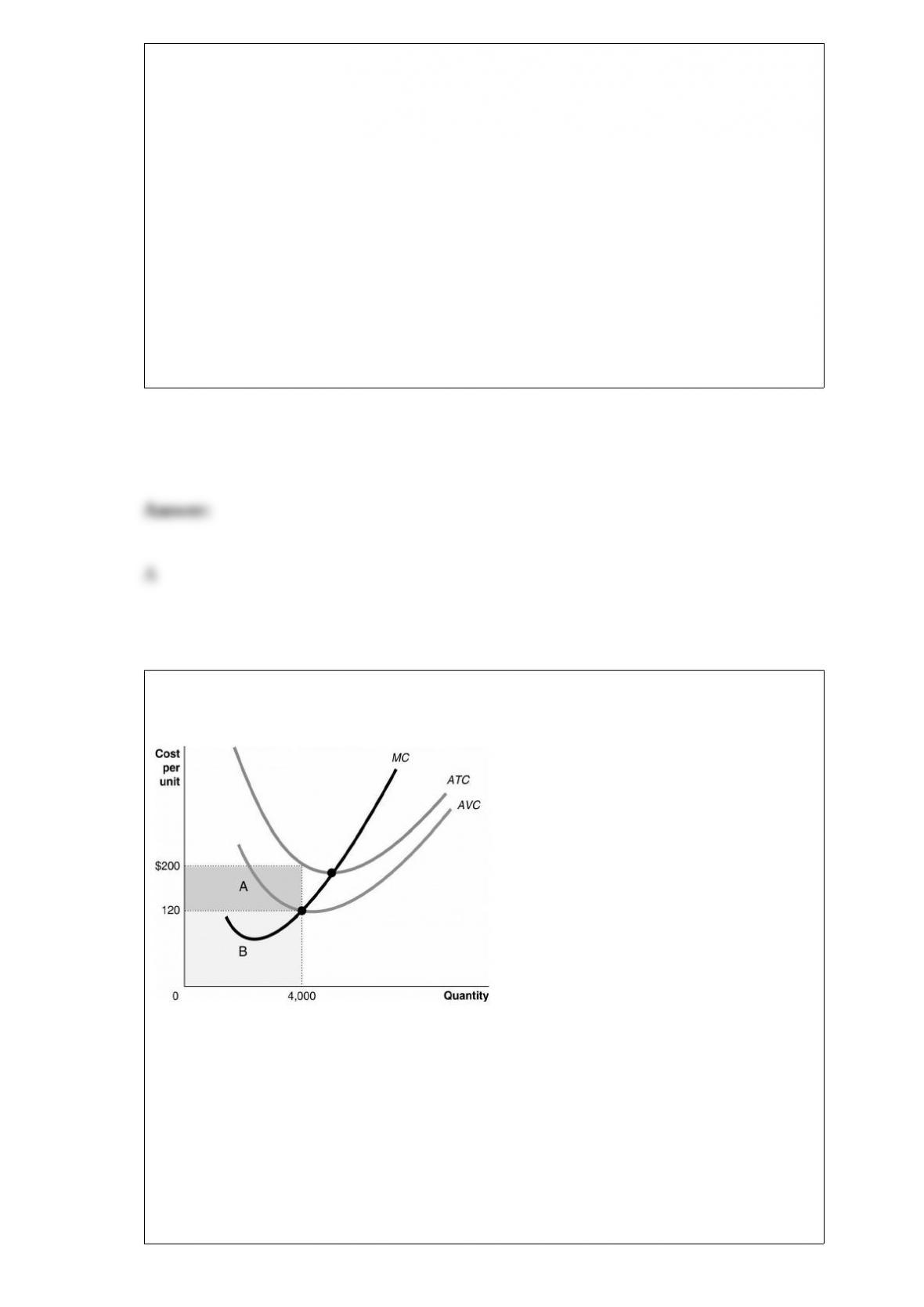
Figure 12-8
Refer to Figure 12-8. Suppose the market price is $120. Which of the following is
true?
A) The firm earns a profit equal to the area A.
B) The firm earns a profit equal to the area A + B.
C) The firm suffers a loss equal to the area A.
D) The firm will break even.
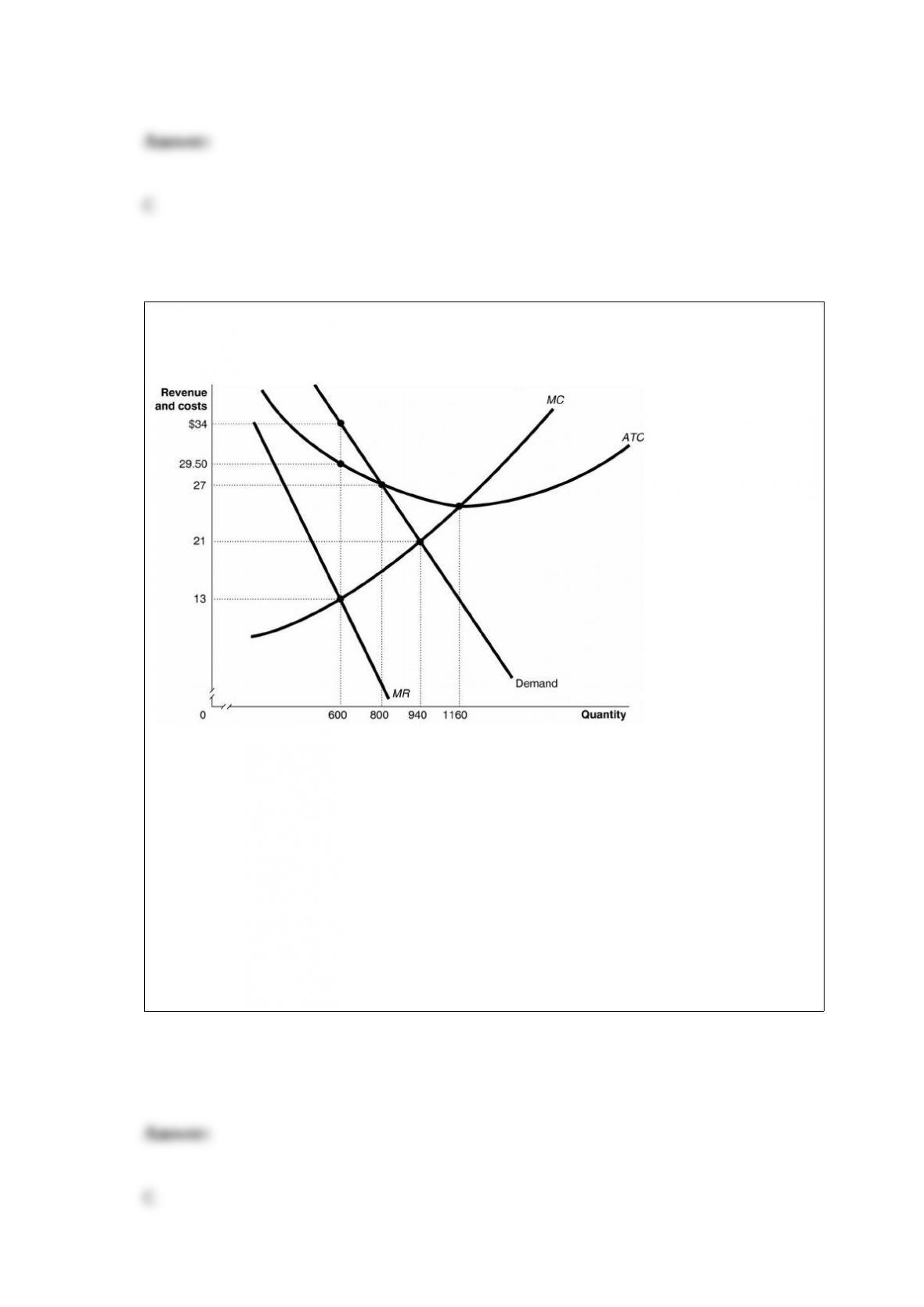
Figure 15-4
Figure 15-4 shows the demand and cost curves for a monopolist.
Refer to Figure 15-4. What is likely to happen to this monopoly in the long run?
A) New firms will enter the market to eliminate its profits.
B) It will expand its output to take advantage of economies of scale so as to further
increase its profit.
C) As long as there are entry barriers, this firm will continue to enjoy economic profits.
D) It will be regulated by the government because of its excess profits.

Transactions costs refer to
A) the implicit costs of production.
B) the costs in time and other resources that parties incur in the process of agreeing to
and carrying out an exchange of goods or services.
C) the raw material cost of production.
D) the cost of transporting goods from one destination to another.
All of the following are examples of spending on factors of production in the circular
flow model except
A) Bima hires two students to work at his ice-cream store.
B) “Get Fit Together” purchases 3 new treadmills for its gym.
C) Iris buys a dozen roses for her mother’s birthday.
D) The Banyan Tree rents a much larger property so that it can add a restaurant to its
facilities.
Which of the following is an example of a “how much” decision?
A) Dinah’s Diner is only open for breakfast and lunch. Dinah is trying to decide
whether to open for dinner as well.

B) Zander has torn up his front yard and is debating whether to plant grass or install a
rock garden.
C) You received a nice birthday check from your grandmother and are deciding on
whether to spend it on a trip to New York or a trip to San Francisco.
D) Sergio quit his job to go back to school full time.
Better health allows people to work harder, which raises a country’s total income. This
indicates that in effect, better health
A) is a primary cause of price increases.
B) reduces the incentive to work.
C) shifts out a country’s production possibilities frontier.
D) increases consumer surplus.
In England during the Middle Ages each village had an area of pasture on which any
family in the village was allowed to graze its cows and sheep without charge.
Eventually, the grass in the pasture would be depleted and no family’s cow or sheep
would get enough to eat. The reason the grass was depleted was
A) the area of pasture was nonexcludable and the consumption of the grass was rival.
B) self-interest motives led livestock owners to raise too many cows and sheep.
C) due to a policy of neglect on the part of the English government.
D) it did not get enough rainfall.
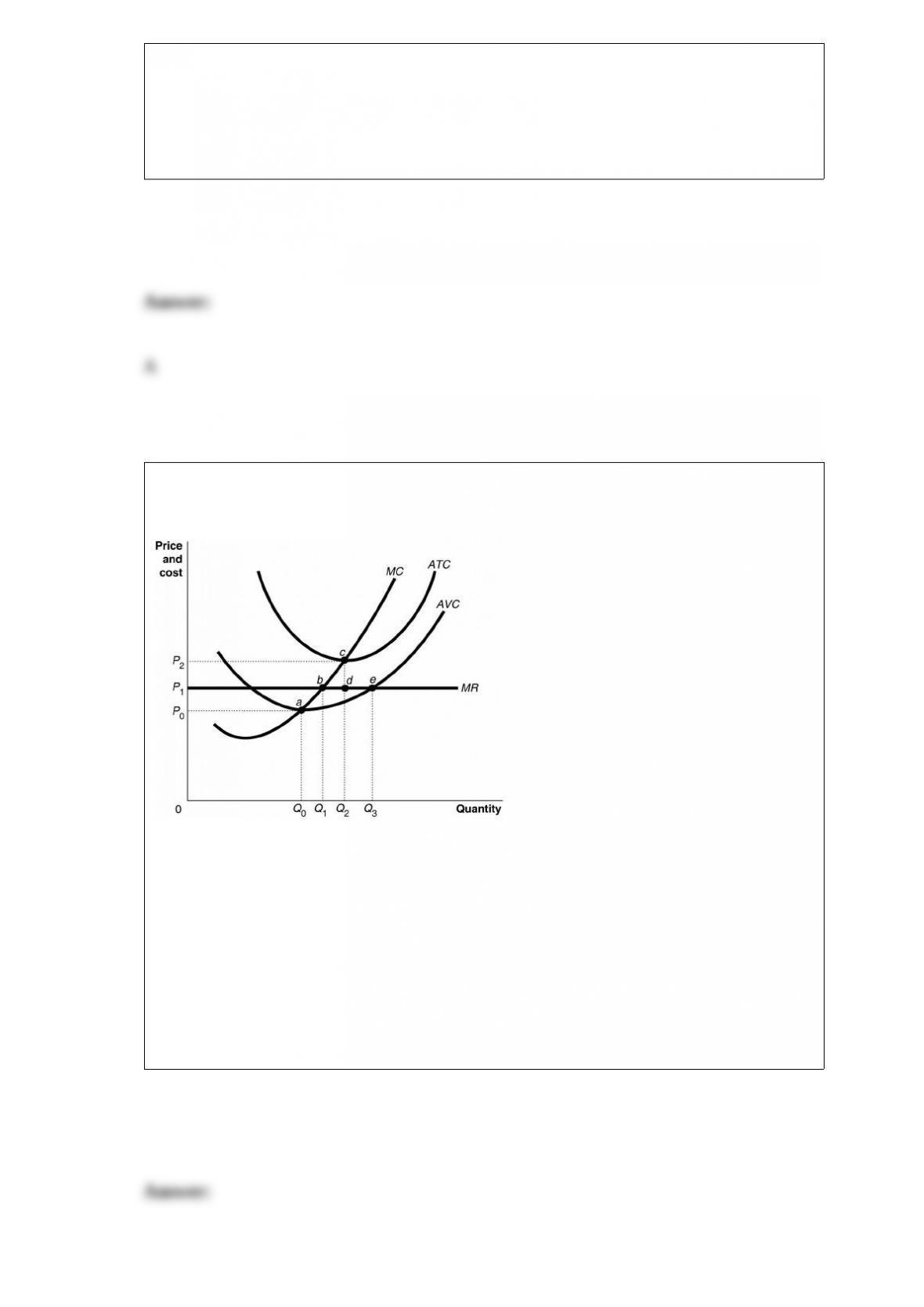
Figure 12-13
Refer to Figure 12-13. Suppose the prevailing price is P1 and the firm is currently
producing its loss-minimizing quantity. In the long-run equilibrium
A) there will be fewer firms in the industry and total industry output decreases.
B) there will be more firms in the industry and total industry output increases.
C) there will be fewer firms in the industry but total industry output increases.
D) there will be more firms in the industry and total industry output remains constant.

Firms that face downward-sloping demand curves for their output in the product market
are called
A) price takers.
B) price dictators.
C) monopolists.
D) price makers.
Let D= demand, S = supply, P = equilibrium price, Q= equilibrium quantity. What
happens in the market for walnuts if the Centers for Disease Control and Prevention
announces that consuming a half cup of walnuts each week helps to lower bad levels of
cholesterol?
A) D increases, S no change, P and Q increase
B) S increases, D no change, P decreases, Q increases
C) D and S increase, P and Q decrease
D) D no change, S increases, P decreases, Q decreases
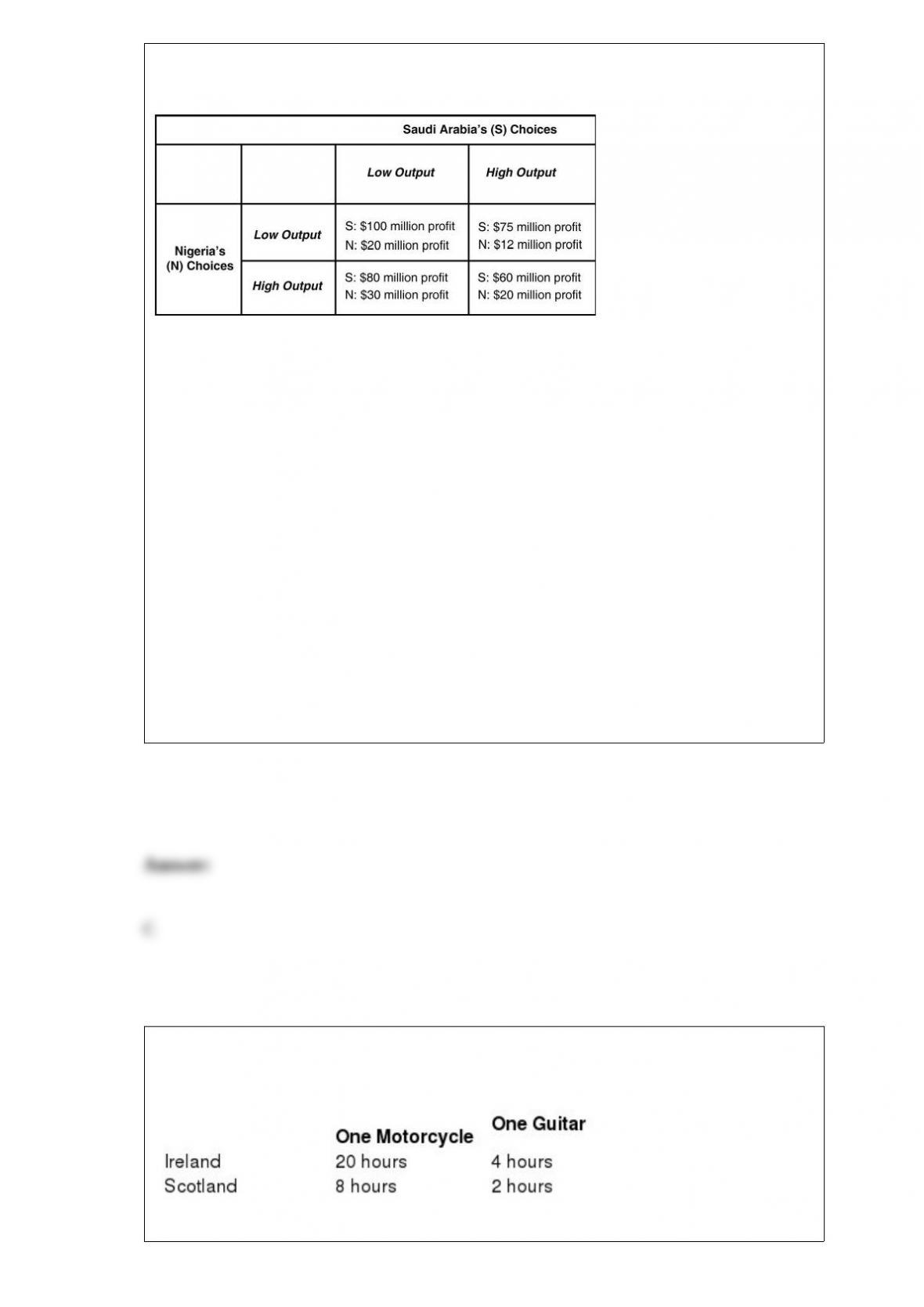
Table 14-3
Suppose OPEC has only two producers, Saudi Arabia and Nigeria. Saudi Arabia has far
more oil reserves and is the lower cost producer compared to Nigeria. The payoff
matrix in Table 14-3 shows the profits earned per day by each country. “Low output”
corresponds to producing the OPEC assigned quota and “high output” corresponds to
producing the maximum capacity beyond the assigned quota.
Refer to Table 14-3. What is the Nash equilibrium in this game?
A) In the Nash equilibrium both Saudi Arabia and Nigeria produce a low output and
earn a profit of $100 million and $20 million respectively.
B) In the Nash equilibrium both Saudi Arabia and Nigeria produce a high output and
earn a profit of $60 million and $20 million respectively.
C) In the Nash equilibrium Saudi Arabia produces a low output and earns a profit of
$80 million and Nigeria produces a high output and $30 million respectively.
D) There is no Nash equilibrium.
Table 2-11

Table 2-11 shows the number of labor hours required to produce a motorcycle and a
guitar in Ireland and Scotland.
Refer to Table 2-11. What is Scotland’s opportunity cost of producing one motorcycle?
A) 0.25 guitar
B) 4 guitars
C) 12 guitars
D) 16 guitars
A constant-cost industry is an industry in which
A) average costs fall as the industry expands output.
B) average costs rise as the industry expands output.
C) average costs remain constant as the industry expands output.
D) input prices rise at a constant rate as firms in the industry use more inputs.
Most film processing companies have a policy of printing every picture on a roll of film
and allowing customers to request a refund for pictures that were not clearly developed.
The companies do this knowing that most customers do not ask for refunds. This is an
example of consumers

A) failing to ignore sunk costs.
B) being overly optimistic about their future behavior.
C) not taking nonmonetary opportunity costs into account.
D) not making themselves aware of the policy regarding refunds.
A patent is a government-imposed entry barrier because
A) it allows a firm to achieve economies of scale.
B) it is a key input owned by the firm that is granted the patent.
C) it limits the quantity of a good that can be imported into a country.
D) it gives a firm the exclusive right to a new product for a period of 20 years from the
date the product is invented.
Which of the following statements regarding equilibrium in the markets for capital and
for a natural resource used in producing a good is true?
A) The marginal revenue product of capital will equal the marginal revenue product of
the natural resource.
B) The rental price of capital will equal the price of the natural resource.

C) The marginal product of capital will equal the rental price of capital and the marginal
product of the natural resource will equal the price of the natural resource.
D) The marginal revenue product of capital will equal the rental price of capital and the
marginal revenue product of the natural resource will equal the price of the natural
resource.
What does a Lorenz curve illustrate?
A) a comparison of the distribution of income in two different countries
B) the distribution of income within a country in a given time period
C) the share of taxes paid by different groups of households
D) the change over time in the percentage of households with incomes that place them
below the poverty line
If, when a firm doubles all its inputs, its average cost of production increases, then
production displays
A) diminishing returns.
B) economies of scale.
C) diseconomies of scale.

D) declining fixed costs.
Scenario: Topsy Turvey Toys and Ureshi Toys
Topsy Turvey Toys is a U.S.-based toy retailer that buys all its merchandise from Ureshi
Toys, a Japan-based toy manufacturer with production facilities in twelve nations.
Ureshi Toys markets its toys globally without modification.Topsy Turvey Toys buying
its merchandise from Ureshi Toys is an example of ________.
A) importing
B) exporting
C) outsourcing
D) insourcing