
The marginal productivity theory of income distribution states that
A) as more and more units of labor are added to a fixed quantity of capital, eventually
labor’s contribution to a firm’s income will decrease.
B) income distribution is determined by the marginal productivity of the factors of
production that individuals own.
C) factors of production in short supply command higher prices than those available in
abundant quantities.
D) capital owners receive the bulk of a nation’s income because capital-intensive
production generates productivity gains.
The “ability-to-pay” principle of taxation is the normative idea that
A) an equitable tax system is one in which high income individuals should bear a
greater burden of taxes than low income individuals.
B) each individual should voluntarily contribute according to her ability to pay taxes.
C) progressive taxes are more equitable than regressive taxes.
D) two individuals earning the same income should have equal ability to pay, all else
constant.
Supporters affirm that globalization ________.

A) brings an end to practices like outsourcing
B) causes worker dislocation that gradually lowers wages
C) increases wealth and efficiency in all countries
D) curbs market flexibility in developed nations
Which of the following is not a result of government price controls?
A) Some people win and some people lose.
B) Price controls benefit poor consumers but harm producers and wealthy consumers.
C) Price controls decrease economic efficiency.
D) A deadweight loss will occur.
The rise of a new international entity called the ________ suggests that any company,
regardless of age, experience, and resources, can engage in international business.
A) transnational corporation
B) multinational corporation
C) born global firm
D) global firm
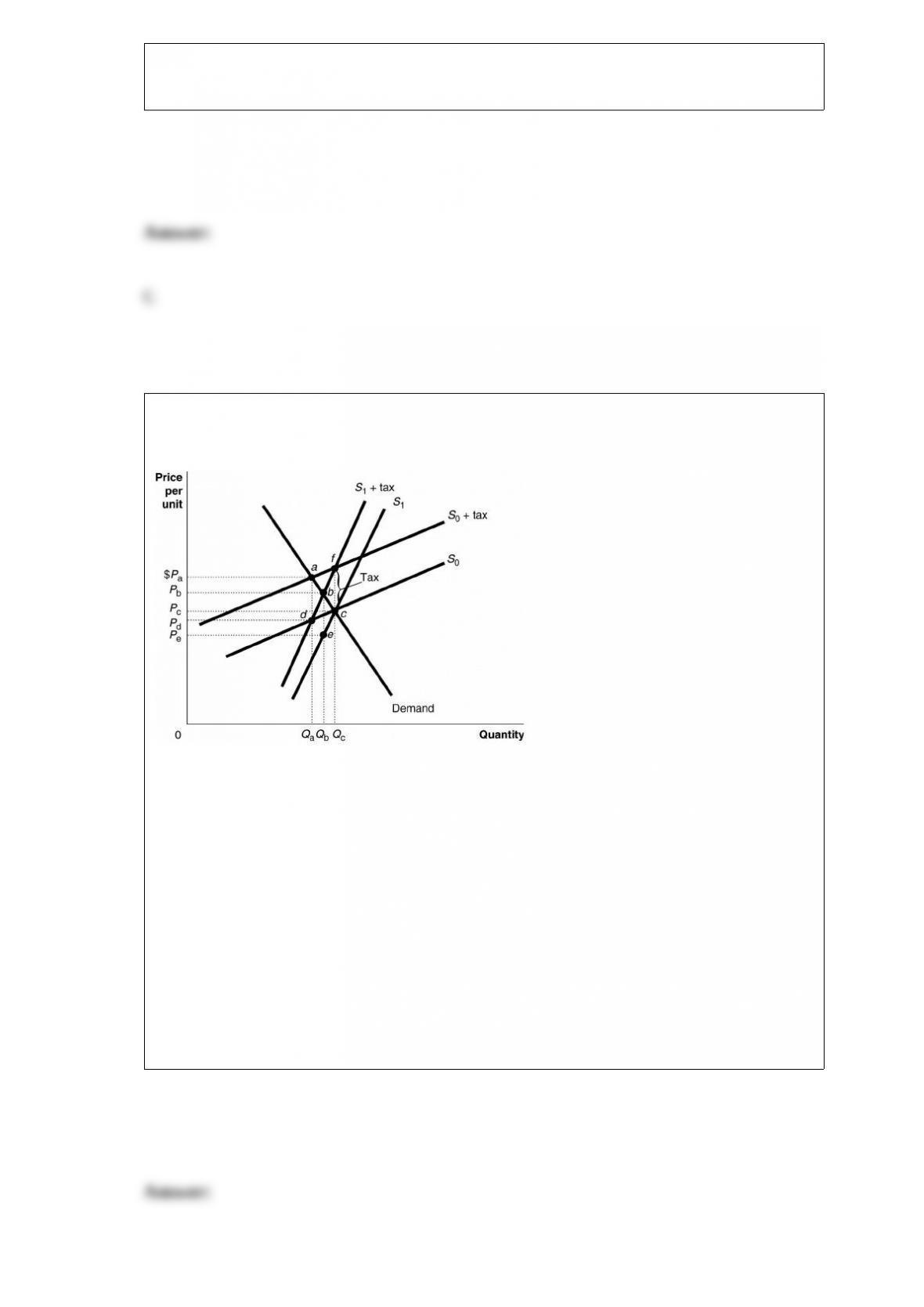
Figure 18-2
Figure 18-2 shows a demand curve and two sets of supply curves, one set more elastic
than the other.
Refer to Figure 18-2. If the government imposes an excise tax of $1.00 on every unit
sold, the government’s revenue from the tax
A) is larger if the supply curve is S0.
B) is larger if the supply curve is S1.
C) is identical under either supply curve.
D) is not maximized.
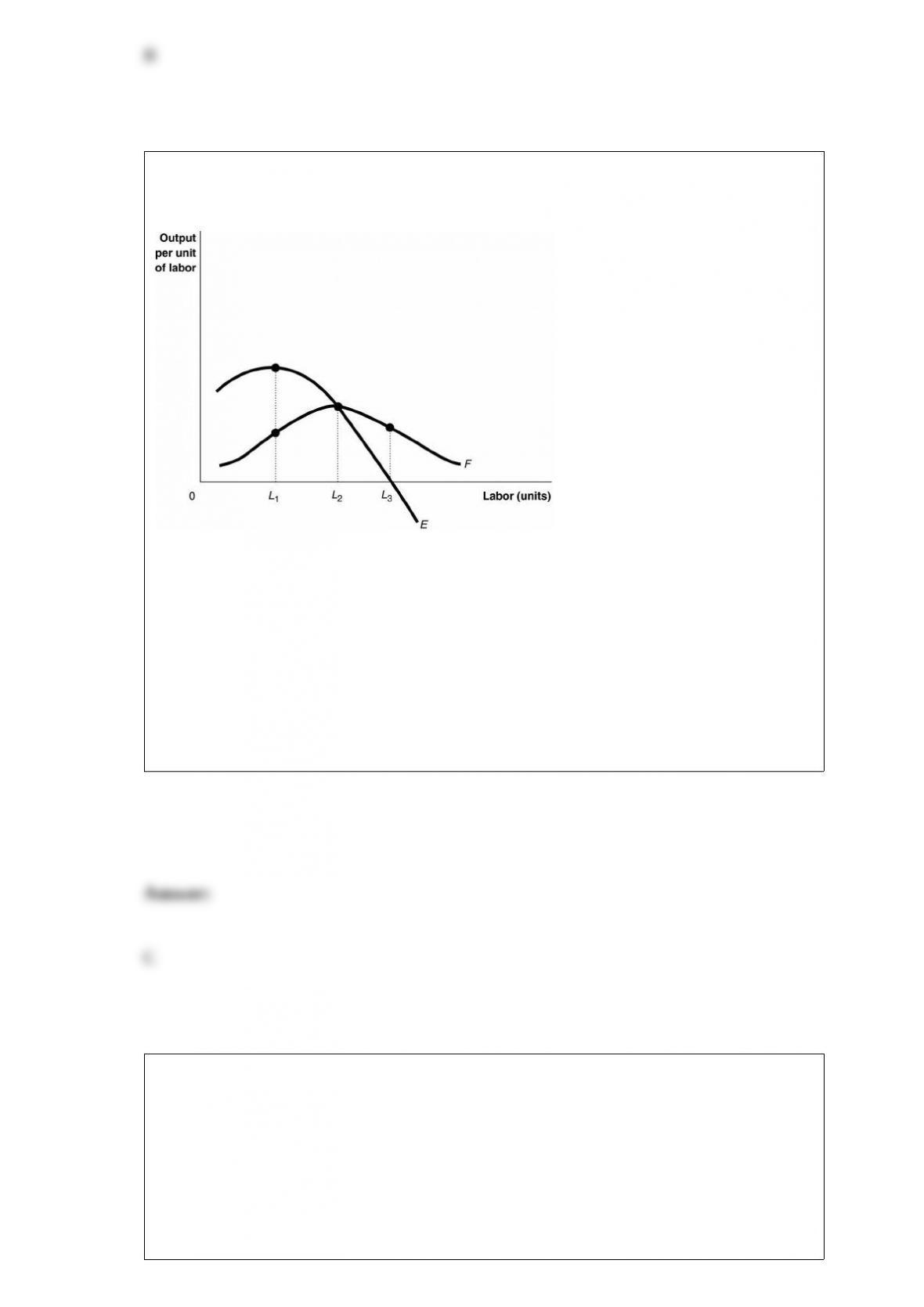
Figure 11-2
Refer to Figure 11-2. Short run output is maximized at
A) L1.
B) L2.
C) L3.
D) insufficient information to determine
The largest government-run health care system in the world, with 1.7 million
employees, is in
A) Canada.
B) Japan.
C) the United Kingdom.
D) the United States.
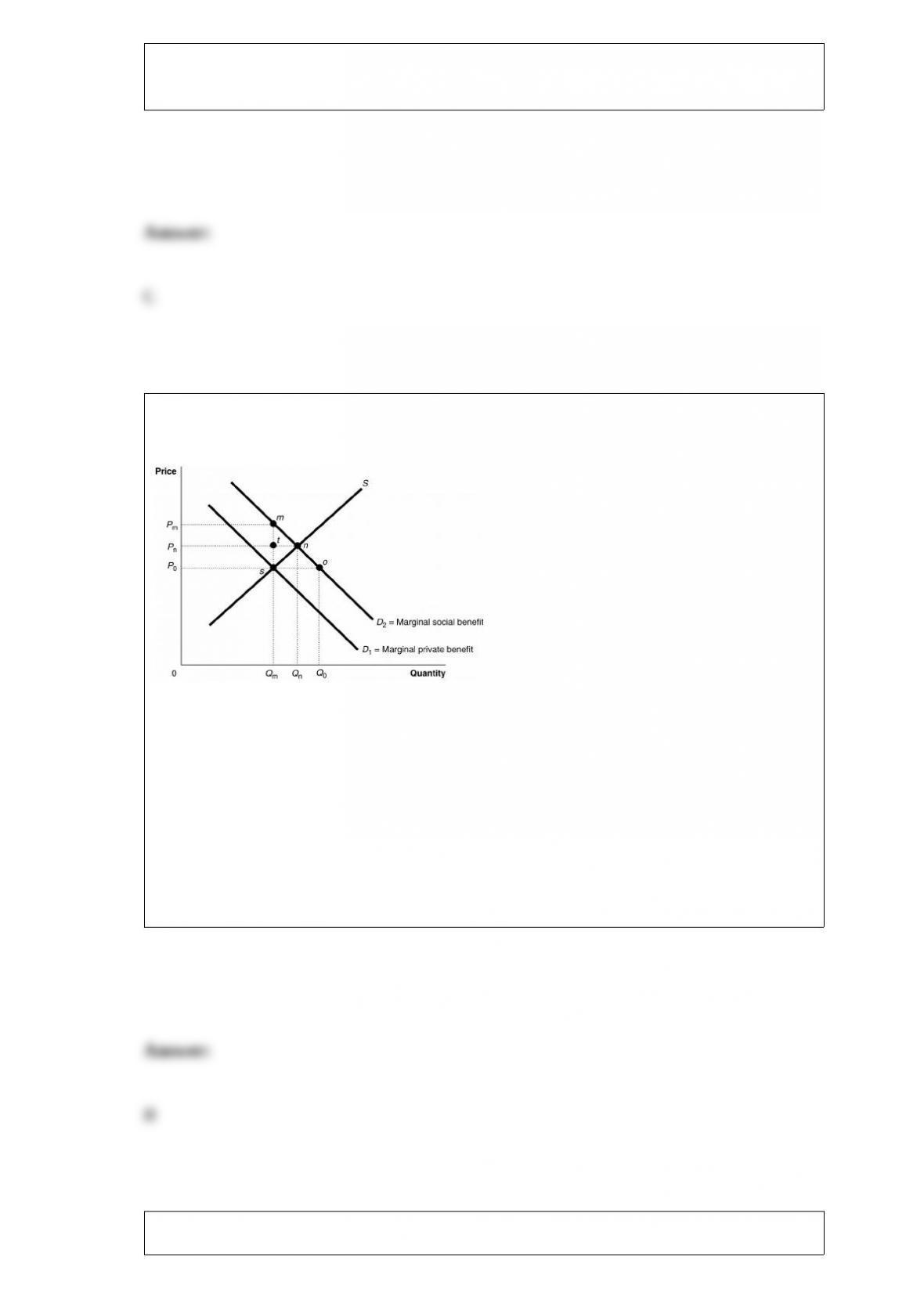
Figure 5-3
Refer to Figure 5-3. At the competitive market equilibrium, for the last unit produced
A) the size of the external cost is Pm– Po.
B) the size of the external benefit is Pm– Po.
C) the size of the external cost is Pn– Po.
D) the size of the external benefit is Pn– Po.
What is a market failure?

A) It refers to the inability of the market to allocate resources efficiently up to the point
where marginal social benefit equals marginal social cost.
B) It refers to the inability of the market to allocate resources efficiently up to the point
where marginal social benefit equals marginal private cost.
C) It refers to a situation where an entire sector of the economy (for example, the airline
industry) collapses because of some unforeseen event.
D) It refers to a breakdown in a market economy because of widespread corruption in
government.
Why does a prisoner’s dilemma lead to a noncooperative equilibrium?
A) because each player had agreed before the game started to minimize the harm that he
can inflict on the other players
B) because each player is uncertain how other players will play the game
C) because players must choose from a limited number of non-dominant strategies
D) because each rational player has a dominant strategy to play a certain way regardless
of what other players do
If preferences are transitive, indifference curves

A) intersect at the equilibrium consumption bundle.
B) intersect at the optimum consumption bundle.
C) intersect where the marginal rate of substitution for each indifference curve is equal.
D) do not intersect.
A trademark is
A) a legal instrument which grants a firm the right to differentiate its product.
B) a legal right to position a firm’s product in high-traffic public areas such as airports
and post offices.
C) a patent on a firm’s product.
D) a distinguishing attribute such as a sign or logo that allows a firm to uniquely
identify its product.
If the quantity of sunglasses supplied is represented by the equation QS = -60 + 4P then
the corresponding price of sunglasses is represented by the equation
A) P = 0.25QS + 15.
B) P = 15QS + 240.
C) P = QS – 7.5.
D) P = 12 – 0.4QS.
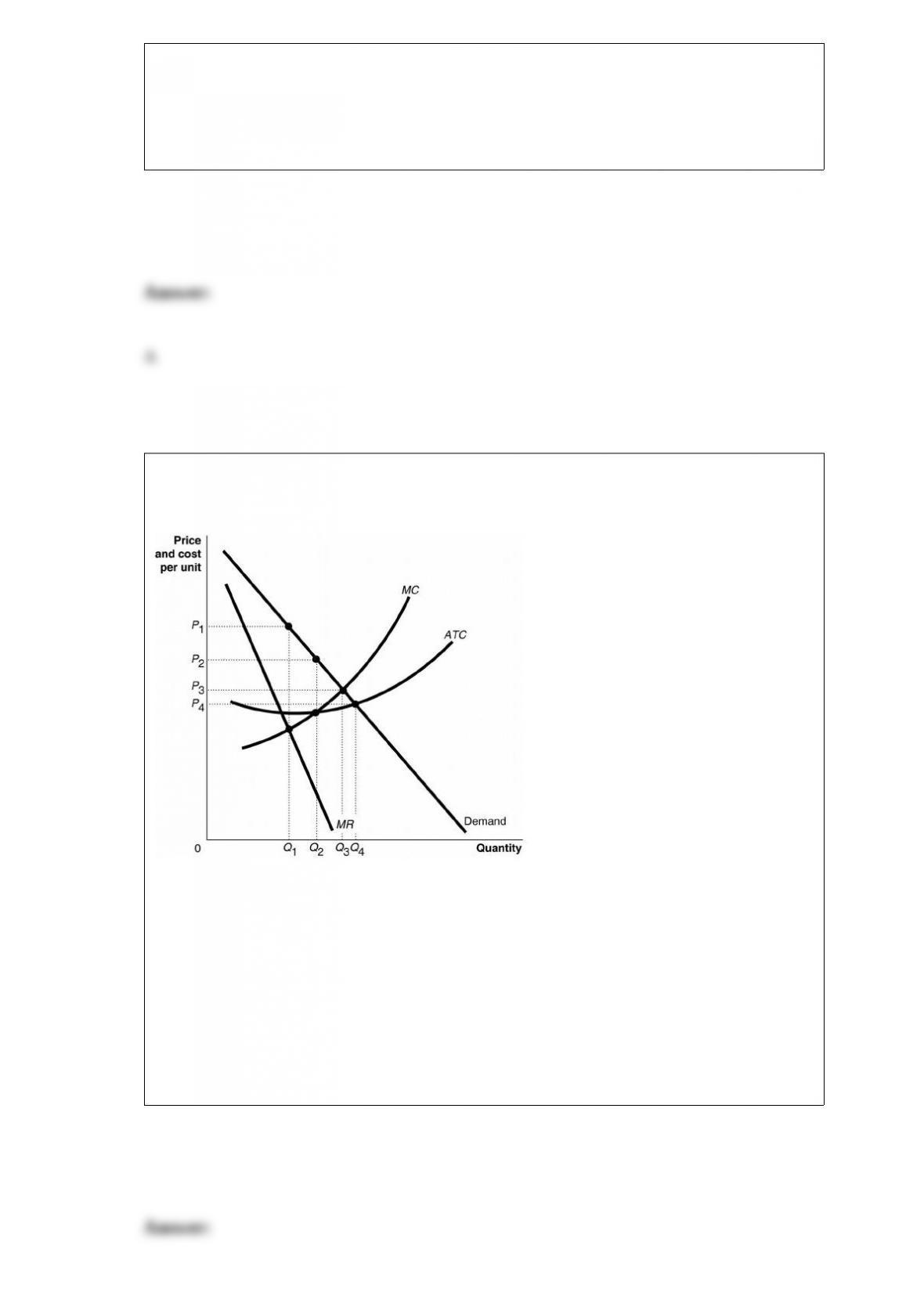
Figure 16-1
Refer to Figure 16-1. With perfect price discrimination, the firm will produce and sell
A) Q1 units.
B) Q2 units.
C) Q3 units.
D) Q4 units.
Which industry has the highest four-firm concentration ratio?
A) discount department stores
B) college bookstores
C) retail gasoline stations
D) cigarettes
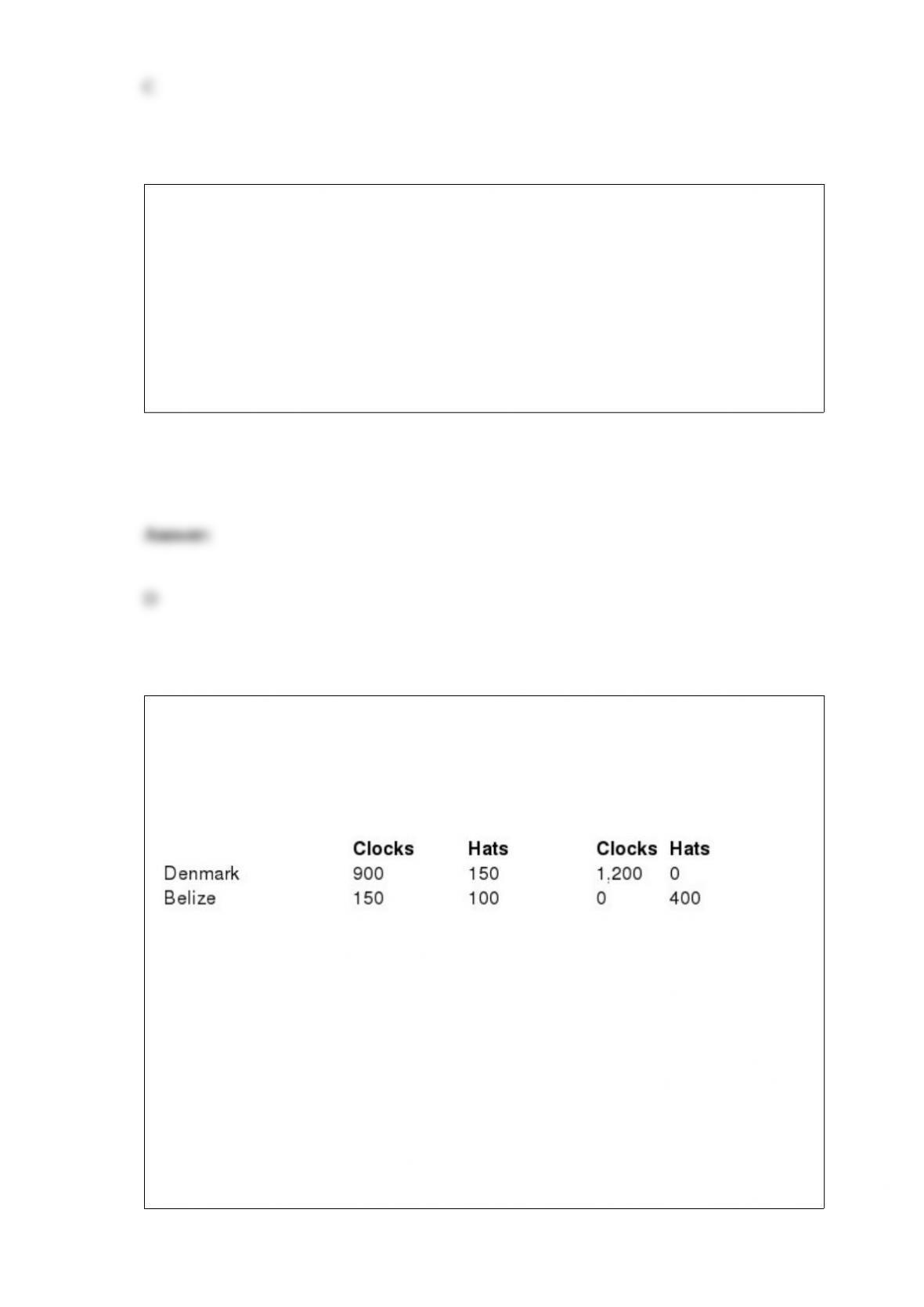
Table 9-6
Production and
Consumption Production
Without Trade With Trade
Denmark and Belize can produce both clocks and hats. Table 9-6 shows the production
and consumption quantities without trade, and the production numbers with trade.
Refer to Table 9-6. Which country has an absolute advantage in producing clocks?
A) Denmark
B) Belize
C) both countries
D) neither country

Table 9-3
Bryce and Tina are artisans who produce homemade candles and soap. Table 9-3 lists
the number of candles and bars of soap Bryce and Tina can each produce in one month.
Refer to Table 9-3. Select the statement that accurately interprets the data in the table.
A) Tina has a comparative advantage in making soap.
B) Bryce has a comparative advantage in making soap.
C) Tina has a comparative advantage in making candles and making soap.
D) Neither Bryce nor Tina has a comparative advantage in making soap.
Figure 12-5
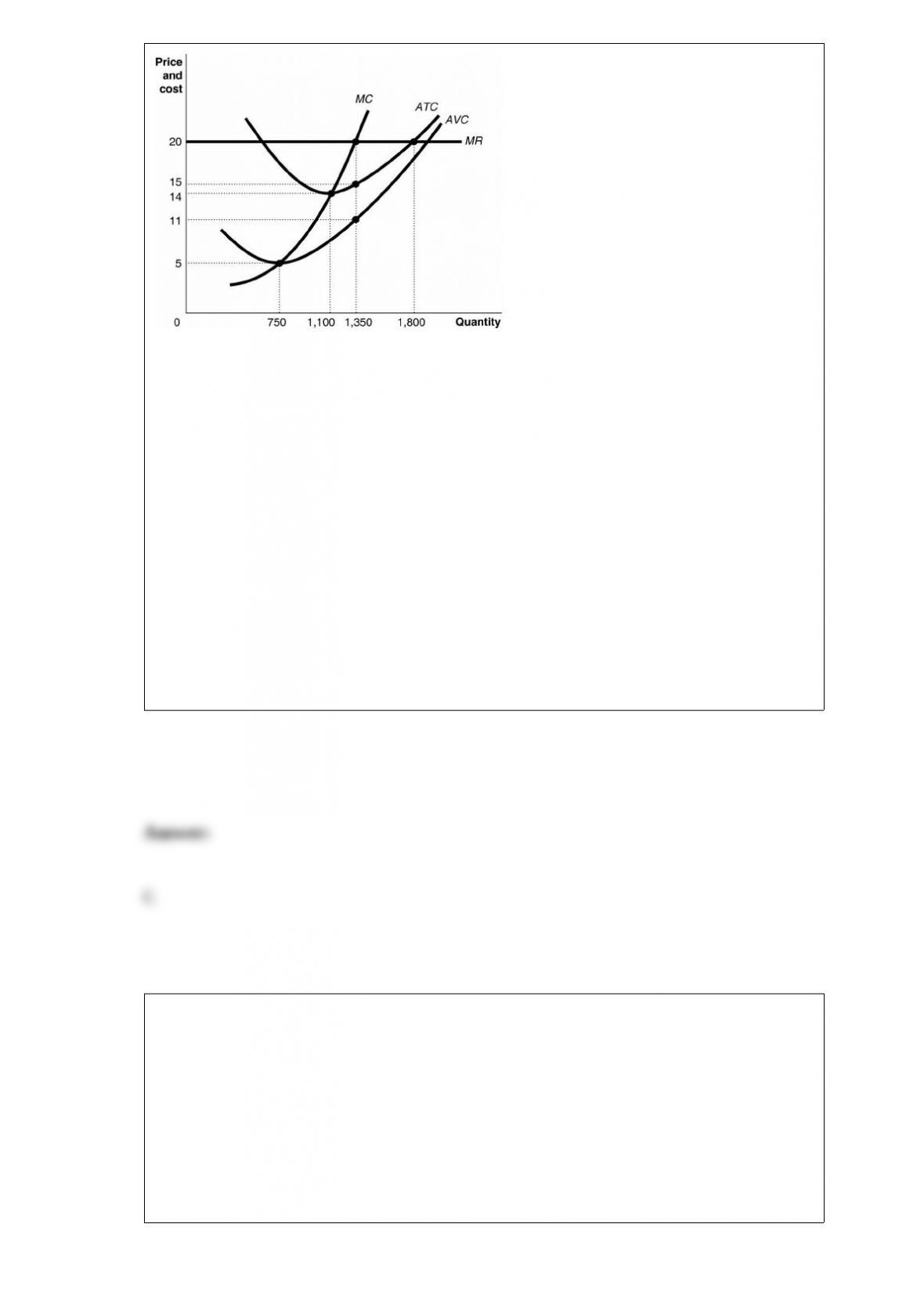
Figure 12-5 shows cost and demand curves facing a typical firm in a constant-cost,
perfectly competitive industry.
Refer to Figure 12-5. If the firm’s fixed cost increases by $1,000 due to a new
environmental regulation, what happens in the diagram above?
A) All the cost curves shift upward.
B) Only the average variable cost and average total cost curves shift upward; marginal
cost is not affected.
C) Only the average total cost curve shifts upward; the marginal cost and average
variable cost curves are not affected.
D) None of the curves shifts; only the fixed cost curve, which is not shown here, is
affected.
Which of the following generates productive efficiency?
A) competition among sellers
B) competition among buyers
C) government inspectors
D) government production rules and regulations

Article Summary
In 2012, Colorado and Washington legalized marijuana for recreational use, and one of
the major selling points in each state’s pro-marijuana campaign was the possibility of
generating millions of dollars in tax revenue from sales which could be used for
funding general education. The Colorado legislature was weighing a proposal to tax
marijuana at 30 percent, of which 15 percent would be a sales tax on consumers and 15
percent an excise tax on growers. Washington has set a tax rate of 44 percent on
consumers and 25 percent each for growers and retailers. Since the legalization of
marijuana is relatively new, projecting the economic impact of its sale is difficult,
leading to many questions as to the quantities that will be produced and sold and what
actual tax revenues will be generated.
Source: Elizabeth Dwoskin, “Colorado and Washington Try to Figure Out How to Tax
Marijuana,” Bloomberg Businessweek, April 26, 2013.
Refer to the Article Summary. Suppose the sale of marijuana is legalized in Florida,
and the state decides to charge a tax of $50 per ounce on each sale, with the state
claiming that retailers will bear the entire burden of this tax. Draw a graph illustrating
the situation where retail outlets would bear the entire tax burden of $50 per ounce of
marijuana. Explain what would need to be true about the demand for marijuana for
retailers to bear the entire burden of this tax, and if this would likely occur if marijuana
sales were legalized.
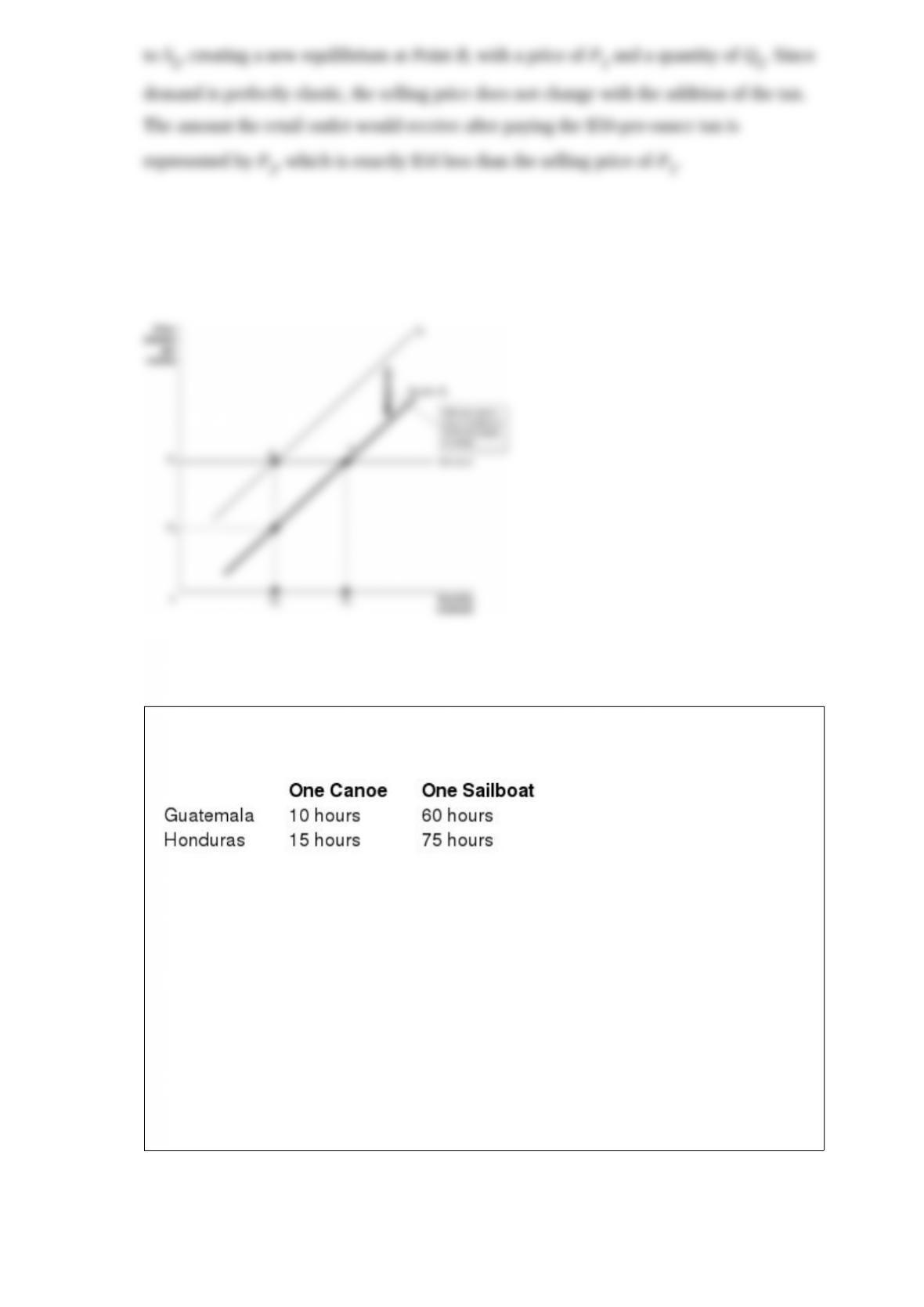
Table 2-9
Table 2-9 shows the number of labor hours required to produce a canoe and a sailboat in
Guatemala and Honduras.
Refer to Table 2-9. Guatemala has a comparative advantage in the production of
A) canoes.
B) sailboats.
C) both products.
D) neither product.

Which of the following characteristics is common to monopolistic competition and
perfect competition?
A) Firms produce identical products.
B) Entry barriers into the industry are low.
C) Each firm faces a downward -sloping demand curve.
D) Firms take market prices as given.
All but one of the following have been suggested by some economists as possible
consequences of path dependency and switching costs. Which of the following isnot a
possible consequence of path dependency and switching costs?
A) Consumers may get locked into using products with inferior technology.
B) market failure
C) diseconomies of scale
D) Government intervention may be necessary in affected markets in order to improve
economic efficiency.

When plasma television sets were first introduced prices were high and few firms were
in the market. Later, economic profits attracted new firms and the price of plasma
televisions fell. This example illustrates
A) a decreasing-cost industry.
B) that consumers receive this new technology “free of charge” in the sense that they
only have to pay a price for plasma televisions equal to the lowest production cost.
C) an industry with a low minimum efficient scale.
D) how fickle consumer demands are.
An asset is
A) anything of value owned by a person or a firm.
B) a payment by a corporation to its shareholders.
C) a nonmonetary opportunity cost.
D) anything owed by a person or a firm.
Hewlett-Packard will not raise the prices of its personal computers without first
considering how Dell might respond. This is evidence of

A) interdependence.
B) collusion.
C) cutthroat competition.
D) price fixing.
There is much evidence to suggest that airlines are more likely to match price cuts than
price increases. Which of the following best explains this evidence?
A) The law of demand which states that an increase in price leads to a decrease in
quantity demanded.
B) No one airline wants to be the first to renege on a tacit collusive agreement in which
all airlines implicitly agree to match price cuts but not price increases.
C) An airline fears that if it does not match a price cut, its sales may fall considerably
but if it does not match a price increase, it will be able to attract customers away from
its rivals.
D) Airlines have different costs of production and therefore it is more difficult to agree
on a price increase than on a price decrease.
Holding everything else constant, the absolute value of the price elasticity of demand
for Saucony tennis shoes is ________ the price elasticity of demand for tennis shoes.

A) less than
B) equal to
C) twice as great as
D) greater than
A monopolistically competitive firm that earns an accounting profit in the short run
A) must also earn an economic profit in the short run.
B) does not earn enough to earn an economic profit in the short run.
C) could earn an economic profit, break even or suffer an economic loss in the short
run.
D) could earn an economic profit or break even, but could not suffer an economic loss
in the short run.
If you expect the economy is going to boom and average income in the economy will
rise in the foreseeable future, the type of firm that would be able to increase its sales if
your expectations are met is
A) one that sells an inferior good.

B) one that sells a necessity good.
C) one that sells a luxury good.
D) one that sells a price inelastic good.
Academic book publishers hire editors, designers, and production and marketing
managers who help prepare books for publication. Because these employees work on
several books simultaneously, the number of people the company hires will not go up
and down with the quantity of books the company publishes during any particular year.
The salaries and benefits of people in these job categories will be included in
A) fixed cost and marginal cost but not variable cost.
B) fixed cost but not variable cost and total cost.
C) marginal cost and total cost but not fixed cost.
D) fixed cost and total cost but not variable cost.
In economics, the term ________ means “additional” or “extra.”
A) allocative
B) marginal
C) equity

D) optimal
The largest source of tax revenue for state and local governments in the United States in
2012 was
A) sales taxes.
B) the corporate income tax.
C) the property tax.
D) the individual income tax.