If, as your taxable income decreases, you pay a smaller percentage of your taxable
income in taxes, then the tax is
A) regressive.
B) proportional.
C) progressive.
D) unfair.
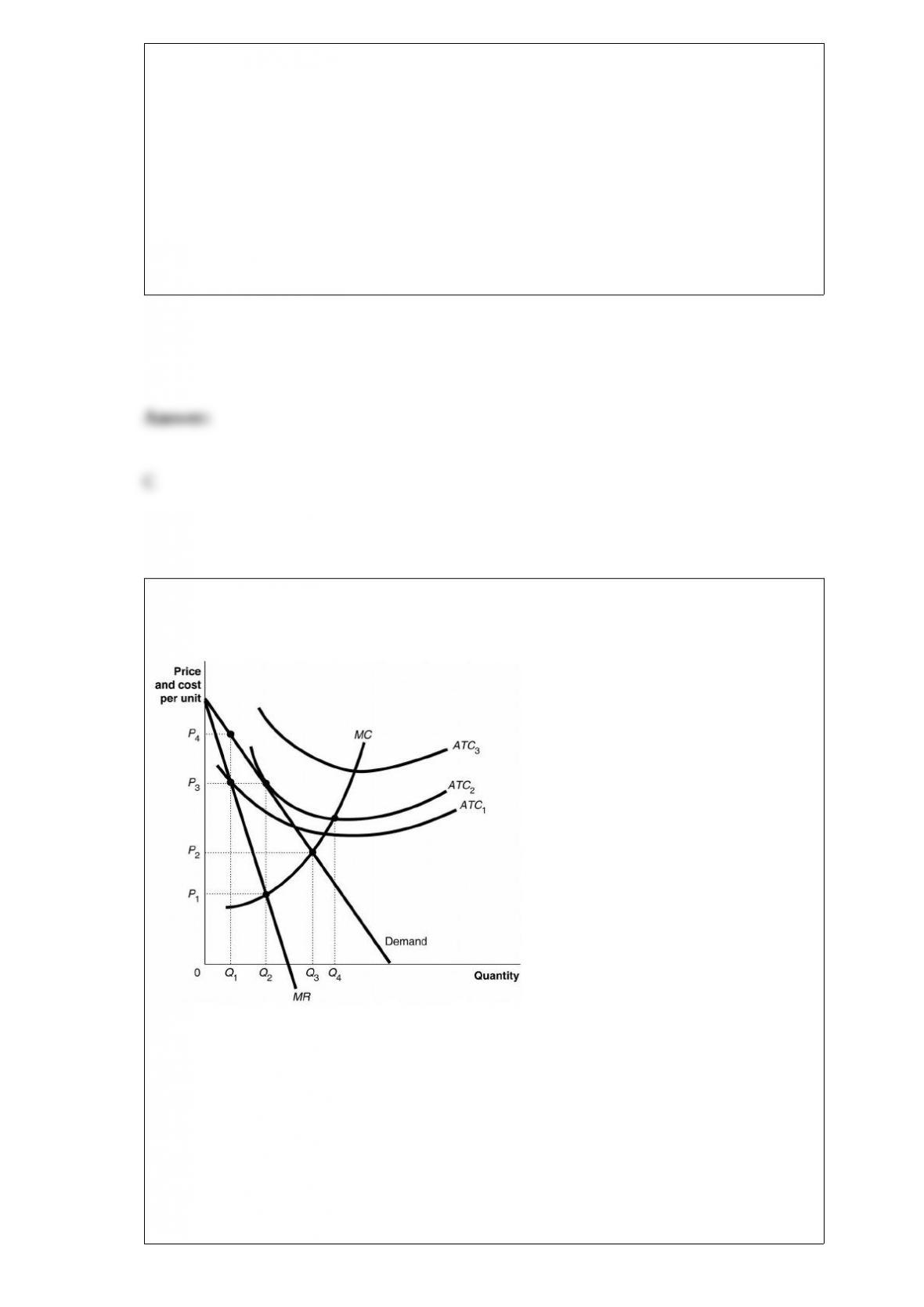
Figure 15-2
Figure 15-2 above shows the demand and cost curves facing a monopolist.
Refer to Figure 15-2. The firm’s profit-maximizing price is
A) P1.
B) P2.
C) P3.
D) P4.
With an optimal two-part tariff
A) consumer surplus equals producer surplus.
B) all consumer surplus is transformed into profit.
C) consumers maximize consumer surplus.
D) the firm earns zero profit.
To maintain a monopoly, a firm must have
A) a perfectly inelastic demand.
B) an insurmountable barrier to entry.
C) marginal revenue equal to demand.
D) few competitors.

Article Summary
Seeking ways to improve education, Garrett Johnson has organized technology
competitions called hackathons where participants such as students, teachers, and
engineers build applications designed to improve secondary and higher education
systems. These applications can include ways for teachers to improve skills, more
productive study habits for students, improving school safety, or any number of ideas
related to education. Several hackathons have been planned for around the country,
including a virtual hackathon, entry is free, and each contest will award $5,000 in prizes
to the winners.
Source: Nancy Dahlberg, “Hackathon tackling education reform this week,” Miami
Herald, October 7, 2013.
Refer to the Article Summary. The article addresses education reform by way of newly
designed applications. If any of these apps lead to a more skilled and better trained
public, the economy would experience
A) an increase in human capital.
B) an increase in the supply of labor.
C) an increase in comparable worth.
D) a decrease in compensating differentials.
A perfectly competitive wheat farmer in a constant-cost industry produces 3,000
bushels of wheat at a total cost of $36,000. The prevailing market price is $15. What
will happen to the market price of wheat in the long run?
A) The price remains constant at $15.

B) The price falls to $12.
C) The price rises above $15.
D) There is insufficient information to answer the question.
Studies show that the income elasticity of demand for wine is 5.03 and the income
elasticity of demand for spirits is 1.21. This indicates that
A) wine and spirits are luxury goods.
B) wine is a luxury good and spirits are inferior goods.
C) wine and spirits are highly price elastic.
D) wine is a luxury good and spirits are necessities.
Suppose the per-unit production cost of a book is $4.00 and the retail price is $32. If the
book publisher sells books to a bookstore at a 40 percent discount, what is the amount
of the publisher’s markup per book? Assume that bookstores sell books at the retail
price.
A) $12.80
B) $15.20
C) $19.20
D) $21.60
Giffen goods
A) are theoretical and have never been discovered in the real world.
B) have not existed since prior to the Industrial Revolution.
C) were proven to exist in the 1890s by Sir Robert Giffen.
D) were not shown to actually exist until 2006.
The U.S. Congress has given two government entities the authority to police mergers.
These two entities are
A) the antitrust division of the Department of State and the Securities and Exchange
Commission.
B) the Federal Trade Commission and the Internal Revenue Service.
C) the Antitrust Division of the U.S. Department of Justice and the Council of
Economic Advisors.
D) the Federal Trade Commission and the Antitrust Division of the U.S. Department of
Justice.

A monopolistically competitive firm chooses
A) both the quantity of output to produce and the price at which it will sell its output.
B) the price of the product it sells but market forces determine the quantity it will be
able to sell.
C) the quantity of output to produce but the price of the product it sells is determined
collectively by all firms in the industry.
D) the price of the product it sells but the quantity of output to produce is agreed upon
by all firms in the industry.
When the demand for a product is more elastic than the supply
A) consumers pay the majority of the tax on the product.
B) consumers pay the entire tax on the product.
C) firms pay the majority of the tax on the product.
D) firms pay the entire tax on the product.
If at a price of $24, Octavia sells 36 home-grown orchids and at $30 she sells 24
home-grown orchids, the demand for her orchids is
A) elastic.
B) inelastic.
C) unit-elastic.
D) perfectly elastic.
What is the trade-off that consumers face when buying the product of a
monopolistically competitive firm?
A) Consumers pay higher prices but receive better quality goods compared to the output
of perfectly competitive firms.
B) Consumers pay a price greater than marginal cost, but have the luxury of choices
more suited to their tastes.
C) Consumers pay higher prices but the products are produced by highly efficient firms.
D) Consumers pay lower prices but have fewer choices.
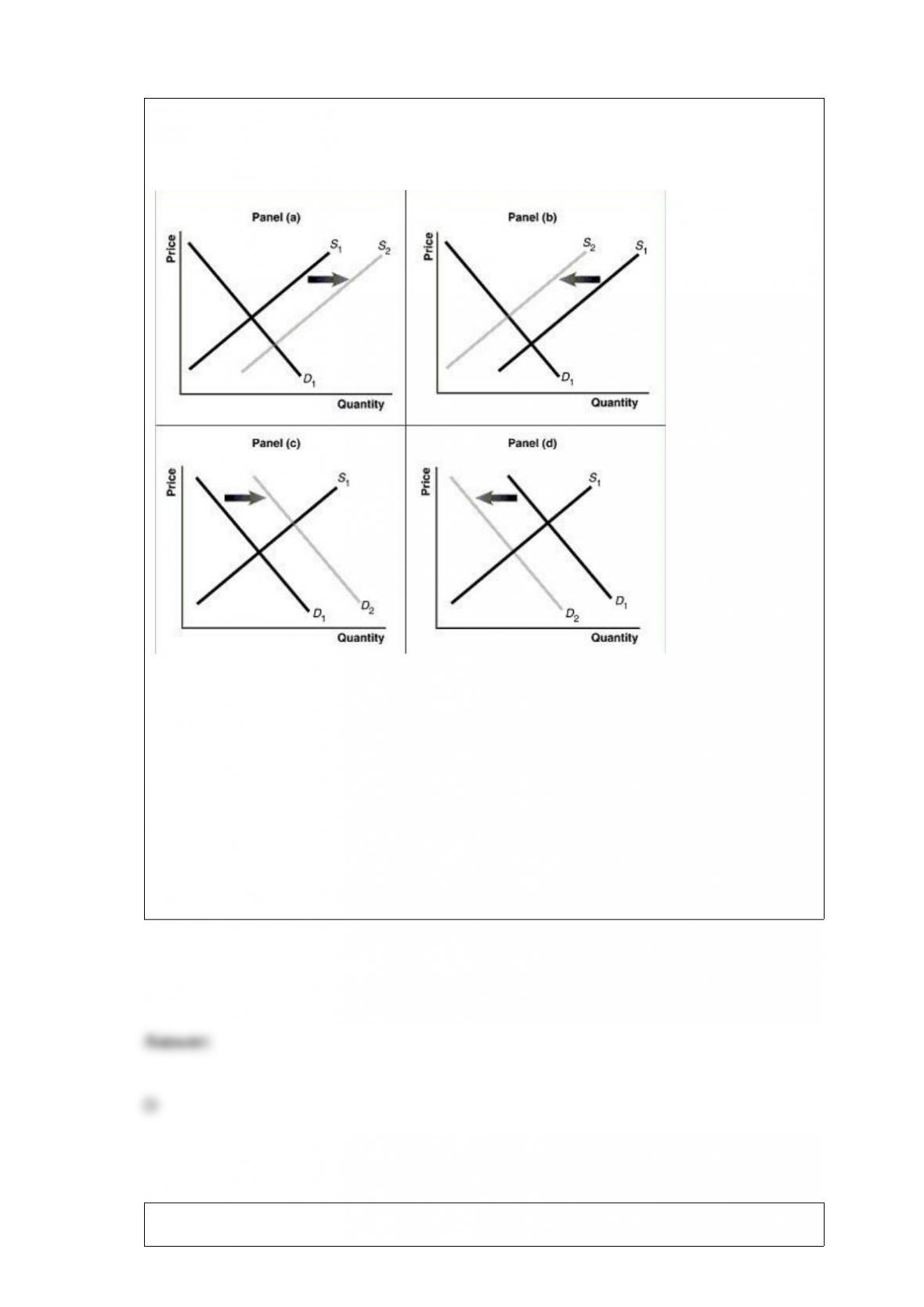
Figure 3-7
Refer to Figure 3-7. Assume that the graphs in this figure represent the demand and
supply curves for rice. What happens in this market if buyers expect the price of rice to
fall?
A) Panel (a)
B) Panel (b)
C) Panel (c)
D) Panel (d)
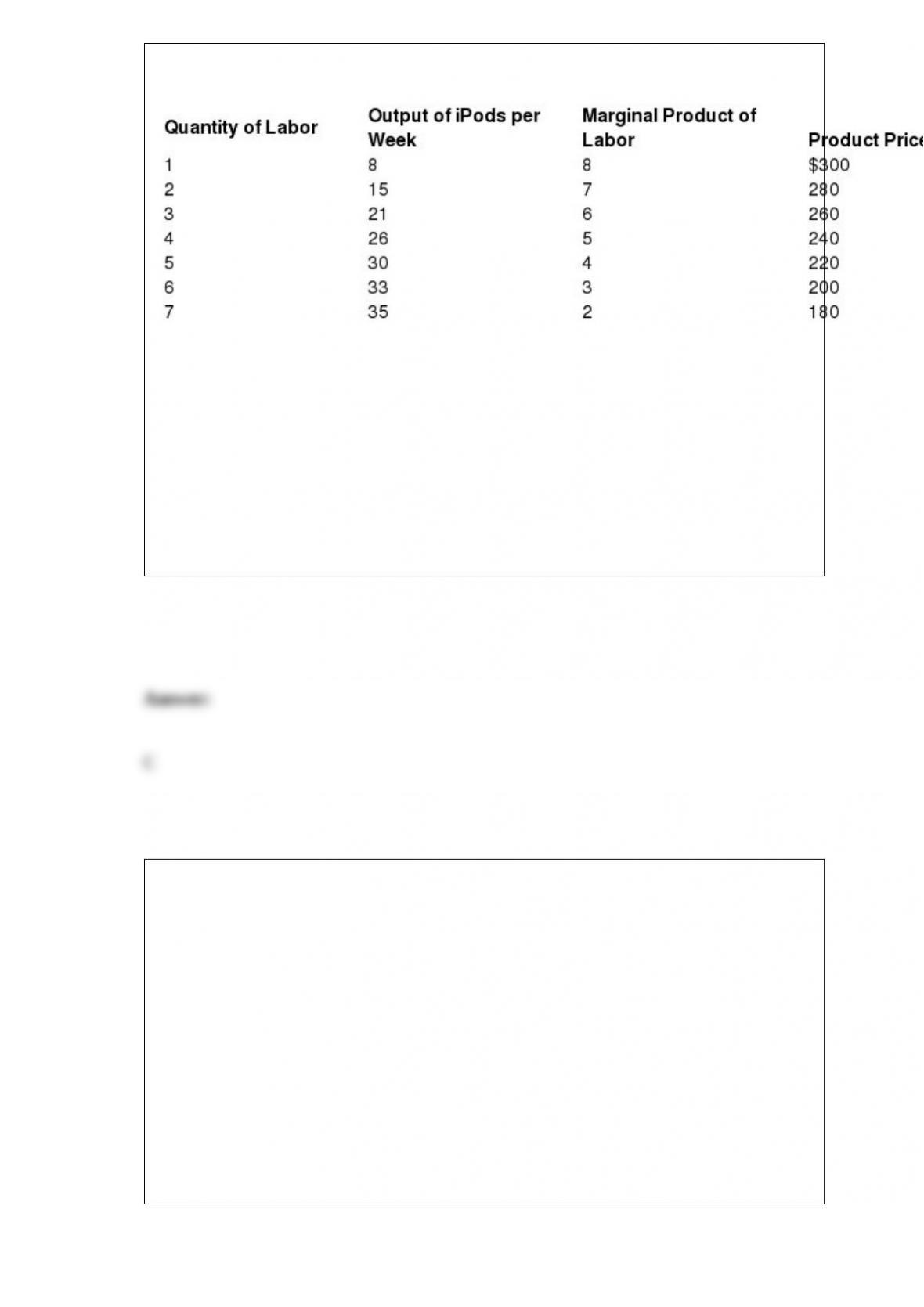
Table 17-2
Refer to Table 17-2. The marginal revenue product of labor from the third unit of labor
is
A) $5,460.
B) $1,560.
C) $1,260.
D) $780.
What is logrolling?
A) a situation where a policymaker votes to approve a bill in exchange for favorable
votes from his colleagues on other bills
B) a situation where policymakers transfer resources from those voters who are unlikely
to have a huge impact on the political outcome to those who contribute to political
campaigns
C) a situation where a policymaker accepts bribes to prevent proposed legislation from
coming to a vote
D) a situation where a policymaker gets the government to fund a non-essential project
benefiting her family members
When there few close substitutes available for a good, demand tends to be
A) perfectly inelastic.
B) perfectly elastic.
C) relatively inelastic.
D) relatively elastic.
Which of the following is an experiment which tests whether fairness is important in
consumer decision making?
A) the fair trade principle
B) the ultimatum game
C) the preferential treatment game
D) the behavioral experiment
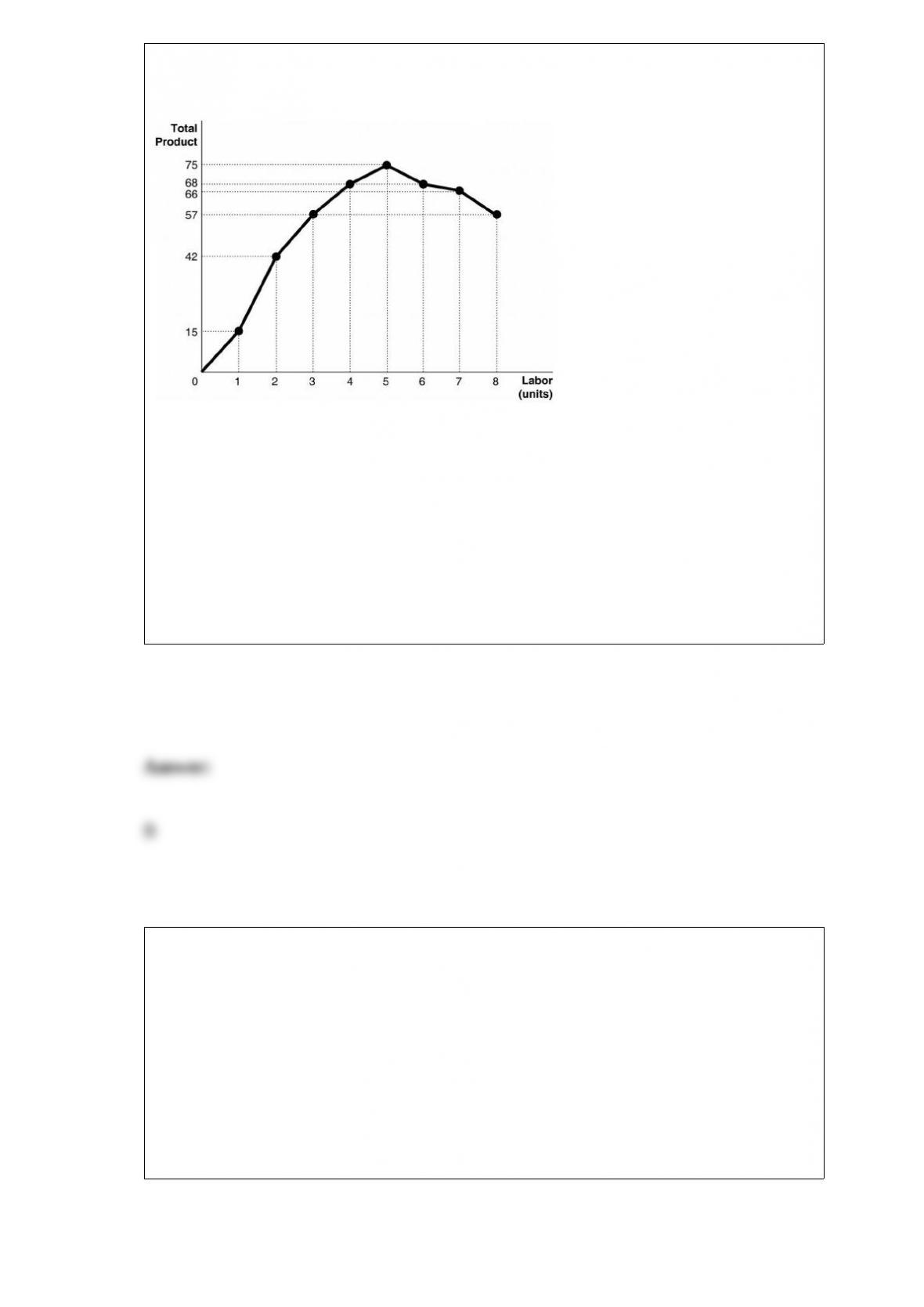
Figure 11-1
Refer to Figure 11-1. In a diagram that shows the marginal product of labor on the
vertical axis and labor on the horizontal axis, the marginal product curve
A) never intersects the horizontal axis.
B) intersects the horizontal axis at a point corresponding to the 5th worker.
C) intersects the horizontal axis at a point corresponding to the 6th worker.
D) intersects the horizontal axis at a point corresponding to the 8th worker.
When the price of summer tank tops falls and you buy more of them because they are
relatively less expensive, this is called
A) the substitution effect.
B) the income effect.
C) the deadweight loss effect.
D) the elasticity effect.
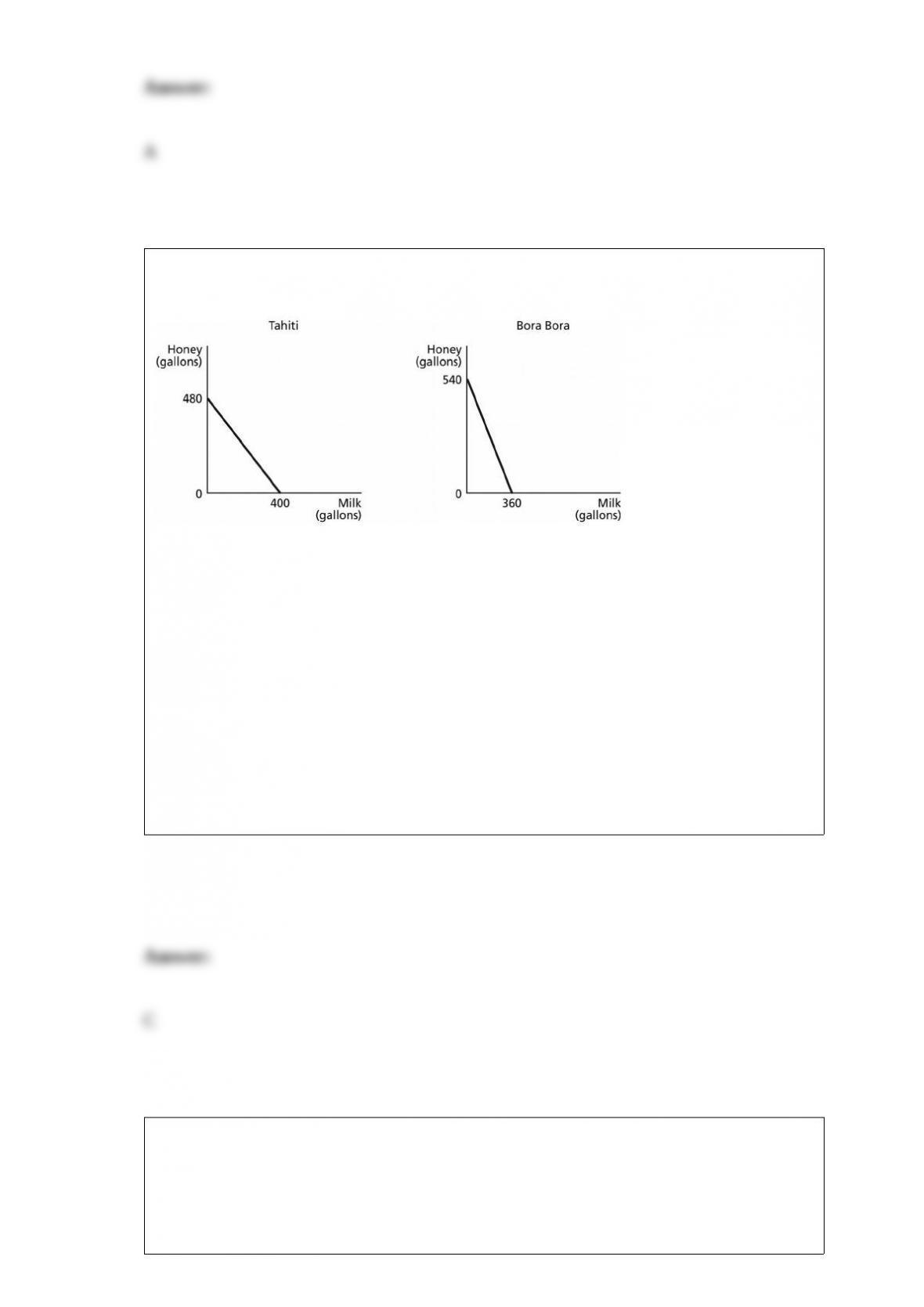
Figure 2-10
Figure 2-10 shows the production possibilities frontiers for Tahiti and Bora Bora. Each
country produces two goods, milk and honey.
Refer to Figure 2-10. What is the opportunity cost of producing one gallon of milk in
Tahiti?
A) 1/2 gallon of honey
B) 5/6 gallon of honey
C) 1.2 gallons of honey
D) 1.5 gallons of honey
Marginal cost is the
A) change in average cost when an additional unit of output is produced.
B) the additional output when total cost is increased by one dollar.
C) additional cost of producing an additional unit of output.
D) change in the price of inputs if a firm buys more inputs to produce an additional unit
of output.
What is the incentive for a firm to join a cartel?
A) to be able to earn profits in the long run but not in the short run
B) to be able to earn larger profits than if it was not part of the cartel
C) to completely insulate itself from competition
D) to produce a larger amount of output than if it was not part of the cartel
Which of the following is not a characteristic of oligopoly?
A) the ability to influence price
B) a small number of firms
C) low barriers to entry
D) interdependent firms
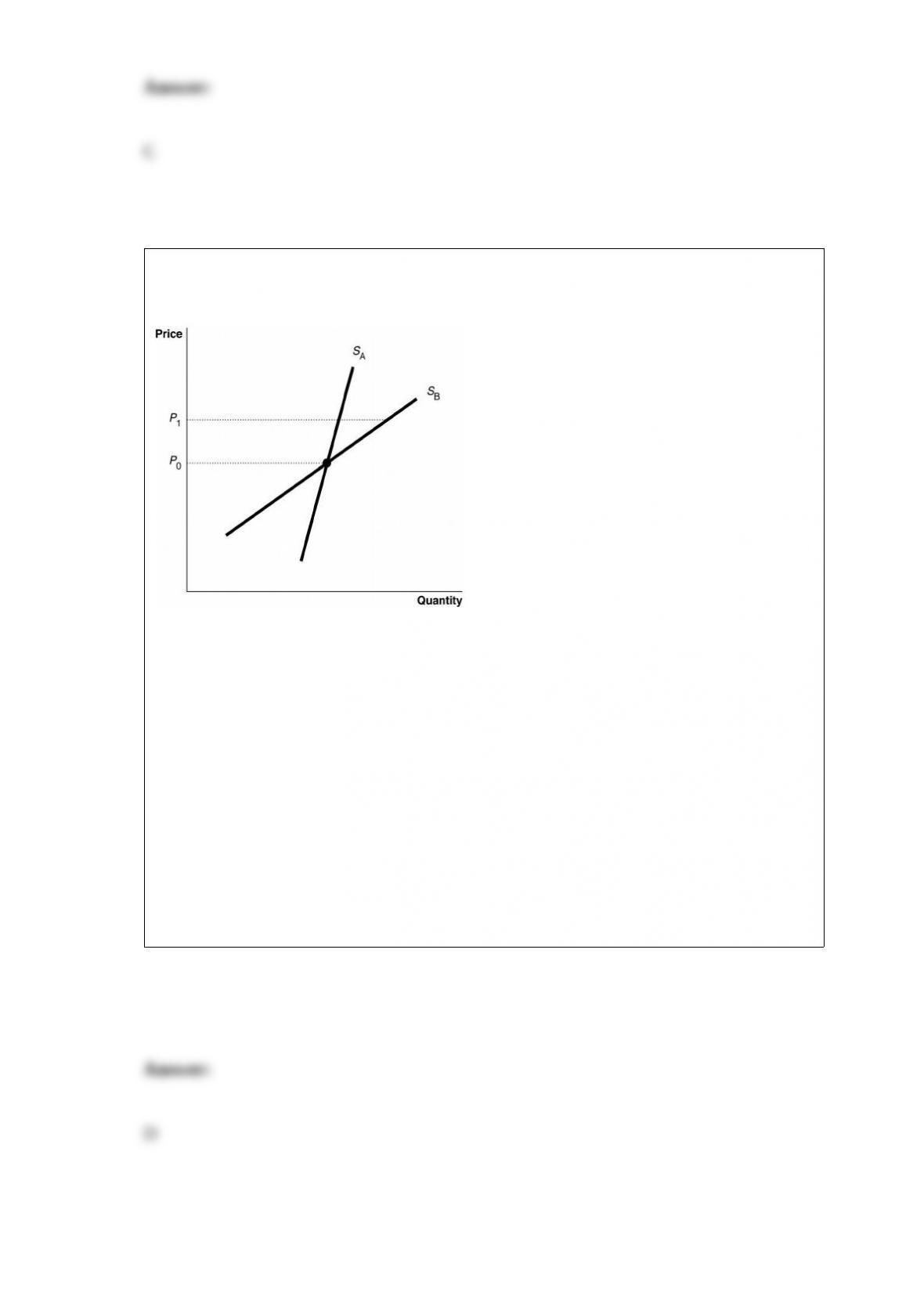
Figure 6-12
Refer to Figure 6-12. Suppose the diagram shows the supply curves for a product in the
short run and in the long run. Which supply curve represents supply in the short run and
which curve represents supply in the long run?
A) SB represents supply in the short run and SA represents supply in the long run.
B) Either SA or SB could represent supply in the short run; in the long run the supply
curve must be a vertical line.
C) Either SA or SB could represent supply in the long run; in the short run the supply
curve must be a horizontal line.
D) SA represents supply in the short run and SB represents supply in the long run.

Standard economic theory asserts that sunk costs are irrelevant in making economic
decisions, yet studies conducted by behavioral economists reveal that sunk costs often
affect economic decisions. Which of the following could explain this observation?
A) People measure the value of a good in terms of its purchase price.
B) Even though sunk costs cannot be recovered, it has been incurred and therefore
should be treated as part of the product’s value.
C) If consumers maximize their utility, it makes sense to consider the full purchase
price of a product in their consumption decisions.
D) Sunk costs have a higher opportunity cost than costs that can be recovered.
Sheldon Cleaver commented on the difficulty people have in overcoming poverty in the
United States: “Most people whose incomes fall below the poverty line have difficulty
pulling themselves above the line in future years. In this sense, poverty becomes a
vicious cycle. I believe the psychological damage households face when they are
branded with the ‘poverty’ label in our society is a major factor in their remaining in
poverty. Despair is a major reason why the percentage of people with incomes that lie
below the poverty line never falls below 10 percent.” Which of the following correctly
evaluates Cleaver’s statement?
A) Cleaver is correct. Economists often fail to take into account psychological factors
when they analyze poverty and the distribution of income in the United States. Policies
must take such factors into account if we are to make progress in eliminating poverty.
B) Cleaver is correct when he notes that poverty is a chronic problem. The best way to
reduce poverty is to force the poor to become better educated so that they can work
their way out of poverty.
C) Cleaver is correct, but he is looking at the wrong statistic. The official poverty line
understates the true degree of poverty in the United States.
D) Cleaver assumes that all those with incomes below the poverty line in one year
remain in poverty in subsequent years. In fact, research has shown that the number of
people who remain in poverty for many years is much smaller than the number who are
in poverty during any one year.
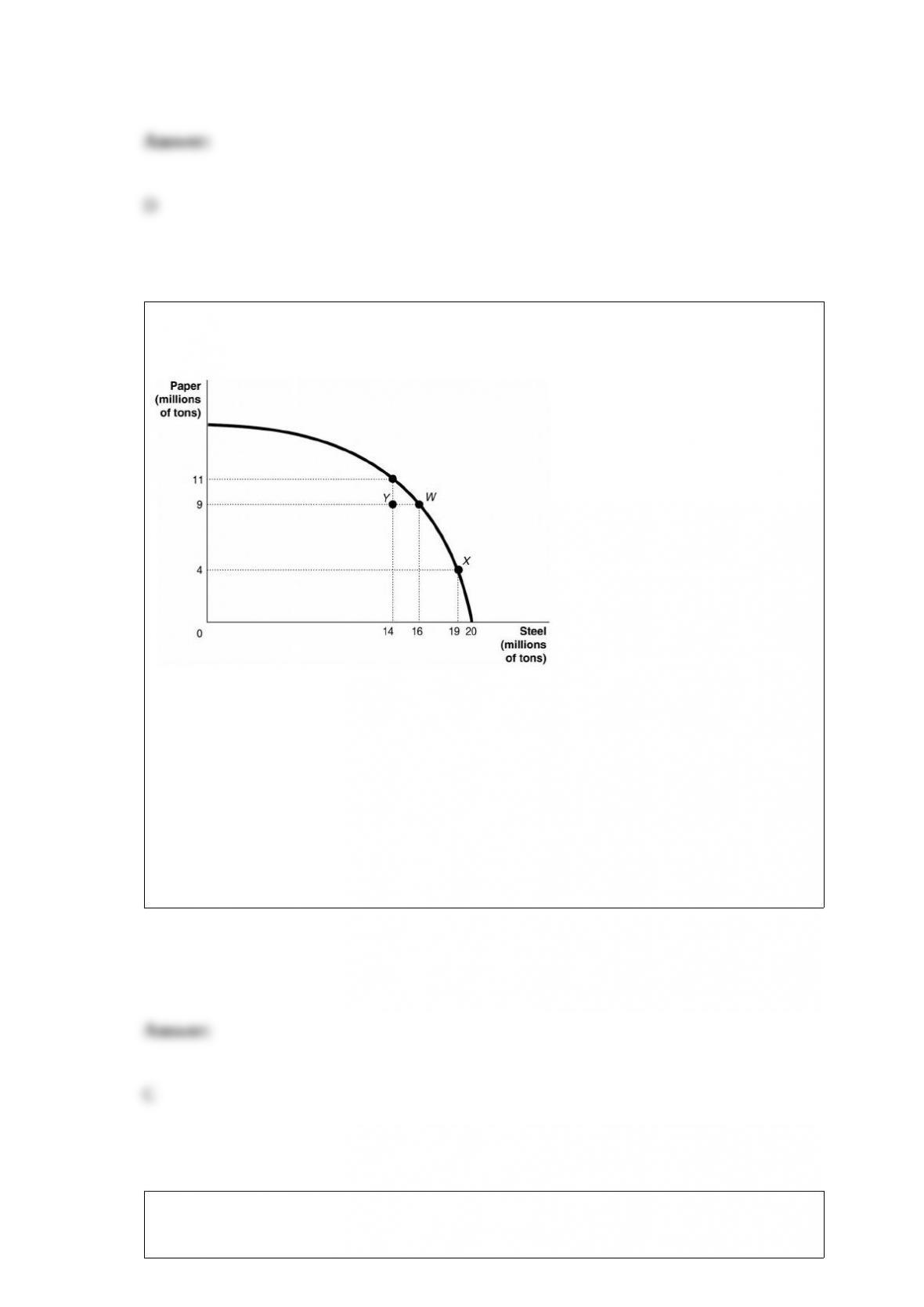
Figure 2-5
Refer to Figure 2-5. If the economy is currently producing at point W, what is the
opportunity cost of moving to point X?
A) 3 million tons of steel
B) 19 million tons of steel
C) 5 million tons of paper
D) 9 million tons of paper
Economists assume that individuals
A) behave in unpredictable ways.
B) will never take actions to help others.
C) prefer to live in a society that values fairness above all else.
D) are rational and respond to incentives.
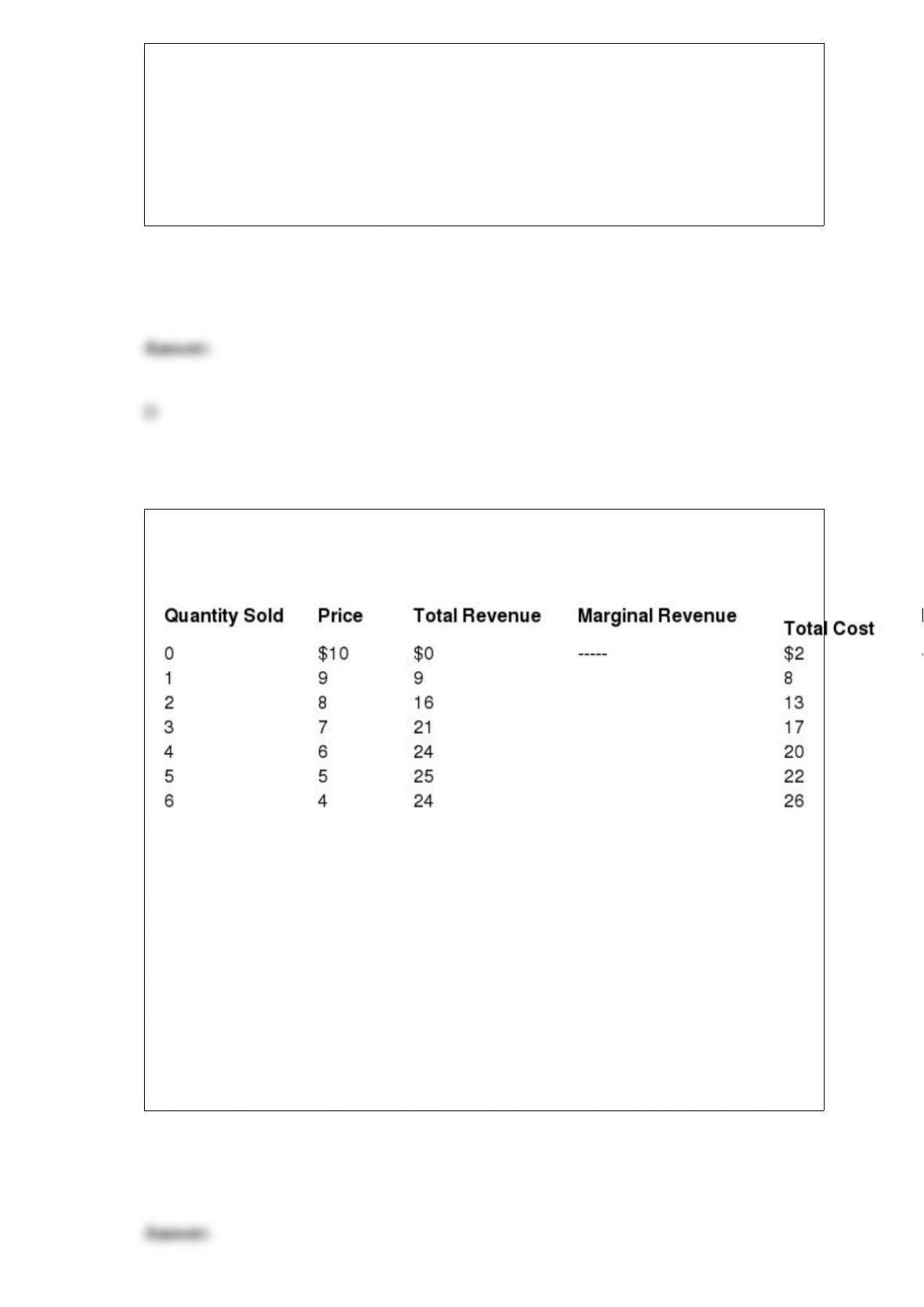
Table 13-4
Table 13-4 lists estimated revenues and costs (per week) for plastic vials (100 vials per
box) for the Victoria Biological Supplies Company. Victoria sells plastic vials to
university and private research laboratories.
Refer to Table 13-4. Victoria’s profit-maximizing output is where
A) total profit equals $3.
B) marginal revenue and marginal cost both equal $4.
C) marginal revenue and marginal cost both equal $3.
D) marginal cost is at its minimum value.

If a restaurant was a natural monopoly, dividing the restaurant equally into two separate
restaurants would
A) decrease marginal cost.
B) raise average total cost.
C) increase total revenue.
D) make marginal revenue less elastic.
All of the following cost curves are U-shaped except one. Which curve is not
U-shaped?
A) the marginal cost curve
B) the average fixed cost curve
C) the average total cost curve
D) the average variable cost curve