
Max Shreck, an accountant, quit his $80,000-a-year job and bought an existing tattoo
parlor from its previous owner, Sylvia Sidney. The lease has five years remaining and
requires a monthly payment of $4,000. Max’s explicit cost amounts to $3,000 per month
more than his revenue. Should Max continue operating his business?
A) Max’s explicit cost exceeds his total revenue. He should shut down his tattoo parlor.
B) Max should continue to run the tattoo parlor until his lease runs out.
C) If Max’s marginal revenue is greater than or equal to his marginal cost, then he
should stay in business.
D) This cannot be determined without information on his revenue.
The firm’s gain in profit from hiring another worker is
A) the marginal revenue product of the extra worker.
B) the difference between marginal revenue product and the wage of the worker.
C) the extra output of the extra worker.
D) the reduction in costs from hiring another worker.
Arbitrage refers to the act of
A) resolving a dispute in front of an arbitrator instead of a court of law.

B) buying a product in one market at a low price and reselling in another market at a
higher price.
C) trading in the foreign exchange market.
D) suing a producer for illegal business practices.
An individual seller in perfect competition will not sell at a price lower than the market
price because
A) demand for the product will exceed supply.
B) the seller would start a price war.
C) the seller can sell any quantity she wants at the prevailing market price.
D) demand is perfectly inelastic.
If a buyer in an economic transaction has more information than the seller, the buyer
benefits at the expense of the seller. This phenomenon is due to
A) moral hazard.
B) adverse selection.
C) economically irrational behavior.

D) gains from trade.
Which of the following would result in a positive externality?
A) A local government establishes a price ceiling on rental apartments.
B) An electric utility burns coal that causes acid rain.
C) Medical research results in a cure for malaria.
D) McDonald’s adds new fat-free items to its menu.
Harvey Rabbitt pays for monthly cable TV service. Last week the cable company
informed Harvey that his monthly cable price would go down because the city council
has granted approval for three new cable companies to service his area. How is the
market for cable TV services affected by this?
A) There is an increase in the supply of cable TV service.
B) There is a decrease in the demand for cable TV service.
C) There is a decrease in the quantity of cable TV service supplied.
D) There is a decrease in the supply of cable TV service.

Bill owns “Bill’s Home of Blues” a store that specializes in selling CDs and DVDs of
blues musicians of the 1960s and 1970s. Bill took out a loan from his bank to pay for
his store and its initial inventory. Bill pays the bank $900 per week for his loan. The
$900 bank payment
A) is a long-run implicit cost.
B) is a fixed cost.
C) is a short-run implicit cost.
D) is a variable cost.
Behavioral economics refers to the study of situations
A) where consumers and firms appear to make choices that are appropriate to reach
their goals.
B) where consumers and firms appear to value fairness when they make choices.
C) where consumers and firms disobey the laws of demand and supply.
D) where consumers and firms do not appear to be making choices that are
economically rational.
Which of the following is not a shortcoming of the concentration ratio as a measure of
the extent of competition in an industry?
A) Concentration ratios do not include sales in the United States by foreign firms.
B) Concentration ratios are calculated for the national market, even though the
competition in some industries is mainly local.
C) Concentration ratios assign weights to only the four largest firms in an industry.
D) Concentration ratios do not address the fact that competition sometimes exists
between firms in different industries.
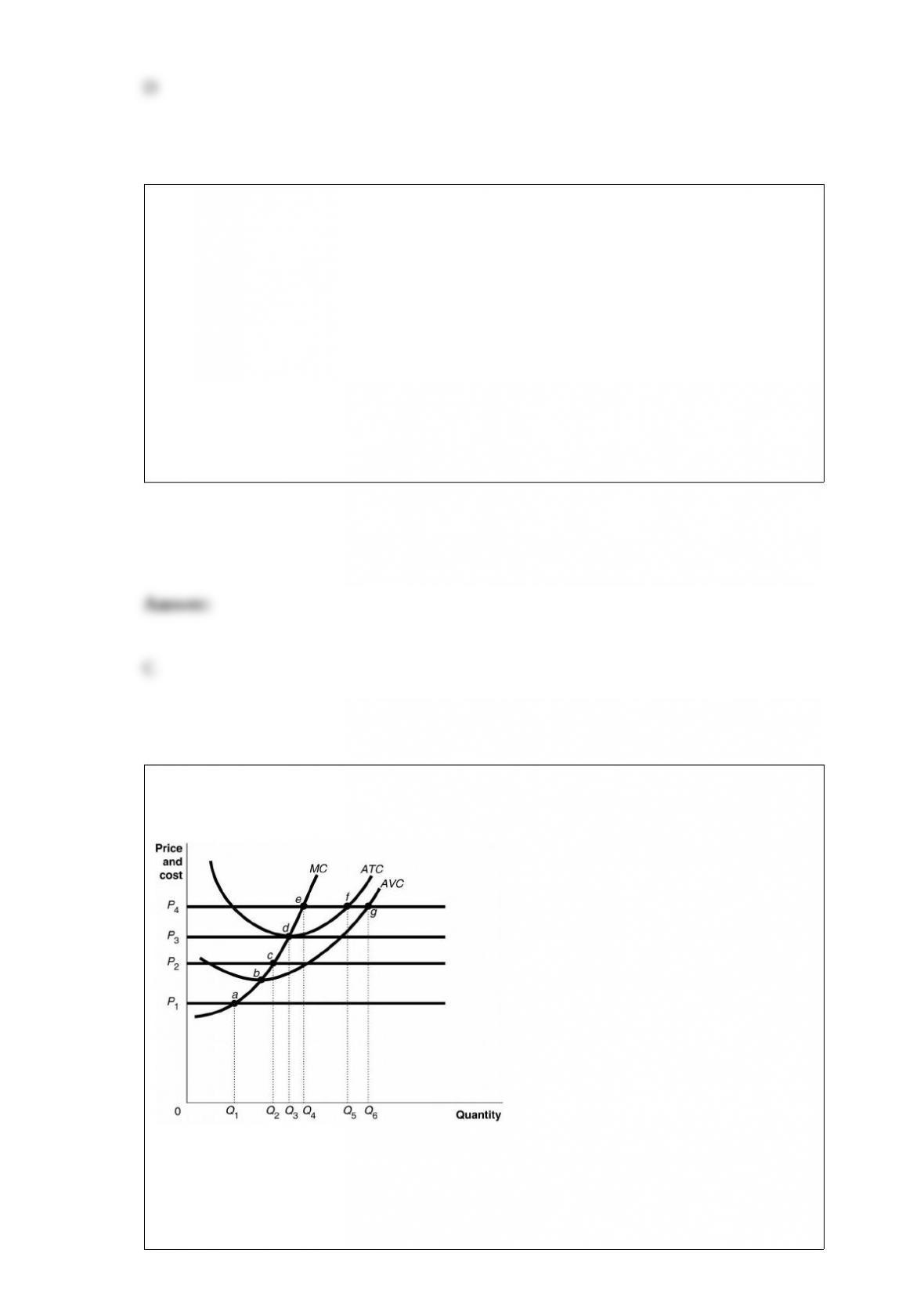
Figure 12-9
Figure 12-9 shows cost and demand curves facing a profit-maximizing, perfectly
competitive firm.
Refer to Figure 12-9. Identify the short-run shut down point for the firm.
A) a
B) b
C) c
D) d
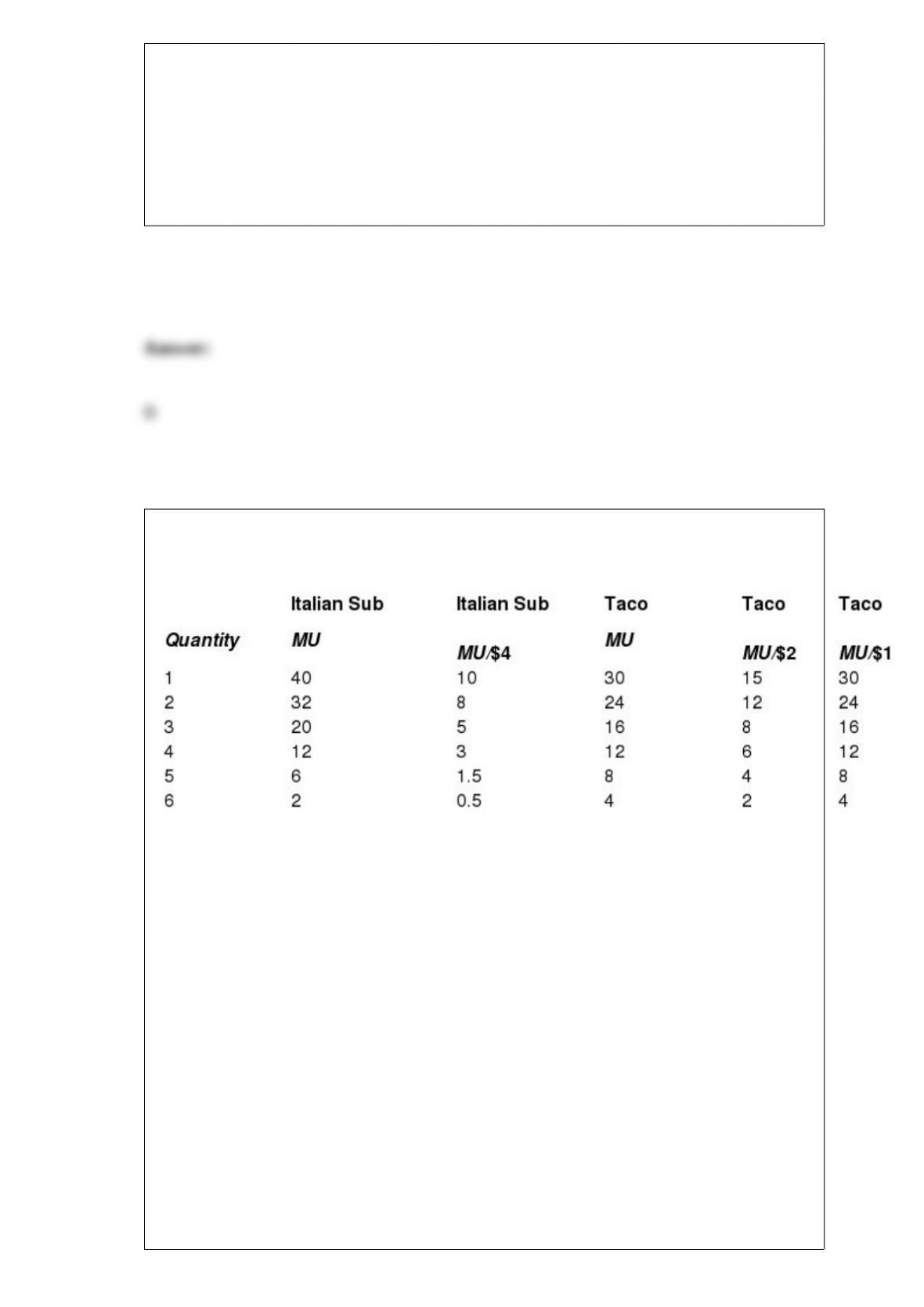
Table 10-5
Refer to Table 10-5, which lists the values of Harry Taber’s marginal utility and
marginal utility per dollar for Italian submarine (sub) sandwiches and tacos. Assume
that the price of the sub sandwiches is $4 and the price of tacos is $2. When Harry’s
income is $14 he buys two Italian sub sandwiches and three tacos. The last column lists
the values of the marginal utility per dollar for tacos when the price of tacos decreases
to $1. Complete this statement: As a result of the change in price
A) Harry’s purchasing power has increased. He will reduce his consumption of tacos so
he can buy one more sub. This is an example of the substitution effect of a price change.
B) Harry’s purchasing power has increased. If tacos are a normal good for Harry he will
buy fewer tacos. This is an example of the income effect of a price change.
C) Harry’s purchasing power has increased. If tacos are a normal good for Harry he will
buy more tacos. This is an example of the income effect of a price change.
D) Harry’s purchasing power has increased. Harry buys fewer tacos. This is an example
of the substitution effect of a price change
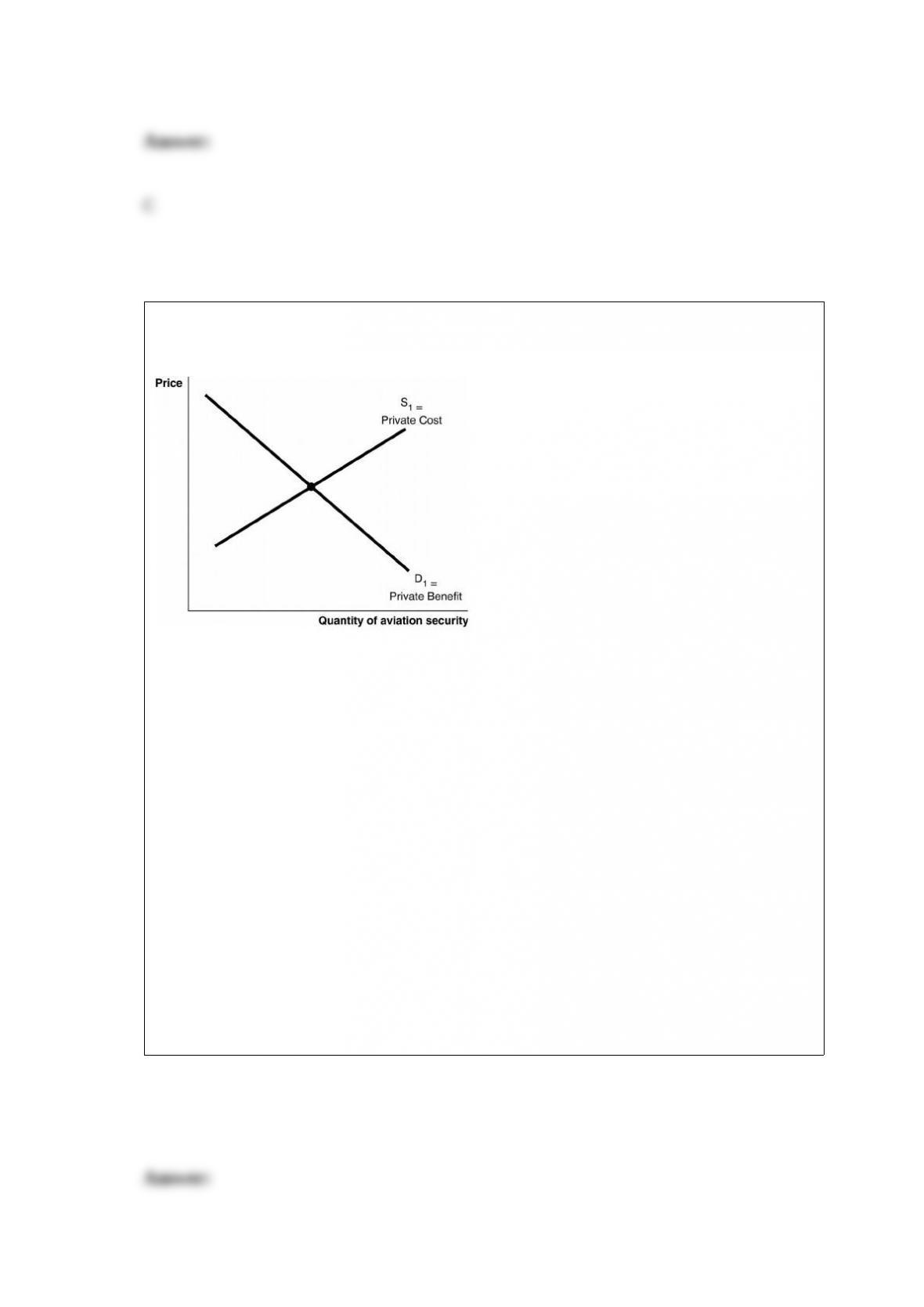
Figure 5-14
Figure 5-14 shows the market for aviation security. Aviation security generates a
positive externality because people who are not airline passengers benefit from aviation
security.
Refer to Figure 5-14 to answer the following questions.
a. In the absence of any government intervention what is the equilibrium level of
security that airlines will supply? Denote this level, Q*. Briefly explain why this
quantity is not the economically efficient level of aviation security.
b. In the diagram, illustrate the presence of positive externalities in the aviation security
market. Label any new curve that you draw.
c. On your diagram identify the economically efficient level of aviation security. Denote
this level Qe.
d. Explain how a government subsidy for the airlines can bring about the economically
efficient aviation security level. Be sure to identify the size of the subsidy.
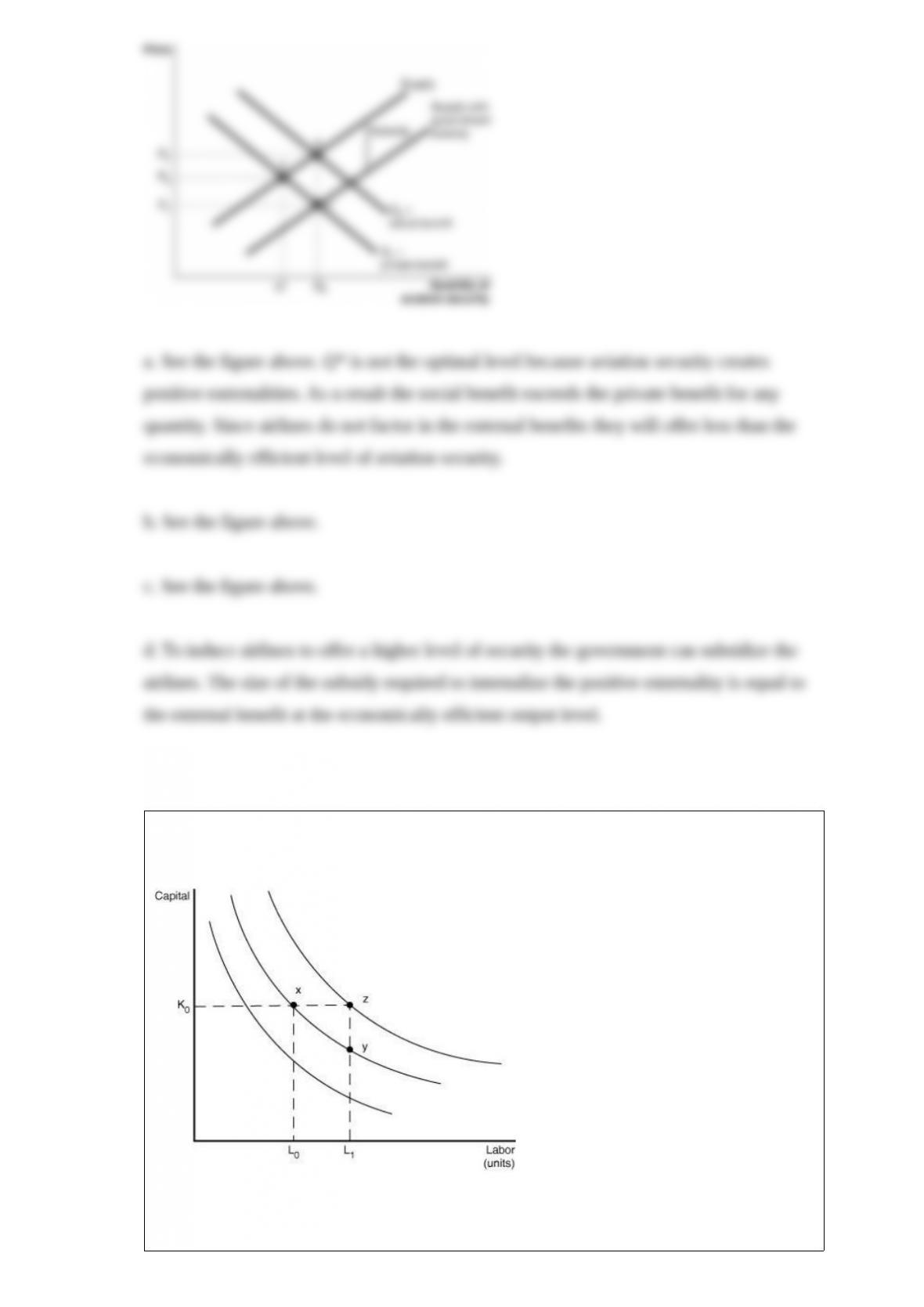
Figure 11-16
Refer to Figure 11-16. The figure above illustrates a series of isoquants. Which of the
following statements is true?
A) Points x, z, and y all represent the same output.
B) Points z and y represent the same output; this output is produced with more capital at
z than at y.
C) Point x and y represent the same output but the cost of production at y is greater than
the cost of production at x.
D) Point z represents a greater output than point x or point y.
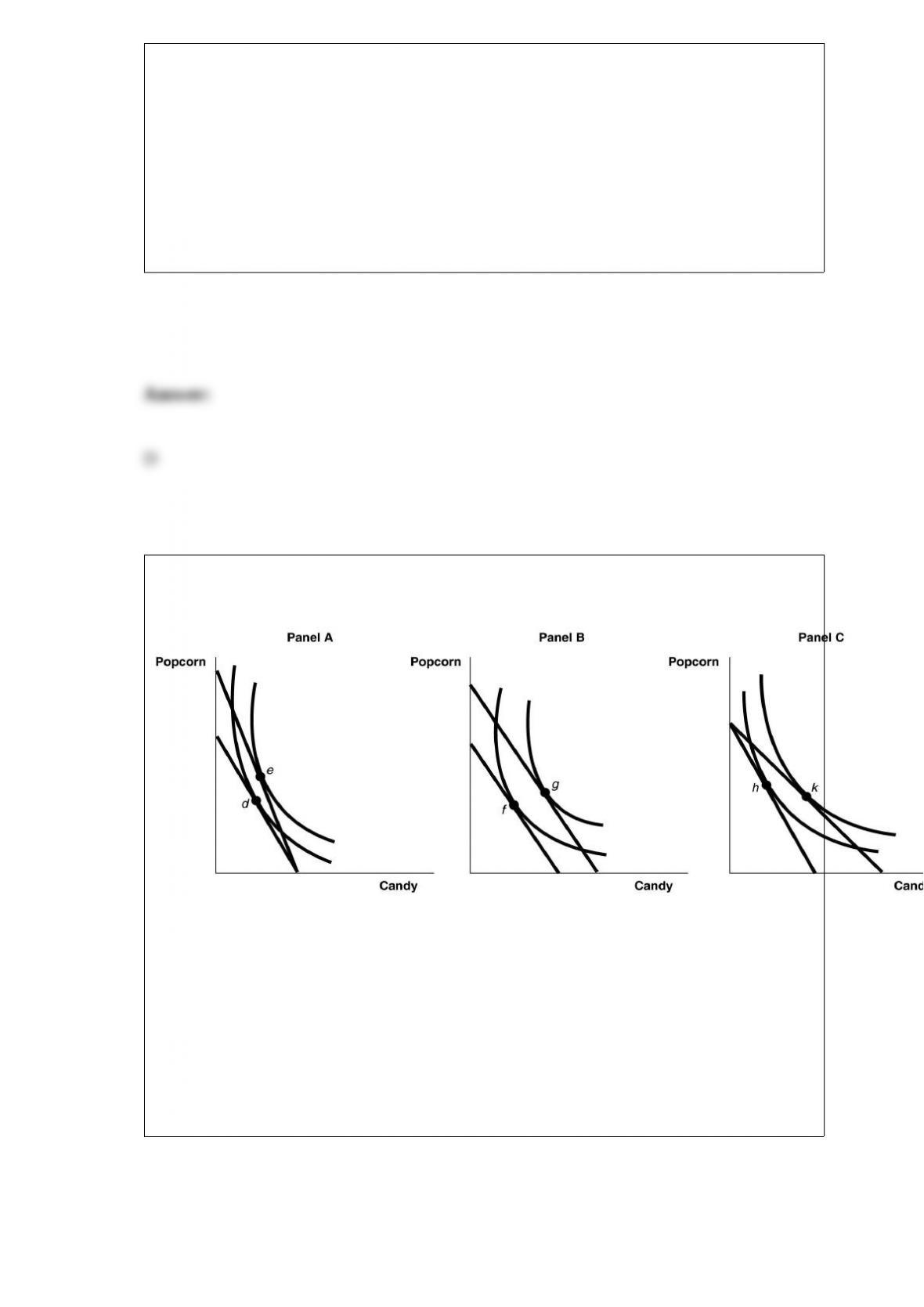
Figure 10-6
Refer to Figure 10-6. Which diagram demonstrates an increase in total utility following
a decrease in the price of popcorn?
A) the movement from d to e in Panel A
B) the movement from f to g in Panel B
C) the movement from h to k in Panel C
D) none of the above

A perfectly competitive wheat farmer in a constant-cost industry produces 1,000
bushels of wheat at a total cost of $50,000. The prevailing market price is $48. What
will happen to the market price of wheat in the long run?
A) The price remains constant at $48.
B) The price falls below $48.
C) The price rises above $48.
D) There is insufficient information to answer the question.
A market demand curve reflects the
A) private benefits of consuming a product.
B) external benefits of consuming a product.
C) social benefits of consuming a product.
D) the sum of private and social benefits of consuming a product.

If policymakers use a pollution tax to control pollution, the tax per unit of pollution
should be set
A) equal to the marginal external cost at the economically efficient level of pollution.
B) equal to the marginal private cost of production at the economically efficient level of
pollution.
C) equal to the amount of the deadweight loss created in the absence of a pollution tax.
D) at a level low enough so that producers can pass along a portion of the additional
cost onto consumers without significantly reducing demand for the product.
Which of the following is not necessarily a consequence of occupational licensing
laws?
A) They restrict competition.
B) Consumers pay higher prices for the services of licensed professions.
C) They result in a higher quality of service.
D) They ensure that licensed professionals meet some minimum qualifications.
Who receives the most of what is produced in a market economy?
A) lawmakers and other politically favored groups

B) those who are willing and able to buy them
C) everyone receives an equal amount
D) people who earn the highest incomes
Technological change is a key reason why Wal-Mart has become one of the largest
firms in the world. Which of the following is a change in technology implemented by
Wal-Mart?
A) Wal-Mart developed a supply chain that allows it to manage inventories efficiently.
B) Instead of buying goods it sells from other companies, Wal-Mart makes many of
these goods in its own factories.
C) Wal-Mart employs hundreds of scientists and engineers who develop new
cost-saving techniques.
D) Wal-Mart hires managers from many of the top business schools in the United
States.
When Mr. Peabody decides on the companies to which he will donate his time and
money, a ________ issue is being addressed.
A) microeconomic

B) macroeconomic
C) positive economic
D) normative economic
The overall decline in death rates in the United States since 1981 was due to all of the
following except
A) a decline in smoking.
B) the decline in the population.
C) the availability of new prescription drugs.
D) new surgical techniques.
Some policymakers have argue that products like cigarettes, alcohol, and sweetened
soda generate negative externalities in consumption. All else equal, if the government
decided to impose a tax on soda, the equilibrium quantity of soda would ________ and
the equilibrium price of soda would ________.
A) increase; increase
B) increase; decrease
C) decrease; increase

D) decrease; decrease
Which of the following describes a difference between the marginal product of labor
and the marginal revenue product of labor?
A) The marginal product of labor declines as each additional worker is hired because of
the law of diminishing returns. The marginal revenue product of labor declines as each
additional worker is hired because of diseconomies of scale.
B) The marginal product of labor declines as each additional worker is hired because of
the law of diminishing returns. The marginal revenue product increases as each
additional worker is hired because of increases in the productivity of labor.
C) The marginal product of labor is inelastic. The marginal revenue product of labor is
elastic.
D) The marginal product of labor measures the change in output as additional workers
are hired. The marginal revenue product measures the change in revenue as additional
workers are hired.
The total output produced by a firm divided by the quantity of workers employed by the
firm is the definition of
A) the marginal product of labor.
B) the division of labor.

C) the average product of labor.
D) the average cost of production.
If there are no externalities a competitive market achieves economic efficiency. If there
is a negative externality, economic efficiency will not be achieved because
A) too little of the good will be produced.
B) too much of the good will be produced.
C) a deadweight loss will occur that is equal to the area under the demand curve for the
good.
D) economic surplus is maximized.
If a 6 percent increase in income leads to a 4 percent increase in quantity demanded for
audio books the income elasticity of demand is
A) -0.67.
B) 0.67.
C) 1.5.
D) 2.

Included on the board of directors of Microsoft are Dina Dublon, former chief financial
officer of JP Morgan Chase , the president of Harvey Mudd college Maria M. Klawe,
and the vice chairman of Bank of America Charles H. Noski. These three board
members do not have a direct management role with Microsoft and are therefore
referred to as
A) inside directors.
B) outside directors.
C) competitive directors.
D) honorary directors.
Consider the market for opticians. What is likely to happen to the equilibrium wage and
quantity of opticians if more and more people turn to laser eye surgery instead of
wearing glasses or contact lens?
A) The equilibrium wage and the equilibrium quantity of opticians rise.
B) The equilibrium wage and the equilibrium quantity of opticians fall.
C) The equilibrium wage rises and the equilibrium quantity of opticians falls.
D) The equilibrium quantity falls and the equilibrium wage of opticians rises.

In economics, the term “equity” means
A) everyone has an equal standard of living.
B) the hardest working individuals consume all they want.
C) only elected officials have high standards of living.
D) economic benefits are distributed fairly.
Consumers maximize total utility within their budget constraint by
A) buying the cheapest goods they can find.
B) buying whatever they like the best.
C) buying the goods with the largest marginal utility per dollar spent.
D) spending the same dollar amount for each good.