Allocative efficiency best explains ________, and productive efficiency best explains
________.
A) how something will be produced; when something will be produced
B) when something will be produced; why something will be produced
C) why something will be produced; what will be produced
D) what will be produced; how something will be produced
Explain why member firms of a cartel like OPEC have incentives to agree to a low
cartel production level and then produce more than its quota.
Over the past twenty years, the number of small family farms has fallen significantly
and in their place there are fewer, but larger, farms owned by corporations. Which of
the following best explains this trend?
A) diseconomies of scale in farming
B) economies of scale in farming

C) diminishing returns to labor in farming
D) declining productivity
Article Summary
Seeking ways to improve education, Garrett Johnson has organized technology
competitions called hackathons where participants such as students, teachers, and
engineers build applications designed to improve secondary and higher education
systems. These applications can include ways for teachers to improve skills, more
productive study habits for students, improving school safety, or any number of ideas
related to education. Several hackathons have been planned for around the country,
including a virtual hackathon, entry is free, and each contest will award $5,000 in prizes
to the winners.
Source: Nancy Dahlberg, “Hackathon tackling education reform this week,” Miami
Herald, October 7, 2013.
Refer to the Article Summary. The article addresses education reform by way of newly
designed applications. Education reform could lead to a more skilled and better trained
public. A more skilled and better trained public would
A) cause the market supply curve for labor to shift to the right.
B) cause the market demand curve for labor to shift to the right.
C) not shift the market demand curve for labor.
D) cause both the market demand curve for labor and the market supply curve for labor
to shift to the left.

If the quantity supplied of walkie-talkies increases by 5 percent when prices increase by
12 percent, then
A) the supply of walkie-talkies is inelastic.
B) the supply of walkie-talkies is elastic.
C) the walkie-talkie supply curve will shift to the right.
D) the walkie-talkie supply curve will shift to the left.
The typical shape of an isoquant is
A) convex towards the origin.
B) concave towards the origin.
C) linear and downward sloping.
D) linear and upward sloping.
In the United States in 2012, the percentage of people that directly purchased an
individual or family health insurance policy from an insurance company was about
A) 2%.

B) 10%.
C) 17%.
D) 26%.
Which of the following describes a situation in which a good or service is produced at
the lowest possible cost?
A) productive efficiency
B) allocative efficiency
C) marginal efficiency
D) profit maximization
An investor is more likely to buy a firm’s stock if the firm’s income statement shows
________ and if its balance sheet shows ________.
A) a large net worth; a large price-earnings ratio
B) a large after-tax profit; a large net worth
C) a large price-earnings ratio; a large dividend yield

D) low opportunity costs; large liabilities
Private solutions to the problem of externalities are most likely when
A) government actively encourages these solutions.
B) transaction costs are low and the number of bargaining parties is small.
C) transaction costs are low and the number of bargaining parties is large.
D) transaction costs are low and the monetary damages to third parties is high.
The slope of an isoquant measures
A) the price ratio of the two inputs.
B) the average product of labor.
C) the ratio of the marginal utility of the two inputs.
D) the rate at which inputs can be substituted for each other keeping total output
constant.

A perfectly competitive firm earns a profit when price is
A) equal to minimum average total cost.
B) above minimum average total cost.
C) equal to minimum average variable cost.
D) equal to minimum average fixed cost.
A standard which came to the market first, such as the QWERTY letter layout in
typewriters, can become entrenched (this layout is still used in computer keyboards
today). What is this phenomenon called?
A) network externalities
B) path dependency
C) sunk cost
D) comparative advantage
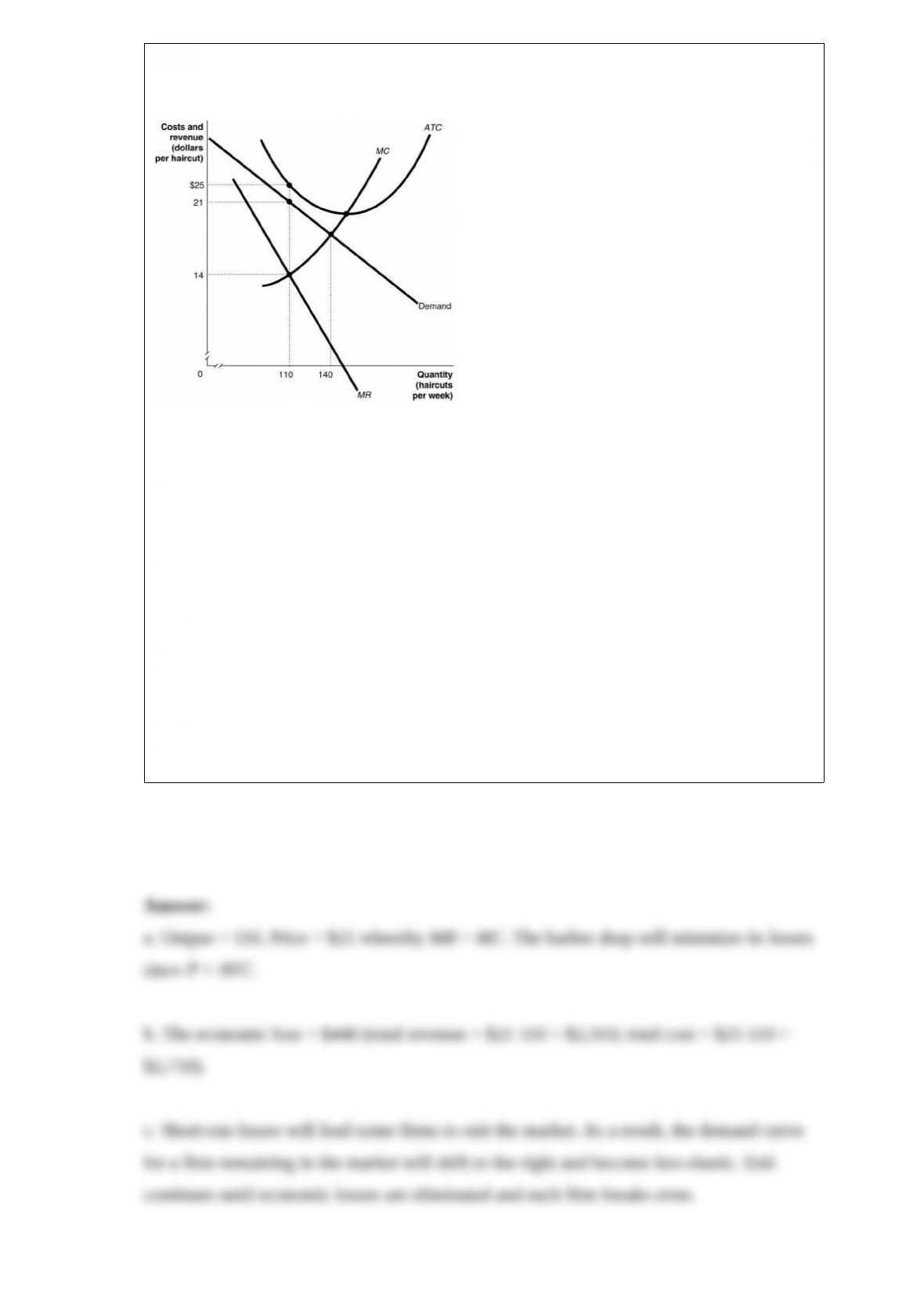
Figure 13-16
Refer to Figure 13-16. Figure 13-16 depicts a monopolistically competitive barber
shop. Use the diagram to answer the following questions.
a. Suppose the average variable cost of production is $15 when output equals 110
haircuts and $15.25 when output equals 140 haircuts. If the firm wants to maximize its
profit or minimize its losses, how many haircuts will it produce and what price should it
charge? Explain your answer.
b. Calculate the firm’s profit or loss.
c. What is likely to happen in this industry over time as it moves to its new long-run
equilibrium?
d. Suppose the barber shop depicted in the diagram remains in the industry. Is this
barber shop likely to produce this same quantity of haircuts as in part (a) in the long
run?

In a study conducted by Marianne Bertrand and Sendhil Mullianthan, identical resumes
were sent in response to help wanted ads in newspapers, with half of the resumes
assigned an African-American-sounding name and half assigned a white-sounding
name. The study found that
A) employers were equally likely to interview workers with white-sounding names and
with African-American-sounding names.
B) employers were 50 percent more likely to interview workers with
African-American-sounding names.
C) employers were 50 percent more likely to interview workers with white-sounding
names.
D) no employers chose to interview workers with African-American-sounding names.
Suppose Jason owns a small pastry shop. Jason wants to maximize his profit, and
thinking back to the college microeconomics class he took in college, he decides he
needs to produce a quantity of pastries which will minimize his average total cost. Will
Jason’s strategy necessarily maximize profits for his pastry shop?
A) Yes; Since jason’s pastry shop is in a perfectly competitive market, the only way to
maximize profit is to produce the quantity where average total cost is minimized.
B) Not necessarily; This strategy will only maximize Jason’s profit in the long run, but
not in the short run.
C) No; In order to maximize profit, Jason would never want to produce the quantity
where average total cost is minimized.
D) Not necessarily; Depending on demand, Jason may maximize profit by producing a
quantity other than that where average total cost is at a minimum.
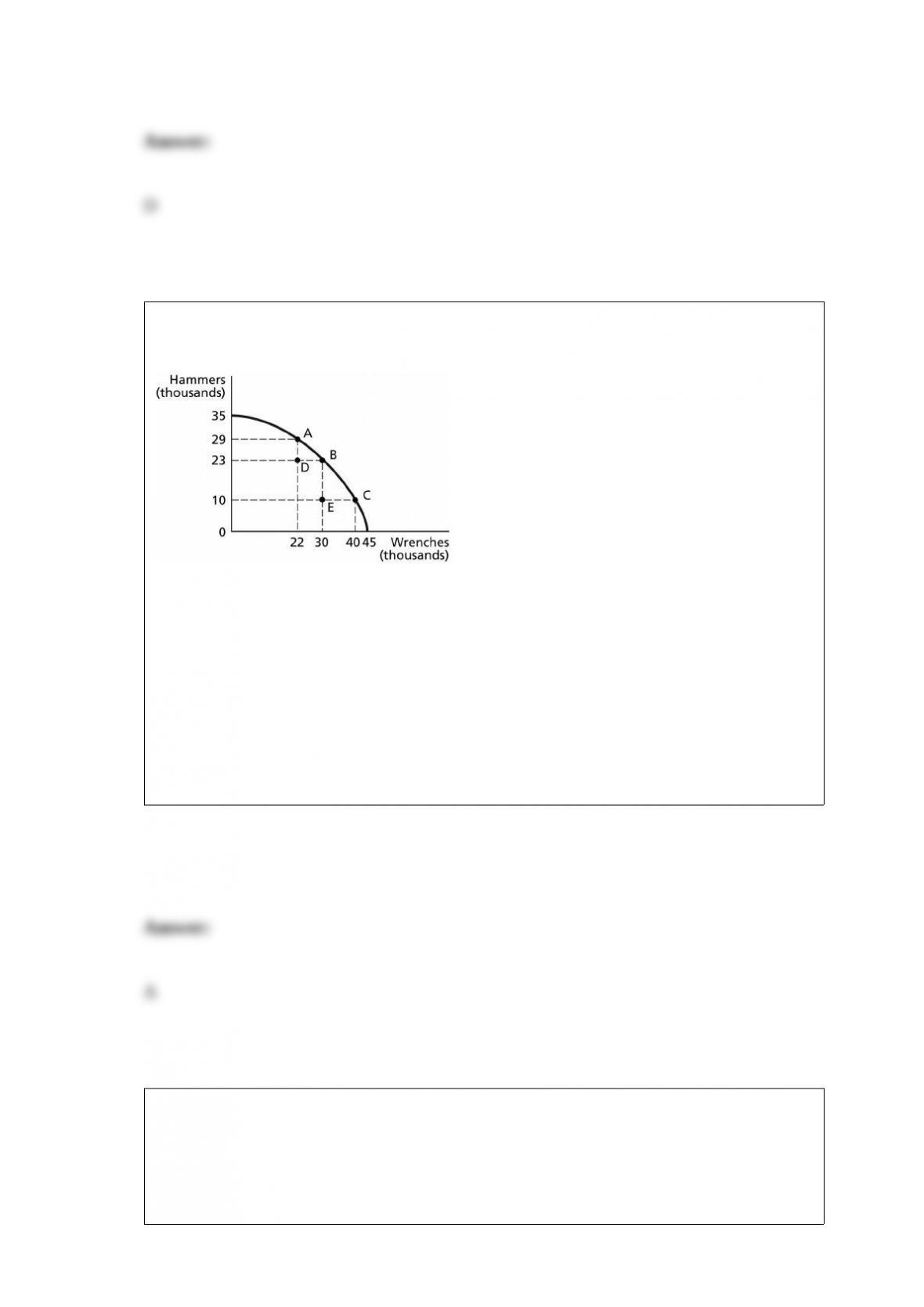
Figure 2-6
Refer to Figure 2-6. If the economy is currently producing at point C, what is the
opportunity cost of moving to point B?
A) 10 thousand wrenches
B) 13 thousand hammers
C) 30 thousand wrenches
D) 23 thousand hammers
Table 9-6
Production and
Consumption Production
Without Trade With Trade

Denmark and Belize can produce both clocks and hats. Table 9-6 shows the production
and consumption quantities without trade, and the production numbers with trade.
Refer to Table 9-6. Prior to trade, what was the opportunity cost to produce 1 hat in
Denmark?
A) 1/6 of a clock
B) 2/3 of a clock
C) 1.5 clocks
D) 6 clocks
The profit-maximizing rule for a monopolistically competitive firm is to select the
quantity at which
A) marginal revenue equals marginal cost.
B) average revenue exceeds marginal cost by the greatest amount.
C) price equals marginal cost.
D) average revenue equals average total cost.

Suppose the U.S. government encouraged consumers to trade in their old automobiles
for more efficient, new models by paying up to $5,000 for the old automobiles. These
consumers would be exemplifying the economic idea that
A) people are rational.
B) people respond to economic incentives.
C) optimal decisions are made at the margin.
D) equity is more important than efficiency.
________ describes the actions a firm takes to maintain the differentiation of its product
over time.
A) Product differentiation.
B) Brand management
C) Aggressive marketing.
D) Advertising
If you pay $2,000 in taxes on an income of $20,000, and a tax of $3,000 on an income
of $30,000, then over this range of income the tax is
A) regressive.

B) proportional.
C) progressive.
D) There is insufficient information to answer the question.
The explicit cost of production is also called
A) variable cost.
B) accounting cost.
C) direct cost.
D) overhead cost.
Sequential games are used to analyze
A) firms that are subject to the prisoner’s dilemma.
B) cartels.
C) second-price auctions.
D) situations in which one firm acts and other firms respond.

A firm in a market economy must do all of the following to succeed except
A) produce the goods and services that consumers want at a lower cost than consumers
themselves can produce.
B) organize the factors of production into a functioning, efficient unit.
C) have access to sufficient funds.
D) be organized as a corporation.
When an investor buys a corporate bond
A) the investor becomes part owner of the corporation.
B) the principal of the bond is a loan to the corporation.
C) the interest made on the bond represents the bondholder’s limited liability in the
company.
D) the face value of the bond is equal to what the investor paid for the bond.

What is a subgame?
A) It is one that begins at any node of the tree, including the game itself.
B) It is one that begins at any decision node of the tree except the first decision node.
C) It is one that starts at the final decision node of the tree.
D) It is a simultaneous game embedded in a sequential game.
Which of the following statements is used to justify protectionism?
A) Free trade leads to higher prices for imported goods.
B) Free trade increases employment by protecting domestic firms.
C) A country should not rely on other countries for goods that are critical to its national
defense.
D) Trade restrictions are not necessary to protect new firms since they can gain
experience and become more productive without protection.

If a consumer receives 20 units of utility from consuming two candy bars, and 25 units
of utility from consuming three candy bars, the marginal utility of the second candy bar
is
A) 25 utility units.
B) 20 utility units.
C) 5 utility units.
D) unknown as more information is needed to determine the answer.
In general, the labor supply curve
A) slopes downward because firms will hire fewer workers at higher wages.
B) slopes upward because as the wage rises the opportunity cost of leisure increases.
C) is vertical at the equilibrium wage rate.
D) is perfectly elastic at the equilibrium wage rate.