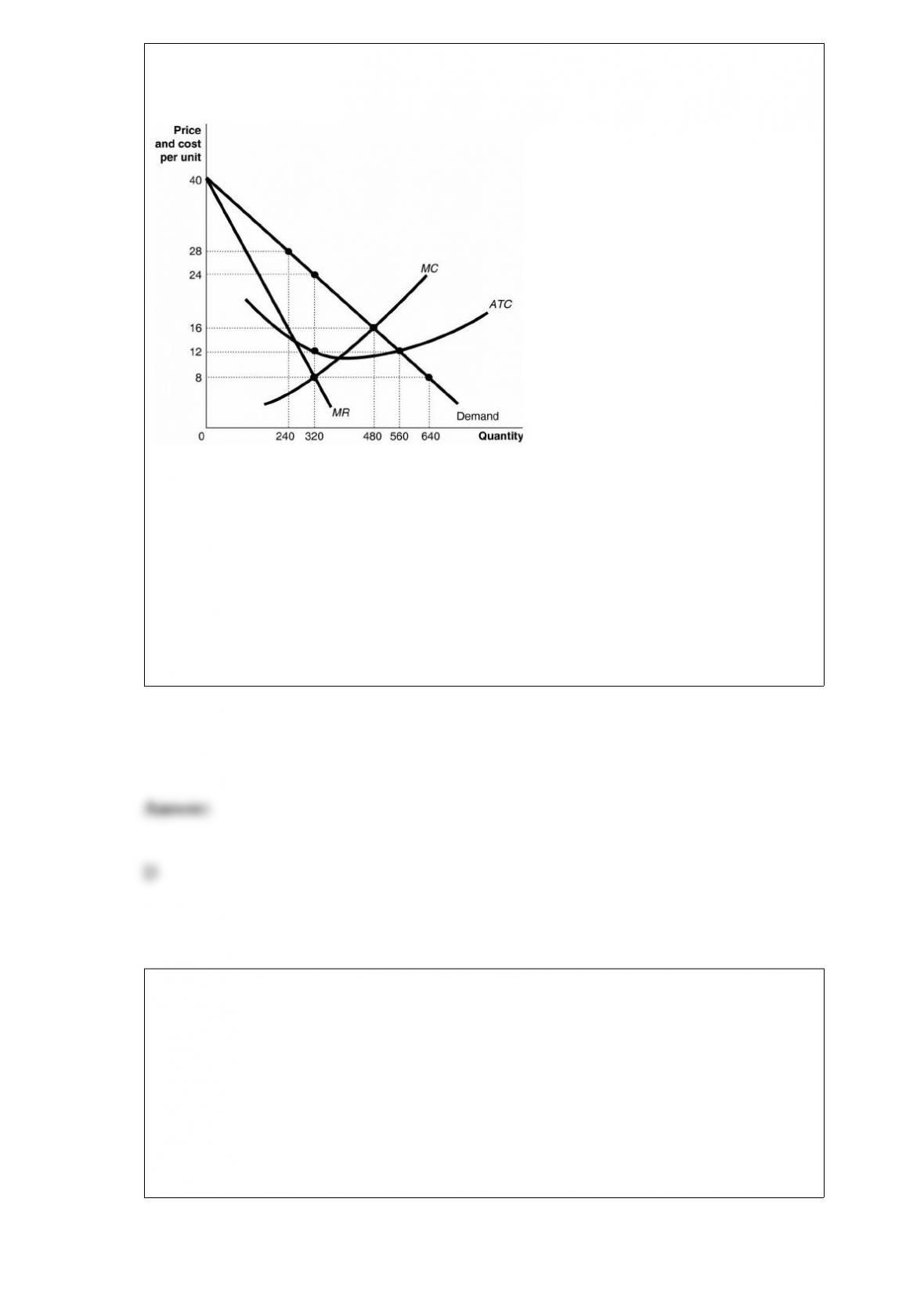
Figure 16-5
Refer to Figure 16-5. Suppose the firm represented in the diagram decides to practice
perfect price discrimination. What is the total revenue collected by the firm?
A) $6,720
B) $7,680
C) $10,240
D) $13,440
Holding everything else constant, an increase in the price of MP3 players will result in
A) a decrease in the quantity of MP3 players supplied.
B) a decrease in the demand for MP3 players.
C) an increase in the supply of MP3 players.
D) a decrease in the quantity of MP3 players demanded.

Being the first to sell a particular good can give a firm advantages over other firms that
sell similar products. What is the name given to these advantages?
A) first-mover
B) first come, first served
C) follow the leader
D) first to market
Which of the following is not a source of comparative advantage?
A) relative abundance of labor and capital
B) technology
C) climate and natural resources
D) a strong foreign currency exchange rate
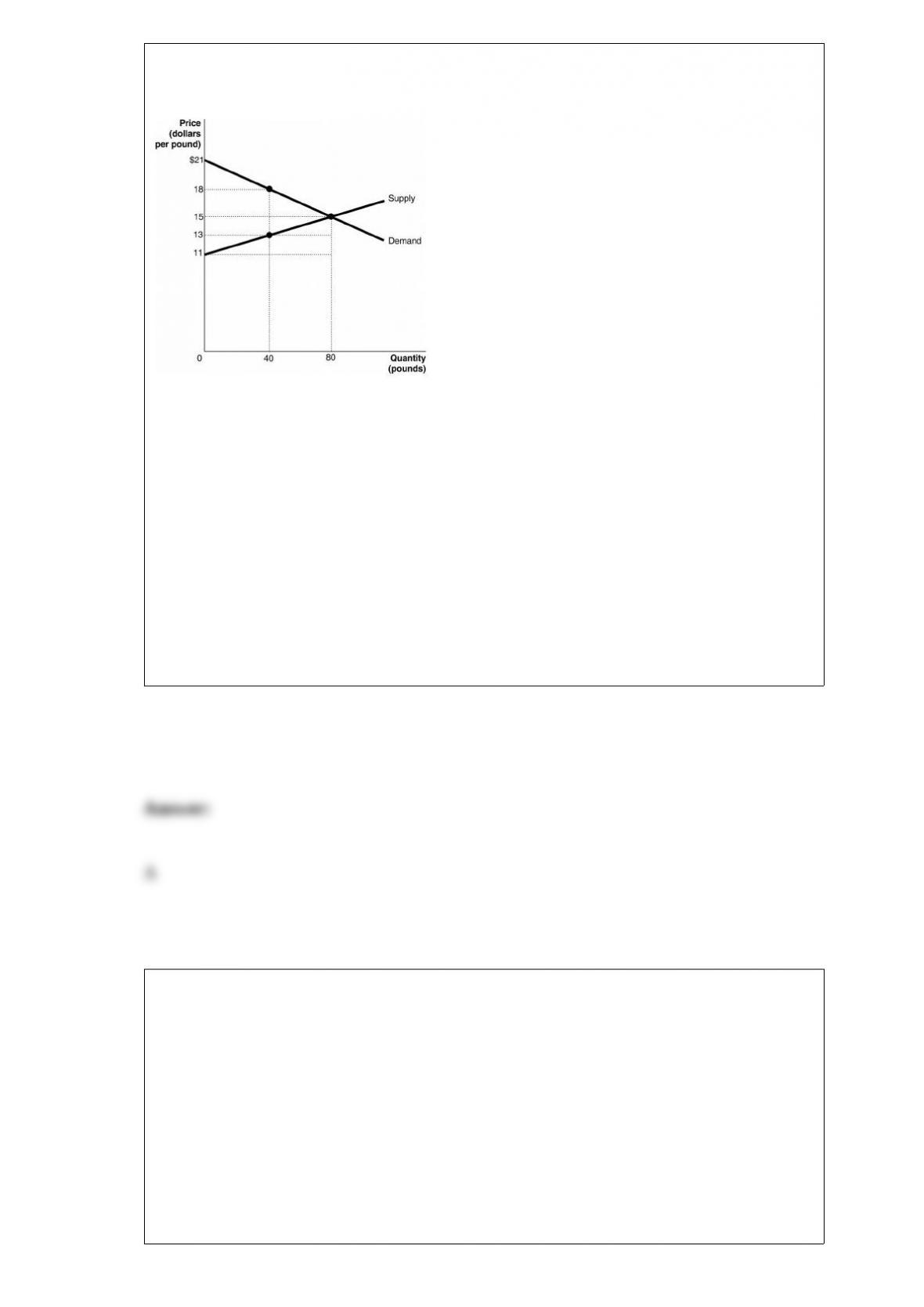
Figure 4-3
Figure 4-3 shows the market for tiger shrimp. The market is initially in equilibrium at a
price of $15 and a quantity of 80. Now suppose producers decide to cut output to 40in
order to raise the price to $18.
Refer to Figure 4-3. What is the value of the deadweight loss at a price of $18?
A) $100
B) $180
C) $660
D) $1,040
A supply schedule
A) is a table that shows the relationship between the price of a product and the quantity
of the product supplied.
B) is a curve that shows the relationship between the price of a product and the quantity
of the product supplied.
C) is the relationship between the supply of a good and the cost of producing the good.
D) is a table that shows the relationship between the price of a product and the quantity

of the product that producers and consumers are willing to exchange.
Suppose the total cost of producing 40,000 flash drives is $120,000, and the fixed cost
is $30,000.
a. What is the variable cost?
b. When output is 40,000, what are the average variable cost and the average fixed cost?
c. Assuming the cost curves have the usual shape, is the dollar difference between the
average total cost and the average variable cost greater when the output is 40,000 flash
drives or when the output is 60,000 flash drives? Explain.
Marginal benefit is equal to the ________ benefit to a consumer receives from
consuming one more unit of a good or service.
A) total
B) unintended

C) additional
D) surplus
A patent or copyright is a barrier to entry based on
A) ownership of a key necessary raw material.
B) large economies of scale as output increases.
C) government action to protect a producer.
D) widespread network externalities.
Table 2-8
Table 2-8 shows the number of labor hours required to produce a digital camera and a
pound of wheat in China and South Korea.
Refer to Table 2-8. If the two countries specialize and trade, who should export digital
cameras?

A) There is no basis for trade between the two countries.
B) China
C) South Korea
D) They should both be importing digital cameras.
The financial statements of firms generally are audited by
A) employees of the firm being audited.
B) employees of private accounting firms.
C) employees of the federal government.
D) the board of directors of the corporation being audited.
Economists played a key role in the development of merger guidelines by the
Department of Justice and the Federal Trade Commission in 1982. These guidelines
have three main parts. What are these parts?
A) concentration ratios; the Herfindahl-Hirschman Index; market standards
B) concentration standards; concentration ratios; competitive analysis
C) economic analysis; political analysis; dynamic analysis

D) market definition; measure of concentration; merger standards
If equilibrium is achieved in a competitive market
A) there is no deadweight loss.
B) the deadweight loss will be maximized.
C) the deadweight loss will equal the sum of consumer surplus and producer surplus.
D) the deadweight loss will be the same as the opportunity cost of the last unit of output
sold.
Figure 12-16
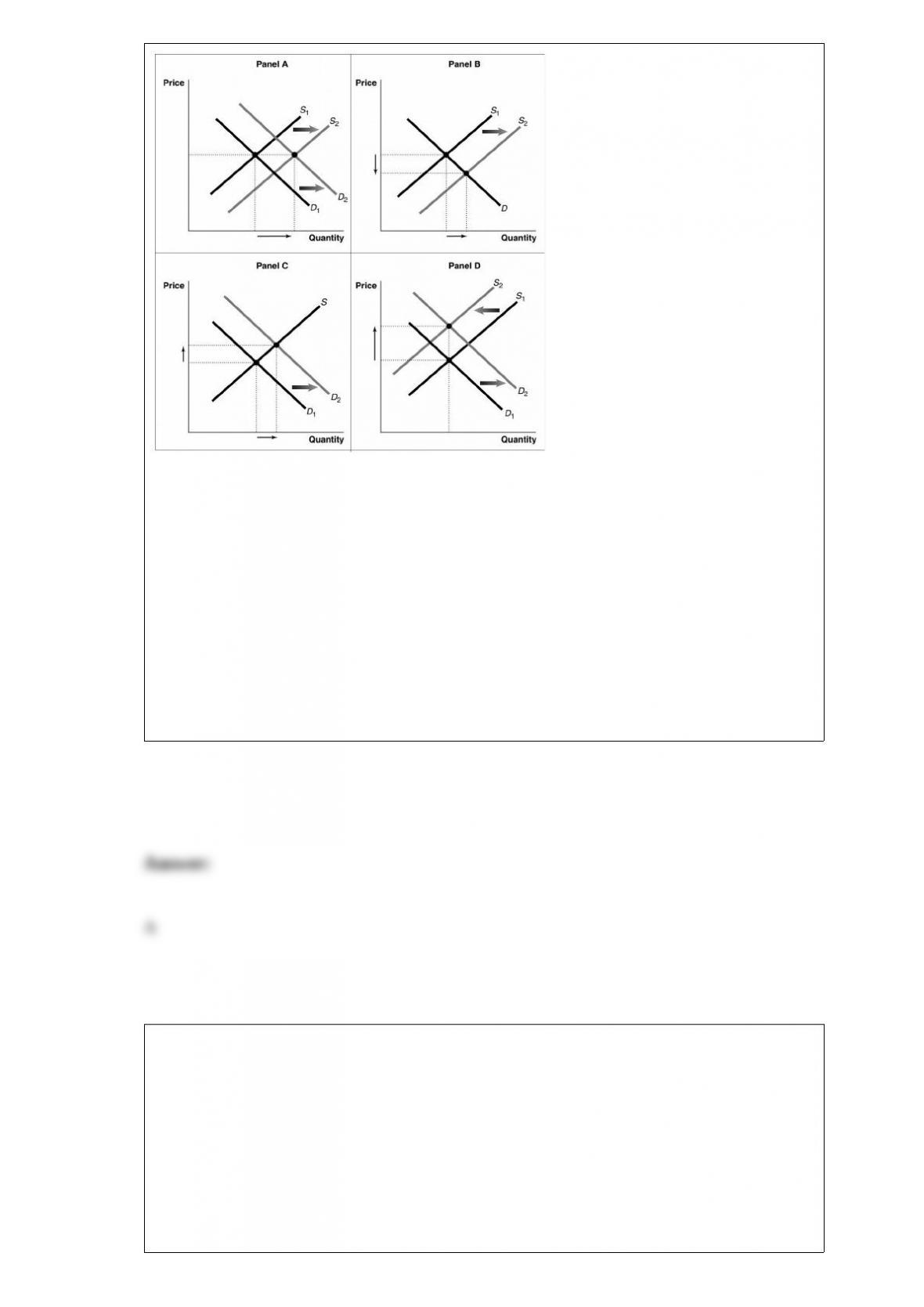
Refer to Figure 12-16. Which panel best represents the perfectly competitive organic
produce market in which some firms are earning short-run economic profits, and the
Surgeon General announces that switching from non-organic produce to organic
produce will add 5 years to the average life span of consumers?
A) Panel A
B) Panel B
C) Panel C
D) Panel D
Which of the following will prevent firms from engaging in price discrimination?
A) yield management
B) arbitrage
C) transactions costs
D) odd pricing

Economists generally favor the use of tradable emissions allowances to reduce
pollution. However, the use of these allowances has been criticized by some
environmentalists. Which of the following describes this criticism?
A) Some environmentalists believe the allowances give firms a license to pollute.
B) Some environmentalists believe that the price of allowances is often too high for
consumers to afford.
C) Some environmentalists believe that Pigovian taxes are a more efficient way to
reduce pollution.
D) Some environmentalists oppose allowances on legal grounds; they believe the use of
allowances is unconstitutional.
Figure 3-2
Refer to Figure 3-2. A decrease in the expected future price of the product would be

represented by a movement from
A) A to B.
B) B to A.
C) S1 to S2.
D) S2 to S1.
If a commercial dairy farm wants to raise funds to purchase feeding troughs, it does so
in the
A) output market.
B) product market.
C) factor market.
D) dairy products market.
Oligopolies exist and do not attract new rivals because
A) of competition.
B) of barriers to entry.

C) the firms keep profits and prices so low that no rivals are attracted.
D) there can be no product differentiation.
The Pre-Existing Condition Insurance Plan is a federally administered part of the
Affordable Care Act, and is designed for people with pre-existing medical conditions to
obtain insurance.By offering health insurance to all U.S. citizens with pre-existing
medical conditions, the Pre-Existing Condition Insurance Plan eliminates ________ for
both the insurer and the insured, and eliminates ________ for the issuer of the insurance
policy.
A) the principal-agent problem; moral hazard
B) asymmetric information; adverse selection
C) adverse selection; the principal-agent problem
D) moral hazard; adverse selection
Figure 12-11
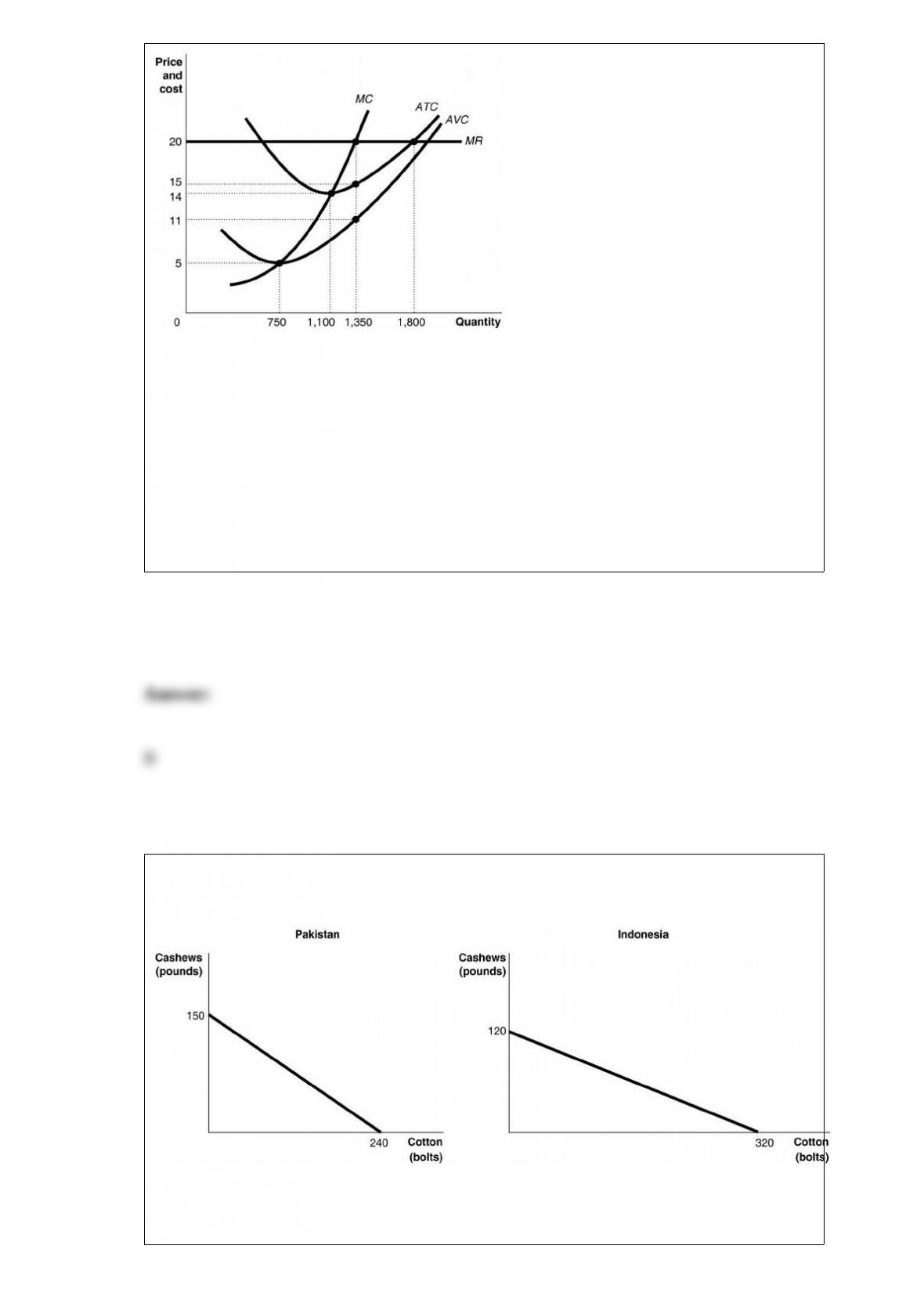
Refer to Figure 12-11. If this is a constant-cost industry, what is the market price in the
long-run equilibrium?
A) $5
B) $14
C) $15
D) $20
Figure 2-9
Figure 2-9 shows the production possibilities frontiers for Pakistan and Indonesia. Each
country produces two goods, cotton and cashews.

Refer to Figure 2-9. What is the opportunity cost of producing 1 pound of cashews in
Pakistan?
A) 3/8 of a bolt of cotton
B) 5/8 of a bolt of cotton
C) 1 3/5 bolts of cotton
D) 240 bolts of cotton
Suppose the consumer’s income increases while the prices of the goods remain constant.
Then the
A) budget constraint shifts inward parallel to the original budget constraint.
B) budget constraint shifts outward parallel to the original budget constraint.
C) indifference curves shift outward away from the origin.
D) indifference curves become flatter.
Table 4-4
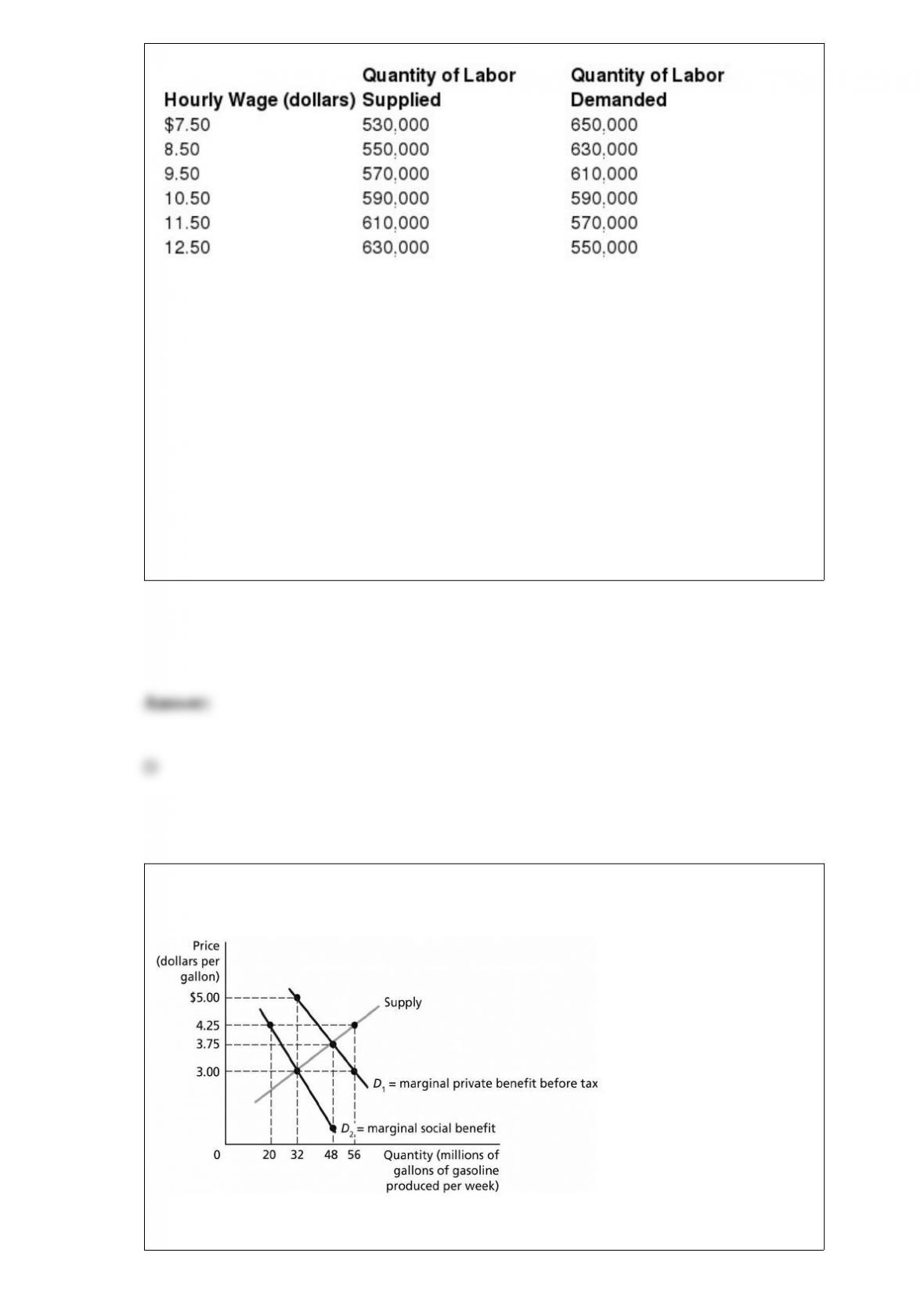
Table 4-4 shows the demand and supply schedules for labor market in the city of Pixley.
Refer to Table 4-4. Suppose that the quantity of labor demanded increases by 40,000 at
each wage level. What are the new free market equilibrium hourly wage and the new
equilibrium quantity of labor?
A) W = $8.50; Q = 550,000
B) W = $12.50; Q = 630,000
C) W = $9.50; Q = 570,000
D) W = $11.50; Q = 610,000
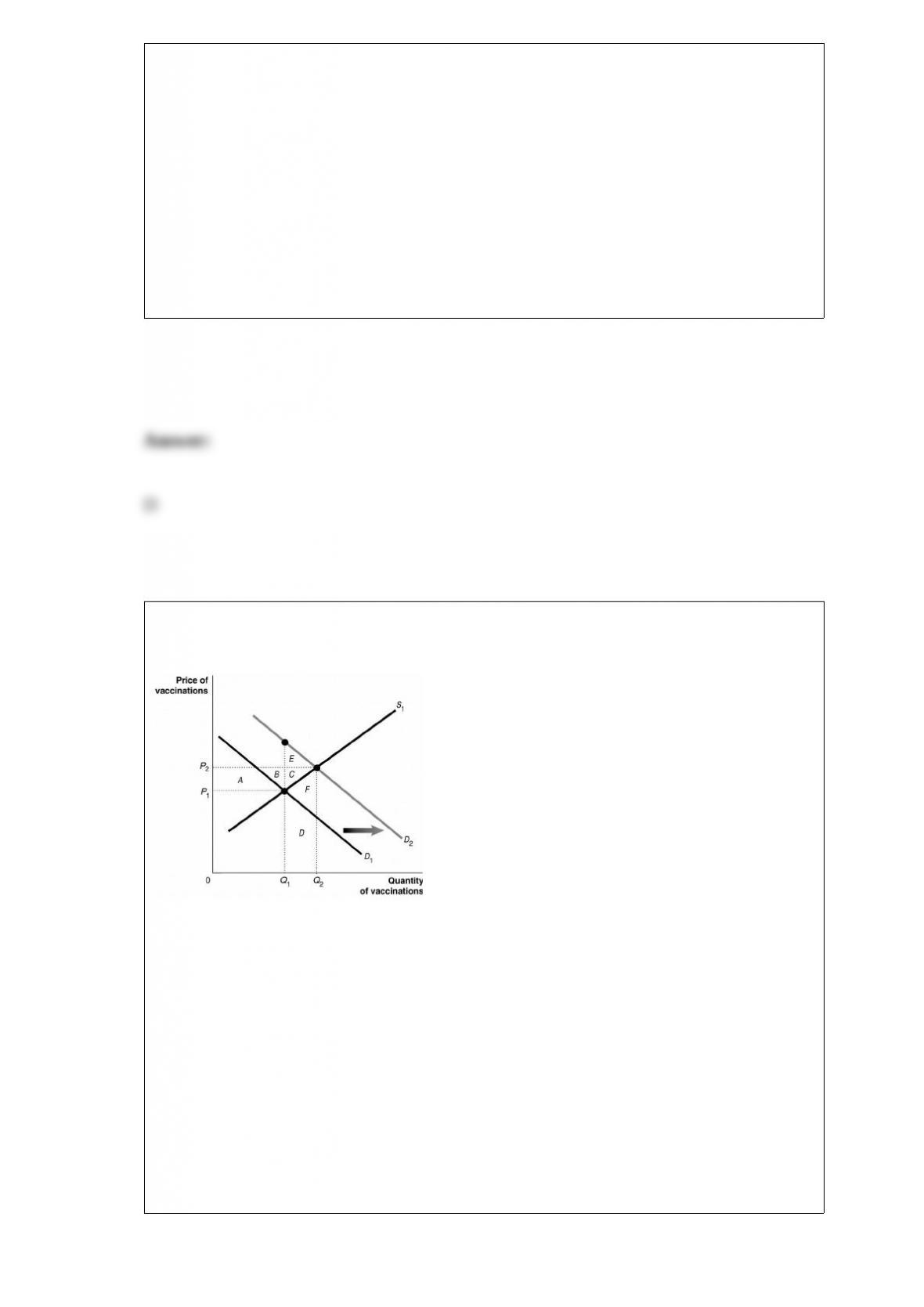
Figure 5-13
Figure 5-13 illustrates the market for gasoline before and after the government imposes

a tax to bring about the efficient level of gasoline production.
Refer to Figure 5-13. The actual price of gasoline paid by consumers after the tax is
implemented is ________ per gallon.
A) $3.00
B) $3.75
C) $4.25
D) $5.00
The 2005, 24 European Union nations established a cap-and-trade system which was
designed to
A) eliminate air pollution and greenhouse gases by the year 2020.
B) reduce carbon dioxide emissions.
C) provide fast growing developing countries with the technology to reduce their
carbon emissions.
D) remove all taxes from polluting industries.
What type of protection does U.S. law grant the creator of a book, film or piece of
music?
A) A public franchise, which grants the exclusive right to use the creation during the
author’s lifetime and to his or her heirs for 70 years after the author’s death.
B) A copyright, which grants exclusive rights to the creation’s author for 20 years after
the work is created.
C) A patent, which grants the exclusive right to use the creation during the author’s
lifetime and to his or her heirs for 70 years after the author’s death.
D) A copyright, which grants the exclusive right to use the creation during the author’s
lifetime and to his or her heirs for 70 years after the author’s death.
Figure 5-6
Figure 5-6 shows the market for measles vaccinations, a product whose use generates
positive externalities.
Refer to Figure 5-6. What is the economically efficient output level?
A) Q1
B) Q1 + Q2
C) Q2 – Q1
D) Q2

The selling of a product for a price below its cost of production is called
A) fair competition.
B) dumping.
C) unfair competition.
D) operating at a loss.
A change in which variable will change the market demand for a product?
A) the price of the product
B) population
C) technology
D) the prices of substitutes in production

Public goods are distinguished by two primary characteristics. What are they?
A) nonrivalry and nonexcludability
B) government intervention and low prices
C) market failure and high prices
D) rivalry and exclusivity
If you put $100 into a bank account that earns five percent interest per year, what is the
formula you should use to determine the account’s future value in one year?
A) Future value equals the present value divided by the rate of interest.
B) Future value equals the present value multiplied by the rate of interest.
C) Future value equals the present value multiplied by one plus the rate of interest in
decimals.
D) All of these yield the same answer.
Figure 11-14
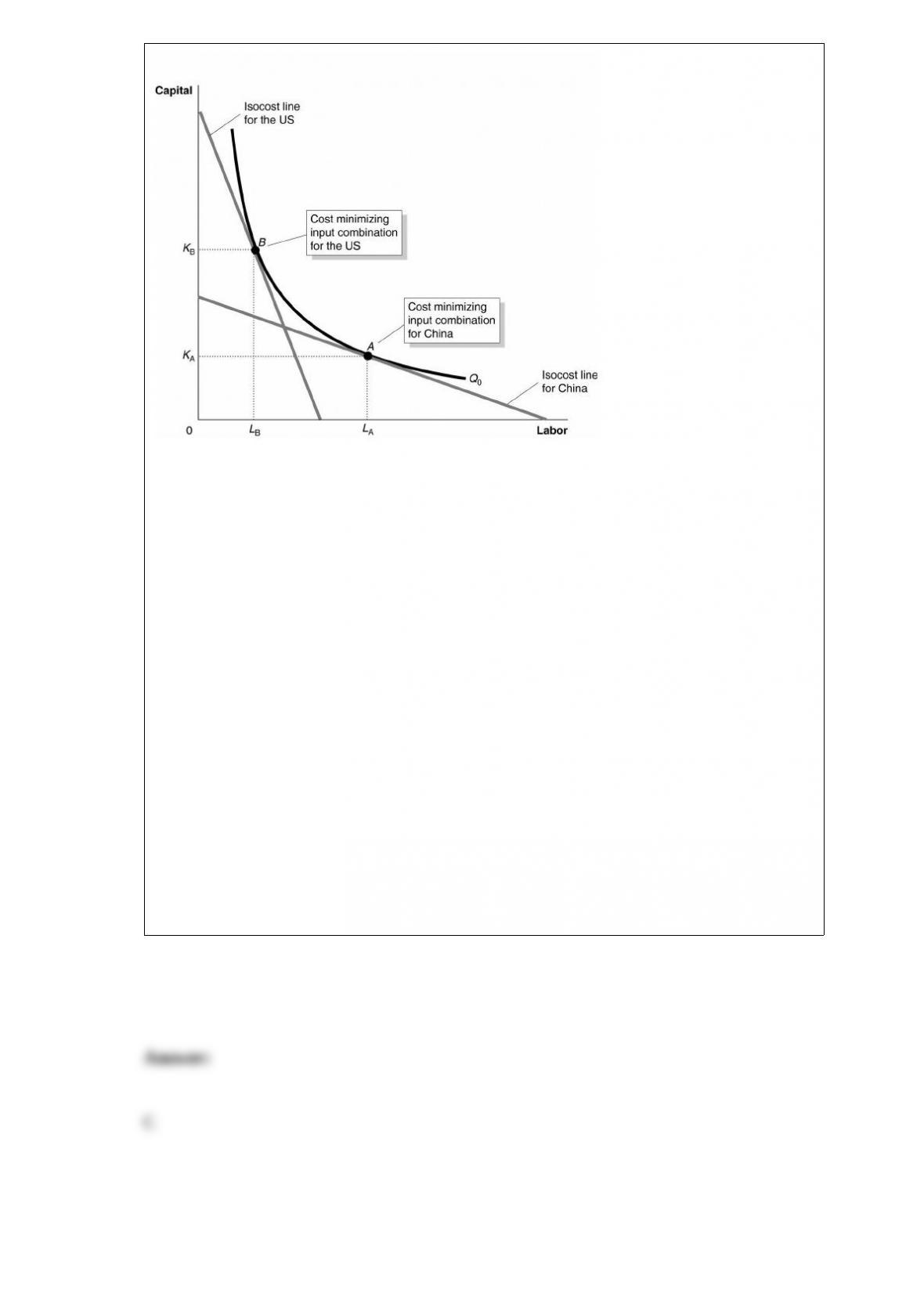
Figure 11-14 shows the optimal input combinations for the production of a given
quantity of cotton in the United States and in China.
Refer to Figure 11-14. Consider the following statements:
a. For each country, the marginal product per dollar spent on labor equals to the
marginal product per dollar spent on capital.
b. The price of labor is relatively higher in the United States than in China and the price
of capital is relatively lower in the United States than in China.
c. The price of labor and the price of capital are relatively higher in the United States
than in China. Based on the figure, which of the statements above is true?
A) All of the statements are true.
B) statements a and c only
C) statements a and b only
D) statements b and c only
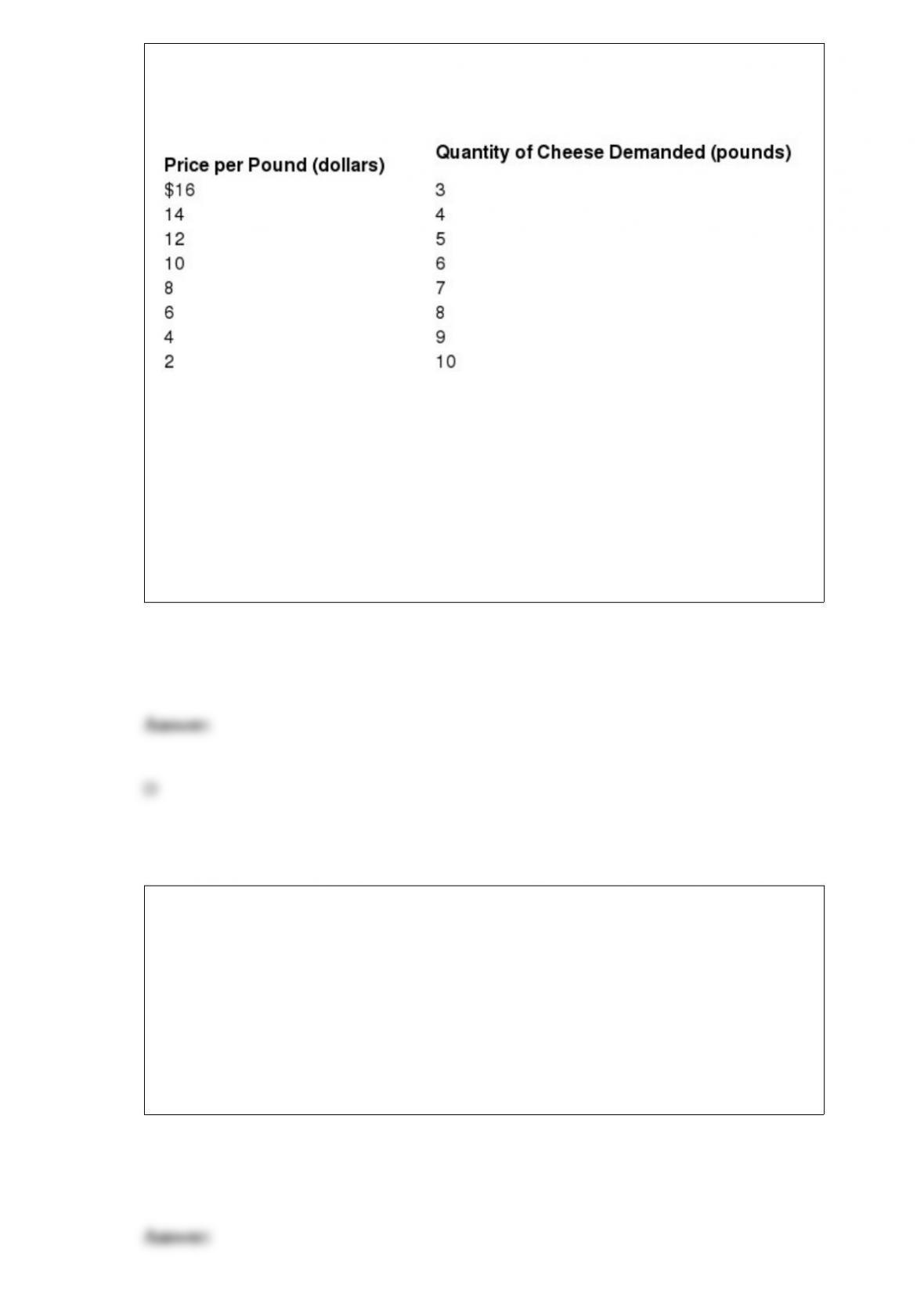
Table 6-3
Refer to Table 6-3. Over what range of prices is the demand inelastic?
A) over the entire range of prices
B) between $12 and $16
C) between $8 and $16
D) between $2 and $8
The slope of an isocost line ________ and equals the negative of ________.
A) increases as we move down the line; the ratio of input prices
B) decreases as we move down the line; the ratio of the marginal products
C) is constant; the ratio of input prices
D) is constant; the ratio of the marginal products