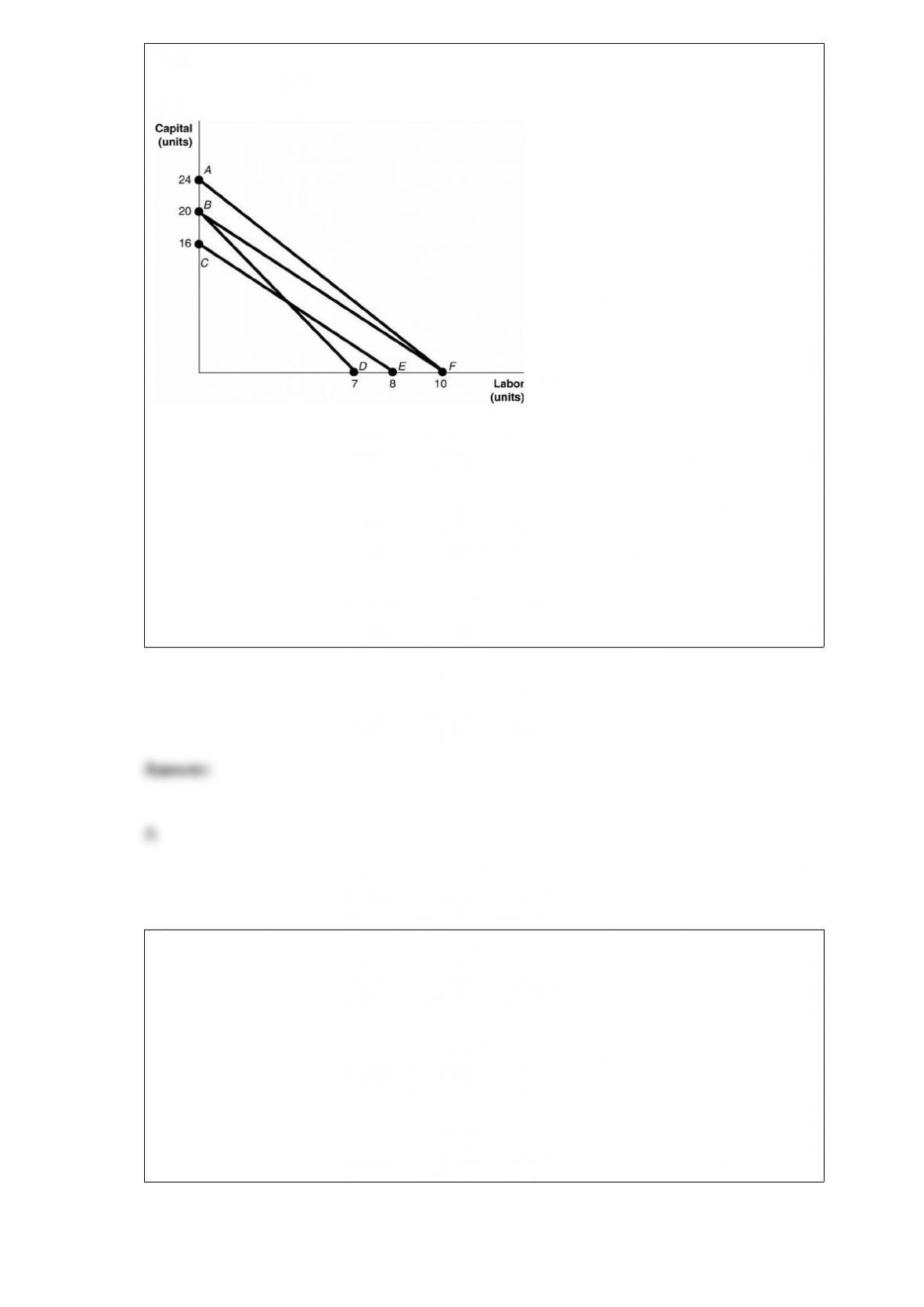
Figure 11-13
Refer to Figure 11-13. The lines shown in the diagram are isocost lines. If the price of
labor is $50 per unit, then along the isocost AF, the total cost
A) is $500.
B) is $750.
C) is $1,250.
D) cannot be determined without the price of capital.
The way in which a corporation is structured and the impact a corporation’s structure
has on the firm’s behavior is referred to as
A) corporate taxation.
B) structure composition theory.
C) structural behavior.
D) corporate governance.
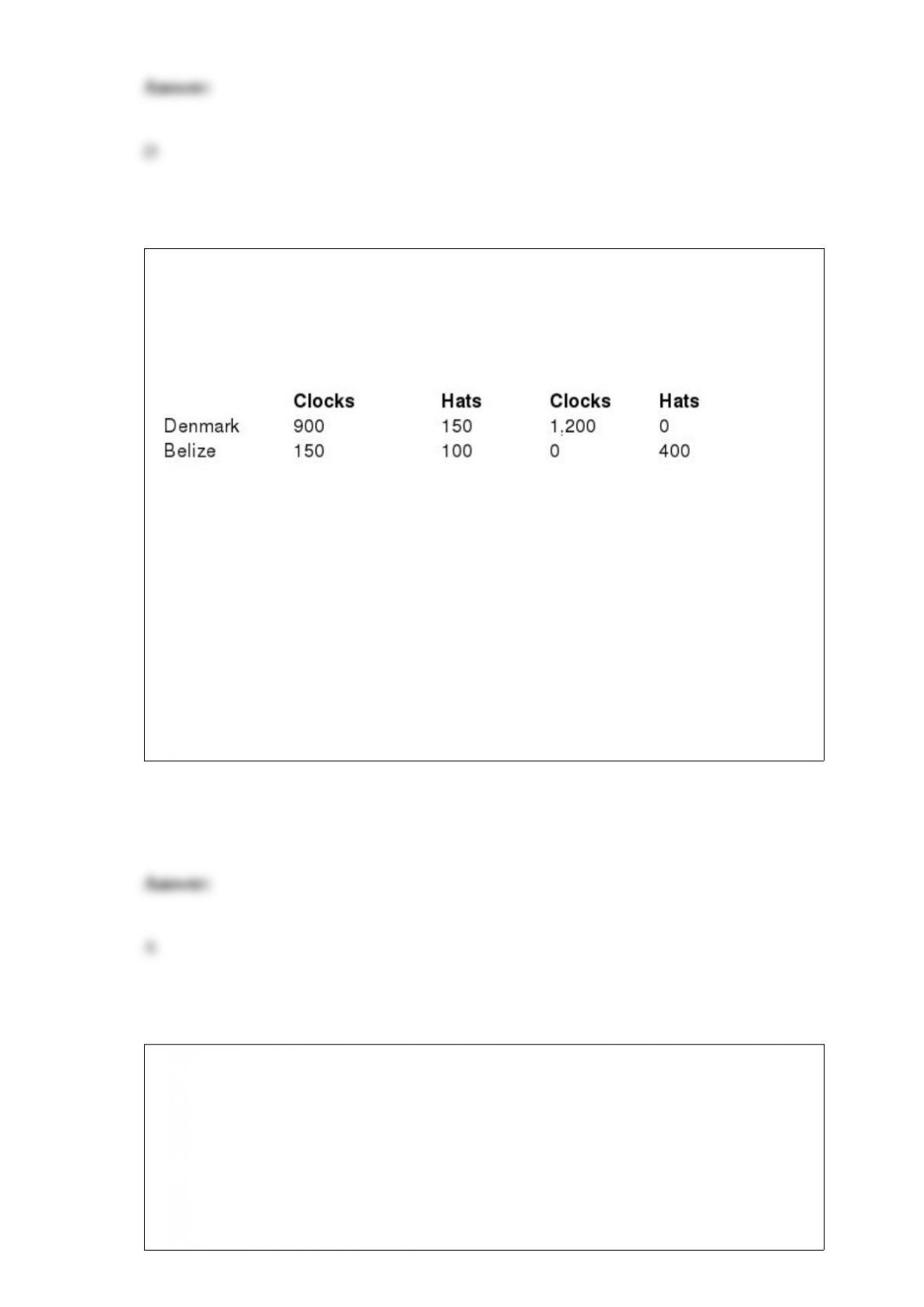
Table 9-6
Production and
Consumption Production
Without Trade With Trade
Denmark and Belize can produce both clocks and hats. Table 9-6 shows the production
and consumption quantities without trade, and the production numbers with trade.
Refer to Table 9-6. Which country has a comparative advantage in producing clocks?
A) Denmark
B) Belize
C) both countries
D) neither country
If Japanese workers are more productive than French workers then trade between Japan
and France
A) can take place only if France has an absolute advantage in producing a good or
service Japanese buyers want.
B) cannot take place because Japanese goods and services will be less expensive than
French goods and services.

C) cannot take place until French workers become more productive.
D) will take place so long as each country has a comparative advantage in a good or
service that buyers in the other country want.
Economies of scale can lead to an oligopolistic market structure because
A) if larger firms have lower costs, new small entrants will not be able to produce at the
low costs achieved by the big established firms.
B) if economies of scale are insignificant, only a few firms are able to produce at the
low costs achieved by the big established firms.
C) a few firms can force rivals to produce at low levels of output.
D) a few firms can use high profits to keep out new entrants.
Critics of globalization say that global consumer-goods companies destroy ________ .
A) the homogenization of markets
B) societal conformity
C) free trade areas
D) cultural diversity
A firm’s cost of production is determined by all of the following except
A) the technology used to produce its output.
B) the productivity of its workers.
C) the cost of raw material used in production.
D) the amount of corporate taxes it must pay on its profit.
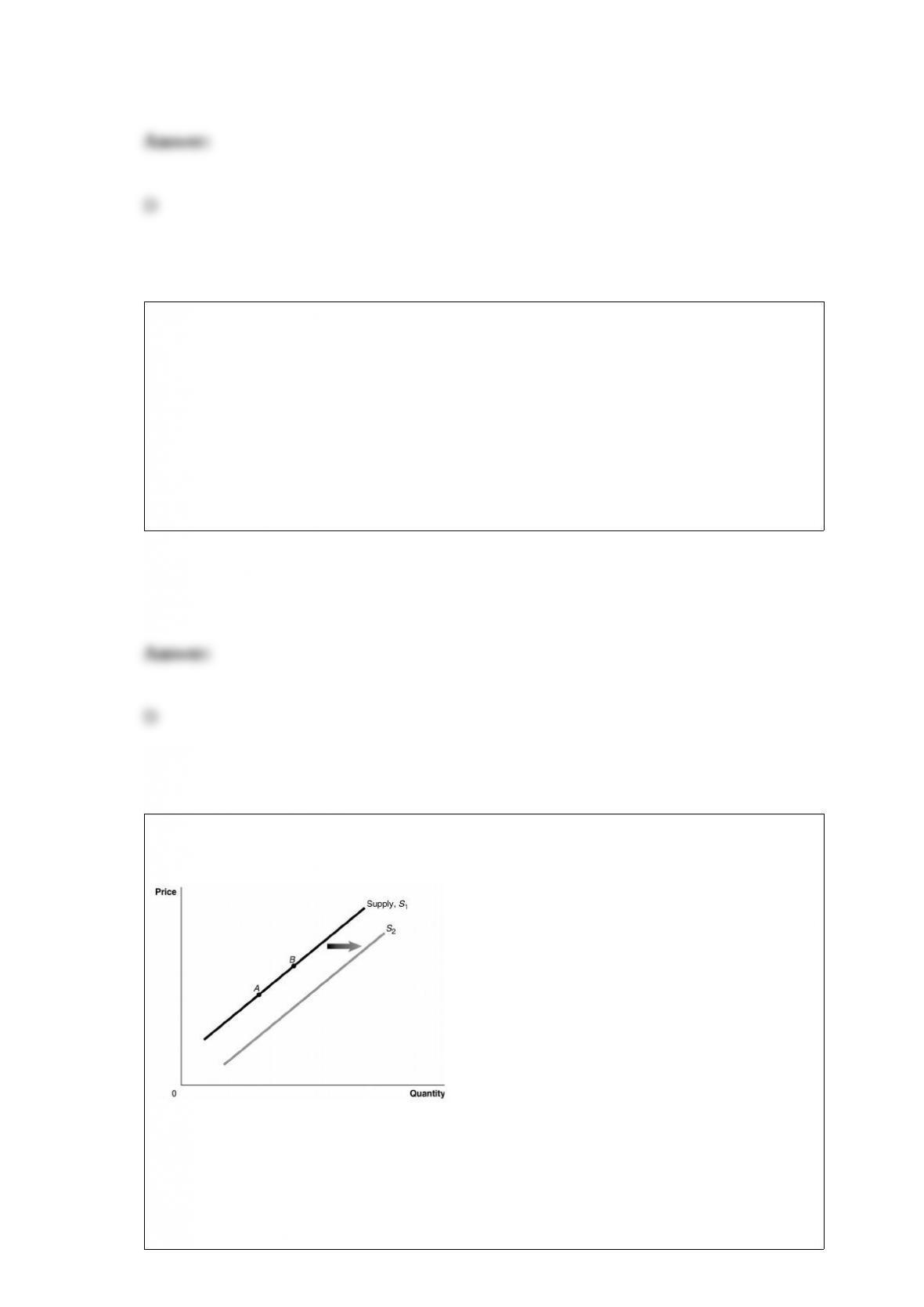
Figure 3-2
Refer to Figure 3-2. An increase in the price of substitutes in production would be
represented by a movement from
A) A to B.
B) B to A.

C) S1 to S2.
D) S2 to S1.
If a firm knew every consumer’s willingness to pay and could prevent arbitrage it could
charge every consumer a different price. This practice is known as
A) first-degree exploitation, or perfect price discrimination.
B) maximization of producer surplus, or perfect price discrimination.
C) first-degree price discrimination, or perfect price discrimination.
D) first-degree transfer of consumer surplus, or perfect price discrimination.
According to the law of one price
A) if transaction costs are zero, identical goods should sell for the same price
everywhere.
B) if transactions costs are zero, firms must sell a product at a price equal to its
marginal cost.
C) if transactions costs are zero, all firms must earn the same profit margin.

D) there must be no differences in the cost of producing identical goods by different
producers.
If a consumer receives 22 units of marginal utility for consuming the first can of soda,
20 units from consuming the second, and 15 from the third, the total utility of
consuming the three units is
A) 57 utility units.
B) 35 utility units.
C) 15 utility units.
D) unknown as more information is needed to determine the answer.
A perfectly competitive firm faces a demand curve that is
A) horizontal.
B) vertical.
C) perpendicular to the quantity axis.
D) perfectly inelastic.

If a corporation goes bankrupt, which of the following has first claim on the firm’s
assets?
A) stockholders
B) the state where chartered
C) employees
D) bondholders
In the short run, why does a production function eventually display diminishing returns
to labor?
A) As the number of workers increases it becomes difficult to monitor them.
B) As a firm hires more workers the skills and the work ethic of the additional workers
will eventually decline.
C) As the number of workers increases eventually the gains from the division of labor
and specialization are used up.
D) The opportunity cost of hiring additional workers must eventually rise.

In September 2006, the Food and Drug Administration recommended that Americans
avoid eating bagged raw spinach in the wake of an outbreak of E. coli bacteria.
Following this recommendation, the food industry looked at alternatives and many
turned to arugula. One Chicago distributor claimed, “The sale of the stuff has gone
through the roof.” Based on this information
A) arugula is a normal good while raw spinach is an inferior good.
B) the cross-price elasticity between arugula and spinach is negative.
C) the cross-price elasticity between arugula and spinach is positive
D) the price elasticity of arugula is positive while the price elasticity of spinach falls to
zero.
As output increases
A) average variable cost becomes smaller and smaller.
B) the difference between average total cost and average variable cost decreases.
C) marginal cost increases continuously.
D) the difference between average total cost and average variable cost becomes greater
and greater.
If a firm expects that the price of its product will be higher in the future than it is today
A) the firm will go out of business.
B) the firm has an incentive to increase supply now and decrease supply in the future.
C) the firm has an incentive to decrease quantity supplied now and increase quantity
supplied in the future.
D) the firm has an incentive to decrease supply now and increase supply in the future.
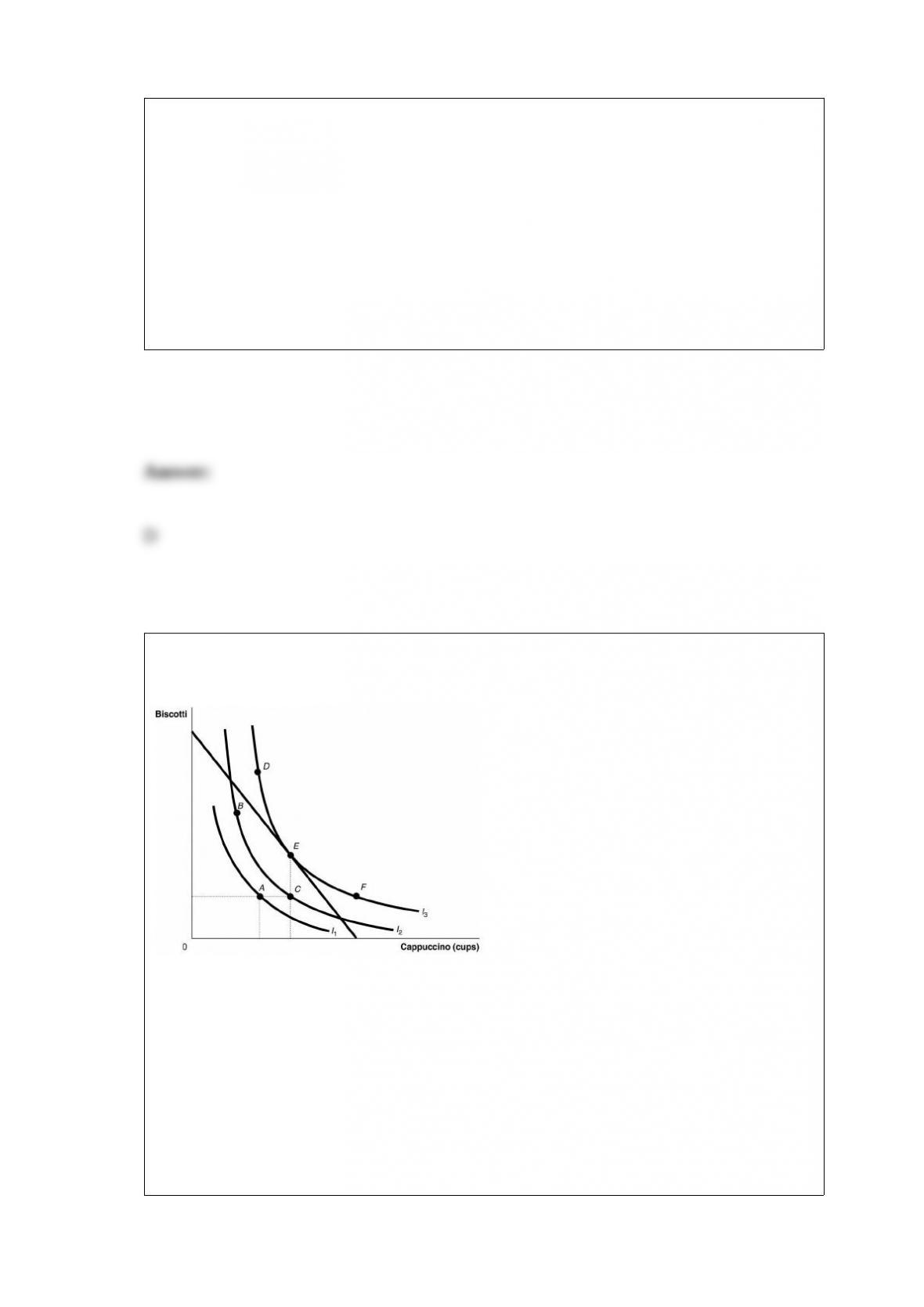
Figure 10-8
Refer to Figure 10-8. If the price of biscotti is $1.50 and the price of a cappuccino is
$3.00, what is the slope of the budget constraint?
A) -2
B) -(3.00 – 1.50)/(3.00 + 1.50) = -1/3
C) -1/2
D) The slope cannot be determined without the value of income.
Which term refers to a legally established minimum price that firms may charge?
A) a price ceiling
B) a subsidy
C) a price floor
D) a tariff
Figure 12-11
Refer to Figure 12-11. Suppose the prevailing price is $20 and the firm is currently
producing 1,350 units. In the long-run equilibrium, the firm represented in the diagram
A) will continue to produce the same quantity.
B) will reduce its output to 1,100 units.
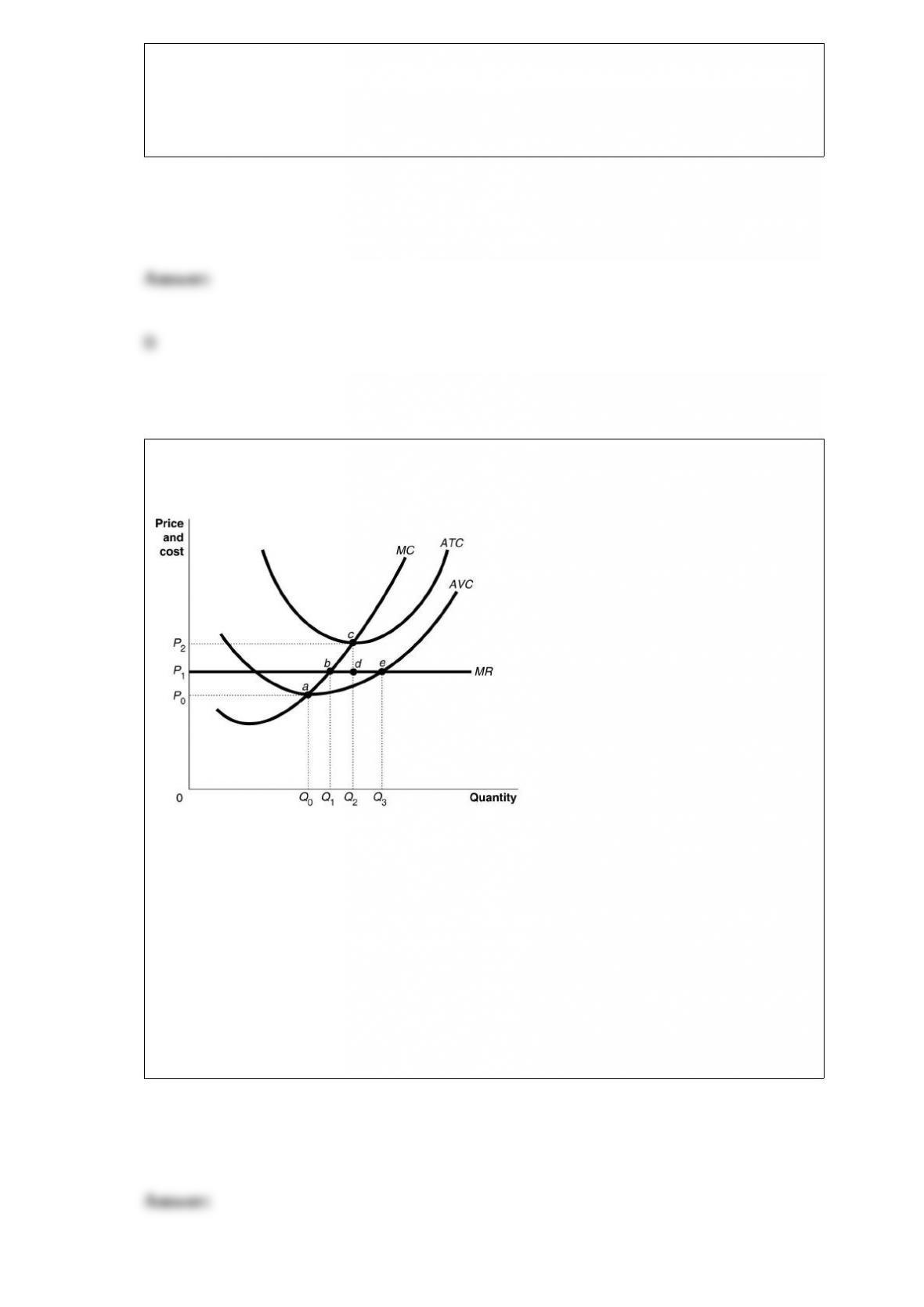
C) will reduce its output to 750 units.
D) will cease to exist.
Figure 12-20
Refer to Figure 12-20. If the market price is P1, what is the allocatively efficient output
level?
A) Q0
B) Q1
C) Q2
D) There is no allocatively efficient output level because the firm is making a loss.
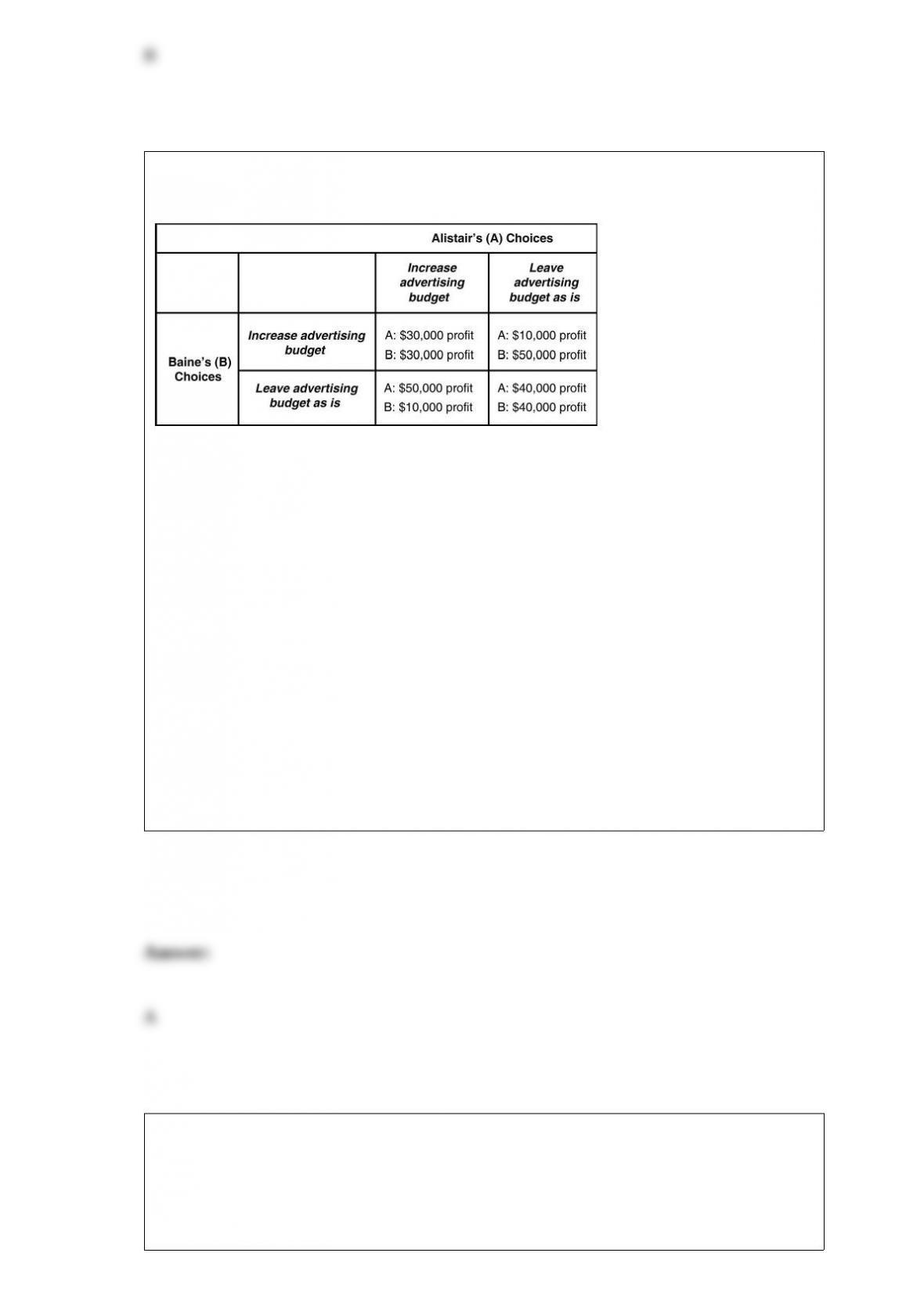
Table 14-4
Alistair Luggage and Baine Baggage are the only firms selling luggage in the upscale
town of Montecito. Each firm must decide on whether to increase its advertising
spending to compete for customers. If one firm increases its advertising budget but the
other does not, then the firm with the higher advertising budget will increase its profit.
Table 14-4 shows the payoff matrix for this advertising game.
Refer to Table 14-4. Does Alistair have a dominant strategy and if so, what is it?
A) Yes, Alistair should increase its advertising budget.
B) Yes, Alistair should keep its advertising budget as is.
C) There are two dominant strategies: if Baine increases its advertising budget, then
Alistair’s best bet is to keep its budget the same but if Baine does not increase its
spending then Alistair should raise its advertising budget
D) No, there is no dominant strategy.
Successful price discrimination cannot take place if
A) the market is perfectly competitive.
B) the market can be segmented into different buyer groups.

C) customers are not able to resell the product.
D) the demand curve facing the firm is downward-sloping.
Assume that air pollution from a copper smelter imposes external costs on people who
live near the smelter. If the victims of the pollution could not legally enforce the right of
their property not to be damaged, the amount of pollution reduction
A) would be significantly less than if the owners of the smelter were legally liable for
damages.
B) would be less than the amount at which the marginal benefit of pollution reduction
equaled the marginal cost.
C) would be the same as if it would be if the owners of the smelter were legally liable.
D) would be too small; the government would have to intervene to bring about an
efficient outcome.
Suppose the following two events occur in the market for elementary school teachers:
a. Overcrowded schools and education budget cuts have discouraged young college
students from pursuing careers in teaching.
b. With an increasing birth rate, the number of children entering the elementary school
system is expected to increase significantly over the next ten years.
What is likely to happen to the equilibrium wage and quantity of teachers as a result of
these two events?
A) The equilibrium quantity and the equilibrium wage of elementary school teachers
fall.
B) The equilibrium wage rises and the effect on the equilibrium quantity of elementary
school teachers is indeterminate.
C) The equilibrium quantity falls and the effect on the equilibrium wage of elementary
school teachers is indeterminate.
D) The equilibrium quantity falls and the equilibrium wage of elementary school
teachers rises.
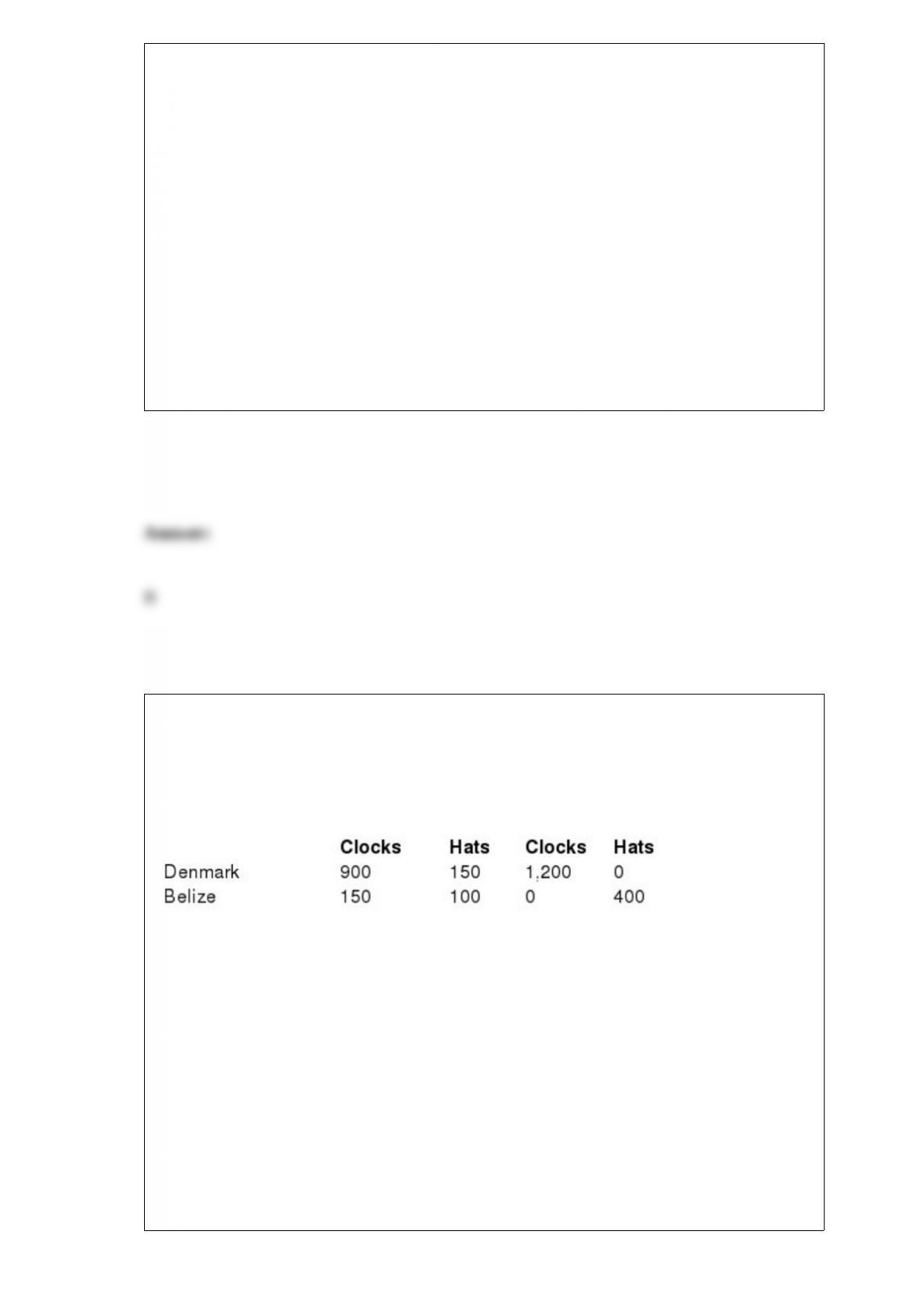
Table 9-6
Production and
Consumption Production
Without Trade With Trade
Denmark and Belize can produce both clocks and hats. Table 9-6 shows the production
and consumption quantities without trade, and the production numbers with trade.
Refer to Table 9-6. Prior to trade, what was the opportunity cost to produce 1 clock in
Denmark?
A) 1/6 of a hat
B) 2/3 of a hat
C) 1.5 hats
D) 6 hats

When a firm charges $4.95 instead of $5.00, what do economists call this pricing
strategy?
A) cost-plus pricing
B) indirect pricing
C) odd pricing
D) unusual pricing
In the United States, private health insurance companies
A) are all for-profit firms.
B) are all not-for-profit firms.
C) can be either for-profit or not-for-profit firms.
D) are all government-run firms.

Jaycee Jeans sold 40 pairs of jeans at a price of $40. When it lowered its price to $20,
the quantity sold increased to 60 pairs. Calculate the absolute value of the price
elasticity of demand. Use the midpoint formula.
A) 1.67
B) 1.0
C) 0.6
D) 0.53
In the past the federal government often employed what is called a “command and
control” approach to the reduction of pollution emissions. Many economists are critical
of this approach because
A) it does not lead to significant reductions in pollution.
B) they believe a market-based approach will reduce pollution more efficiently.
C) the “command and control” approach is designed to help firms at the expense of
consumers.
D) the “command and control” approach leads to negative externalities.
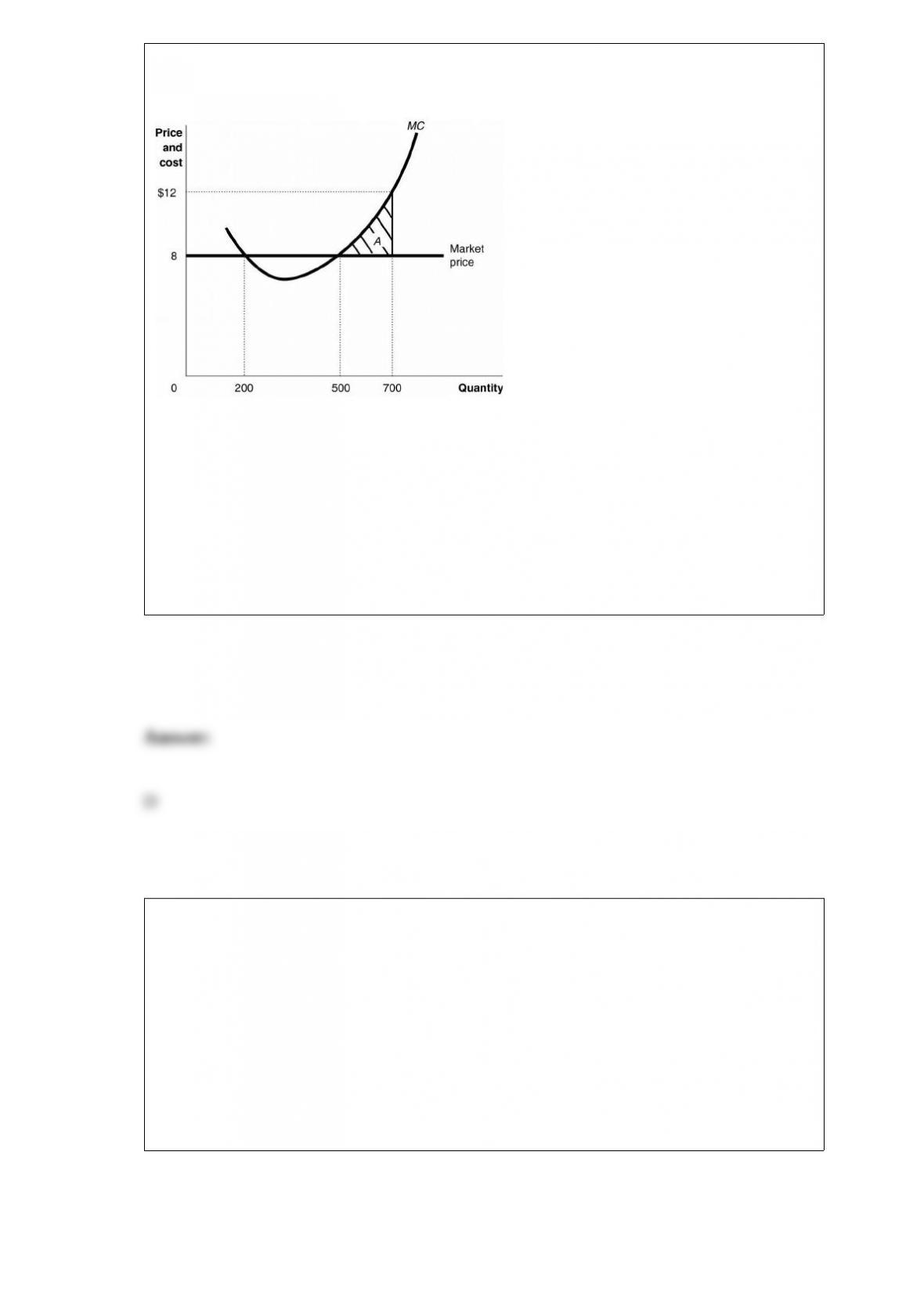
Figure 12-1
Refer to Figure 12-1. If the firm is producing 200 units
A) it breaks even.
B) it is making a loss.
C) it should cut back its output to maximize profit.
D) it should increase its output to maximize profit.
Which of the following is the source of revenue for Medicare and Social Security in the
United States?
A) individual income taxes
B) sales taxes
C) social insurance taxes
D) property taxes

Grace Makutsi finally bought a pair of blue shoes that she had been coveting for a long
time. In less than a week she discovered that the shoes were uncomfortable. Grace went
back to wearing her old pair and stashed away the new pair. When asked by her boss,
Mme. Ramotswe why does she not simply give away the new pair, she said: “But I paid
so much for them.” Grace’s behavior
A) is rational: she should not discard a valuable item.
B) ignores the fact that the purchase price is now a sunk cost and has no bearing on
whether she should give them away or not.
C) supports the endowment effect which states that ownership of an item makes it more
valuable.
D) is rational because the more you pay for an item the more valuable it is.