
Table 9-6
Production and
Consumption Production
Without Trade With Trade
Denmark and Belize can produce both clocks and hats. Table 9-6 shows the production
and consumption quantities without trade, and the production numbers with trade.
Refer to Table 9-6. If the actual terms of trade are 1 hat for 1.8 clocks and 150 hats are
traded, how many hats will Denmark gain compared to the “without trade” numbers?
A) -150
B) 0
C) 150
D) 1,050
The free rider problem refers to a situation in which
A) people consume a pure public good without payment, even though the good may not
be produced if no one chooses to pay.
B) the marginal cost of allowing additional consumers to consume a public good is
zero.
C) high income individuals subsidize the production of goods, such as education, that
make society better off.
D) markets fail to allocate resources efficiently when benefits outweigh costs.
Long-run equilibrium in a monopolistically competitive market is similar to long-run
equilibrium in a
perfectly competitive market in that in both markets, firms
A) produce at the minimum point of their average total cost curves.
B) produce where price equals marginal cost.
C) break even.
D) produce where price equals marginal revenue.
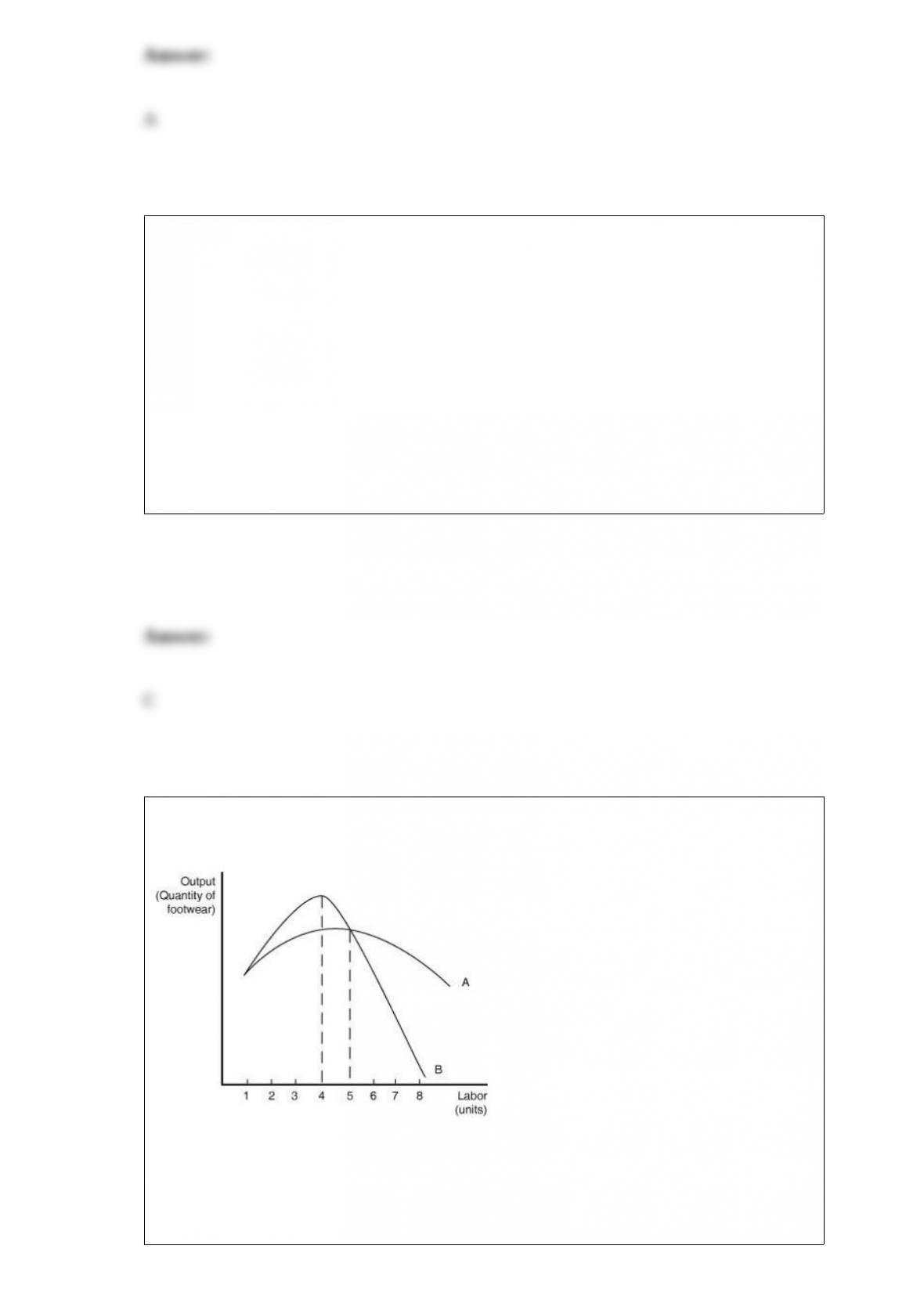
Figure 11-3
Fancy Footwear manufactures shoes. Figure 11-3 shows Fancy Footwear’s marginal
product of labor and average product of labor curves in the short run.
Refer to Figure 11-3. Which of the following statements correctly describes the curves
in the figure?

A) The marginal product of labor curve is represented by curve A and the average
product of labor curve is represented by curve B.
B) The marginal product of labor curve is represented by curve B and the average
product of labor curve is represented by curve A.
C) Curve A could represent either the average product curve or the marginal product
and curve. Curve B represents the total product curve.
D) Curve B could represent either the average product curve or the marginal product
curve. Curve A represents the total product curve.
In the short run, marginal product of labor increases at first and then falls because
A) as more labor is hired, they are not as skilled as the first ones hired.
B) there are fewer opportunities for division of labor and specialization when fewer
workers are hired.
C) managerial inefficiency sets in when a firm gets too large.
D) the new workers do not have as much experience as those who have been with the
firm for a long time and therefore are not as productive.
________ is a situation in which a good or service is produced at the lowest possible
cost.
A) Allocative efficiency
B) Productive efficiency
C) Equity
D) Optimal marginalism
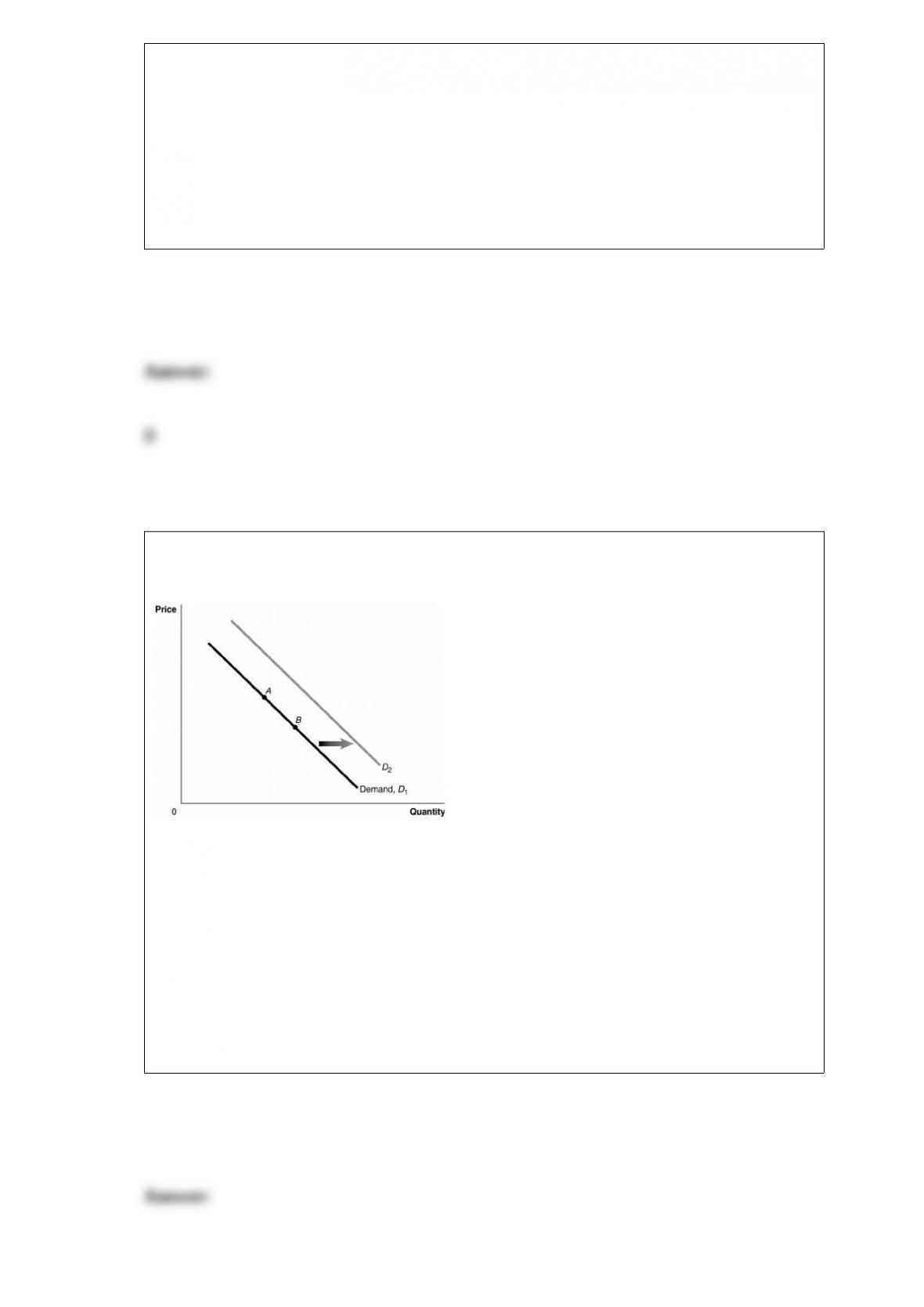
Figure 3-1
Refer to Figure 3-1. If the product represented is a normal good, a decrease in income
would be represented by a movement from
A) A to B.
B) B to A.
C) D1 to D2.
D) D2 to D1.
If Paul decides to buy a $60 ticket to a Cirque du Soleil show rather than a $45 ticket
for a Blue Man Group performance, we can conclude that
A) the marginal utility per dollar spent on Cirque du Soleil is lower than the marginal
utility per dollar spent on Blue Man Group.
B) Paul’s demand for a ticket to see Cirque du Soleil is more elastic than his demand for
a ticket to see Blue Man Group.
C) Paul is not making a rational choice.
D) the marginal utility per dollar spent on Cirque du Soleil is higher than the marginal
utility per dollar spent on Blue Man Group.
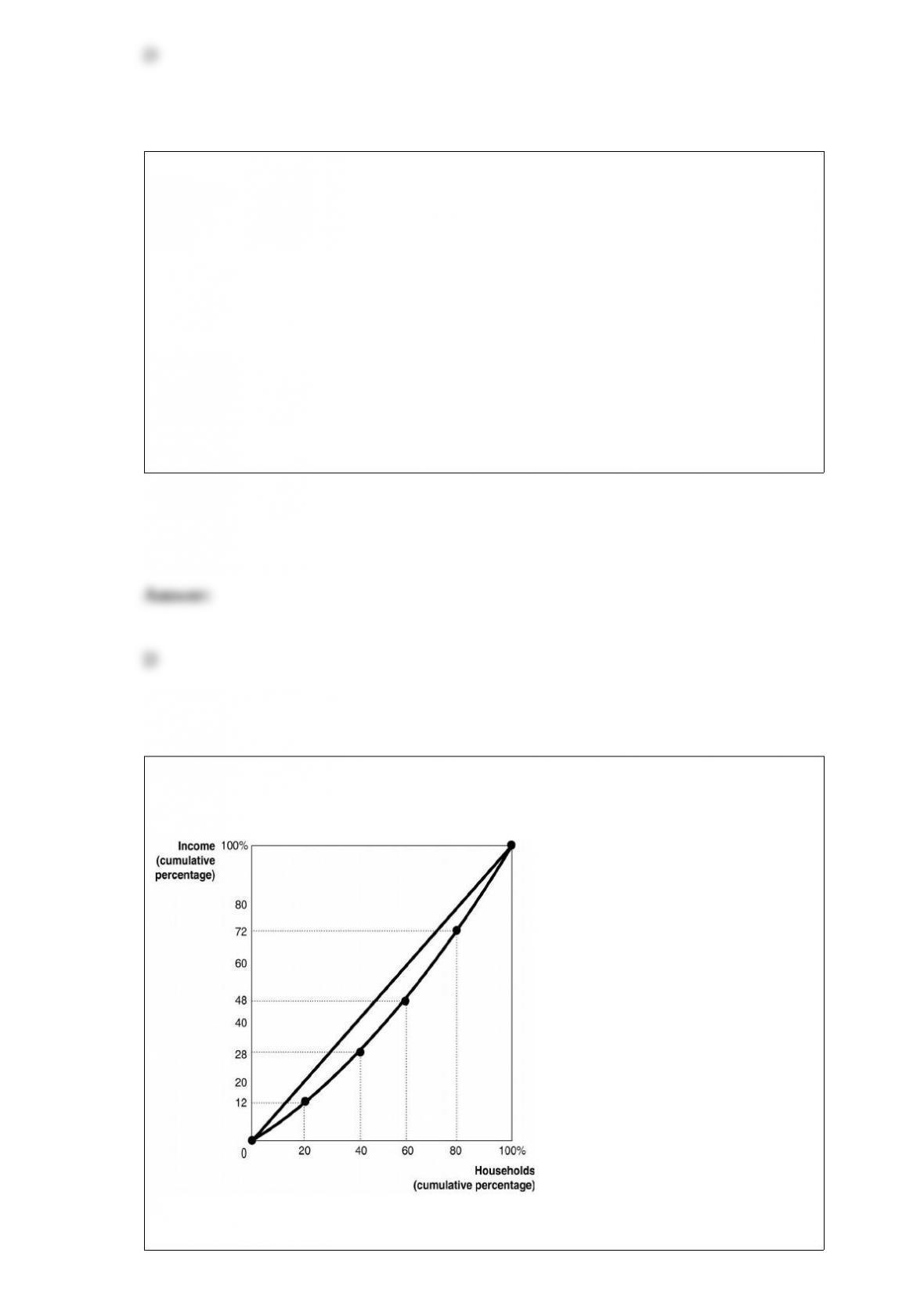
Figure 18-7
Figure 18-7 shows the Lorenz curve for a hypothetical country.

Refer to Figure 18-7. The second highest 20 percent of households
A) earn 24 percent of the society’s total income.
B) earn 28 percent of the society’s total income.
C) earn 42 percent of the society’s total income.
D) earn 72 percent of the society’s total income.
If a 5 percent increase in income leads to a 10 percent increase in quantity demanded
for airline travel, then airline travel is
A) a necessity.
B) a substitute for another good.
C) a luxury.
D) an inferior good.
Governments grant patents to encourage
A) research and development on new products.
B) competition.

C) low prices.
D) firms to form public enterprises.
The key characteristics of a monopolistically competitive market structure include
A) many small (relative to the total market) sellers acting independently.
B) all sellers sell a homogeneous product.
C) barriers to entry are strong.
D) sellers have no incentive to advertise their products.
Max Shreck, an accountant, quit his $80,000-a-year job and bought an existing tattoo
parlor from its previous owner, Sylvia Sidney. The lease has five years remaining and
requires a monthly payment of $4,000. The lease
A) is a fixed cost of operating the tattoo parlor.
B) is a variable cost of operating the tattoo parlor.
C) is an implicit cost of operating the tattoo parlor.
D) is part of the marginal cost of operating the tattoo parlor.
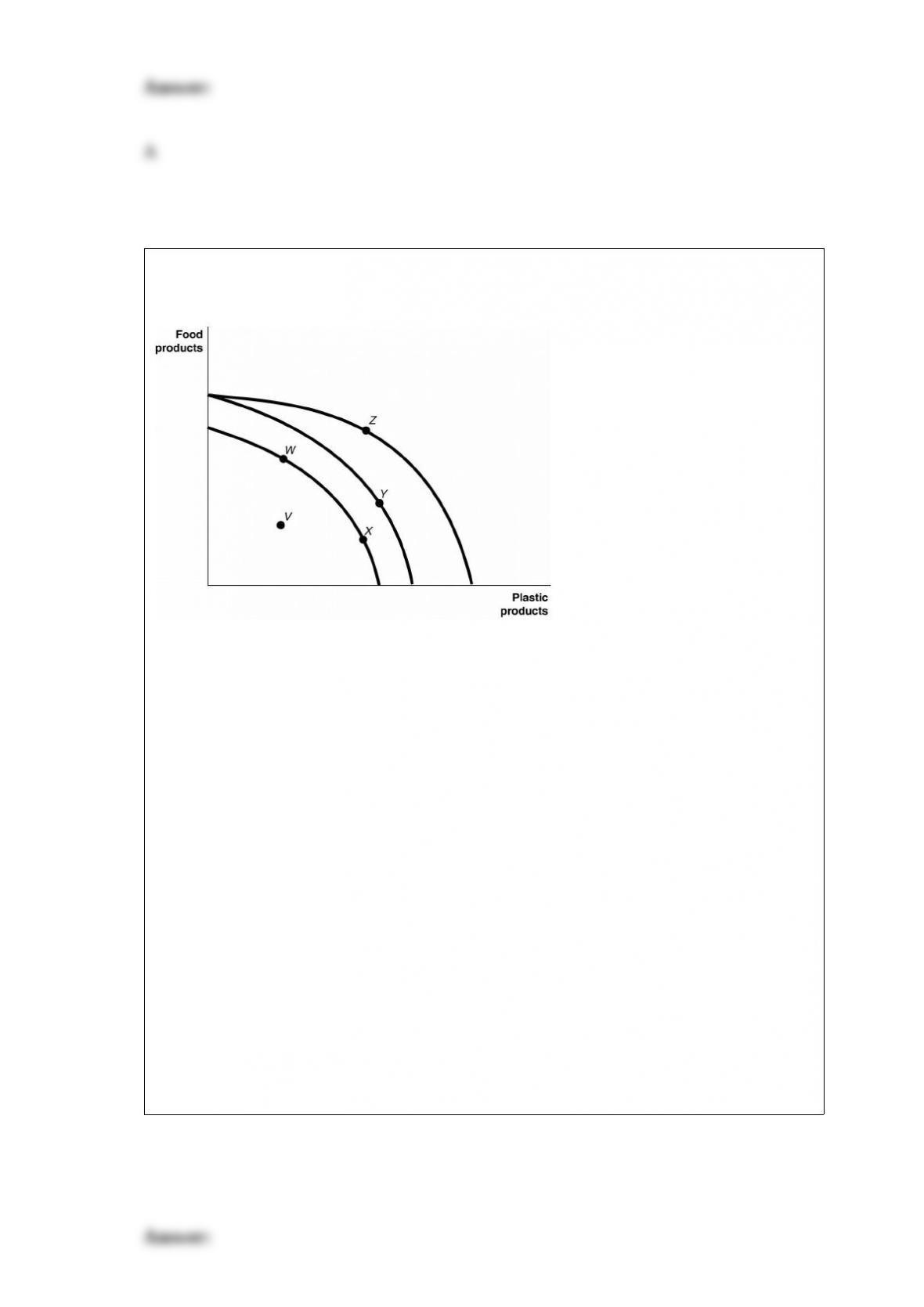
Figure 2-4
Figure 2-4 shows various points on three different production possibilities frontiers for
a nation.
Refer to Figure 2-4. Consider the following movements:
a. from point V to point W
b. from point W to point Y
c. from point Y to point Z
Which of the movements listed above represents advancements in technology with
respect to only plastic production?
A) a, b, and c
B) b and c only
C) b only
D) c only

Carrie Bradshaw claims that when it comes to buying shoes, “price is no object.” If this
is true, then her demand for shoes is
A) perfectly elastic.
B) perfectly inelastic.
C) unit-elastic.
D) horizontal.
When the price of a good falls, consumers buy a larger quantity because of the
________ effect and the ________ effect.
A) substitution; income
B) normal; inferior
C) substitute; complement;
D) supply; demand
If the percentage increase in price is 15 percent and the value of the price elasticity of
demand is -3, then quantity demanded
A) will increase by 45 percent.
B) will increase by 5 percent.
C) will decrease by 45 percent.
D) will decrease by 5 percent.
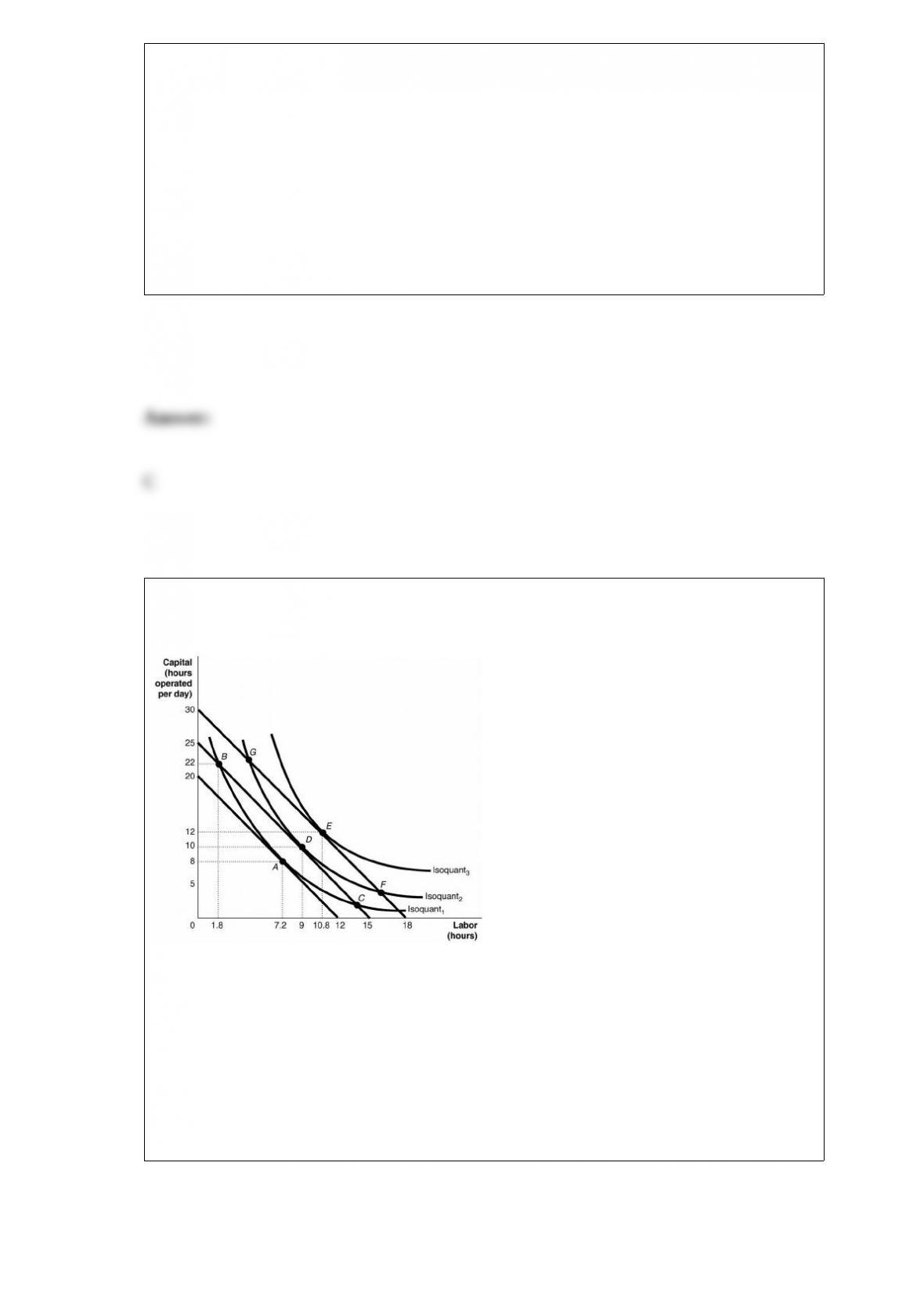
Figure 11-18
Refer to Figure 11-18. Starting from point e, a movement along the isocost to point f
A) decreases the total cost of production but not output.
B) increases the total cost of production and decreases output.
C) decreases both the total cost of production and output.
D) decreases output but not the total cost of production.

If a firm raised its price and discovered that its total revenue fell, then the demand for
its product is
A) perfectly inelastic.
B) relatively inelastic.
C) perfectly elastic.
D) relatively elastic.
Microsoft hires marketing and sales specialists to decide what prices it should set for its
products, whereas a wealthy corn farmer in Iowa, who sells his output in the world
commodity market, does not. Why is this so?
A) because Microsoft is large enough to hire the best people in the field
B) because Microsoft could potentially lose sales if it sets prices indiscriminately
C) because the wealthy corn farmer is a price taker who chooses his optimal output
independently of market price but Microsoft’s optimal output depends on the price it
selects
D) because unlike Microsoft, the wealthy corn farmer is probably a monopolist

One difference between the demand for a private good and that for a public good is that
A) with a private good, each consumer chooses the quantity she wants to consume but
with a public good, each consumer chooses the price she is willing to pay for a fixed
quantity.
B) with a private good, each consumer chooses the quantity she wants to consume but
with a public good, everyone consumes the same quantity.
C) with a private good, each consumer receives different amounts of benefit from
consuming the product but with a public good, every consumer realizes the same
amount of benefit from consuming the product.
D) the marginal benefit from consuming the last unit of a public good always exceeds
the marginal benefit from consuming the last unit of a private good because there are
externalities in the consumption of the former.
In economics, the accumulated skills and training that workers have is known as
A) human capital.
B) entrepreneurship.
C) physical capital.
D) innovation.

If the price of gasoline decreases, what will be the impact in the market for public
transportation?
A) The demand curve for public transportation shifts to the right.
B) The quantity of public transportation demanded increases.
C) The demand curve for public transportation shifts to the left.
D) The quantity of public transportation demanded decreases.
Marginal cost is
A) the total cost of producing one unit of a good or service.
B) the average cost of producing a good or service.
C) the difference between the lowest price a firm would have been willing to accept and
the price it actually receives.
D) the additional cost to a firm of producing one more unit of a good or service.
Suppose that when the price per ream of recycled printer paper rises from $4 to $4.50,
the quantity demanded falls from 800 to 600 reams per day. Using the midpoint
formula, what is the price elasticity of demand (in absolute value) over this range?
A) 0.003
B) 0.41
C) 2.43
D) 4
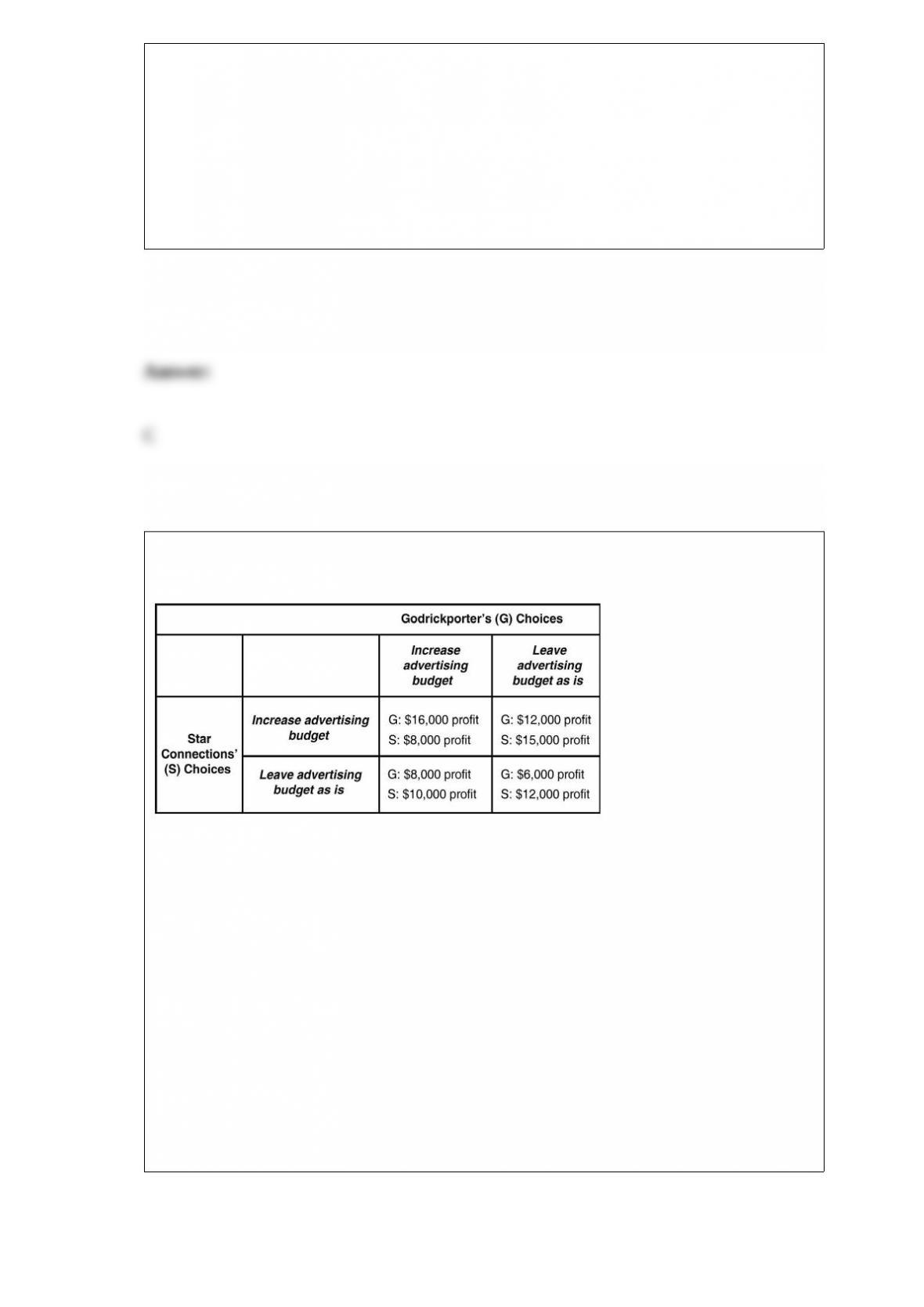
Table 14-1
Godrickporter and Star Connections are the only two airport shuttle and limousine
rental service companies in the mid-sized town of Godrick Hollow. Each firm must
decide on whether to increase its advertising spending to compete for customers. Table
14-1 shows the payoff matrix for this advertising game.
Refer to Table 14-1. Is there a dominant strategy for Star Connections and if so, what is
it?
A) No, its outcome depends on what Godrickporter does.
B) Yes, Star Connections should increase its advertising spending.
C) Yes, Star Connections should reduce its advertising spending.
D) Yes, Star Connections’ dominant strategy is to collude with Godrickporter.

The difference between technology and technological change is that
A) technology refers to the processes used by a firm to transform inputs into output
while technological change is a change in a firm’s ability to produce a given level of
output with a given quantity of inputs.
B) technology is carried out by firms producing physical goods but technological
change is an intellectual exercise into seeking ways to improve production.
C) technology is product-centered, that is, developing new products with our limited
resources while technological change is process-centered in that it focuses on
developing new production techniques.
D) technology involves the use of capital equipment while technological change
requires the use of brain power.
Which of the following is not held constant along a firm’s demand curve for labor?
A) the quantity of other inputs used by the firm
B) the wage rate
C) changes in technology
D) the price of the product produced by the firm

An explicit cost is
A) a nonmonetary opportunity cost.
B) a cost specifically related to government rules and regulations.
C) a cost that involves spending money.
D) a cost unique to corporations.
In Walnut Creek, California, there are three very popular supermarkets: Safeway, Whole
Foods and Lunardi’s. While Safeway remains open twenty-four hours a day, Whole
Foods and Lunardi’s close at 9 pm. Which of the following statements is true?
A) Safeway is a monopoly all day because it produces a service that has no close
substitutes.
B) Safeway has a monopoly at midnight but not during the day.
C) Safeway can ignore the pricing decisions of the other two supermarkets.
D) Safeway probably has a higher markup to compensate for its higher cost of
production.

The Arrow impossibility theorem
A) explains why people can be rational as well as ignorant at the same time.
B) explains why voting systems do not consistently represent the preferences of voters.
C) explains why candidates for public office must represent the preferences of the
political middle.
D) explains why it is impossible, in most cases, to eliminate special-interest legislation
after it has become law.