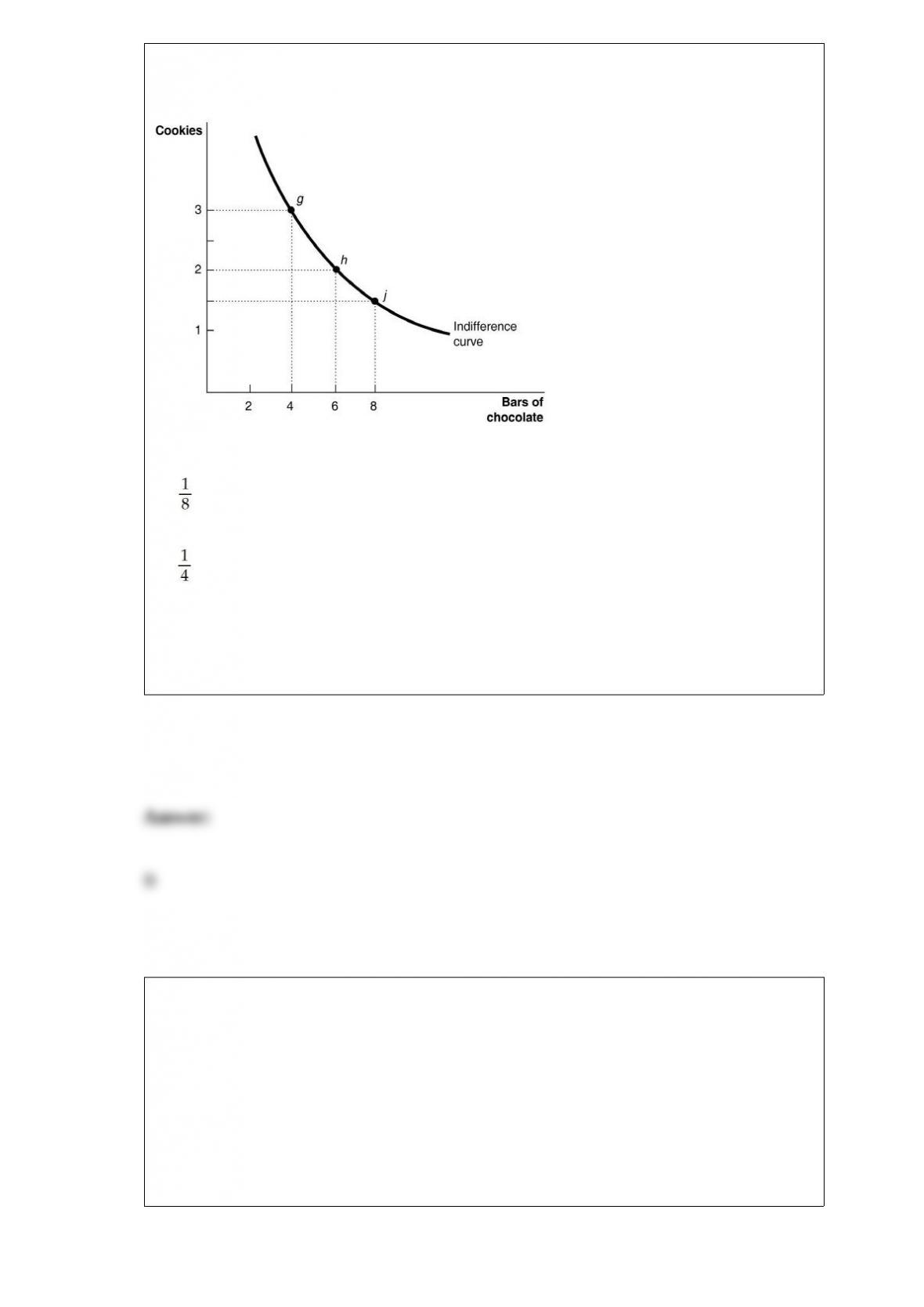
Figure 10-4
Refer to Figure 10-4. What is the marginal rate of substitution between h and j?
A) cookie.
B) cookie.
C) 2 cookies.
D) 4 cookies.
At low wages, the labor supply curve for most people slopes upward because
A) the supply of labor is perfectly inelastic at low wages.
B) as wages increase the opportunity cost of leisure increases.
C) as wages increase income also increases unless hours worked decrease.
D) the demand for labor is perfectly elastic at low wages.
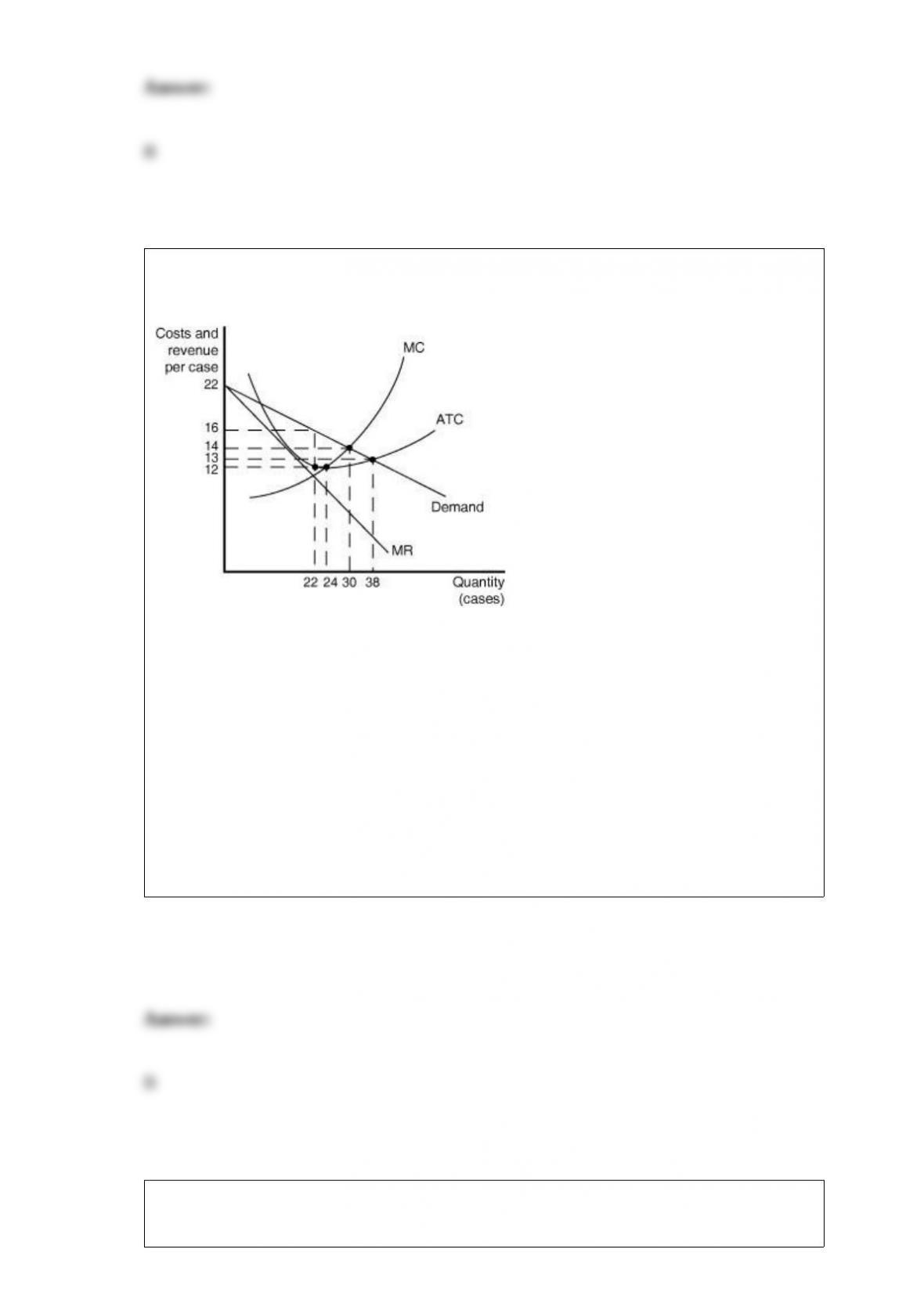
Figure 13-8
Figure 13-8 shows cost and demand curves for a monopolistically competitive producer
of iced tea.
Refer to Figure 13-8. Based on the diagram, one can conclude that
A) some existing firms will exit the market.
B) new firms will enter the market.
C) the industry is in long-run equilibrium.
D) firms achieve productive efficiency.
Economists Kenneth Chay and Michael Greenstone find that in the two years following
the passage of the Clean Air Act of 1970, the sharp reduction in air pollution also led to

a decline in infant deaths. Although this and other studies provide compelling evidence
of the link between pollution and infant health, it is not clear that reductions from the
much lower levels of ambient pollution today would have the same effect. Which of the
following reasons could explain this?
A) The cost of pollution abatement today is much higher than it was in the 1970s. Thus,
it would be far more costly to achieve the same level of benefit today as the benefit
achieved in 1970.
B) When levels of pollution are high, the marginal benefit of reducing pollution also is
high. It follows therefore that the benefit of reducing air pollution in 1970 would be
much higher than the benefit from a proportional reduction in air pollution today when
the level of pollution is much lower.
C) Today, the level of pollution is much higher. Therefore, it will take a much larger
reduction in air pollution to reap similar benefits as it did in 1970.
D) When levels of pollution are high, the marginal benefit of reducing pollution is low.
Therefore, it was necessary to significantly reduce air pollution in 1970 before benefits
can be realized. Today, when the level of pollution is much lower, such drastic measures
are unnecessary.
Which of the following is a factor of production?
A) a necklace produced by a jewelry manufacturer
B) 50 shares of Google stock
C) the security guard at the local bank
D) $1,000 in casino chips

Table 16-3
Julie plans to start a pet-sitting service. She surveyed her neighborhood to determine the
demand for this service. Assume that each person surveyed demands only one hour of
pet sitting services per period. Table 16-3 above shows a portion of her survey results.
Refer to Table 16-3. If Julie charges $10 per hour, what is the value of the consumer
surplus received by Dawn?
A) $2
B) $10
C) $12
D) $22
Which of the following statements is false?
A) Corporations can issue stocks and bonds, while proprietorships cannot.
B) Corporations have one owner, while proprietorships have many owners.
C) Corporations face more taxes than do proprietorships.
D) Proprietorships have unlimited liability while corporations have limited liability.
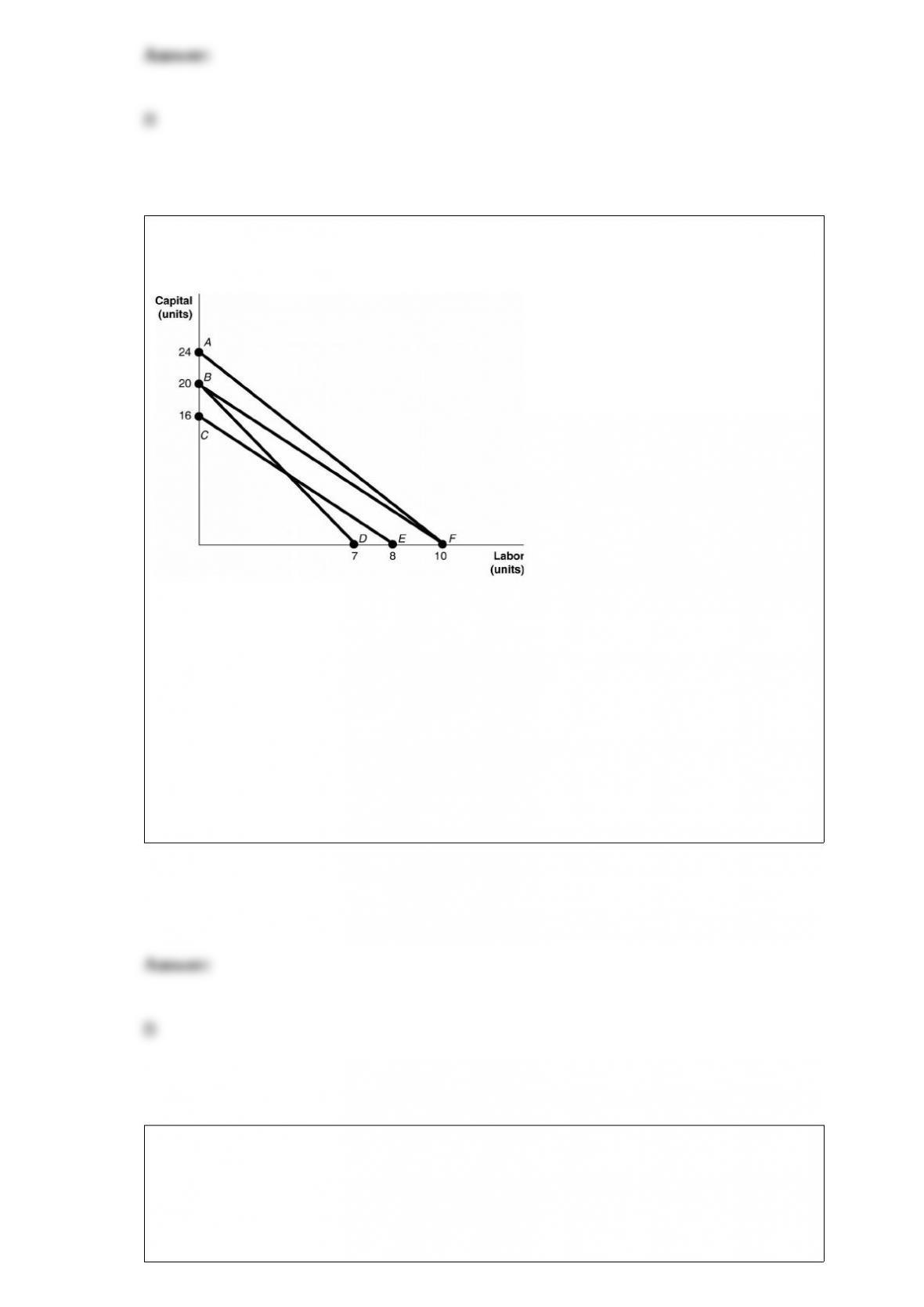
Figure 11-13
Refer to Figure 11-13. The lines shown in the diagram are isocost lines. Which of the
following shows a decrease in the price of capital while the price of labor remains
unchanged?
A) the movement from AF to BF
B) the movement from BF to AF
C) the movement from BF to BD
D) the movement from BF to CE
Which of the following is the best example of a perfectly competitive firm?
A) a corn farmer in Illinois
B) a Taco Bell restaurant

C) the Ford Motor Company
D) the United Parcel Service (UPS)
If a stock’s dividend is expected to grow at a constant rate of eight percent in the future
and it has just paid a dividend of $1.25 a share, and you have an alternative investment
of equal risk that will earn a 12 percent rate of return, what would you be willing to pay
per share for this stock?
A) $31.25
B) $1.40
C) $1.25
D) $1.12
Consider the following types of demand curves:
a. a vertical demand curve
b. a horizontal demand curve
c. a linear downward-sloping demand curve
Which of the demand curves listed exhibits a price elasticity of demand coefficient that

remains constant along the demand curve?
A) a only
B) b only
C) a and b only
D) a, b, and c
When production generates a negative externality, the true cost of production is the
A) private cost of production.
B) public cost of production.
C) social cost of production.
D) average cost of production.
If a straight line passes through the point x = 24 and y = 8 and also through the point x =
8 and y = 16, the slope of this line is
A) negative 8 divided by 4.
B) seven tenths.

C) negative one half.
D) one and one half.
Table 2-6
Table 2-6 shows the output per week of two jewelers, Serena and Haley. They can either
devote their time to making bracelets or making necklaces.
Refer to Table 2-6. What is Serena’s opportunity cost of making a necklace?
A) 2 necklaces
B) 1/2 of a bracelet
C) 1/2 of a necklace
D) 3/4 of a bracelet
Auctions in recent years have resulted in higher prices paid for letters written by John
Wilkes Booth than those written by Abraham Lincoln. What is a reason for this
difference in price?

A) There is a surplus of letters written by Booth and a shortage of letters written by
Lincoln.
B) Many people are more fascinated by villains and anti-heroes than by heroic figures.
C) There are more letters available for collectors to buy that were written by Lincoln
than there are letters that were written by Booth.
D) Booth was a well-known actor; the demand for his letters rose as wealthy actors
attempted to buy them.
All of the following are examples of public goods except
A) broadcast television with commercials.
B) clean water systems.
C) stock of knowledge in the public domain.
D) crime prevention.
Which of the following will not happen as a consequence of a monopolistically
competitive firm suffering economic losses in the short run?
A) The firm’s demand curve will shift to the right if it stays in business in the long run.

B) The firm will exit the industry if it continues to suffer economic losses.
C) The firm will break even if its stays in business in the long run.
D) In the long run the firm will be able to charge a price that is greater than its average
total cost.
The supply curve for watches
A) shows the supply of watches consumers are willing and able to buy at any given
price.
B) is downward sloping.
C) shows the relationship between the quantity of watches firms are willing and able to
supply and the quantity of watches consumers are willing and able to purchase.
D) shows the relationship between the price of watches and the quantity of watches
supplied.
In recent years unemployment rates in several European countries have been higher
than unemployment rates in the United States. Many economists believe that European
unemployment rates have been higher because
A) of the different methods used to measure unemployment. If similar methods were
used, unemployment rates in Europe and the United States would be about the same.

B) European firms hire many seasonal workers from other countries, and this tends to
inflate unemployment rates in their countries.
C) unemployment benefits are more generous in Europe than in the United States.
D) the size of the military is much higher in the United States and all military personnel
are classified as employed.
Suppose Renee can increase her total utility from consuming video rentals and books by
buying one more book and renting one fewer video. Which of the following is true?
A) The marginal utility of video rentals is negative.
B) The marginal utility per dollar spent on books exceeds that of video rentals.
C) The marginal utility of the last book consumed exceeds the marginal utility of the
last video rental consumed.
D) The marginal utility of the last video rental consumed exceeds the marginal utility of
the last book consumed.
Figure 2-2

Figure 2-2 above shows the production possibilities frontier for Mendonca, an agrarian
nation that produces two goods, meat and vegetables.
Refer to Figure 2-2. Suppose Mendonca is currently producing 60 pounds of
vegetables per period. How much meat is it also producing, assuming that resources are
fully utilized?
A) 45 pounds of meat
B) 75 pounds of meat
C) 80 pounds of meat
D) 100 pounds of meat
After selling 1,000 three-ring binders Tony DiFulvio realizes that the marginal revenue
from selling the last binder was less than the marginal cost. From this we can conclude
that
A) Tony’s business earns a short-run economic profit.
B) Tony should shut down his business temporarily.
C) Tony’s profit fell after selling his 1,000th three-ring binder.
D) Tony’s profit would be greater if he sold an additional three-ring binder.

The public choice model can be used to examine voting models that contrast the
manner in which collective decisions are made by governments (state, local and federal)
and the manner in which individual choices are made in markets. Which of the
following descriptions is consistent with the difference between collective
decision-making and decision-making in markets?
A) Everyone who votes must agree with a decision made collectively through
government, but in markets individuals can make their own choices.
B) Individuals are less likely to see their preferences represented in the outcomes of
government policies than in the outcomes of markets.
C) The cost of a government policy is determined by a majority vote of members of the
public; decisions made in markets are based on individual willingness to pay.
D) Choices made through government policies are more important than decisions
individuals make through markets.
Allison’s Auto Art is a company that applies pinstripes to vehicles. Allison’s cost for a
basic 1-color pinstriping job is $35, and she charges $95 for this service. For a total
price of $175, Allison will apply a fancier 3-color pinstripe application to an
automobile, a service that adds an additional $40 to the total cost of the package.
Should Allison continue to offer the 3-color pinstripe application?
A) yes, she still makes a profit by selling the 3-color application.
B) yes, but only if she lowers the price of the 1-color application

C) no, her marginal benefit is less than her marginal cost
D) More information is needed for Allison to make this decision.
The change in a firm’s revenue as a result of hiring one more worker
A) is the definition of the marginal product of labor.
B) is equal to the firm’s marginal cost.
C) is the definition of the marginal revenue product of labor.
D) will be negative if the demand for the firm’s output is inelastic.
What is the present value of $575 in a one year if the current rate of interest is 4
percent?
A) $410.71
B) $552.88
C) $598
D) $805

Suppose a tax equal to the value of the marginal external cost at the optimal output is
imposed on a pollution generating good. All of the following will result from the tax
except
A) an increase in the equilibrium market price.
B) a decrease in the equilibrium quantity produced and consumed.
C) a decrease in market supply of the good.
D) an increase in the demand for the good.
The Jeans Store sells 7 pairs of jeans per day when it charges $100 per pair. It sells 8
pairs of jeans per day at a price of $90 per pair. The marginal revenue of the eighth pair
of jeans is
A) $20.
B) $90.
C) $100.
D) $700.

A monopolistically competitive firm faces a downward-sloping demand curve because
A) it is able to control price and quantity demanded.
B) there are few substitutes for its product.
C) of product differentiation.
D) its market decisions are affected by the decisions of its rivals.
If a monopolistically competitive firm is producing 50 units of output where marginal
cost equals marginal revenue, total cost is $1,674 and total revenue is $2,000, its
average profit is
A) $326.
B) $40.
C) $6.52.
D) impossible to determine without additional information.

If the market price is $25, the average revenue of selling five units is
A) $5.
B) $12.50.
C) $25.
D) $125.
Assuming that the total market size remains constant, a monopolistically competitive
firm earning profits in the short run will find the demand for its product decreasing in
the long run because
A) new entrants into the market are more likely to have cutting edge products.
B) as the firm raises its price in the long run, it will lose some customers to new
entrants in the market.
C) some of its customers have switched to purchasing the products of new entrants in
the market.
D) its costs of production rises.