
The costs in time and other resources that parties incur in the process of agreeing to and
carrying out an exchange of goods or services are called
A) exchange costs.
B) implicit costs.
C) transactions costs.
D) selling costs.
Assume that the market for barley is in equilibrium and the demand for barley is
inelastic. Predict what happens to the revenue of barley farmers if a prolonged drought
reduces the supply of barley. The drought will cause farm revenue to
A) rise because there will be a shortage of barley.
B) rise because the percentage decrease in quantity sold is less than the percentage
increase in price.
C) rise because the percentage increase in quantity sold is greater than the percentage
increase in price.
D) fall because of the decrease in the quantity of barley sold.
That some talented people may not enter an occupation because they have heard that
people with their personal characteristics do not get hired in that occupation is known

as
A) economic discrimination.
B) a compensating difference.
C) a negative feedback loop.
D) worker discrimination.
The ________ demonstrates the roles played by households and firms in the market
system.
A) production possibilities frontier
B) circular flow model
C) theory of comparative advantage
D) business cycle
Economic efficiency is defined as a market outcome in which the marginal benefit to
consumers of the last unit produced is equal to the marginal cost of production, and in
which
A) the sum of consumer surplus and producer surplus is at a maximum.

B) economic surplus is minimized.
C) the sum of the benefits to firms is equal to the sum of the benefits to consumers.
D) the sum of consumer surplus and producer surplus is minimized.
The production possibilities frontier model shows that
A) if consumers decide to buy more of a product its price will increase.
B) a market economy is more efficient in producing goods and services than is a
centrally planned economy.
C) economic growth can only be achieved by free market economies.
D) if all resources are fully and efficiently utilized, more of one good can be produced
only by producing less of another good.
An oligopoly firm is similar to a monopolistically competitive firm in that
A) both firms face the prisoner’s dilemma.
B) both operate in a market in which there are entry barriers.
C) both firms have market power.
D) both firms are in industries characterized by an interdependent firm.

Improvements in inventory control represent a positive technological change because
they allow firms to produce the same output with fewer inputs. In recent years, many
firms have adopted an inventory system in which firms accept shipments from suppliers
as close as possible to the time they will be needed. Wal-Mart has been a pioneer in
using inventory control systems to this in its stores. This type of inventory system is
called a ________ inventory system.
A) first-in-first-out
B) cash-and-carry
C) just-in-time
D) buy-now-pay-later
In markets with asymmetric information
A) moral hazard causes adverse selection which in turn causes asymmetric information.
B) adverse selection causes moral hazard which in turn causes asymmetric information.
C) asymmetric information causes moral hazard and then it causes adverse selection.
D) asymmetric information causes adverse selection and then it causes moral hazard.

Which of the following best illustrates the free rider problem?
A) Since no one owns elephants and elephants are valued for their hide, meat and ivory,
elephants can be hunted to extinction.
B) For every purchase of a $30 fare card, you are entitled to five free bus rides.
C) If your neighbors professionally landscape their front yards, it is likely that the
market value of your property will increase.
D) All three homeowners in a quiet cul-de-sac have expressed the desirability of
security lighting in the common parking area. One of the homeowners installs the
lighting and asks you to contribute toward the cost. You choose not to contribute.
Producing a homogeneous product occurs in which of the following industries?
A) oligopoly, monopolistic competition and perfect competition
B) perfect competition only
C) oligopoly and perfect competition
D) monopolistic competition and perfect competition

Which of the following is not an option for a perfectly competitive firm that suffers
short-run losses?
A) shutting down
B) reducing production
C) reducing the use of variable factors
D) raising price
For which of the following products is social influence likely to have the greatest
impact?
A) toothpaste
B) restaurants
C) high-blood pressure medication
D) school textbook
Diseconomies of scale occur when
A) long-run average costs rise as a firm increases its output.

B) long-run average cost fall as a firm expands its plant size.
C) short-run average costs rise as a firm expands its plant size.
D) long-run labor costs rise as a firm increases its output.
All of the following are part of the “taxes” provision of the Patient Protection and
Affordable Care Act (ACA) except
A) pharmaceutical firms and health insurance firms will pay new taxes.
B) investors earning more than $200,000 will pay a new tax on their investment
income.
C) beginning in 2018, all taxes on employer-provided health insurance plans will be
reduced or eliminated.
D) workers earning more than $200,000 will have their share of the Medicare payroll
tax increase.
The labor market is considered as one of the more important markets in an economy
because
A) most people typically earn the bulk of their income from wages and salaries.
B) most people are concerned that wages determined in the labor market are unfair.
C) the usual market forces do not hold in the labor market.
D) the labor market does not reach an equilibrium.
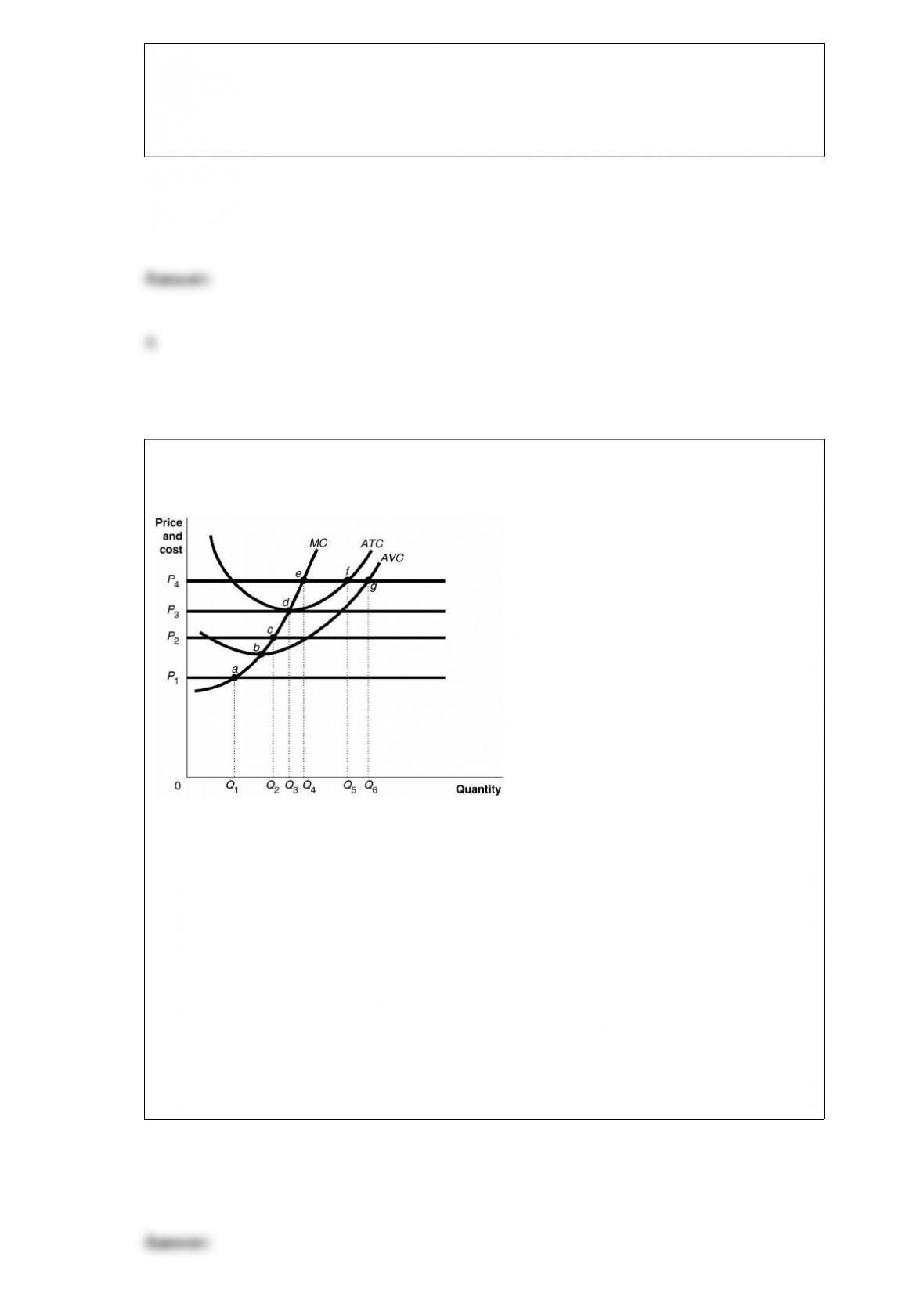
Figure 12-9
Figure 12-9 shows cost and demand curves facing a profit-maximizing, perfectly
competitive firm.
Refer to Figure 12-9. At price P4, the firm would produce
A) Q3 units.
B) Q4 units.
C) Q5 units.
D) Q6 units.
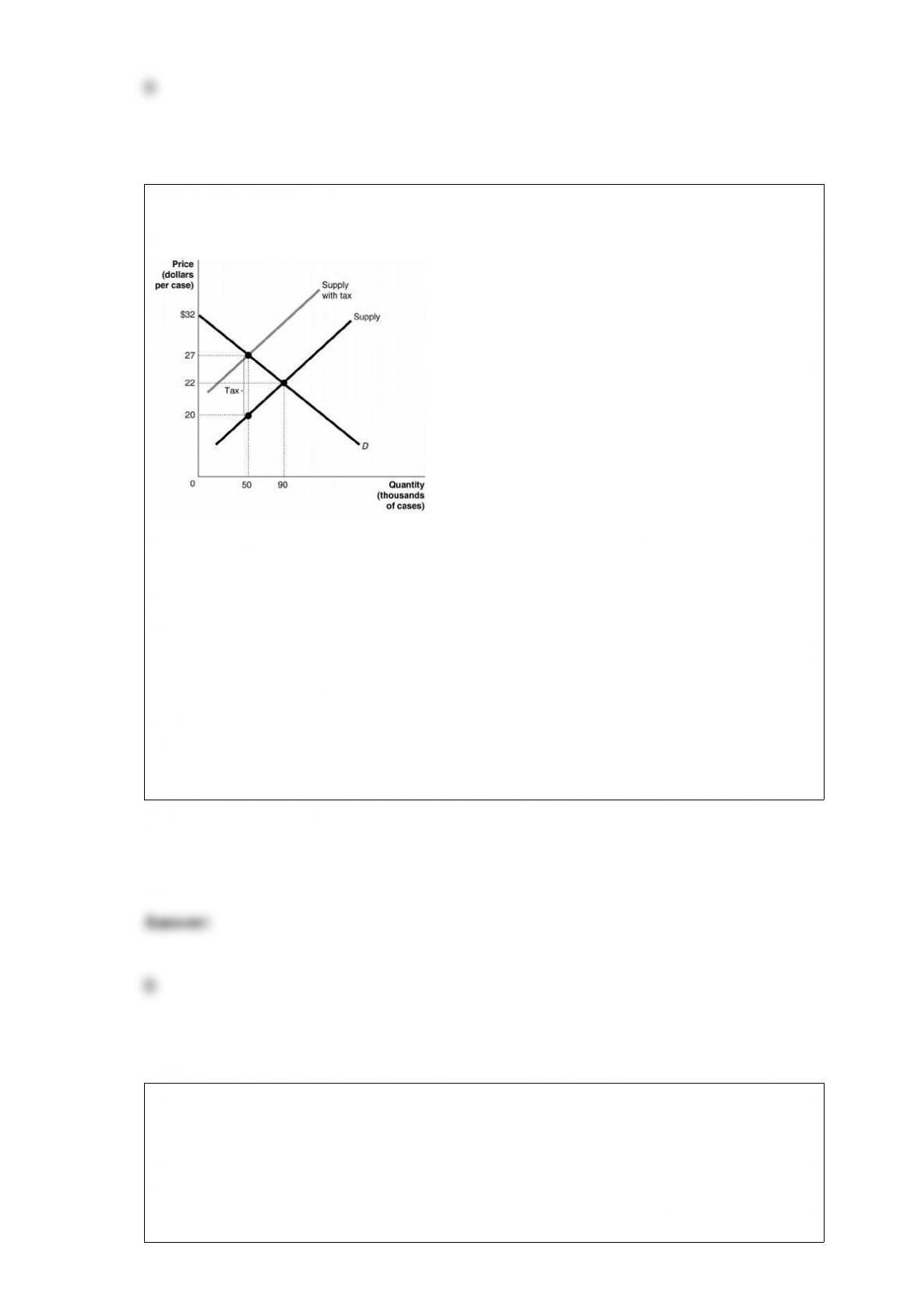
Figure 4-8
Figure 4-8 shows the market for beer. The government plans to impose a unit tax in this
market.
Refer to Figure 4-8. How much of the tax is paid by buyers?
A) $2
B) $5
C) $7
D) $12
A patent
A) grants the creator of a book, film, or piece of music the exclusive right to use the
creation for 20 years.
B) grants the creator of a book, film, or piece of music the exclusive right to use the

creation during the creator’s lifetime.
C) gives a firm the exclusive right to a new product for 20 years from the date the
product is invented.
D) gives the firm the exclusive right to a new product during the product inventor’s
lifetime.
Merger guidelines developed by the U.S. Department of Justice and the Federal Trade
Commission use the Herfindahl-Hirschman Index as a measure of concentration. This
index measures concentration in an industry by
A) adding up the market shares of all firms in the industry, squaring this number and
then dividing by the number of firms in the industry.
B) squaring the market shares of each firm in an industry and then adding up the values
of the squares.
C) squaring the four-firm concentration ratio of the industry and dividing this number
by the total number of firms in the industry.
D) determining the market shares of the four largest firms in the industry, but unlike the
concentration ratio, the Index includes sales in the United States by foreign firms.
Economists caution that conventional statistics used to estimate the extent of poverty in
the United States fail to account for benefits people receive that, if considered, would
reduce the amount of poverty. Which of the following is an example of these benefits?

A) Individuals can use tax credits and the personal exemption to reduce their taxable
incomes. This reduces what they owe the government and increases their disposable
incomes.
B) The federal income tax system is progressive. As a result, the poor have higher
after-tax incomes than they would have if the income tax system was proportional or
progressive.
C) Individuals with low incomes receive non-cash benefits such as free school lunches
and food stamps.
D) The federal minimum wage forces employers to pay workers with low skills an
efficiency wage.
Which of the following statements explains the difference between diminishing returns
and diseconomies of scale?
A) Diminishing returns are the result of changes in explicit costs. Diseconomies of
scale are the result of changes in explicit costs and implicit costs.
B) Diminishing returns refer to production while diseconomies of scale refer to costs.
C) Diminishing returns cause a firm’s marginal cost curve to rise; diseconomies of scale
cause a firm’s marginal cost curve to fall.
D) Diminishing returns apply only to the short run; diseconomies of scale apply only in
the long run.

Zach Greinke and other star baseball players earn millions of dollars annually. These
salaries are due to
A) the greed of players and their agents.
B) the demand and supply of labor in the market for baseball players.
C) the elastic demand for jobs in Major League Baseball.
D) the irrational behavior of team owners.
Eliza consumes 12 cappuccinos and 8 apple turnovers per week. The price of
cappuccino is $4 each and apple turnovers are $1 each.
a. What is the amount of income allocated to cappuccino and apple turnover
consumption?
b. What is the price ratio (the price of cappuccino relative to the price of apple
turnovers)?
c. Explain the meaning of the price ratio you computed.
d. If Eliza maximize utility, what is the ratio of the marginal utility of cappuccino to the
marginal utility of apple turnovers?
e. If the price of apple turnovers falls, will Eliza consume more apple turnovers, fewer
apple turnovers or the same amount of apple turnovers? Explain your answer using the
rule of equal marginal utility per dollar.

The law of diminishing marginal returns states
A) that at some point, adding more of a fixed input to a given amount of variable inputs
will cause the marginal product of the variable input to decline.
B) that at some point, adding more of a variable input to a given amount of a fixed input
will cause the marginal product of the variable input to decline.
C) that in the presence of a fixed factor, at some point average product of labor starts to
fall as more and more variable inputs are added.
D) average total costs of production initially fall and after some point starts to rise at a
decreasing rate as output increases.
Which of the following are implicit costs for a typical firm?
A) opportunity costs of capital owned and used by the firm
B) the cost of labor hired by the firm
C) utilities cost
D) a business licensing fee

A firm will make a profit when
A) P > AVC.
B) P > ATC.
C) P = ATC.
D) P = MC.
Which of the following statements is true?
A) If a tax is imposed on a product sold by a monopolist, the monopolist will maximize
its profits by producing where marginal revenue equals marginal cost.
B) A monopolist will always charge the highest possible price.
C) If a tax is imposed on a product sold by a monopolist, the monopolist can increase
its price to pass along the entire tax to consumers.
D) Because a monopolist faces no competition, the demand for its product is perfectly
inelastic.

If workers in nuclear power plants underestimate the true risk of their jobs
A) employers will pay compensating differential to compensate employees fully for the
risk they have assumed.
B) safety legislation will not make workers better off.
C) the wages of these workers will not be high enough to compensate them fully for the
risk they have assumed.
D) the supply of workers in this occupation will exceed demand.
The phrase “demand has decreased” means that
A) a demand curve has shifted to the left.
B) there has been an upward movement along a demand curve.
C) there has been a downward movement along a demand curve.
D) a demand curve has shifted to the right.

Pookie’s Pinball Palace restores old Pinball machines. Pookie has just spent $300
purchasing and cleaning a 1960s-era machine which he expects to sell for $2,000 once
he is finished with the restoration. After having spent $300, Pookie discovers that he
will need to rewire the entire machine at a cost of $1,100 in order to finish the
restoration. Alternatively, he can sell the machine “as is” now for $1,000. What is his
marginal benefit if he sells the machine “as is” now?
A) $300
B) $900
C) $1,000
D) The marginal benefit cannot be determined.