
One reason Starbucks experienced a decline in sales in the late 2000s is because
A) the product they offered was becoming less differentiated from their competitors’
products.
B) the coffeehouse market transitioned from being monopolistically competitive to
perfectly competitive.
C) barriers to entry became more restrictive in the coffeehouse market.
D) the number of competitors in the market declined dramatically.
In a typical year, ________ new firms open in the United States.
A) more than 600,000
B) more than 1 million
C) less than 200,000
D) approximately 125,000
If a firm wanted to know whether the demand for its product was elastic, unit-elastic, or
inelastic, then the firm could
A) survey competitors and ask them what they think demand elasticity is for the
product.

B) talk to its customers.
C) change price a little bit and observe what happens to total revenue.
D) not do anything as there is no way to find an elasticity value.
If a good has a negative income elasticity of demand, this indicates that the good is
A) a substitute with another good.
B) a complement with another good.
C) inferior.
D) normal.
The demand curve for each seller’s product in perfect competition is horizontal at the
market price because
A) each seller is too small to affect market price.
B) the price is set by the government.
C) all the sellers get together and set the price.
D) all the demanders get together and set the price.

Compared to perfect competition, the consumer surplus in a monopoly
A) is unchanged because price and output are the same.
B) is lower because price is higher and output is lower.
C) is higher because price is higher and output is the same.
D) is eliminated.
The highest-valued alternative that must be given up to engage in an activity is the
definition of
A) utility.
B) implicit cost.
C) opportunity cost.
D) economic sacrifice.

Assume a hypothetical case where an industry begins as perfectly competitive and then
becomes a monopoly. Which of the following statements regarding economic surplus in
each market structure is true?
A) Under perfectly competitive conditions, economic surplus in this industry equals
consumer surplus plus producer surplus. Under monopoly conditions, some consumer
surplus is transferred to producer surplus, but economic surplus is the same as it was
under perfectly competitive conditions.
B) Under perfectly competitive conditions, economic surplus in this industry is
maximized. Under monopoly conditions economic surplus is minimized.
C) Under perfectly competitive conditions, economic surplus is equal to consumer
surplus; there is no producer surplus because firms are price-takers. Under monopoly
conditions, economic surplus is equal to producer surplus.
D) Under perfectly competitive conditions, economic surplus is maximized. Under
monopoly conditions economic surplus is less than under perfect competition and there
is a deadweight loss.
A recent study indicated that “Stricter college alcohol policies such as raising the price
of alcohol, or banning alcohol on campus, decreases the number of students who use
marijuana.” This indicates that the cross-price elasticity between alcohol and marijuana
is positive.

Minimum efficient scale is defined as the level of output at which
A) all economies of scale are exhausted.
B) diminishing returns affect average total cost.
C) the firm’s long-run average total cost starts falling.
D) the maximum output is produced.
Which of the following characterizes the market that Starbucks competes in?
A) All coffeehouses face horizontal demand curves.
B) Coffeehouses sell identical products.
C) Barriers to entry are low.
D) There are a small number of firms.
Table 9-6
Production and
Consumption Production
Without Trade With Trade

Denmark and Belize can produce both clocks and hats. Table 9-6 shows the production
and consumption quantities without trade, and the production numbers with trade.
Refer to Table 9-6. With trade, what is the total gain in clock production?
A) 150
B) 300
C) 2,100
D) 2,250
Figure 17-3
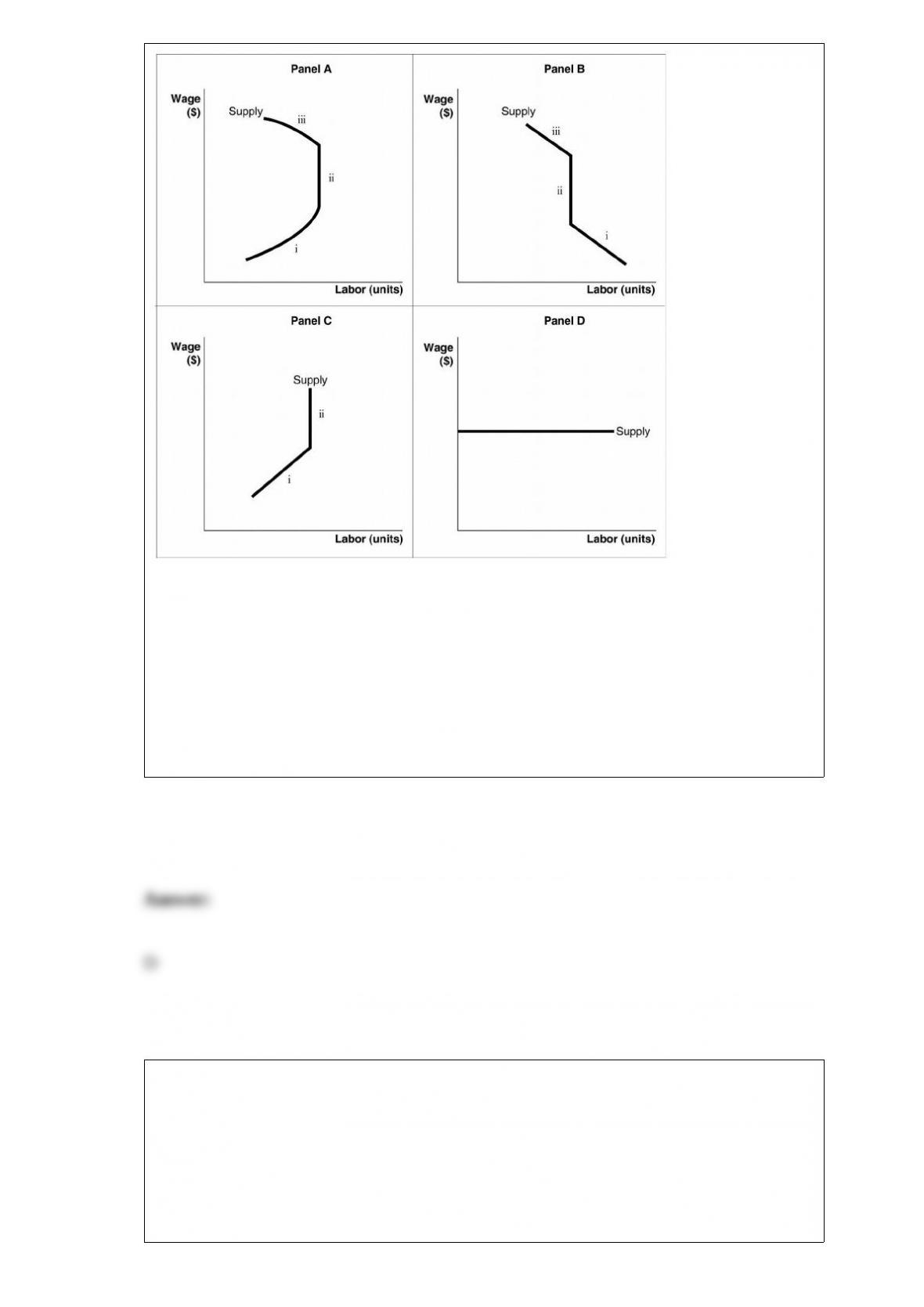
Refer to Figure 17-3. InPanel A, at high wages (segment iii)
A) the price of leisure is rising relative to the price of labor.
B) the price of leisure is falling relative to the price of labor.
C) laborers work more as wages increase.
D) labor suppliers take more leisure as wages increase.
Which of the following statements is true about advertising by a monopolistically
competitive firm?
A) Since the monopolistic competitor, like the perfect competitor, makes zero profit in
the long run, it is a waste of resources to advertise its products.
B) Advertising could make the monopolistic competitor’s demand more inelastic, but

advertising has no effect on a perfect competitor’s demand.
C) Advertising will be more beneficial if a monopolistic competitor colludes with other
firms to advertise the products of the industry as a whole rather than an individual firm’s
product.
D) Monopolistically competitive firms tend to shun advertising because advertising
draws attention to the variety of differentiated products available in the industry.
“Sin taxes,” such as taxes on alcoholic beverages, are intended to
A) increase the amount of the products supplied.
B) generate money to subsidize production of the products taxed.
C) reduce the quantity demanded.
D) generate funds to aid in the medical care of those harmed by the product.
Figure 2-7
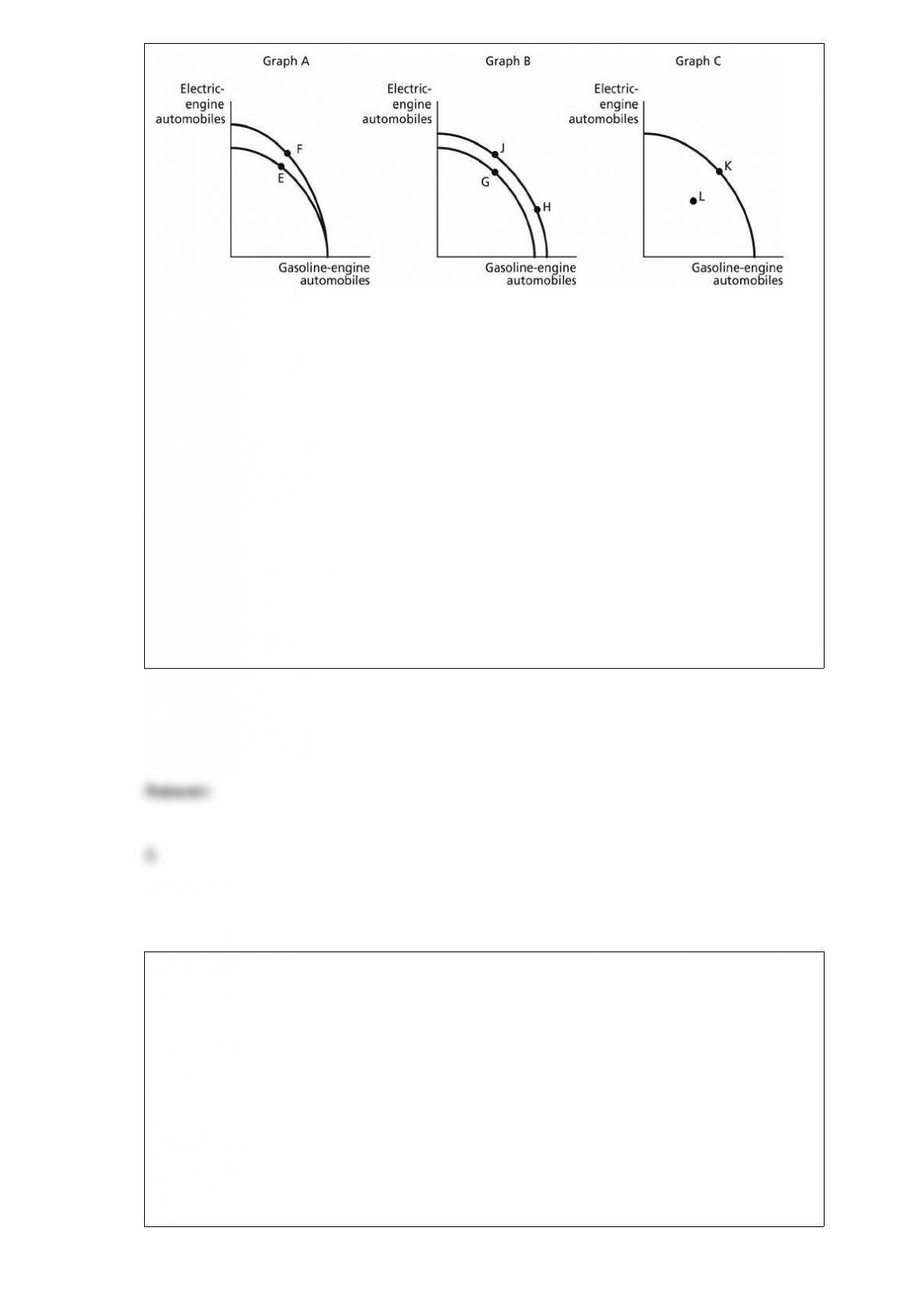
Mercedes Benz recently decided to introduce its B-class automobile in the U.S. market,
an electric car that is has designed and developed in a partnership with Tesla Motors.
Assume Mercedes Benz chooses to produce both electric-engine vehicles and
gasoline-engine vehicles. Figure 2-7 shows changes to its production possibilities
frontier in response to new developments and different strategic production decisions.
Refer to Figure 2-7. Assume a technological advancement greatly reduces the cost to
produce electric-engine vehicles. This is best represented by the
A) movement from E to F in Graph A.
B) movement from G to H in Graph B.
C) movement from K to L in Graph C.
D) movement from H to J in Graph B.
The Patient Protection and Affordable Care Act (ACA) is scheduled to be fully
implemented by 2019, at which point
A) current budget cuts are expected to have completely offset the cost of the program.
B) more than 30 million additional individuals are expected to have health care
coverage.
C) all hospitals in the United States will be taken over by the federal government.
D) private health insurance companies will no longer exist in the United States.

In long-run perfectly competitive equilibrium, which of the following is false?
A) There is efficient, low-cost production at the minimum efficient scale.
B) Economic surplus is maximized.
C) Firms earn economic profit.
D) Economies of scale are exhausted.
A firm’s technology may depend on which of the following factors?
A) the skill of its managers
B) the training of its workers
C) the speed and efficiency of its equipment
D) all of the above

After getting an A on your economics exam, you decide to go to your favorite Mexican
restaurant to celebrate. You are having trouble deciding whether to order the chipotle
chicken chimichanga or the cilantro seafood enchiladas. Use the rule of equal marginal
utility per dollar to determine which one to purchase: (a) the chimichanga for $8 which
gives you 120 units of utility, or (b) the enchiladas for $15 which gives you 195 units of
utility?
Private producers have no incentive to provide public goods because
A) the government subsidy granted is usually insufficient to enable private producers to
make a profit.
B) production of huge quantities of public goods entails huge fixed costs.
C) they cannot avoid the tragedy of the commons.
D) once produced, it will not be possible to exclude those who do not pay for the good.
A local electricity-generating company has a monopoly that is protected by an entry
barrier that takes the form of
A) control of a key raw material.

B) network externalities.
C) economies of scale.
D) perfectly inelastic demand curve.
Increases in the marginal product of labor result from
A) the use of new technology.
B) hiring more efficient workers.
C) the division of labor and specialization.
D) increasing the usage of all inputs.
In a report made to the U.S. Congress in 2001, the National Academy of Sciences
cautioned that if fuel economy encourages the production of smaller and lighter cars,
“Some additional traffic fatalities would be expected.” This statement suggests that
A) U.S. auto manufacturers are more concerned about producing fuel efficient cars to
compete with their Japanese and South Korean rivals than about consumer safety.
B) there is a tradeoff between safety and fuel economy.
C) society should value safety more highly than fuel economy.

D) society should value fuel economy more highly than consumer safety because of the
long term environment benefits generated by less gasoline use.
Studies by the U.S. Census Bureau have shown that
A) families remain below the poverty line for an average of five years.
B) there is significant income mobility in the U.S. over time.
C) income mobility in the U.S. is minimal.
D) over half the people below the poverty line never move out of poverty.
Figure 13-1
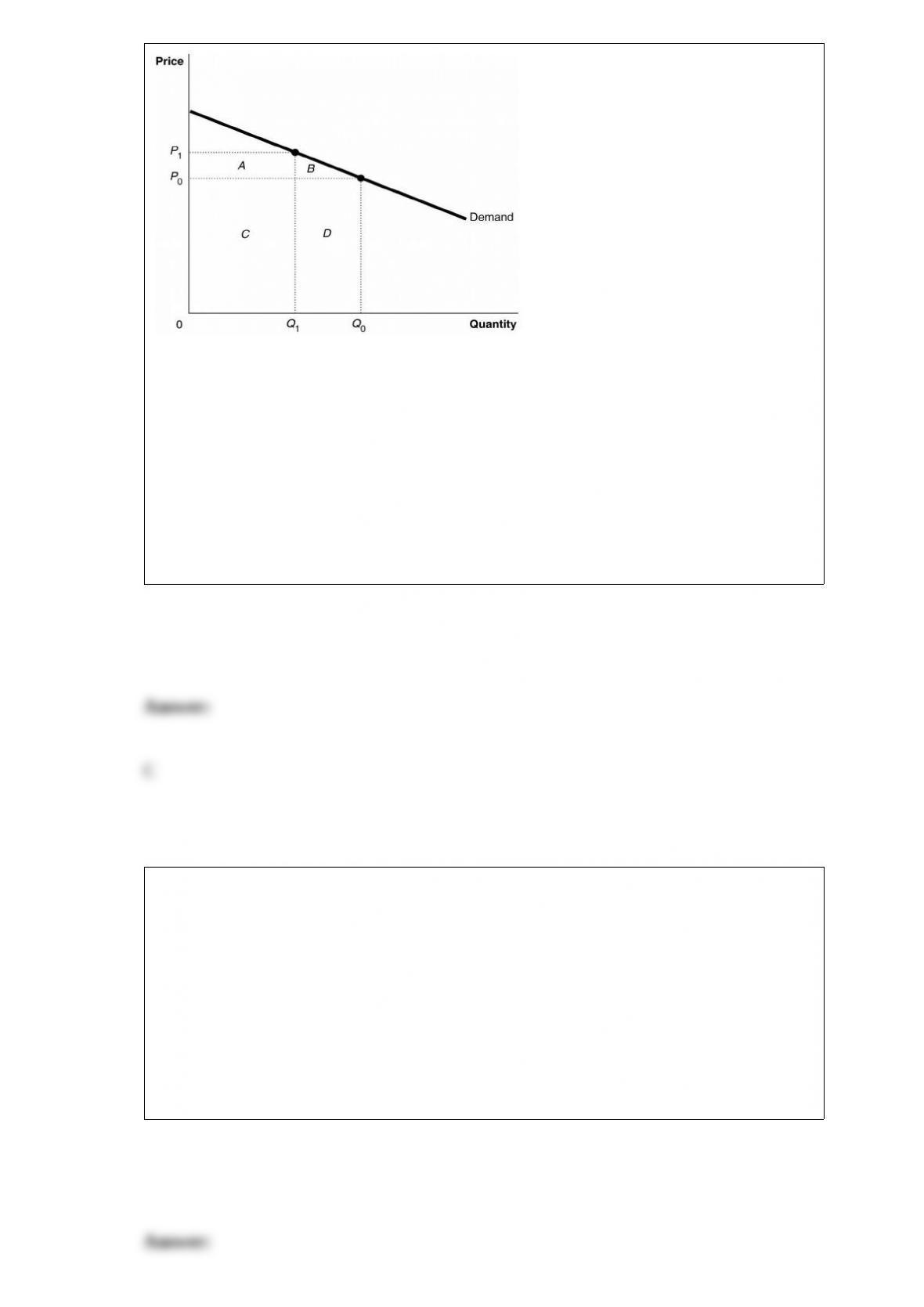
Refer to Figure 13-1. The marginal revenue from the increase in price from P0 to P1
equals
A) the area A.
B) the area (B + D – A).
C) the area (A – D).
D) the area (C – B).
The price elasticity of supply is usually a positive number because
A) quantity supplied increases in response to income increases.
B) quantity supplied increases in response to price increases.
C) the quantity demanded usually rises when price falls and therefore suppliers would
want to capitalize on this increase in demand.
D) price rises when supply increases.

The area ________ the market supply curve and ________ the market price is equal to
the total amount of producer surplus in a market.
A) above; above
B) above; below
C) below; above
D) below; below
The marginal rate of technical substitution is measured by
A) the slope of the isoquant.
B) the relative input prices.
C) the slope of the isocost line.
D) the ratio of the product’s price to the product’s cost of production.

The Arrow impossibility theorem explains
A) why there is no system of voting that will consistently represent the underlying
preferences of voters.
B) why government regulation of private markets will always result in a reduction in
economic efficiency in these markets.
C) why voters are always rationally ignorant.
D) why it is not possible to provide the economically efficient amount of any public
good.
For many small firms, providing health insurance for their workers
A) has decreased in cost over the past 10 years.
B) represents their most rapidly increasing cost.
C) costs virtually nothing under the ACA.
D) encourages them to hire more full-time workers.
Which of the following is an example of a common resource?
A) the Sumatran tiger population in the world

B) rabbit fur
C) the stock of knowledge in the public domain
D) taxicab services