
Figure 6-4
Refer to Figure 6-4. Which of the following statements is true about the price elasticity
of demand?
A) The elasticity coefficient is constant along the demand curve.
B) The elastic portion of a straight-line downward sloping demand curve corresponds to
the segment above the midpoint.
C) The inelastic portion of the demand curve corresponds to the segment above the
midpoint.
D) At the midpoint of the demand curve, the elasticity coefficient is zero.
The Congressional Budget Office estimates that the Patient Protection and Affordable
Care Act (ACA) will
A) increase government spending by just under $1 trillion over 10 years.
B) cost the government significantly more than the additional taxes and fees enacted
under the law will bring in.
C) eliminate the budget deficit within 10 years.
D) actually reduce government spending over a 20 year period.

Aisha and Debbie both purchase milk and bread at the same Quik Mart. They have
different tastes for milk and bread and different incomes. They both buy some milk and
some bread, but they buy considerably different quantities of the two goods. Which of
the following statements is true, given that Aisha and Debbie are utility-maximizers?
A) In equilibrium, their marginal rate of substitution between milk and bread is the
same.
B) In equilibrium, their marginal rate of substitution between milk and bread is higher
for the person with the higher income.
C) In equilibrium, the marginal rate of substitution between milk and bread is greater
for the person who prefers milk more than bread.
D) No statement can be made about their respective marginal rates of substitution
without their budget constraint/indifference curve diagrams.
Table 3-1
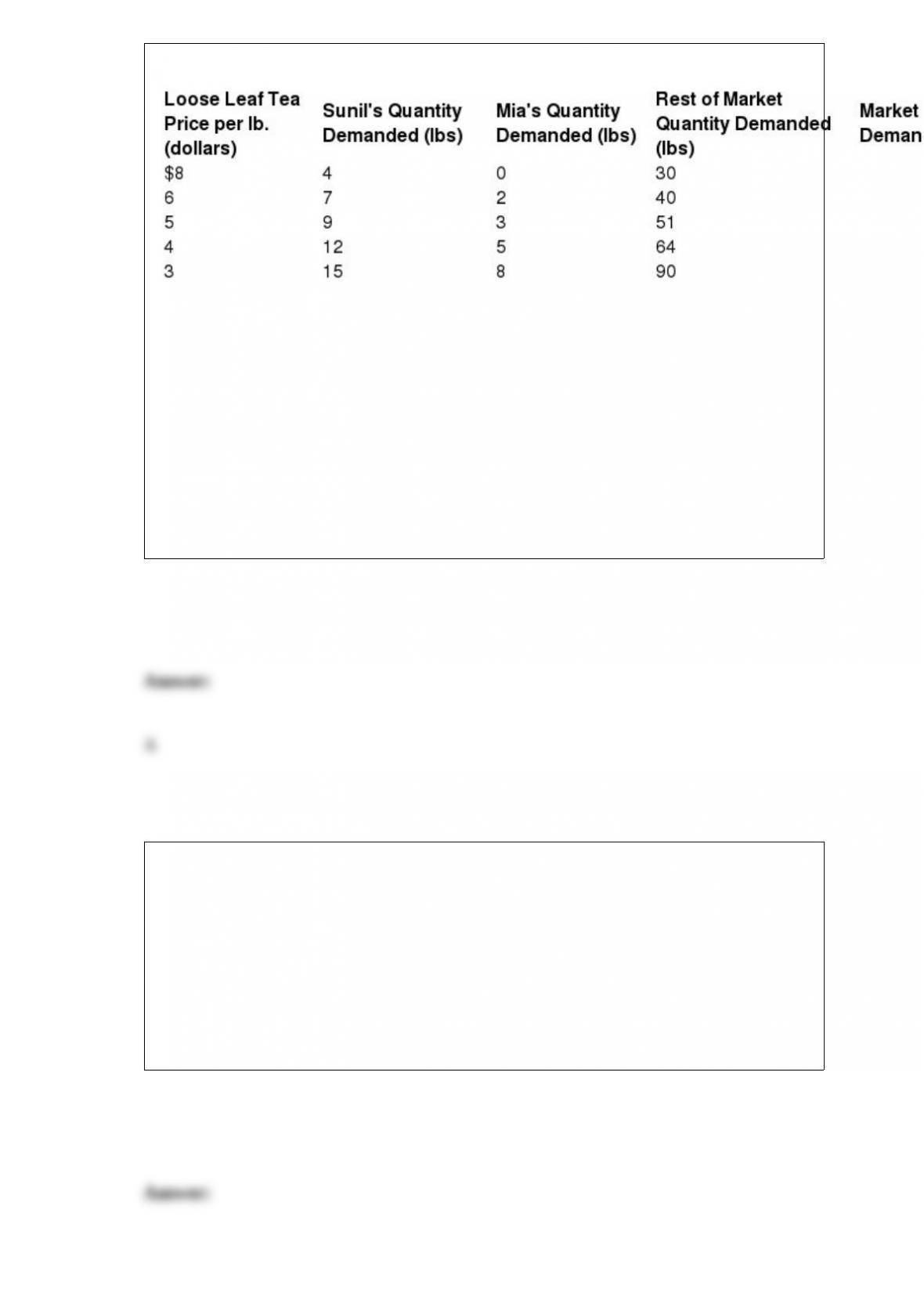
Refer to Table 3-1. The table above shows the demand schedules for loose-leaf tea of
two individuals (Sunil and Mia) and the rest of the market. If the price of loose-leaf tea
rises from $3 to $4, the market quantity demanded would
A) decrease by 32 lbs.
B) increase by 64 lbs.
C) increase by 32 lbs.
D) decrease by 64 lbs.
As a form of business, a partnership
A) has limited liability.
B) has only one owner.
C) cannot issue stock.
D) has the most government rules and regulations affecting it.
A numerical limit imposed by a government on the quantity of a good that can be
imported into the country is called a
A) tariff.
B) quota.
C) quantity floor.
D) barricade.
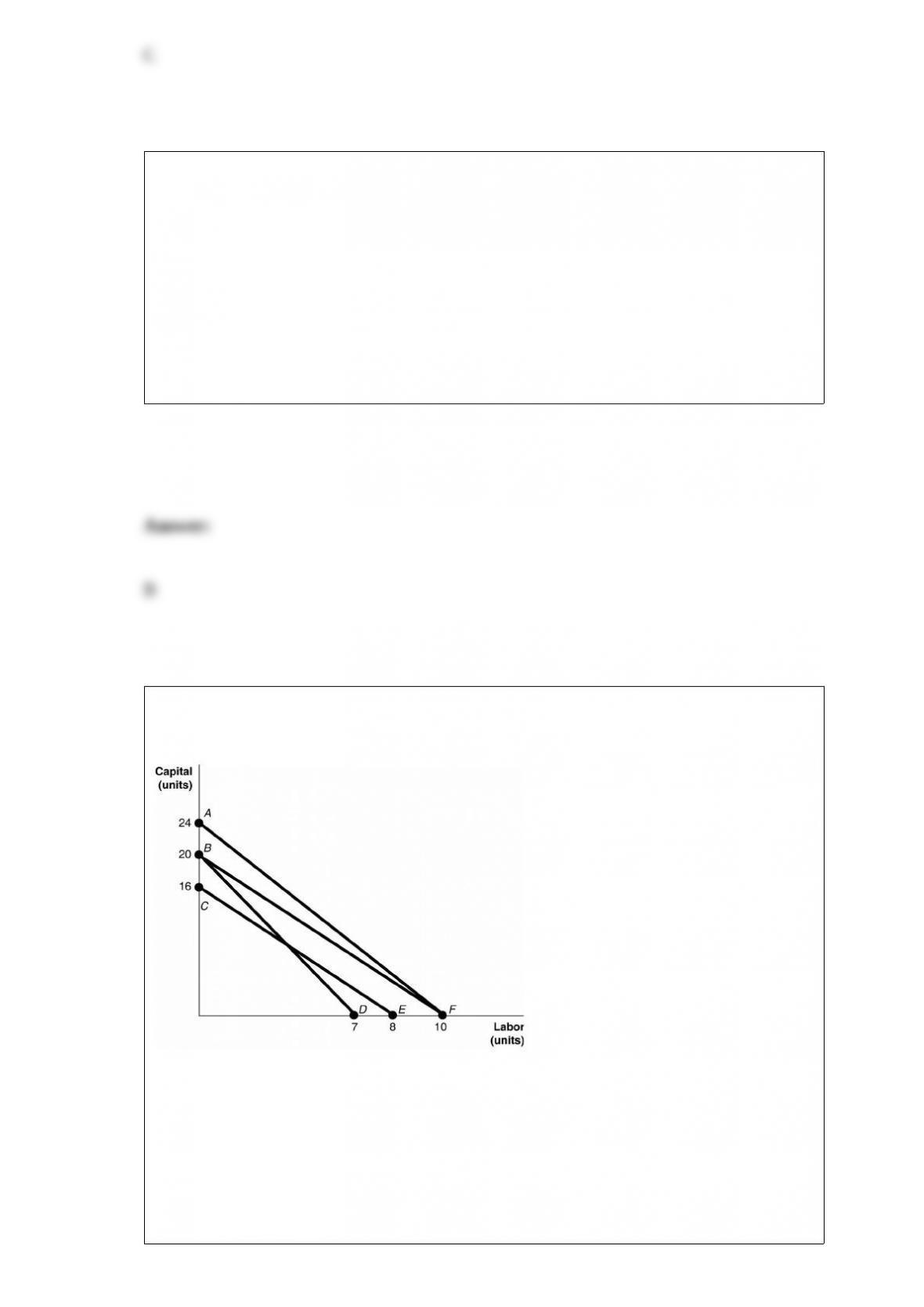
Figure 11-13
Refer to Figure 11-13. The lines shown in the diagram are isocost lines. A movement
from CE to BD occurs when
A) the price of capital increases while the price of labor remains unchanged.
B) the price of labor decreases while the price of capital remains unchanged.
C) the price of capital increases while the price of labor decreases.

D) the price of capital decreases while the price of labor increases.
If the quantity of donuts supplied is represented by the equation QS = -15 + 5P then the
corresponding price of donuts is represented by the equation
A) P = 0.2QS + 3.
B) P = 5QS + 75.
C) P = QS – 7.5.
D) P = 15 – 0.5QS.
Mortgages issued to borrowers who fail to document that their incomes are high enough
to afford their mortgage payments are known as ________ mortgages.
A) subprime
B) Alt-A
C) gray market
D) reciprocal

Suppose a price floor on sparkling wine is proposed by the Health Minister of the
country of Vinyardia. What will be the likely effect on the market for sparkling wine in
Vinyardia?
A) Consumer surplus will increase.
B) Producer surplus will increase.
C) Deadweight loss will increase.
D) Market efficiency will increase.
Which of the following would cause an increase in the equilibrium wage?
A) The supply of labor increases more than the demand for labor.
B) The supply of jobs increases more than the demand for jobs.
C) The demand for labor increases faster than the supply of labor.
D) The supply of labor increases and the demand for labor decreases.

Suppose a price floor on sparkling wine is proposed by the Health Minister of the
country of Vinyardia. What will be the likely effect on the market for sparkling wine in
Vinyardia?
A) Quantity demanded will decrease, quantity supplied will increase, and a surplus will
result.
B) Quantity demanded will increase, quantity supplied will decrease, and a surplus will
result.
C) Quantity demanded will decrease, quantity supplied will increase, and a shortage
will result.
D) Quantity demanded will increase, quantity supplied will decrease, and a shortage
will result.
If, for a perfectly competitive firm, price exceeds the marginal cost of production, the
firm should
A) increase its output.
B) reduce its output.
C) keep output constant and enjoy the above normal profit.
D) lower the price.

Table 2-3
Production Choices for Dina’s Diner
Refer to Table 2-3. Dina faces ________ opportunity costs in the production of sliders
and hot wings.
A) increasing
B) decreasing
C) constant
D) negative
If a monopolist’s price is $50 per unit and its marginal cost is $25, then
A) to maximize profit the firm should increase output.
B) to maximize profit the firm should decrease output.
C) to maximize profit the firm should continue to produce the output it is producing.
D) Not enough information is given to say what the firm should do to maximize profit.

In response to accounting scandals in 2002, the federal government passed legislation
requiring that corporate directors have a certain level of expertise with financial
information and mandating that chief executive officers personally certify the accuracy
of financial statements. What is the name of this legislation?
A) the Accountant Reliability Act
B) the 24th amendment to the Constitution
C) the Kennedy-Lott Act
D) the Sarbanes-Oxley Act
What is the difference between an “increase in supply” and an “increase in quantity
supplied”?
A) There is no difference between the two terms; they both refer to a shift of the supply
curve.
B) There is no difference between the two terms; they both refer to a movement along a
given supply curve.
C) An “increase in supply” means the supply curve has shifted to the right while an
“increase in quantity supplied” means at any given price supply has increased.
D) An “increase in supply” means the supply curve has shifted to the right while an
“increase in quantity supplied” refers to a movement along a given supply curve in
response to an increase in price.

The most important determinant of the price elasticity of demand for a good is
A) the definition of the market for a good.
B) the availability of substitutes for the good.
C) the share of the good in the consumer’s budget.
D) whether the good is a necessity or a luxury.
How are corporate profits taxed in the United States?
A) Earnings are taxed first by state sales taxes and then as corporate profits at the
Federal level.
B) Earnings are taxed first as personal income then as corporate profits at the Federal
level.
C) Earnings are taxed first as corporate profits then as personal income after dividends
are paid.
D) Corporate profits are not taxed at all.
What is an inside director?
A) a movie director who also appears in the movie
B) a member of a corporate board of directors that is also a manager of the business
C) the CEO that is selected by the corporation’s board of directors
D) a board of director chair who has been in the job for at least three years
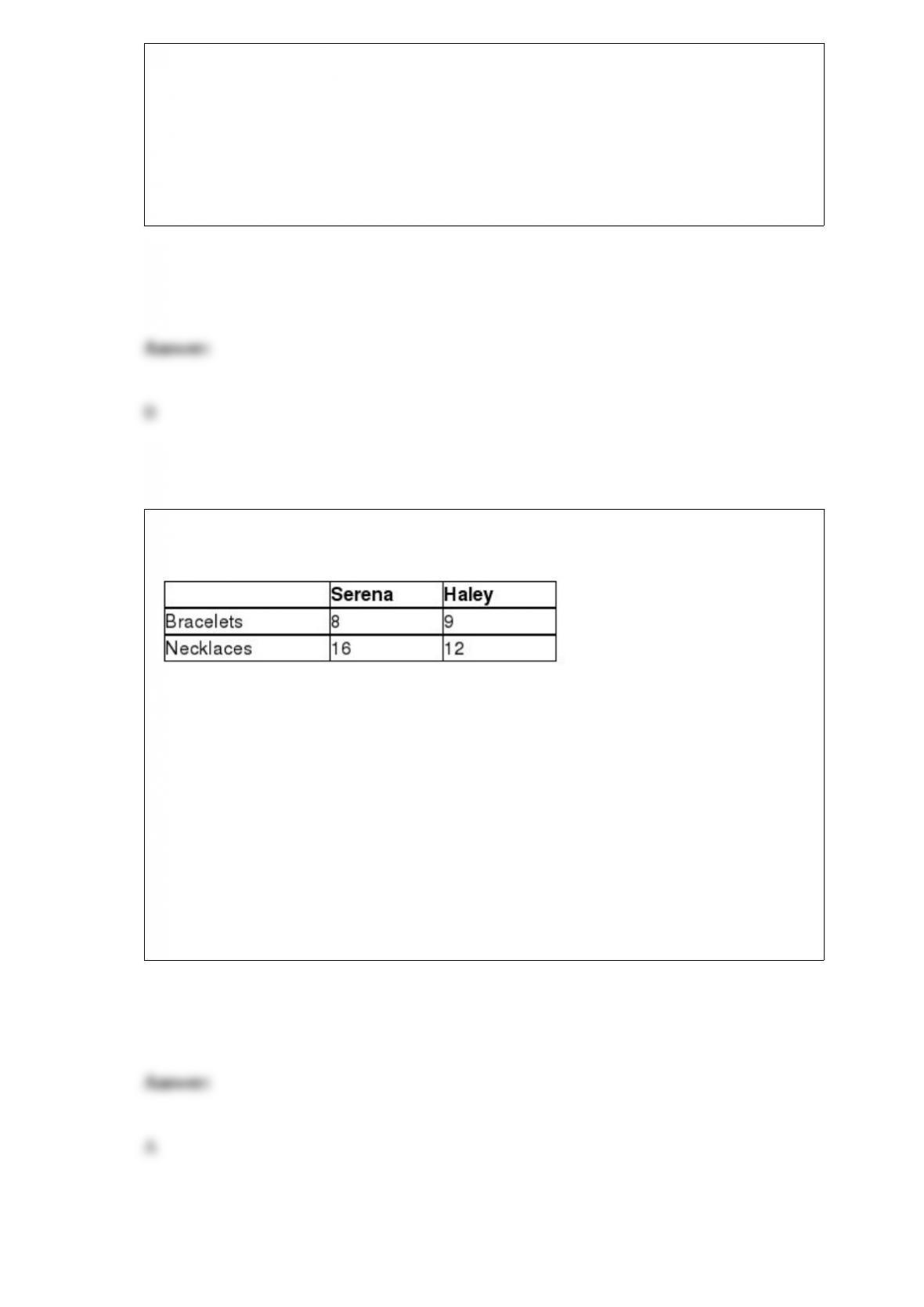
Table 2-6
Table 2-6 shows the output per week of two jewelers, Serena and Haley. They can either
devote their time to making bracelets or making necklaces.
Refer to Table 2-6. What is Haley’s opportunity cost of making a necklace?
A) 3/4 of a bracelet
B) 3 bracelets
C) 1 1/3 necklaces
D) 2 necklaces

If a corporate bond with a face value of $5,000 pays yearly coupon payments of $100,
what is the coupon rate?
A) 2%
B) 5%
C) 10%
D) 20%
One of your classmates asserts that advertising, marketing research, and brand
management are redundant expenditures because a firm can obtain the same
information by simply looking at what customers are already buying. Which of the
following is not a response you might offer her?
A) Conducting market research is a good way for firms to keep abreast of changing
consumer tastes and preferences.
B) Advertising and brand management allow a firm to create an entry barrier which will
insulate the firm from competition and from undertaking further product innovations.
C) Marketing research could allow a firm to identify new market opportunities and at
least, in the short run, a firm can make a profit supplying products to this market
segment.
D) If a firm successfully manages its brand, customers become less price sensitive as
they perceive fewer substitutes for the firm’s brand.

Which of the following is necessary in order for a firm to successfully practice price
discrimination?
A) The firm must practice product differentiation.
B) The demand for the firm’s product is inelastic.
C) The firm must be able to segment the market for the product.
D) The firm’s transactions costs must be zero.
Article Summary
Brandeis University economist Benjamin Shiller has written a paper which explains
how Netflix could combine demographic data with customers’ Web browsing habits to
more accurately predict how much a customer would be willing to pay for a Netflix
subscription, and how using this method of first-degree price discrimination would
generate higher profits. Shiller explains that the more information a company has about
its customers, the better it is at being able to set prices to increase profits. As he stated
in his paper, “Using all variables to tailor prices, one can yield variable profits 1.39
percent higher than variable profits obtained using non-tailored 2nd degree
price-discrimination. Using demographics alone to tailor prices raises profits by much
less, yielding variable profits only 0.14% higher than variable profits attainable under
2nd degree [price discrimination].”
Source: Brian Fung, “How Netflix could use Big Data to make twice as much money
off you,” Washington Post, September 4, 2013.
Refer to the Article Summary. The pricing method described in the article is referred to
as first-degree price discrimination. First-degree price discrimination is also known as
A) arbitrage.
B) perfect price discrimination.
C) odd pricing.
D) two-part tariff pricing.

If total utility increases at a decreasing rate as a consumer consumes more coffee, then
marginal utility must
A) remains constant.
B) increase also.
C) decrease.
D) be negative.
Owners of a corporation share in the profits of the firm
A) by selling any bonds or stocks owned and realizing a capital gain.
B) through coupon payments on that firm’s bonds.
C) through dividend payments on shares of that firm’s stock.
D) by raising the interest rate on bonds.
If the marginal tax rate is equal to the average tax rate as taxable income increases, the
tax structure is
A) regressive.
B) proportional.
C) progressive.
D) unfair.
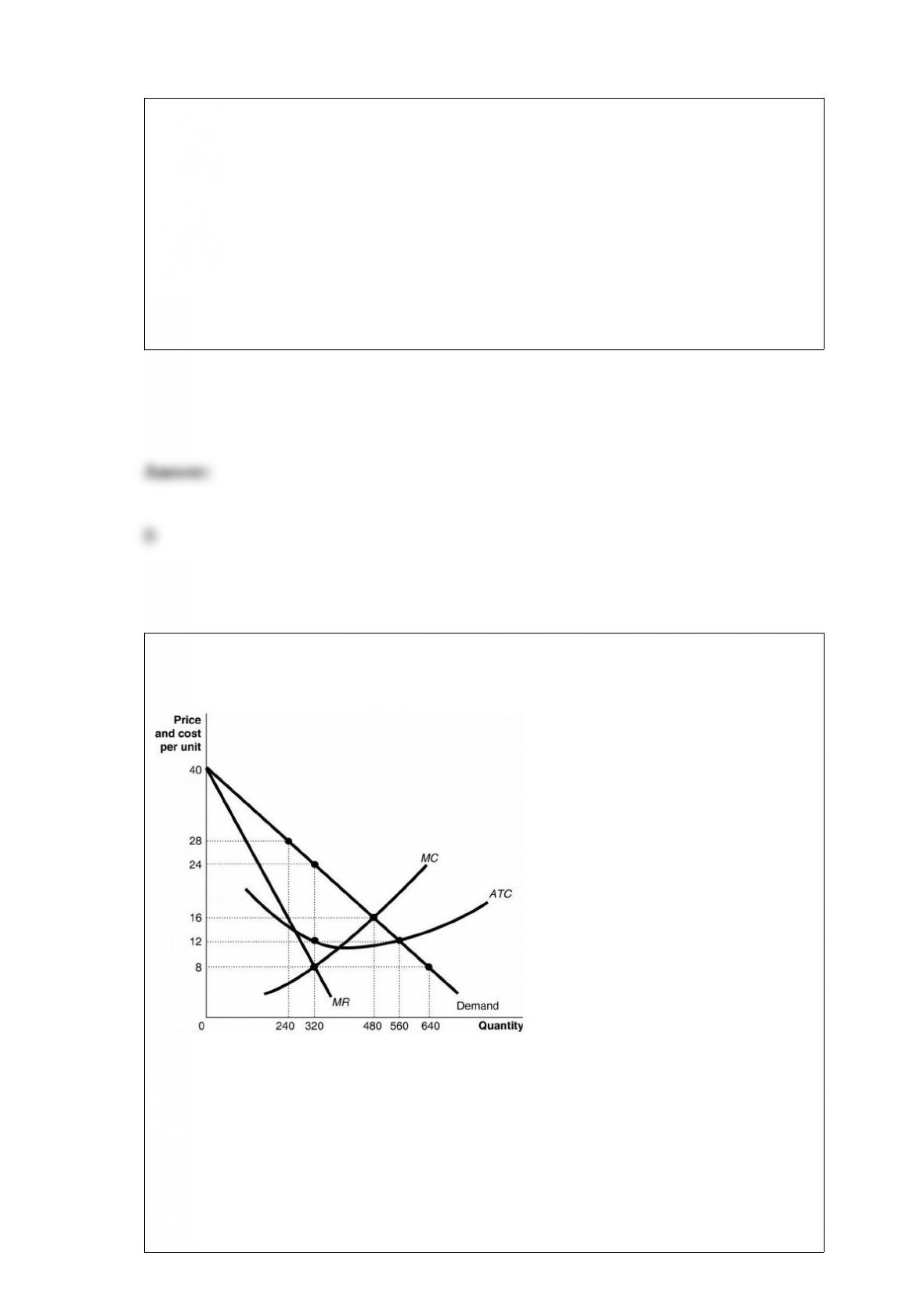
Figure 16-5
Refer to Figure 16-5. Suppose the firm represented in the diagram decides to use a
two-part pricing strategy such that it charges a fixed fee and a per-unit price equal to the
competitive price. (This is also called an optimal two-part tariff.) What is the total
revenue it can expect to collect from the fixed fee portion of the price?
A) $2,560
B) $5,760
C) $7,870
D) $10,240
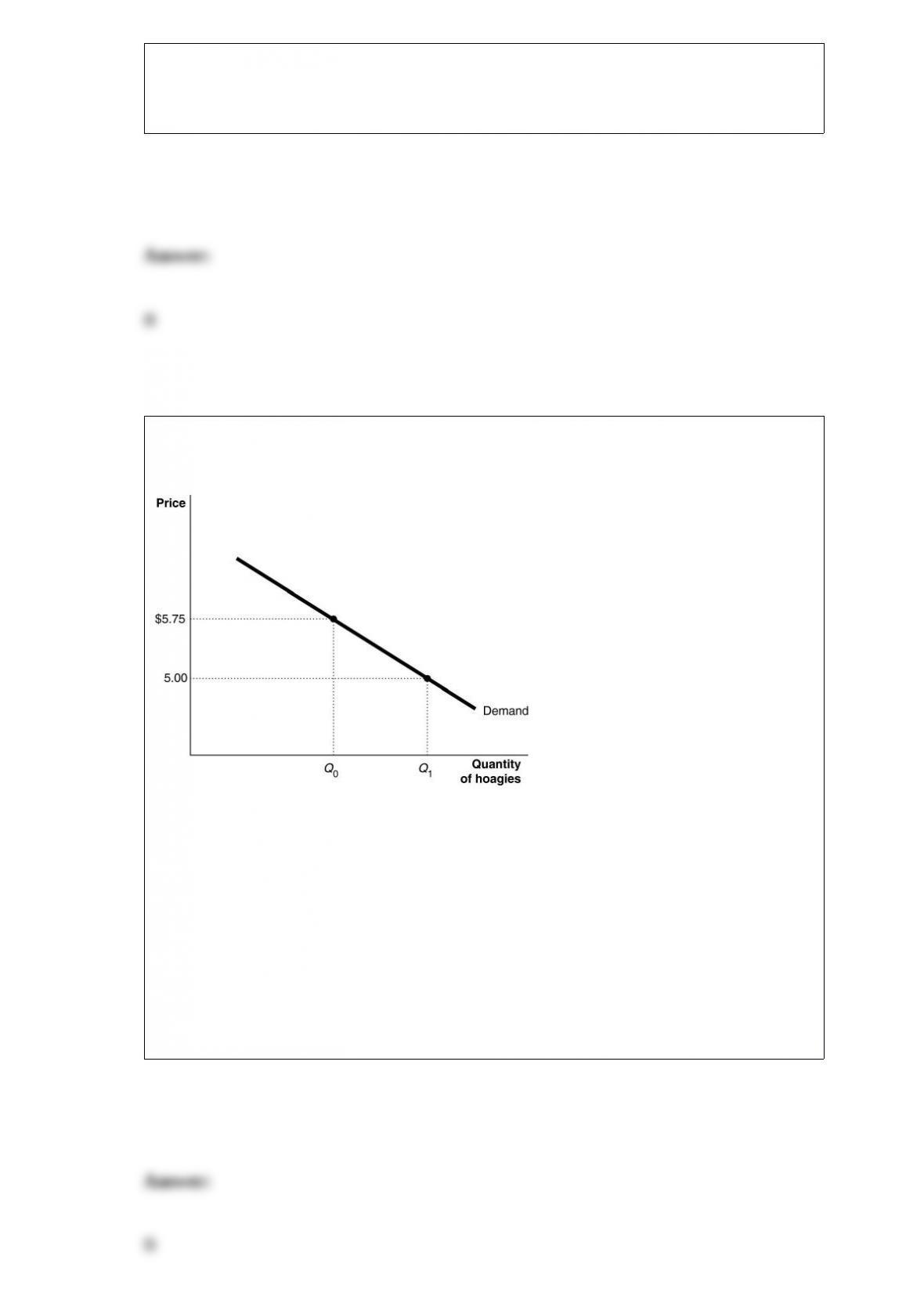
Figure 10-1
Refer to Figure 10-1. When the price of hoagies increases from $5.00 to $5.75,
quantity demanded decreases from Q1 to Q0. This change in quantity demanded is due
to
A) the price and output effects.
B) the income and substitution effects.
C) the fact that marginal willingness to pay falls.
D) the law of diminishing marginal utility.
If demand is taken into account, firms that use cost-plus pricing can adjust price by
A) letting sales fall, but hold the markup constant if demand falls.
B) lowering markups on price-elastic goods and raising markups on price-inelastic
goods.
C) raising markups on price-elastic goods and lowering markups on price-inelastic
goods.
D) letting sales rise, but hold the markup constant if demand rises.
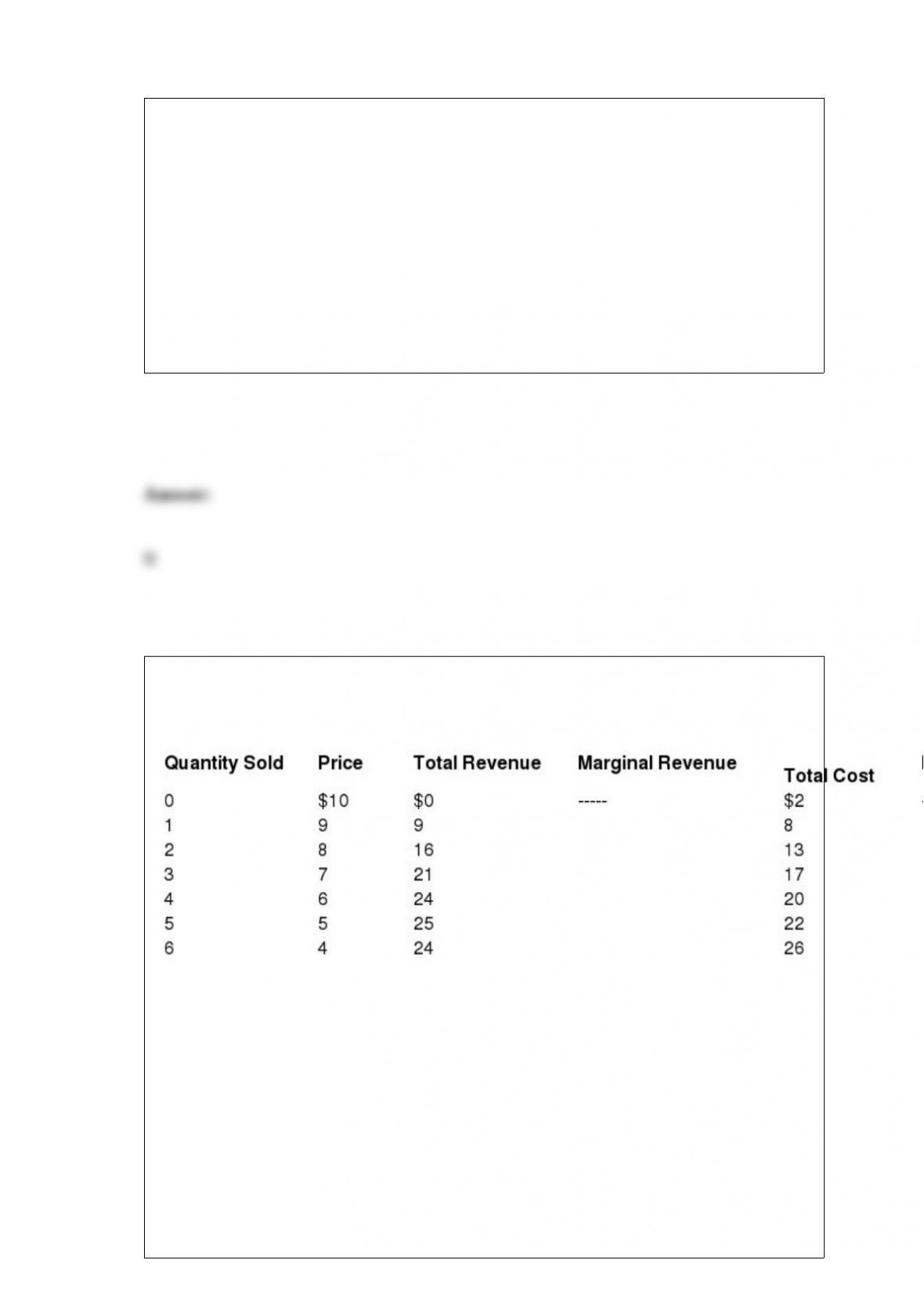
Table 13-4
Table 13-4 lists estimated revenues and costs (per week) for plastic vials (100 vials per
box) for the Victoria Biological Supplies Company. Victoria sells plastic vials to
university and private research laboratories.
Refer to Table 13-4. At Victoria’s profit-maximizing output
A) profit equals $2.
B) total revenue equals $24 and total cost equals $20.
C) total revenue equals $25 and total cost equals $22.
D) total revenue equals $21 and total cost equals $17.

Scenario: Jeans Unlimited
Jeans Unlimited produces clothing for young adults. It designs its clothes at its New
York headquarters and produces them at facilities located in two Southeast Asian
countries. The company recently received negative press after one of its facilities was
found using questionable labor practices, such as, employing children and operating in
a manner that damages the environment.Which of the following arguments against
globalization, if true, could be made using Jeans Unlimited as an example?
A) Globalization results in the government making nearly all economy-related
decisions.
B) Globalization permits the use of unethical practices as long as it brings the company
profits.
C) Globalization causes companies to produce goods in nations with the most lenient
labor regulations.
D) Globalization places least emphasis on corporate social responsibility.
Policies that mandate the installation of specific pollution control devices are called
A) command and control policies.
B) benefit policies.
C) welfare policies.

D) incentive policies.
Suppose you have worked at a local sandwich shop for six months and now you plan to
ask your manager for a raise. How can you convince your manager that you are worth
more money than you are currently being paid?
A) by threatening to quit if he refuses to give you a raise
B) by demonstrating to your manager the marginal revenue product your employment
contributes to the sandwich shop
C) by explaining to him how difficult it is for you to save enough money to go to
college
D) by convincing him that you are a dedicated worker and ready to take on more
responsibilities at the shop