
Psychologists Daniel Kahneman and Amos Tversky conducted the following
experiments by asking a sample of people the following questions:
Scenario A: “Imagine that you have decided to see a play and paid the admission price
of $10 per ticket. As you enter the theater you discover that you have lost the ticket. The
seat was not marked and the ticket cannot be recovered. Would you pay $10 for another
ticket?”
Scenario B: “Imagine that you have decided to see a play where admission is $10 per
ticket. As you enter the theater you discover that you have lost a $10 bill. Would you
still pay $10 for a ticket for the play?”
As long as additional tickets are available, there’s no meaningful difference between
losing $10 in cash before buying a ticket, and losing the $10 ticket after buying it. In
both cases, you are out $10. Yet, far more subjects (88 percent) in Scenario B say they
would pay $10 for another ticket and see the play while in Scenario A, only 46 percent
of the subjects say they would be willing to spend another $10 to see the play.
Which of the following is the best explanation for the results of the experiment?
A) The endowment effect applies in Scenario A since people already own the ticket and
therefore it is more valuable but this is not so in Scenario B.
B) In Scenario B, people had not anticipated spending an additional $10 so in effect the
price of the ticket is $20 and not $10 whereas in Scenario A, the price of the ticket is
still $10.
C) In Scenario A, people make an immediate connection between the lost ticket and the
play and feel poorer by incorrectly assigning a greater value to the value of the ticket
whereas in ScenarioB, they do not make the connection between the lost $10 bill and
the play.
D) The net benefit derived from watching the play is lower in Scenario A where the
effective cost is $20 compared to the net benefit in Scenario B.
Article Summary
In an August 2013 speech from the Lincoln Memorial, President Obama was expected

to emphasize that increased economic equality is needed to improve racial equality.
Economic gaps based on race have endured for 50 years, with the differences in
unemployment rates between blacks and whites remaining virtually unchanged and the
gap in wealth actually increasing. “If you look at 50 years after the 1960s civil rights
movement, the most stubborn and persistent challenge when it comes to the nation’s
racial challenge remains in the areas of economics and wealth,” said Marc Morial,
president of the National Urban League.
Source: Zachary A. Goldfarb, “For Obama, 50 years after historic march, economic
equality the path to racial justice,” Washington Post, August 17, 2013.
The government makes all economic decisions in a mixed economy.
A minimum wage law dictates
A) the minimum quantity of labor that a firm must employ.
B) the lowest wage that firms may pay for labor.
C) the highest wage that firms must pay for labor.
D) the minimum qualifications for labor.
Figure 12-4
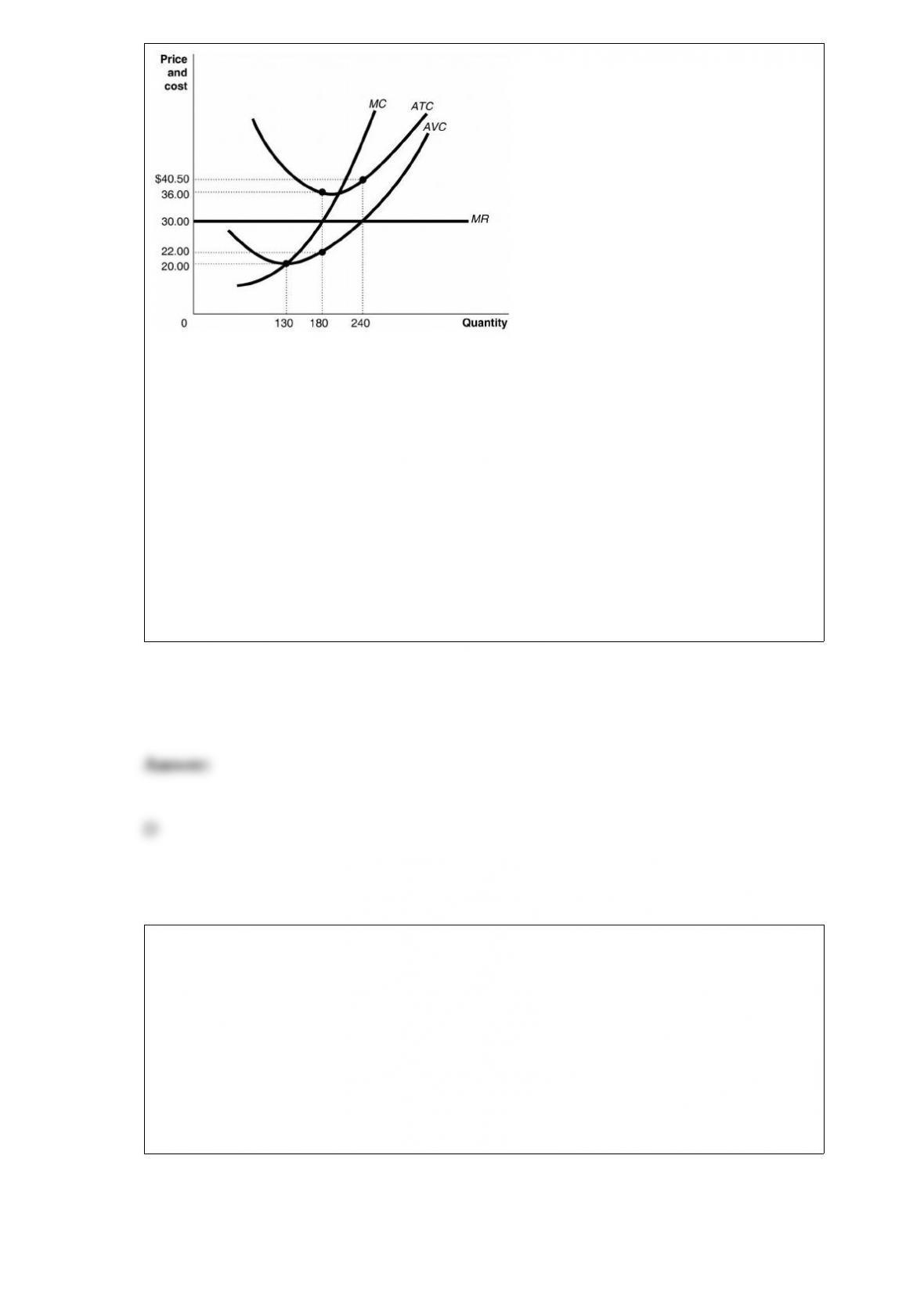
Figure 12-4 shows the cost and demand curves for a profit-maximizing firm in a
perfectly competitive market.
Refer to Figure 12-4. If the market price is $30 and if the firm is producing output,
what is the amount of its total variable cost?
A) $7,200
B) $6,480
C) $5,400
D) $3,960
In a typical year, ________ of new jobs are created by small firms.
A) less than 5 percent
B) 10 percent
C) 40 percent
D) 75 percent
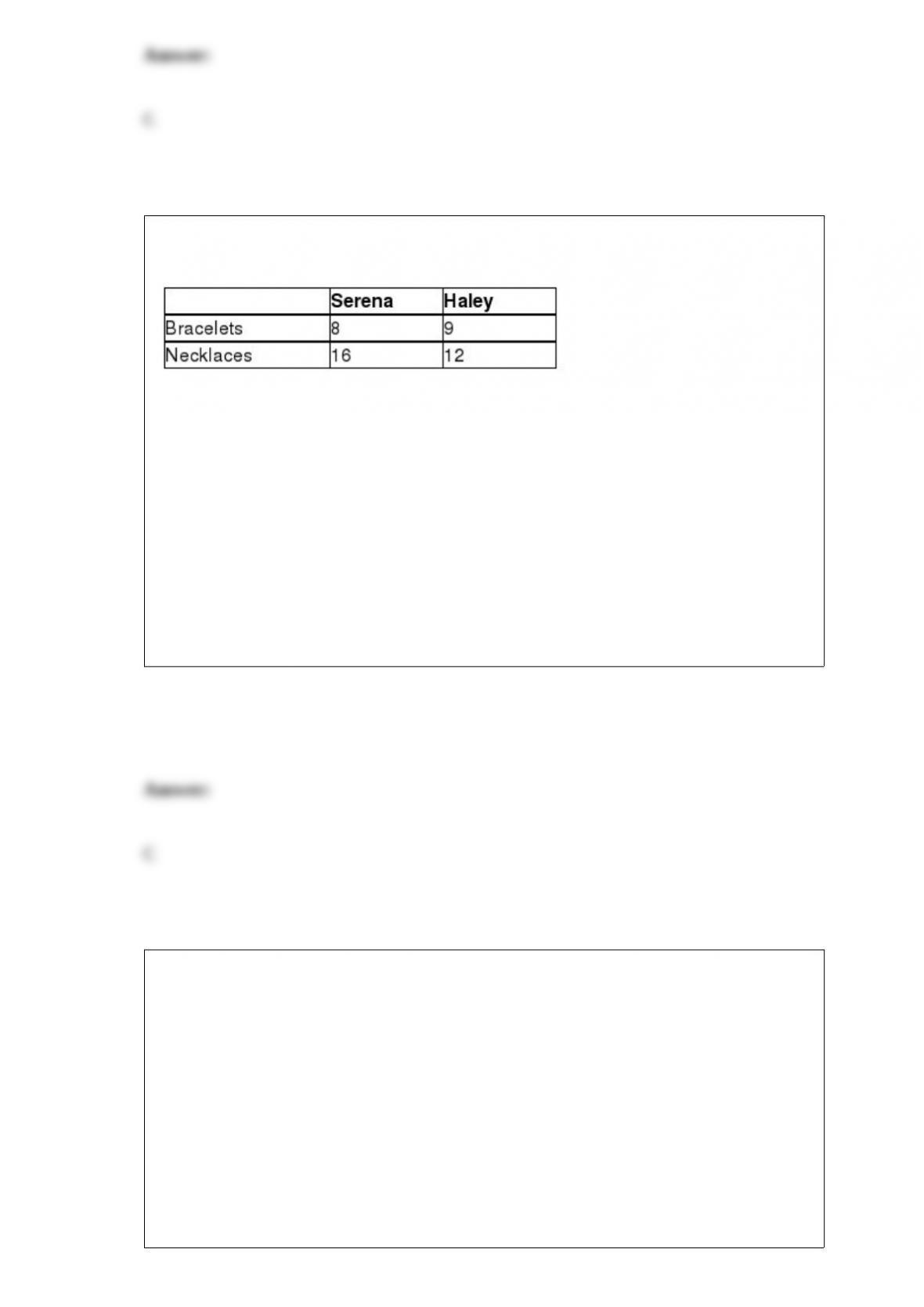
Table 2-6
Table 2-6 shows the output per week of two jewelers, Serena and Haley. They can either
devote their time to making bracelets or making necklaces.
Refer to Table 2-6. What is Haley’s opportunity cost of making a bracelet?
A) 3/4 of a bracelet
B) 3 bracelets
C) 1 1/3 necklaces
D) 2 necklaces
Economist Jerry Hausman estimated the price elasticity of demand for breakfast cereal.
He found that
A) the price elasticity for a particular brand of raisin bran was the same as the elasticity
of demand for all family cereals.
B) the price elasticity of demand for Post Raisin Bran is less than the price elasticity of
demand for Kellogg’s Raisin Bran.
C) the price elasticity of all family breakfast cereals is greater than the price elasticity of
demand for Post Raisin Bran or Kellogg’s Raisin Bran.
D) the price elasticity of demand for a particular brand of raisin bran was larger in
absolute value than the elasticity for all family cereals.
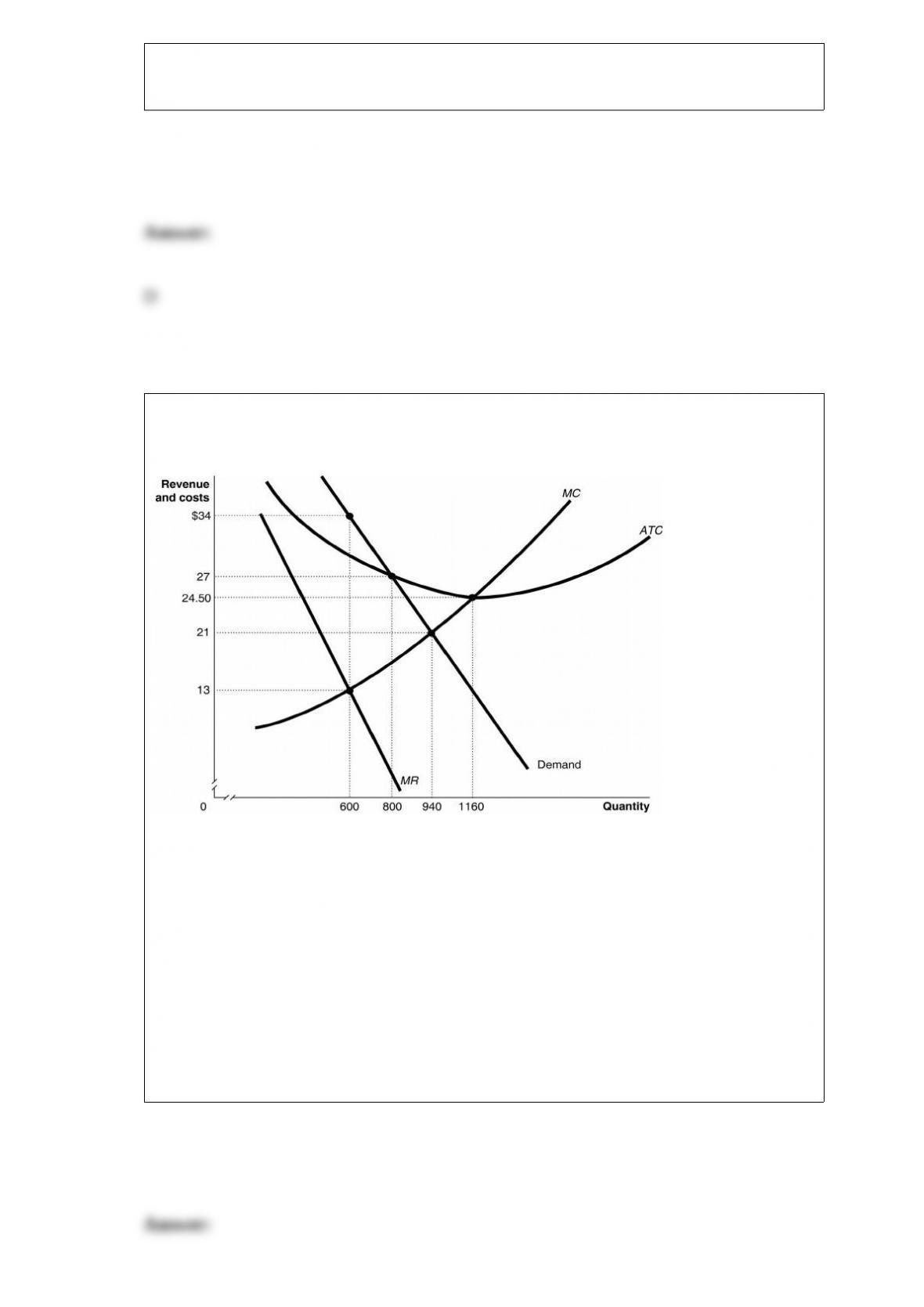
Figure 15-9
Figure 15-9 shows the demand and cost curves for a monopolist.
Refer to Figure 15-9. What is the difference between the monopoly output and the
perfectly competitive output?
A) 140 units
B) 240 units
C) 340 units
D) 560 units

Which of the following is a positive economic statement?
A) U.S. citizens should only buy products which are produced in the United States.
B) The government should ban the production and sale of incandescent light bulbs.
C) Raising the tax on gasoline raises the selling price of gasoline.
D) The government should revamp its immigration policies.
When large firms in oligopoly markets cut their prices
A) rival firms will also cut their prices to avoid losing sales.
B) rival firms will not change their prices because most of their customers have signed
contracts that commit them to doing business with the same firms for the life of their
contracts.
C) we don’t know for sure how rival firms will respond.
D) rival firms will not cut their prices because they fear that the federal government will
accuse them of collusion.
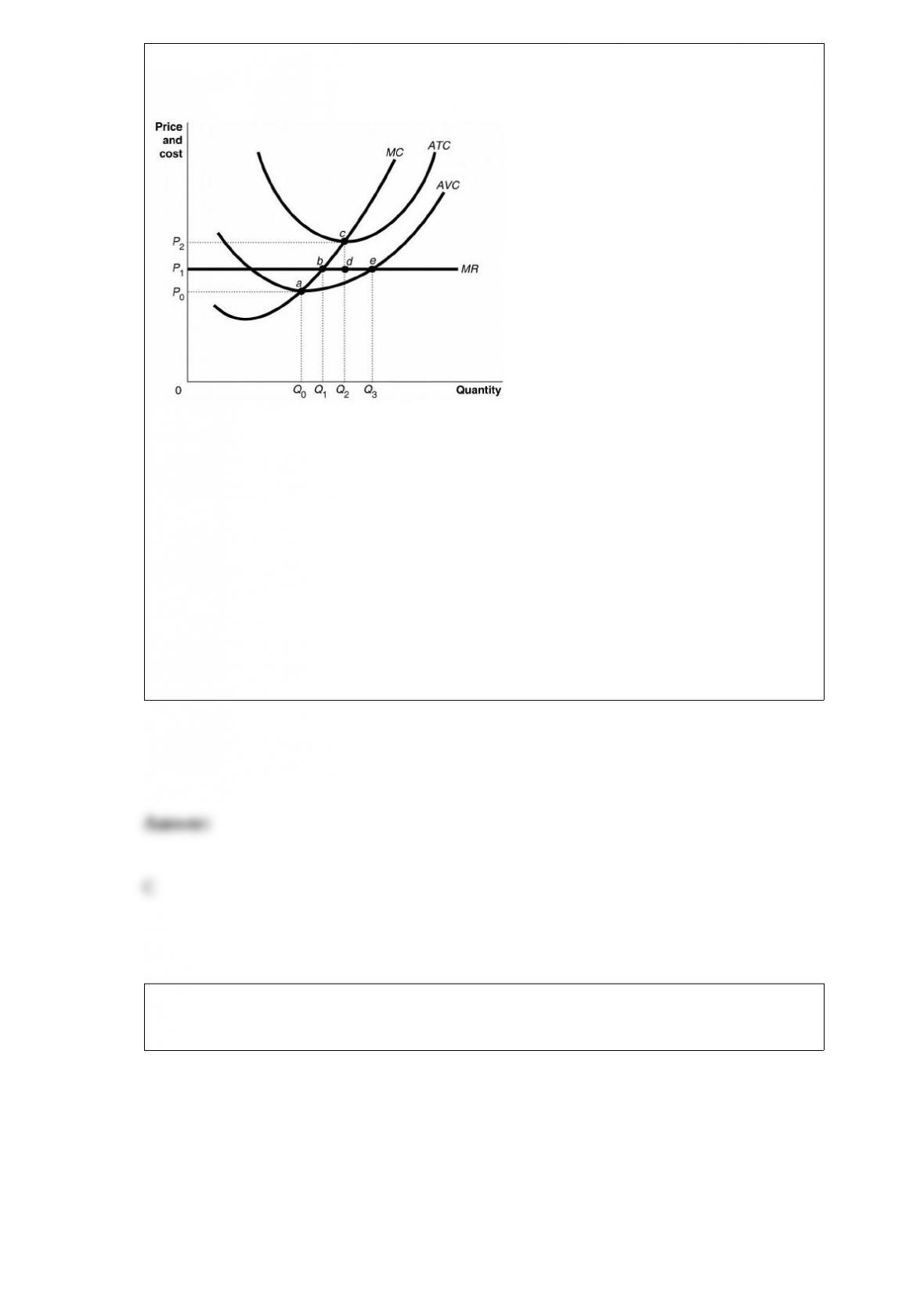
Figure 12-13
Refer to Figure 12-13. Suppose the prevailing price is P1 and the firm is currently
producing its loss-minimizing quantity. If the firm represented in the diagram continues
to stay in business, in the long-run equilibrium
A) it will reduce its output to Q0 and face a price of P0.
B) it will continue to produce Q1 but faces the higher price of P2.
C) it will expand its output to Q2 and face a price of P2.
D) it will expand its output to Q3 and face a price of P1.
Figure 12-14
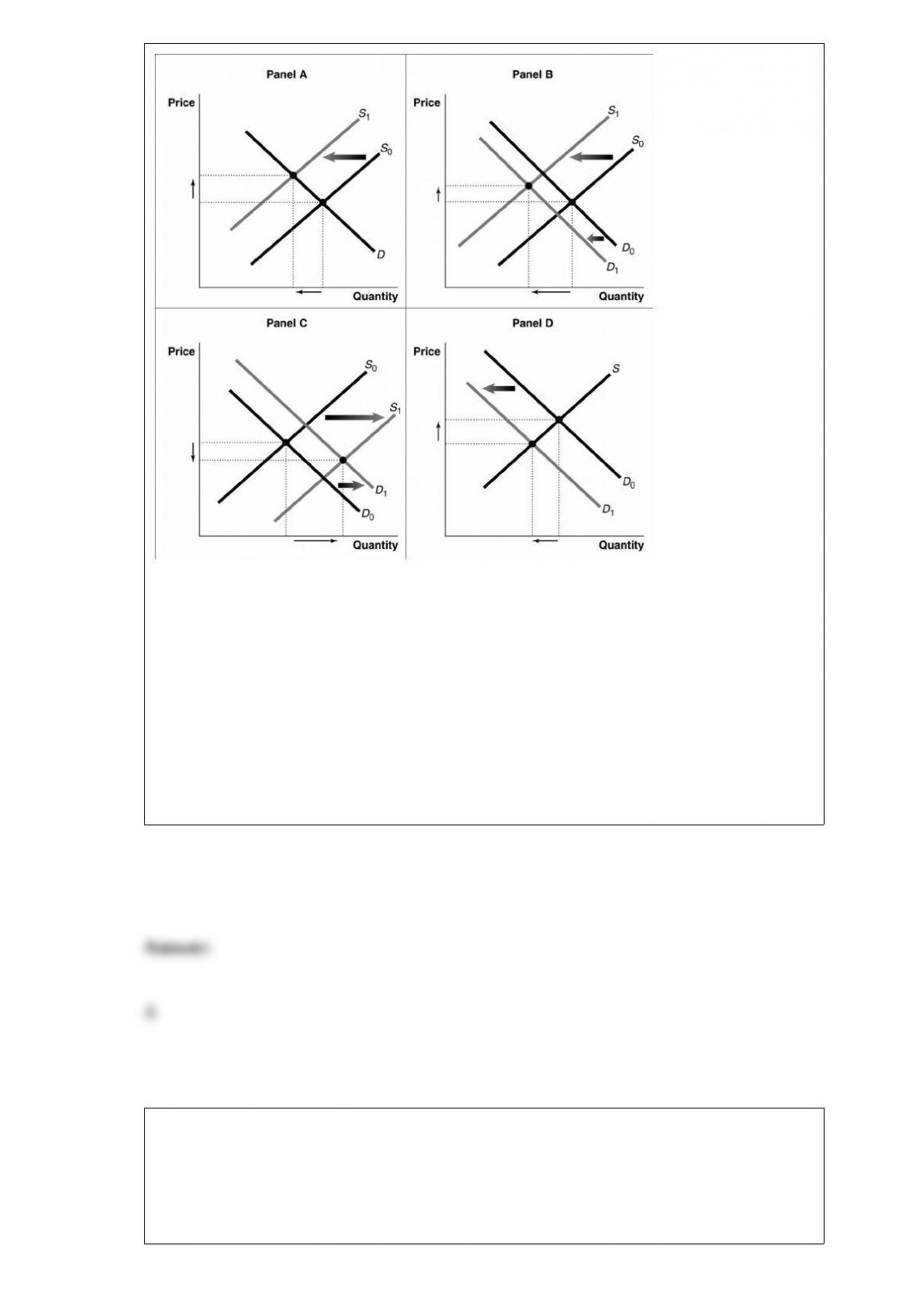
Refer to Figure 12-14. Consider a typical firm in a perfectly competitive industry
which is incurring short-run losses. Which of the diagrams in the figure shows the effect
on the industry as it transitions to a long-run equilibrium?
A) Panel A
B) Panel B
C) Panel C
D) Panel D
Which type of businesses earns the majority of profits in the United States?
A) corporations
B) partnerships

C) sole proprietorships
D) none of these
If a supply curve is a horizontal line, supply is said to be
A) perfectly inelastic.
B) unit-elastic.
C) inelastic.
D) perfectly elastic.
Who was the economist who first analyzed the advantages of specialization and the
division of labor?
A) David Ricardo
B) Arthur C. Pigou
C) Ronald Coase
D) Adam Smith
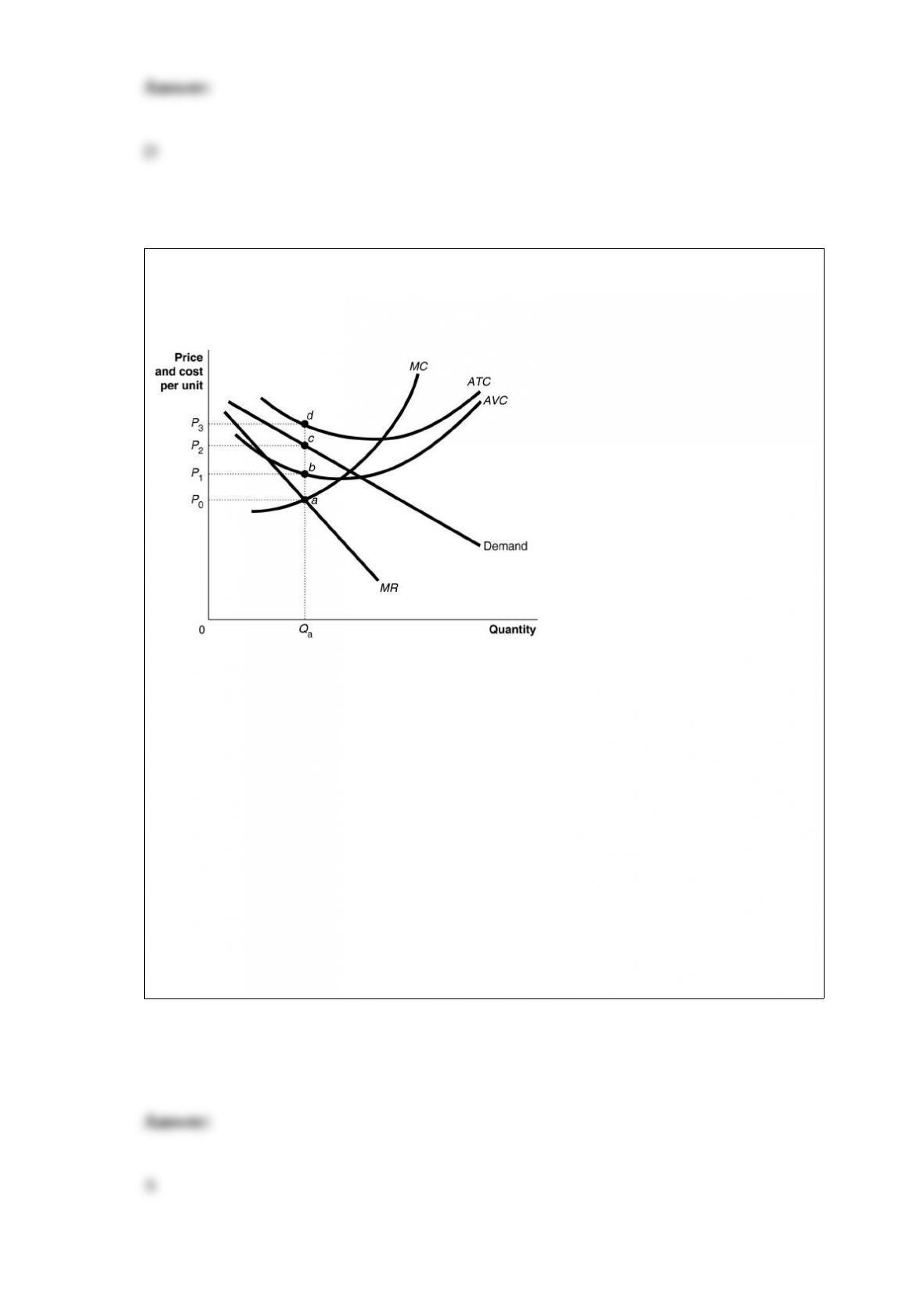
Figure 13-12
Figure 13-12 shows short-run cost and demand curves for a monopolistically
competitive firm in the market for designer watches.
Refer to Figure 13-12. If the diagram represents a typical firm in the designer watch
market, what is likely to happen in the long run?
A) Some firms will exit the market causing the demand to increase for firms remaining
in the market.
B) The firms that are making losses will be purchased by their more successful rivals.
C) Inefficient firms will exit the market and new cost efficient firms will enter the
market.
D) Firms will have to raise their prices to cover costs of production.

A corporation’s board of directors
A) hire the managers of the corporation.
B) control the day-to-day activities of the corporation.
C) are personally liable for the debts of the corporation.
D) are the sole owners of the corporation.
Last year, the Pottery Palace supplied 8,000 ceramic pots at $40 each. This year, the
company supplied the same quantity of ceramic pots at $55 each. Based on this
evidence, The Pottery Palace has experienced
A) a decrease in supply.
B) an increase in supply.
C) an increase in the quantity supplied.
D) a decrease in the quantity supplied.
Table 11-2
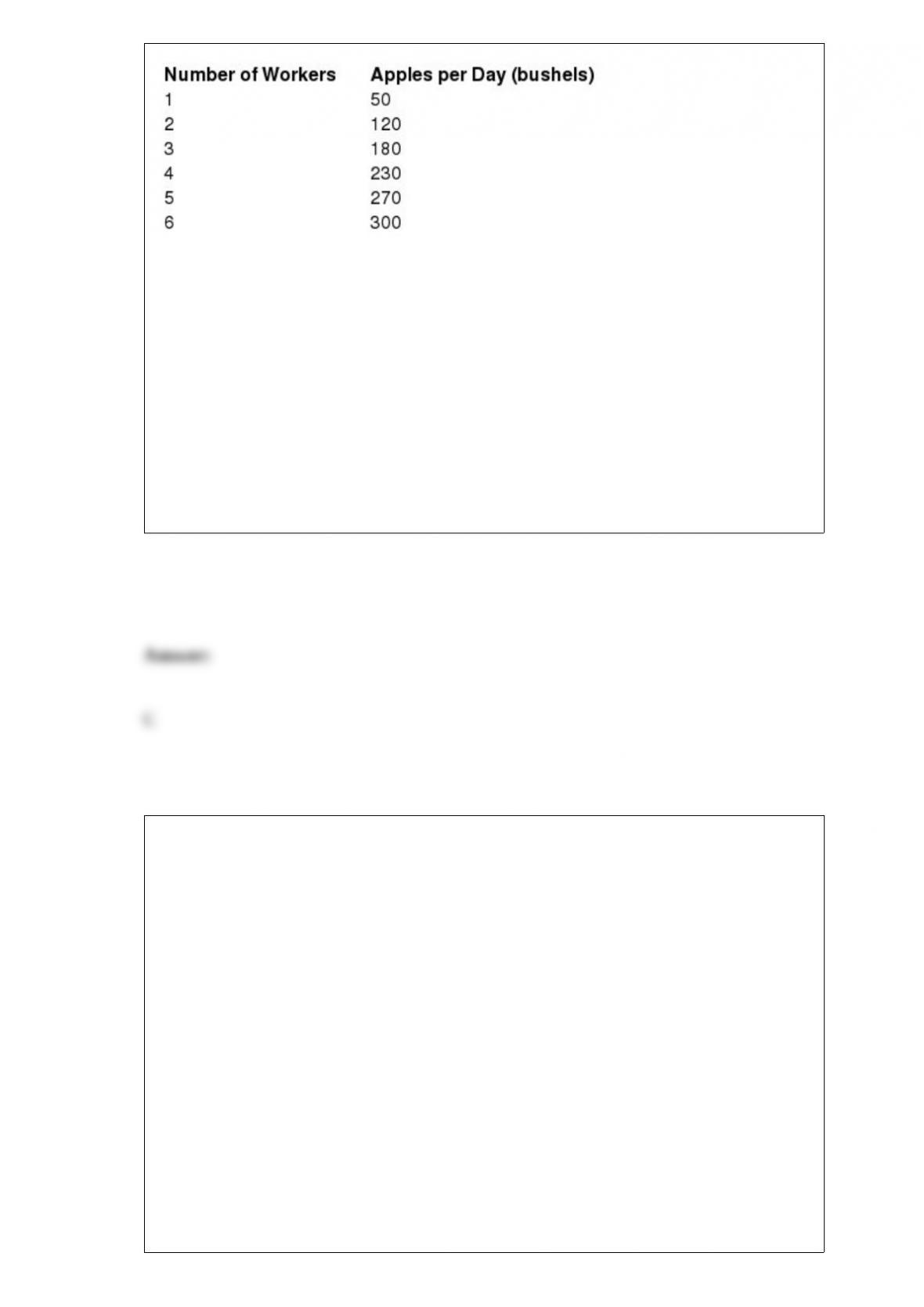
Table 11-2 summarizes production at the Crunchy Apple Orchard for the month of April
2005.
Refer to Table 11-2. What is the marginal product of the 4th worker?
A) 230 bushels
B) 57.4 bushels
C) 50 bushels
D) 12.4 bushels
Consider the following statements:
a. Consumers buy more MP3 players from an electronics store that sells MP3 players at
a lower price than other rival electronics stores in the area.
b. Schools take steps to increase security since they believe it is more costly to allow
vandalism than to hire additional security guards.
c. Citrus growers produce more oranges when the selling price of oranges falls.
Which of the above statements demonstrates that economic agents respond to
incentives?
A) a only.
B) b only.
C) c only.

D) a and b.
E) a, b, and c.
If total variable cost exceeds total revenue at all output levels, a perfectly competitive
firm
A) should produce in the short run.
B) is making short-run profits.
C) should shut down in the short run.
D) has covered its fixed cost.
Article Summary
Arguing that a merger would lead to higher prices, reduced service, and significantly
less competition, the Justice Department and attorneys general from 6 states and the
District of Columbia filed a lawsuit in August to challenge the pending merger of
American Airlines and US Airways. The lawsuit took some by surprise as the Justice
Department has in recent years approved the mergers of Delta with Northwest and
United with Continental. The European Union approved the merger in August, and
American and US Airways had hoped to complete the merger by September.

Source: Even Perez, “US government seeks to block American-US Airways merger,”
CNN.com, August 13, 2013.
Refer to the Article Summary. A merger between two competitors such as American
Airlines and US Airways may ultimately be approved by the Department of Justice and
the FTC if the two companies can substantiate ________ as a result of the merger.
A) increases in revenue for the merged company
B) an increase in the HHI to over 1,800
C) decreases in marginal revenue for the merged company
D) increases in economic efficiency
Why does a monopoly cause a deadweight loss?
A) because it does not produce some output for which marginal benefit exceeds
marginal cost
B) because it appropriates a portion of consumer surplus for itself
C) because it increases producer surplus at the expense of consumer surplus
D) because it does not produce some output for which demand exceeds supply
When the price of tortilla chips rose by 10 percent, the quantity of tortilla chips sold fell
4 percent. This indicates that the demand for tortilla chips is

A) inelastic.
B) elastic.
C) unit-elastic.
D) perfectly inelastic.
Some economists and policymakers who are in favor of government-provided health
care believe that providing health care will generate
A) additional moral hazard.
B) positive externalities.
C) greater asymmetric information.
D) more adverse selection.
Figure 4-5
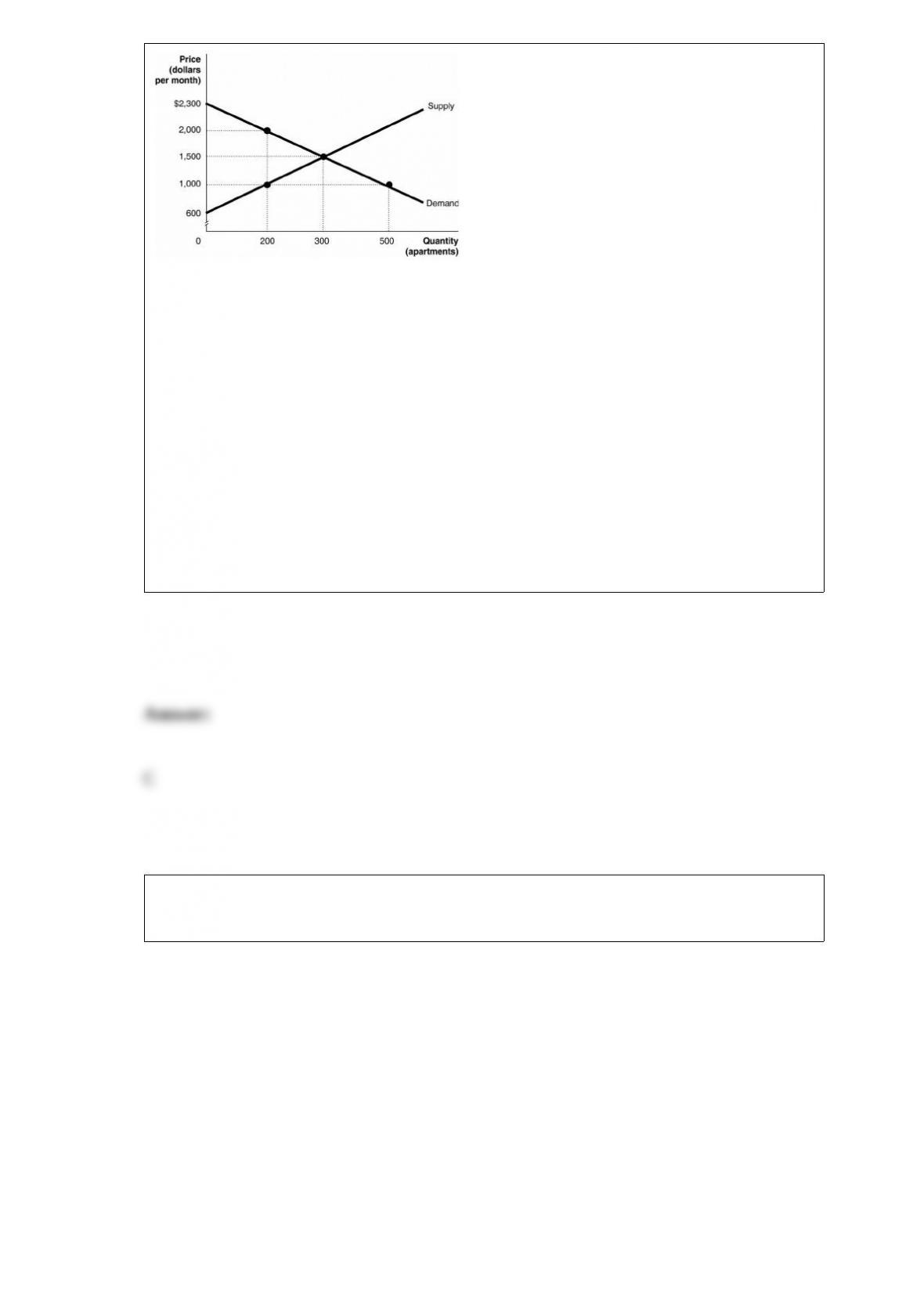
Figure 4-5 shows the market for apartments in Springfield. Recently, the government
imposed a rent ceiling of $1,000 per month.
Refer to Figure 4-5. With rent control, the quantity supplied is 200 apartments.
Suppose apartment owners ignore the law and rent this quantity for the highest rent they
can get. What is the highest rent they can get per month?
A) $1,000
B) $1,500
C) $2,000
D) $2,300
Figure 16-5
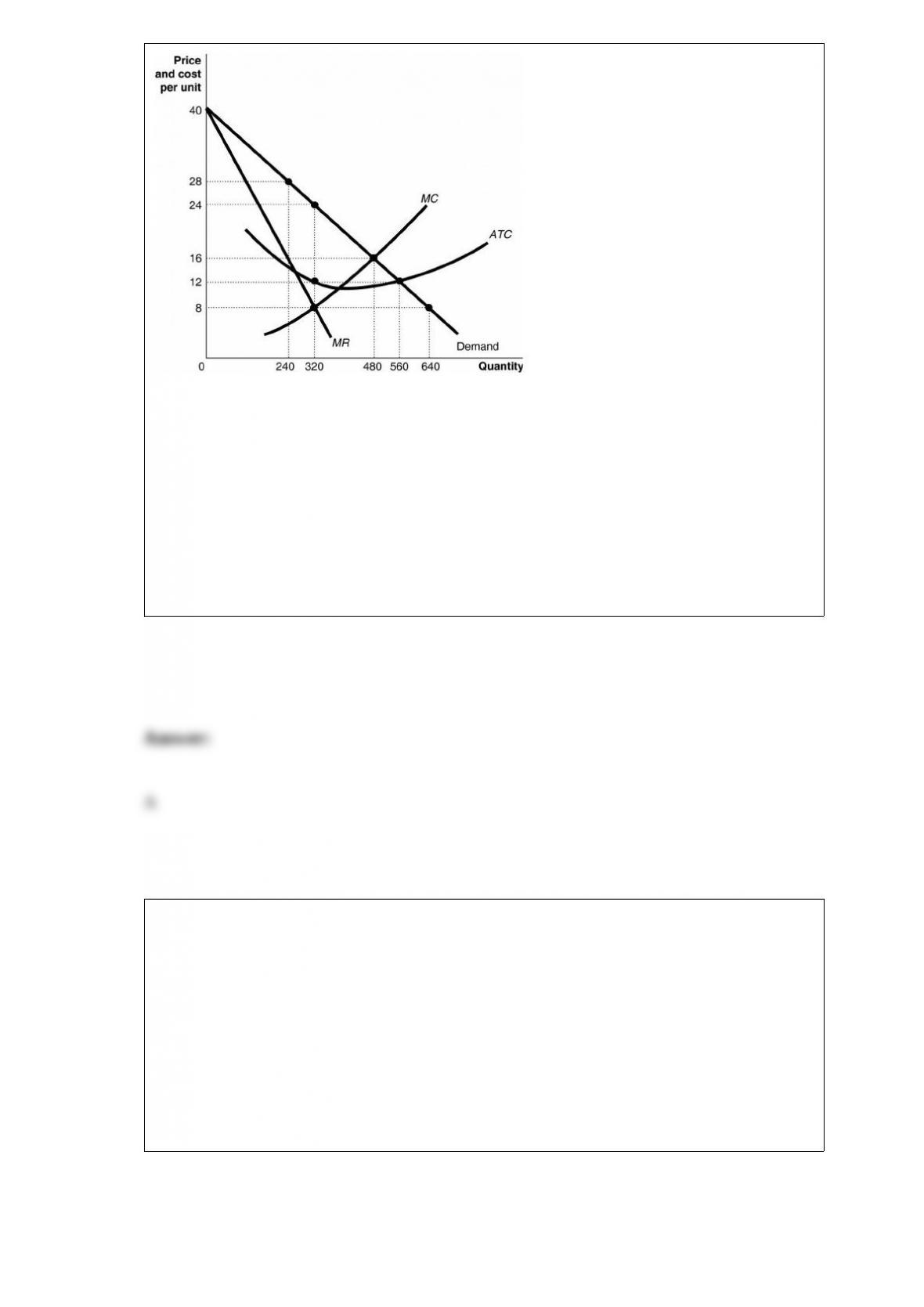
Refer to Figure 16-5. Suppose the firm represented in the diagram decides to practice
perfect price discrimination. What is the profit-maximizing price it will charge?
A) It should charge a range of prices from $40 to $16.
B) It should charge a range of prices from $40 to $12.
C) $2
D) $8
Which of the following pairs of goods is likely to have a negative cross-price elasticity
of demand?
A) pancakes and syrup
B) hot dogs and hamburgers
C) orange juice and grapefruit juice
D) peanuts and cat food

The larger the share of a good in a consumer’s budget, holding everything else constant,
the
A) more price elastic is a consumer’s demand.
B) more vertical is a consumer’s demand curve.
C) more price inelastic is a consumer’s demand.
D) more unit-elastic is a consumer’s demand.
The word “util” has been used by economists in the past as an objective measure of
utility. Today economists believe that
A) utility cannot be measured objectively.
B) utility can be measured objectively because people can use prices of different goods
to measure utility.
C) all of the important conclusions of the economic model of consumer behavior
depend on utility being measured objectively.
D) the util truly is an objective, rather than a subjective, measure of utility.

A natural monopoly is most likely to occur in which of the following industries?
A) the pharmaceutical industry because the development and approval of new drugs
through the Food and Drug Administration can take more than 10 years
B) the diamond mining and marketing industry because one firm can control a key
resource
C) the software industry because of the importance of network externalities
D) an industry where fixed costs are very large relative to variable costs
What is behavioral economics?
A) the study of how people make wealth-maximizing decisions
B) the study of how people behave in the face of scarcity
C) the study of situations in which people act in ways that are not economically rational
D) the study of how people make decisions at the margin