
In January, buyers of gold expect that the price of gold will rise in February. What
happens in the gold market in January, holding all else constant?
A) The supply curve shifts to the right.
B) The demand curve shifts to the left.
C) The demand curve shifts to the right.
D) The quantity demanded increases.
If, in response to a decrease in the price of grapes, the quantity of grapes demanded
increases, economists would describe this as
A) an increase in demand.
B) an increase in quantity demanded.
C) a change in consumer income.
D) an increase in consumers’ taste for coffee.
A constant cost, perfectly competitive market is in long-run equilibrium. At present,
there are 1,000 firms each producing 400 units of output. The price of the good is $60.
Now suppose there is a sudden increase in demand for the industry’s product which
causes the price of the good to rise to $64. In the new long-run equilibrium, how will
the average total cost of producing the good compare to what it was before the price of

the good rose?
A) The average total cost will be higher than it was before the price increase since the
increase in demand will drive up input prices.
B) The average total cost will be lower than it was before the price increase because of
economies of scale.
C) The average total cost will be higher than it was before the price increase because of
diseconomies of scale arising from the increased demand.
D) The average total cost will be the same as it was before the price increase.
The Sherman Act prohibited
A) marginal cost pricing.
B) setting price above marginal cost.
C) collusive price agreements among rival sellers.
D) selling below average total cost.
Table 17-1
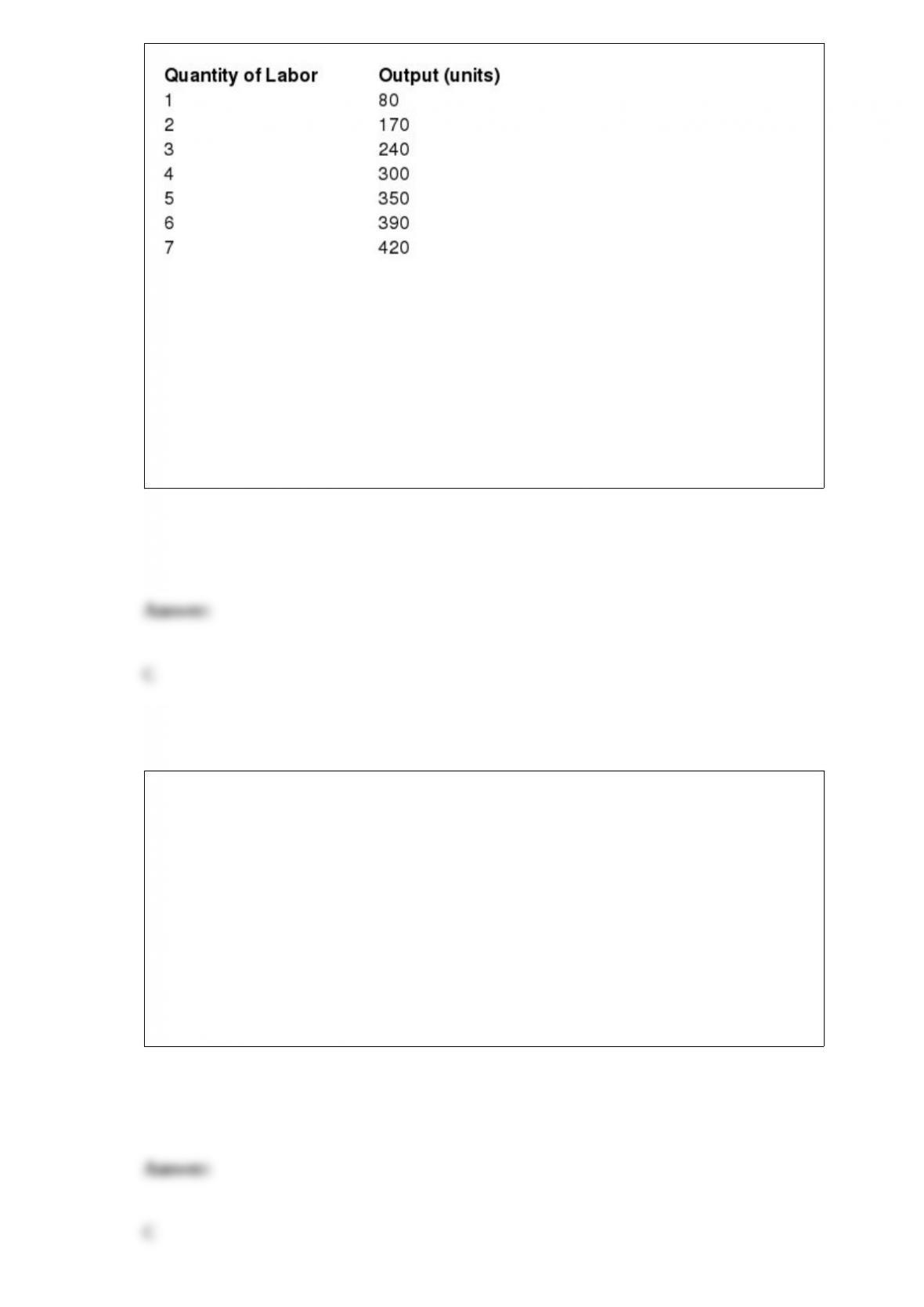
Refer to Table 17-1. The marginal product of the fourth unit of labor is
A) 300.
B) 75.
C) 60.
D) 15.
Conceptually, the efficient level of carbon emissions is the level for which
A) the marginal benefit of reducing carbon emissions is maximized.
B) the marginal cost of reducing carbon emissions is minimized.
C) the marginal benefit of reducing carbon emissions is equal to the cost of reducing
carbon emissions.
D) the marginal benefit of reducing carbon emissions is minimized and the marginal
cost of reducing carbon emissions is maximized.

Article Summary
According to a study by the Center for Neighborhood Technology, homes located
within one-half mile of frequently-used public transportation held their value much
better during the recent housing market downturn than did those without easy access to
public transportation, and the greater home values reflect greater demand for
neighborhoods in close proximity to public transportation. In addition to higher home
values, the study found that close proximity to public transportation offers lower
transportation costs, a wider variety of travel options, and access to more employment
opportunities.
Source: Meg Handley, “Study: Proximity to Public Transit Boosts Home Values,” U.S.
News & World Report, March 22, 2013.
Refer to the Article Summary. Higher home values which result from close proximity
to public transportation are an example of a ________ due to the public transportation.
A) positive externality.
B) negative externality.
C) private cost.
D) social cost.
What is the term that explains why voters often lack knowledge of pending legislation,
and lack knowledge of the views of candidates for office on a range of issues that affect
their own (the voters’) welfare?
A) the voting paradox
B) logrolling
C) rational ignorance
D) regulatory capture

A possible advantage of a horizontal merger for the economy is that
A) the merging firms could avoid losses.
B) the merged firm might reap economies of scale which could translate into lower
prices.
C) the degree of competition in the industry will be intensified.
D) the government stands to collect more corporate income tax revenue.
When BMW, an German company, purchases a welding machine that was made in
Toronto, the purchase is
A) both a German and a Canadian import.
B) a German import and a Canadian export.
C) a German export and a Canadian import.
D) neither an export nor an import for either country.
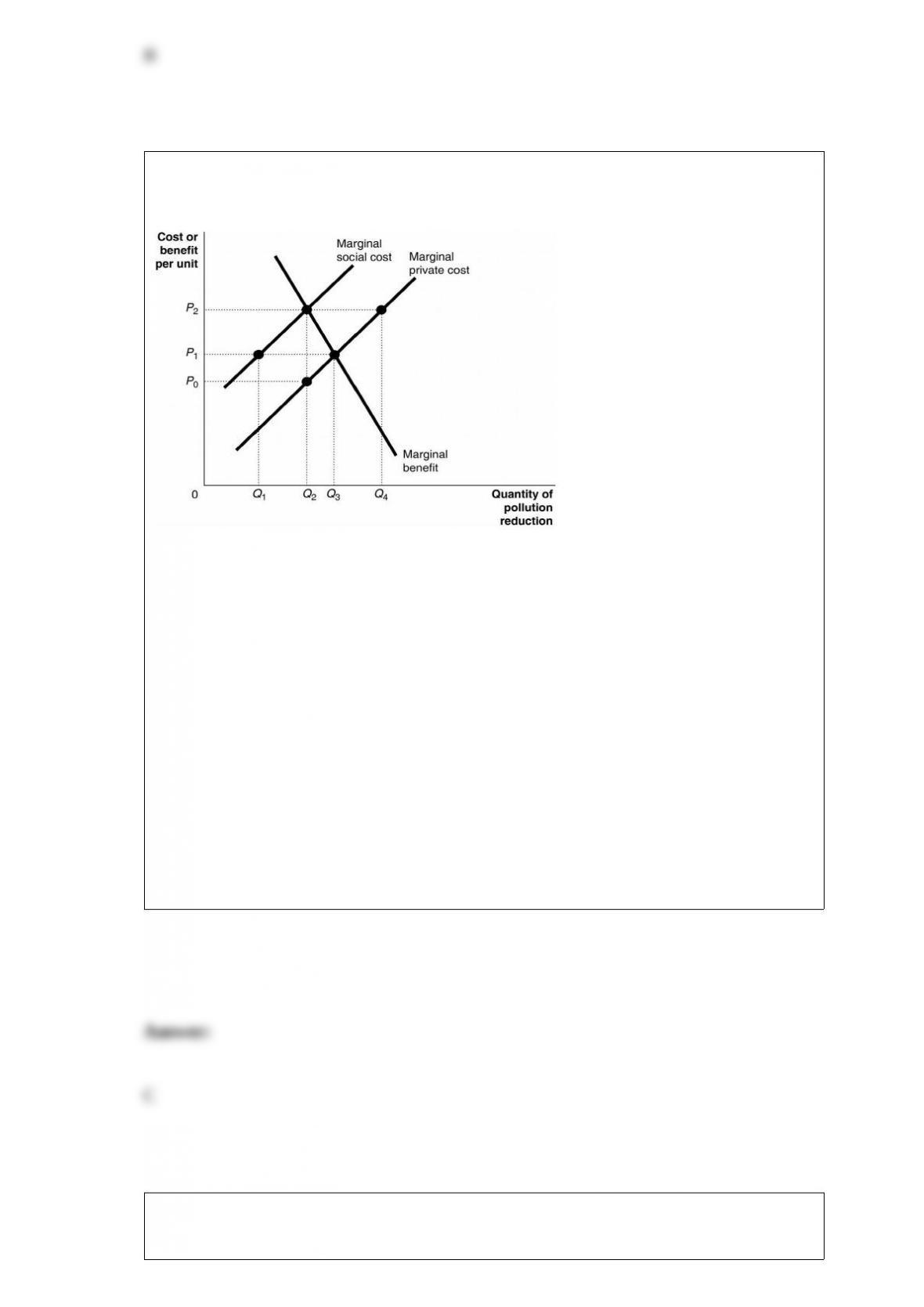
Figure 5-9
Companies producing toilet paper bleach the paper to make it white. The bleach is
discharged into rivers and lakes and causes substantial environmental damage. Figure
5-9 illustrates the situation in the toilet paper market.
Refer to Figure 5-9. Let’s suppose the government imposes a tax of $50 per ton of toilet
paper to bring about the efficient level of production. What happens to the market price
of toilet paper?
A) It rises by $50.
B) It rises by more than $50.
C) It rises by less than $50.
D) It remains the same because the tax is imposed on producers who create the
externality.
If the cross-price elasticity of demand between Breeze Detergent and Faber Detergent is
a relatively large positive number, then it indicates that

A) the two brands are probably made by the same company.
B) the two brands of detergent are close substitutes.
C) consumers have a distinct preference for one brand versus the other.
D) detergents are necessities.
How much is a bond that pays $20 in coupon payments for 4 years and $1,000 at the
end of the fourth year worth if the interest rate is 5%?
A) $822.70
B) $893.62
C) $1,070.92
D) $1,080
Figure 10-9

Refer to Figure 10-9. If the consumer has $240 to spend on DVDs and CDs, what is the
price of a DVD if the budget constraint is BC1?
A) $10
B) $20
C) $24
D) $40
The “Buy American” provision in the 2009 stimulus package required that stimulus
money be spent only on U.S.-made goods, effectively acting as a quota of zero imports
when stimulus money was being spent. In the market for steel, the “Buy American”
provision would ________ the price of steel in the United States and ________ the
quantity of steel demanded in the United States.
A) increase; increase
B) increase; decrease
C) decrease; increase
D) decrease; decrease

An increase in input costs in the production of electric automobiles caused the price of
electric automobiles to rise. Holding everything else constant, how would this affect the
market for gasoline-powered automobiles (a substitute for electric automobiles)?
A) The supply of gasoline-powered automobiles would increase and the equilibrium
price of gasoline-powered automobiles would decrease.
B) The demand for gasoline-powered automobiles would increase and the equilibrium
price of gasoline-powered automobiles would increase.
C) The demand for gasoline-powered automobiles would decrease because consumers
could afford to buy fewer gasoline-powered automobiles.
D) The demand for gasoline-powered automobiles would increase and the equilibrium
price of gasoline-powered automobiles would decrease.
Suppose the price of gasoline is $3.50 per gallon, the quantity of gasoline demanded is
150 billion gallons per year, the price elasticity of demand for gasoline is -0.06, and the
federal government decides to increase the excise tax on gasoline by $1.00 per gallon,
which increases the price of gasoline by $0.75 per gallon. How much revenue does the
federal government receive from the tax?
A) $95.44 billion
B) $111.20 billion
C) $148.27 billion
D) $161.61 billion
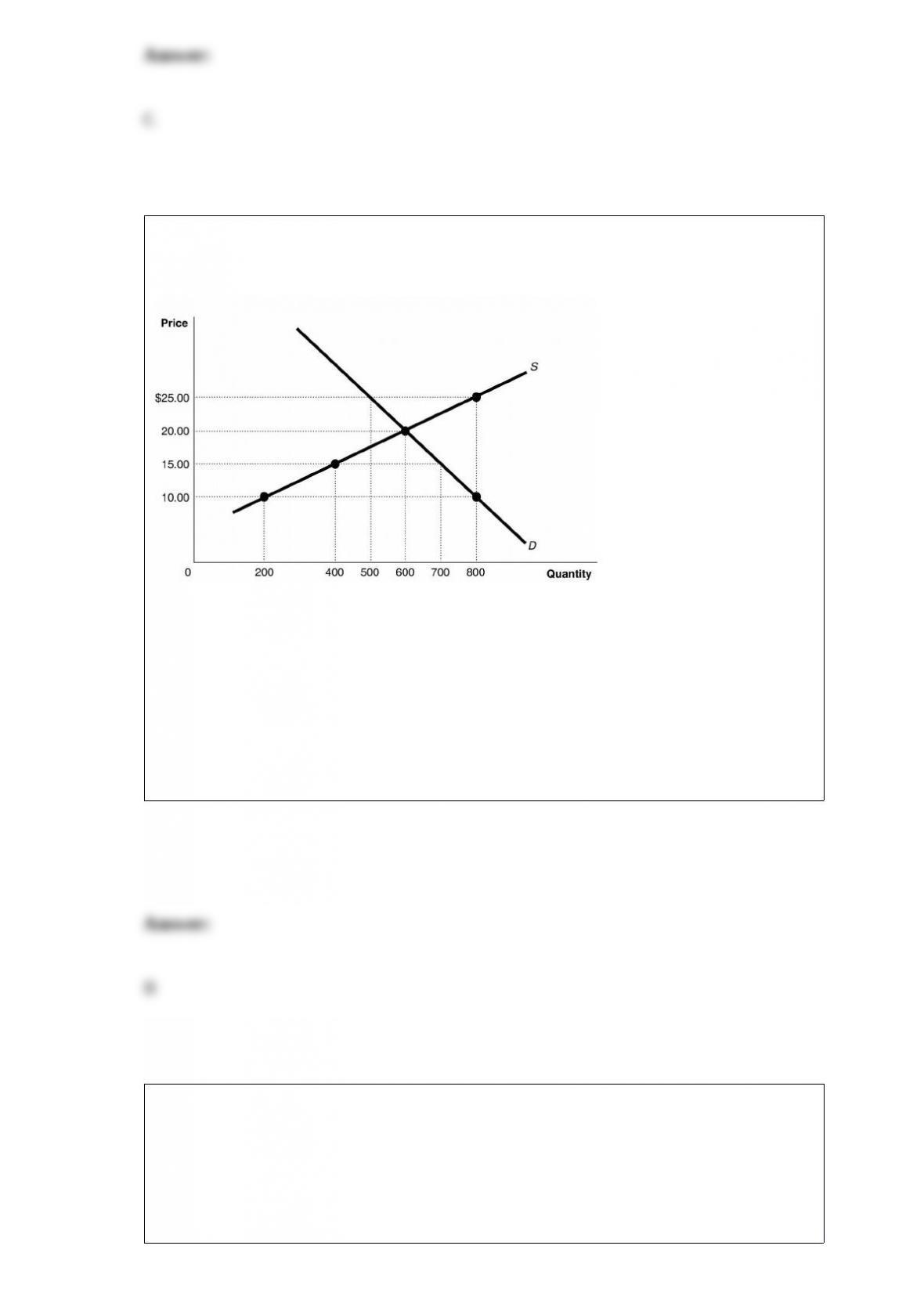
Figure 3-4
Refer to Figure 3-4. If the price is $10,
A) there would be a surplus of 600 units.
B) there would be a shortage of 600 units.
C) there would be a surplus of 200 units.
D) there would be a shortage of 200 units.
Beginning in 1965, the head of the Antitrust Division of the U.S. Department of Justice
began to change antitrust policy. How did antitrust policy change?
A) For the first time horizontal mergers were allowed – with government approval – and
vertical mergers were allowed without need for approval from the government.

B) For the first time concentration ratios were used to evaluate the degree of
competition in the industries of firms that proposed mergers.
C) The Division began to systematically consider the economic consequences of
proposed mergers.
D) Proposed mergers no longer needed the approval of the Federal Trade Commission
or the court system.
One reason why, in the short run, the marginal product of labor might increase initially
as more workers are hired is that
A) the first workers hired get to use the best equipment.
B) specialization allows a worker to focus on one task, thereby increasing her
proficiency at that task.
C) the best workers are hired first and later hires are not as skillful.
D) beyond some point, a firm has hired too many workers.
Table 18-1

Suppose $1 billion is available in the budget and Congress is considering allocating the
funds to one of the following three alternatives: 1. Subsidies for education, 2. Research
on Alzheimer’s or 3. Increased border security. Table 18-1 shows three voters’ rankings
of the alternatives.
Refer to Table 18-1.Suppose a series of votes are taken in which each pair of
alternatives is considered in turn. If the vote is between allocating funds to research on
Alzheimer’s and increased border security
A) Ivy and Jasmine vote for Alzheimer’s research, Rose votes for increased border
security, and Alzheimer’s research wins.
B) Ivy and Rose vote for increased border security, Jasmine votes for Alzheimer’s
research, and increased border security wins.
C) Jasmine and Rose vote for Alzheimer’s research, Ivy votes for increased border
security, and Alzheimer’s research wins.
D) Jasmine and Ivy vote for increased border security, Rose votes for Alzheimer’s
research, and increased border security wins.
A consumer’s budget constraint is
A) the limited income that a consumer has to spend on goods and services.
B) the rate at which the consumer must give up one good to purchase an additional unit
of the other goods in the market.
C) the price ratio a consumer faces in the marketplace.
D) the extent to which one’s preferences are limited by one’s income.
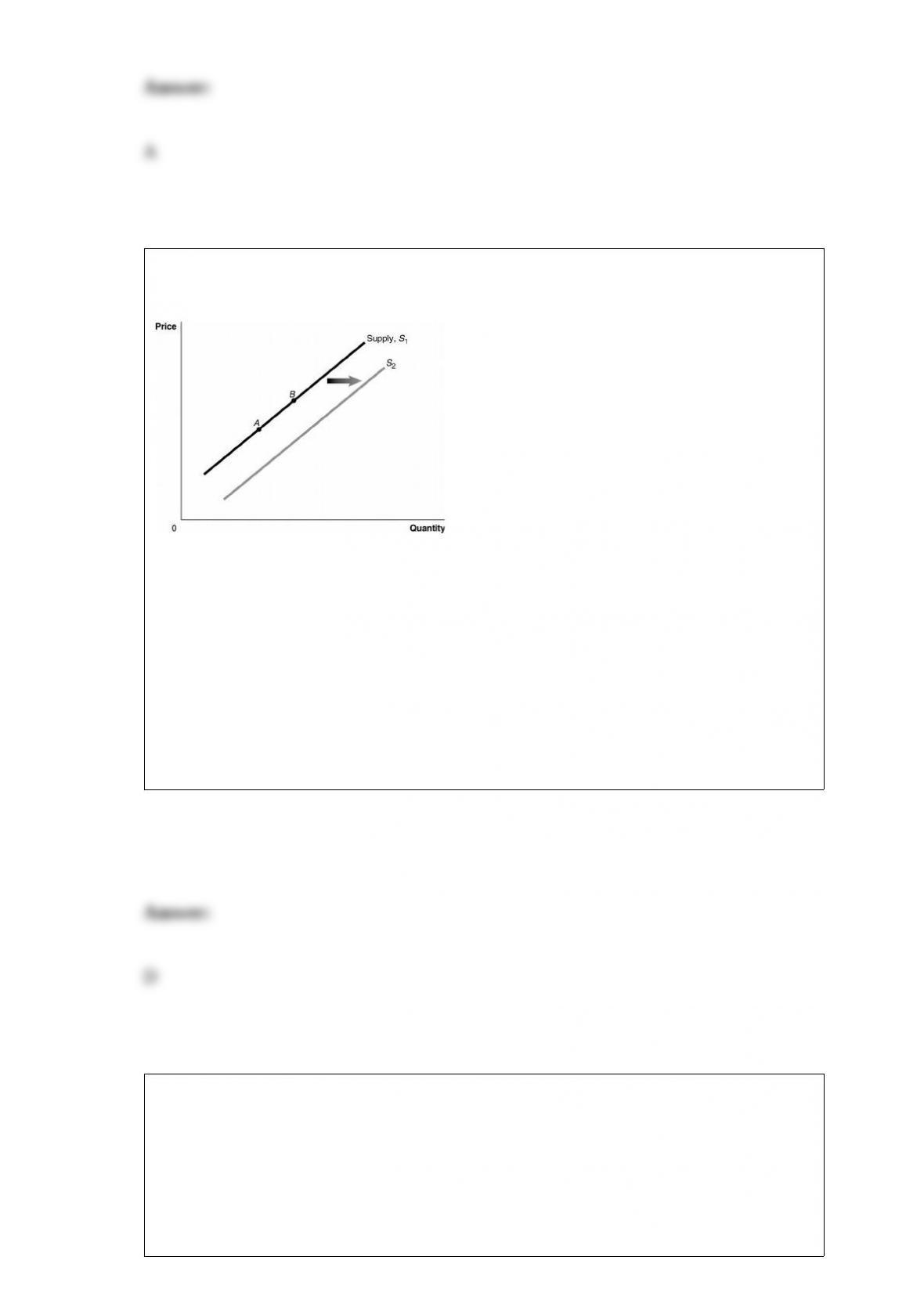
Figure 3-2
Refer to Figure 3-2. A decrease in productivity would be represented by a movement
from
A) A to B.
B) B to A.
C) S1 to S2.
D) S2 to S1.
The income elasticity of demand measures
A) the responsiveness of quantity demanded to changes in income.
B) how a consumer’s purchasing power is affected by a change in the price of a product.
C) the percentage change in the price of a product divided by the percentage change in

consumer income.
D) the income effect of a change in price.
Pookie’s Pinball Palace restores old Pinball machines. Pookie has just spent $300
purchasing and cleaning a 1960s-era machine which he expects to sell for $2,000 once
he is finished with the restoration. After having spent $300, Pookie discovers that he
will need to rewire the entire machine at a cost of $1,100 in order to finish the
restoration. Alternatively, he can sell the machine “as is” now for $1,000. What should
he do?
A) He should sell the machine now to make the most profit.
B) It does not matter what he does; he is going to take a loss on his project.
C) He should rewire the machine, complete the task and then sell the machine.
D) He should have never purchased the machine because he has already spent too much
time on it and has not been paid for that time.
Which of the following statements is true about the price elasticity of demand along a
downward sloping linear demand curve?
A) It is inelastic at high prices and elastic at low prices.
B) It is unit-elastic throughout the demand curve.

C) It is elastic at high prices and inelastic at low prices.
D) It is perfectly elastic at very high prices and perfectly inelastic at very low prices.
The highest valued alternative that must be given up to engage in an activity is the
definition of
A) economic equity.
B) marginal benefit.
C) opportunity cost.
D) marginal cost.
Article Summary
In 2012, Colorado and Washington legalized marijuana for recreational use, and
one of the major selling points in each state’s pro-marijuana campaign was the
possibility of generating millions of dollars in tax revenue from sales which could
be used for funding general education. The Colorado legislature was weighing a
proposal to tax marijuana at 30 percent, of which 15 percent would be a sales tax
on consumers and 15 percent an excise tax on growers. Washington has set a tax
rate of 44 percent on consumers and 25 percent each for growers and retailers.
Since the legalization of marijuana is relatively new, projecting the economic
impact of its sale is difficult, leading to many questions as to the quantities that
will be produced and sold and what actual tax revenues will be generated.

Source: Elizabeth Dwoskin, “Colorado and Washington Try to Figure Out How to
Tax Marijuana,” Bloomberg Businessweek, April 26, 2013.
Refer to the Article Summary. Colorado is weighing a proposal to tax marijuana at 30
percent, of which 15 percent would be a sales tax on consumers and 15 percent would
be an excise tax on growers. Suppose the actual burden of the tax falls 80 percent on
consumers and 20 percent on producers. In this case, consumers will actually bear the
tax burden of ________ percent of the selling price and producers will actually bear the
tax burden of ________ percent of the selling price.
A) 24; 6
B) 50; 50
C) 15; 15
D) 80; 20
For years economists believed that market structure explained the ability of some firms
to earn economic profits. Today, economists and business strategists put greater
emphasis on
A) the number of years a firm has been in business and the average price of the
products sold by the firm.
B) the number of countries in which a firm conducts business and the number of
employees the firm has in each country.
C) the characteristics of individual firms and the strategies their managements use to
continue to earn economic profits.
D) the size of a firm relative to the industry average and the number of firms in the
domestic industry.

Of the following high-income countries, which has the highest infant mortality rate?
A) Canada
B) Japan
C) the United Kingdom
D) the United States