
If a natural monopoly regulatory commission sets a price where marginal cost is equal
to demand
A) the firm would earn monopoly profits.
B) economic efficiency would not be achieved.
C) the firm would incur a loss.
D) the firm would break even.
Compared to other high-income countries, health care spending per person in the
United States has been
A) growing at a faster rate.
B) declining at a faster rate.
C) growing at approximately the same rate.
D) declining at approximately the same rate.
Table 2-2
Production choices for Billie’s Bedroom Shop
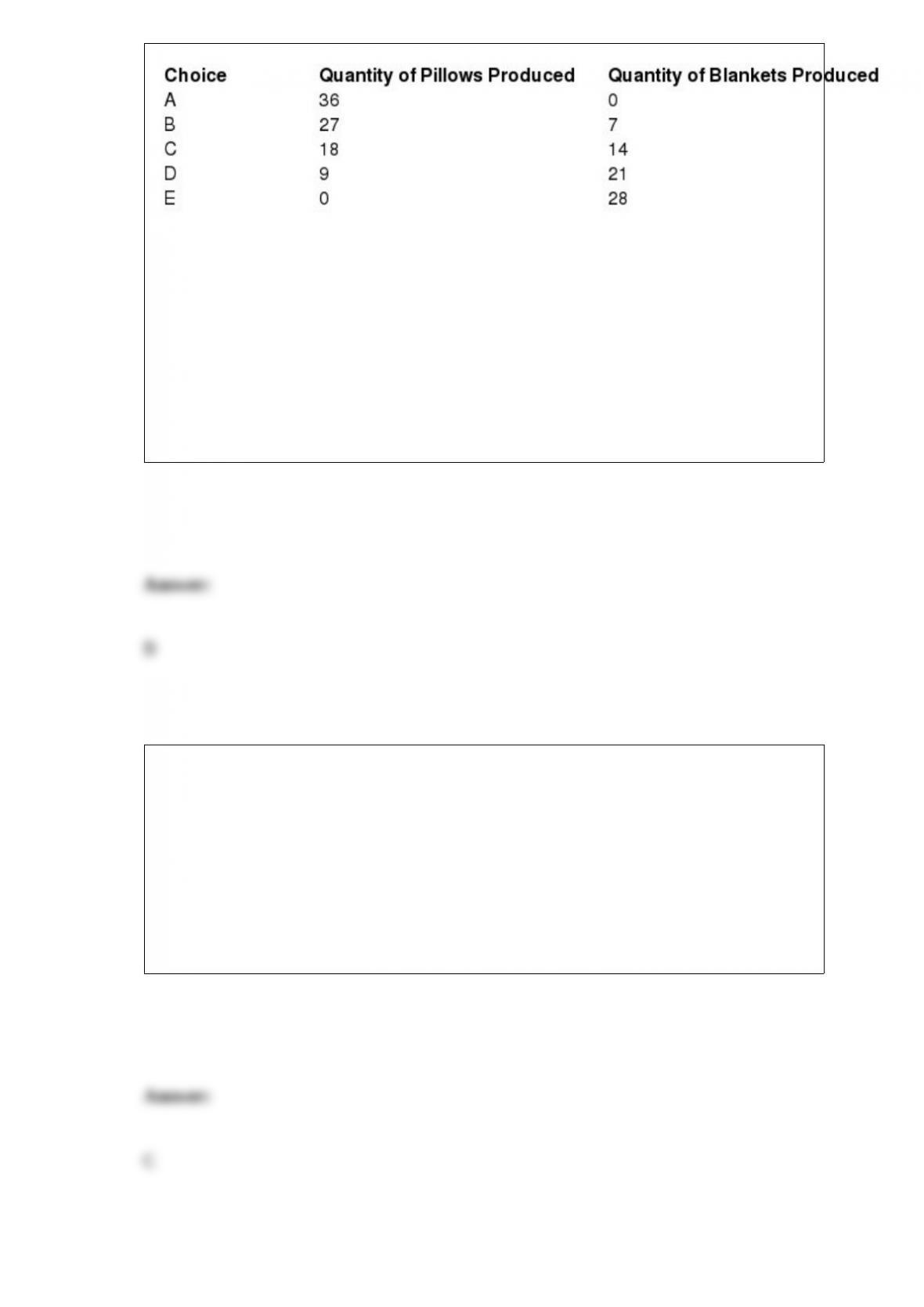
Refer to Table 2-2. Assume Billie’s Bedroom Shop only produces pillows and blankets.
A combination of 5 pillows and 21 blankets would appear
A) along Billie’s production possibilities frontier.
B) inside Billie’s production possibilities frontier.
C) outside Billie’s production possibilities frontier.
D) at the vertical intercept of Billie’s production possibilities frontier.
What takes place in the indirect finance market?
A) Part ownership of corporations is sold in the form of stocks.
B) Corporate and government bonds are sold to savers.
C) Deposits of savers are accepted and loans made to borrowers.
D) Government purchases of buildings and equipment are sold to the highest bidder.

Long-run equilibrium under monopolistic competition and perfect competition is
similar in that
A) firms produce at the minimum point of their average cost curves.
B) price equals marginal cost.
C) firms break even.
D) price equals marginal revenue.
The Santa Fe Spark Plug Company supplies spark plugs to automotive parts dealers. An
increase in the demand for its product led Santa Fe to hire 150 new workers. Santa Fe
also plans to expand the capacity of its plant but this project will take 2 years to
complete. Which of the following statements is true?
A) The wages and benefits paid to the new workers are implicit costs.
B) The long run for Santa Fe is longer than 1 year.
C) The short run for Santa Fe is 1 year.
D) In the short run Santa Fe’s variable costs increase but its fixed costs decrease.
Table 6-2
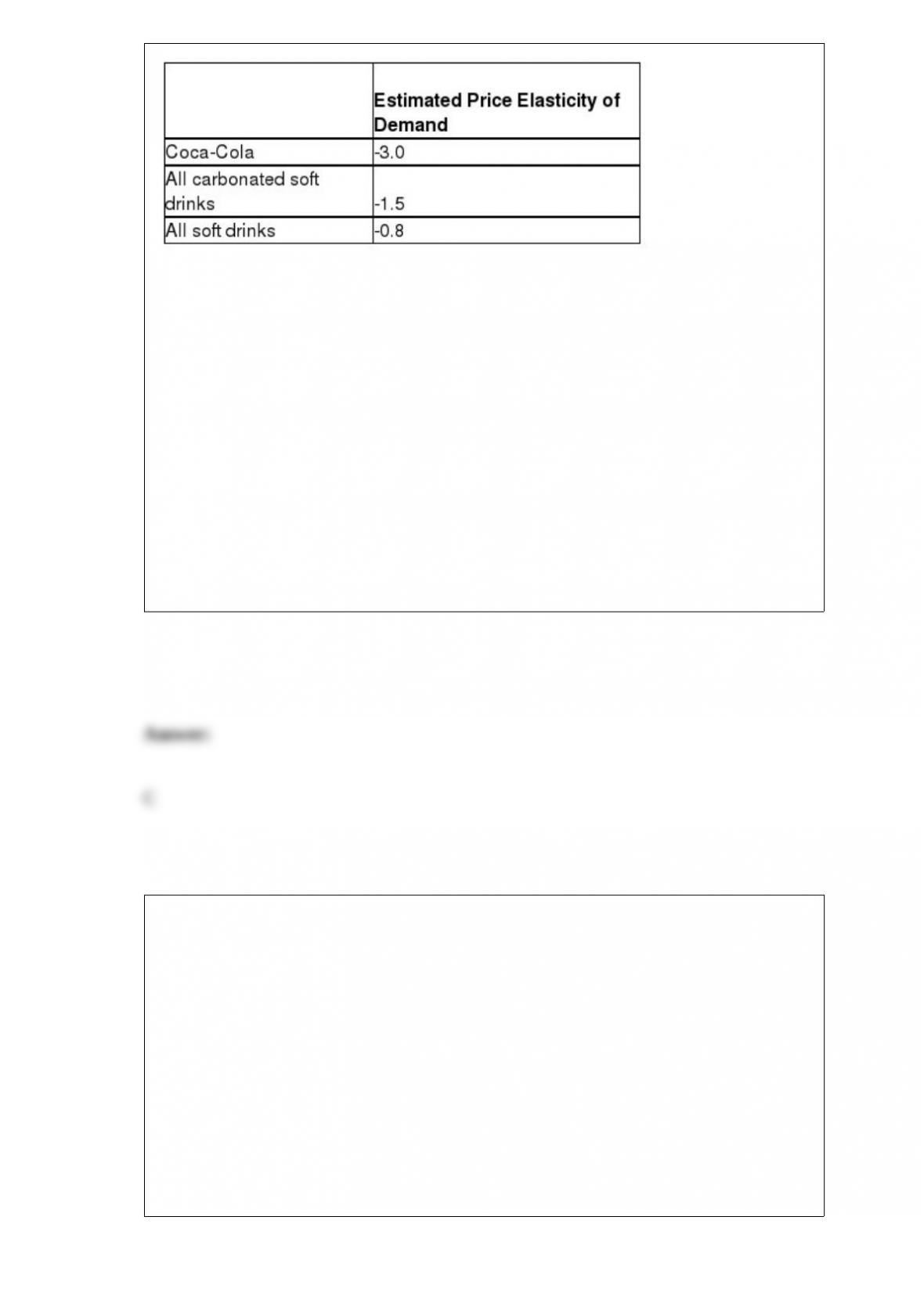
Refer to Table 6-2. Assume that an economist has estimated the price elasticity of
demand values in the table above. Use the data in the table to select the correct
statement.
A) The demand for Coca-Cola is inelastic.
B) The elasticity for “All soft drinks” is less than the elasticity for Coca-Cola because
Coca-Cola is more of a luxury than a necessity; “All soft drinks” represent goods that
are more necessity than luxury.
C) The difference in elasticity values is explained by the fact that the more narrowly we
define a market the more elastic the demand will be.
D) There are fewer substitutes for “All carbonated soft drinks” than there are for “All
soft drinks.”
What is an indifference curve?
A) It is a curve that shows the total utility and the marginal utility derived from
consuming a bundle of goods.
B) It is a curve that shows the combinations of consumption bundles that gives the
consumer the same utility.
C) It is a curve that shows ranks a consumer’s preference for various consumption
bundles.
D) It is a curve that shows the tradeoff a consumer faces among different combinations
of consumption bundles.

The income effect of a decrease in the price of legal services, a normal good, results in
A) a decrease in the demand for legal services.
B) a decrease in the quantity demanded of legal services.
C) an increase in the quantity demanded of legal services.
D) an increase in the demand for legal services.
In the United States in 2012, the percentage of firms that employed between 3 and 199
workers and offered health insurance as a fringe benefit to the workers was about
A) 29%.
B) 42%.
C) 61%.
D) 98%.

If, as your taxable income decreases, you pay a larger percentage of your taxable
income in taxes, then the tax is
A) regressive.
B) proportional.
C) progressive.
D) unfair.
Which of the following are necessary condition(s) for successful price discrimination?
a. zero transaction cost
b. a perfectly competitive market structure
c. an imperfectly competitive market structure
d. at least two different markets with different price elasticities of demand
e. at least two different markets with different price elasticities of supply
A) a, b, and d only
B) c and d only
C) a, c, d and, e only
D) a and c only

Which of the following statements is true?
A) Exports benefit trading countries because exports create jobs. Imports do not benefit
trading countries because they result in a loss of jobs.
B) Each year China exports about 50 percent of its wheat crop and 40 percent of its rice
crop.
C) Most of the leading exporting countries are large, high-income countries.
D) All sectors of the U.S. economy are affected equally by international trade.
Suppose the United States has a Gini coefficient of 0.4 and Sweden has a Gini
coefficient of 0.25. Which of the following statements is true?
A) The distribution of income is more equal in the United States.
B) The distribution of income is more equal in the Sweden.
C) Income distribution is changing faster in the United States.
D) Without information on population, it is not possible to compare income distribution
between countries.
How does the increasing use of MP3 players affect the market for compact discs?

A) The demand curve for compact discs shifts to the right.
B) The supply curve for compact discs shifts to the left.
C) The supply curve for compact discs shifts to the right.
D) The demand curve for compact discs shifts to the left.
In perfect competition
A) the market demand curve and the individual’s demand are identical.
B) the market demand curve is perfectly inelastic while demand for an individual
seller’s product is perfectly elastic.
C) the market demand curve is perfectly elastic while demand for an individual seller’s
product is perfectly inelastic.
D) the market demand curve is downward sloping while demand for an individual
seller’s product is perfectly elastic.
The U.S. Bureau of Labor Statistics predicts that 9 of the 20 fastest growing
occupations over the next ten years will be in
A) the medical field.

B) the travel and leisure industry.
C) education.
D) construction.
In a perfectly competitive industry, in the long-run equilibrium
A) the typical firm is producing at the output where its long-run average total cost is not
minimized.
B) the typical firm is earning an accounting profit greater than its implicit costs.
C) the typical firm earns zero profit.
D) the typical firm is maximizing its revenue.
Which of the following statements is consistent with the views of Joseph Schumpeter?
A) Research and development by competitive firms is responsible for most
technological changes.
B) An economy benefits from firms having market power because these firms are more
likely to be able to commit funds for research and development.
C) Enforcement of antitrust laws is necessary to promote competition among firms.

D) A lack of competition discourages firms from developing new technologies.
Which of the following is not an example of a monopolistically competitive market?
A) automobile producers
B) supermarkets
C) video stores
D) makers of women’s clothing
The people firms hire to attempt to convince state legislators and members of Congress
to pass laws that are favorable to the economic interests of the firms are called
A) economic advisors.
B) legislative assistants.
C) government bureaucrats.
D) lobbyists.

The term “payroll taxes” is often used to refer to
A) individual income taxes that are withheld from paychecks.
B) corporate income taxes.
C) Social Security and Medicare taxes.
D) sales taxes.
Compared to monopoly pricing, an optimal two-part tariff
A) reduces economic efficiency.
B) eliminates the deadweight loss.
C) equates marginal revenue and average revenue.
D) increases consumer surplus.

Orange juice drinkers want to consume more orange juice at a lower price. Which of the
following events would have this effect?
A) a decrease in the price of orange juice processing
B) an increase in the cost of fertilizer used for orange groves
C) a decrease in income, assuming orange juice is a normal good
D) a decrease in the population
One method of setting price using the cost-plus method is to add
A) a given percentage of marginal cost to marginal cost of production.
B) a given percentage of fixed cost to total fixed cost.
C) a given percentage of average total cost to average total cost.
D) a given percentage of average variable cost to average total cost.
Figure 11-13
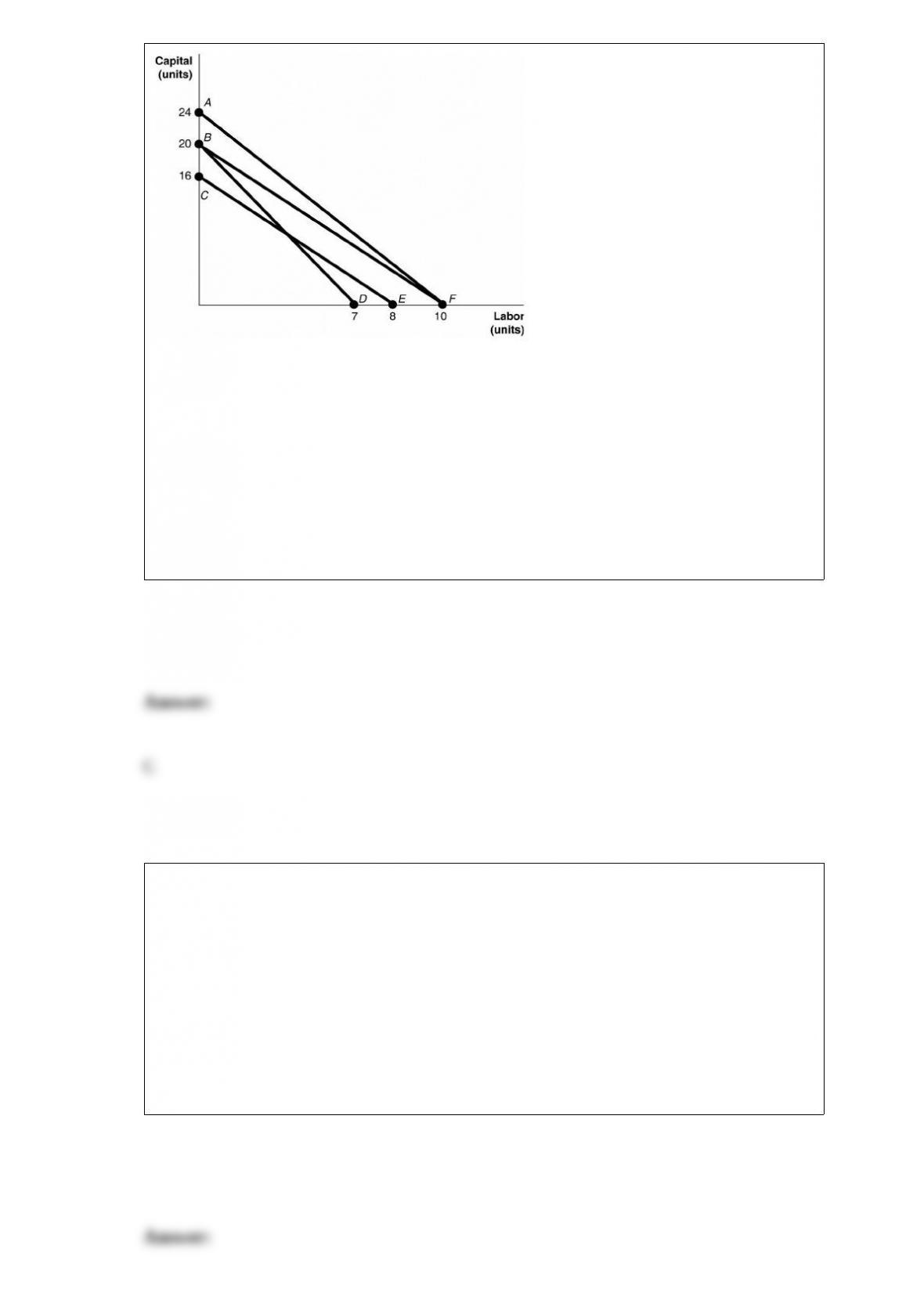
Refer to Figure 11-13. The lines shown in the diagram are isocost lines. If the price of
labor is $50 per unit, what is the price of capital along the isocost CE?
A) $400 per unit
B) $100 per unit
C) $25 per unit
D) insufficient information to answer question
Collusion is
A) common among monopoly firms.
B) an agreement among firms to charge the same price or otherwise not to compete.
C) necessary for firms to raise money by borrowing from investors or from banks in
order to fund research and development required to develop new products.
D) legal under U.S. antitrust laws if the intent is to increase competition.

Suppose you pre-ordered a non-refundable movie ticket to X-Men: Days of Future Past.
On the day of the movie you decide that you would rather not go to the movie.
According to economists, what is the rational thing to do?
A) Since the cost of the movie ticket is a sunk cost, it should not influence your
decision. Your decision should be based solely on whether you want to see the movie or
not.
B) You should not waste resources. Since you have paid for the ticket you should watch
the movie.
C) Your should go to the movie to minimize your losses.
D) You should go to the movie to maximize your utility.
Which of the following is an example of an implicit cost a firm might incur?
A) the out-of-pocket expense to hire resources
B) taxes owed to the state and Federal governments
C) the rental value of the office space the company owns and uses for itself
D) the revenue a firm generates in using its resources

In addition to requiring that CEO’s personally certify the accuracy of financial
statements, the Sarbanes-Oxley Act of 2002 also requires that
A) CEO’s conduct audits of their corporations themselves.
B) firms raise funds for expansion through the sale of bonds only, not stocks.
C) auditors disclose any potential conflicts of interest.
D) corporations issue financial statements monthly rather than quarterly.