Tax laws affect
A) economic efficiency but not equity.
B) equity but not economic efficiency.
C) consumption and production, not efficiency and equity.
D) both efficiency and equity.
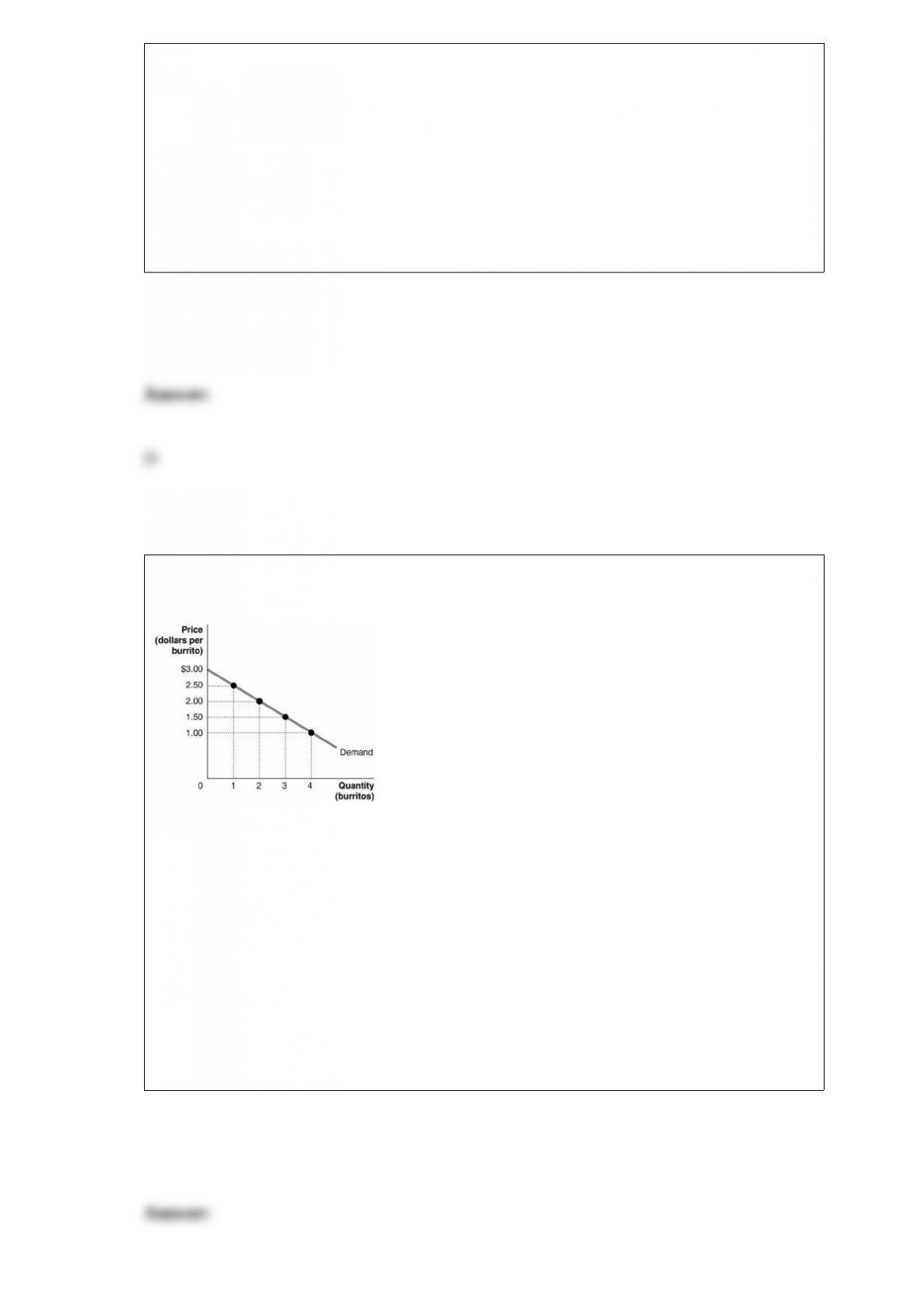
Figure 4-1
Figure 4-1 shows Arnold’s demand curve for burritos.
Refer to Figure 4-1. If the market price is $1.50, what is the consumer surplus on the
first burrito?
A) $0.50
B) $1.00
C) $1.50
D) $7.50
Suppose the demand curve for hybrid cars shifts to the right. This will cause a relatively
small increase in the price of hybrid cars if
A) demand is elastic and supply is inelastic.
B) demand is inelastic and supply is elastic.
C) both demand and supply are inelastic.
D) both demand and supply are elastic.
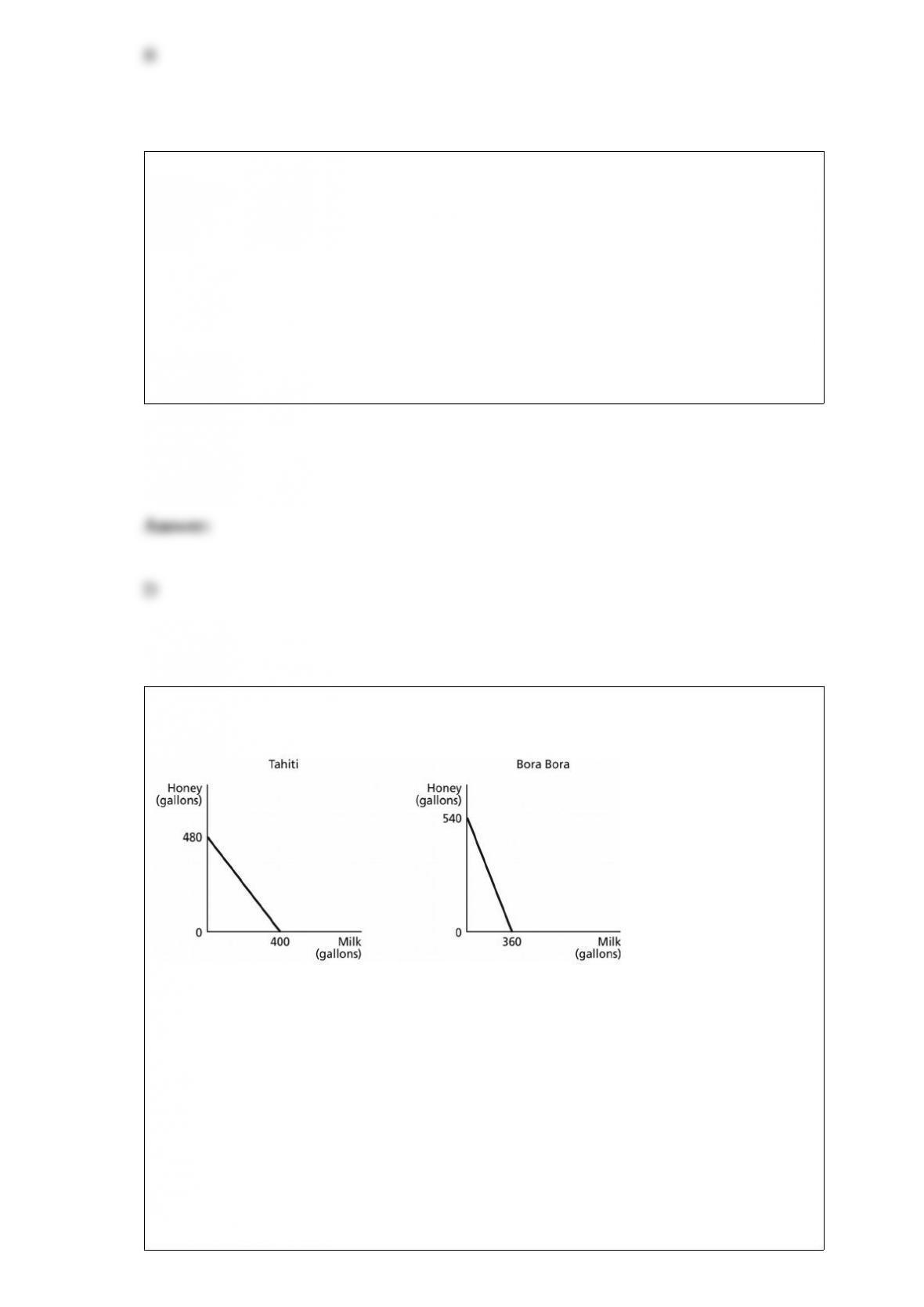
Figure 2-10
Figure 2-10 shows the production possibilities frontiers for Tahiti and Bora Bora. Each
country produces two goods, milk and honey.
Refer to Figure 2-10. What is the opportunity cost of producing one gallon of honey in
Bora Bora?
A) 2/3 gallon of milk
B) 0.9 gallon of milk
C) 1 1/3 gallons of milk
D) 1.5 gallons of milk
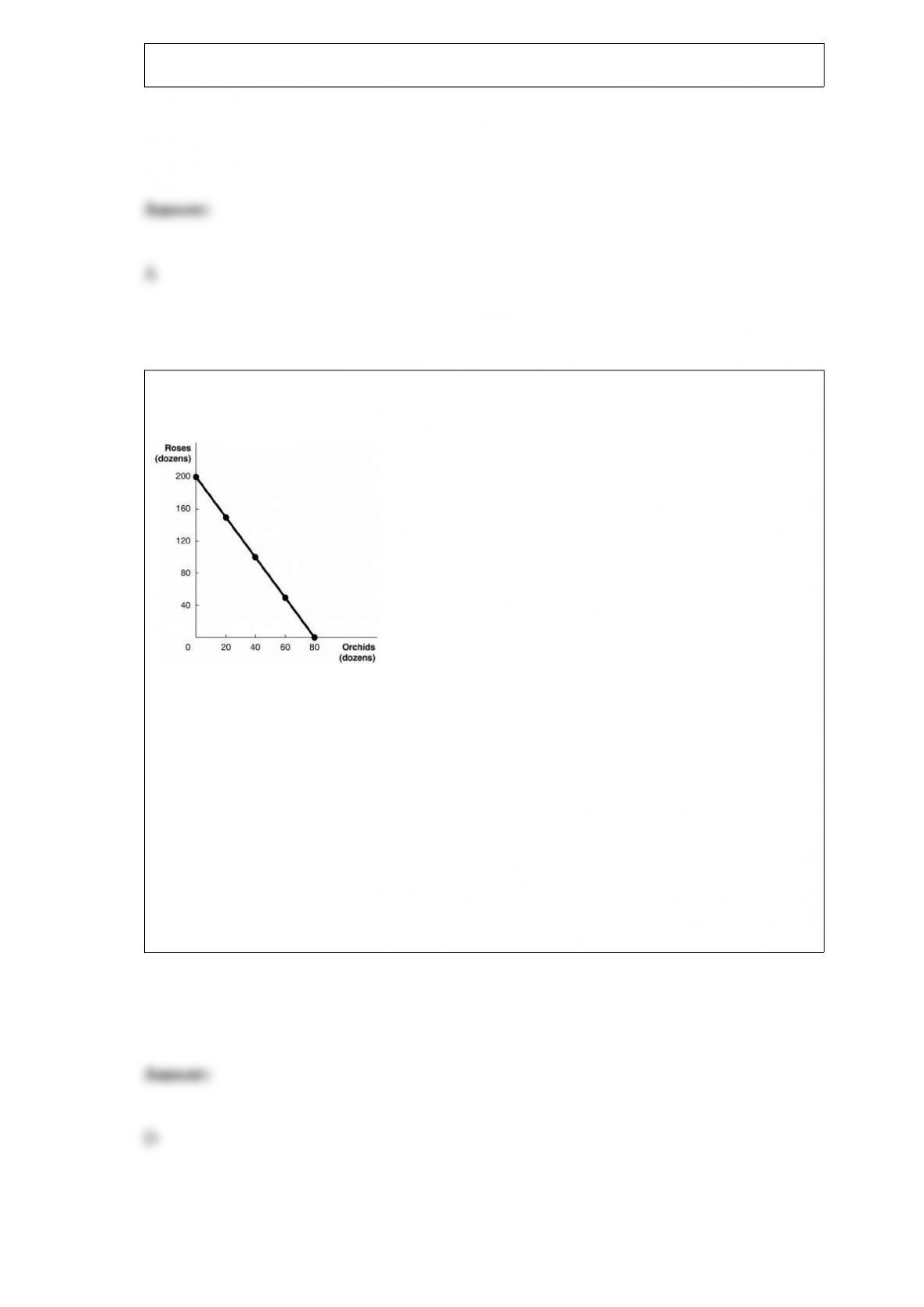
Figure 2-8
Figure 2-8 above shows the production possibilities frontier for Vidalia, a nation that
produces two goods, roses and orchids.
Refer to Figure 2-8. What is the opportunity cost of 80 dozen orchids?
A) 0 roses
B) 2.5 dozen roses
C) 40 dozen roses
D) 200 dozen roses

Which of the following is a microeconomics question?
A) Why do economies experience periods of high inflation?
B) Will Federal Reserve intervention lower the inflation rate?
C) Why has growth in the economy increased since the end of the recession?
D) Will the merger of American Airlines and US Airways increase or decrease airfares?
The sales tax
A) is consistent with the benefits-received principle because low-income individuals
spend less on goods and services than do high-income people.
B) is not consistent with the ability-to-pay principle because low-income individuals
tend to spend a larger fraction of their income than do high-income individuals.
C) is not consistent with the ability-to-pay principle because low-income individuals
tend to purchase a smaller bundle of goods and services compared to high-income
individuals.
D) is not consistent with the benefits-received principle because low-income individuals
spend less on goods and services than do high-income individuals, yet pay the same
sales tax rate.
Tanesha sells homemade candles over the Internet. Her annual revenue is $64,000 per

year, the explicit costs of her business are $17,000, and the opportunity costs of her
business are $22,000. What is her accounting profit?
A) $17,000
B) $22,000
C) $47,000
D) $64,000
One reason for the success that firms have in getting the government to erect barriers to
foreign competition is that jobs lost to foreign competition are easy to identify but jobs
created by foreign trade are often hard to identify. Which of the following is a second
reason?
A) The costs that tariffs and quotas impose on consumers are large in total but relatively
small per person.
B) People who benefit from foreign trade tend not to vote in elections; people who are
harmed by foreign trade are much more likely to vote.
C) Firms that benefit from trade barriers have more money to lobby government
officials to support the barriers than do firms that are harmed by trade barriers.
D) The benefits from free trade are less than the costs.

Golda Rush quit her job as a manager for Home Depot to start her own hair dressing
salon, Goldilocks. She gave up a salary of $40,000 per year, invested her savings of
$30,000 (which was earning 5 percent interest) and borrowed $10,000 from a close
friend, agreeing to pay 5 percent interest per year. In her first year, Golda spent $18,000
to rent a salon, hired a part-time assistant for $12,000 and incurred another $15,000 on
equipment and hairdressing material. Based on this information, what is the amount of
her implicit costs?
A) $80,000
B) $70,000
C) $42,000
D) $41,500
Since 1950 there has been a substantial increase in wheat production. The increase in
production has led to a decrease in the price of wheat because of which of the following
factors?
A) The absolute value of the price elasticity of demand for wheat is less than 1 and the
income elasticity of demand for wheat is greater than 1.
B) The absolute value of the price elasticity of demand for wheat is greater than 1 and
wheat is a close substitute for other food products.
C) The absolute value of the price elasticity of demand for wheat is less than 1 and the
income elasticity of demand for wheat is low.
D) The income elasticity of demand for wheat is high and wheat is an inferior good.
a. What is the defining characteristic of a natural monopoly?
b. Should the government break up a natural monopoly into two or more firms to make
the industry more competitive?
c. Suppose the government wants to ensure that some of the benefits of declining
average total cost are passed on to consumers. To achieve this goal, it requires that the
natural monopoly set its price equal to marginal cost. Is this a feasible goal? Explain.
d. What is an alternative to marginal cost pricing that ensures that consumers reap some
of the benefits of declining average total cost?
Figure 4-4
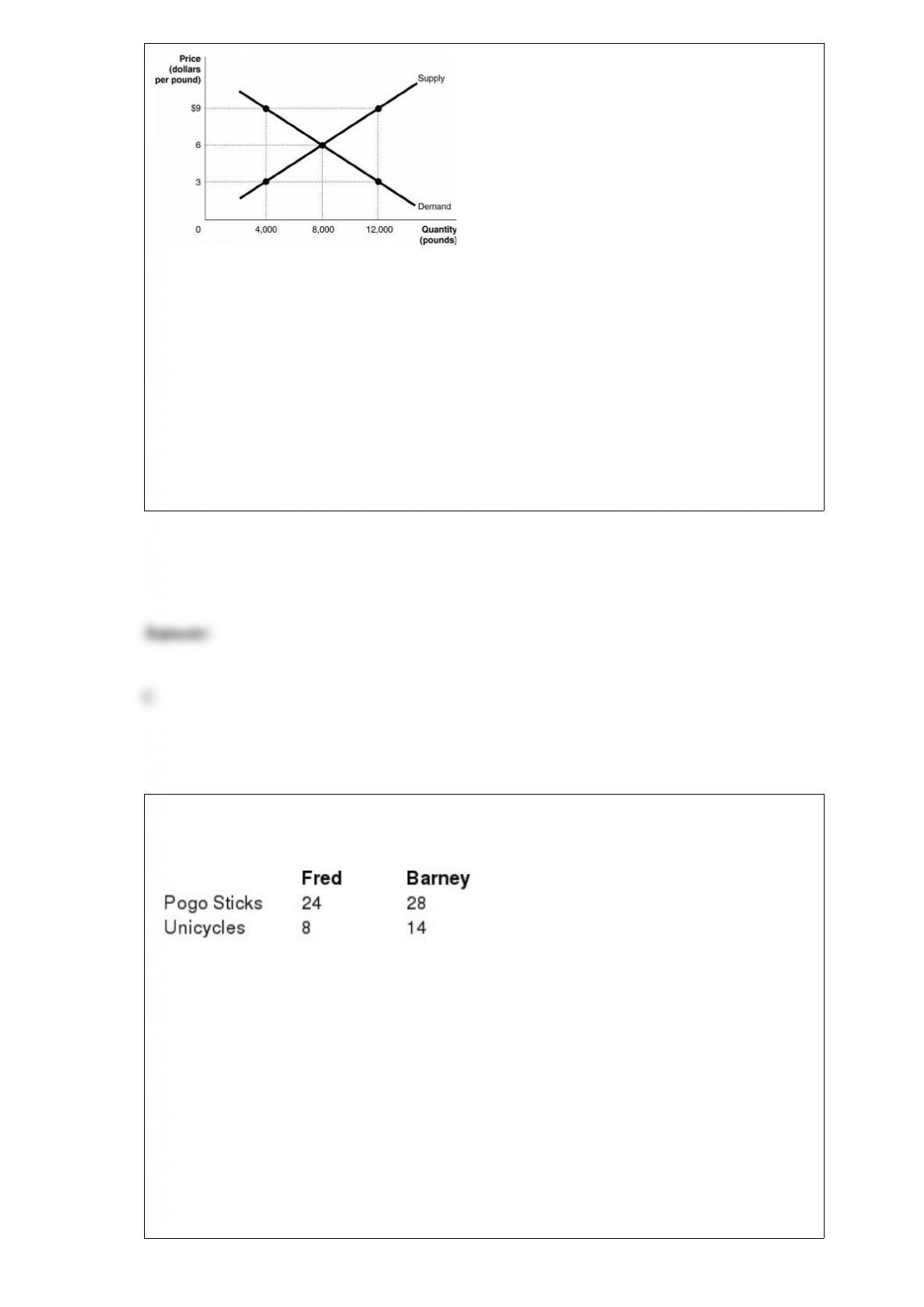
Refer to Figure 4-4. The figure above represents the market for pecans. Assume that
this is a competitive market. If the price of pecans is $3
A) economic surplus is maximized.
B) not enough consumers want to buy pecans.
C) the quantity supplied is less than the economically efficient quantity.
D) the quantity supplied is economically efficient but the quantity demanded is
economically inefficient.
Table 2-7
Table 2-7 shows the output per month of two people, Fred and Barney. They can either
devote their time to making pogo sticks or making unicycles.
Refer to Table 2-7. What is Barney’s opportunity cost of making a pogo stick?
A) 1/2 unicycle
B) 2 unicycles
C) 1/3 unicycle
D) 1.4 pogo sticks
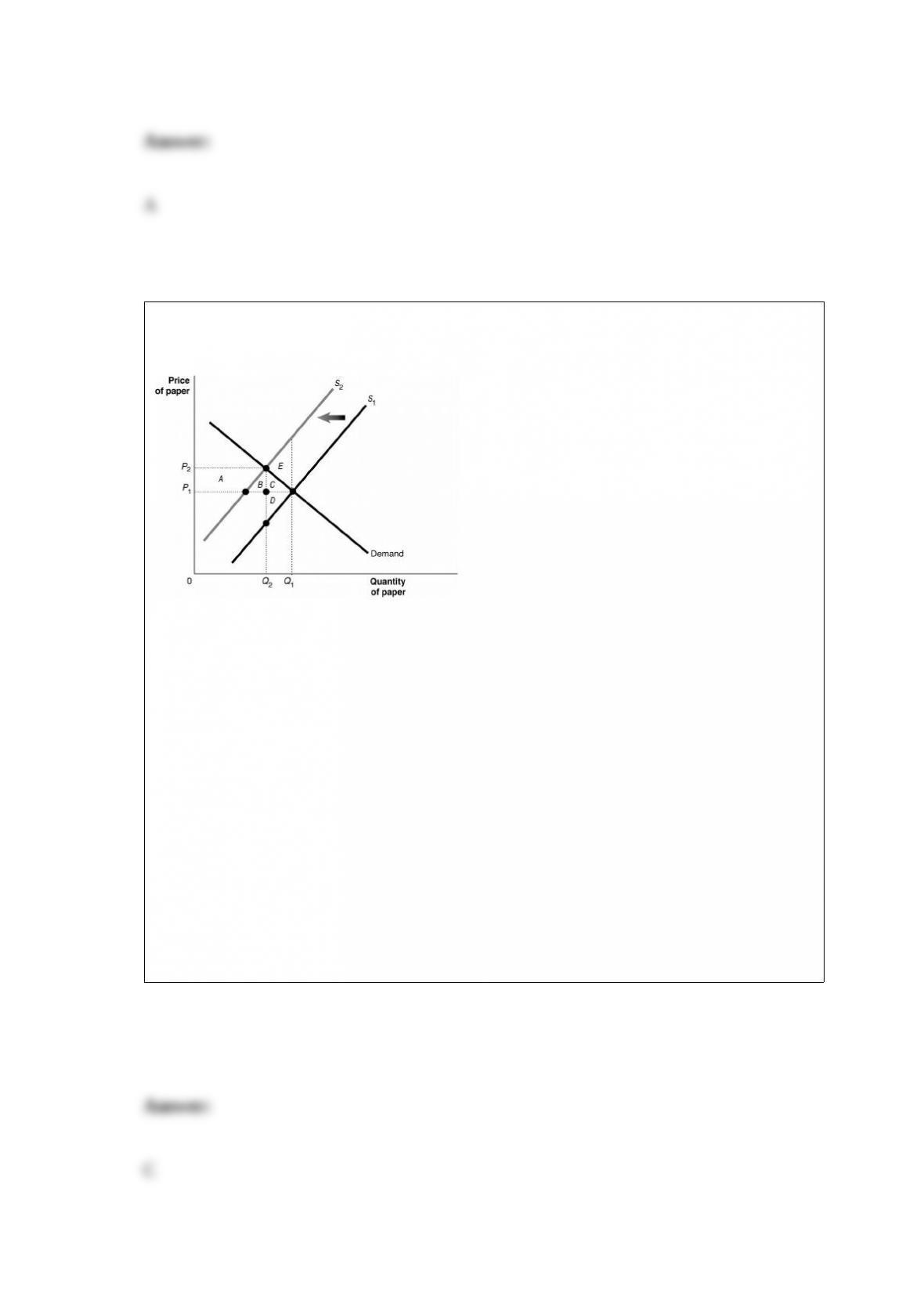
Figure 5-4
Suppose there are several paper mills producing paper for a market. These mills,
located upstream from a fishing village, discharge a large amount of wastewater into the
river. The waste material affects the number of fish in the river, and the use of the river
for recreation and as a public water supply source. Figure 5-4 shows the paper market.
Use this Figure to answer the following question(s).
Refer to Figure 5-4.What is the economically efficient output level?
A) Q1
B) Q2 minus Q1
C) Q2
D) Q1 plus Q2
In both monopolistically competitive and perfectly competitive industries
A) firms produce products for which there are no close substitutes.
B) there are high barriers to entry.
C) there are many buyers and sellers.
D) firms are price takers.
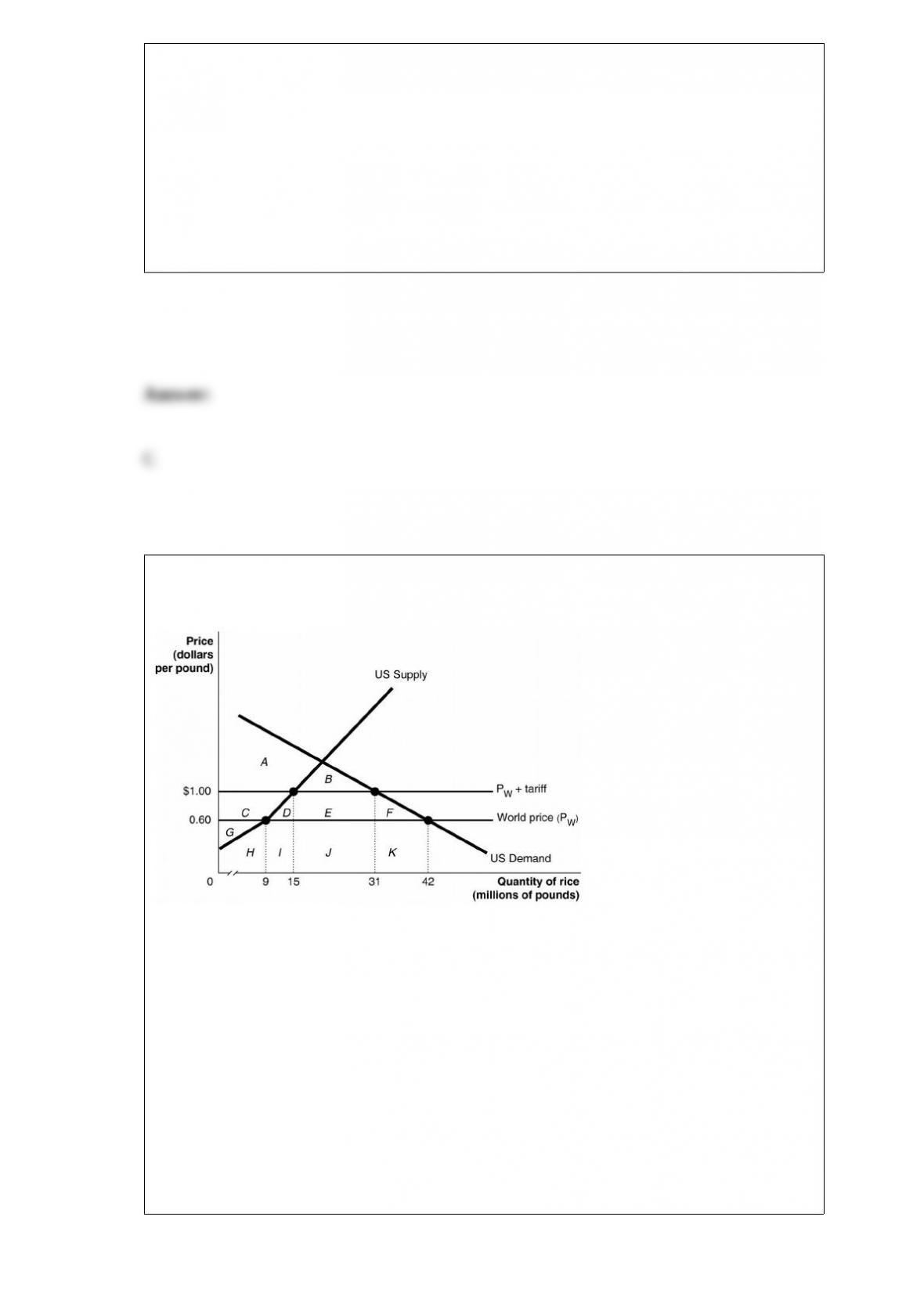
Figure 9-2
Suppose the U.S. government imposes a $0.40 per pound tariff on rice imports. Figure
9-2 shows the impact of this tariff.
Refer to Figure 9-2. The loss in domestic consumer surplus as a result of the tariff is
equal to the area
A) B + D + E + F.
B) D + E + F.
C) C + D + E + F.
D) B.

When the government wants to give an exclusive right to one firm to produce a product,
it
A) imposes a tariff on imports of the product.
B) imposes a quota on imports of the product.
C) grants a patent or copyright to an individual or firm.
D) uses antitrust laws to keep other firms from entering the market.
Who hires the managers of a corporation?
A) the board of directors
B) stockholders
C) managers
D) employees

An established consumer market that primarily comprises the middle class and
possesses efficient infrastructure is characteristic of ________ markets.
A) emerging
B) frontier
C) traditional
D) developed
If we use a narrow definition of monopoly, then a monopoly is defined as a firm
A) that has been granted special production rights by the government.
B) that can ignore the actions of all other firms because it produces a superior product
compared to its rivals’ products.
C) that can ignore the actions of all other firms because it produces a product for which
there are no close substitutes.
D) that has the largest market share in an industry.
The points outside the production possibilities frontier are
A) efficient.
B) attainable.
C) inefficient.
D) unattainable.
A sole proprietorship is
A) the easiest type of business to set up.
B) the most difficult type of business to set up.
C) the most expensive type of business to set up.
D) the least profitable type of business to set up.
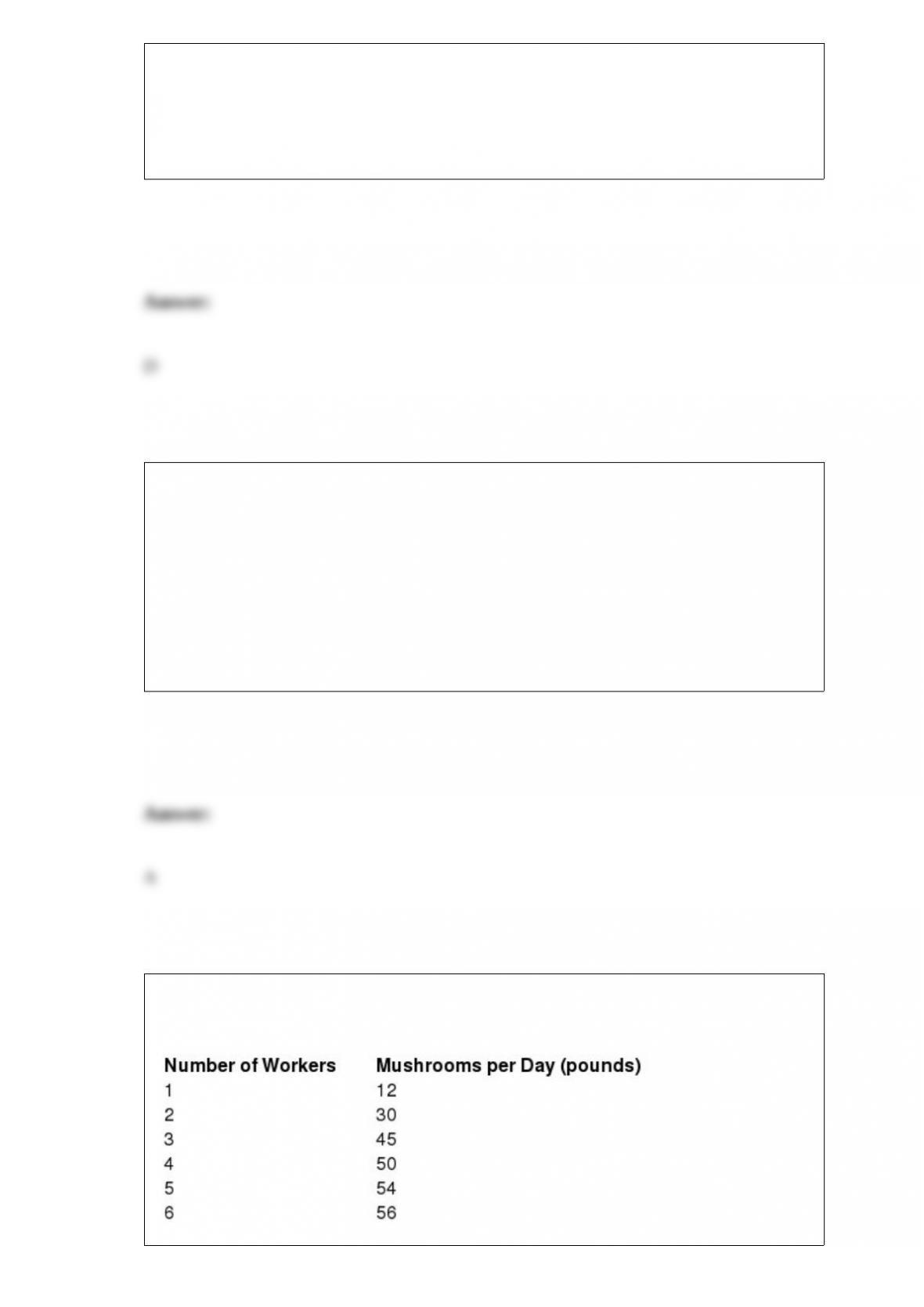
Table 11-1

Table 11-1 shows the technology of production at the Matsuko’s Mushroom Farm for
the month of May.
Refer to Table 11-1. Diminishing marginal returns sets in when the ________ worker is
hired.
A) 2nd
B) 3rd
C) 4th
D) None of the above; the production function displays increasing marginal returns.
Article Summary
Administrative overhead costs resulting from insurance companies handling
reimbursement claims is in large part the reason that health care in the United States is
much more expensive than in other countries. An analysis on the administration costs of
health care in the United States found that roughly 30 percent of the costs of health care
are administrative and that more than 25 percent of health-sector employees work in
administration. Health insurance companies are often paid a fixed percentage of the
claims they administer, which gives them little to no impetus to increase efficiency and
keep costs down.
Source: Jeffrey Pfeffer, “The Reason Health Care Is So Expensive: Insurance
Companies,” Bloomberg Businessweek, April 10, 2013.
Refer to the Article Summary. Even if insurance companies were more efficient and
brought administrative costs down, consumers would still pay less than the full cost of
medical treatment. This would result in the market equilibrium price of medical
services being ________ than the efficient equilibrium price, and the market
equilibrium quantity of medical services being ________ than the efficient equilibrium
quantity.
A) greater; greater
B) greater; less
C) less; greater
D) less; less
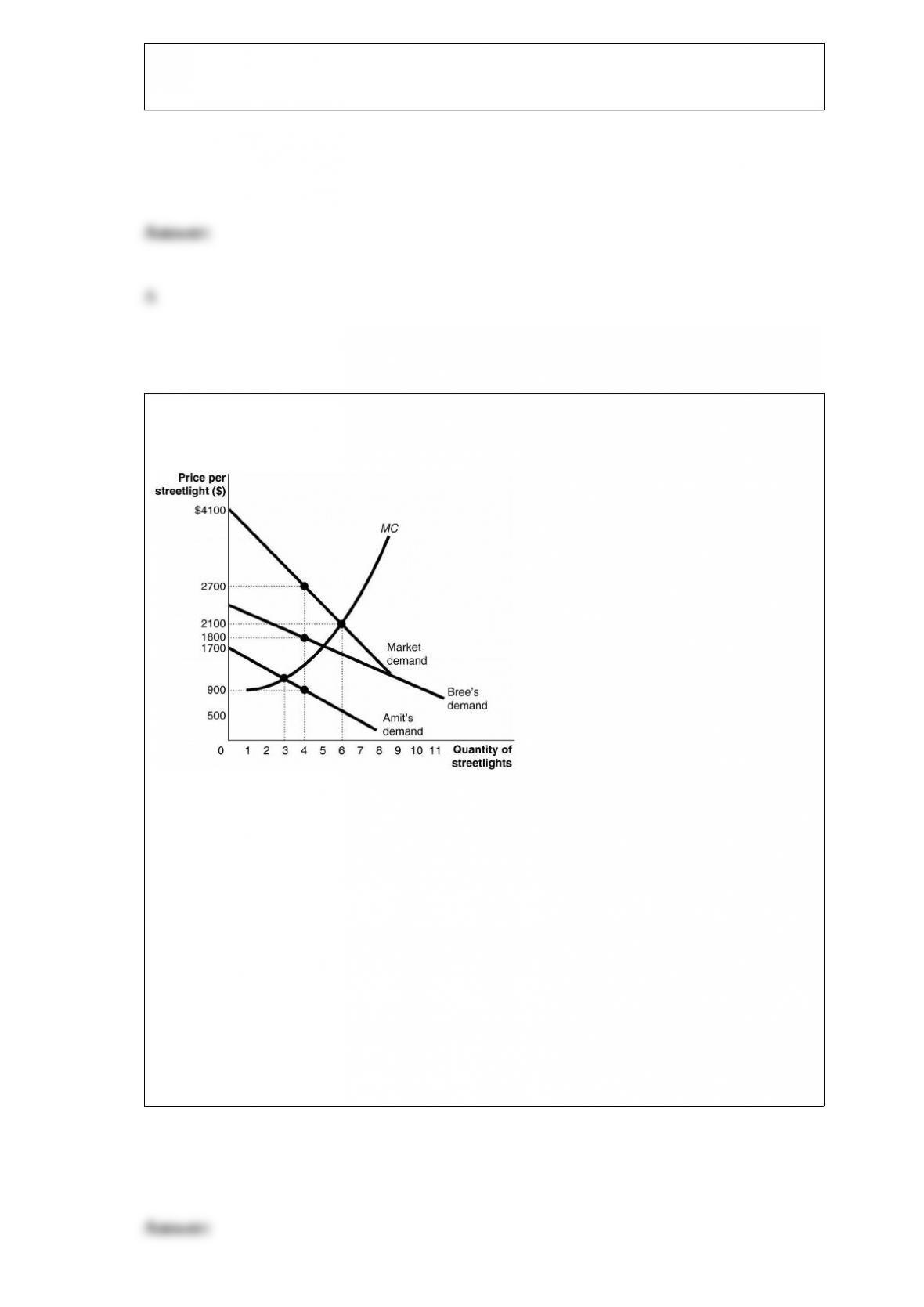
Figure 5-16
Amit and Bree are the only two homeowners on an isolated private road. Both agree
that installing street lights along the road would be beneficial and want to do so. Figure
5-16 shows their willingness to pay for different quantities of street lights, the market
demand for street lights and the marginal cost of installing the street lights.
Refer to Figure 5-16. How much is Amit willing to pay to have 4 street lights installed?
A) $3,600
B) $2,700
C) $1,800
D) $900

Globalization tends to foster two important values, tolerance and ________.
A) nationalization
B) diversity
C) authoritarianism
D) heterogeneity
The law of diminishing marginal returns
A) sets in because not all workers are equally productive.
B) applies only in the short run.
C) holds even when there are no fixed factors.
D) ultimately explains why production displays diseconomies of scale.
When you buy at a low price in one market then sell at a higher price in another market

you are engaging in
A) odd pricing.
B) arbitrage.
C) an antitrust prohibited practice.
D) price discrimination.
In cities with rent controls, the actual rents paid can be higher than the legal maximum.
One explanation for this is
A) rent control laws are so complicated that landlords and tenants may not be aware of
what the legal price is.
B) landlords are allowed to charge more than the legal maximum on some apartments
so long as they charge less on others.
C) because there is a shortage of apartments, tenants often are willing to pay rents
higher than the law allows.
D) the legal penalty landlords face for charging more than the legal maximum rent is
less than the revenue earned by charging their tenants more than the maximum rent.
An outward shift of a nation’s production possibilities frontier represents

A) economic growth.
B) rising prices of the two goods on the production possibilities frontier model.
C) an impossible situation.
D) a situation in which a country produces more of one good and less of another.
Oligopolies are difficult to analyze because
A) the firms are so large.
B) demand and cost curves do not exist for these types of industries.
C) how firms respond to a price change by a rival is uncertain.
D) oligopolies are a recent development so economists have not had time to develop
models.
For each pair of items below determine which product would have the higher price
elasticity of demand (in absolute value).
a. Blood pressure medicine for someone who has high blood pressure and the purchase
of Clairol hair coloring product.
b. A new Ford Fusion or a tank of gas for your current car.
c. A Seiko watch or watches in general.
Because the copyright on the L. Frank Baum book The Wonderful Wizard of Oz expired
many years ago, the actual written words from the book are in the public domain.
Publishers who now choose to sell their own versions of the book
A) can claim copyright of Baum’s words if they are the first to publish the book after
the original copyright expired.
B) can claim copyright of Baum’s words no matter how many versions are published,
since the original is in the public domain.
C) can not claim copyright of Baum’s words since they are in the public domain, but
can claim copyright on any new design or illustrations created for the book.
D) can not claim copyright of Baum’s words, or on any new design or illustrations
created for the book, since the original written words are in the public domain.

The production possibilities frontier shows the ________ combinations of two products
that may be produced in a particular time period with available resources.
A) minimum attainable
B) maximum attainable
C) only
D) equitable