
As women’s wages have risen relative to men’s wages, the opportunity cost to women
of doing housework has ________ than has the opportunity cost to men.
A) increased less
B) increased more
C) decreased more
D) decreased less
Which of the following is a factor of production?
A) an oven in a bakery
B) a share of General Motors’ stock
C) a credit card
D) a $500 Treasury bond
Figure 5-8
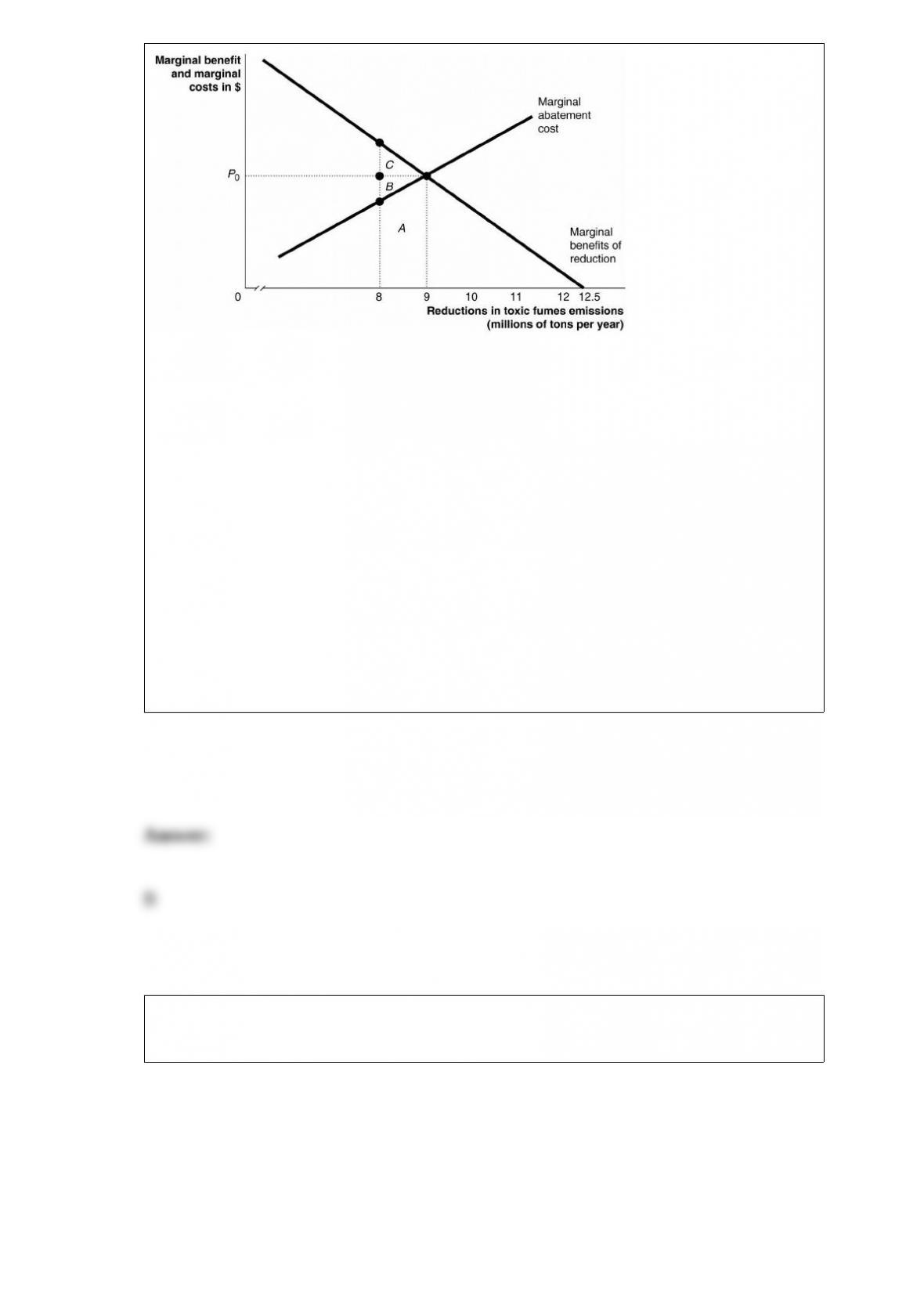
Consider a chemical plant that discharges toxic fumes over a nearby community. To
reduce the emissions of toxic fumes the firm can install pollution abatement devices.
Figure 5-8 shows the marginal benefit and the marginal cost from reducing the toxic
fumes emissions.
Refer to Figure 5-8. Suppose the emissions reduction target is currently established at 8
million tons. Should society undertake to reduce an additional 1 million tons so that the
total reduction is 9 million tons?
A) No, because there is a net cost represented by the area B + C.
B) Yes, because the marginal benefit exceeds the marginal costs.
C) Yes, because toxic fumes are dangerous and must be eliminated at any cost.
D) No, because the firms will pass the additional cost on to consumers.
Figure 11-1
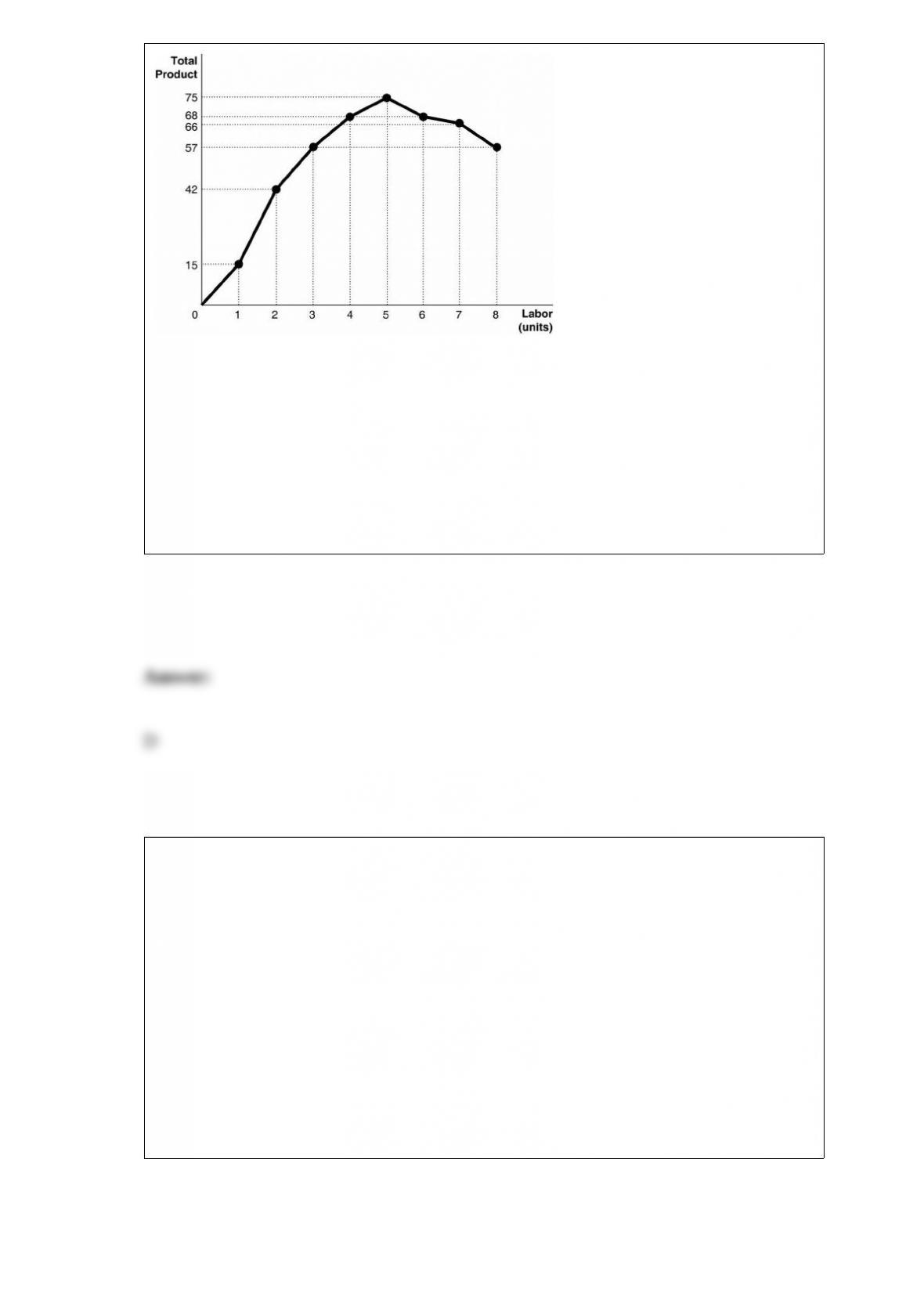
Refer to Figure 11-1. The marginal product of the 7th worker is
A) 66.
B) 9.43.
C) 2.
D) -2.
Suppose a negative externality exists in a market. If transactions costs are low and
parties are willing to bargain, then, according to the Coase theorem
A) an equitable solution can be reached only if property rights are assigned to the
victims of pollution and not the polluters.
B) an equitable solution can be reached only if property rights are assigned to polluters
and not to the victims of pollution.
C) an efficient solution can be reached regardless of the initial assignment of property
rights.
D) government intervention is necessary to reach an efficient and equitable solution.
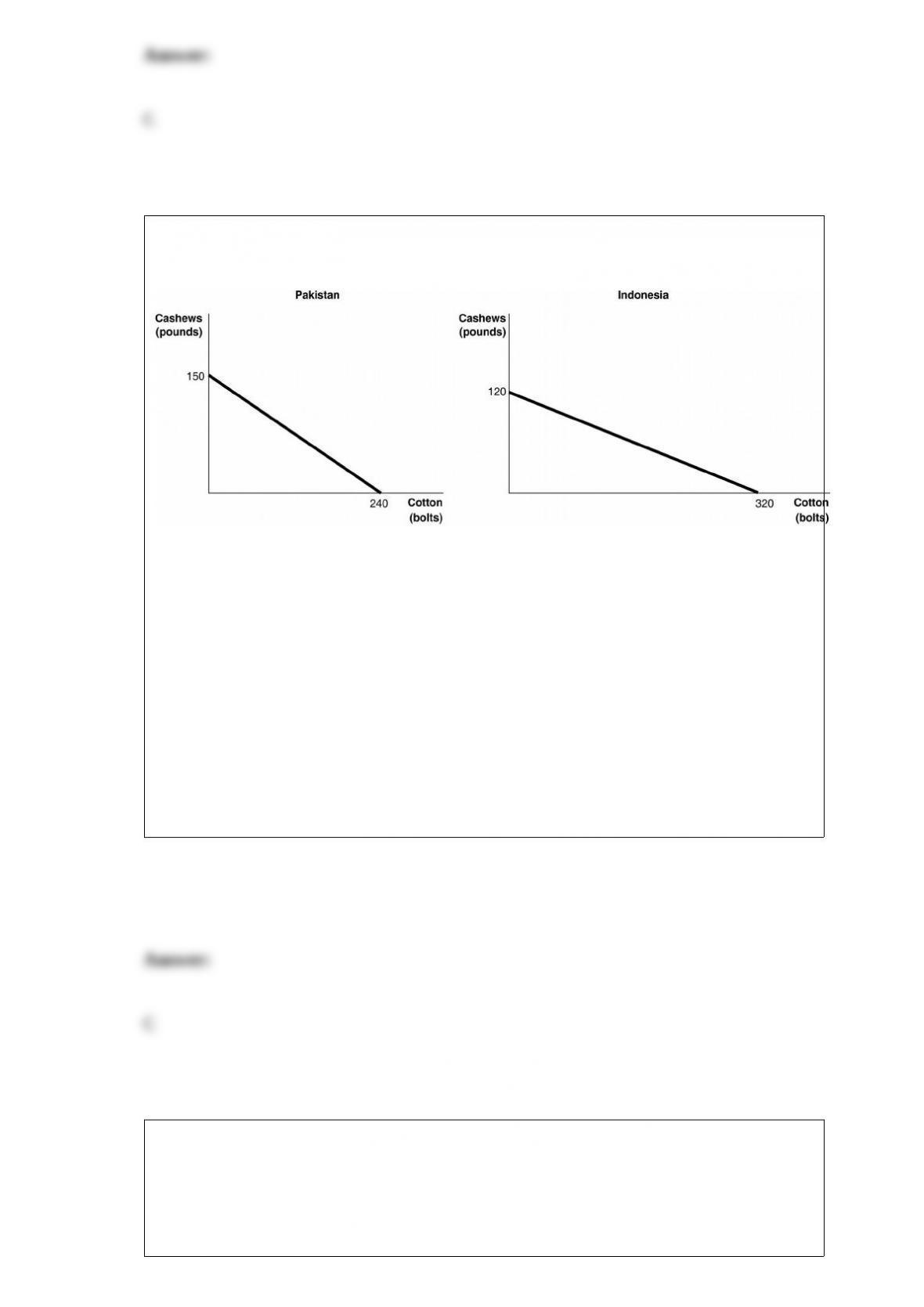
Figure 2-9
Figure 2-9 shows the production possibilities frontiers for Pakistan and Indonesia. Each
country produces two goods, cotton and cashews.
Refer to Figure 2-9. Which country has a comparative advantage in the production of
cashews?
A) Indonesia
B) They have equal productive abilities.
C) Pakistan
D) neither country
In September 2012, the average price of gasoline in the United States was $3.91 per
gallon, and consumers purchased nearly 5 percent less gasoline than they had during
September 2011, when the average price of gasoline was $3.66 per gallon. Based on
these figures, from September 2011 to September 2012, the demand for gasoline was

A) elastic.
B) inelastic.
C) unit elastic.
D) perfectly elastic.
In October 2013, General Motors (GM) posted a price-earnings ratio of 10.13. If the
price of the stock at that time was $36 per share, which of the following must have been
true?
A) GM’s revenues that month were $364.68 million.
B) GM’s earnings per share was $3.55.
C) GM’s coupon payment was $36 per year.
D) GM’s dividend yield for the year was 36.5%.
Which of the following is a result of a market economy?
A) environmental protection
B) an equal income distribution
C) agreement on equity
D) voluntary exchange
________ is called an implicit cost, while ________ is called an explicit cost.
A) An accounting cost; an economic cost
B) A nonmonetary opportunity cost; a cost that involves spending money
C) A production cost; a sales cost
D) An actual cost; a hypothetical cost
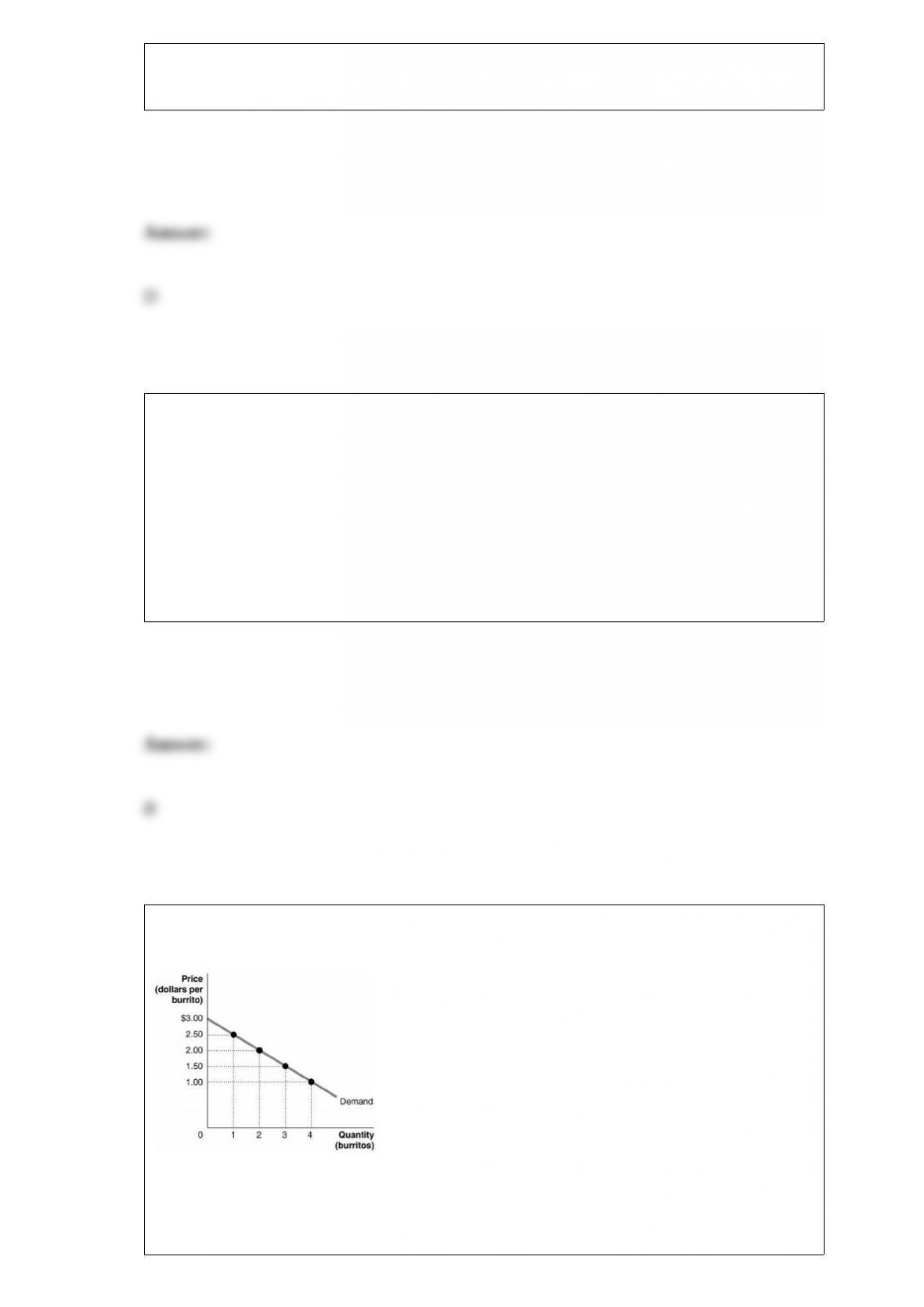
Figure 4-1
Figure 4-1 shows Arnold’s demand curve for burritos.
Refer to Figure 4-1. If the market price is $3.00, what is the maximum number of
burritos that Arnold will buy?

A) 0
B) 2
C) 3
D) 4
Letters are used to represent the terms used to answer this question: price (P), quantity
of output (Q), total cost (TC) and average total cost (ATC). Which of the following
equations is equal to a firm’s profit?
A) P – ATC
B) (P Q) – TC
C) (P Q) – (P ATC)
D) P – TC
What is the profit-maximizing rule for a monopolistically competitive firm?
A) to produce a quantity that maximizes market share
B) to produce a quantity that maximizes total revenue

C) to produce a quantity such that marginal revenue equals marginal cost
D) to produce a quantity such that price equals marginal cost
According to the production possibility model, if more resources are allocated to the
production of physical and human capital, then which of the following is likely to
happen?
A) Fewer goods will be produced for consumption today.
B) The production possibilities frontier will be shift inward in the future.
C) Future economic growth will decline.
D) The country’s total production will fall.
Figure 3-4
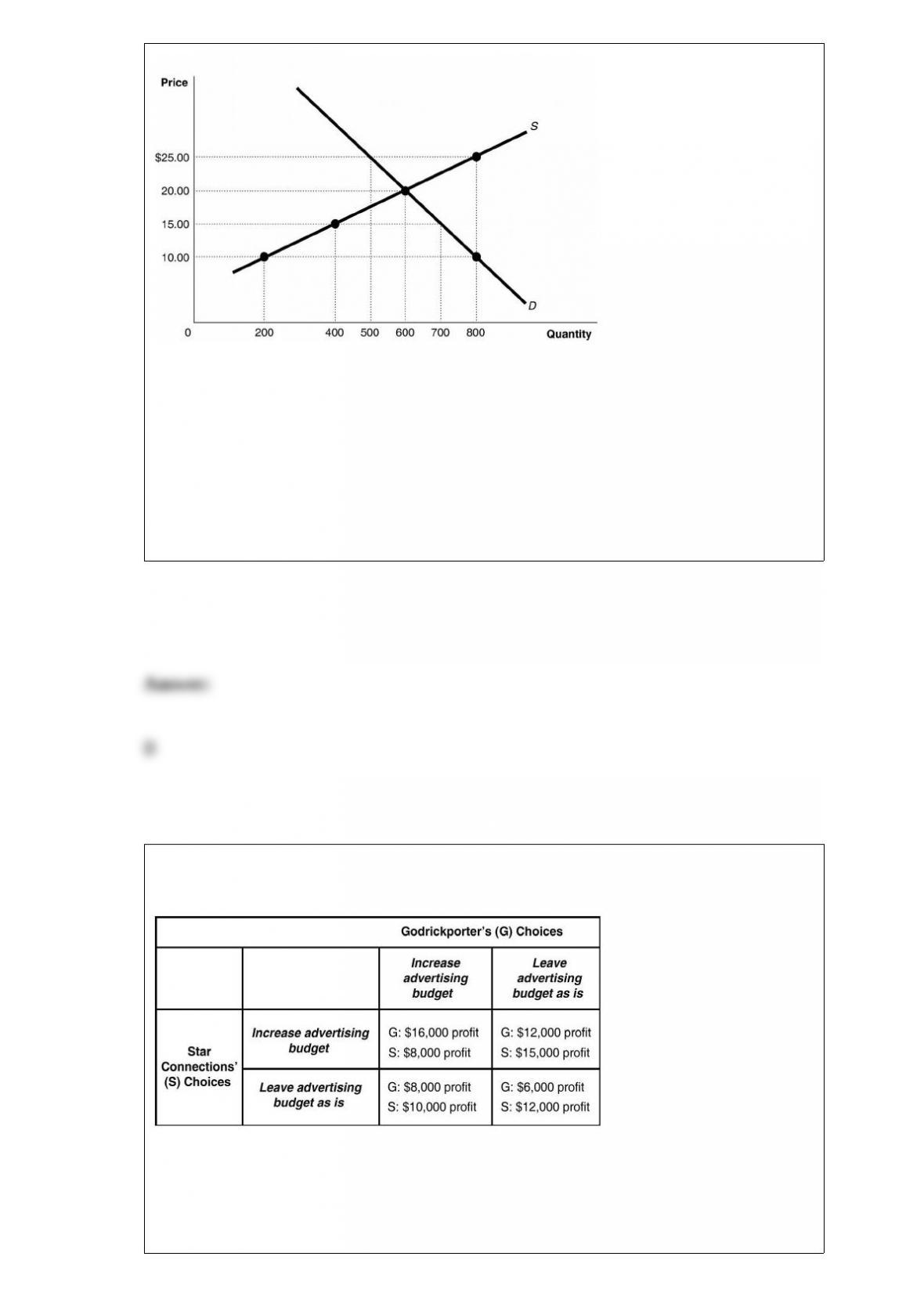
Refer to Figure 3-4. If the price is $15,
A) there would be a surplus of 300 units.
B) there would be a shortage of 300 units.
C) there would be a surplus of 400 units.
D) there would be a shortage of 400 units.
Table 14-1
Godrickporter and Star Connections are the only two airport shuttle and limousine
rental service companies in the mid-sized town of Godrick Hollow. Each firm must
decide on whether to increase its advertising spending to compete for customers. Table
14-1 shows the payoff matrix for this advertising game.

Refer to Table 14-1. What is the Nash equilibrium in this game?
A) There is no Nash equilibrium.
B) Godrickporter increases its advertising budget, but Star Connections does not.
C) Star Connections increases its advertising budget, but Godrickporter does not.
D) Both Godrickporter and Star Connections increase their advertising budgets.
Which of the following statements is true?
A) As output increases, average fixed cost becomes smaller and smaller.
B) Average fixed cost does not change as output increases.
C) The marginal cost curve intersects the average fixed cost curve at its minimum point.
D) When marginal cost is greater than average fixed cost, average fixed cost increases.
Differences in marginal revenue products are the most important factor in explaining
wage differences. Other factors that explain wage differences include all but one of the
following. Which factor does not help explain differences in wages?
A) cognitive differentials
B) compensating differentials

C) discrimination
D) labor unions
Compare two situations. (A) A firm is not legally responsible for damages that result
from air pollution caused by its production of steel. (B) A firm is legally responsible for
damages that result from its production of steel. Ronald Coase argued that
A) bargaining between the firm and the victims of the air pollution caused by the firm
will result in little reduction of pollution in either situation (A) or (B) because the firm
has greater economic and political power than the victims.
B) bargaining between the firm and the victims of the air pollution caused by the firm
would lead to a greater reduction in pollution in situation (A) than situation (B).
C) bargaining between the firm and the victims of the air pollution caused by the firm
would lead to a smaller reduction in pollution in situation (A) than situation (B).
D) bargaining between the firm and the victims of the air pollution caused by the firm
would lead to an equal reduction in pollution in situation (A) and situation (B).
Which of the following statements is true?
A) An increase in demand causes a change in equilibrium price; the change in price
does not cause a further change in demand or supply.

B) A decrease in supply causes equilibrium price to rise; the increase in price then
results in a decrease in demand.
C) If both demand and supply increase there must be an increase in equilibrium price;
equilibrium quantity may either increase or decrease.
D) If demand decreases and supply increases one cannot determine if equilibrium price
will increase or decrease without knowing which change is greater.
Consider the following pieces of information:
a. According to Bonnie Reyes, president and chief operating officer of Better Investing,
a national organization of investment clubs, women have traditionally made up about
60 percent of the membership of investment clubs. By contrast, less than a third of
team-managed mutual funds on Wall Street have even one woman on the management
team.
b. Research conducted by professors E. Brooke Harrington and Max Planck concluded
that mixed investment clubs, on average, outperformed the typical single-sex
investment club.
c. The lack of gender diversity in Wall Street could be influenced by its reputation,
according to professor Harrington, “for being inhospitable to women.”
Source: Michael Hulbert, “Strategies: At some Funds, a Gender Communications
Gap,” The New York Times, October 7, 2007, Sunday Money, page 5.
The information presented is an example of
A) economic discrimination.
B) a negative feedback loop.
C) marginal productivity theory.
D) the absence of comparable worth.
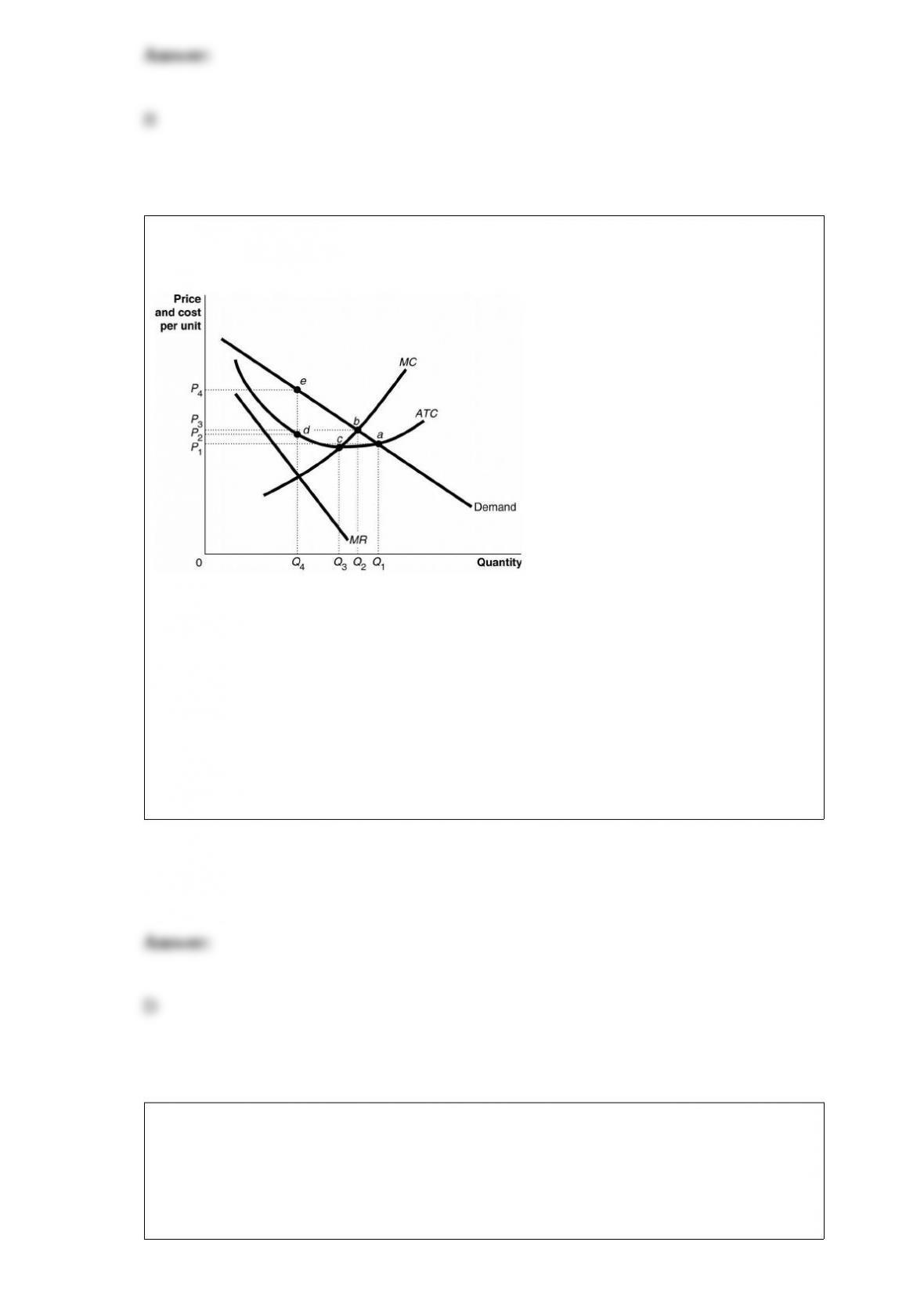
Figure 13-13
Refer to Figure 13-13. What is the profit maximizing output level?
A) Q1 units
B) Q2 units
C) Q3 units
D) Q4 units
A firm increased its production and sales because the firm’s manager rearranged the
layout of his factory floor. This is an example of
A) investment in human capital.

B) economies of scale.
C) positive technological change.
D) inspired management.
If demand is perfectly inelastic, the absolute value of the price elasticity of demand is
A) zero.
B) less than one.
C) more than one.
D) equal to the absolute value of the slope of the demand curve.
Figure 16-6
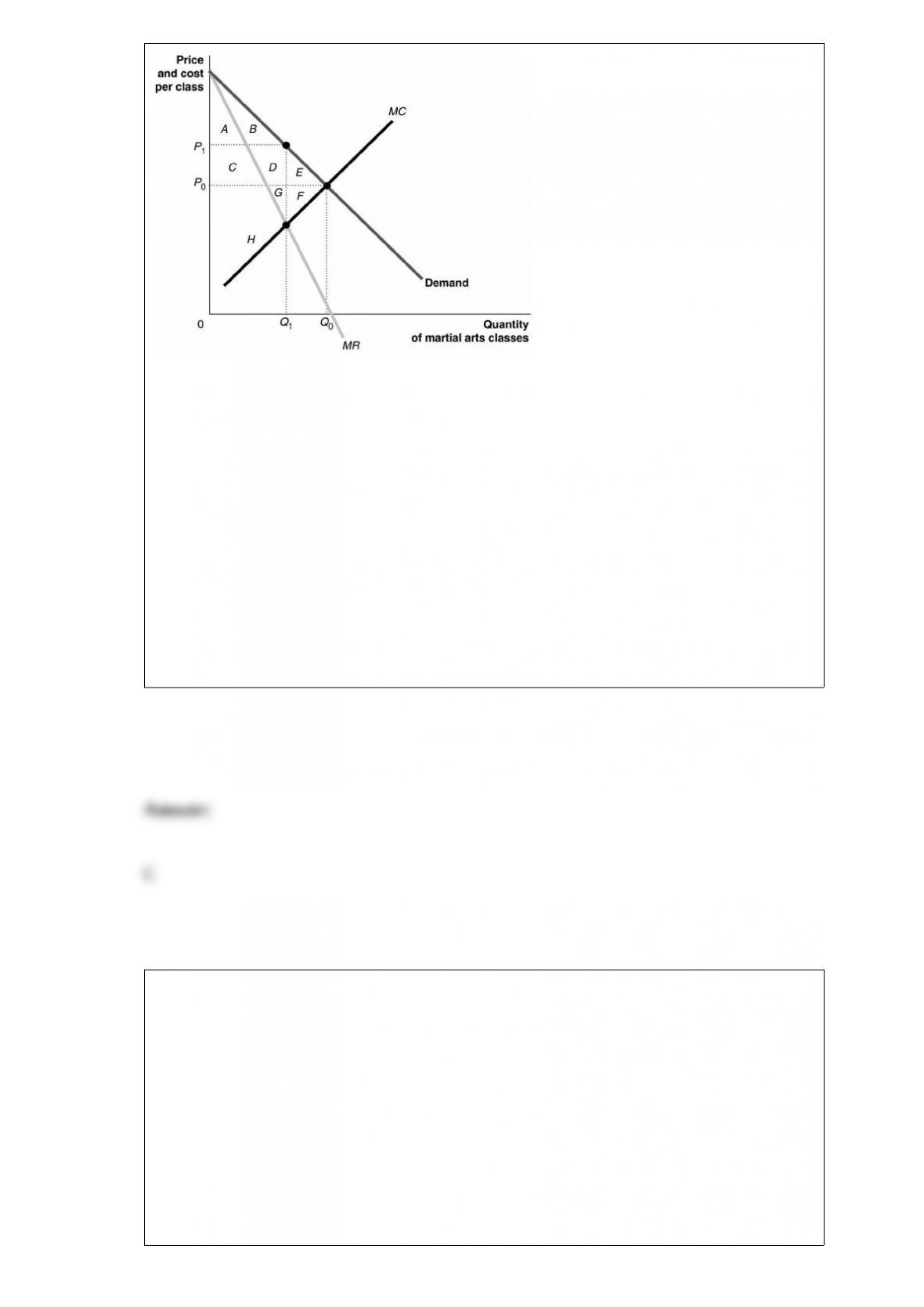
Watanabe Sensei operates the only martial arts school in Hartfield. For simplicity,
assume that consumers have identical demand curves and that Sensei knows what this
demand curve is. Figure 16-6 shows this demand curve.
Refer to Figure 16-6. If Sensei acts as a monopolist and charges the profit-maximizing
price, what is the consumer surplus received by his customers?
A) the area A + B + C + D
B) the area A + B + C + D + E
C) the area A + B
D) the area A + C + H
Consider a situation in which a utility company emits high levels of sulfur dioxide and
the company is not liable for the damages its pollution causes. According to the Coase
theorem, government action is ________ to achieve an ________ amount of pollution.
A) necessary; equitable
B) necessary; efficient
C) not necessary; equitable
D) not necessary; efficient

In general, the supply curve for a natural resource
A) is vertical.
B) is horizontal.
C) slopes downward to reflect decreasing available quantities over time.
D) slopes upward.
Consumers who will pay high prices to be among the first to own certain new products
are called
A) savvy consumers.
B) naive consumers.
C) gullible.
D) early adopters.

Which of the following would cause a decrease in the equilibrium price and an increase
in the equilibrium quantity of salmon?
A) a decrease in demand and an increase in supply
B) an increase in supply
C) an increase in supply and an increase in demand greater than the increase in supply
D) a decrease in demand and a decrease in supply
Scenario 1-1
Suppose a cell phone manufacturer currently sells 20,000 cell phones per week and
makes a profit of $5,000 per week. A manager at the plant observes, “Although the last
3,000 cell phones we produced and sold increased our revenue by $6,000 and our costs
by $6,700, we are still making an overall profit of $5,000 per week so I think we’re on
the right track. We are producing the optimal number of cell phones.”
Refer to Scenario 1-1. Had the firm not produced and sold the last 3,000 cell phones,
would its profit be higher or lower, and if so by how much?
A) Its profit will be $6,700 higher.
B) Its profit will be $700 higher.
C) Its profit will be $700 lower.
D) Its profit will be $6,000 lower.