
The marginal productivity theory of income distribution was developed by
A) Edward Lazear.
B) George Akerlof.
C) William Stanley Jevons.
D) John Bates Clark.
If Dawson prefers pizza to hamburgers and hamburgers to hot dogs, then if preferences
are transitive
A) at times she could be indifferent among the three items.
B) she must prefer pizza to hot dogs.
C) she could prefer hamburgers to pizza on some occasions but not hot dogs to pizza.
D) she could prefer hot dogs to pizza on some occasions but not hamburgers to hot
dogs.
Figure 15-4

Figure 15-4 shows the demand and cost curves for a monopolist.
Refer to Figure 15-4. What is the amount of the monopoly’s total revenue?
A) $21,600
B) $20,400
C) $19,740
D) $7,800
Figure 5-16

Amit and Bree are the only two homeowners on an isolated private road. Both agree
that installing street lights along the road would be beneficial and want to do so. Figure
5-16 shows their willingness to pay for different quantities of street lights, the market
demand for street lights and the marginal cost of installing the street lights.
Refer to Figure 5-16. Suppose Amit and Bree know each other’s preferences so that it
is not possible for one to deceive the other. Which of the following statements best
describes the circumstances under which the optimal quantity of street lights could be
achieved?
A) The optimal quantity will be installed only if the two parties agree to pay according
to their willingness to pay as indicated by their respective demand curves.
B) Because there are only two consumers, it is likely that private bargaining will result
in the optimal quantity being installed.
C) The optimal quantity will be installed only if the two parties split the cost of
installation equally.
D) The optimal quantity will be installed only if Bree pays for the entire installation
cost.
If average total cost is $50 and average fixed cost is $15 when output is 20 units, then
the firm’s total variable cost at that level of output is
A) $1,000.

B) $700.
C) $300.
D) impossible to determine without additional information.
The marginal revenue product of capital is
A) the cost to the firm of renting an additional unit of capital.
B) the change in the firm’s revenue as a result of employing one more unit of capital,
such as a machine.
C) the economic rent received by hiring an additional unit of capital.
D) the revenue generated by substituting capital for labor in the production process.
A firm cannot control all of the factors that allow it to make economic profits. Which of
the following is an example of an uncontrollable factor?
A) product differentiation
B) input prices
C) producing at a lower average total cost than competing firms

D) hiring competent managers
If, for a product, the quantity supplied exceeds the quantity demanded, the market price
will fall until
A) the quantity demanded exceeds the quantity supplied. The market will then be in
equilibrium.
B) quantity demanded equals quantity supplied. The equilibrium price will then be
lower than the market price.
C) all consumers will be able to afford the product.
D) quantity demanded equals quantity supplied. The market price will then equal the
equilibrium price.
As a firm moves to higher isocost lines
A) its profits increase.
B) its revenue increases.
C) its input price ratio increases.
D) its total cost increases.

Technological advances have resulted in lower prices for digital cameras. What is the
impact of this on the market for traditional (non-digital) cameras?
A) The demand curve for traditional cameras shifts to the right.
B) The supply curve for traditional cameras shifts to the right.
C) The demand curve for traditional cameras shifts to the left.
D) The supply curve for traditional cameras shifts to the left.
Which of the following is an example of a quasi-public good?
A) cable television
B) organic apples
C) stock of knowledge in the public domain
D) crime prevention

Wall Street, in the borough of Manhattan in New York City, is the heart of the U.S.
financial system, where banks, brokerage houses, other financial firms, and the New
York Stock Exchange are all located. What is the reason for New York City’s
comparative advantage in the financial market?
A) the development of superior information technology
B) an abundant supply of skilled labor
C) New York City has one of the largest sea ports in the world.
D) external economies
Research by Daniel Kahneman, Jack Knetch, and Richard Thaler has shown that
companies like airlines were explicitly able to include a fuel surcharge in their prices
because
A) consumers had no choice but to pay the price of the surcharges due to the lack of
competition in the industry.
B) a government-imposed price ceiling on airline ticket prices left the airlines not other
way to cover the increase in costs.
C) adding a separate fuel surcharge to the price of airline tickets did not actually
increase the price of the tickets.
D) consumers see it as fair for firms to raise prices after an increase in costs.
If the opportunity cost of production for two goods is different between two countries,
then
A) trade cannot benefit either country.
B) only one country can be made better off by trade.
C) mutually beneficial trade is possible.
D) trade will only benefit both countries if one can lower its opportunity costs.
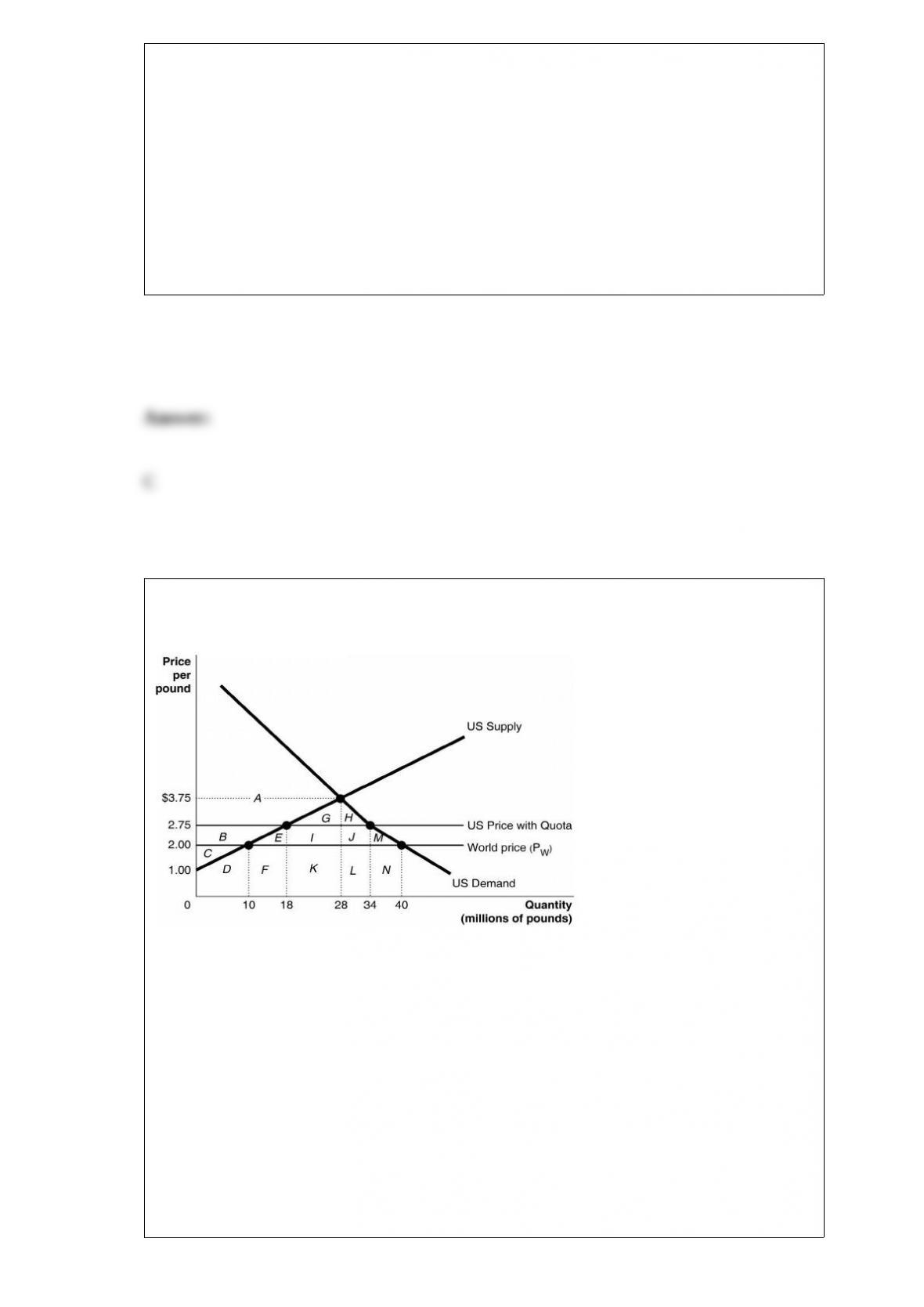
Figure 9-3
Since 1953 the United States has imposed a quota to limit the imports of peanuts.
Figure 9-3 illustrates the impact of the quota.
Refer to Figure 9-3. With a quota in place, what is the quantity consumed in the
domestic market?
A) 10 million pounds
B) 28 million pounds
C) 34 million pounds
D) 40 million pounds

The marginal product of labor is defined as
A) the additional sales revenue that results when one more worker is hired.
B) the additional output that results when one more worker is hired, holding all other
resources constant.
C) the additional number of workers required to produce one more unit of output.
D) the cost of hiring one more worker.
If the price of gasoline was $3.25 a gallon and it is now $3.75 a gallon, what is the
percentage change in price?
A) 7.1 percent
B) 13.3 percent
C) 15.4 percent
D) 33.3 percent

A set of actions that a firm takes to achieve a goal, such as maximizing profits, is called
A) a business strategy.
B) a payoff matrix.
C) the Porter’s Competitive Forces plan.
D) game theory.
When the price of pistachio nuts is $7.50 per lb. the quantity demanded is 48 lbs. When
the price of peaches is $9.00 per lb. the quantity demanded is 40 lbs. When the
midpoint formula is used to measure the price elasticity of demand we can say that the
demand for pistachio nuts is
A) relatively, but not perfectly, elastic.
B) unit-elastic.
C) completely inelastic.
D) relatively, but not perfectly, inelastic.
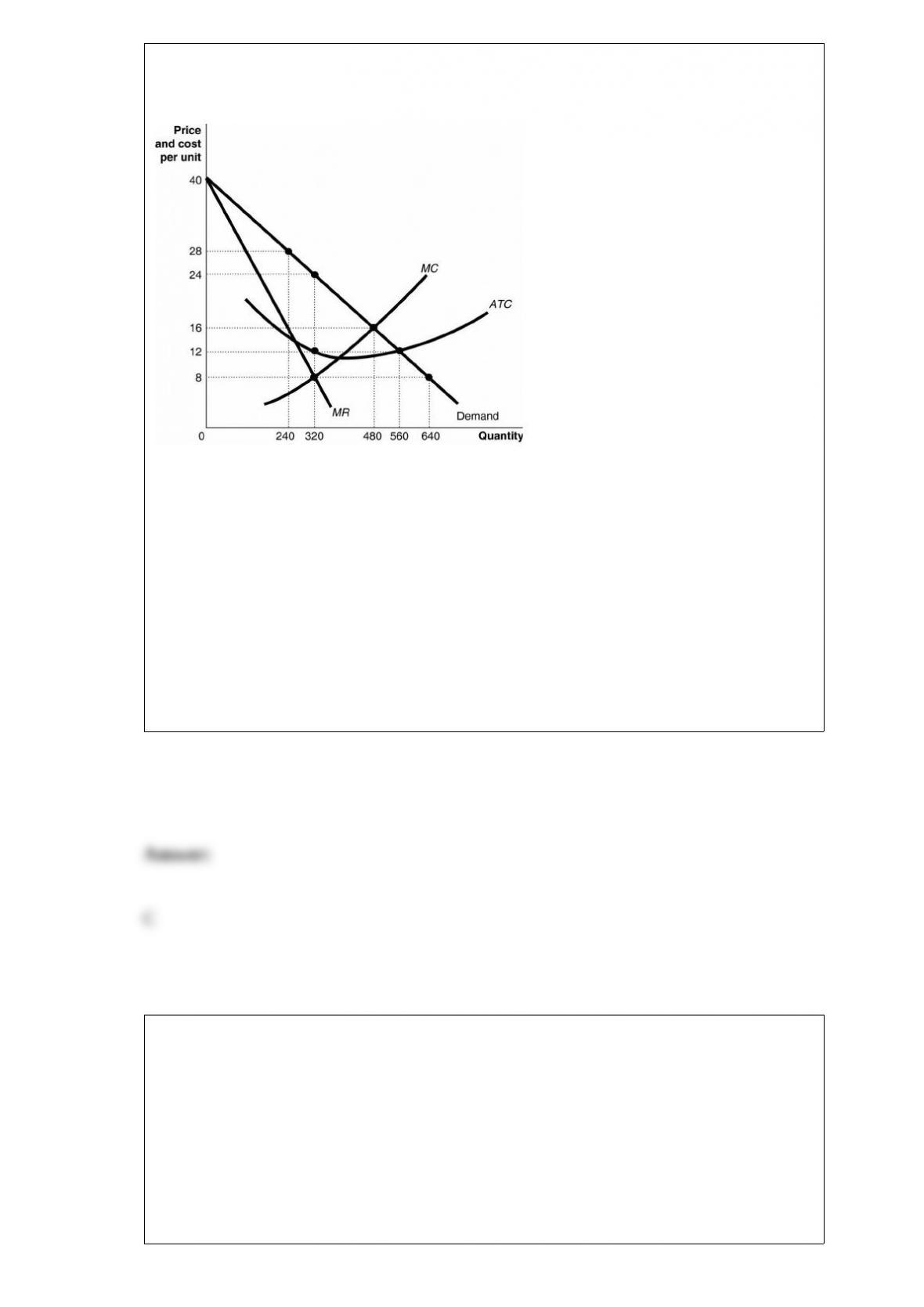
Figure 16-5
Refer to Figure 16-5. Suppose the firm represented in the diagram decides to use a
two-part pricing strategy such that such that it charges a fixed fee and a per-unit price
equal to the competitive price. (This is also called an optimal two-part tariff.) What is
the quantity it should produce?
A) 240 units
B) 320 units
C) 480 units
D) 560 units
Which of the following can a firm use to defend a successful product’s brand name?
A) The firm can obtain a patent on the brand name.
B) The firm can apply for a trademark to ban other firm’s from using the product’s
name.
C) The firm can increase the amount it spends on advertising for the product.
D) The firm can attempt to copyright the brand name.
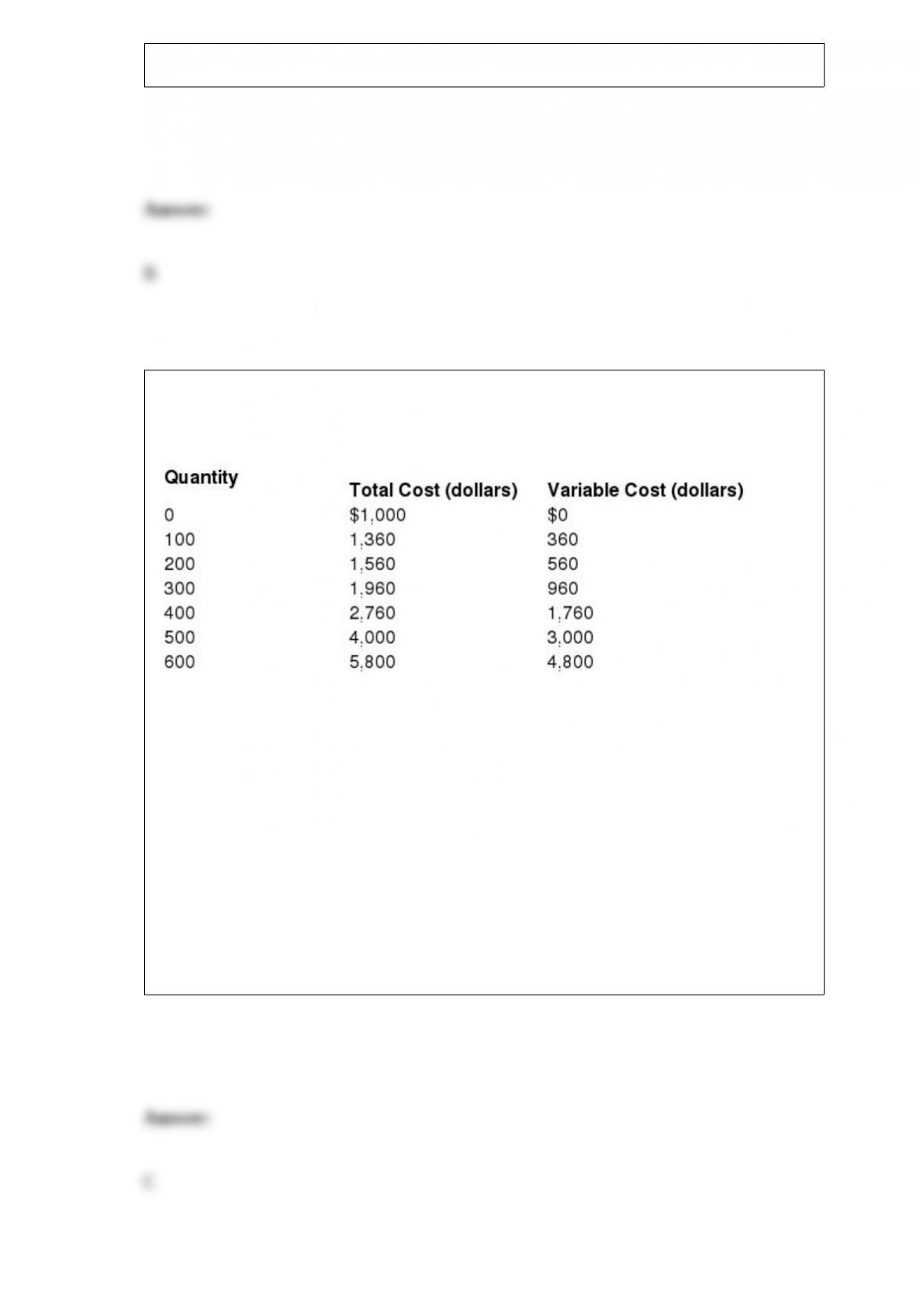
Table 12-1
Table 12-1 shows the short-run cost data of a perfectly competitive firm that produces
plastic camera cases. Assume that output can only be increased in batches of 100 units.
Refer to Table 12-1. If the market price of each camera case is $8 and the firm
maximizes profit, what is the amount of the firm’s profit or loss?
A) $0 (it breaks even)
B) loss of $1,000
C) profit of $440
D) loss of $440

If a firm could practice perfect price discrimination, it would
A) allow resale of its product.
B) charge every buyer a different price.
C) charge a price based on the quantity of a product bought.
D) use odd pricing.
Gertrude Stork’s Chocolate Shoppe normally employs 4 workers. When the Chocolate
Shoppe hired a 5th worker the Shoppe’s total output decreased. Therefore
A) the marginal product of the 5th worker is negative.
B) the total output of Gertrude Stork’s Chocolate Shoppe is negative.
C) the average product of the 5th worker is negative.
D) the 5th worker should be hired only if he is willing to accept a wage lower than the
wage paid to the other 4 workers.
Last year, Anthony Millanti earned exactly $30,000 of taxable income. Assume that the
income tax system used to determine Anthony’s tax liability is progressive. The table
below lists the tax brackets and the marginal tax rates that apply to each bracket.
a. Draw a new table that lists the amounts of income tax that Anthony is obligated to
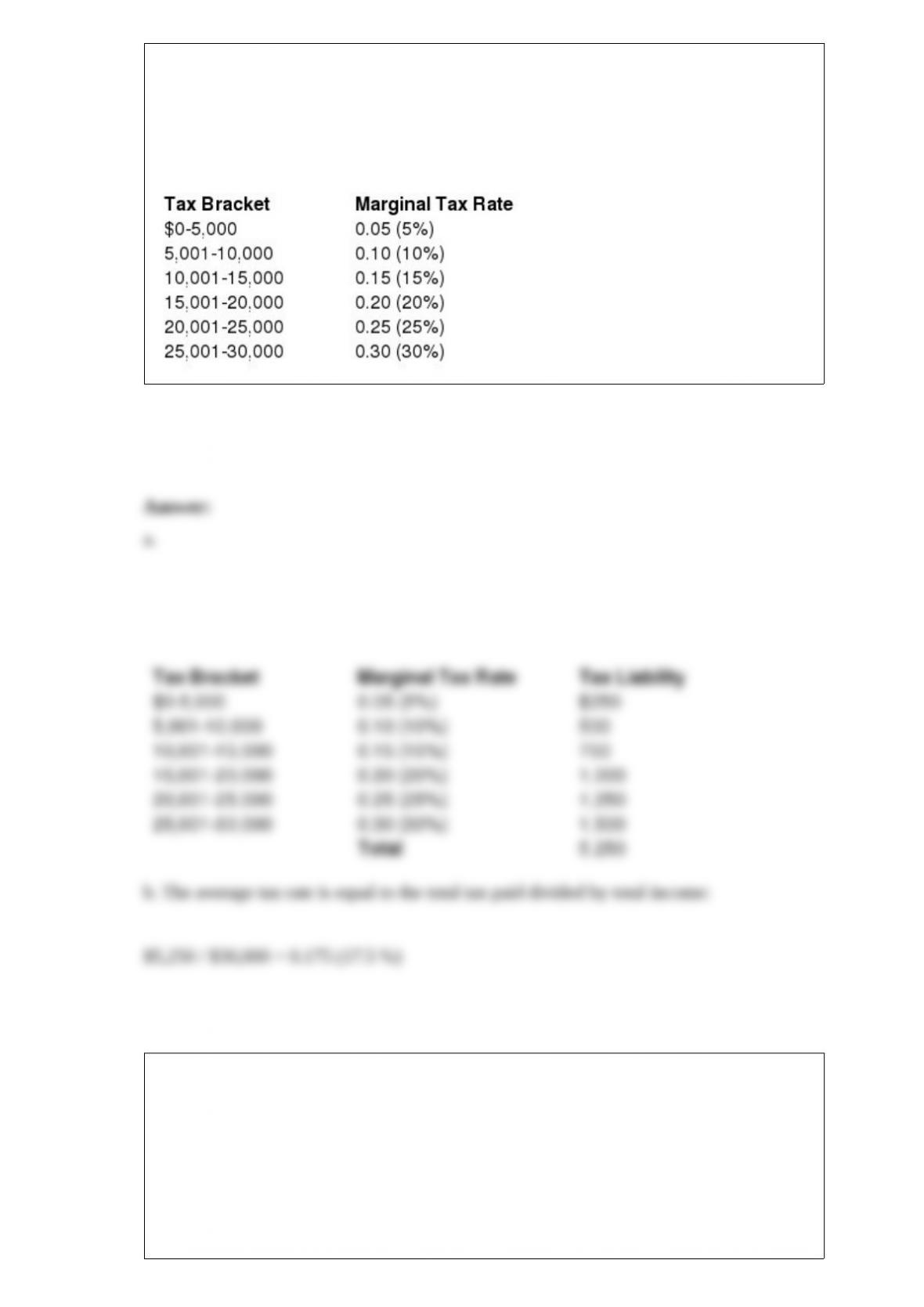
pay for each tax bracket, and the total tax he owes the government. (Assume that there
are no allowable tax deductions, tax credits, personal exemptions or any other
deductions that Anthony can use to reduce his tax liability).
b. Determine Anthony’s average tax rate.
If, as a person consumes more and more of a good, each additional unit adds less
satisfaction than the previous unit consumed, we are seeing the workings of
A) the law of demand.
B) the law of supply.
C) the law of increasing marginal opportunity cost.
D) the law of diminishing marginal utility.
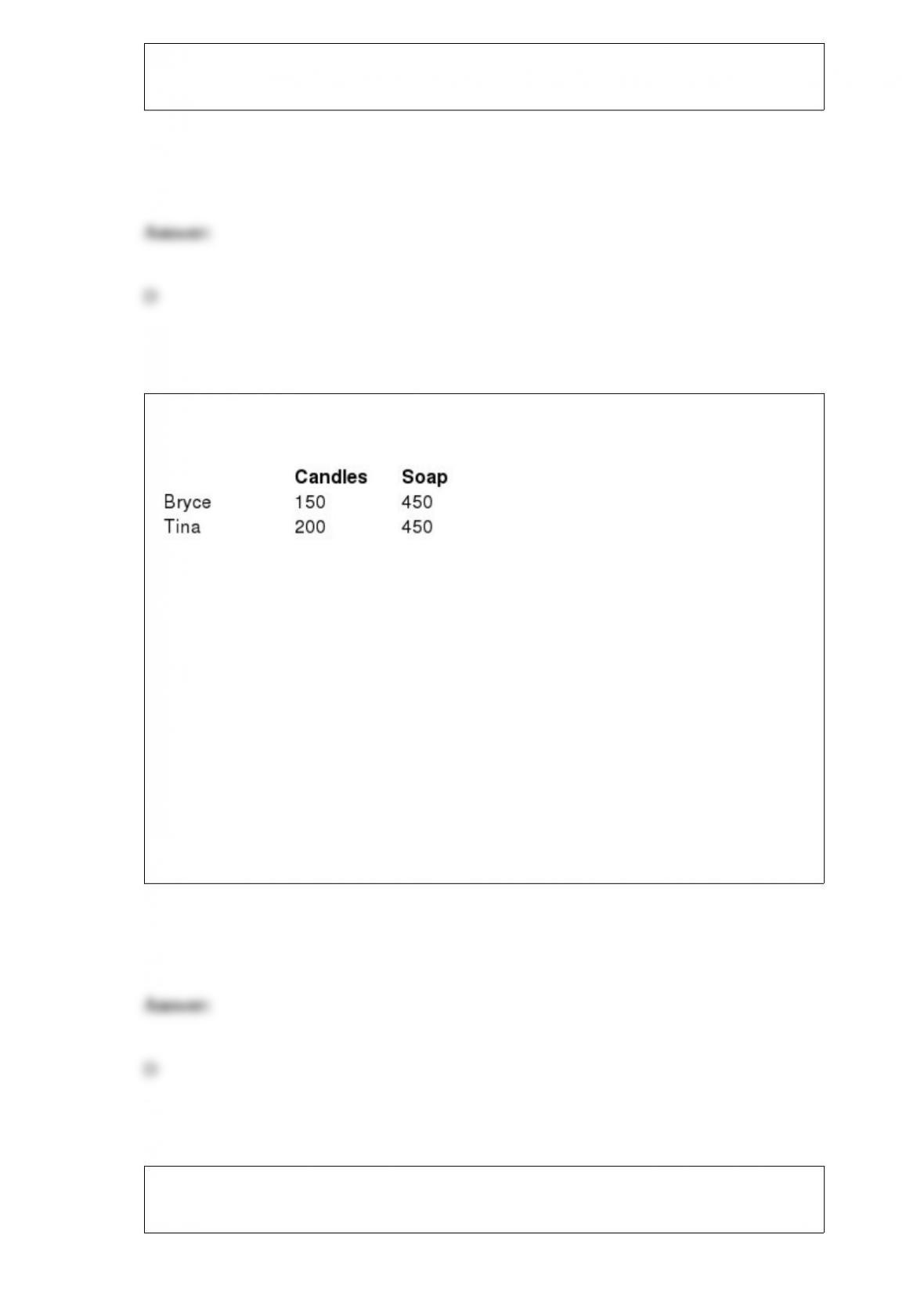
Table 9-3
Bryce and Tina are artisans who produce homemade candles and soap. Table 9-3 lists
the number of candles and bars of soap Bryce and Tina can each produce in one month.
Refer to Table 9-3. Select the statement that accurately interprets the data in the table.
A) Bryce has an absolute advantage in making candles and Tina has an absolute
advantage in making soap.
B) Bryce has an absolute advantage in making soap and Tina has an absolute advantage
in making candles.
C) Bryce has an absolute advantage in making soap.
D) Tina has an absolute advantage in making candles.
The table below shows the demand and cost data facing “Velvet Touches,” a
monopolistically competitive producer of velvet throw pillows.
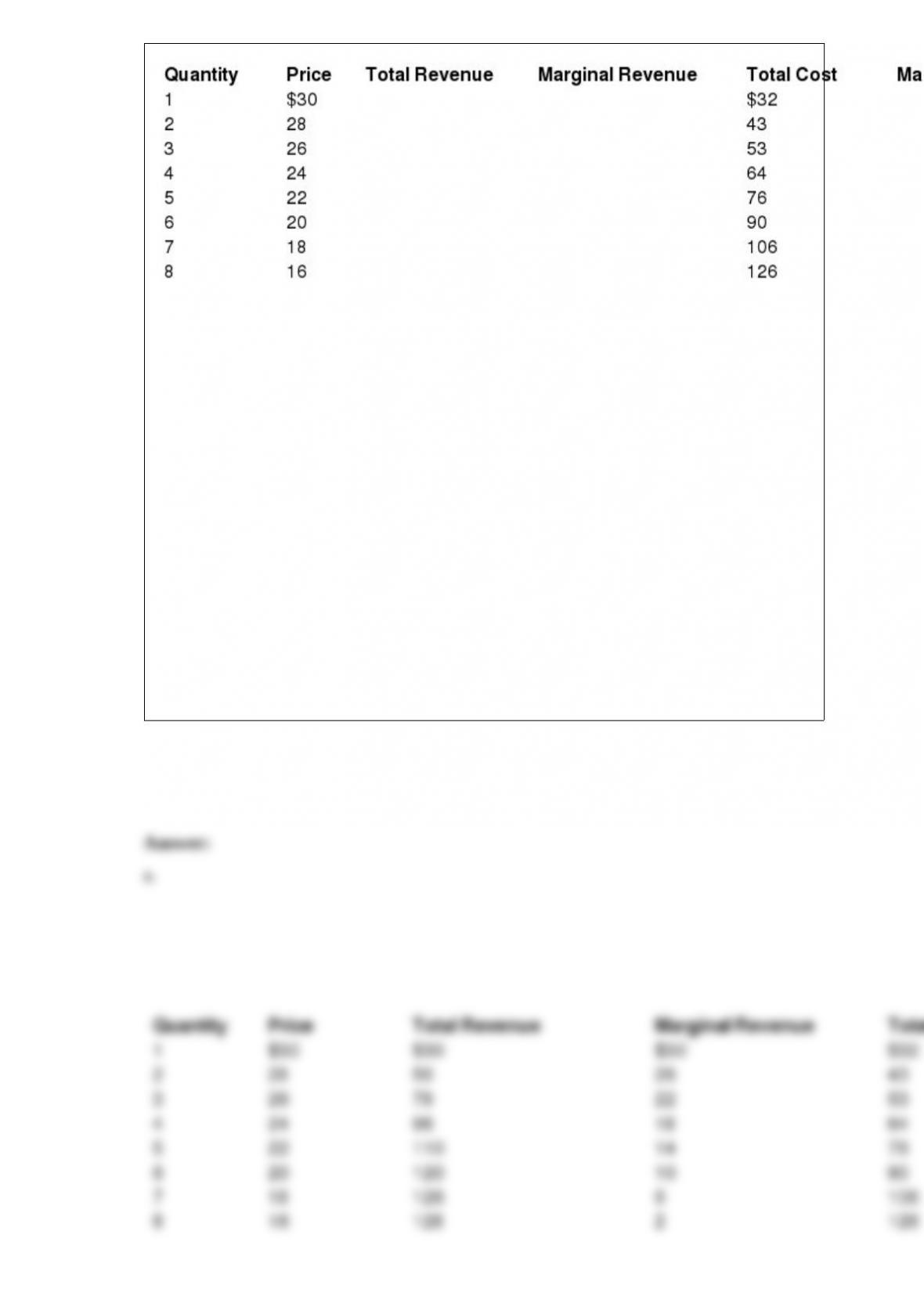
Use the data to answer the following questions.
a. Complete the Total Revenue (TR), Marginal Revenue (MR) and Marginal Cost (MC)
columns above.
b. What are the profit-maximizing price and quantity for Velvet Touches?
c. Is the firm making a profit or a loss? How much is the profit or loss? Show your
work.
d. Is this firm operating in the long run or in the short run? Explain your answer.
e. If the firm’s profit or loss is typical of all firms in the market for throw pillows, what
is likely to happen in the future? Will there be more firms or will some existing firms
leave the industry? Explain your answer.
f. What will happen to the typical firm’s profit or loss after all entry/exit adjustments?

If a doctor knows that an insurance company will pay for most of a patient’s bill, the
doctor has more of an incentive to require additional medical procedures and tests, even
if the patient may not require them. This is an example of
A) moral hazard.
B) the principle-agent problem.
C) asymmetric information.
D) adverse selection.
________ is maximized in a competitive market when marginal benefit equals marginal
cost.
A) Deadweight loss
B) Marginal profit

C) Economic surplus
D) Selling price