
When a firm produces 50,000 units of output, its total cost equals $6.5 million. When it
increases its production to 70,000 units of output, its total cost increases to $9.4 million.
Within this range, the marginal cost of an additional unit of output is
A) $41.43.
B) $134.29.
C) $135.
D) $145.
In long-run competitive equilibrium, the perfectly competitive firm produces where
price equals minimum average total cost.
a. What is this efficiency criterion called?
b. How does it benefit consumers?
In early 2007, Pioneer and JVC, two Japanese electronics firms, each announced that
their profits were going to be lower than expected because they both had to cut prices

for LCD and plasma television sets. Which of the following could explain why these
firms did not simply raise their prices and increase their profits?
A) The move to cut prices is probably just a temporary one to gain market share. In the
long run the firms will raise prices and be able to increase their profits.
B) Most likely, intense competition between these two major producers probably
pushed prices down. Thereafter, each feared that it would lose its customers to the other
if it raised its prices.
C) In perfect competition, prices are determined by the market and firms will keep
lowering prices until there are no profits to be earned.
D) The firms are still making profits, just not as high as expected so there is room to
lower prices until one can force the other out of business.
Consider the following pairs of items:
a. shampoo and conditioner
b. iPhones and earbuds
c. a laptop computer and a desktop computer
d. beef and pork
e. air-travel and weed killer
Which of the pairs listed will have cross-price elasticity of zero?
A) a and b only
B) c only since most people cannot do without computers
C) e only
D) none of the pairs listed

Table 2-10
Table 2-10 shows the output per day of two pet groomers, Tammi and Horace. They can
either devote their time to grooming dogs or bathing cats.
Refer to Table 2-10. Which of the following statements istrue?
A) Horace has an absolute advantage in both tasks.
B) Tammi has an absolute advantage in both tasks.
C) Horace has an absolute advantage in dog grooming and Tammi in cat bathing.
D) Horace has an absolute advantage in cat bathing and Tammi in dog grooming.
Figure 15-3
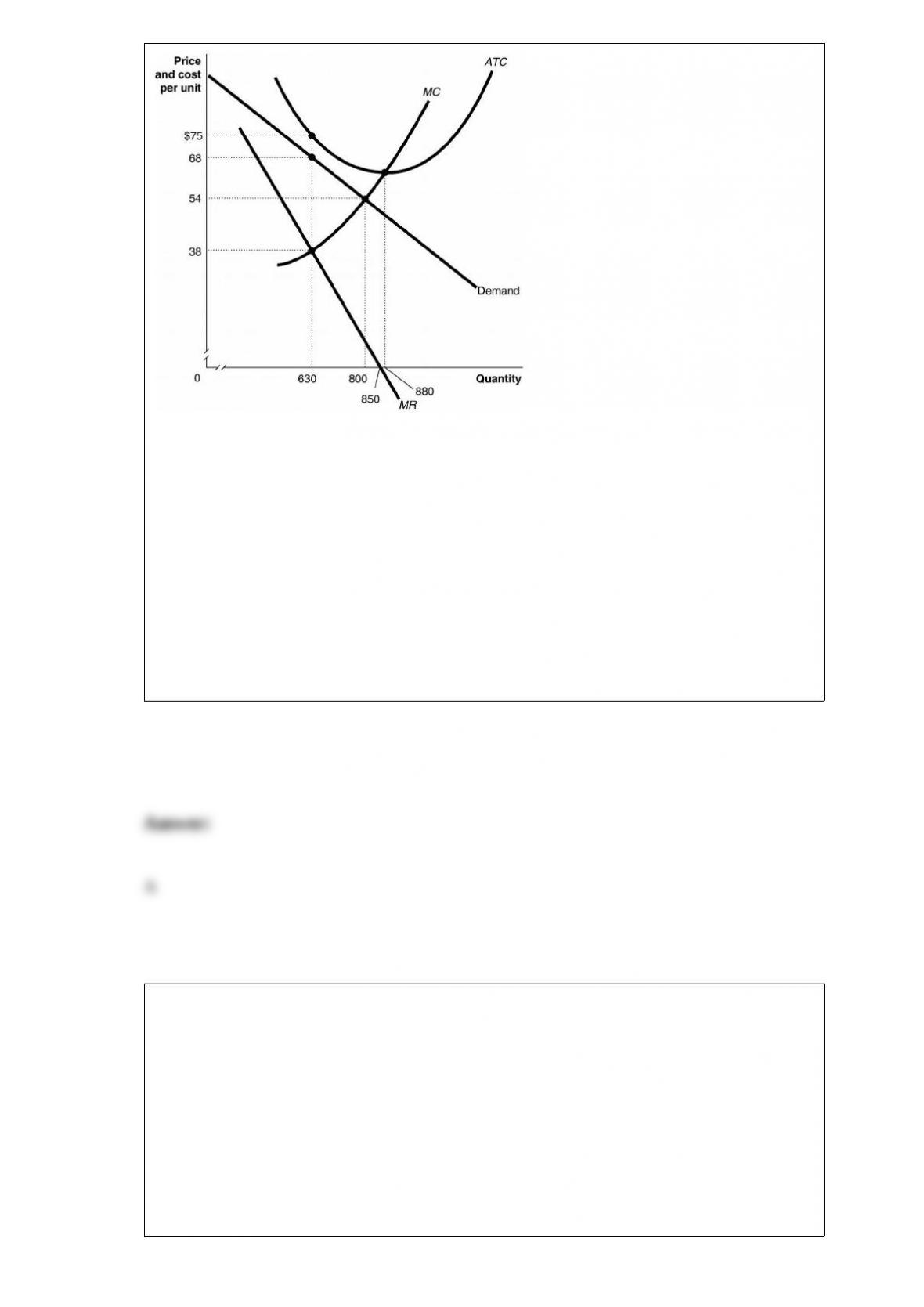
Figure 15-3 above shows the demand and cost curves facing a monopolist.
Refer to Figure 15-3. Suppose the monopolist represented in the diagram above
produces positive output. What is the profit-maximizing/loss-minimizing output level?
A) 630 units
B) 800 units
C) 850 units
D) 880 units
Which of the following refers to the increase in the usefulness of a product as the
number of consumers who use it increases?
A) positive externalities
B) network externalities
C) external marginal utility
D) the impact of celebrity endorsements

How will an increase in population affect the labor market?
A) It will shift the market supply curve.
B) It will cause a decrease in the quantity of labor demanded.
C) It will increase the supply of jobs.
D) It will increase the opportunity cost of leisure.
An equilibrium in a game in which players pursue their own self-interests and do not
cooperate is called a
A) cartel equilibrium.
B) noncooperative equilibrium.
C) prisoner’s dilemma equilibrium.
D) dominant strategy equilibrium.
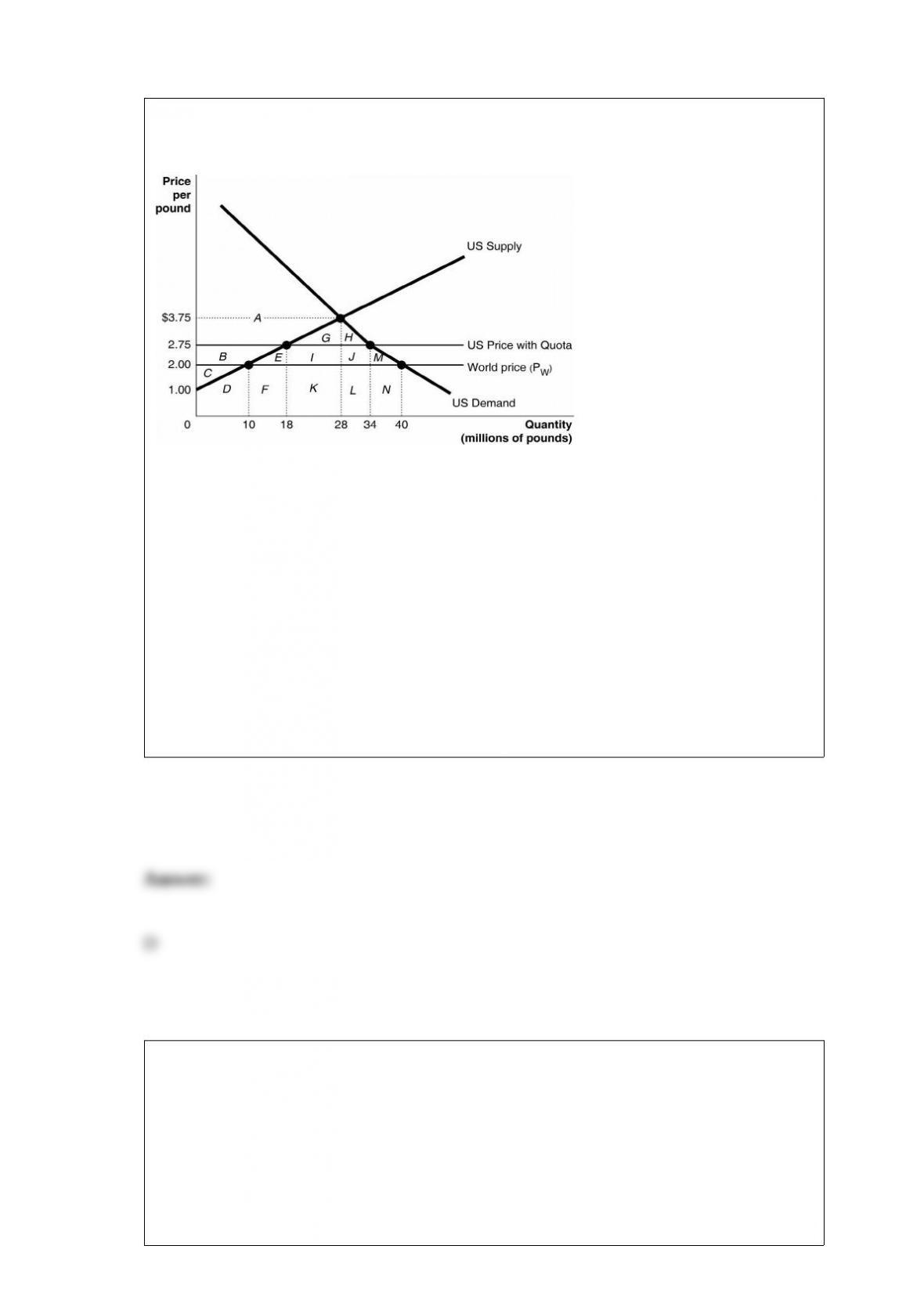
Figure 9-3
Since 1953 the United States has imposed a quota to limit the imports of peanuts.
Figure 9-3 illustrates the impact of the quota.
Refer to Figure 9-3. With a quota in place, what is the quantity supplied by domestic
producers?
A) 8 million pounds
B) 10 million pounds
C) 16 million pounds
D) 18 million pounds
Suppose the demand curve for a product is represented by a typical downward-sloping
curve. Now suppose the demand for this product decreases. Which of the following
statements
accurately predicts the resulting decrease in price?
A) The more elastic the supply curve, the greater the price increase.

B) The more elastic the supply curve, the smaller the price decrease.
C) The increase in price is not affected by the elasticity of the supply curve.
D) The decrease in price will always be proportional to the magnitude of the demand
shift.
Assume the market for organic produce sold at farmers’ markets is perfectly
competitive. All else equal, as more farmers choose to produce and sell organic produce
at farmers’ markets, what is likely to happen to the equilibrium price of the produce and
profits of the organic farmers in the long run?
A) The equilibrium price is likely to increase and profits are likely to remain
unchanged.
B) The equilibrium price is likely to remain unchanged and profits are likely to
increase.
C) The equilibrium price is likely to decrease and profits are likely to decrease.
D) The equilibrium price is likely to increase and profits are likely to increase.
Why is a dollar today more valuable than a dollar a year from now?
A) The dollar today can be immediately used to buy something.
B) A dollar a year from now will likely have less purchasing power because of inflation.

C) The unknown future is riskier than the known present.
D) all of these
Table 2-7
Table 2-7 shows the output per month of two people, Fred and Barney. They can either
devote their time to making pogo sticks or making unicycles.
Refer to Table 2-7. Which of the following statements istrue?
A) Fred has a comparative advantage in making both products.
B) Barney has a comparative advantage in making both products.
C) Barney has a comparative advantage in making pogo sticks and Fred in making
unicycles.
D) Barney has a comparative advantage in making unicycles and Fred in making pogo
sticks.
Let D= demand, S = supply, P = equilibrium price, Q= equilibrium quantity. What

happens in the market for tropical hardwood trees if the governments restrict the
amount of forest lands that can be logged?
A) D decreases, S no change, P and Q decrease
B) S decreases, D no change, P increases, Q decreases
C) D and S decrease, P and Q increase
D) D no change, S decreases, P increases, Q increases
A proportional tax is a tax for which people with lower incomes
A) pay a higher percentage of their incomes in tax than do people with higher incomes.
B) pay a lower percentage of their incomes in tax than do people with higher incomes.
C) pay the same percentage of their incomes in tax as do people with higher incomes.
D) pay the same amount of taxes as people with higher incomes pay.
If a nation changes its laws to more actively enforce intellectual property rights, all of
the following will most likely take place except
A) more software companies will choose to export their products to that country.
B) more film makers will choose to do business in that country.

C) the black market for intellectual property will become more prosperous in in that
country.
D) foreign investment in that country will increase.
When a firm’s long-run average cost curve is horizontal for a range of output, then that
range of production displays
A) increasing returns to scale.
B) constant returns to scale.
C) decreasing returns to scale.
D) constant average fixed costs.
Table 14-4

Alistair Luggage and Baine Baggage are the only firms selling luggage in the upscale
town of Montecito. Each firm must decide on whether to increase its advertising
spending to compete for customers. If one firm increases its advertising budget but the
other does not, then the firm with the higher advertising budget will increase its profit.
Table 14-4 shows the payoff matrix for this advertising game.
Refer to Table 14-4. What is the Nash equilibrium in this game?
A) There is no Nash equilibrium.
B) Baine increases its advertising budget, but Alistair does not.
C) Alistair increases its advertising budget, but Baine does not.
D) Both Alistair and Baine increase their advertising budgets.
All of the following are examples of spending on goods and services in the circular
flow model except
A) Giovani buys a new cell phone to replace the one he flushed down the toilet.
B) Amir buys a new humidor for his cigar shop.
C) Isabella buys the sushi plate for lunch at the Turning Japanese Sushi Bar.
D) Vijay buys a new minivan for his family’s cross-country vacation.
The marginal revenue curve for a perfectly competitive firm
A) is downward-sloping.
B) is the same as its demand curve.
C) is perfectly inelastic.
D) is the same as its marginal cost curve.
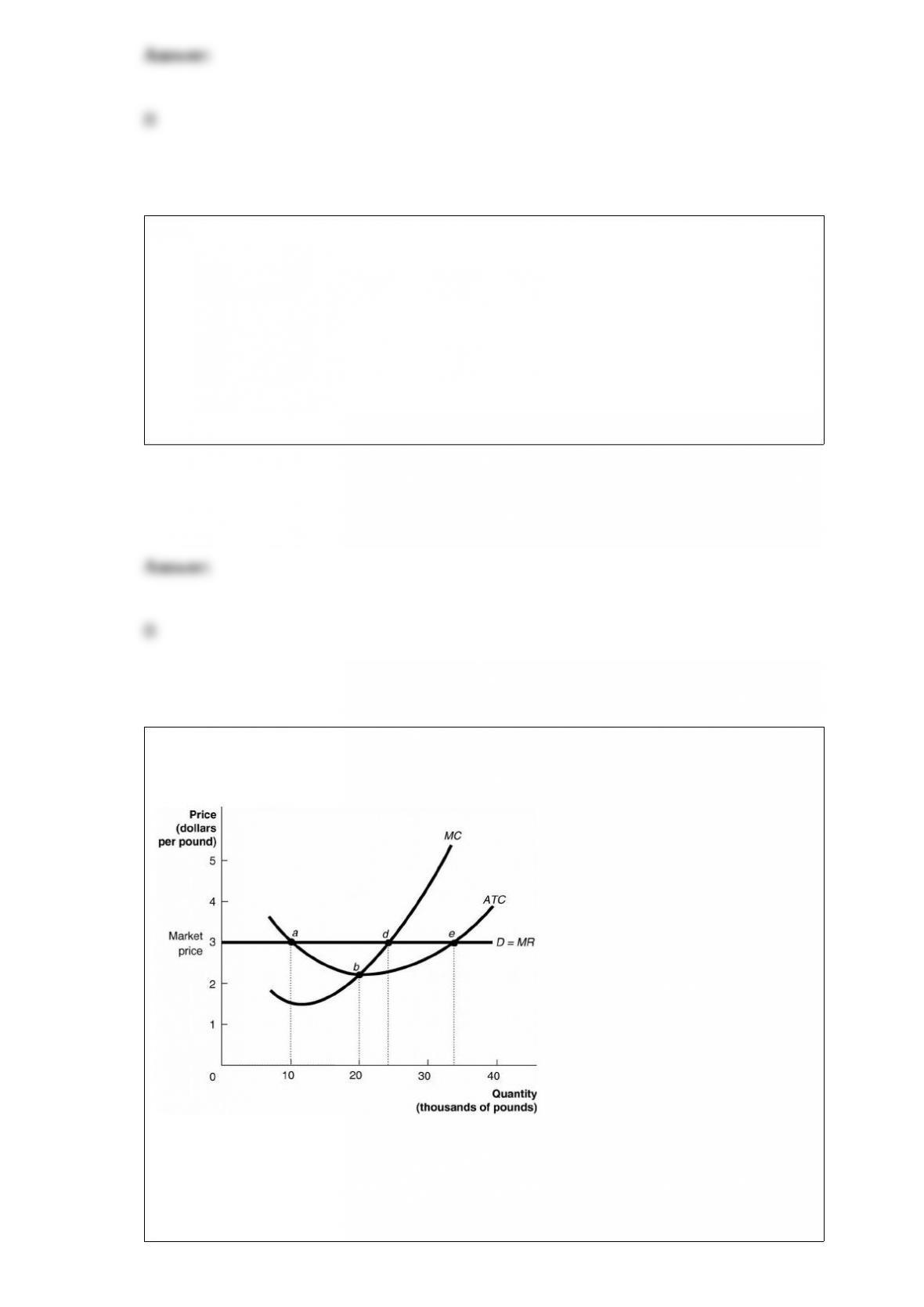
Figure 12-6
Figure 12-6 shows the demand, marginal cost (MC) and average total cost (ATC) curves
for Jason’s House of Apples.
Refer to Figure 12-6. If Jason maximizes his profit he will produce the output rate
indicated by point ________ and his average profit will equal ________.

A) d; $3 minus ATC at point d
B) b; $3 minus ATC at point b
C) e; $3 minus ATC at point e
D) a; $3
What is allocative efficiency?
A) It refers to a situation in which resources are allocated to their highest profit use.
B) It refers to a situation in which resources are allocated such that goods can be
produced at their lowest possible average cost.
C) It refers to a situation in which resources are allocated such that the last unit of
output produced provides a marginal benefit to consumers equal to the marginal cost of
producing it.
D) It refers to a situation in which resources are allocated fairly to all consumers in a
society.
Figure 12-2
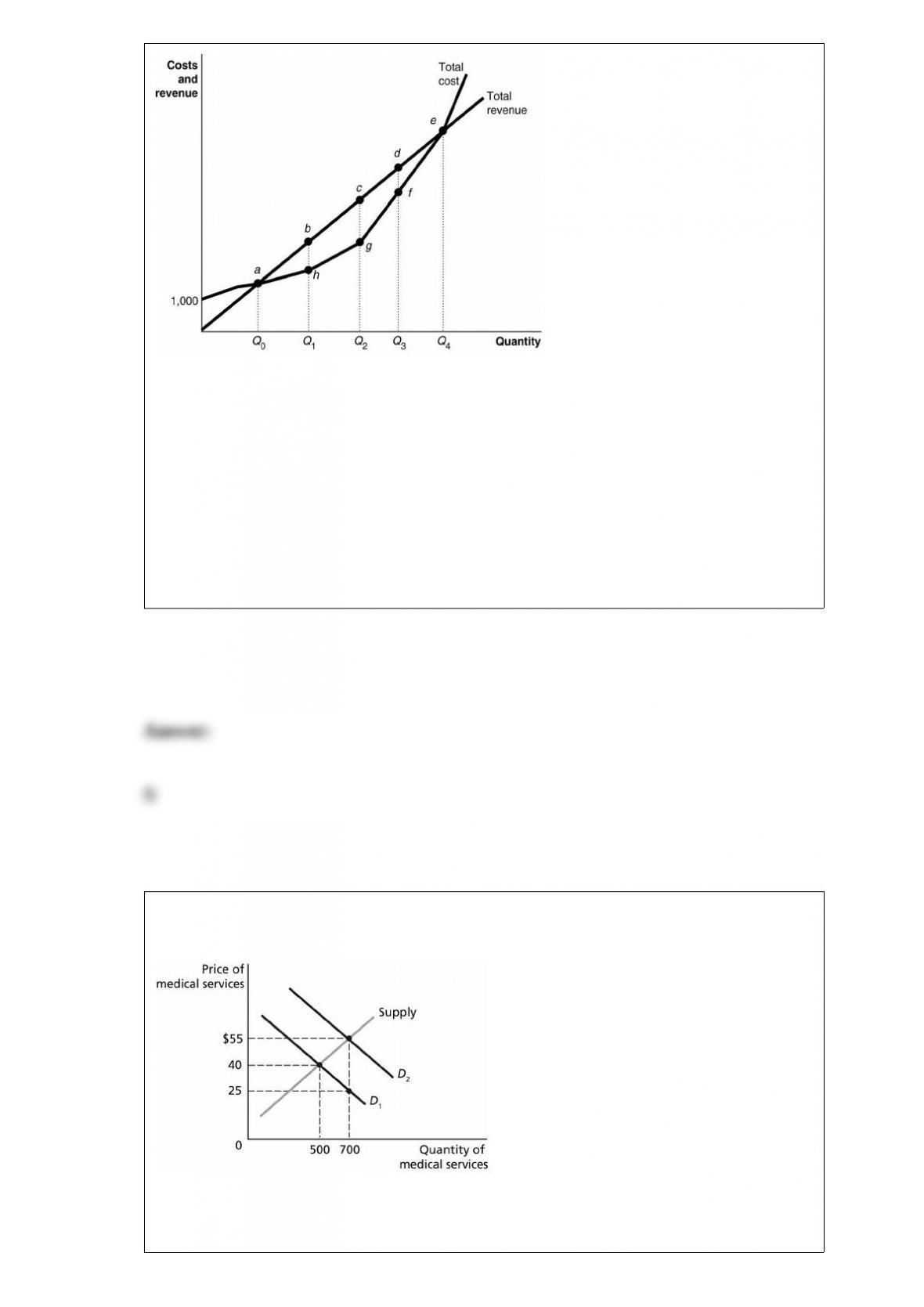
Refer to Figure 12-2. Suppose the firm is currently producing Q2units. What happens if
it expands output to Q3units?
A) Its profit increases by the size of the vertical distance df.
B) It makes less profit.
C) It incurs a loss.
D) It will be moving toward its profit maximizing output.
Figure 7-2
Figure 7-2 represents the market for medical services with and without insurance, and
the effect of a third-party payer system on the demand for medical services.

Refer to Figure 7-2. The efficient price of medical services is
A) $25.
B) $40.
C) $55.
D) >$55.
If, as a perfectly competitive industry expands, it can supply larger quantities at the
same long-run market price, it is
A) a constant-cost industry.
B) an increasing-cost industry.
C) a decreasing-cost industry.
D) a fixed-cost industry.
Figure 2-7
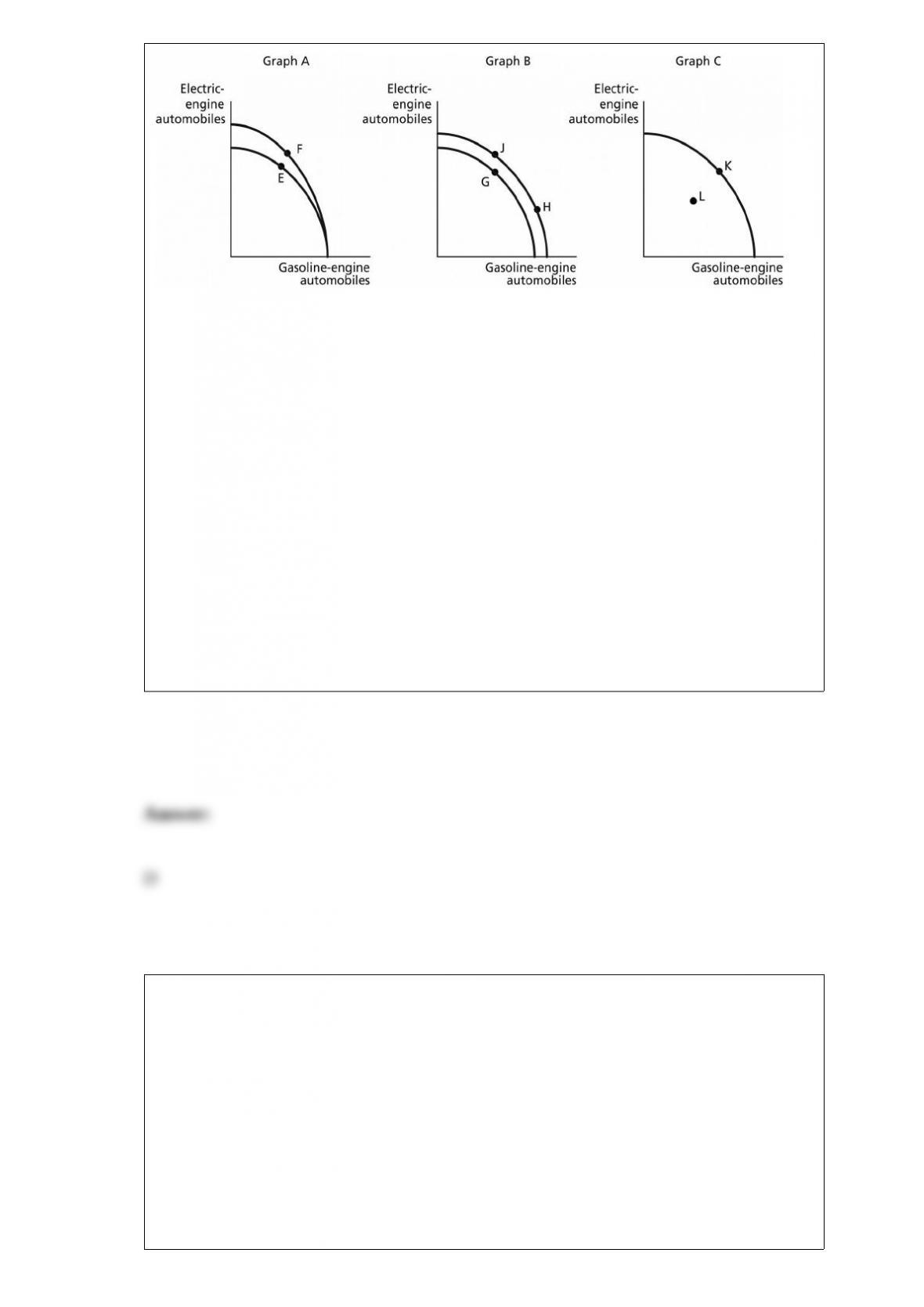
Mercedes Benz recently decided to introduce its B-class automobile in the U.S. market,
an electric car that is has designed and developed in a partnership with Tesla Motors.
Assume Mercedes Benz chooses to produce both electric-engine vehicles and
gasoline-engine vehicles. Figure 2-7 shows changes to its production possibilities
frontier in response to new developments and different strategic production decisions.
Refer to Figure 2-7. Assume that in response to changing consumer demands,
Mercedes cuts back on the production of electric vehicles and increased its production
of gasoline-powered vehicles. This strategy is best represented by the
A) movement from F to E in Graph A.
B) movement from G to J in Graph B.
C) movement from L to K in Graph C.
D) movement from J to H in Graph B.
In October 2013, Abercrombie & Fitch (ANF) posted a price-earnings ratio of 13. If the
price of the stock at that time was $36 per share, which of the following must have been
true?
A) ANF’s revenues that month were $4.68 million.
B) ANF’s earnings per share was $2.77.
C) ANF’s coupon payment was $23.23 per year.
D) ANF’s dividend yield for the year was 47%.

Lou buys an Iron Man 2 poster from Evan for $30 and resells it on eBay for $60. Which
of the following statements is false?
A) Lou has earned some arbitrage profits, assuming that transaction costs are
negligible.
B) The transaction has made Evan worse off because he undersold the poster.
C) Lou has probably incurred some costs in connection with this sale.
D) It is possible that Evan has earned some producer surplus from this transaction.
Sarita can bake either a combination of 25 cakes and 15 pies or a combination of 10
cakes and 20 pies. If she now bakes 10 cakes and 20 pies, what is the opportunity cost
of baking an additional 15 cakes?
A) 5 pies
B) 10 pies
C) 15 pies
D) 20 pies

Phil Harrison is a welder who works on skyscrapers and extension bridges. Phil’s
brother William is also a welder but he works in a manufacturing plant where he does
all of his welding on ground level. Which of the following would not explain why Phil
earns a higher wage than his brother?
A) cognitive dissonance
B) Phil has greater experience as a welder than his brother has.
C) Phil’s marginal revenue product is greater than William’s marginal revenue product.
D) Phil’s job is more hazardous than William’s job.
Suppose your expenses for this term are as follows: tuition: $28,000, room and board:
$9,000, books and other educational supplies: $2,500. Further, during the term, you can
only work part-time and earn $16,000 instead of your full-time salary of $42,000. What
is the opportunity cost of going to college this term, assuming that your room and board
expenses would be the same even if you did not go to college?
A) $36,500
B) $56,500
C) $65,500
D) $72,500

The largest source of revenue for the federal government of the United States is from
A) tariffs collected on imported goods.
B) property taxes imposed on private property.
C) sales taxes on items purchased for consumption.
D) individual income taxes.