
The demand for most farm products is relatively inelastic. All else constant, what is the
effect on farm revenues as a result of the introduction of new and better farm equipment
which increases in productivity?
A) Farm revenues increase.
B) Farm revenues decrease.
C) Farm revenues remain constant because consumers will not increase their
consumption of farm products by much.
D) Farm revenues could increase or decrease depending on the cost of this new
equipment.
A quota
A) makes domestic consumers better off.
B) makes both domestic producers and consumers better off.
C) makes everyone worse off.
D) makes domestic producers better off.
When a perfectly competitive firm finds that its market price is below its minimum
average variable cost, it will sell
A) the output where marginal revenue equals marginal cost.
B) any positive output the entrepreneur decides upon because all of it can be sold.
C) nothing at all; the firm shuts down.
D) the output where average total cost equals price.
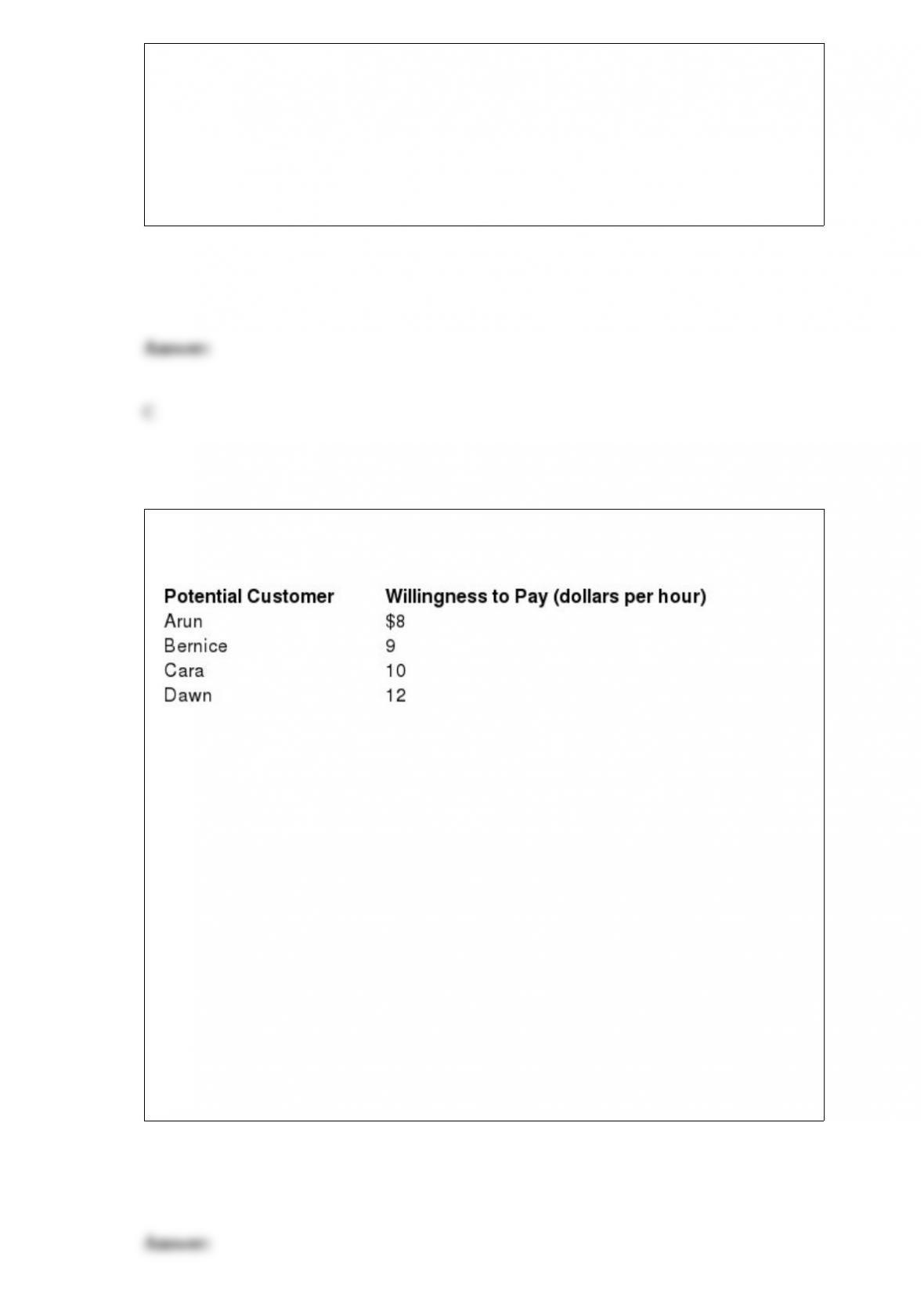
Table 16-3
Julie plans to start a pet-sitting service. She surveyed her neighborhood to determine the
demand for this service. Assume that each person surveyed demands only one hour of
pet sitting services per period. Table 16-3 above shows a portion of her survey results.
Refer to Table 16-3. Suppose Julie’s marginal cost of providing this service is constant
at $7 and she charges each customer according to his or her willingness to pay instead
of a uniform price of $7. Which of the following statements is true?
A) Julie is worse off because the demand for her services is reduced.
B) Julie has converted the consumer surplus (from a uniform price) into economic
profit.
C) Julie’s customers are better off because their consumer surplus has increased.
D) Julie’s has converted the producer surplus (from a uniform price) into consumer
surplus.
The slope of the indifference curve is referred to as
A) the marginal rate of substitution.
B) the price ratio.
C) the marginal rate of consumption.
D) the marginal tradeoff rate.
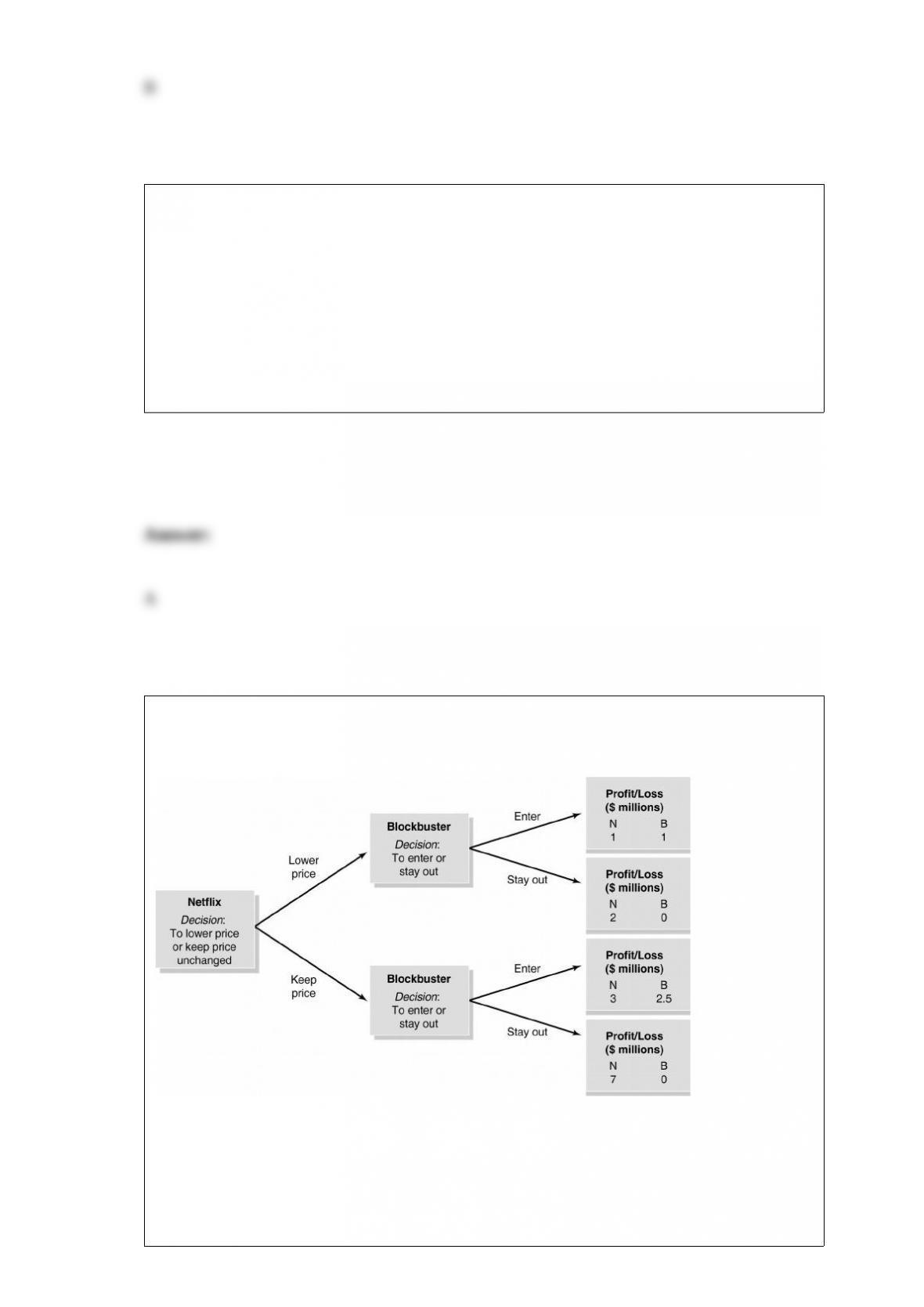
Figure 14-5
A few years ago Netflix (N) pioneered an online DVD rental service. Blockbuster (B), a
brick and mortar DVD/video rental company, waited until Netflix had been in business
for over a year before deciding whether to establish its own online rental service. At this
point, Netflix had to decide whether or not to lower its subscription price in order to
deter Blockbuster’s entry into the market. Figure 14-5 shows the decision tree for the

Netflix-Blockbuster entry game.
Refer to Figure 14-5. If Netflix lowers its price will this deter Blockbuster from setting
up an online DVD rental service?
A) Yes, because Blockbuster stands to lose $1 million if it competes with Netflix.
B) Yes, because Blockbuster will make a smaller profit than Netflix if it chooses to
compete.
C) No, because Blockbuster will make a profit if it competes with Netflix.
D) No, because Blockbuster will make a larger profit than Netflix if it chooses to
compete.
One requirement for a firm pursuing a price-discrimination strategy is the ability to
segment the market for its product. This means that
A) the firm must set different prices for different regions where the product is sold.
B) the firm must be willing to offer price discounts for senior citizens and children.
C) the firm must be able to divide the market in a way that makes arbitrage impossible.
D) the firm must choose a marketing strategy that appeals to different segments of the
economy.
A dominant strategy is

A) an equilibrium where each firm chooses the best strategy, given the strategies of
other firms.
B) a strategy chosen by two firms that decide to charge the same price or otherwise not
to compete.
C) a strategy that is obviously the best for each firm that is a party to a business
decision.
D) a strategy that is the best for a firm no matter what strategies other firms use.
What is a secondary market?
A) a market where factory seconds and damaged merchandise are sold
B) a market where newly issued bonds are sold to initial buyers by the borrowing firm
C) a market where a newly issued stocks are sold to initial buyers by the borrowing
firm
D) a market where you can sell any stocks you own as a private investor
What is productive efficiency?
A) a situation in which resources are allocated to their highest profit use
B) a situation in which resources are allocated such that goods can be produced at their
lowest possible average cost
C) a situation in which resources are allocated such the last unit of output produced
provides a marginal benefit to consumers equal to the marginal cost of producing it
D) a situation in which firms produce as much as possible
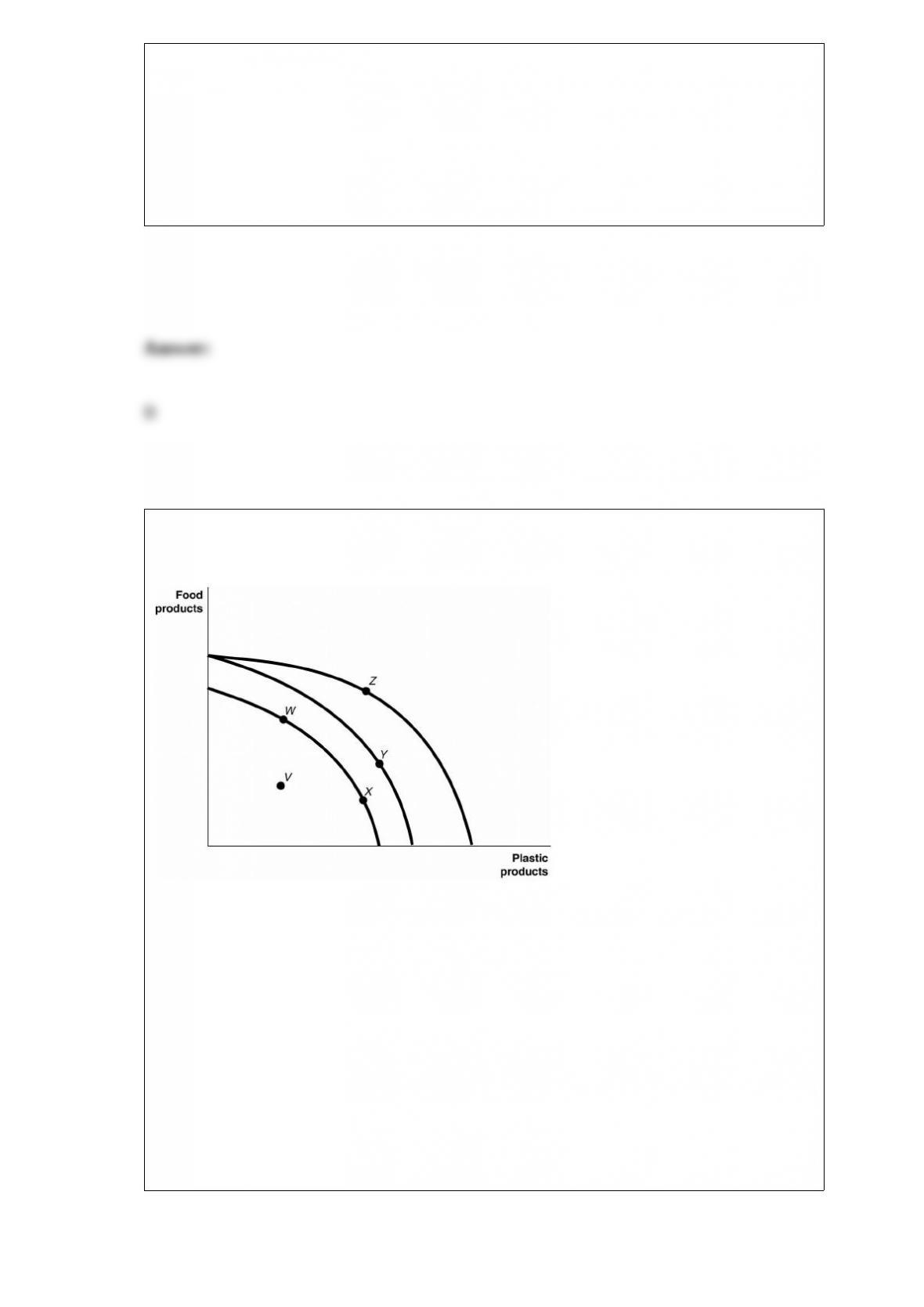
Figure 2-4
Figure 2-4 shows various points on three different production possibilities frontiers for
a nation.
Refer to Figure 2-4. A movement from ________ is the result of negative technological
change in plastic production.
A) V to X
B) X to W
C) W to Z
D) Z to Y

If the total cost of producing 20 units of output is $1,000 and the average variable cost
is $35, what is the firm’s average fixed cost at that level of output?
A) $65
B) $50
C) $15
D) It is impossible to determine without additional information.
If the 15th unit of output has a marginal cost of $29.50 and the average cost of
producing 14 units of output is $30.23, what will happen to the average cost of
production if the 15th unit is produced?
A) Average cost increases as more is produced.
B) Average cost will fall.
C) Average cost could increase or decrease depending on what happens to variable cost.
D) Average cost could increase or decrease depending on what happens to fixed cost.

Which of the following is true for a firm with a downward-sloping demand curve for its
product?
A) Price, average revenue, and marginal revenue are all equal.
B) Price, average revenue, and marginal revenue are all different.
C) Price equals average revenue but is greater than marginal revenue.
D) Price equals average revenue but is less than marginal revenue.
Mr. Peabody chooses to invest in companies that produce goods and services at the
lowest possible cost. Mr. Peabody is investing in companies that are
A) allocatively efficient.
B) productively efficient.
C) guaranteed to make a profit.
D) all of the above.
If you burn your trash in the back yard in spite of regulations against it, then you are
A) acting economically irrationally and creating a social cost.

B) avoiding the private costs associated with disposing your trash some other way and
creating a social cost.
C) acting rationally and creating a positive externality.
D) saving landfill space and creating a social benefit.
Which of the following is not a characteristic of a monopolistically competitive firm in
long-run equilibrium?
A) Marginal revenue is equal to marginal cost.
B) Price is equal to average revenue.
C) The firm has excess capacity.
D) Price is equal to marginal cost.
All else equal, the decrease in consumer preference predicted by Apple for its iPhone 5
would be represented by a
A) shift the supply curve for iPhones to the right.
B) shift the supply curve for iPhones to the left.
C) shift the demand curve for iPhones to the right.

D) shift the demand curve for iPhones to the left.
Which of the following statements is true?
A) Input prices are one of the success factors that firms can control.
B) Consumers will buy a product only if its price is below that of its competitors.
C) Consumers will buy a product only if it meets a need not met by competing
products.
D) Sheer chance can play a significant role in the success or failure of a business.
Suppose you have surveyed a few industries and obtained information about the income
elasticity of demand for their products. If you expect that the economy is headed for a
long recession, you would advise people to look for jobs in an industry with
A) a high positive income elasticity coefficient such as 5.
B) a low positive income elasticity coefficient such as 0.8.
C) a “high” negative income elasticity coefficient such as -4.
D) a “low” negative income elasticity coefficient such as -0.2.
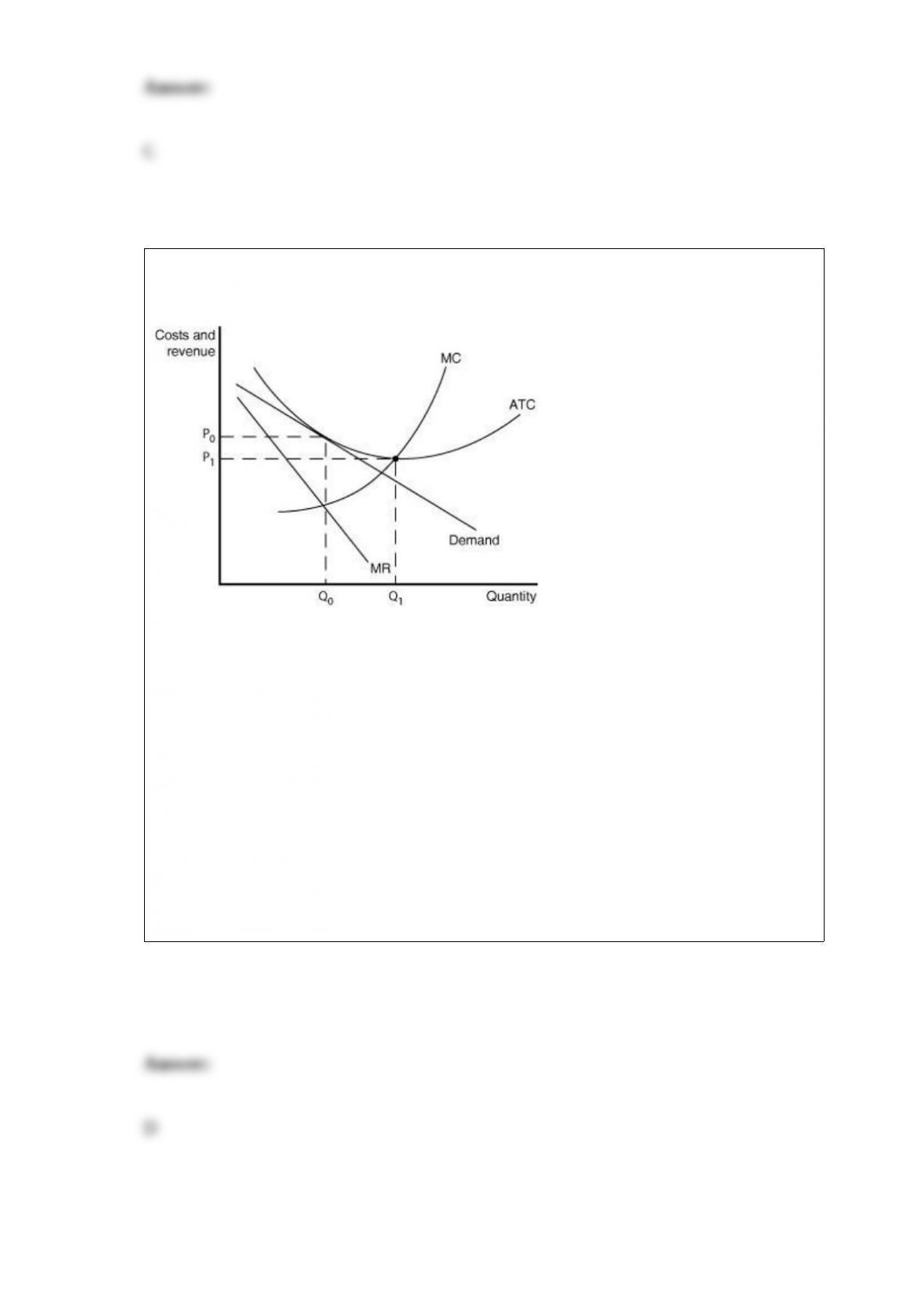
Figure 13-14
Figure 13-14 illustrates a monopolistically competitive firm.
Refer to Figure 13-14. Which of the following statements describes the firm depicted
in the diagram?
A) The firm is making no economic profit and will exit the industry.
B) The firm is suffering an economic loss by producing at Q0 but will break even it
increases its output to Q1.
C) The firm achieves productive efficiency by producing at Q0.
D) The firm is in long-run equilibrium and is breaking even.
Assume that the medical screening industry is perfectly competitive. Consider a typical
firm that is making short-run losses. Suppose the medical screening industry runs an
effective advertising campaign which convinces a large number of people that yearly
CT scans are critical for good health. How will this affect a typical firm that remains in
the industry?
A) The firm’s supply curve shifts right and its marginal revenue curve shifts upwards as
the market price rises and ultimately the firm starts making profits.
B) The firm’s marginal revenue curve and average cost curve shift upwards in response
to the increase in market price and advertising expenditure. The firm increases output
until it starts breaking even.
C) The marginal revenue curve shifts upwards, the firm’s output increases along its
marginal cost curve, it expands production and eventually starts making profits.
D) The marginal revenue curve shifts upwards, the firm’s output increases along its
marginal cost curve, it expands production until it breaks even.
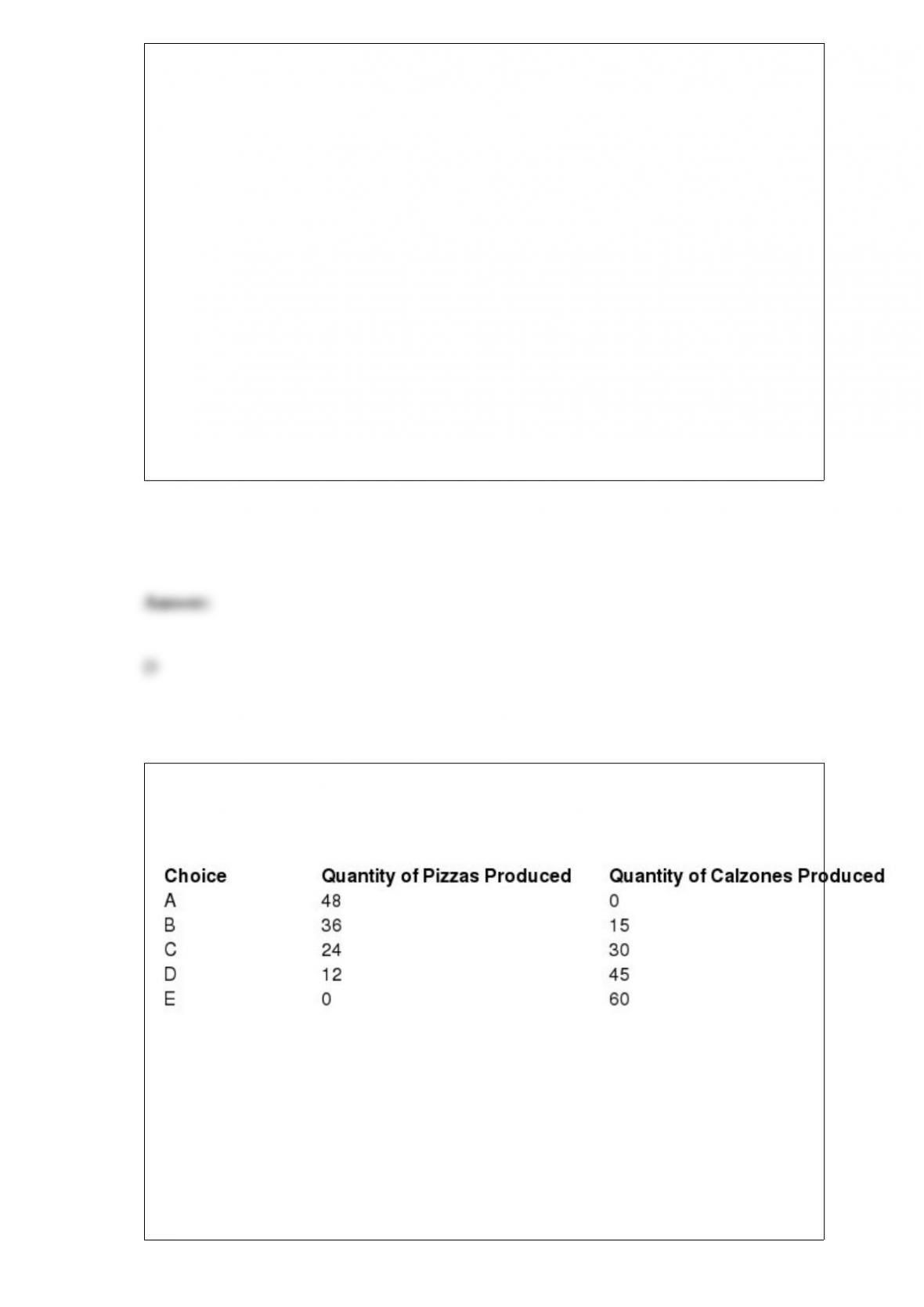
Table 2-1
Production choices for Tomaso’s Trattoria
Refer to Table 2-1. Assume Tomaso’s Trattoria only produces pizzas and calzones.
Tomaso faces ________ opportunity costs in the production of pizzas and calzones.
A) increasing
B) decreasing
C) constant

D) negative
What are liabilities?
A) anything of value owned by a person or a business
B) anything a person or a business owes to entities outside the business
C) the total cost of labor for a firm
D) only those unpaid expenses for which a business or person is making interest
payments
Kenneth Chay and Michael Greenstone examined the impact of reductions in air
pollution since the passage of the Clean Air Act of 1970. Which of the following
statements summarizes their findings?
A) The marginal benefit of reductions in air pollution was less than the marginal cost.
B) The marginal cost of reducing emissions of sulfur dioxide has increased over time as
the marginal benefit of the reductions has increased.
C) The benefits of reducing the six main air pollutants in the two years following the
Act greatly exceeded the costs.
D) In the two years following passage of the Act, fewer infants died than would have
died if the Act had not been passed.

Draw a demand curve and label itD1. On the graph, illustrate an increase in demand and
a decrease in demand, and label the curves D2 and D3, respectively. Starting on demand
curve D1, explain the shift that would result from each of the following events:
a. an increase in income and the good is a normal good
b. an increase in income and the good is an inferior good
c. a decrease in the price of a substitute good
d. a decrease in the price of a complementary good
e. an increase in the taste for the good
f. a decrease in population
g. an increase in the expected future price of the good

Suppose the price of gasoline is $3.50 per gallon, the quantity of gasoline demanded is
150 billion gallons per year, the price elasticity of demand for gasoline is -0.06, and the
federal government decides to increase the excise tax on gasoline by $1.00 per gallon,
which increases the price of gasoline by $0.75 per gallon. What is the new equilibrium
quantity of gasoline demanded after the tax is imposed?
A) 109.72 billion gallons per year
B) 127.25 billion gallons per year
C) 148.27 billion gallons per year
D) 161.61 billion gallons per year
If economies of scale are relatively unimportant in an industry, the typical firm’s
long-run average total cost curve will reach a minimum at a level of output that is a
________ fraction of total industry sales. The industry will be ________.
A) large; competitive
B) large; an oligopoly
C) small; competitive
D) small; an oligopoly
If a perfectly competitive firm’s price is above its average total cost, the firm
A) is earning a profit.
B) should shut down.
C) is incurring a loss.
D) is breaking even.
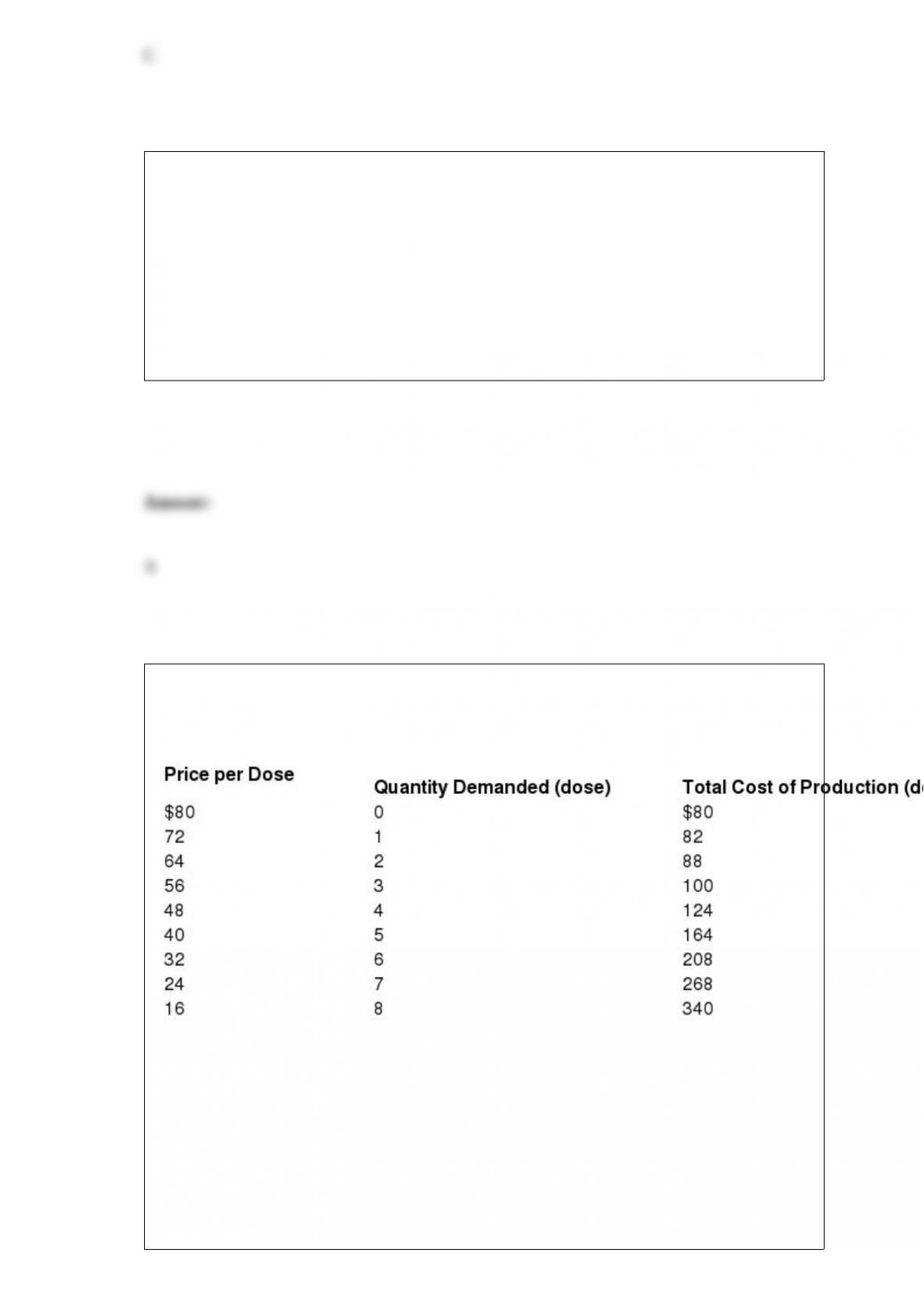
Table 15-4
Shakti Inc. has been granted a patent for its Arnica toothache balm. Table 15-4 shows
the demand and the total cost schedule for the firm.
Refer to Table 15-4. What is the economically efficient output level?
A) 5 units
B) 6 units
C) 7 units
D) 8 units
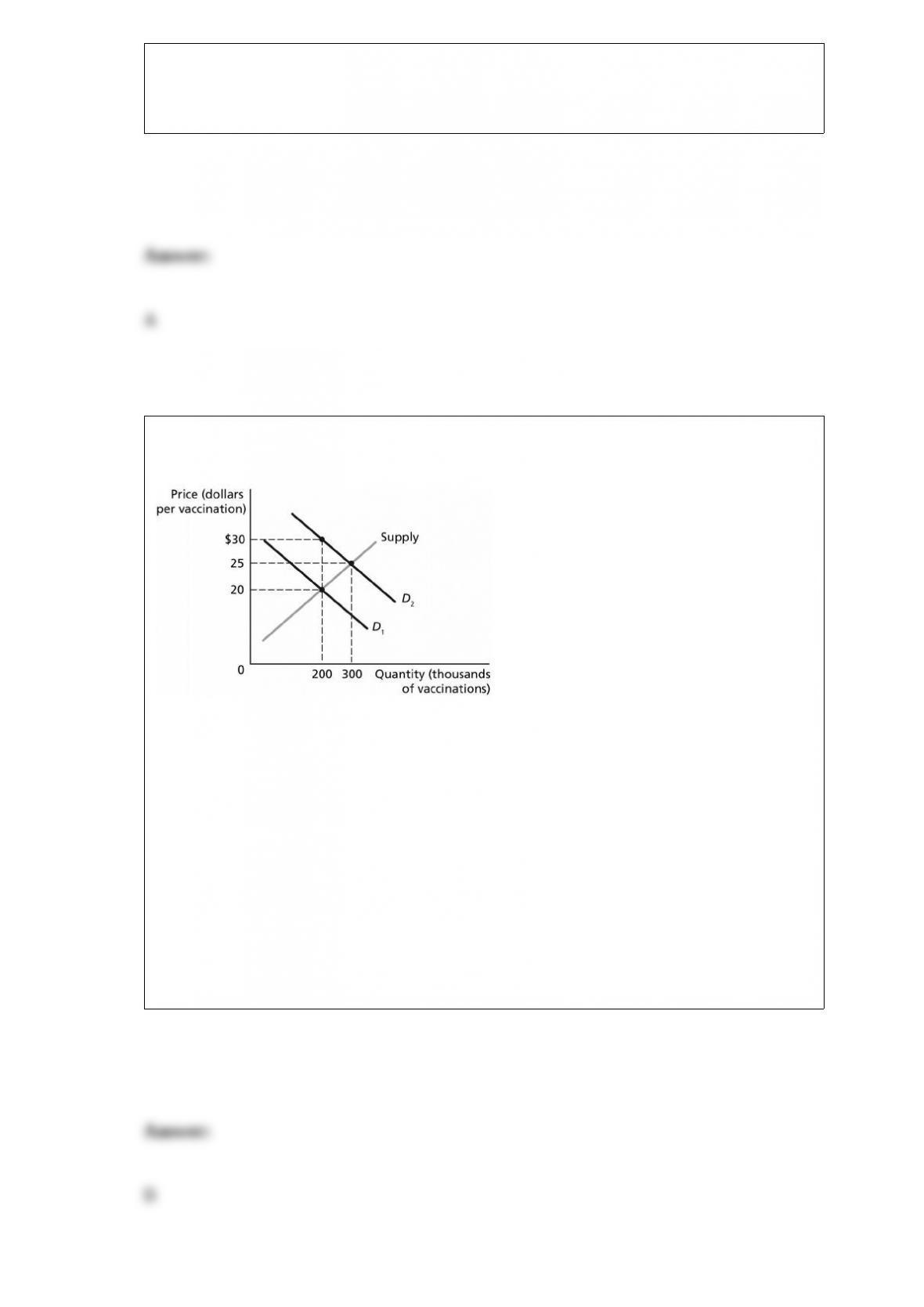
Figure 7-1
Figure 7-1 represents the market for vaccinations. Vaccinations are considered a benefit
to society, and the figure shows both the marginal private benefit and the marginal
social benefit from vaccinations.
Refer to Figure 7-1. The efficient equilibrium price is
A) $30.
B) $25.
C) $20.
D) <$20.

Trinh quits his $80,000-a-year job to become a full-time volunteer at a museum. What
is the opportunity cost of his decision?
A) 0 since he will no longer be earning a salary
B) depends on the “going rate” of museum employees
C) at least $80,000
D) the value he attributes to the joy of working at a museum
All of the following are examples of oligopolistic markets except
A) the broadcasting industry
B) aircraft manufacture
C) college bookstores
D) seafood restaurant chains
The income effect of an increase in the price of salmon
A) is the change in the demand for salmon when income increases.
B) refers to the relative price effect – salmon is more expensive compared to other types
of fish – which causes the consumer to buy less salmon.

C) refers to the effect on a consumer’s purchasing power which causes the consumer to
buy less salmon, holding all other factors constant.
D) is the change in the demand for other types of fish, say trout, that result from a
decrease in purchasing power.