How do current tax laws in the United States favor employer-based health care
insurance?
A) Individuals who receive health insurance benefits are allowed to deduct the value of
these benefits from their taxable income.
B) Employers who provide health insurance benefits are reimbursed by the government
and are not taxed on these reimbursements.
C) Individuals who receive health insurance benefits do not pay taxes on the value of
these benefits.
D) Health insurance companies that provide insurance to employers are subject to a
lower tax rate than those insurance companies that provide insurance to private
individuals.
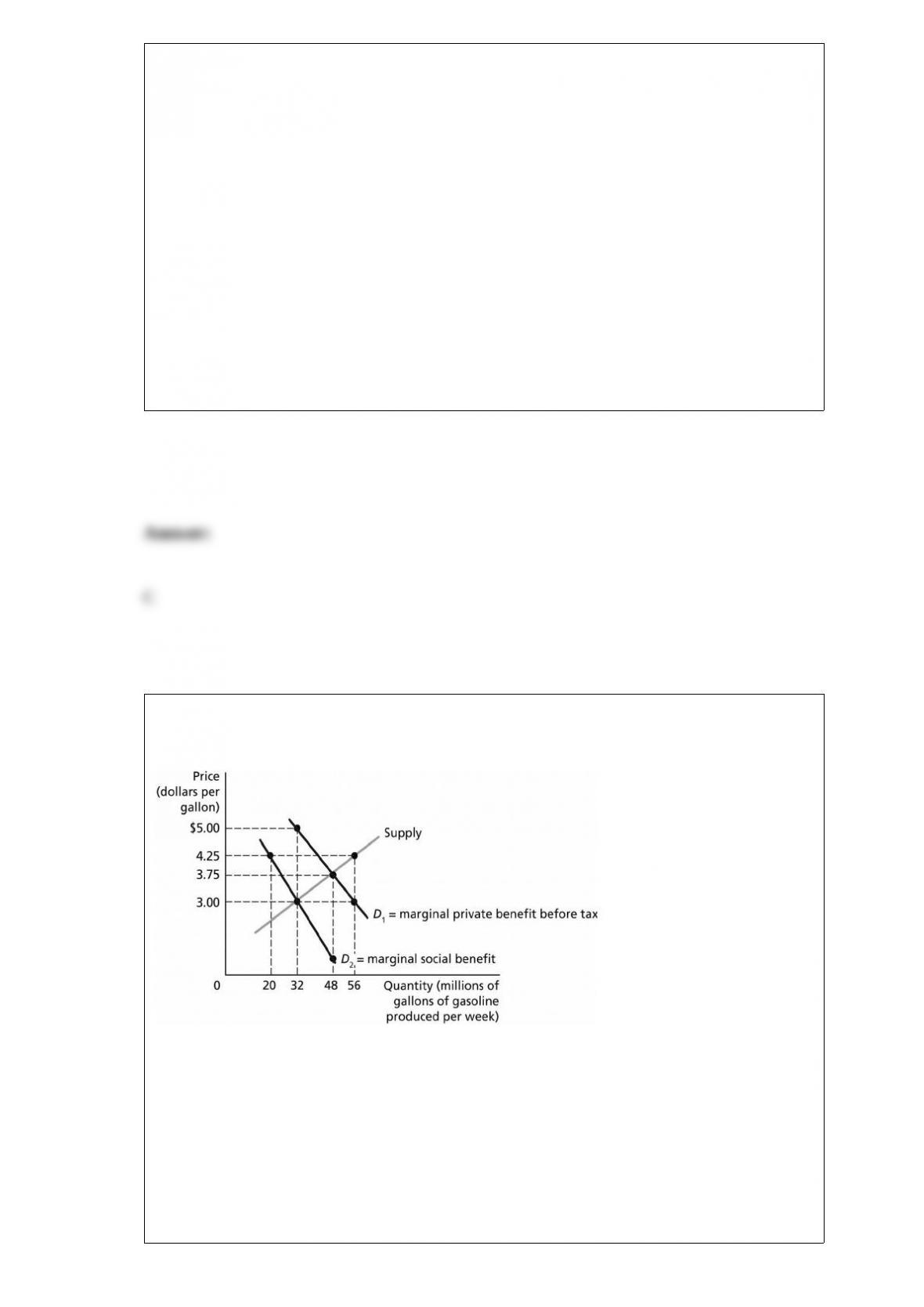
Figure 5-13
Figure 5-13 illustrates the market for gasoline before and after the government imposes
a tax to bring about the efficient level of gasoline production.
Refer to Figure 5-13. The amount of the gasoline tax is ________ per gallon.
A) $0.75
B) $1.25

C) $1.75
D) $2.00
In the long run, if the demand curve of a monopolistically competitive firm is tangent to
its average total cost curve then
A) the firm would break even.
B) the firm would shut down temporarily.
C) the firm would earn enough revenue to cover its variable costs, but not its fixed
costs.
D) the firm would earn an economic profit.
Congress passed the ________ in 1996, the purpose of which was to phase out price
floors and return to a free market in agriculture
A) Rice and Beans Act
B) Smoot-Hawley Act
C) Agribusiness Act
D) Freedom to Farm Act
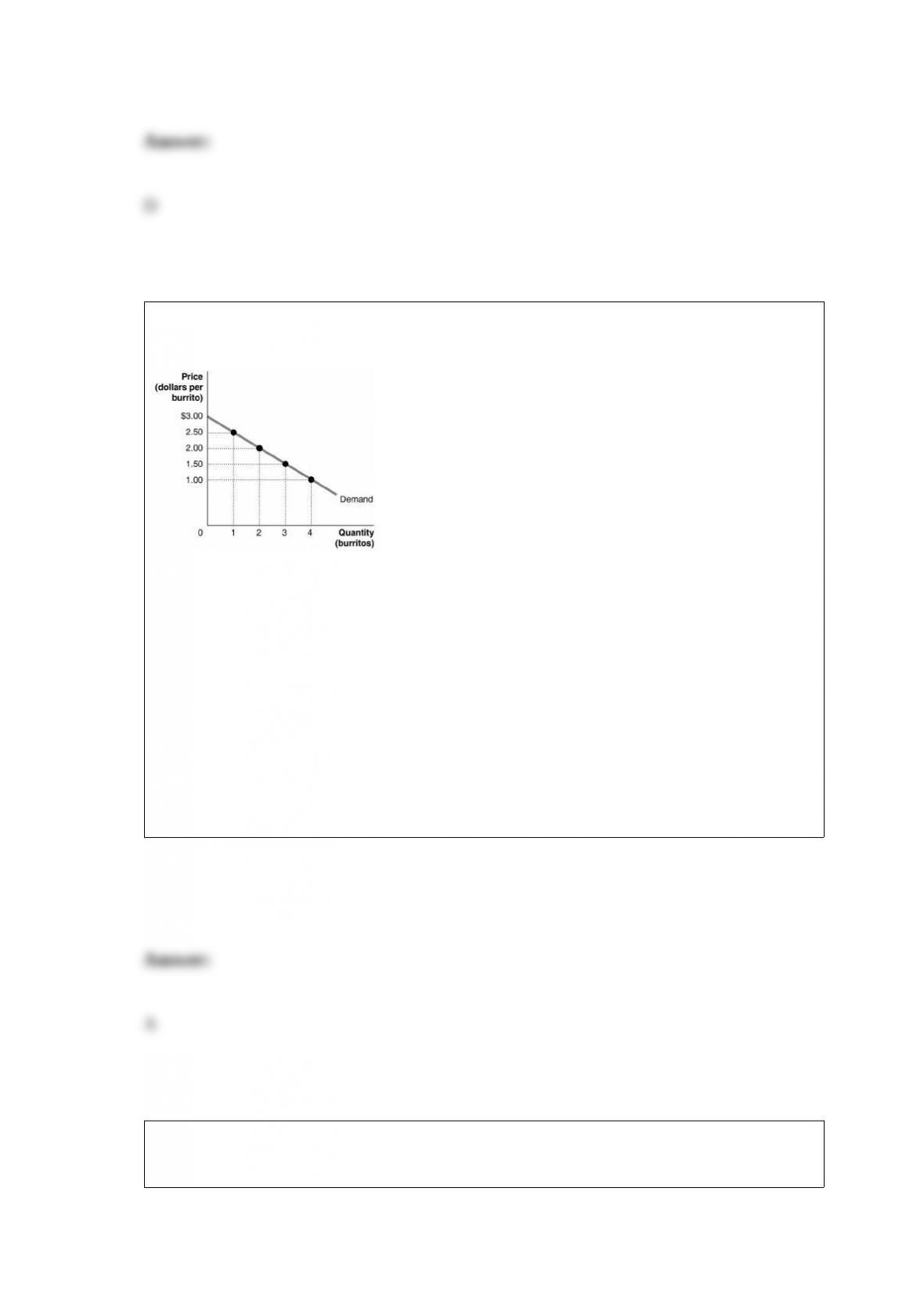
Figure 4-1
Figure 4-1 shows Arnold’s demand curve for burritos.
Refer to Figure 4-1. If the market price is $1.00, what is the consumer surplus on the
fourth burrito?
A) $0
B) $0.50
C) $1.50
D) $2.25
Figure 2-5
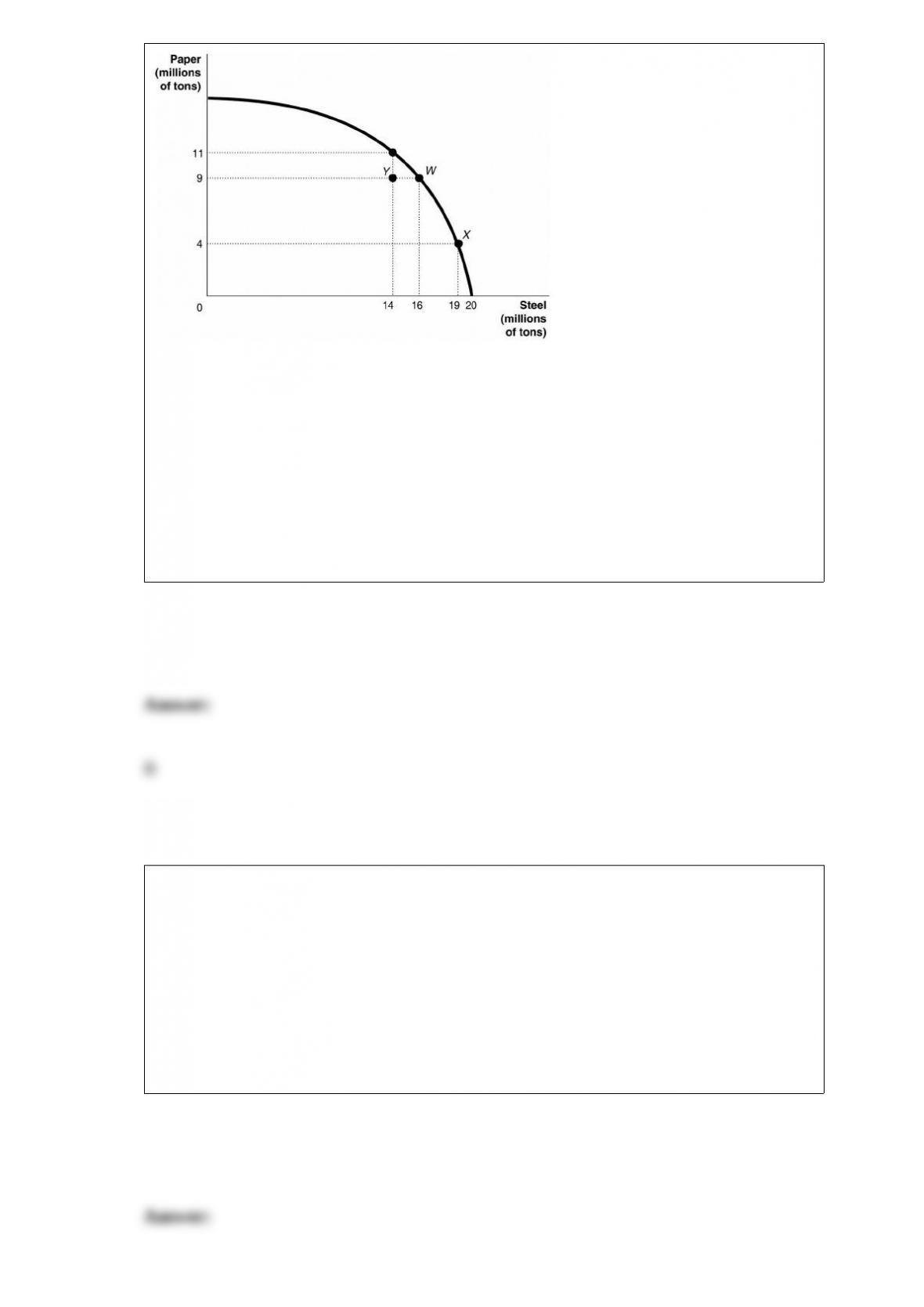
Refer to Figure 2-5. If the economy is currently producing at point Y, what is the
opportunity cost of moving to point W?
A) 2 million tons of steel
B) zero
C) 9 million tons of paper
D) 16 million tons of paper
A linear downward sloping demand curve has price elasticities (in absolute values) that
A) increase as price decreases.
B) remain constant along the demand curve.
C) decrease as price decreases.
D) are greater than or equal to 1.

The price elasticity of an upward-sloping supply curve is always
A) positive.
B) negative.
C) greater than one.
D) impossible to determine.
Which of the following statements is true?
A) In general, if a product has few substitutes it will have an elastic demand.
B) The more time that passes the more inelastic the demand for a product becomes.
C) The demand curve for a necessity is more elastic than the demand curve for a luxury.
D) The more narrowly we define a market, the more elastic the demand for a product
will be.
According to two economists, George Ackerlof and William Dickens, how can

cognitive dissonance affect workers’ perceptions of their jobs?
A) Cognitive dissonance makes workers believe that measures to improve their health
and safety in the workplace are ineffective.
B) Cognitive dissonance causes workers to perceive they are victims of discrimination
when, in fact, they are not.
C) Cognitive dissonance might cause workers to underestimate the true risks of their
jobs.
D) Cognitive dissonance causes a worker to believe his marginal revenue product is
greater than it really is.
________ are all goods and services sold abroad and sent out of a country.
A) Net national products
B) Exports
C) Gross domestic products
D) Imports
With perfect price discrimination, the marginal revenue curve
A) is below the demand curve.

B) is above the demand curve.
C) is equal to the demand curve.
D) is horizontal.
Cost-plus pricing would be consistent with selecting the profit-maximizing price when
A) it results in a price that causes quantity sold to be where marginal revenue equals
marginal cost.
B) a firm has no difficulty estimating its demand curve.
C) consumers value the product beyond its marginal cost.
D) the demand for the firm’s product is unit-elastic.
Figure 5-16
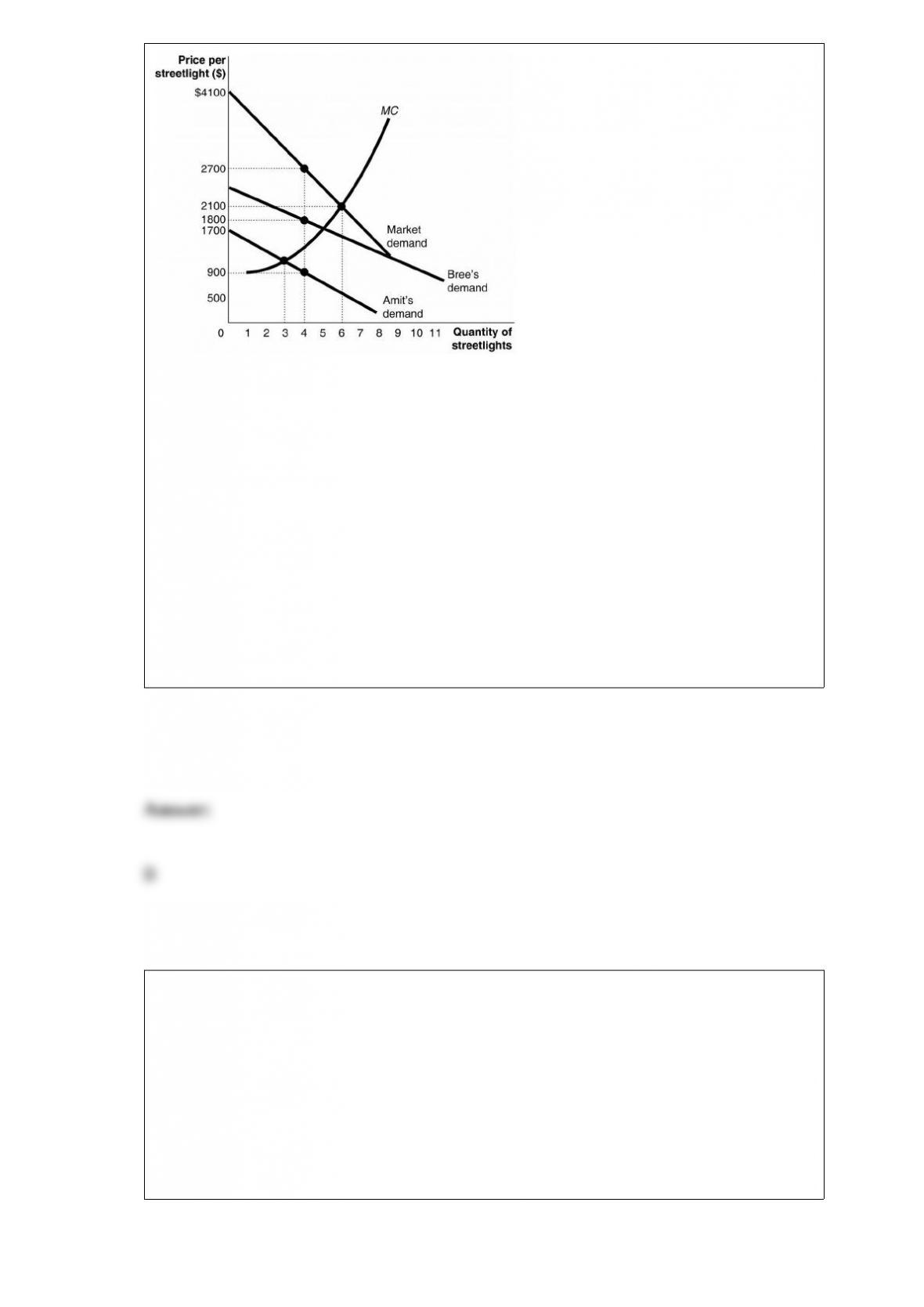
Amit and Bree are the only two homeowners on an isolated private road. Both agree
that installing street lights along the road would be beneficial and want to do so. Figure
5-16 shows their willingness to pay for different quantities of street lights, the market
demand for street lights and the marginal cost of installing the street lights.
Refer to Figure 5-16. How much is Bree willing to pay to have 4 street lights installed?
A) $1,500
B) $1,800
C) $2,700
D) $7,200
Firms price discriminate
A) to reduce the quantity sold so as to reduce production costs.
B) to increase profits.
C) to take advantage of customers.
D) to increase total economic surplus.

What do economists call the situation where a hired manager does not have the same
interests as the owners of the business?
A) conquest and control
B) a financial problem
C) a principal-agent problem
D) a financial intermediary problem
A regressive tax is a tax for which people with lower incomes
A) pay a lower percentage of their incomes in tax than do people with higher incomes.
B) pay a higher percentage of their incomes in tax than do people with higher incomes.
C) pay the same percentage of their incomes in tax as do people with higher incomes.
D) do not have to pay unless their incomes exceeds a certain amount.

Assume that China has a comparative advantage in producing corn and exports corn to
Japan. We can conclude that
A) China also has an absolute advantage in producing corn relative to Japan.
B) China has a lower opportunity cost of producing corn relative to Japan.
C) Japan has an absolute disadvantage in producing corn relative to China.
D) Labor costs are higher for corn producers in Japan than in China.
If there is a market outcome in which the marginal benefit to consumers of the last unit
produced is equal to its marginal cost of production and consumer surplus plus producer
surplus is maximized, then
A) maximum deadweight loss occurs.
B) economic efficiency is achieved.
C) profits are maximized.
D) costs are minimized.
If firms in a monopolistically competitive industry are making profits in the short run
A) barriers to entry will be erected to keep out rivals.

B) some firms will ultimately exit the industry.
C) they will resort to advertising wars to help sustain these profits.
D) new firms will enter the market.
Although advertising raises the price of a monopolistic competitor’s product, it does
confer a benefit to consumers. Which of the following is a benefit to consumers?
A) Advertising acts as a barrier to entry.
B) Advertising engenders brand loyalty.
C) Advertising could provide consumers with useful information about new products
and enable them to comparison shop.
D) Advertised products tend to be of higher quality so consumers feel special when they
consume advertised products.
Table 1-3
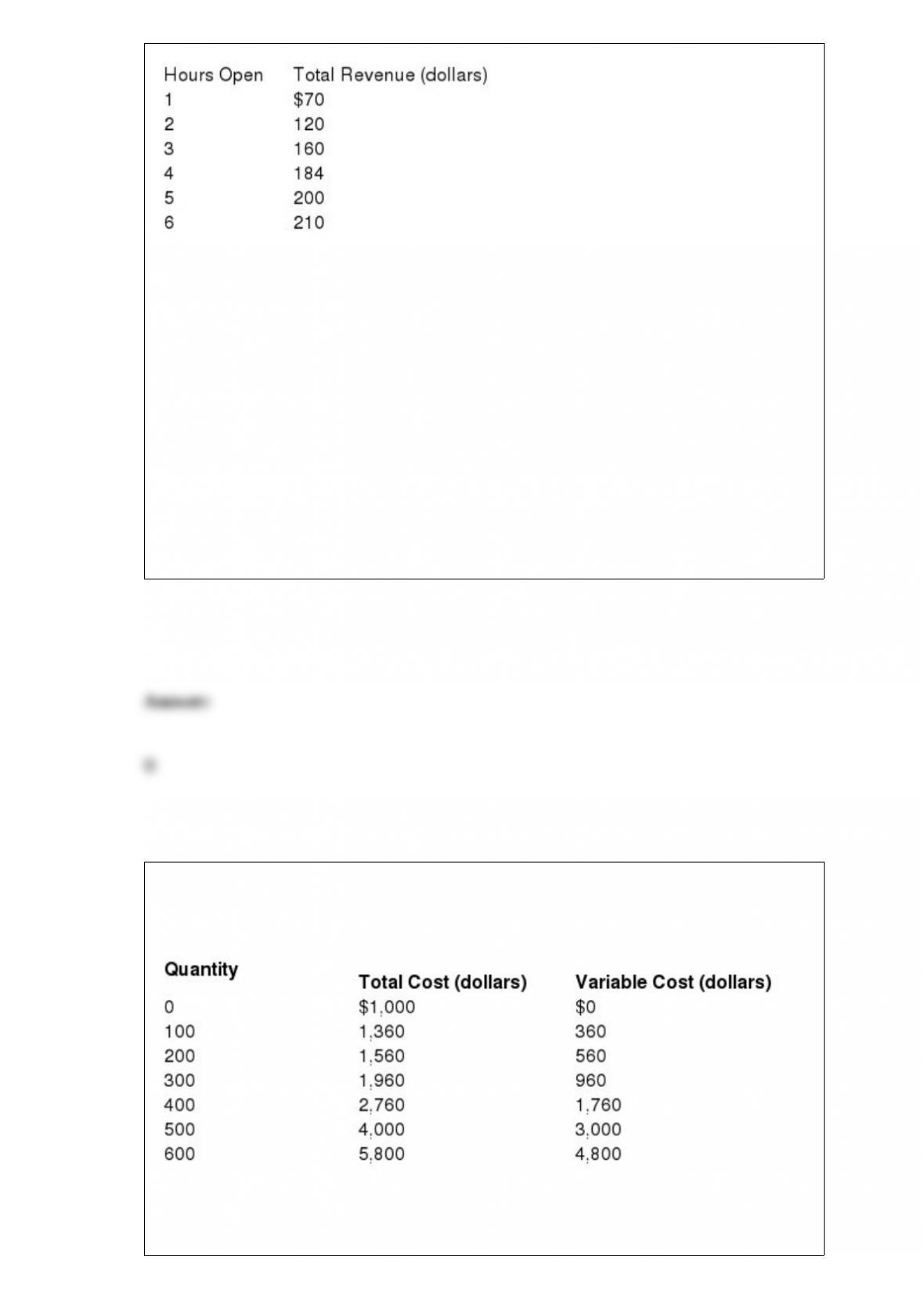
Santiago runs a comic book store in the town of East Arbor. He is debating whether he
should extend his hours of operation. Santiago figures that his sales revenue will
depend on the number of hours the store is open as shown in the table above. He would
have to hire a worker for those hours at a wage rate of $18 per hour.
Refer to Table 1-3. What is Santiago’s marginal benefit if he decides to stay open for
two hours instead of one hour?
A) $40
B) $50
C) $120
D) $190
Table 12-1
Table 12-1 shows the short-run cost data of a perfectly competitive firm that produces
plastic camera cases. Assume that output can only be increased in batches of 100 units.

Refer to Table 12-1. What is the fixed cost of production?
A) $0
B) $500
C) $1,000
D) It cannot be determined.
Which of the following is an example of a compensating wage differential?
A) Nurse anesthetists are paid less than anesthesiologists (who have medical degrees).
B) Workers in a dynamite mine receive higher wages than if they worked in other jobs
that require the same level of skills.
C) In the market for lawyers, top graduates from the top programs earn starting salaries
that are significantly higher than the starting salaries earned by lower-ranked graduates
from the lower-ranked programs.
D) Popular movie stars like George Clooney command much higher salaries than other
talented but lesser-known actors.
Figure 3-7
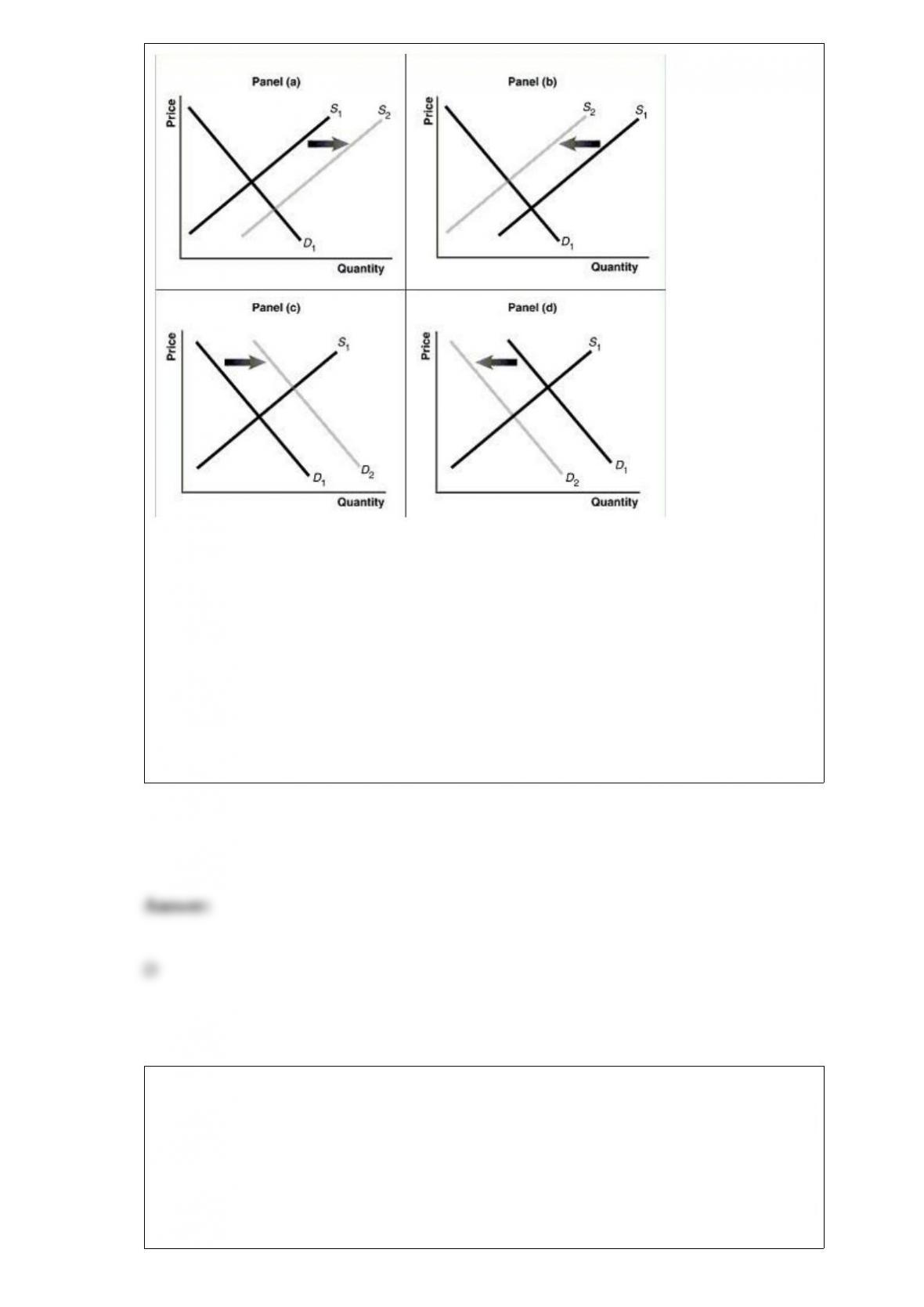
Refer to Figure 3-7. Assume that the graphs in this figure represent the demand and
supply curves for Fruitopia, a soft drink. Which panel describes what happens in the
market for Fruitopia when the price of Snapple, a substitute product, decreases?
A) Panel (a)
B) Panel (b)
C) Panel (c)
D) Panel (d)
Jewelry manufacturers produce a range of products such as rings, necklaces, bracelets,
and brooches. What fundamental economic question are they addressing by offering
this range of items?
A) How to produce goods that consumers want?
B) Why produce a variety of items?

C) What to produce?
D) Who to produce the items for?
Suppose favorable weather resulted in a bumper crop of oranges in Florida. In the
market for oranges
A) the supply curve shifted to the right resulting in a decrease in the equilibrium price.
B) the supply curve shifted to the right resulting in an increase in the equilibrium price.
C) the demand curve shifted to the left resulting in a decrease in the equilibrium price.
D) the demand curve shifted to the right resulting in an increase in the equilibrium
price.
The absolute value of the slope of the budget constraint is equal to
A) the marginal rate of substitution between the two goods in question.
B) the price of good on the vertical axis divided by the price of the good on the
horizontal axis.
C) the price of good on the horizontal axis divided by the price of the good on the
vertical axis.
D) quantity of the good on the vertical axis divided by the quantity of the good on the
horizontal axis.
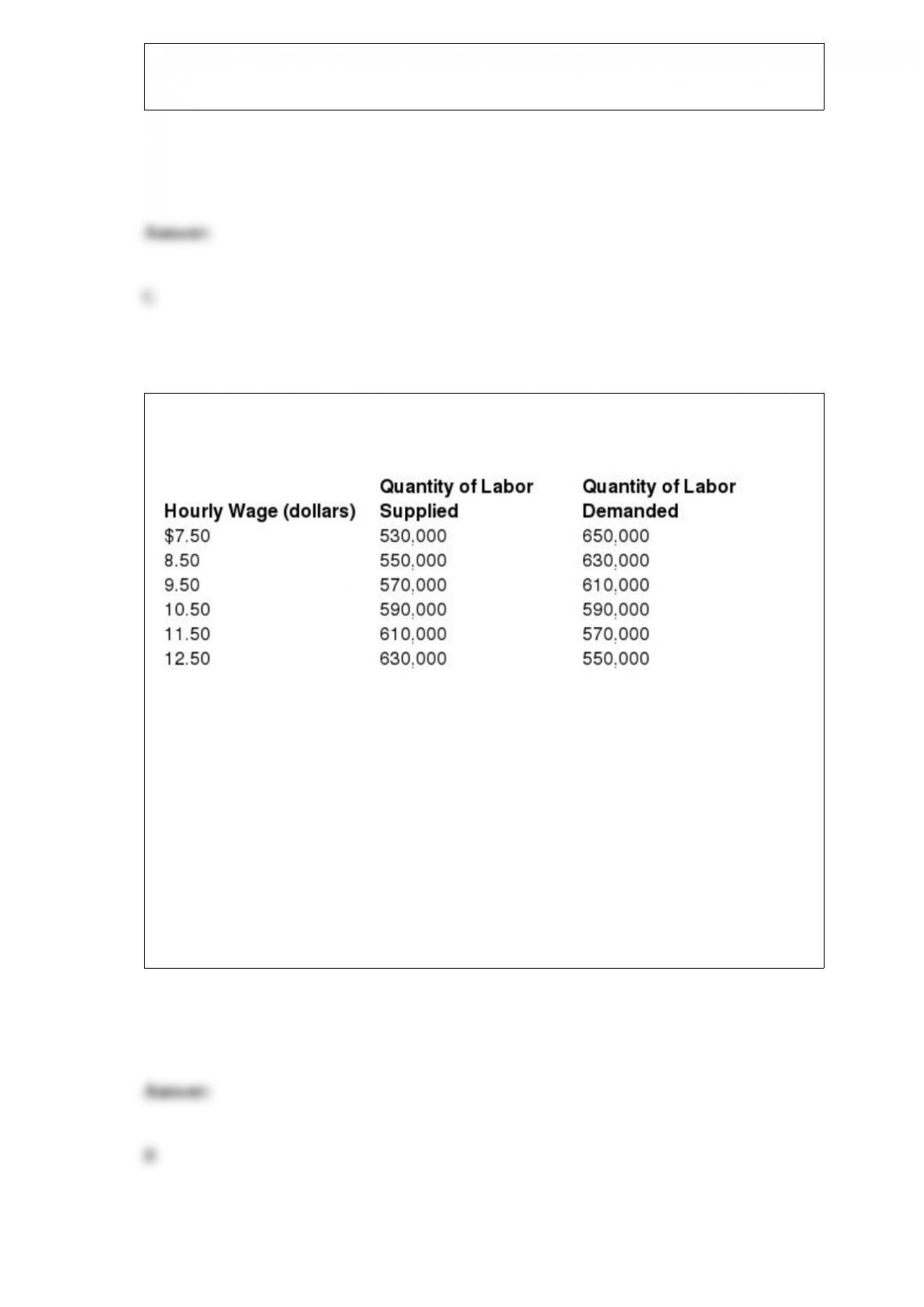
Table 4-4
Table 4-4 shows the demand and supply schedules for labor market in the city of Pixley.
Refer to Table 4-4. If a minimum wage of $12.50 an hour is mandated, what is the
quantity of labor demanded?
A) 80,000
B) 550,000
C) 630,000
D) 1,180,000
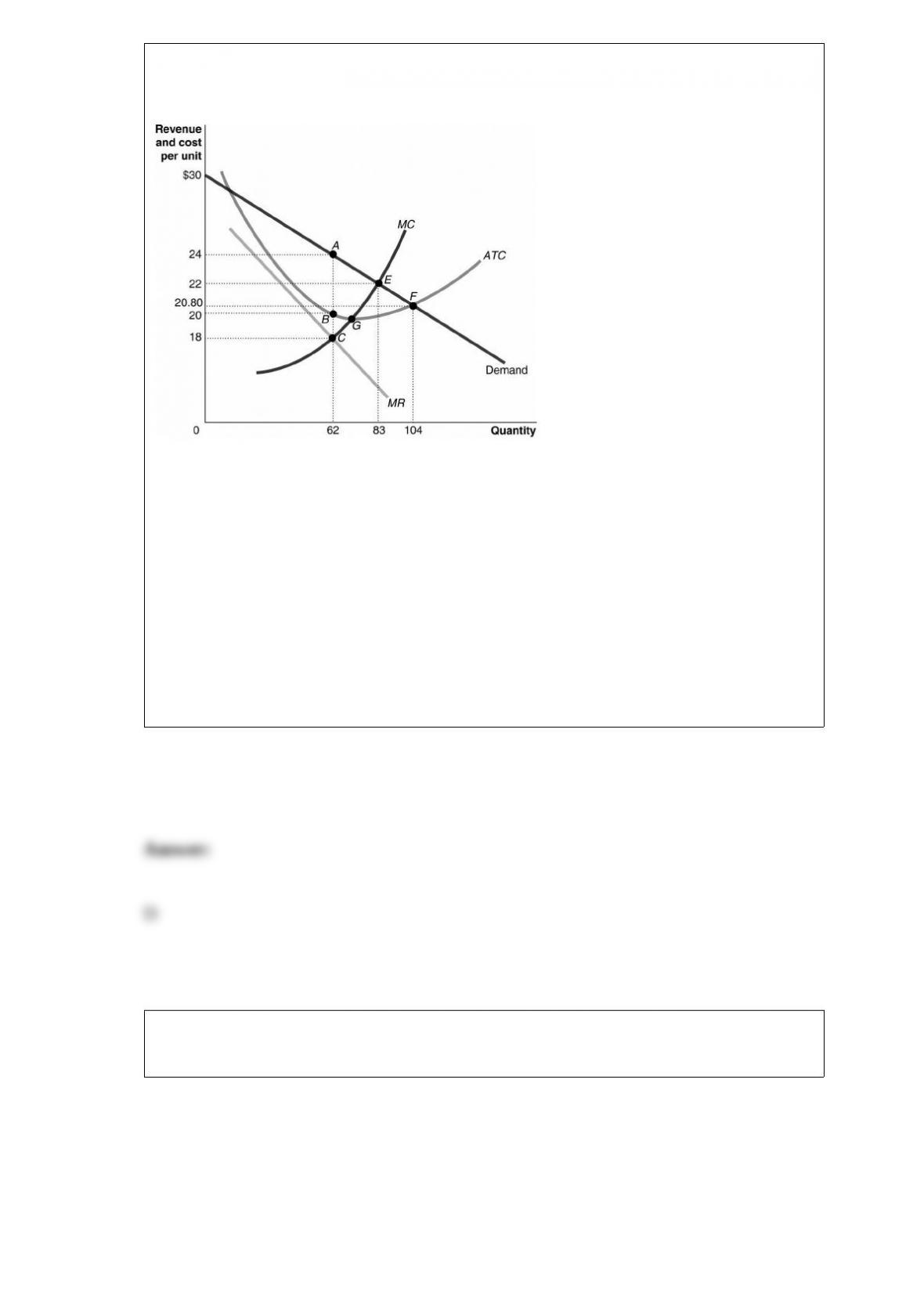
Figure 15-12
Figure 15-12 shows the cost and demand curves for a monopolist.
Refer to Figure 15-12. What is the amount of consumer surplus if, instead of
monopoly, the industry was organized as a perfectly competitive industry?
A) $21
B) $124
C) $186
D) $332
Figure 3-8
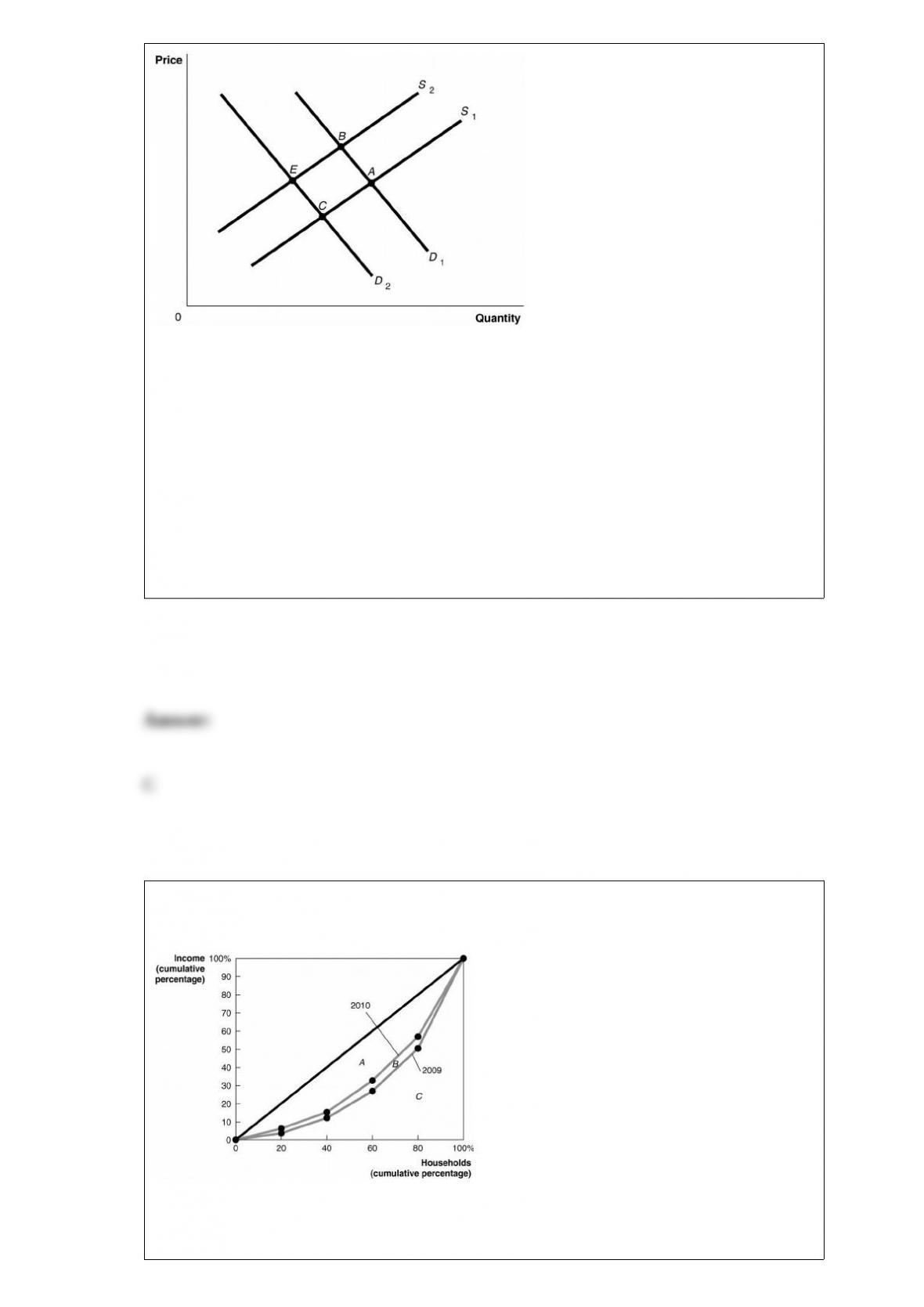
Refer to Figure 3-8. The graph in this figure illustrates an initial competitive
equilibrium in the market for apples at the intersection of D1 and S1 (point A). If there is
a shortage of apples how will the equilibrium point change?
A) The equilibrium point will move from A to B.
B) The equilibrium point will move from A to C.
C) There will be no change in the equilibrium point.
D) The equilibrium point will move from A to E.
Figure 18-9
Refer to Figure 18-9 to answer the following questions.
a. Did the distribution of income become more equal in 2010 that it was in 2009, or did
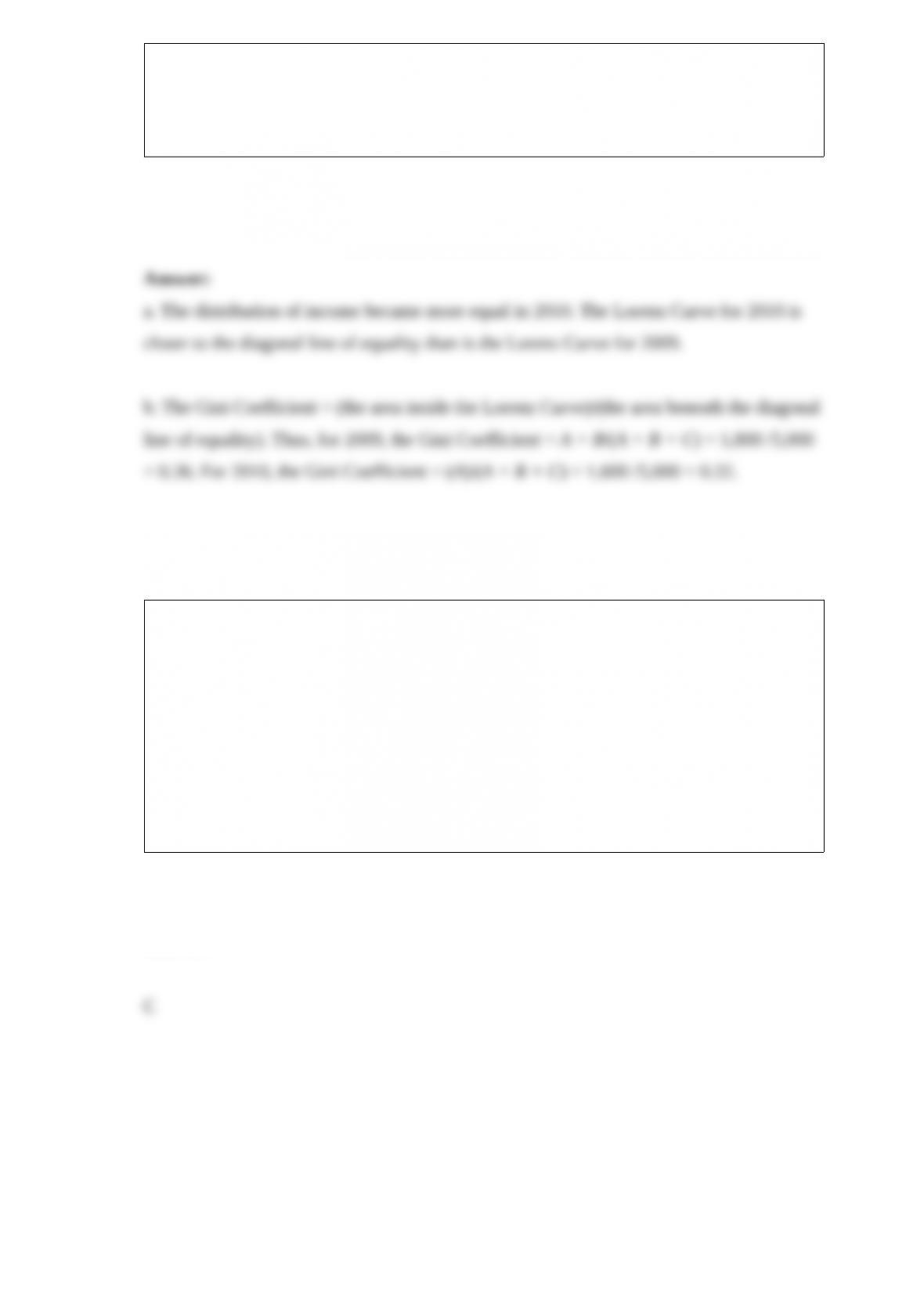
it become less equal? Explain.
b. If area A = 1,600, area B = 200, and area C = 3,200, calculate the Gini coefficient for
2009 and the Gini coefficient for 2010.
If a firm charges different consumers different prices for the same product and the
difference cannot be attributed to cost variations, then it is engaging in
A) odd pricing.
B) cost-plus pricing.
C) price discrimination.
D) markup pricing.