The first important law regulating monopolies in the United States was
A) the Grant Act, which was passed in 1890.
B) the Clayton Act, which was passed in 1890.
C) the Sherman Act, which was passed in 1890.
D) the Federal Trade Commission Act, which was passed in 1914.
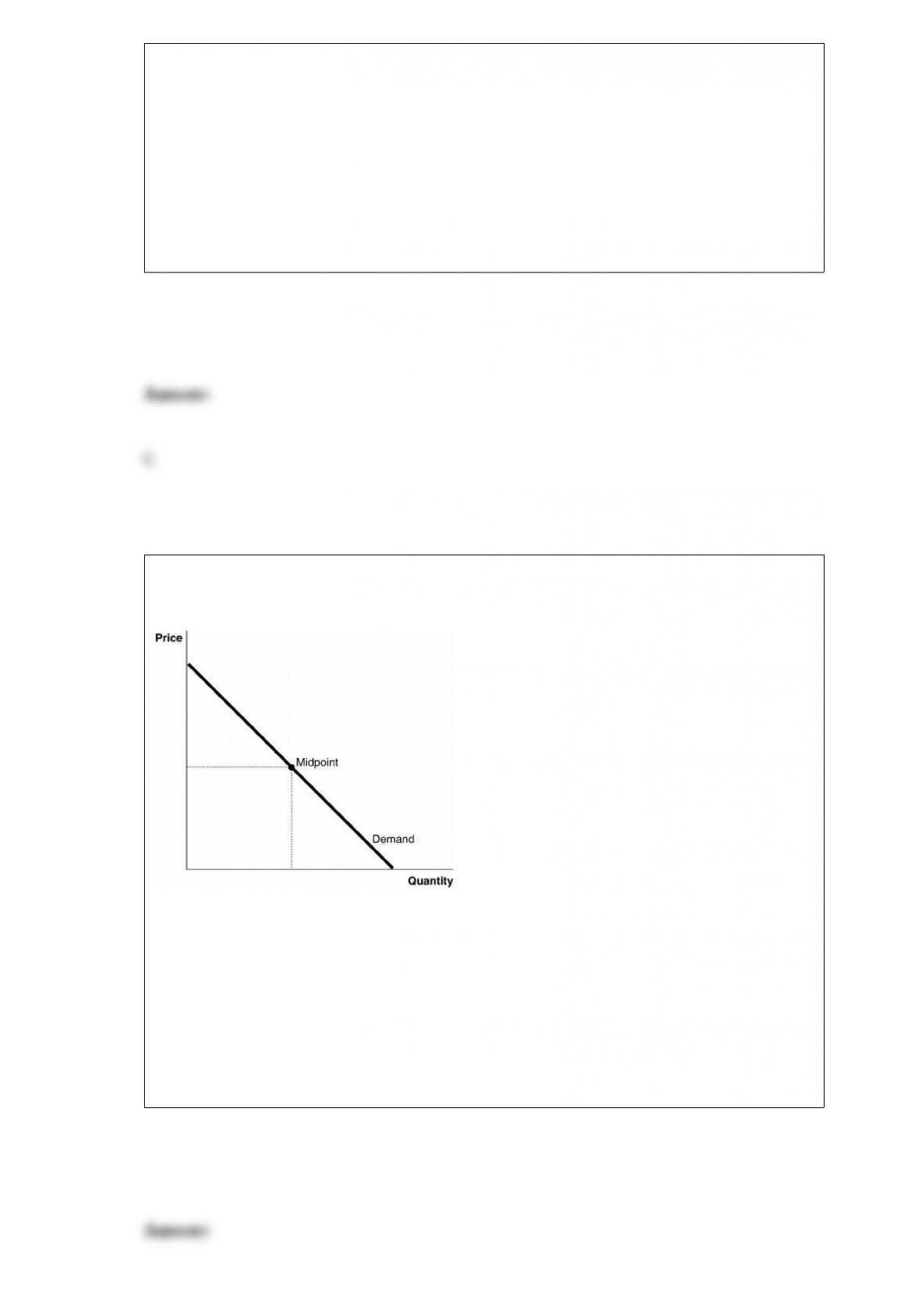
Figure 6-4
Refer to Figure 6-4. At the midpoint of the demand curve, in absolute value
A) the price elasticity coefficient is at a maximum.
B) the price elasticity coefficient is at a minimum.
C) the price elasticity coefficient is zero.
D) the price elasticity coefficient is one.

Marsha Murphy complained, “Many jobs that are filled mostly by men offer higher
wages than most jobs that are typically filled by women. In many cases, the jobs men
have require the same education and skills as the jobs women have. This is clearly
unfair. Women should be paid the same wages as men are paid for jobs that are
equivalent in terms of their qualifications.” Which of the following statements describes
Marsha’s position?
A) Marsha believes that women’s wages should include a compensating differential.
B) Marsha believes employers assume that men and women have different job
preferences.
C) Marsha believes that employers are reluctant to hire women for certain jobs because
of cognitive dissonance.
D) Marsha endorses a concept called comparable worth.
Which of the following is held constant along an indifference curve?
A) the prices of the goods in question
B) the marginal rate of substitution between the two goods in question
C) the marginal utility derived from consuming any bundle of goods on the indifference
curve
D) the total utility derived from consuming any bundle of goods on the indifference
curve
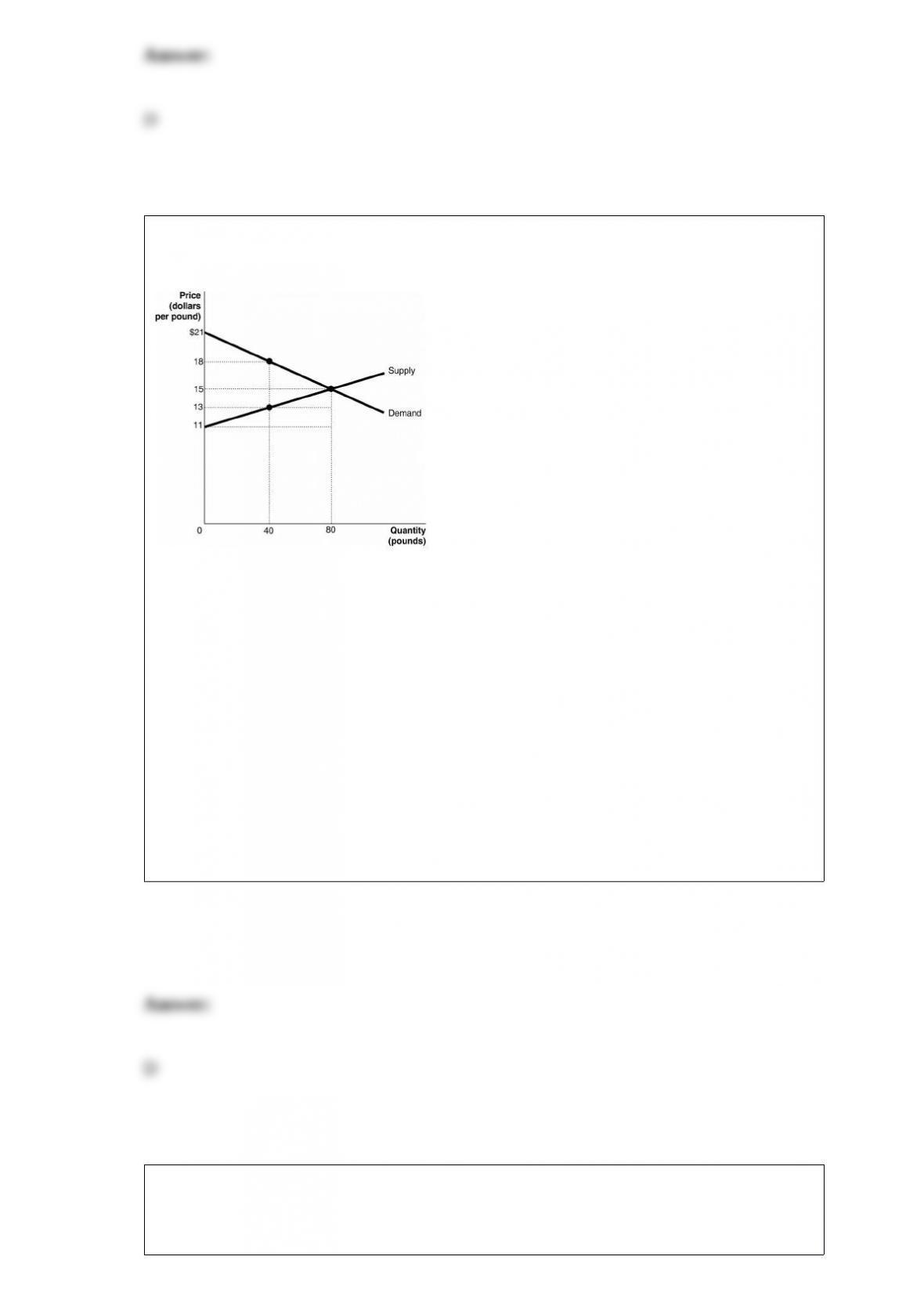
Figure 4-3
Figure 4-3 shows the market for tiger shrimp. The market is initially in equilibrium at a
price of $15 and a quantity of 80. Now suppose producers decide to cut output to 40in
order to raise the price to $18.
Refer to Figure 4-3. What is the value of consumer surplus at the equilibrium price of
$15?
A) $60
B) $120
C) $180
D) $240
Which of the following statements is true?
A) As the wage rate rises, the substitution effect decreases the opportunity cost of
leisure and causes a worker to devote more time to working and less time to leisure.
B) As the wage rate rises, the substitution effect increases the opportunity cost of leisure
and causes a worker to devote more time to working and less time to leisure.
C) As the wage rate rises, the income effect increases the opportunity cost of leisure and
causes a worker to devote more time to working and less time to leisure.
D) As the wage rate rises, the income effect causes a worker to devote more time to
work and less time to leisure.
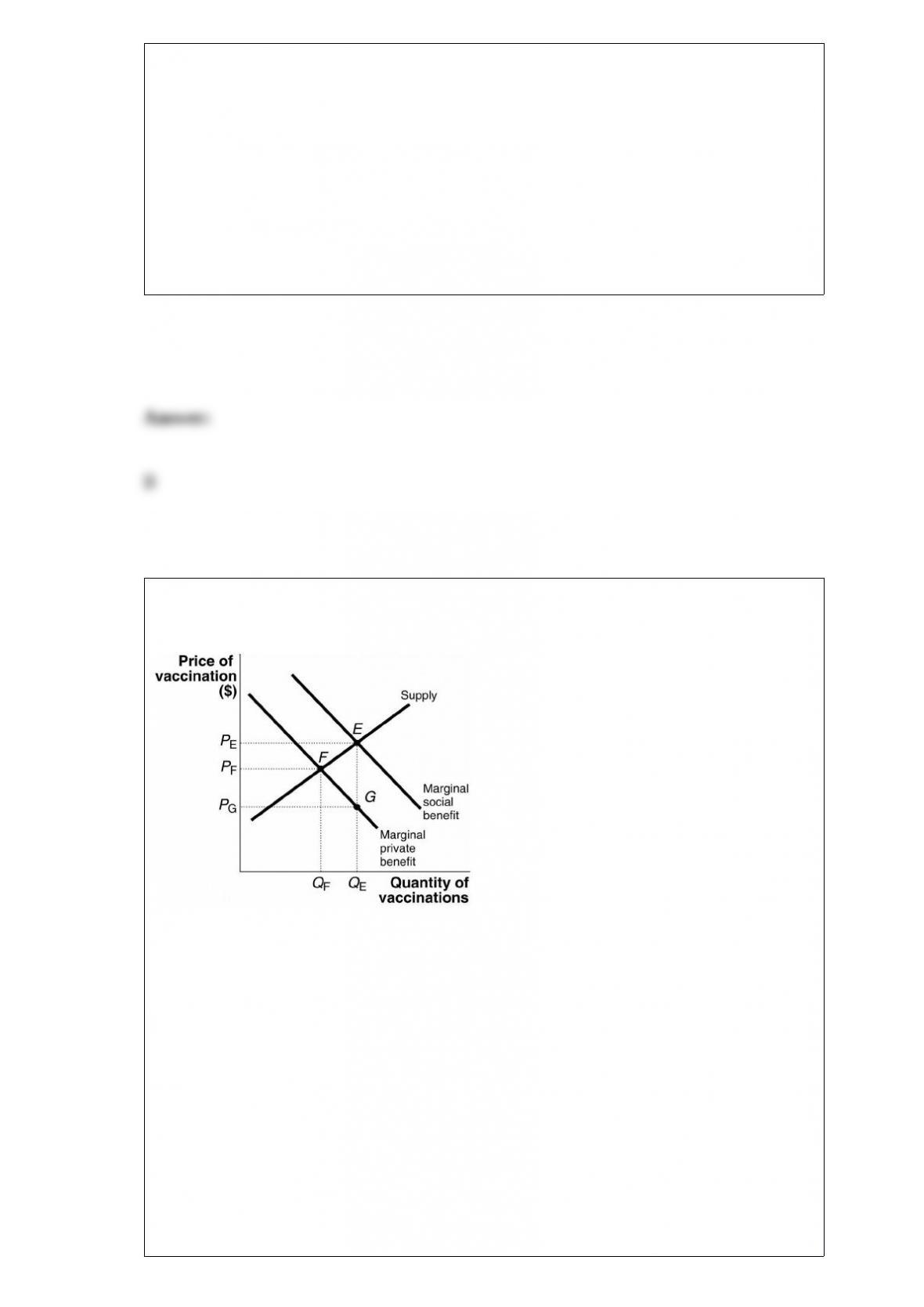
Figure 5-10
Chicken pox vaccinations for toddlers benefit society by protecting young children and
by preventing an epidemic of the disease. Thus, the social benefits of chicken pox
vaccinations exceed the private benefit for any quantity of vaccinations as illustrated in
Figure 5-10.
Refer to Figure 5-10. What is the value of the net gain to society as a result of
subsidizing chicken pox vaccinations?
A) (PEQE)
B) (PFQF)
C) value equal to the area of FEG

D) value equal to the area of QFFGQE
A set of actions that a firm takes to achieve a goal is the definition of a
A) business plan.
B) business strategy.
C) business prospectus.
D) business goal.
In 1935, the U.S. Patent and Trademark Office issued Parker Brothers a trademark on
the
use of the name Monopoly for a board game. Hasbro bought Parker Brothers in 1991.
Which of the following statements is true regarding the trademark on the name
Monopoly for a board game?
A) The original trademark expired well before Hasbro bought Parker Brothers, so they
never had a trademark on Monopoly.
B) Trademarks never expire, so Hasbro continues to have a trademark on the name
Monopoly.
C) The trademark expired in 2011, 20 years after Hasbro’s purchase of Parker Brothers.
D) The trademark expired in 1955, 20 years after the trademark was issued to Parker
Brothers.
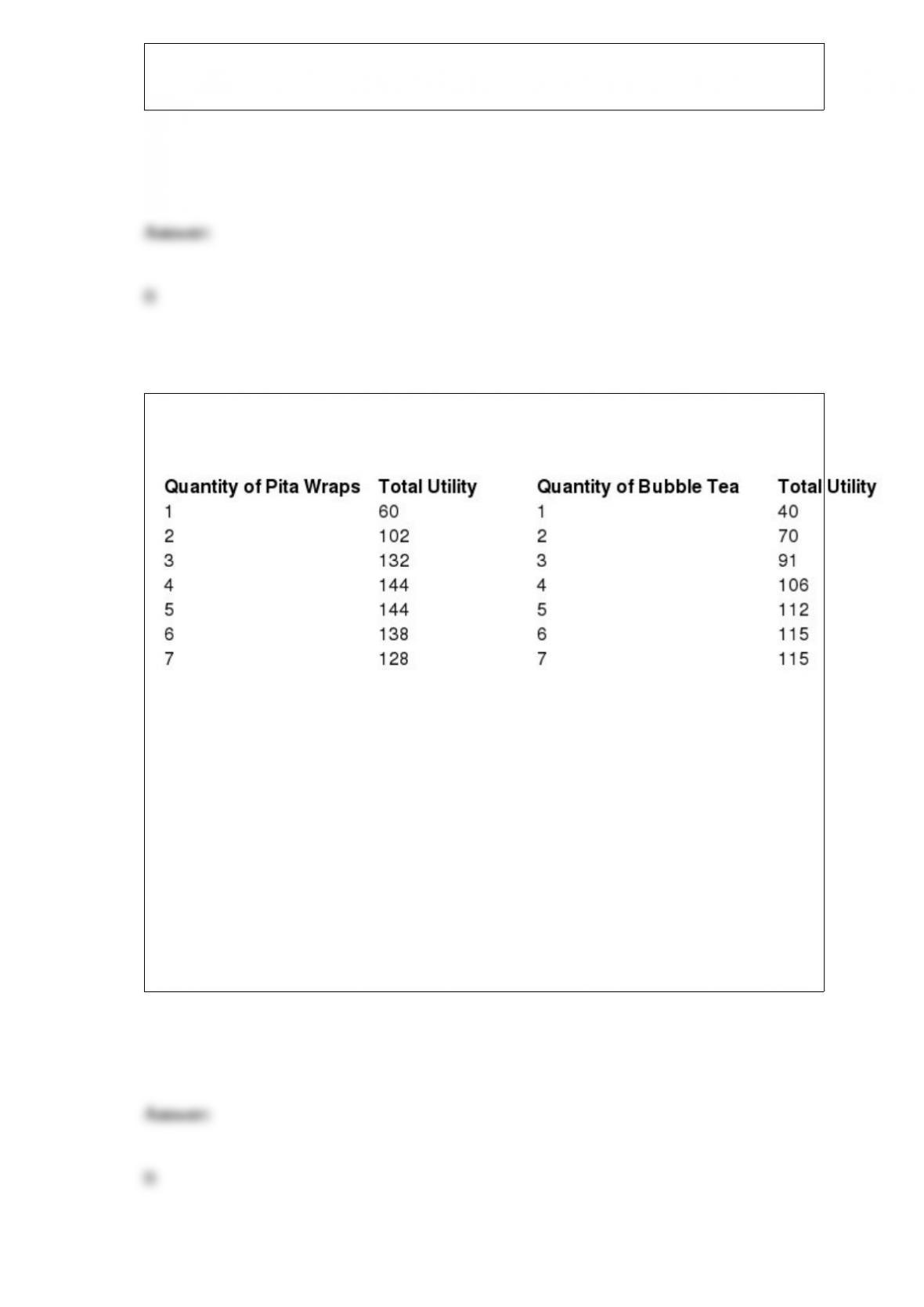
Table 10-1
Keegan has $30 to spend on Pita Wraps and Bubble Tea. The price of a Pita Wrap is $6
and the price of a glass of Bubble Tea is $3. Table 10-1 shows his total utility from
different quantities of the two items.
Refer to Table 10-1. What is Keegan’s optimal consumption bundle?
A) 3 pita wraps and 3 bubble teas
B) 3 pita wraps and 4 bubble teas
C) 4 pita wraps and 2 bubble teas
D) 5 pita wraps and 0 bubble teas
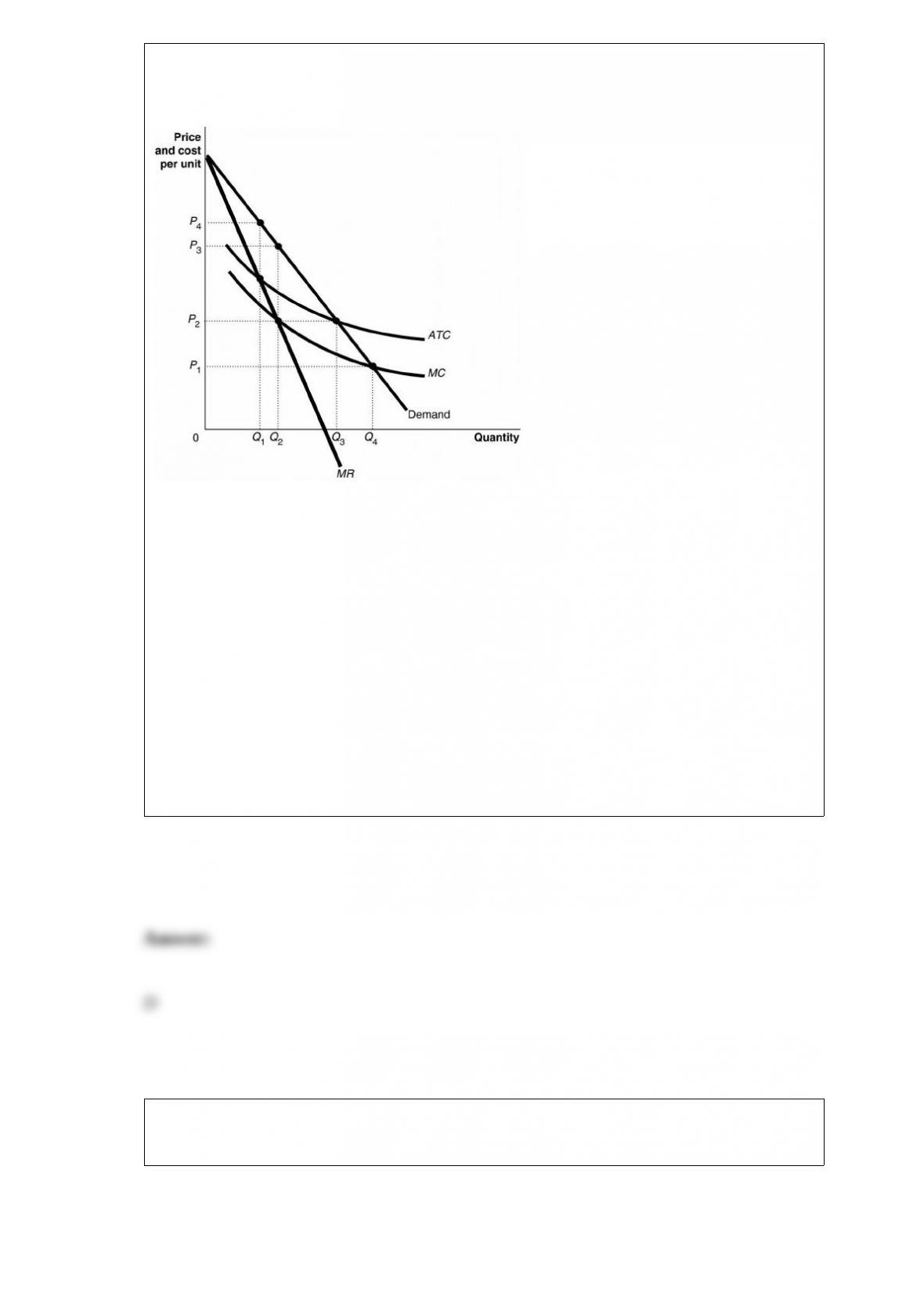
Figure 15-15
Figure 15-15 shows the cost and demand curves for the Erickson Power Company.
Refer to Figure 15-15. Why won’t regulators require that Erickson Power produce the
economically efficient output level?
A) because there is insufficient demand at that output level
B) because at the economically efficient output level, the marginal cost of producing the
last unit sold exceeds the consumers’ marginal value for that last unit
C) because Erickson Power will earn zero profit
D) because Erickson Power will sustain persistent losses and will not continue in
business in the long run
Table 1-3
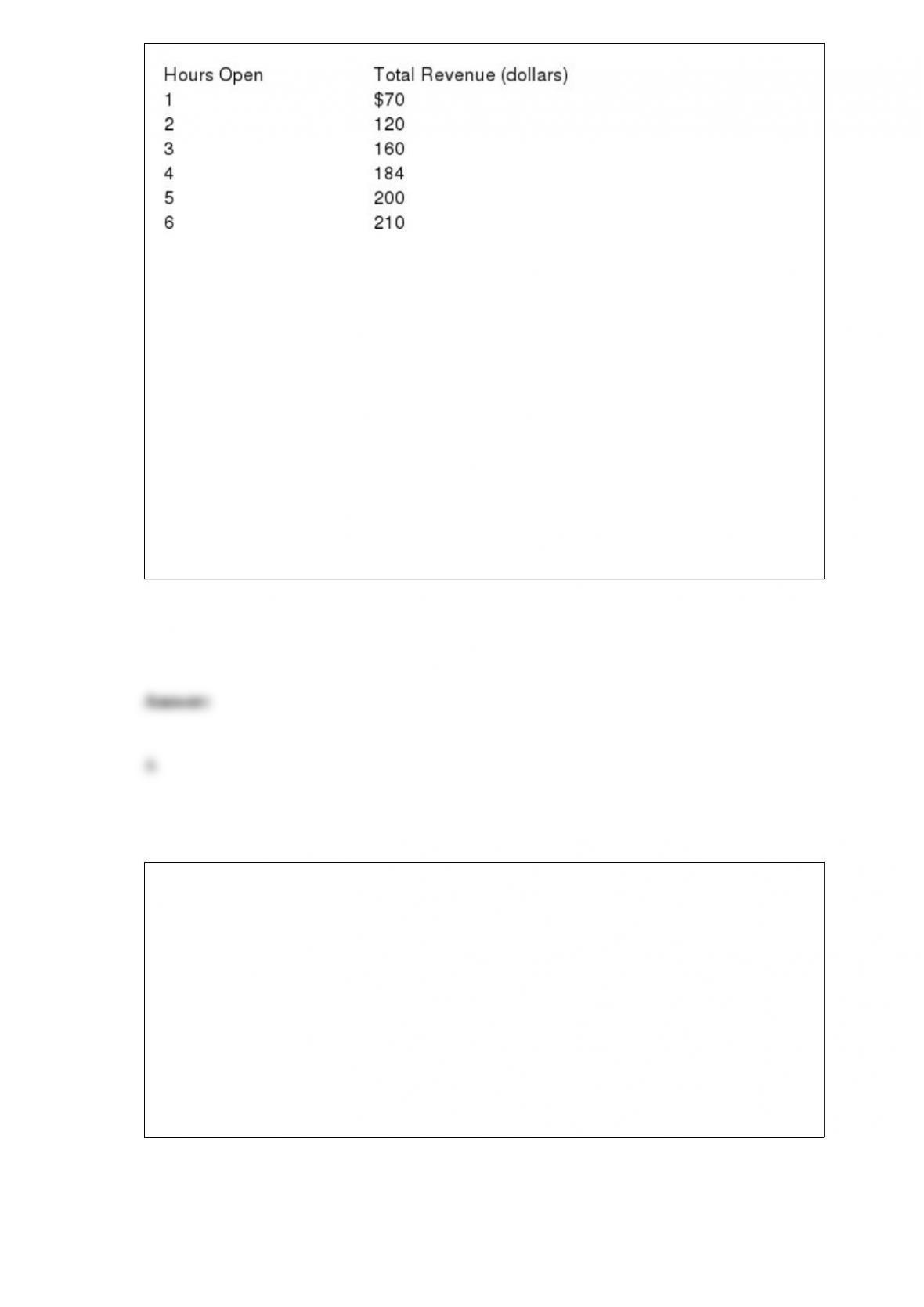
Santiago runs a comic book store in the town of East Arbor. He is debating whether he
should extend his hours of operation. Santiago figures that his sales revenue will
depend on the number of hours the store is open as shown in the table above. He would
have to hire a worker for those hours at a wage rate of $18 per hour.
Refer to Table 1-3. What is Santiago’s marginal cost if he decides to stay open for two
hours instead of one hour?
A) $18
B) $36
C) $38
D) $102
The demand for labor is different from the demand for final goods and services because
A) the demand for labor is derived from the demand for the good or service the labor is
used to produce.
B) it is a demand for people, not inanimate objects.
C) the demand for labor is more inelastic than the demand for the goods and services
produced with this labor.
D) the law of demand does not apply to the demand for labor.

Demand for a luxury item, such as a yacht, is likely to be
A) both income and price inelastic.
B) both income elastic and price elastic.
C) income elastic and price inelastic.
D) income inelastic and price elastic.
The idea that because of scarcity, producing more of one good or service means
producing less of another good or service refers to the economic concept of
A) optimization.
B) efficiency.
C) trade-off.
D) equity.

Economics does not study correct or incorrect behaviors but rather it assumes that
economic agents behave ________, meaning they make the best decisions given their
knowledge of the costs and benefits.
A) equitably
B) rationally
C) emotionally
D) selfishly
Who operates and controls a corporation in its day-to-day activities?
A) the board of directors
B) stockholders
C) employees
D) management
Figure 10-7
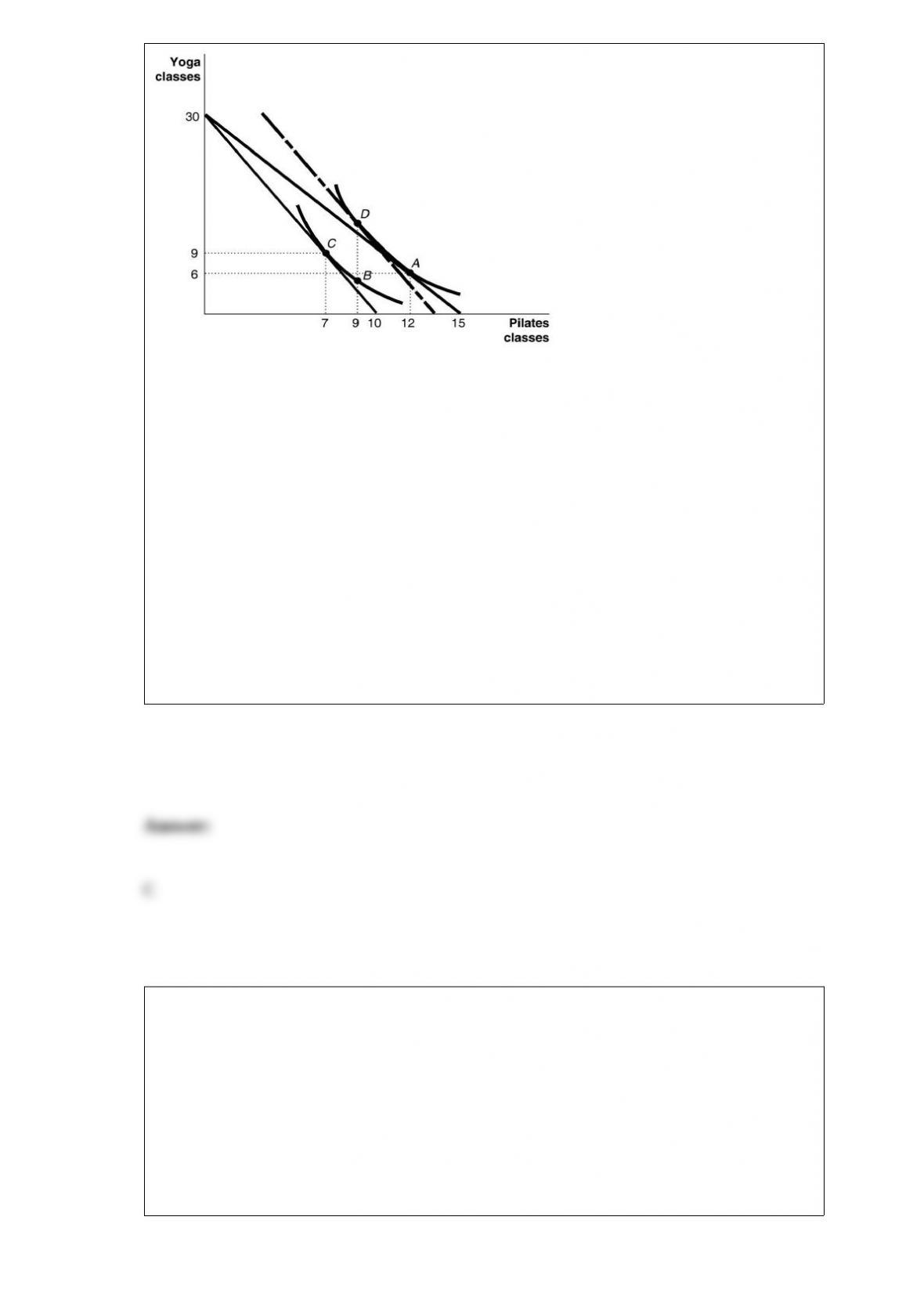
Manuri has $300 to spend on Pilates classes and Yoga classes. The price of a group
Pilates class is $20 and the price of a group Yoga class is $10. Manuri’s optimal bundle
is given by “A” in Figure 10-7.
Refer to Figure 10-7. Suppose the price of Pilates sessions rise to $30 while income
and the price of Yoga sessions remain unchanged. The substitution effect of this price
change is represented by the movement from
A) A to B.
B) A to C.
C) A to D.
D) D to B.
The law of one price states
A) federal and state statutes that prohibit price discrimination.
B) that all customers should pay the same price.
C) that identical products should sell for the same price everywhere.
D) government regulation of prices for all firms.

Which of the following is not a characteristic of monopolistic competition?
A) There are many buyers and sellers.
B) There are low barriers to entry.
C) Average revenue is equal to price.
D) The products sold by all firms are identical.
When every good or service is produced up to the point where the last unit provides
________, allocative efficiency occurs.
A) a marginal benefit to society equal to the marginal cost of producing it
B) a marginal benefit to society greater than the marginal cost of producing it
C) a marginal benefit to society less than the marginal cost of producing it
D) a marginal benefit to society equal to zero

Which of the following is a positive economic statement?
A) The standard of living in the United States is too low.
B) If the price of beef falls, a larger quantity of it will be bought.
C) The government should implement a national consumption tax.
D) The U.S. government should increase regulations on the banking industry.
In the 1930s, the United States charged an average tariff rate ________. Today, the rate
is ________.
A) of 100 percent; 20 percent
B) above 50 percent; less than 1.5 percent
C) of less than 10 percent; over 40 percent
D) of 17 percent; 33 percent
Figure 3-6
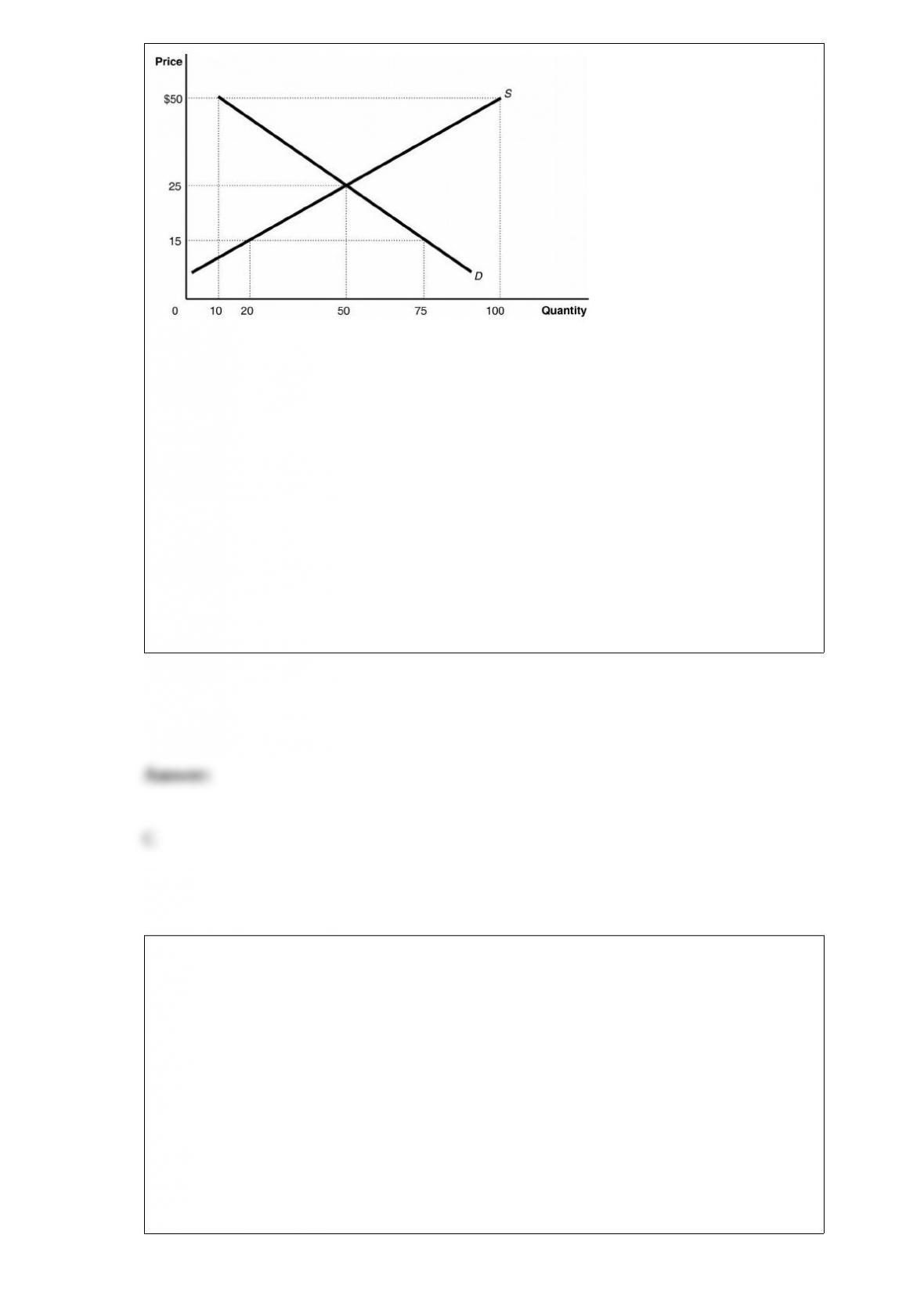
Refer to Figure 3-6. The figure above represents the market for canvas tote bags.
Assume that the price of tote bags is $15. At this price
A) the quantity demanded exceeds the quantity supplied of tote bags by 75. The price
will eventually rise to $25 where quantity demanded will equal quantity supplied.
B) the demand exceeds the supply of tote bags by 55. Some consumers will have an
incentive to offer to buy tote bags at a higher price.
C) there is a shortage, equal to 55 tote bags, that will be eliminated when the price rises
to $25.
D) there is a shortage equal to 55 tote bags; the price of tote bags will rise until demand
is equal to supply.
Suppose that in Canada the government places a $1,500 tax on the buyers of new
snowmobiles. After the purchase of a new snowmobile, a buyer must pay the
government $1,500. How would the imposition of the tax on buyers be illustrated in a
graph?
A) The tax will shift the supply curve to the left by $1,500.
B) The tax will shift the demand curve to the right by $1,500.
C) The tax will shift both the demand and supply curve to the right by $1,500.
D) The tax will shift the demand curve to the left by $1,500.

In the United States from 1981 to 2011, deaths from all of the following declined
substantially except
A) cancer.
B) kidney disease.
C) heart attacks.
D) strokes.
A teenaged babysitter is similar to a firm in a perfectly competitive industry in that, for
both
A) fixed costs are lower than variable costs.
B) there are many other suppliers of similar goods or services.
C) the implicit costs of production exceed the explicit costs of production.
D) average costs of production do not change when their industry expands.

In a market economy, the high salaries of some star baseball players such as Zach
Greinke, are determined by
A) team owners, based on the total number of star athletes they plan to hire.
B) advertising companies, based on what they are willing to pay to advertise their
products at baseball games.
C) the interaction of the demand for star athletes and the supply of star athletes.
D) consumers, based on their willingness to watch baseball games.
The five competitive forces model was developed by
A) Michael Porter.
B) John Nash.
C) Michael Spence.
D) Porter Smith.

If a brewery wants to raise funds to purchase a new fermenting vat, it does so in the
A) factor market.
B) output market.
C) product market.
D) alcoholic beverages market.
All but one of the following economists were awarded a Nobel prize for their
contributions to experimental economics and their explorations of the influence fairness
has on consumer decision-making. Which economist did not receive a Nobel Prize for
this work?
A) Vernon Smith
B) Alan Krueger
C) Daniel Kahneman
D) Maurice Allais
The profit-maximizing level of output and the profit-maximizing price for an
oligopolist cannot be calculated when we don’t know
A) what the concentration ratio for the oligopolist’s industry is.

B) what the minimum efficient scale in the oligopolist’s industry is.
C) the demand curve and the marginal revenue curve of the oligopolist.
D) the type of barrier to entry that exists in the oligopolist’s industry.
Who was the economist who first proposed that governments use taxes and subsidies to
correct for externalities?
A) Ronald Coase
B) A. C. Pigou
C) Adam Smith
D) David Hume
If price discrimination occurs in a market
A) the law of one price does not hold.
B) the firm earns arbitrage profits.
C) consumers whose demand for the product sold is more elastic pay higher prices than
consumers whose demand is less elastic.

D) the marginal cost of production is constant.