
If the paint on your house was eaten away by the fumes from a factory nearby and you
hired a lawyer to sue the polluting firm, your legal fees would be considered
A) external costs.
B) transaction costs.
C) marginal benefits.
D) social costs of the pollution.
Which of the following is not an example of a trade restriction?
A) tariffs
B) quotas and voluntary export restraints
C) legislation requiring that cars sold in a country have a 50 percent domestic content
D) consumer preferences for goods produced domestically
Consider two single-malt whiskey distillers, Laphroaig and Knockando. If they
advertise, they can both sell more whiskey and increase their revenue. However, the
cost of advertising more than offsets the increased revenue so that each distiller ends up
with a lower profit than if they do not advertise. On the other hand, if only one
advertises, that distiller increases its market share and also its profit.
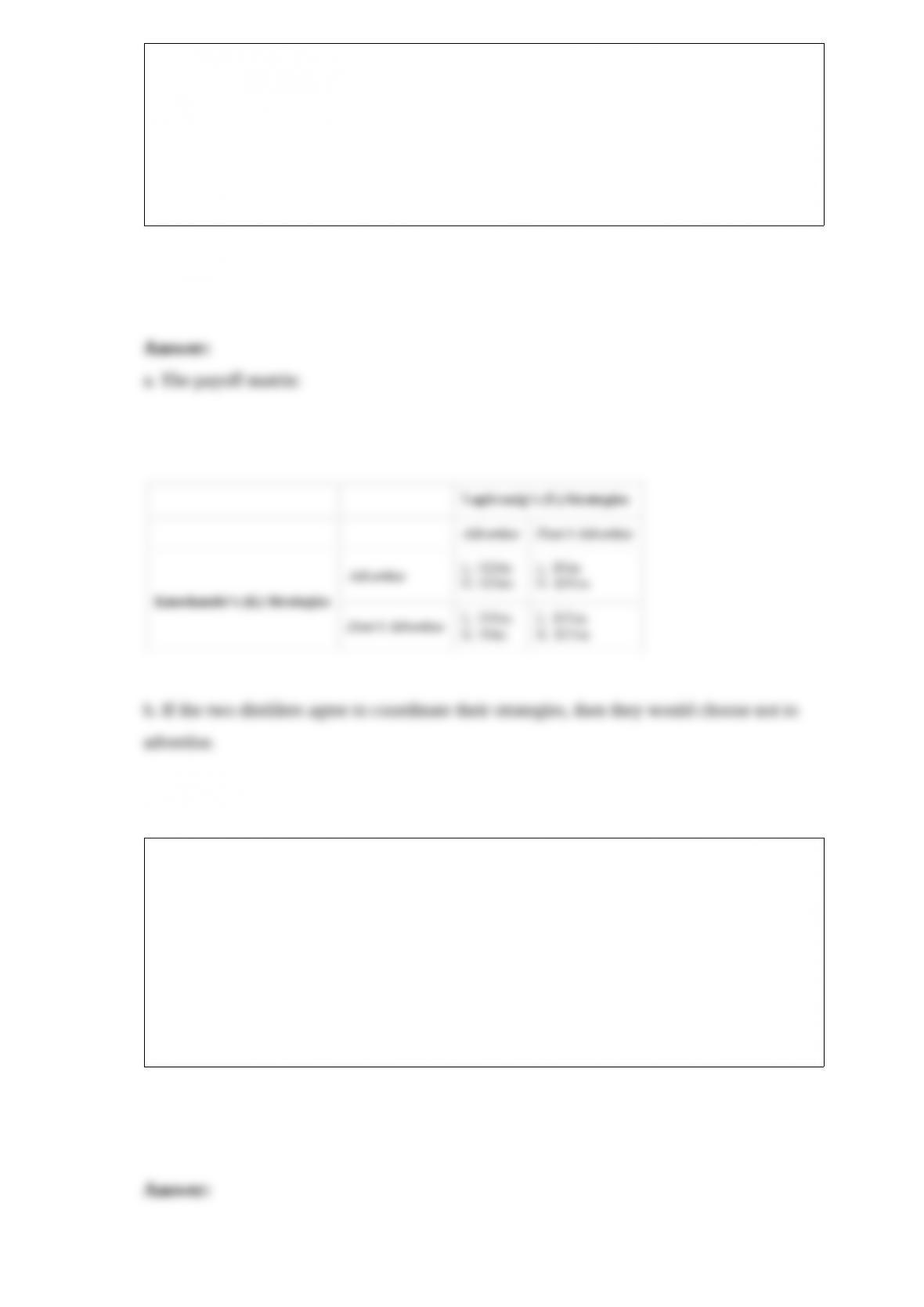
a. Construct a payoff matrix using the following hypothetical information: If neither
distiller advertises: each earns a profit of $35 million per year. If both advertise: each
earns a profit of $20 million per year. If one advertises and the other does not: the
distiller who advertises earns a profit of $50 million and the distiller who does not
advertise earns a profit of $9 million.
b. If the two distillers agree to coordinate their strategies, what is the outcome?
When you purchase a new set of spurs you do so in the
A) resource market.
B) product market.
C) input market.
D) factor market.
According to the signaling hypothesis
A) signaling about job openings occurs in help wanted classified ads.
B) a college diploma signals to employers that a person has certain desirable
characteristics.
C) a slowdown in output signals to companies the need to hire more labor.
D) a high unemployment rate is a signal to the government to take some policy action.
Table 6-4
The publisher of a magazine gives his staff the following information:
He tells the staff, “Our costs are currently $150,000 more than our revenues each
month. I propose to eliminate this problem by raising the price of the magazine to $3.00
per issue. This will result in our revenue being exactly equal to our cost.”
Refer to Table 6-4. Which of the following statements is correct?
A) The publisher’s analysis is correct only if the demand is perfectly elastic.
B) The publisher’s analysis is correct only if the demand is elastic.
C) The publisher’s analysis is correct only if the demand is perfectly inelastic.
D) The publisher’s analysis is correct only if the demand is unit-elastic.

The processes a firm uses to turn inputs into outputs of goods and services is called
A) technology.
B) technological change.
C) marginal analysis.
D) positive economic analysis.
All of the following countries come close to the free market benchmark except
A) Canada.
B) North Korea.
C) Germany.
D) Singapore.

Which of the following statements about the economic decisions consumers, firms, and
the government have to make is false?
A) Governments face the problem of scarcity in making economic decisions.
B) Only individuals face scarcity; firms and the government do not.
C) Both firms and individuals face scarcity.
D) Each faces the problem of scarcity which necessitates trade-offs in making economic
decisions.
Suppose that a price-discriminating producer divides its market into two segments. If
the firm sells its product at a price of $34 in the market segment with relatively
less-elastic customer demand, the price in the market segment with more-elastic
customer demand will be
A) greater than $34.
B) less than $34.
C) less than marginal revenue in that market segment.
D) equal to marginal revenue in that market segment.
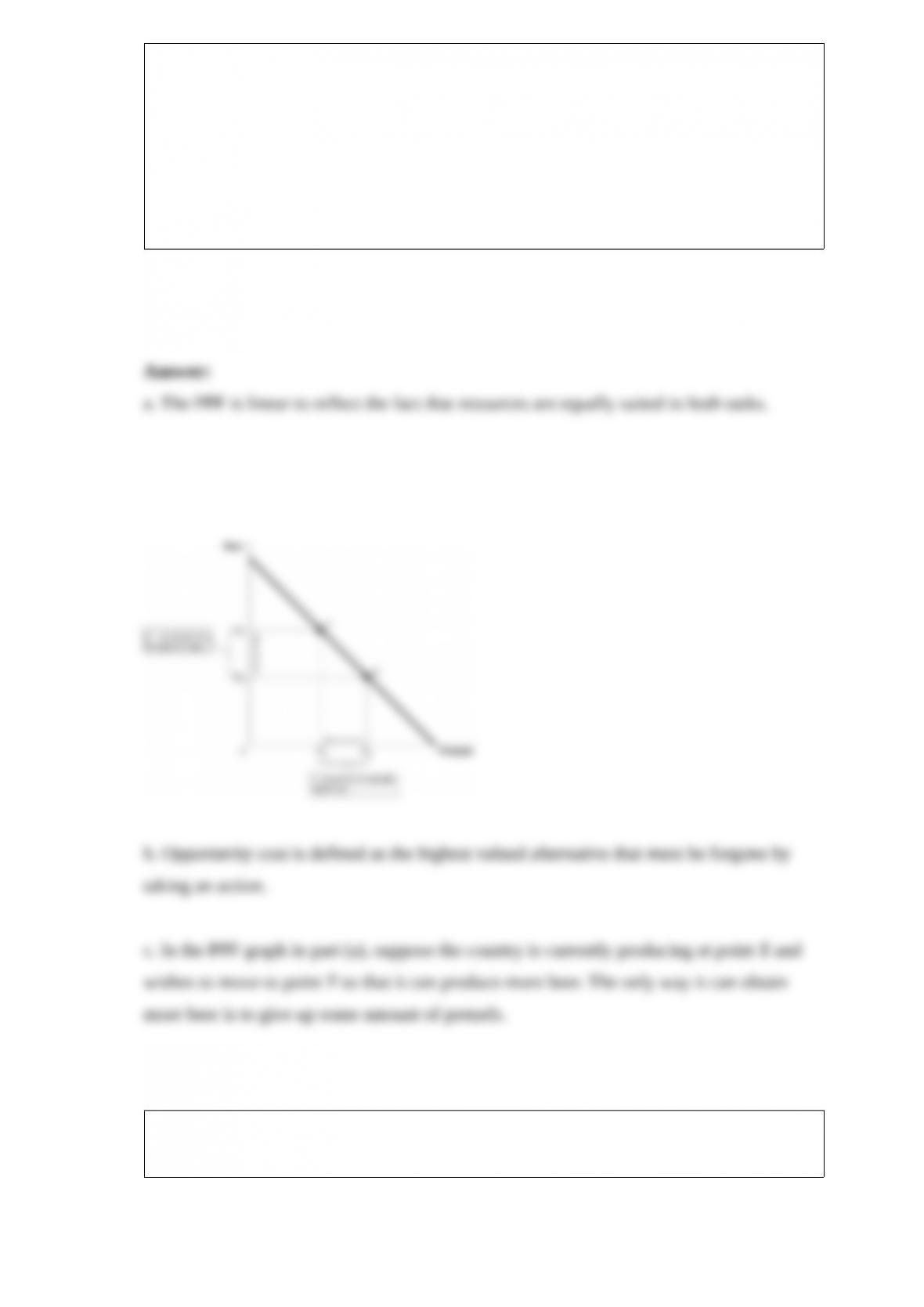
a. Draw a production possibilities frontier for a country that produces two goods, beer
and pretzels. Assume that resources are equally suited to both tasks.
b. Define opportunity costs.
c. Use your production possibilities frontier graph to demonstrate the principle of
opportunity costs.
Figure 12-9
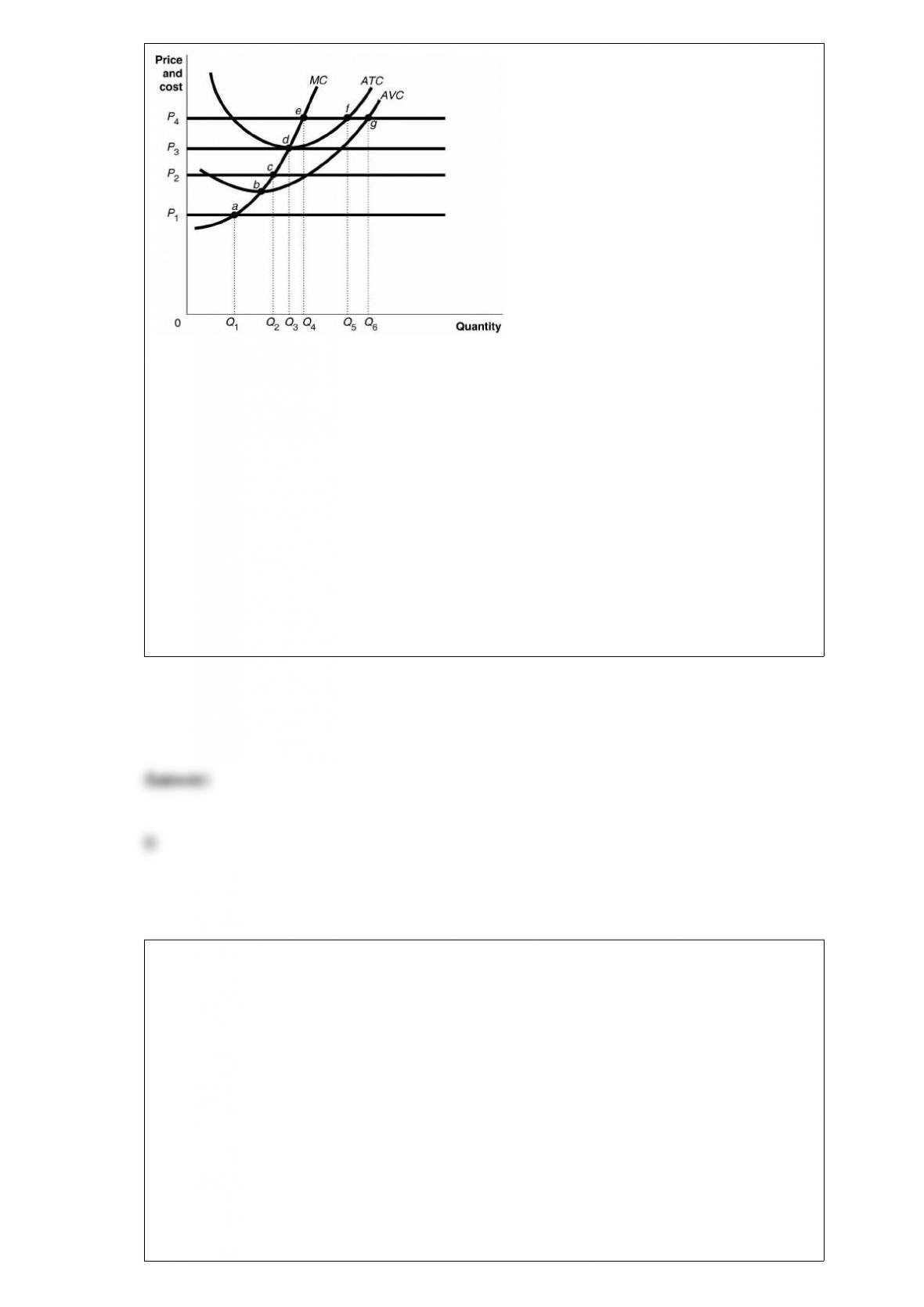
Figure 12-9 shows cost and demand curves facing a profit-maximizing, perfectly
competitive firm.
Refer to Figure 12-9. At price P3, the firm would produce
A) Q2 units
B) Q3 units.
C) Q4 units.
D) Q5 units.
Arnold Harberger was the first economist to estimate the loss of economic efficiency
due to market power. Since Harberger’s findings were published, other researchers have
studied this same issue. How do the results of these researchers compare to Harberger’s
results?
A) The other researchers reached conclusions similar to Harberger’s; namely, the loss of
economic efficiency due to market power is about 10 percent of the value of production
in the United States.
B) The other researchers reached conclusions different from Harberger’s; namely, they
found that the loss of economic efficiency due to market power is only about 1 percent
of the value of production in the United States, much less than Harberger’s estimate.
C) The other researchers reached conclusions different from Harberger’s; namely, the
loss of economic efficiency due to market power is about 10 percent of the value of
production in the United States, significantly greater than Harberger’s estimate.
D) The other researchers reached conclusions similar to Harberger’s; namely, the loss of
economic efficiency due to market power is about 1 percent of the value of production
in the United States.
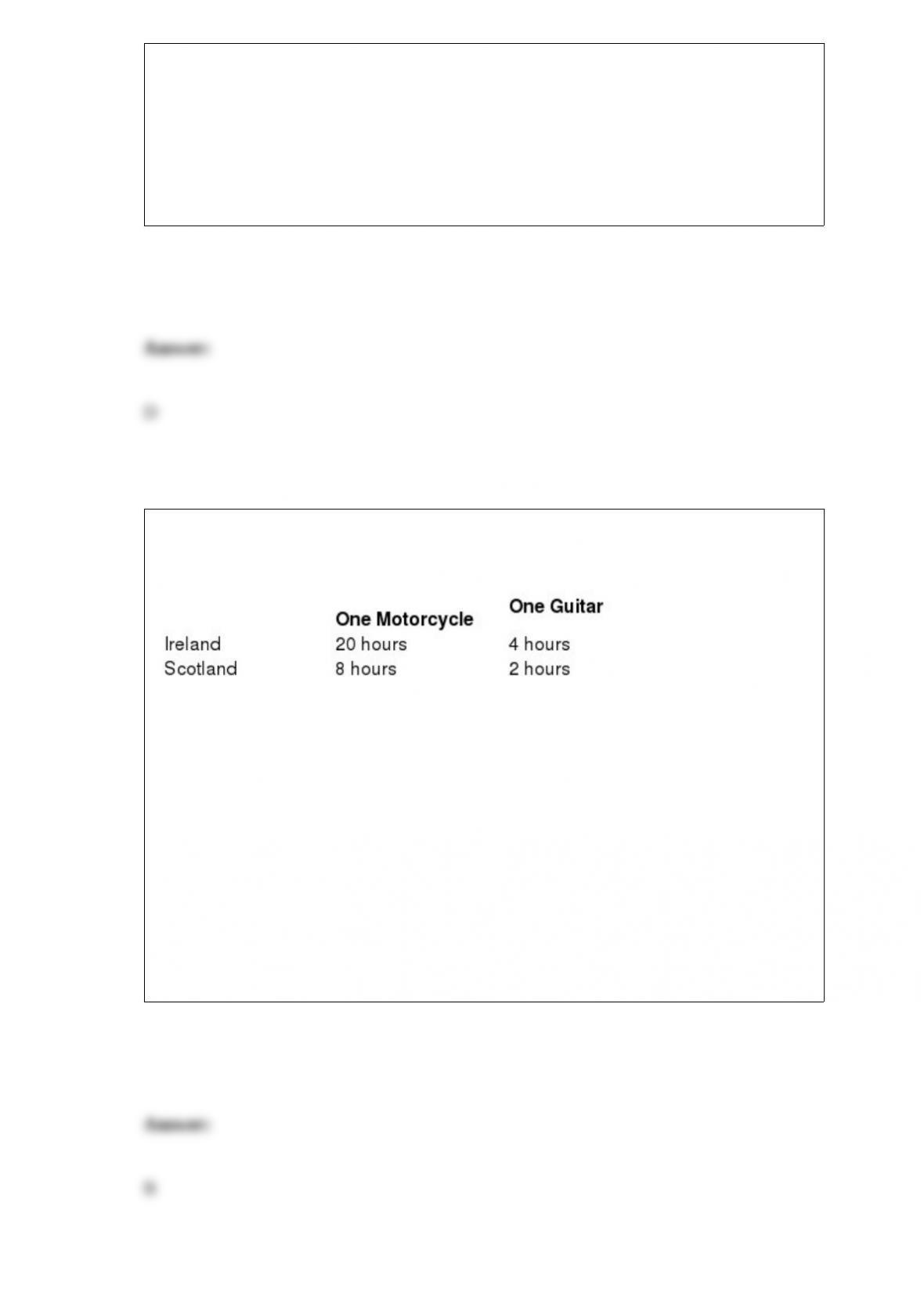
Table 2-11
Table 2-11 shows the number of labor hours required to produce a motorcycle and a
guitar in Ireland and Scotland.
Refer to Table 2-11. If the two countries specialize and trade, who should export
guitars?
A) There is no basis for trade between the two countries.
B) Ireland
C) Scotland
D) They should both be exporting guitars.
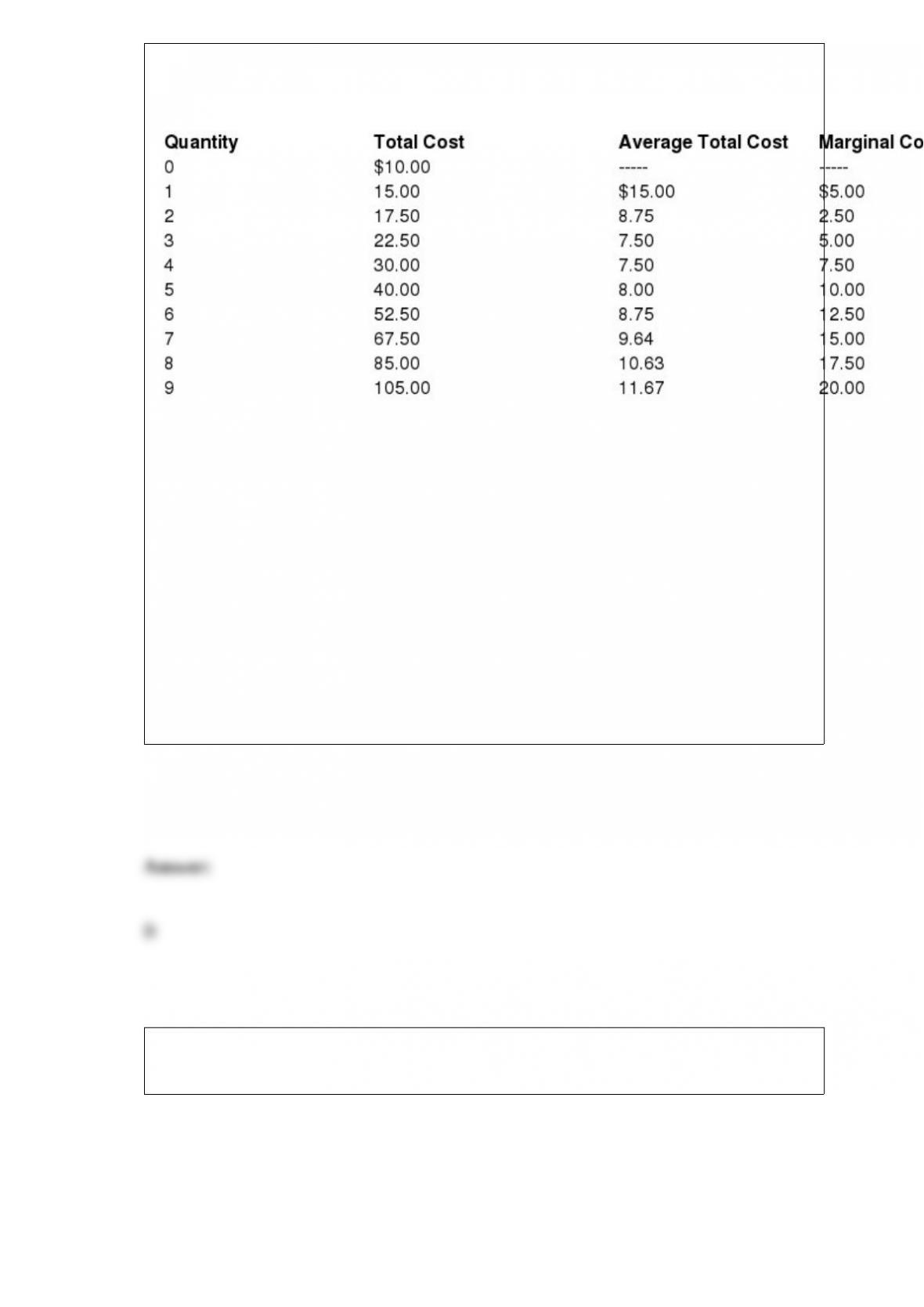
Table 12-3
Arnie sells basketballs in a perfectly competitive market. Table 12-3 summarizes
Arnie’s output per day (Q), total cost (TC), average total cost (ATC) and marginal cost
(MC).
Refer to Table 12-3. What will Arnie’s output be and how much profit will he earn if the
market price of basketballs is $5.00?
A) Q = 1; profit = -$10.
B) Q = 3; profit = -$7.50
C) Q = 0; profit = -$10.00
D) Price and profit cannot be determined from the information given.
Figure 12-10
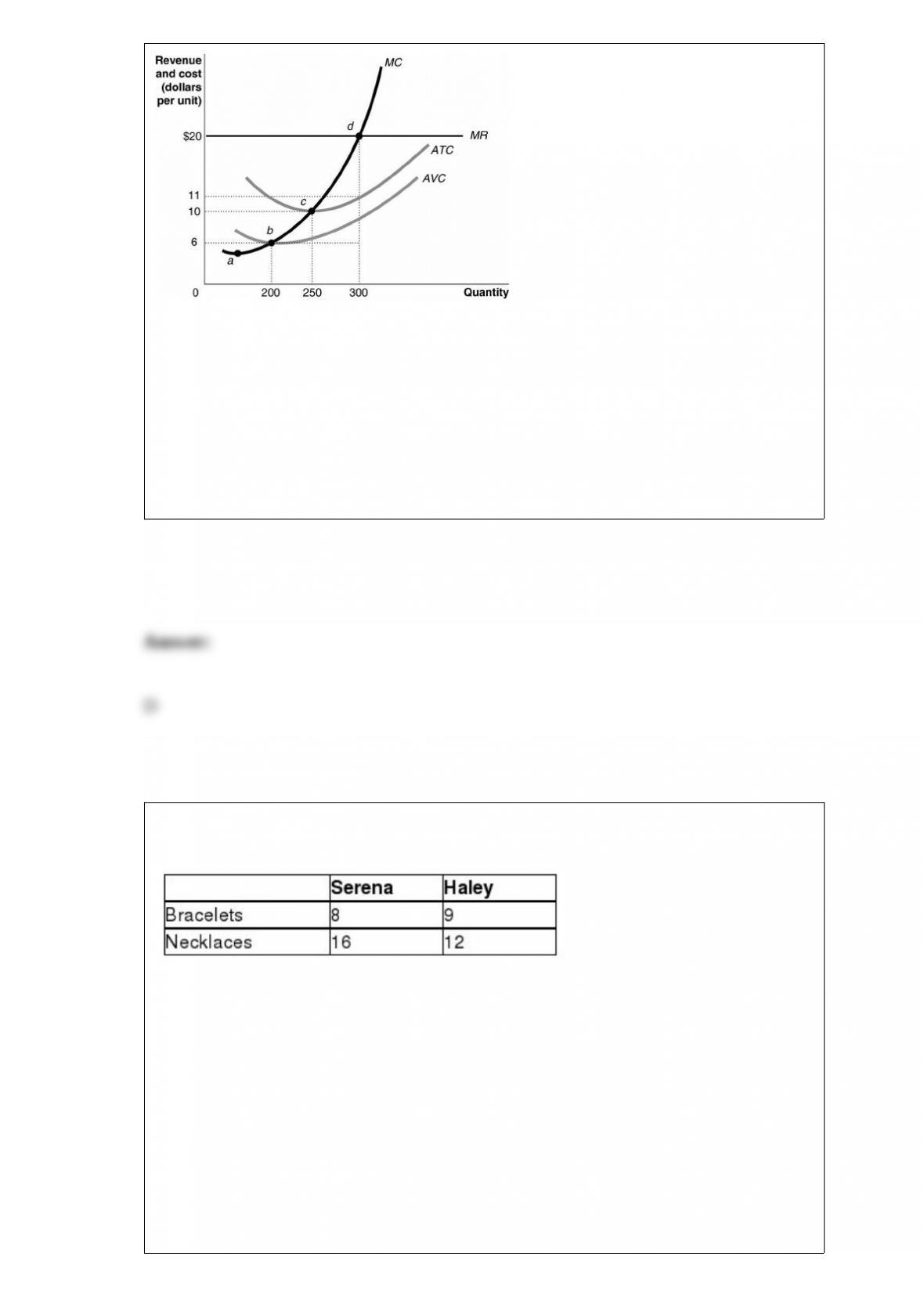
Refer to Figure 12-10. At the profit-maximizing output level, the firm earns
A) zero economic profit.
B) a profit of $600.
C) a profit of $1,200.
D) a profit of $2,700.
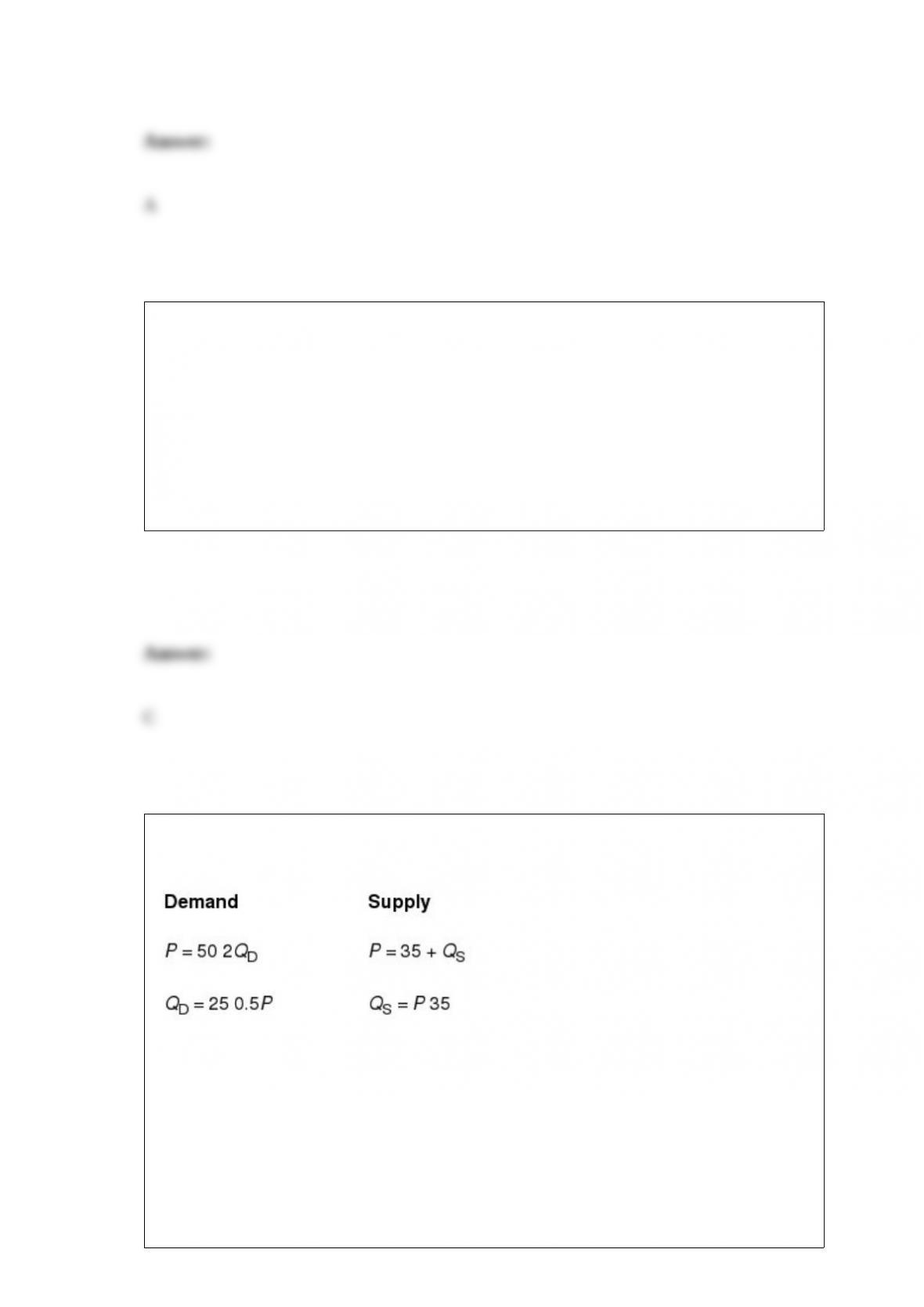
Table 2-6
Table 2-6 shows the output per week of two jewelers, Serena and Haley. They can either
devote their time to making bracelets or making necklaces.
Refer to Table 2-6. What is Serena’s opportunity cost of making a bracelet?
A) 2 necklaces
B) 1/2 of a bracelet
C) 1/2 of a necklace
D) 3/4 of a bracelet
An equilibrium in a game in which players pursue their own self-interest is called
A) a Nash equilibrium.
B) a cooperative equilibrium.
C) a noncooperative equilibrium.
D) a prisoner’s dilemma.
Table 4.7
Refer to Table 4-7. The equations above describe the demand and supply for Bubba’s
Fried Jellybeans. The equilibrium price and quantity for Bubba’s Fried Jellybeans are
$40 and 5 thousand units. What is the value of consumer surplus?
A) $5 thousand
B) $12.5 thousand
C) $25 thousand

D) $37.5 thousand
In many corporations, there is ‘separation of ownership from control.” What does this
mean?
A) The shareholders control the corporation, although the board of directors owns the
corporation.
B) The managers of the corporation run the corporation, although the shareholders own
the corporation.
C) The board of directors controls corporate operations, although the managers of the
corporation own the corporation.
D) Top corporate managers only make decisions that have been approved unanimously
by shareholders.
Figure 4-4
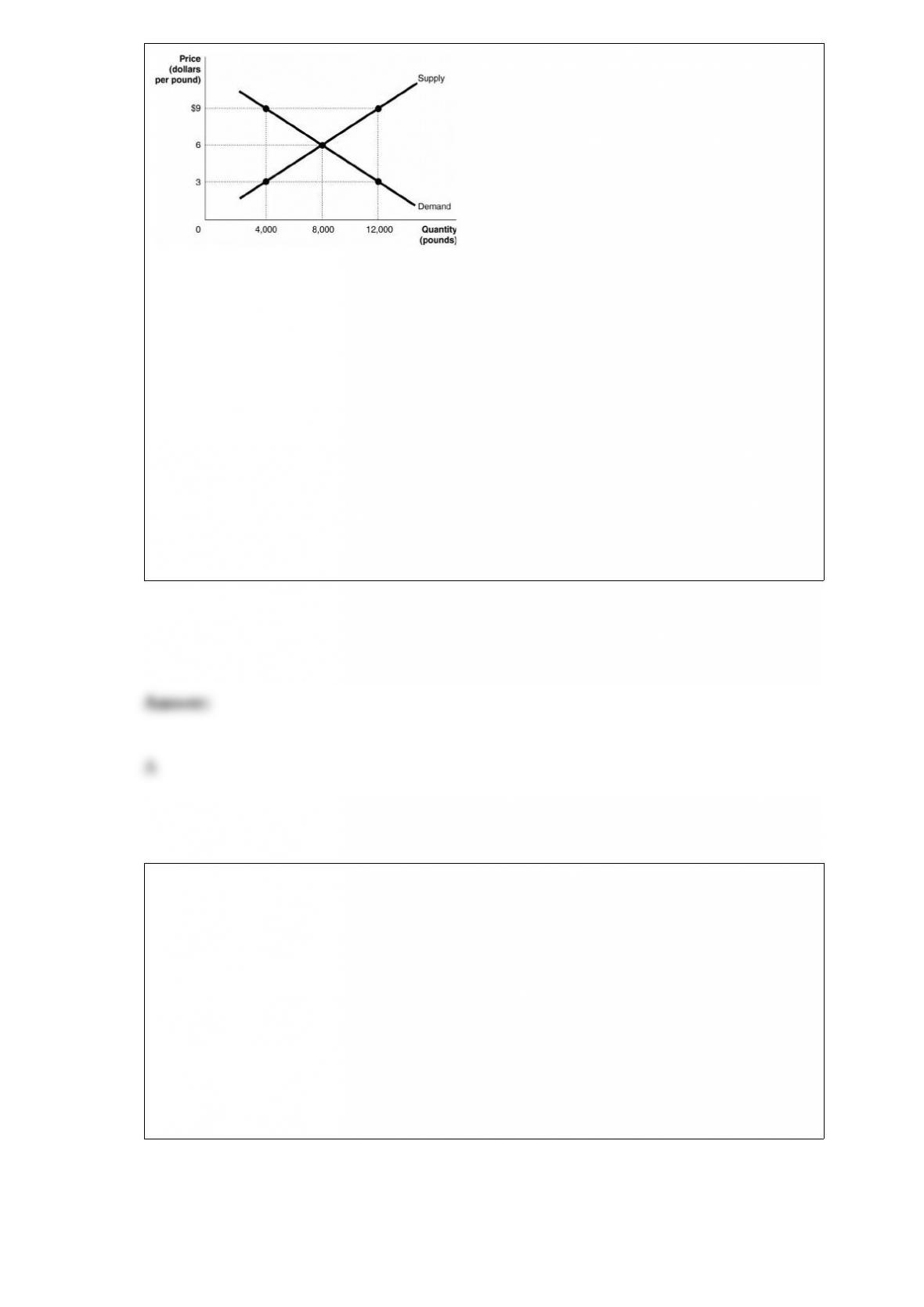
Refer to Figure 4-4. The figure above represents the market for pecans. Assume that
this is a competitive market. At a price of $3
A) the marginal cost of pecans is greater than the marginal benefit; therefore, output is
inefficiently low.
B) producers should raise the price to $9 in order to sell the quantity demanded of
12,000.
C) the marginal benefit of pecans is greater than the marginal cost; therefore, output is
inefficiently high.
D) the marginal benefit of pecans is greater than the marginal cost; therefore, output is
inefficiently low.
Suppose a monopolistically competitive firm’s output where marginal revenue equals
marginal cost is 66 units and the price corresponding to this quantity is $18. If the
average total cost at this output is $16.55, then its total profit is
A) $1,188.
B) $1,092.30.
C) $95.70.
D) $1.45.

Which of the following statements is true?
A) The average product of labor is at its maximum when the average product of labor
equals the marginal product of labor.
B) The average product of labor is at its minimum when the average product of labor
equals the marginal product of labor.
C) The average product of labor tells us how much output changes as the quantity of
workers hired changes.
D) Whenever the marginal product of labor is greater than the average product of labor
the average product of labor must be decreasing.
The long-run average cost curve shows
A) the lowest average cost of producing every level of output in the long run.
B) where the most profitable level of output occurs.
C) the average cost of producing where diminishing returns are not present.
D) the plant size or scale that the firm should build.
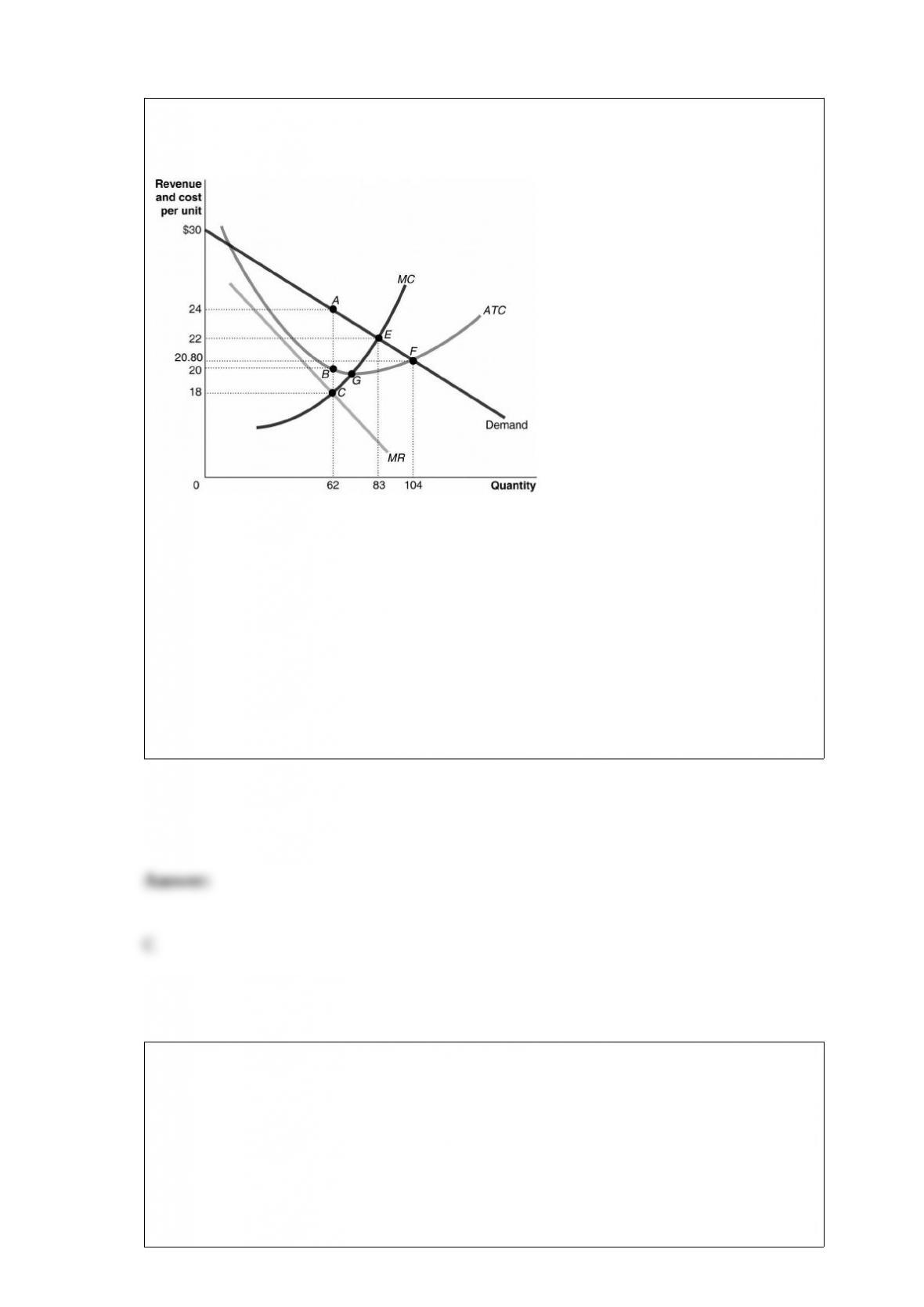
Figure 15-6
Figure 15-6 shows the cost and demand curves for a monopolist.
Refer to Figure 15-6. The monopolist earns a profit of
A) $0.
B) $170.
C) $248.
D) $372.
What is the shape of the labor supply curve implied by the following statements?
a. “I’m sorry, kids, but now that I’m earning more, I just can’t afford to come home early
in the afternoon, so I won’t be here when you get home from school.”
b. “They can pay me a lot or they can pay me a little. I’ll still put in my 8 hours a day.”
c. “Now that I have received a salary increase, I am going to work 36 hours instead of

40 hours a week”
Securities dealers that trade stocks and bonds outside exchanges comprise the
A) foreign exchange market.
B) over-the-counter market.
C) NASDAQ market.
D) outlet market.
The long run refers to a time period
A) during which a firm is able to purchase all of its inputs, including its plant and
equipment.
B) long enough for a firm to vary all of its inputs, to adopt new technology and change
the size of its physical plant.
C) long enough for a firm to pay all of its creditors in full.
D) long enough for a firm to change the use of its variable inputs.
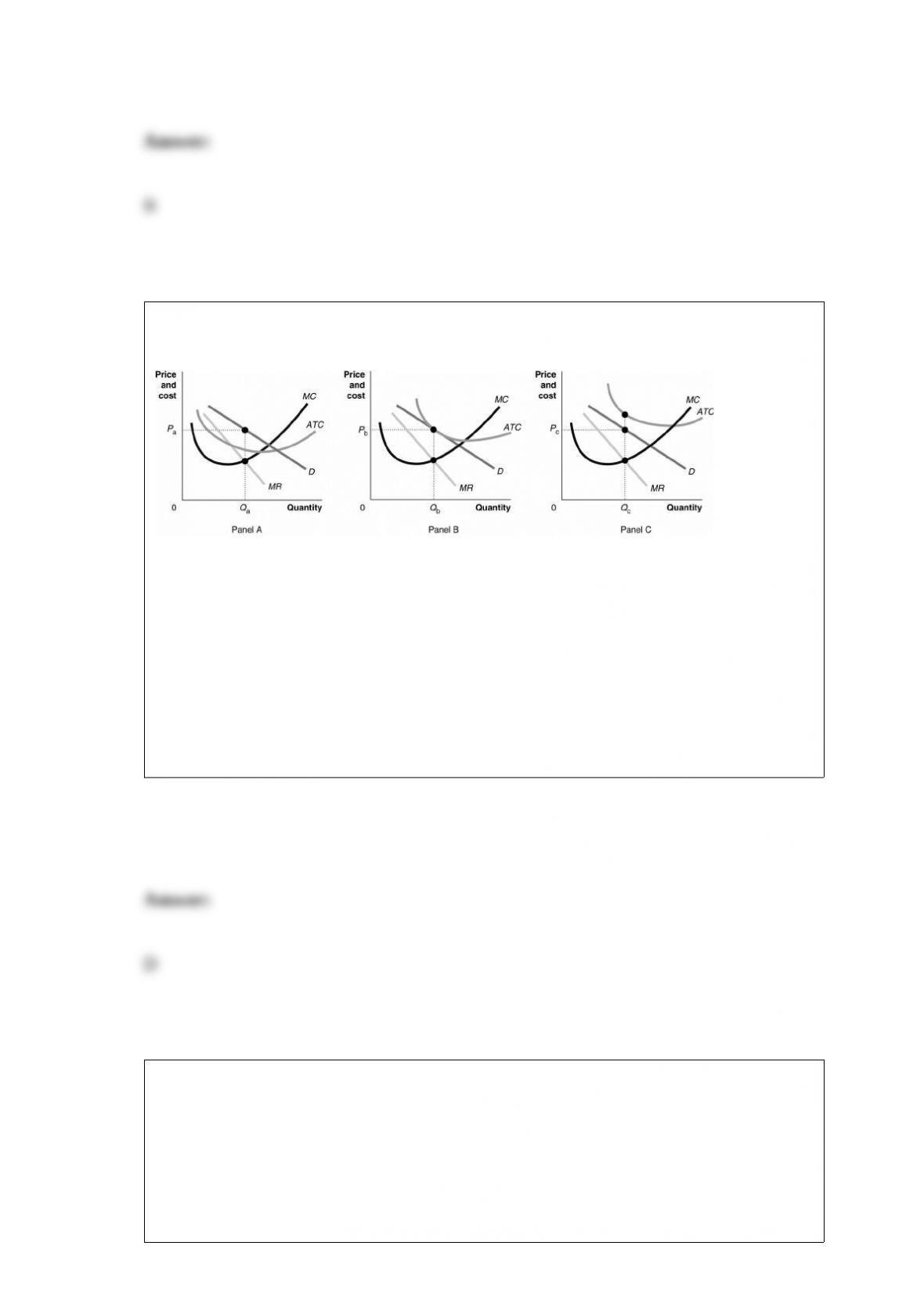
Figure 13-9
Refer to Figure 13-9. Which of the graphs in the figure depicts a monopolistically
competitive firm that is earning economic profits?
A) Panel A
B) Panel B
C) Panel C
D) Panel A and Panel B
What is the central role of financial intermediaries in a market economy?
A) the creation and printing of money
B) keeping the price level stable
C) bringing together savers and borrowers

D) providing safe deposit boxes for people and businesses