All of the following are examples of explicit cost a firm might incur except
A) the out-of-pocket expense to hire employees.
B) taxes owed to the state government.
C) the rental value of the warehouse space the company owns and uses for itself.
D) the revenue a firm generates in using its resources.
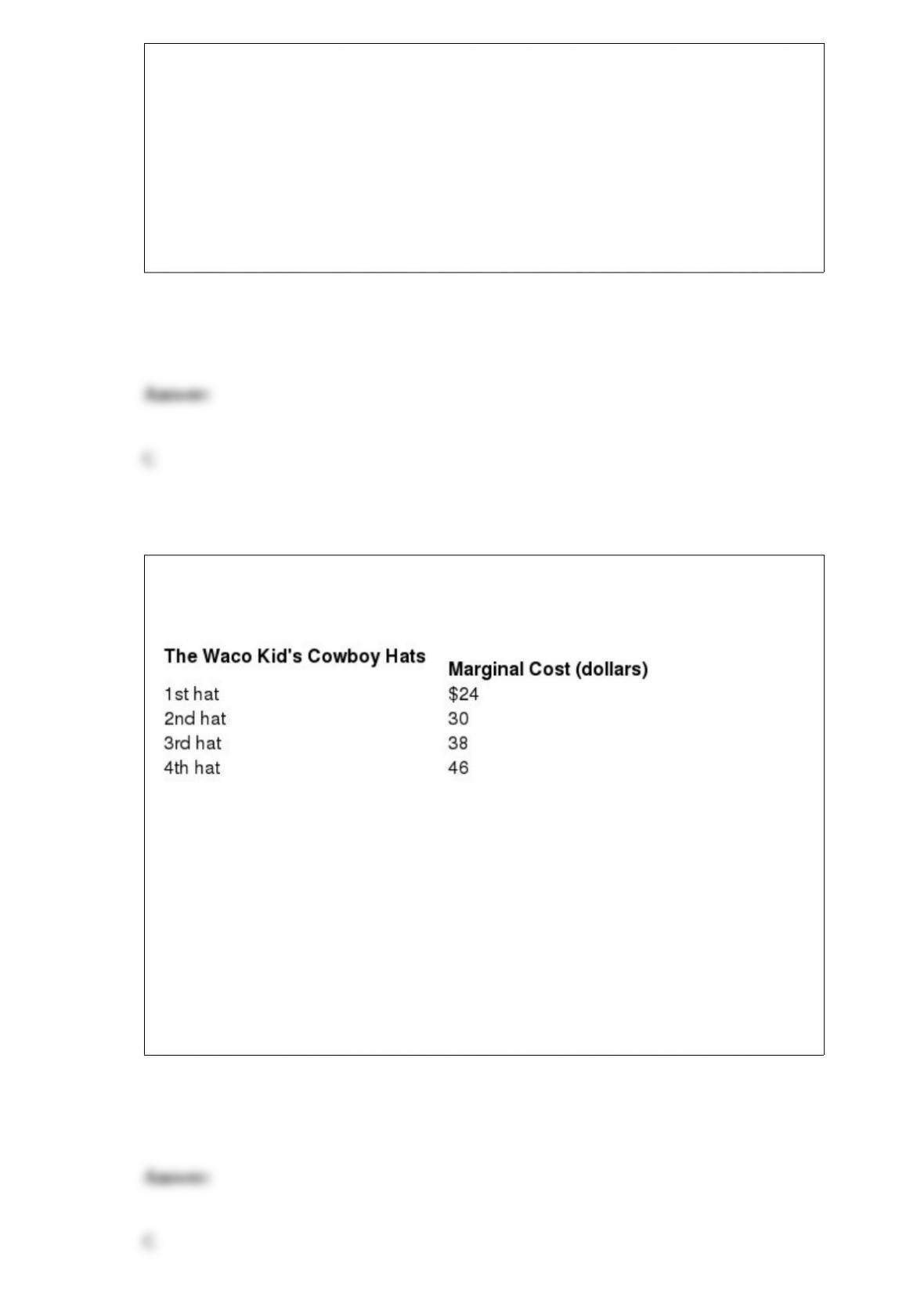
Table 4-3
Refer to Table 4-3. The table above lists the marginal cost of cowboy hats by The Waco
Kid, a firm that specializes in producing western wear. If the market price of cowboy
hats is $50, producer surplus is
A) $0.
B) $4.
C) $62.
D) $138.

If a typical monopolistically competitive firm is making short-run losses, then
A) other more competitive firms will enter the market.
B) as some firms leave, the remaining firms will experience an increase in the demand
for their products.
C) as some firms leave, the demand for the products of the remaining firms will become
more elastic.
D) the industry will eventually cease to exist.
A firm’s primary interest when it hires an additional worker is
A) the cost of hiring the additional worker.
B) how the average output of the firm will be affected by this new worker.
C) the extra revenue the firm realizes from hiring that worker.
D) whether or not the new worker gets along with the firm’s existing workers.
Since lower-income people spend a larger proportion of their incomes on groceries than
do higher-income people, if grocery stores were required by law to charge a 10-cent fee
for disposable bags, this fee could be considered a

A) proportional tax.
B) progressive tax.
C) regressive tax.
D) income tax.
Let D = demand, S = supply, P = equilibrium price, Q = equilibrium quantity. What
happens in the market for electric vehicles if the government offers incentives to
manufacturers to produce more electric vehicles?
A) D increases, S no change, P and Q increase
B) S increases, D no change, P decreases, Q increases
C) D and S increase, P and Q decrease
D) D no change, S increases, P decreases, Q decreases
Which of the following is not a reason why firms experience economies of scale?
A) Technology can make it possible to increase production with a smaller increase in at
least one input.
B) Workers and managers can become more specialized, enabling them to be more
productive.
C) Larger firms may be able to purchase inputs at lower costs than smaller competitors.
D) As output increases, the managers can begin to have difficulty coordinating the
operations of their firms.
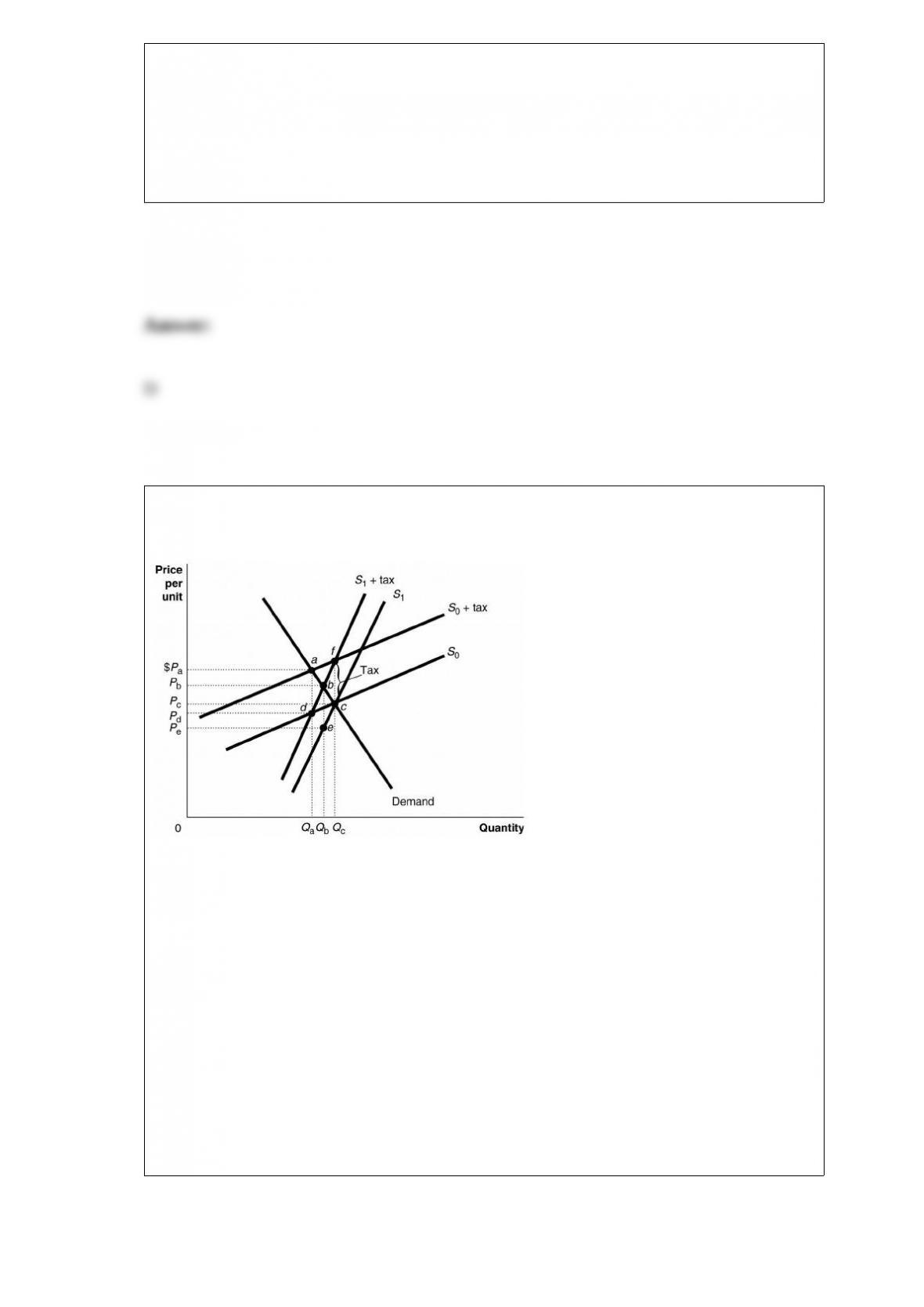
Figure 18-2
Figure 18-2 shows a demand curve and two sets of supply curves, one set more elastic
than the other.
Refer to Figure 18-2. If the government imposes an excise tax of $1.00 on every unit
sold, the government’s revenue from the tax is represented by the area
A) (PaPcQa) if the supply curve is S0 and (PbPcQb) if the supply curve is S1.
B) (PaPdQa) if the supply curve is S0 and (PbPeQb) if the supply curve is S1.
C) (PaPeQa) under either supply curve.
D) (PbPeQb) under either supply curve.
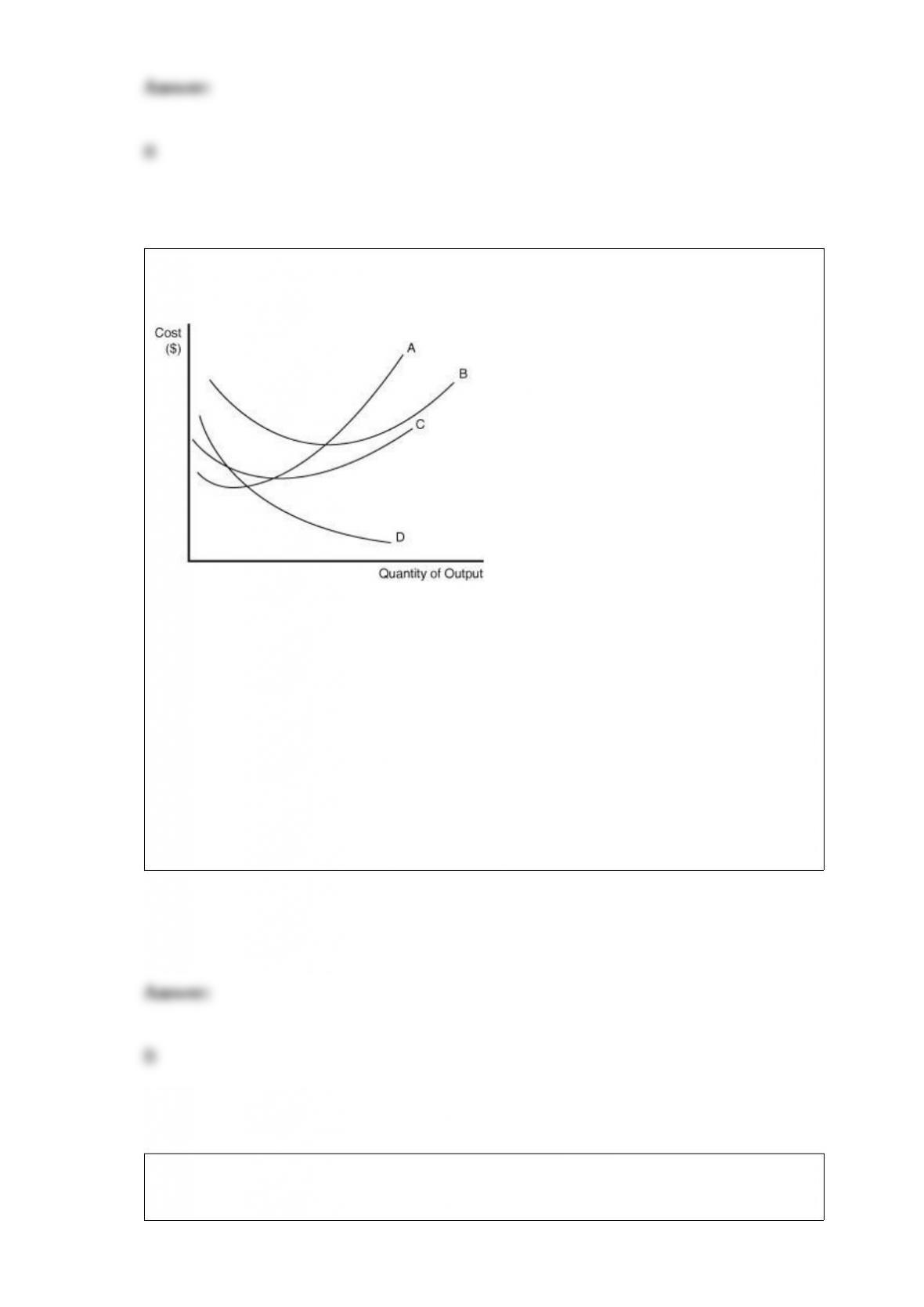
Figure 11-6
Figure 11-6 contains information about the short run cost structure of a firm.
Refer to Figure 11-6. In the figure above which letter represents the average total cost
curve?
A) A
B) B
C) C
D) D
Figure 2-10

Figure 2-10 shows the production possibilities frontiers for Tahiti and Bora Bora. Each
country produces two goods, milk and honey.
Refer to Figure 2-10. Which country has a comparative advantage in the production of
milk?
A) Bora Bora
B) They have equal productive abilities.
C) Tahiti
D) neither country
Economists refer a to a market where buying and selling take place at prices that violate
government price regulations as
A) a black market.
B) an outlaw market.
C) a noncompetitive market.
D) a restricted market.

Higher isocost lines correspond to higher
A) profits.
B) total costs of production.
C) input prices.
D) sales revenue.
Economic surplus
A) does not exist when a competitive market is in equilibrium.
B) is equal to the sum of consumer surplus and producer surplus.
C) is the difference between quantity demanded and quantity supplied when the market
price for a product is greater than the equilibrium price.
D) is equal to the difference between consumer surplus and producer surplus.

Negative externalities and the tragedy of the commons are problems that have a
common source. What is this common source?
A) self-interest motives of producers and consumers
B) a lack of concern for human rights
C) a lack of competition
D) a lack of clearly defined and enforced property rights
Which of the following describes a difference between the marginal revenue and
demand curves of a perfectly competitive firm and a monopolistically competitive firm?
A) The perfectly competitive firm’s marginal revenue and demand curves are the same;
the marginal revenue curve of a monopolistically competitive firm lies above its
demand curve.
B) The perfectly competitive firm’s marginal revenue and demand curves are the same;
the marginal revenue curve of a monopolistically competitive firm lies below its
demand curve.
C) The monopolistically competitive firm’s marginal revenue and demand curves are
the same; the marginal revenue curve of a perfectly competitive firm lies below its
demand curve.
D) The marginal revenue curve of a monopolistically competitive firm lies below its
demand curve; the marginal revenue curve of a perfectly competitive firm lies above its
demand curve.

A firm’s accounting profit is also its
A) economic profit.
B) income statement.
C) net income.
D) statement of liabilities.
Which of the following helps to explain why the supply curve of labor is upward
sloping?
A) The supply curve of labor is a derived supply curve; since the output supply curve is
upward-sloping so is the labor supply curve.
B) As the wage rate rises, the income effect causes the quantity of labor supplied to
increase.
C) The substitution effect of a price change makes a good more expensive relative to
other goods.
D) As the wage rate rises, the opportunity cost of leisure rises.
In the United States, the federal income tax is an example of a

A) progressive tax.
B) regressive tax.
C) proportional tax.
D) flat tax.
Steven Cheung examined the relationship between beekeepers and apple growers.
Cheung noted that: “Pollination contracts usually include stipulations regarding the
number and strength of … [bee] colonies, the rental fee per hive, the time of
delivery…the protection of bees from pesticides, and the strategic placing of hives.”
Cheung’s suggests that the relationship between beekeepers and apple growers is an
example of
A) the Coase Theorem.
B) how excessive legal costs can prevent economic efficiency from being achieved.
C) negative externalities.
D) government intervention improving economic efficiency.
If a firm is in an antitrust court case being accused of monopolizing a product, the firm
would hire an economist to show

A) the cross-price elasticity of demand between the firm’s good and another is negative.
B) the cross-price elasticity of demand between the firm’s good and another is positive.
C) the price elasticity of demand for the firm’s good is highly inelastic.
D) the income elasticity of the firm’s good is inferior.
In the short run, a firm that is operating at a loss has two options. These options are
A) to reduce output or reduce its variable costs.
B) to go out of business or declare bankruptcy.
C) to shut down temporarily or continue to produce.
D) to adopt new technology or change the size of its physical plant.
Which of the following equations is correct?
A) AVC – ATC = AFC
B) AVC + ATC = AFC
C) AFC + AVC = ATC
D) ATC + AVC = AFC

The government of Silverado raises revenue through a general income tax paid by all its
residents to operate the city’s marina. The marina is used by private boat owners. This
method of raising revenue to operate the marina is
A) consistent with the benefits-received principle.
B) consistent with the ability-to-pay principle.
C) inconsistent with the benefits-received principle.
D) inconsistent with the ability-to-pay principle.
Development that meets the needs of the present without compromising the ability of
future generations to meet their own needs indicates ________.
A) egalitarianism
B) denationalization
C) generalizability
D) sustainability

Some corporate governance experts believe that serving on a company’s board of
directors for an extended length of time diminishes that member’s independence from
the company’s CEO. If this is true, it would tend to
A) reduce the principal-agent problem.
B) increase the principal-agent problem.
C) be in the best interest of shareholders.
D) have no impact on the company’s performance, since the CEO is only one member
of top management.
The River Rouge plant was built by the Ford Motor Company in the 1920s to produce
the company’s Model A car. Which of the following is evidence that the River Rouge
plant suffered from diseconomies of scale?
A) Despite an expensive advertising campaign the Model A did not earn the company a
profit.
B) Model A cars made at the River Rouge plant failed to earn Ford a profit. Ford
eventually constructed smaller plants to make the Model A at a lower average cost.
C) Model A cars made at the River Rouge plant failed to earn a profit. Ford reduced the
average cost of the Model A by cutting its employees’ wages.
D) Model A cars made at the River Rouge plant failed to earn a profit because the price
of steel used to manufacture the Model A rose when workers in the steel industry went
on strike.

Market supply is found by
A) vertically summing the relevant part of each individual producer’s marginal cost
curve.
B) horizontally summing the relevant part of each individual producer’s marginal cost
curve.
C) vertically summing each individual producer’s average total cost curve.
D) horizontally summing each individual producer’s average total cost curve.
The demand for labor depends primarily on the additional output produced as a result of
hiring an additional worker and
A) the additional revenue received from selling the output produced as a result of hiring
an additional worker.
B) the payment made to the worker for producing the additional output.
C) the elasticity of demand for the output produced by the worker.
D) the number of workers willing to produce the additional output.

Some markets have many buyers and sellers but fall into the category of monopolistic
competition rather than perfect competition. The most common reason for this is
A) there are high barriers to entering these markets.
B) firms in these markets sell identical products.
C) firms in these markets make high profits.
D) firms in these markets do not sell identical products.
Painters who paint water towers earn higher wages relative to painters who paint houses
because
A) the demand for tower painters is greater than the demand for residential painters.
B) painting water towers is more risky than painting houses.
C) the tower painters’ union is probably more powerful than the house painters’ union.
D) the supply of water tower painters exceeds the supply of house painters.
Table 18-1

Suppose $1 billion is available in the budget and Congress is considering allocating the
funds to one of the following three alternatives: 1. Subsidies for education, 2. Research
on Alzheimer’s or 3. Increased border security. Table 18-1 shows three voters’ rankings
of the alternatives.
Refer to Table 18-1. Suppose a series of votes are taken in which each pair of
alternatives is considered in turn. If the vote is between allocating funds to subsidies for
education and research on Alzheimer’s
A) Ivy and Jasmine vote for education subsidies, Rose votes for Alzheimer’s research,
and education subsidies wins.
B) Ivy and Rose vote for education subsidies, Jasmine votes for Alzheimer’s research,
and education subsidies wins.
C) Jasmine and Rose vote for Alzheimer’s research, Ivy votes for education subsidies,
and Alzheimer’s research wins.
D) Jasmine and Ivy vote for Alzheimer’s research, Rose votes for education subsidies,
and Alzheimer’s research wins.