
Many economists believe that when the federal government establishes an agency to
regulate a particular industry, the regulated firms try to influence the agency even if
these actions do not benefit the public. Economists refer to this result of government
regulation by which of the following terms?
A) regulatory capture
B) logrolling
C) special interest regulation
D) the regulatory paradox
Between 1970 and 2006, the poverty rate in East Asia declined dramatically from about
60 percent to less than 2 percent, while the poverty rate in Sub-Saharan Africa
decreased from 40 percent to only 32 percent. The main reason for this is that
A) the population growth rate decreased in East Asia and increased in Sub-Saharan
Africa.
B) Governments in East Asia increased transfer payments to poor families over this
period of time. The governments of Sub-Saharan Africa had practically no transfer
payment programs from 1970 to 2006.
C) The countries of East Asia have progressive income tax systems. The countries of
Sub-Saharan Africa all have regressive income tax systems.
D) East Asia experienced higher economic growth than Sub-Saharan Africa.

If Ewan is consuming his utility maximizing bundle and the price of one good falls,
what happens to the marginal utility per dollar spent on this good (MU/P), and what
should Ewan do?
A) MU/P has increased and Ewan should buy more of this good.
B) MU/P has increased and Ewan should buy less of this good.
C) MU/P has decreased and Ewan should buy more of this good.
D) MU/P has decreased and Ewan should buy less of this good.
Which of the following firms is not able to practice price discrimination?
A) movie theaters
B) commercial airlines
C) land-line telephone companies
D) the largest wheat farmer in Nebraska
Suppose a large firm allows its employees to choose whether to participate in its health
insurance plan. The firm is trying to decide between two plans: Plan I has a low
monthly premium but a high deductible, and Plan II has a high monthly premium but a
low deductible. Under which plan is adverse selection likely to be a bigger problem?
A) Plan I because it is likely to draw participants who expect high medical costs. This
group expects to consume much health care services and therefore prefer low
deductibles.
B) Plan II because it is likely to draw participants who expect high medical costs.
Healthy individuals who do not expect to consume much health care services will not
be willing to pay the high premiums.
C) Plan I because it is likely to draw the relatively healthy employees who do not
expect to spend much on health care. Because the monthly premiums are low, the
insurance company has to bear a bigger financial burden in the event of serious
illnesses.
D) Plan II because it is likely to draw employees who tend to over-consume health care
services because of the low deductible. Insurance companies are likely to end up paying
out more claims than the premiums they collect.
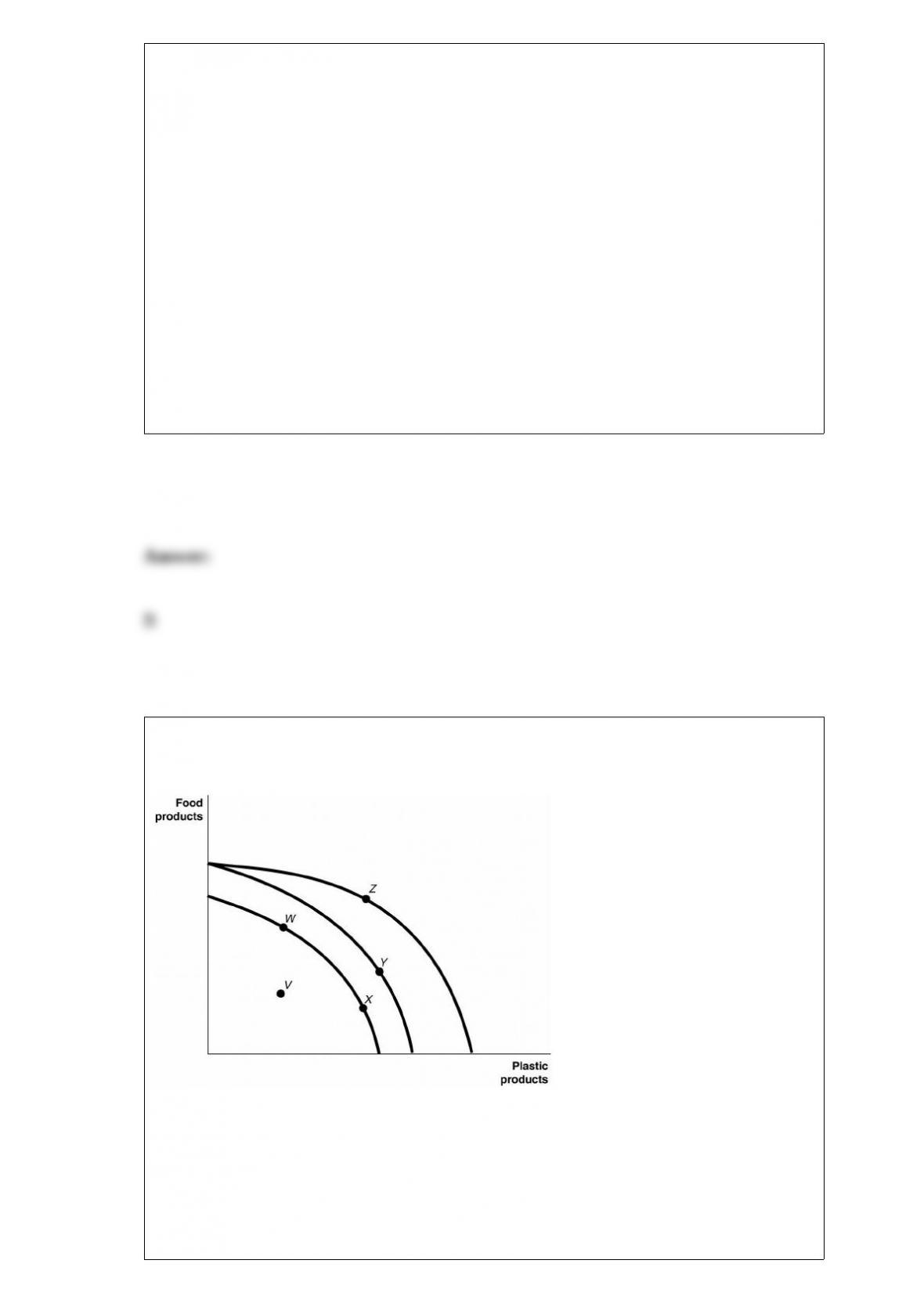
Figure 2-4
Figure 2-4 shows various points on three different production possibilities frontiers for
a nation.
Refer to Figure 2-4. Consider the following events:
a. a reduction in the patent protection period to no more than 2 years

b. a war that destroys a substantial portion of a nation’s capital stock
c. the lack of secure and enforceable property rights system
Which of the events listed above could cause a movement from W to V?
A) a only
B) a and b only
C) a and c only
D) b and c only
E) a, b, and c
Which of the following describes a positive externality?
A) John Henry paints the outside of his house in order to increase its market value just
before he puts the house up for sale.
B) People who do not attend college still benefit from others who receive a college
education.
C) The government imposes a tax on cigarettes in order to discourage smoking among
teenagers.
D) Mary volunteers to drive her neighbor’s children to soccer practice.
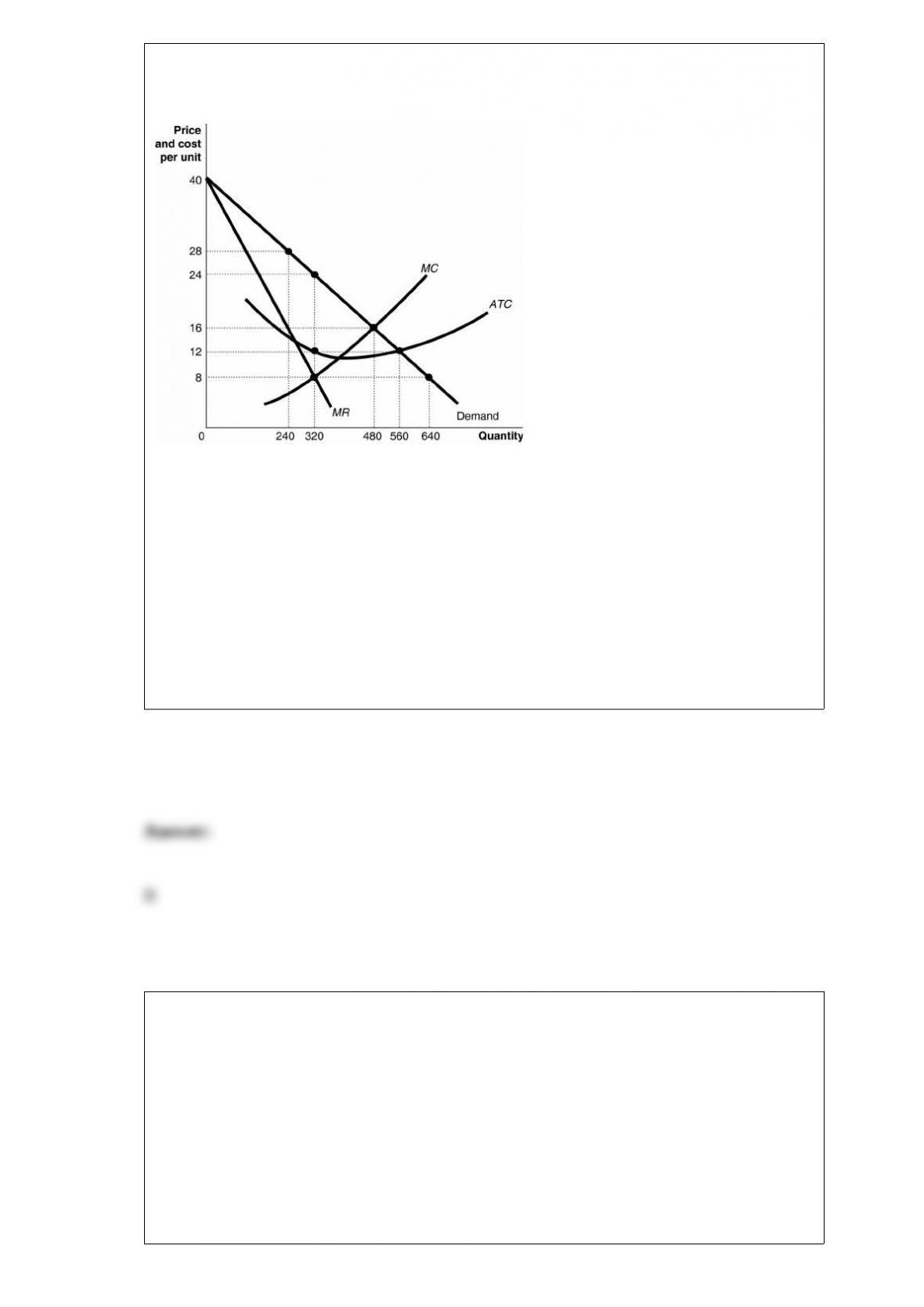
Figure 16-5
Refer to Figure 16-5. Suppose the firm represented in the diagram decides to use a
two-part pricing strategy such that it charges a fixed fee and a per-unit price equal to the
monopoly price. What is the profitearned under this pricing scheme?
A) $5,760
B) $6,400
C) $7,680
D) $7,870
Suppose a decrease in the supply of wheat results in an increase in revenue. This
indicates that
A) the decrease in quantity sold is proportionately larger than the resulting change in
price.
B) the resulting increase in price is proportionately greater than decrease in quantity
sold.
C) the demand curve for wheat must be vertical.
D) the supply curve for wheat must be vertical.
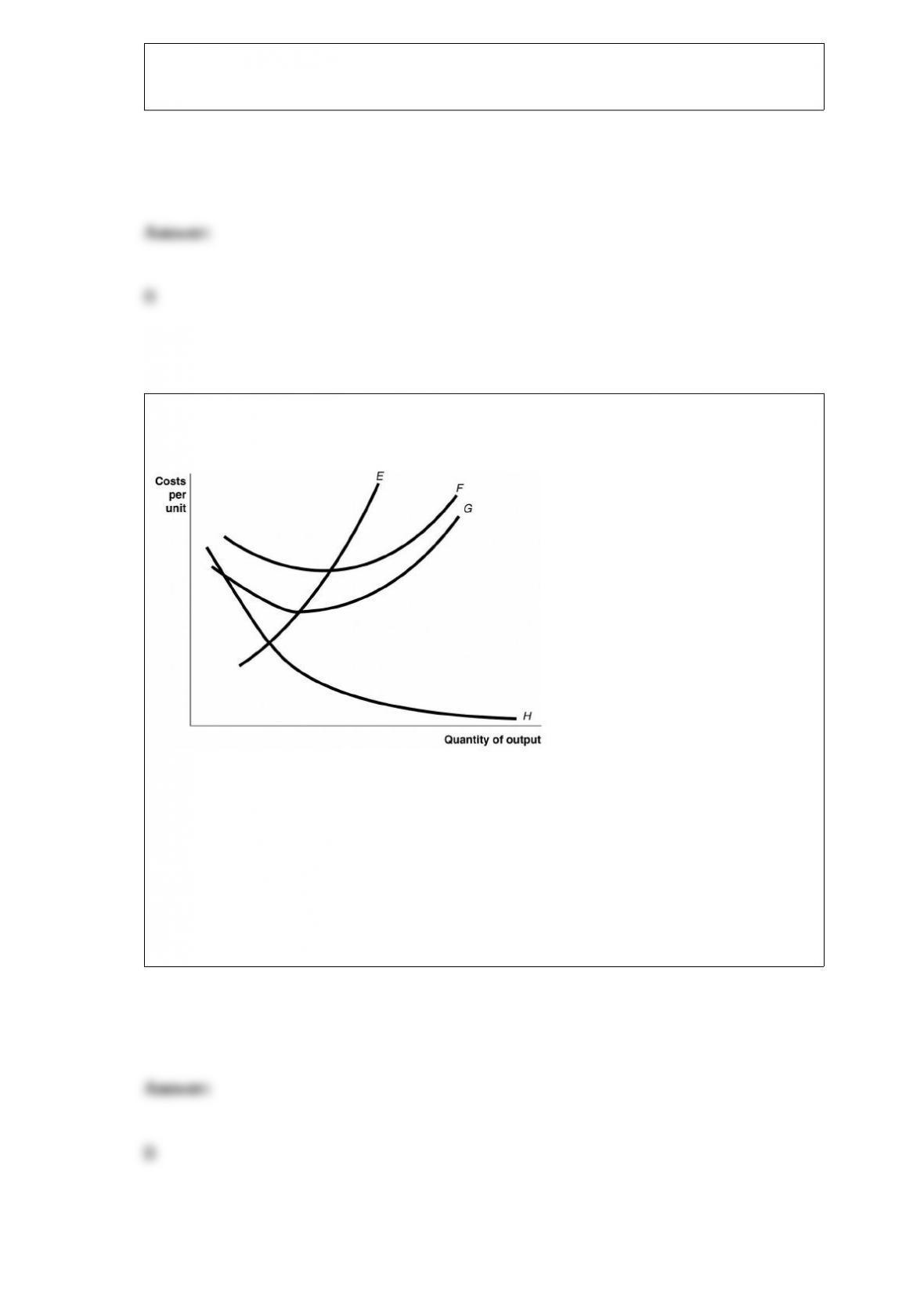
Figure 11-5
Refer to Figure 11-5. Curve Gapproaches curveF because
A) marginal cost is above average variable costs.
B) average fixed cost falls as output rises.
C) fixed cost falls as capacity rises.
D) total cost falls as more and more is produced.
The following appeared in a Florida newspaper a week after a hurricane hit the state.
“Floridians are relieved that the storm produced no fatalities but homeowners face
weeks, if not months, of rebuilding. Matters are made worse by the soaring prices of
plywood and other building materials that always follow in a hurricane’s path.
Complaints of profiteering and price gouging have not deterred firms from raising their
prices by over 100 percent.” Which of the following offers the best explanation for the
price increases referred to in the article?
A) The hurricane reduced the number of suppliers of building materials.
B) The hurricane created an artificial shortage of building materials.
C) The hurricane caused an increase in the demand for building materials.
D) There was a reduction in supply as firms shipped plywood and other materials to
locations not affected by the storm.
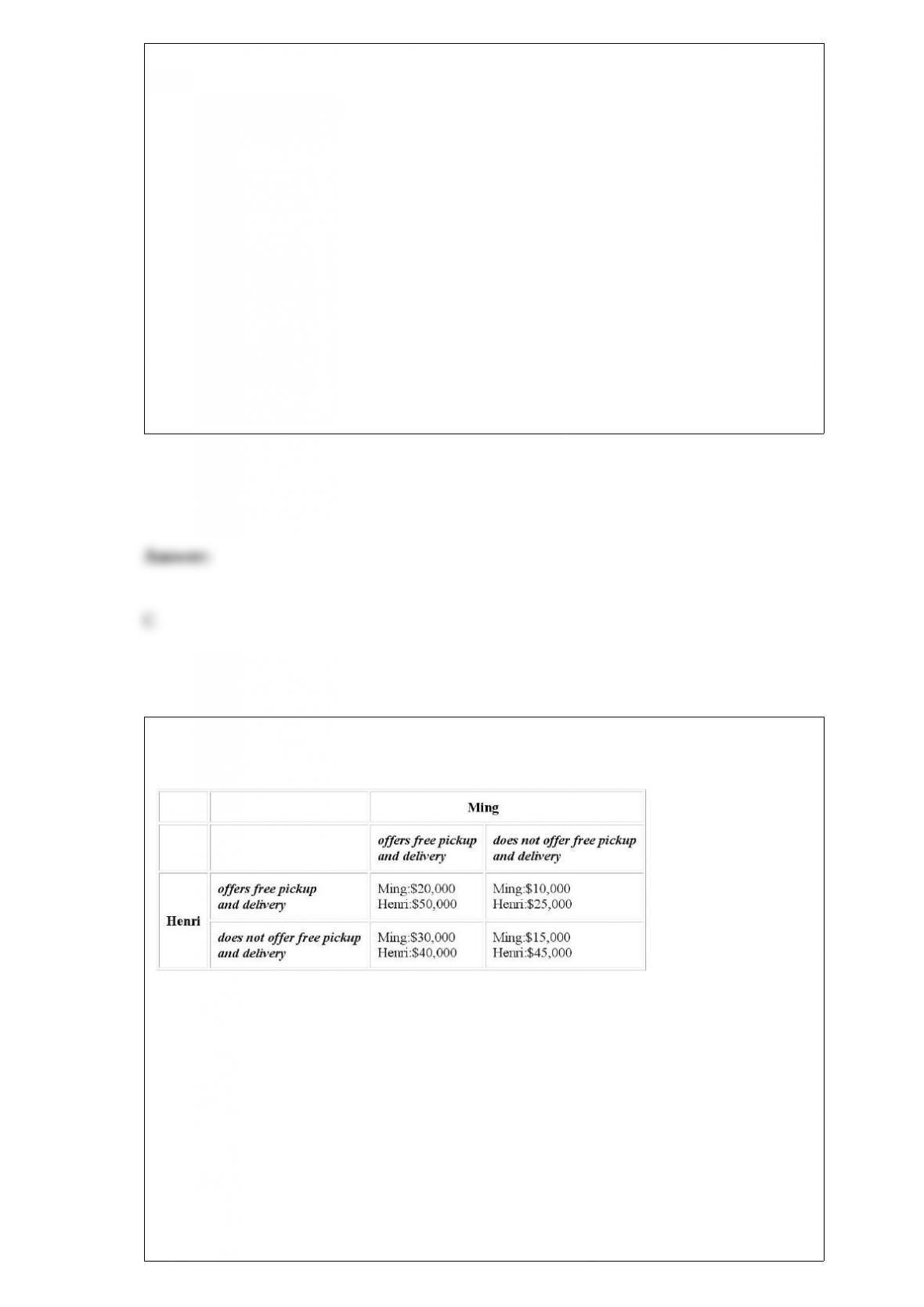
Table 14-5
Ming and Henri each run one of the two dry cleaning facilities in the town of Scaraby.
Both consider offering free pickup and delivery services. Table 14-5 shows the payoff
matrix containing the expected quarterly profits for each firm.
Refer to Table 14-5. Does Ming have a dominant strategy? If yes, what is it?
A) Yes, Ming’s dominant strategy is to offer free pickup and delivery.
B) No, Ming does not a dominant strategy – his best outcome depends on what Henri
does.
C) Yes, Ming’s dominant strategy is to not to offer free pickup and delivery.

D) Yes, Ming’s dominant strategy is to wait to see what Henri does first.
One reason patent protection is vitally important to pharmaceutical firms is
A) successful new drugs are not profitable. If firms are not granted patents many would
go out of business and health care would be severely diminished.
B) the approval process for new drugs through the Food and Drug Administration can
take more than 10 years and is very costly. Patents enable firms to recover costs
incurred during this process.
C) that taxes on profits from drugs are very high; profits from patent protection enable
firms to pay these taxes.
D) the high salaries pharmaceutical firms pay to scientists and doctors make their labor
costs higher than for any other business. Profits from patents are needed to pay these
labor costs.
According to a study of the price elasticities of products sold in supermarkets, the price
elasticity of demand for toothpaste is estimated at -0.45. Which of the following could
explain why the price elasticity of demand for toothpaste is so low?
A) The toothpaste industry is highly competitive.
B) Toothpaste is relatively inexpensive.

C) Toothpaste is heavily endorsed by dentists.
D) There are few close substitutes for toothpaste.
Which of the following statements about the economically efficient level of air
pollution is correct?
A) The economically efficient level of pollution is zero.
B) The economically efficient level of pollution occurs where all social costs equal all
social benefits.
C) The economically efficient level of pollution occurs where the marginal cost of
pollution reduction equals the marginal social benefit of reduction.
D) The economically efficient level of pollution occurs where total benefits of pollution
reduction are maximized.
In the United States, government policies with respect to monopolies and collusion are
embodied in
A) the U.S. Constitution.
B) common law, which the United States adopted from English law.
C) the Supreme Court.

D) antitrust laws.
If in a perfectly competitive industry, the market price facing a firm is below its average
total cost but above average variable cost at the output where marginal cost equals
marginal revenue
A) the industry supply will not change.
B) new firms are attracted to the industry.
C) some existing firms will exit the industry.
D) firms are breaking even.
The United States has developed a comparative advantage in film production due to the
film industry being long-established in southern California, and lower costs result from
the size of the industry in the area. This source of comparative advantage is referred to
as
A) the abundance of natural resources.
B) superior process technology.
C) external economies.
D) best practices of unskilled labor.

Most doctors and hospitals operate as private businesses in all of the following
countries except
A) Canada.
B) Japan.
C) the United Kingdom.
D) the United States.
In economics, the study of the decisions of firms in industries where the profits of each
firm depend on its interactions with other firms is called
A) decision theory.
B) game theory.
C) market structure analysis.
D) profit analysis.

Gentian Violet is a dye manufacturing company that uses computer networks to sell its
products, service customers, and collaborate with partners. Which of the following
technologies is the company engaging in this scenario?
A) rapid prototyping
B) e-business
C) simulation
D) console automation
The demand curve for canned peas is downward sloping. If the price of canned peas, an
inferior good, rises
A) the income effect which causes you to reduce your canned peas purchases is smaller
than the substitution effect which causes you to increase your purchases, resulting in a
net increase in quantity demanded.
B) the income effect which causes you to increase your canned peas purchases is
smaller than the substitution effect which causes you to reduce your purchases,
resulting in a net decrease in quantity demanded.
C) both the income and substitution effects reinforce each other to decrease the quantity
demanded.
D) the income and substitution effects offset each other but the price effect of an
inferior good leads you to buy more canned peas.

If the market price is $40 in a perfectly competitive market, the marginal revenue from
selling the fifth unit is
A) $8.
B) $20.
C) $40.
D) $200.
The price of a seller’s product in perfect competition is determined by
A) the individual seller.
B) a few of the sellers.
C) market demand and market supply.
D) the individual demander.

A decrease in the demand for soft drinks due to changes in consumer tastes,
accompanied by an increase in the supply of soft drinks as a result of reductions in
input prices, will result in
A) a decrease in the equilibrium quantity of soft drinks and no change in the
equilibrium price.
B) a decrease in the equilibrium price of soft drinks and no change in the equilibrium
quantity.
C) a decrease in the equilibrium price of soft drinks; the equilibrium quantity may
increase or decrease.
D) an increase in the equilibrium quantity of soft drinks; the equilibrium price may
increase or decrease.
Which of the following statements about an entrepreneur is false?
A) organizes the other factors of production into a working unit
B) develops the vision for the firm and funds the producing unit
C) sells his entrepreneurial services in the output market
D) risks the personal funds provided
The price elasticity of supply for umbrellas is 2. Suppose you’re told that following a

price increase, quantity supplied increased by 30 percent. What was the percentage
change in price that brought this about?
A) 60 percent
B) 15 percent
C) 6.7 percent
D) impossible to determine without additional information
The actual division of the burden of a tax between buyers and sellers in a market is
called
A) tax incidence.
B) tax liability.
C) tax bearer.
D) tax parity.
Table 13-1
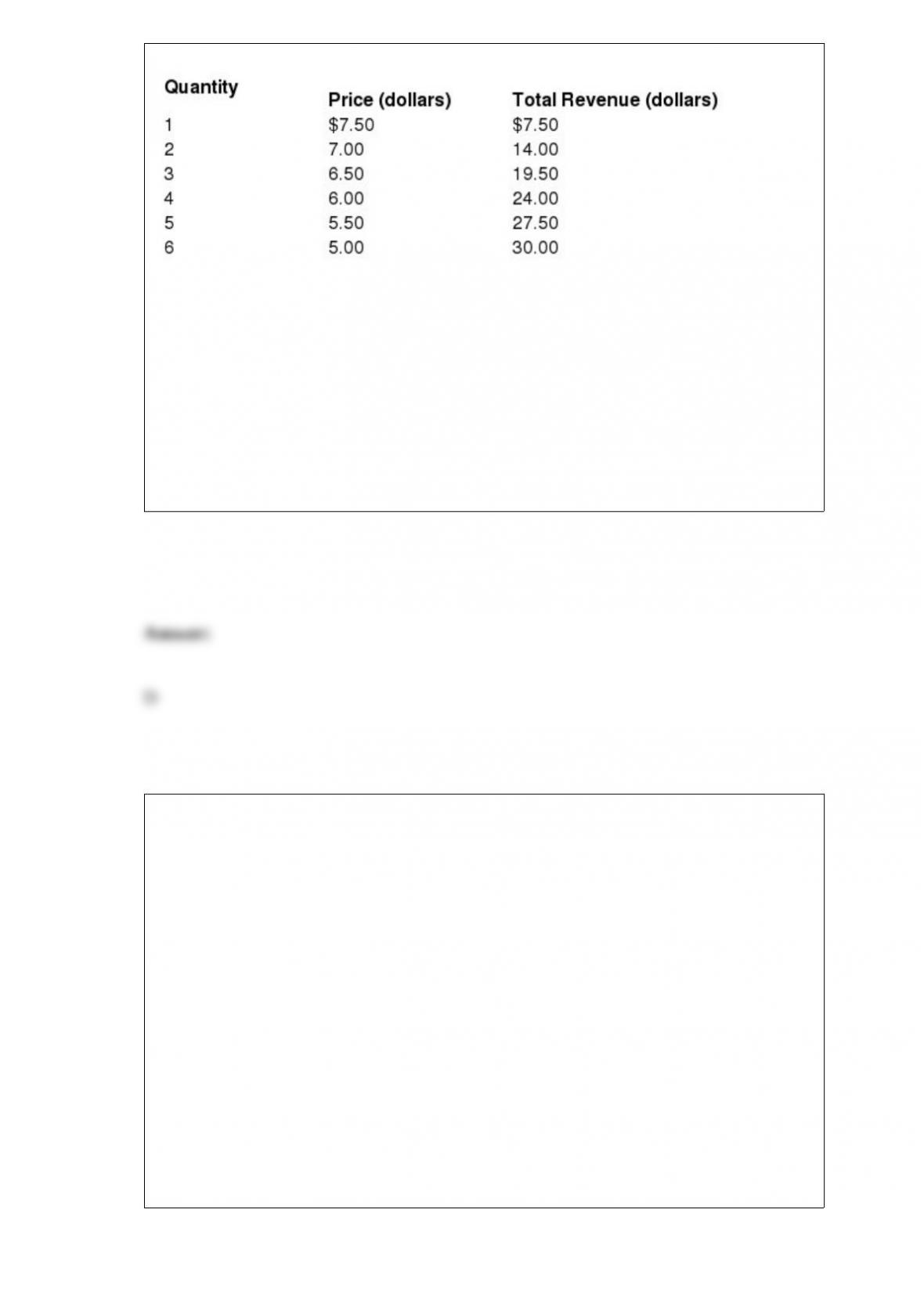
Refer to Table 13-1. What portion of the marginal revenue of the 4th unit is due to the
output effect and what portion is due to the price effect?
A) output effect = $24.00; price effect = $19.50
B) output effect = $6.50; price effect = $2.00
C) output effect = -$0.50; price effect = $5.00
D) output effect = $6.00; price effect = -$1.50
Suppose you have just opened a store to sell espresso machines. Both you and a
competing store buy this machine from a manufacturer for $130 each. Your competitor
who has a store of the same size as yours is currently selling about 10 machines a
month at a price of $200 per machine. You expect to sell about 6 machines a month at a
price of $220 per machine. If you lower your price, you expect to make a loss. Which of
the following could explain why your competitor is able to profitably sell the machine
at a lower price although the cost of purchasing the machine is the same for the both of
you?
A) The competing store probably has a lower marginal cost of production.
B) The competing store probably has a lower average variable cost of production.
C) The competing store’s goal is to maximize revenue and not profit.
D) The competing store probably has a lower average cost because average fixed cost
falls as output increases.
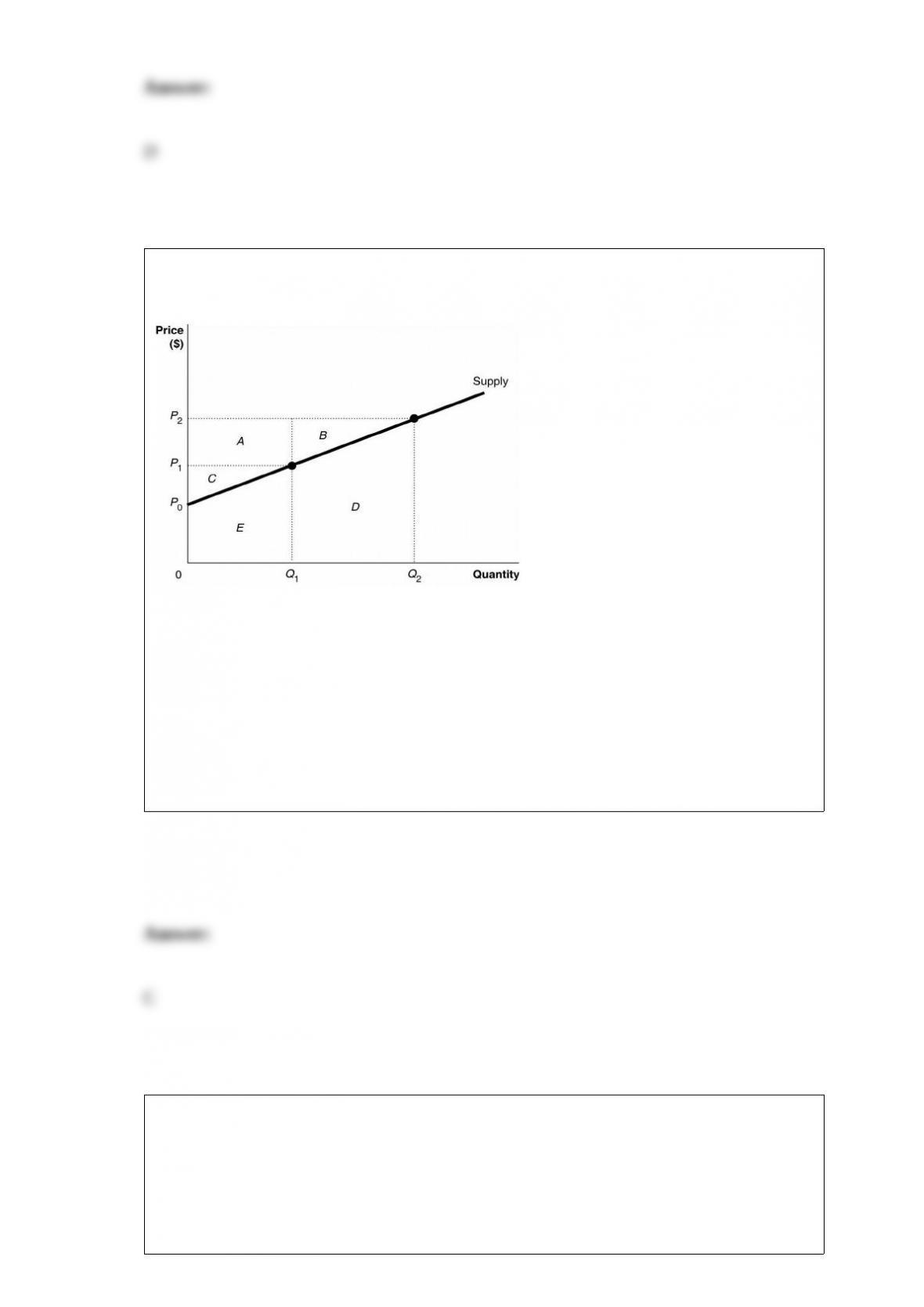
Figure 4-2
Refer to Figure 4-2. What area represents producer surplus at a price of P2?
A) A + B
B) B + D
C) A + B + C
D) A + B + C + D + E
Stan owns a software design business. He obtained a bank loan to buy computer
equipment for his business. He pays $1,000 per month for interest on the loan. He has
10 employees, each of whom is paid $4,000 per month. Because his business has been
successful, next month he will increase employee wages to $5,000. If the revenue from
his business remains at its current level, Stan is considering an addition to his office.
Which of the following statements regarding Stan’s business is false?

A) The payments Stan makes to his employees are variable costs and explicit costs.
B) The monthly payment Stan makes for his bank loan is an implicit cost.
C) The monthly payment Stan makes for his bank loan is a fixed cost.
D) The time and effort Stan spends on his software design business is an implicit cost.
A firm’s net income is also its
A) economic profit.
B) balance sheet.
C) accounting profit.
D) opportunity cost.
What is a factor market?
A) It is a market where financial instruments are traded.
B) It is a market where stocks and bonds are traded.
C) It is a market producers buy consumption and capital goods.

D) It is a market where resources used to produce final goods are traded.