Natural monopolies in the United States are generally regulated by
A) the Federal Trade Commission.
B) the Department of Justice.
C) local or state regulatory commissions.
D) the Department of Commerce.
All of the following would be considered explicit costs of operating a business except
A) rent paid to a landlord.
B) bonuses paid to employees.
C) a normal rate of return for investors.
D) corporate income taxes.
Monopolistically competitive firms can differentiate their products
A) by producing at minimum efficient scale.
B) by producing where marginal revenue equals marginal cost.
C) by equating price and average total cost.
D) through marketing.
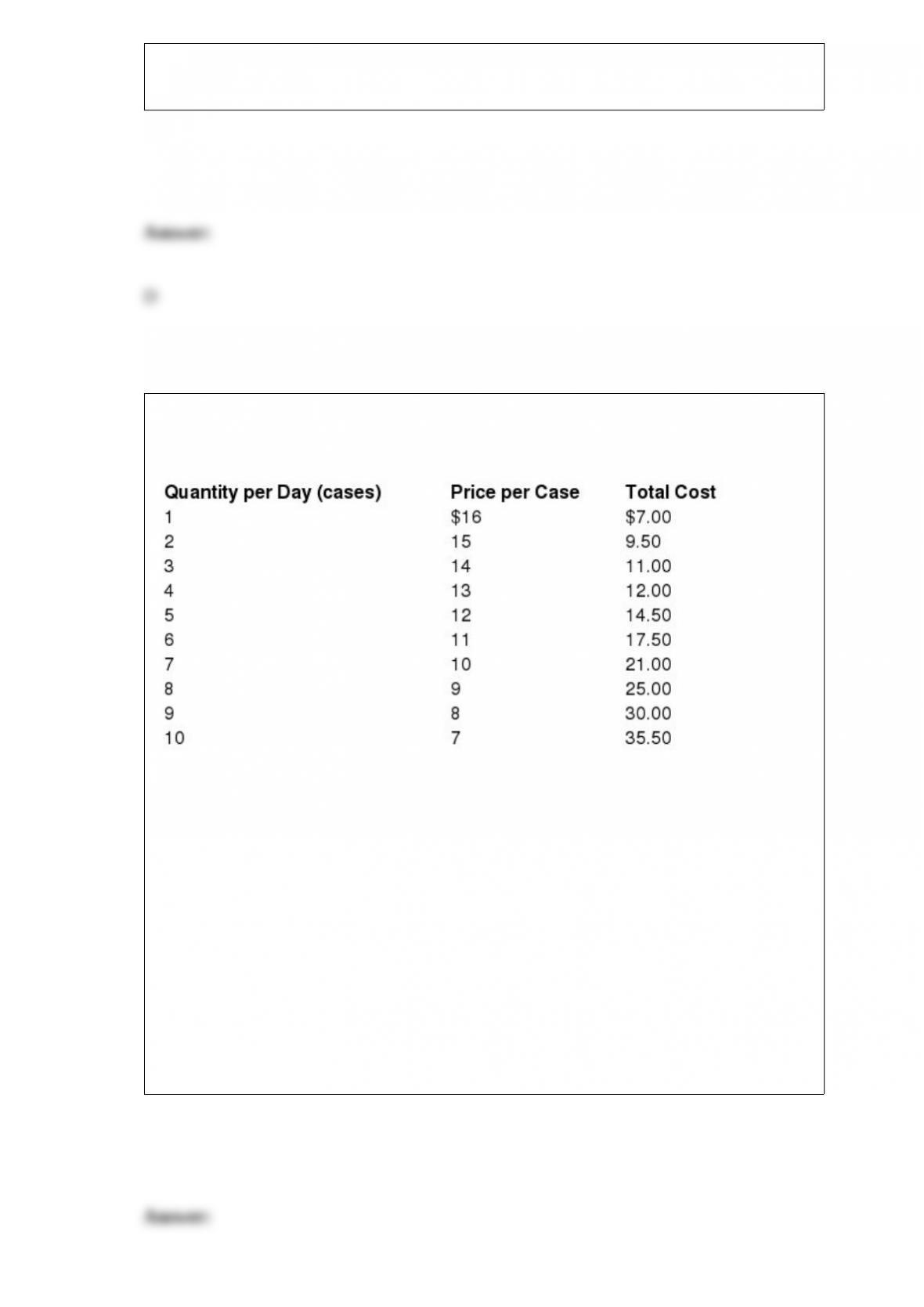
Table 15-2
The government of a small developing country has granted exclusive rights to Linden
Enterprises for the production of plastic syringes. Table 15-2 shows the cost and
demand data for this government protected monopolist.
Refer to Table 15-2. What is the profit-maximizing quantity and price for the
monopolist?
A) Quantity = 8 cases, Price = $9
B) Quantity = 7 cases, Price = $10
C) Quantity = 9 cases, Price = $8
D) Quantity = 10 cases, Price = $7

Economists assume that rational behavior is useful in explaining choices people make
A) because irrational people do not make economic choices.
B) even though people may not behave rationally all the time.
C) because individuals act rationally all the time in all circumstances.
D) even though people rarely, if ever, behave in a rational manner.
Consider three pricing strategies that the firm can pursue:
a. optimal two-part tariff pricing
b. perfect price discrimination
c. single-price monopoly pricing.
Of these three strategies, which is least likely to benefit society as a whole?
A) a two-part tariff pricing because consumers have to pay a fixed fee in addition to a
per-unit price
B) perfect price discrimination because those willing to pay higher prices are forced to
subsidize those who are not
C) Both perfect price discrimination and two-part tariff pricing do not benefit society
because the entire consumer surplus is extracted by the producer.
D) single-price monopoly pricing because there are mutually beneficial trades (between
consumers and seller) that are not exploited

You have a bond that pays $60 per year in coupon payments. Which of the following
would result in a decrease in the price of your bond?
A) Coupon payments on newly-issued bonds fall to $40 per year.
B) The likelihood that the firm issuing your bond will default on debt decreases.
C) The price of a share of stock in the company rises.
D) Coupon payments on newly-issued bonds rise to $75 per year.
A corporation’s management
A) owns the corporation.
B) hires the board of directors.
C) are liable for the corporation’s debts.
D) operates and controls a corporation in its day-to-day activities.

What is the difference between an “increase in demand” and an “increase in quantity
demanded”?
A) There is no difference between the two terms; they both refer to a shift of the
demand curve.
B) An “increase in demand” is represented by a rightward shift of the demand curve
while an “increase in quantity demanded” is represented by a movement along a given
demand curve.
C) There is no difference between the two terms; they both refer to a movement
downward along a given demand curve.
D) An “increase in demand” is represented by a movement along a given demand curve,
while an “increase in quantity demanded” is represented by a rightward shift of the
demand curve.
When a monopolistically competitive firm lowers its price, one good thing happens to
the firm. What is this “one good thing” called?
A) the output effect
B) the price effect
C) the income effect
D) the substitution effect

Which of the following is an example of an activity undertaken by an entrepreneur?
A) designing your landscaping for your new home
B) holding a position as the president of a liberal arts college
C) running for the president of the United States
D) starting your own pet sitting business
“An Inquiry into the Nature and Causes of the Wealth of Nations” published in 1776
was written by
A) John Maynard Keynes.
B) Karl Marx.
C) Alfred Marshall.
D) Adam Smith.
Collusion makes firms better off because if they act as a single entity (a cartel) they can
reduce output and increase their prices and profits. But some cartels have failed and
others are unstable. Which of the following is a reason why cartels often break down?
A) Most cartels do not have a dominant strategy.

B) When a cartel is profitable the amount of competition it faces increases.
C) Members of a cartel may resent having to share their profits equally.
D) Each member of a cartel has an incentive to “cheat” on the collusive agreement by
producing more than its share when everyone else sticks with the collusive agreement.
When the federal government orders firms to use particular methods to reduce
pollution, it is said to be using
A) command-and-control policies.
B) strong-arm tactics.
C) global initiatives.
D) market-based policies.
Rational ignorance
A) explains why consumers ignore sunk costs when they vote.
B) explains the Arrow impossibility theorem.
C) refers to attempts by special interests to use government action to make themselves
better off at the expense of others.

D) helps to explain why rent seeking by special interest groups occurs.
What is the principal-agent problem?
A) It is a problem caused by a person (principal) who hires an agent to act on his behalf
but is unwilling to delegate authority to the agent to carry out the task in the best
possible way.
B) It is a problem caused by agents pursuing their own interests rather than the interests
of the principals who hired them.
C) It is a problem of the power system of boss and subordinate where the boss
(principal) exerts influence over his subordinates (agents) using punishment or threat.
D) It is a problem that exists when a person (principal) has more information about the
task than the agent he hires to perform the task.
If price = marginal cost at the output produced by a perfectly competitive firm and the
firm is earning an economic profit, then
A) marginal revenue is less than price.
B) average total cost is at a minimum.
C) total revenue equals total cost.
D) price exceeds average total cost.

Which of the following is not part of an oligopolist’s business strategy?
A) deciding on how to manage relations with suppliers
B) choosing what new technologies to adopt
C) selecting which new markets to enter
D) independently setting a product’s price without consideration of its rivals’ pricing
policies
The substitution effect of an increase in the price of peaches is
A) the change in the quantity demanded that results from a change in the price of
peaches making peaches more expensive relative to other goods, holding constant the
effect of the price change on consumer purchasing power.
B) the change in the demand for nectarines (a substitute good) that results when
peaches become more expensive relative to nectarines, holding constant the effect of
the price change on consumer purchasing power.
C) the change in the quantity demanded of peaches that results from the effect of the
change in the price of peaches on the consumer’s purchasing power.
D) the change in the demand for peaches that results when the price of peaches
increases.

Which of the following statements best represents the opinion of many economists
regarding the impact that changes in tax laws have had on recent changes in income
inequality in the United States?
A) Reductions in income tax rates have favored high-income individuals more than
low-income individuals. As a result, reductions in federal income tax rates have led to
more income inequality.
B) Reductions in income tax rates have created greater incentives for low-income
individuals to work, save and invest. As a result, reductions in federal income tax rates
have led to less income inequality.
C) Reductions in income tax rates probably have had little impact on the distribution of
income.
D) Reductions in income tax rates have been offset by increases in corporate income tax
rates and payroll taxes. As a result, greater income inequality in the 1990s has been
followed by a more equal distribution of income since 2001.
Table 13-4
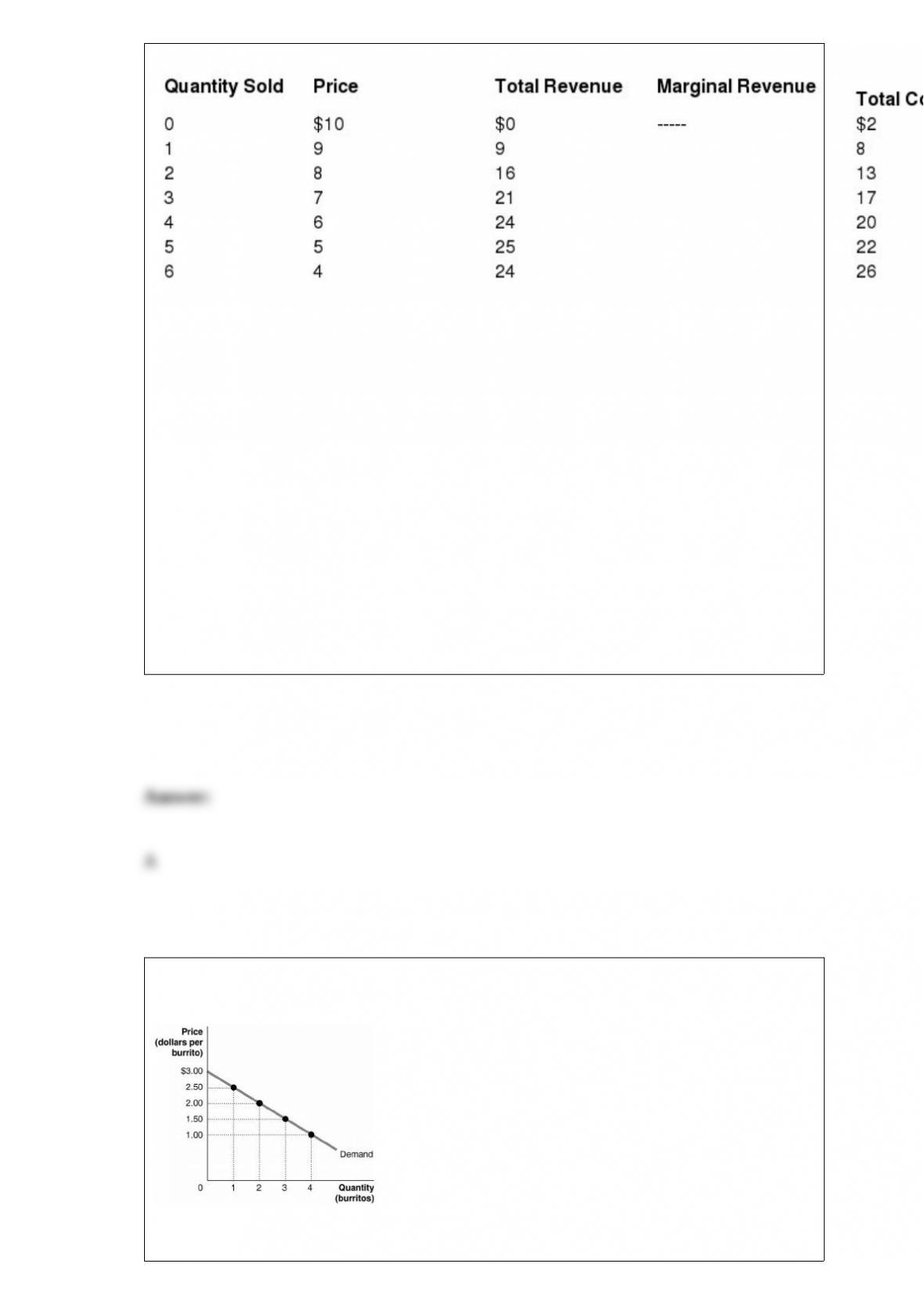
Table 13-4 lists estimated revenues and costs (per week) for plastic vials (100 vials per
box) for the Victoria Biological Supplies Company. Victoria sells plastic vials to
university and private research laboratories.
Refer to Table 13-4. Based on the data in the table, which of the following statements is
true?
A) The table summarizes Victoria’s short-run, rather than long-run, market for plastic
vials.
B) Victoria could be either a monopolistically competitive or a perfectly competitive
firm.
C) Victoria should shut down temporarily.
D) Victoria should advertise more in order to increase the demand for plastic vials.
Figure 4-1
Figure 4-1 shows Arnold’s demand curve for burritos.
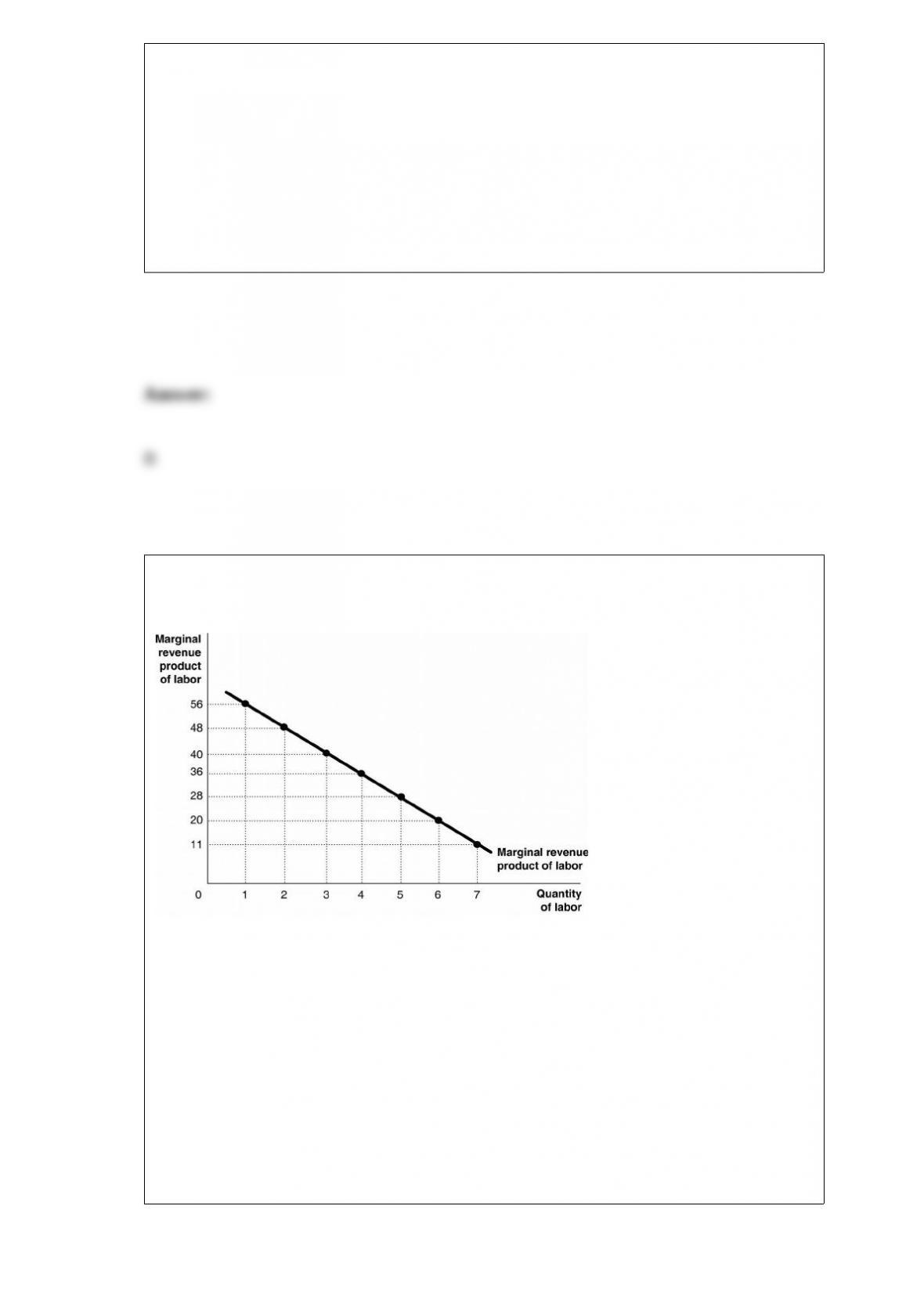
Refer to Figure 4-1. Arnold’s marginal benefit from consuming the third burrito is
A) $1.25.
B) $1.50.
C) $2.50.
D) $6.00.
Figure 17-1
Figure 17-1 shows the marginal revenue product for Dale’s Hand-Sewn Doilies, a
producer of linen doilies.
Refer to Figure 17-1. If the wage rate is $40, how many workers should Dale hire?
A) 6 units
B) 5 units
C) 4 units
D) 3 units
At the profit-maximizing level of output for a perfectly competitive firm
A) price equals marginal cost.
B) average revenue equals average variable cost and price equals marginal cost.
C) marginal revenue equals marginal cost and average total cost equals average fixed
cost.
D) price equals average revenue and marginal cost equals average variable cost.
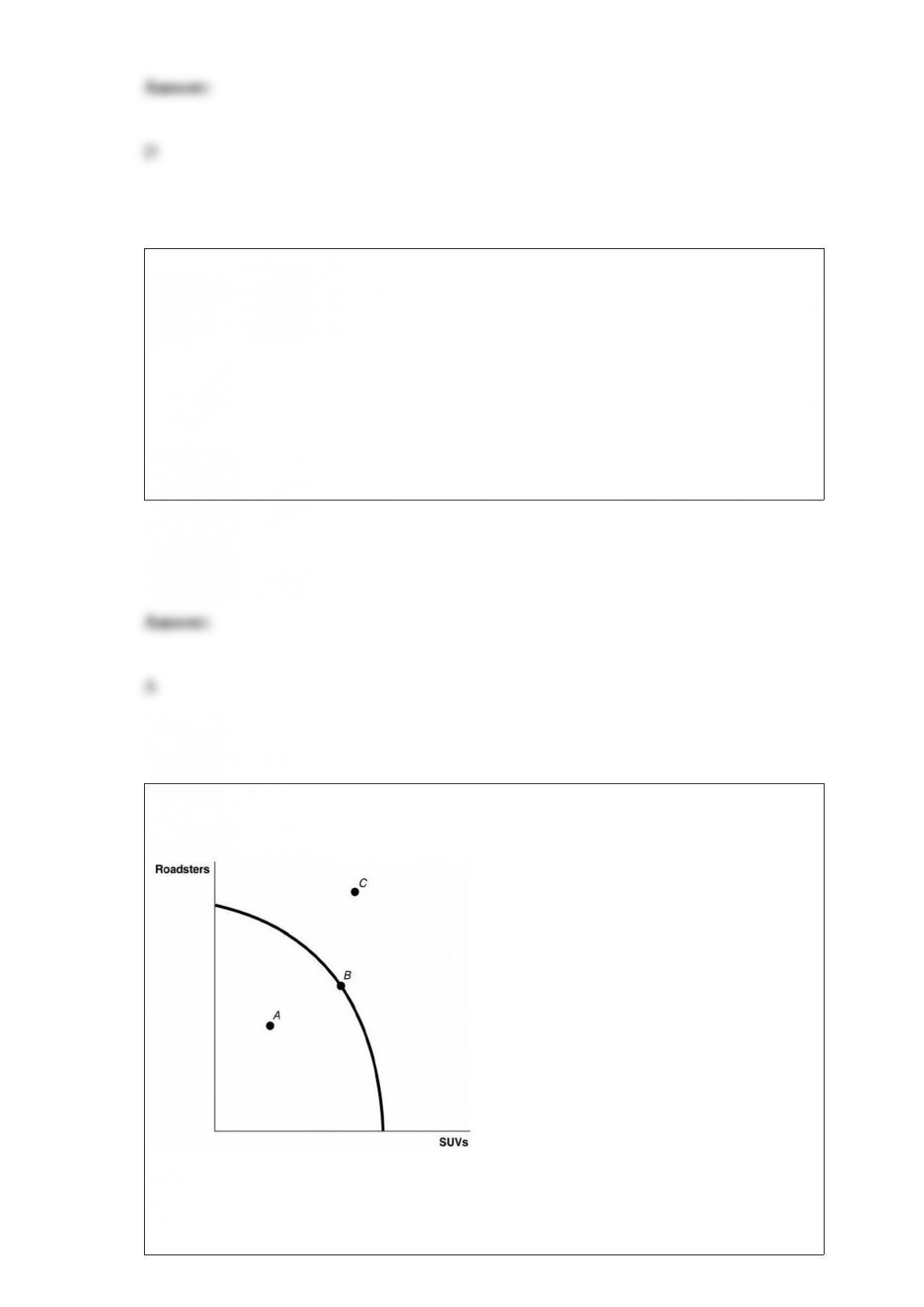
Figure 2-1
Refer to Figure 2-1. Point C is
A) technically efficient.
B) unattainable with current resources.
C) inefficient in that not all resources are being used.
D) is the equilibrium output combination.
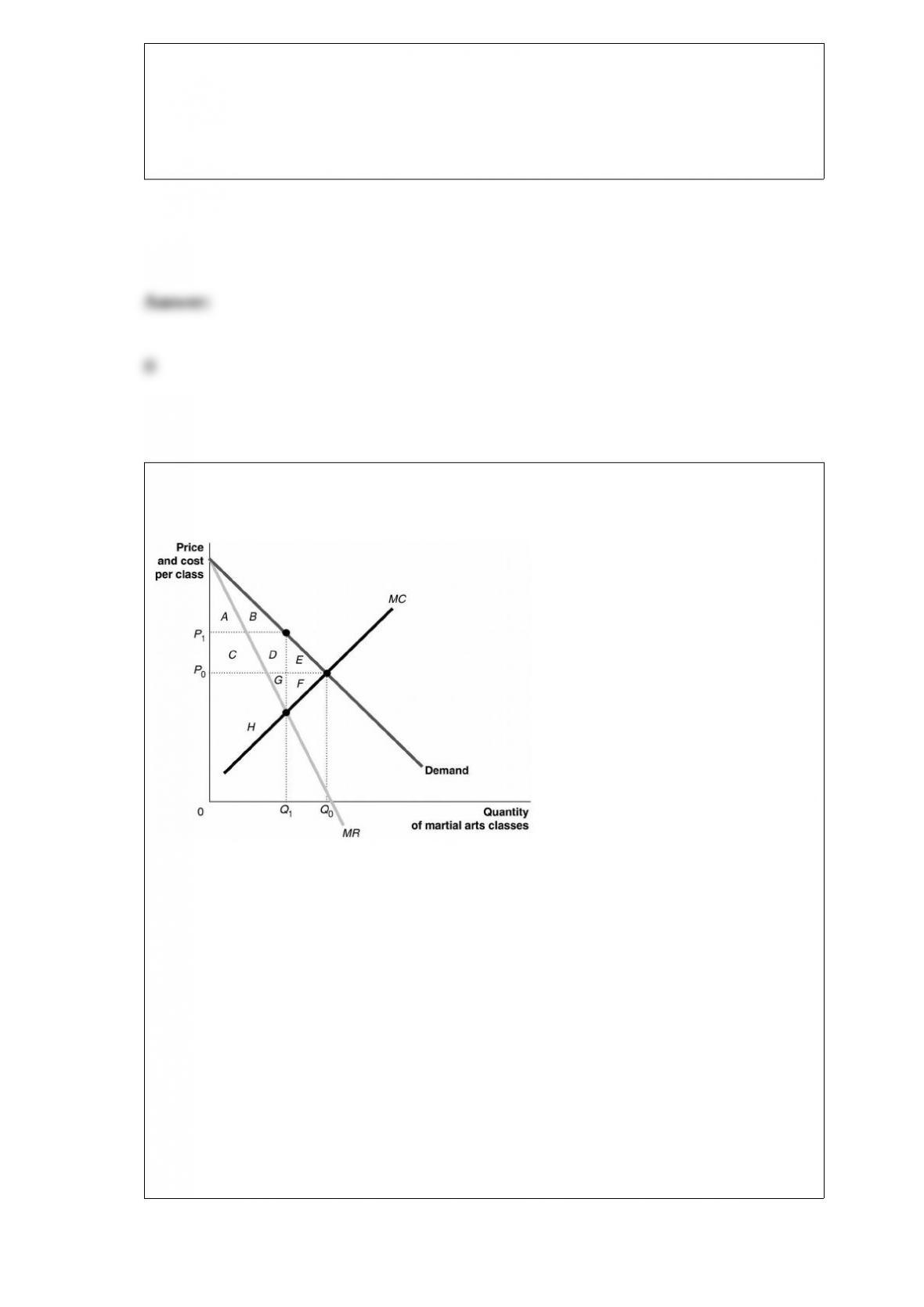
Figure 16-6
Watanabe Sensei operates the only martial arts school in Hartfield. For simplicity,
assume that consumers have identical demand curves and that Sensei knows what this
demand curve is. Figure 16-6 shows this demand curve.
Refer to Figure 16-6. With a two-part pricing scheme – a monopoly price for classes
and a one-time membership fee – what is the amount of producer surplus Sensei will
earn?
A) an amount equal to the area A + B + C + D
B) an amount equal to the area E + F
C) an amount equal to the area A + C + H
D) an amount equal to the area A + B + C + D + H + G

The value you give today to money you will receive in the future is called the future
payment’s
A) time-sensitive value.
B) future value.
C) present value.
D) historical value.
When a credit card company offers different services with its card, like travel insurance
for air travel tickets purchased with the credit card or product insurance for items
purchased with the card, the credit card company is trying to
A) create a barrier to entry for competing firms.
B) create a perfectly competitive market in which to sell its credit card.
C) convince customers that its card has greater value than those offered by rival firms.
D) shift the demand curve for competing firms to the right.
An increase in a perfectly competitive firm’s demand for labor could be caused by
A) a decrease in the market wage rate.
B) an increase in the amount of human capital among the labor force.
C) an increase in the supply of labor.
D) a decrease in the market price of the product the firm produces.
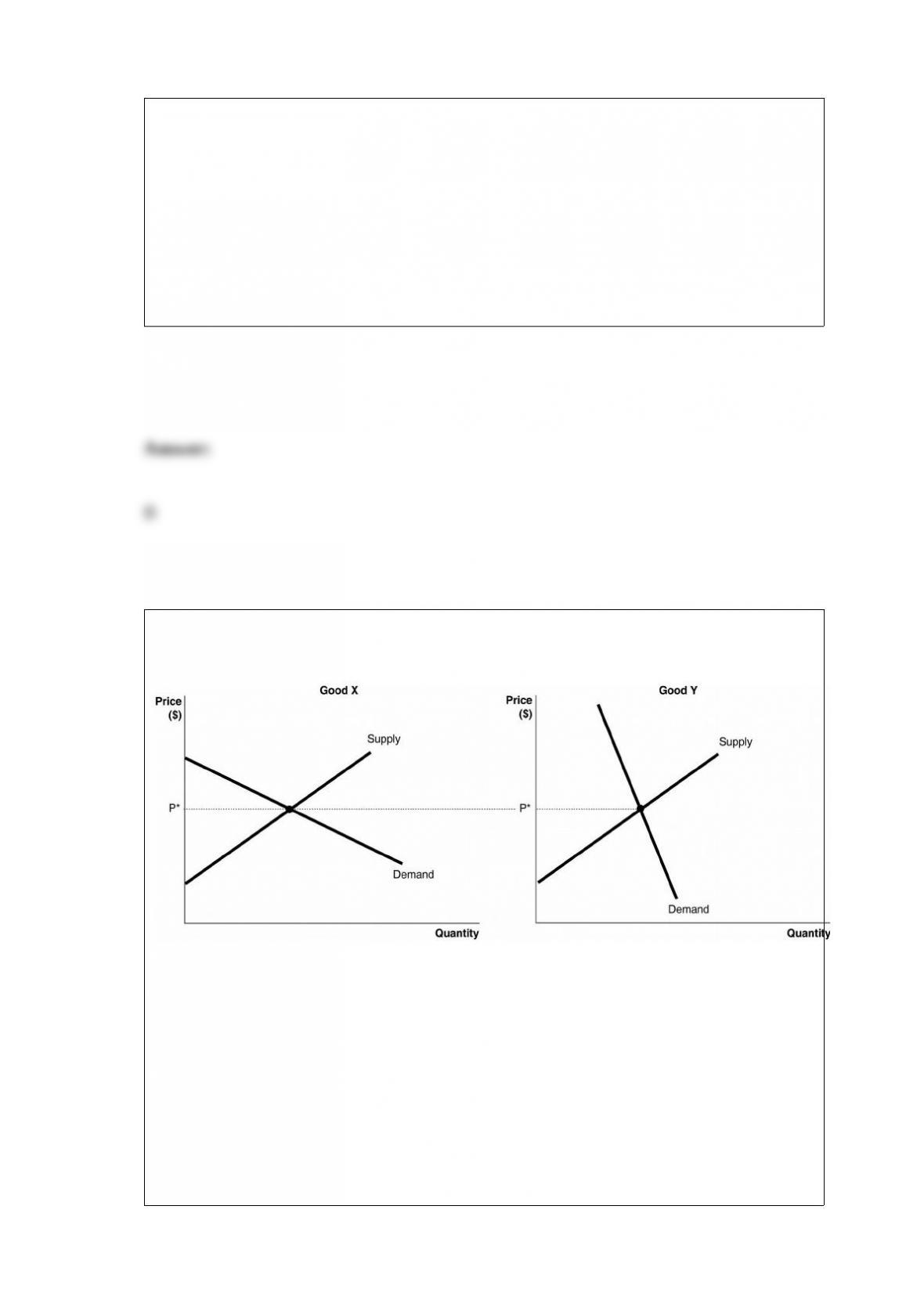
Figure 4-11
Refer to Figure 4-11. The figure above illustrates the markets for two goods, Good X
and Good Y. Suppose an identical dollar tax is imposed in each market.
a. Compare the consumer burden and producer burden in each market. Illustrate your
answer graphically.
b. If the goal of the government is to raise revenue with minimum impact to quantity
consumed, in which market should the tax be imposed?
c. If the goal of the government is to discourage consumption, in which market should
the tax be imposed?