
When the price of tortilla chips rose by 10 percent, the quantity of tortilla chips sold fell
4 percent, and the sale of dips (like salsa and bean dip) fell 8 percent. This set of facts
indicates that
A) the cross-price elasticity between tortilla chips and dips is 0.8, so the two are
substitutes.
B) the cross-price elasticity between tortilla chips and dips is -0.4, so the two are
complements.
C) the cross-price elasticity between tortilla chips and dips is -0.8, so the two are
complements.
D) the cross-price elasticity between tortilla chips and dips is 0.4, so the two are
substitutes.
What is a primary market?
A) a market where primary inputs like steel are sold
B) a market where you can sell any bonds you own as a private investor
C) a market where a newly issued claims are sold to initial buyers by the borrowing
firm
D) a market where you can sell any stocks you own as a private investor
A monopolistically competitive industry that earns economic profits in the short run
will
A) continue to earn economic profits in the long run.
B) experience the entry of new rival firms into the industry in the long run.
C) experience the exit of existing firms out of the industry in the long run.
D) experience a rise in demand in the long run.
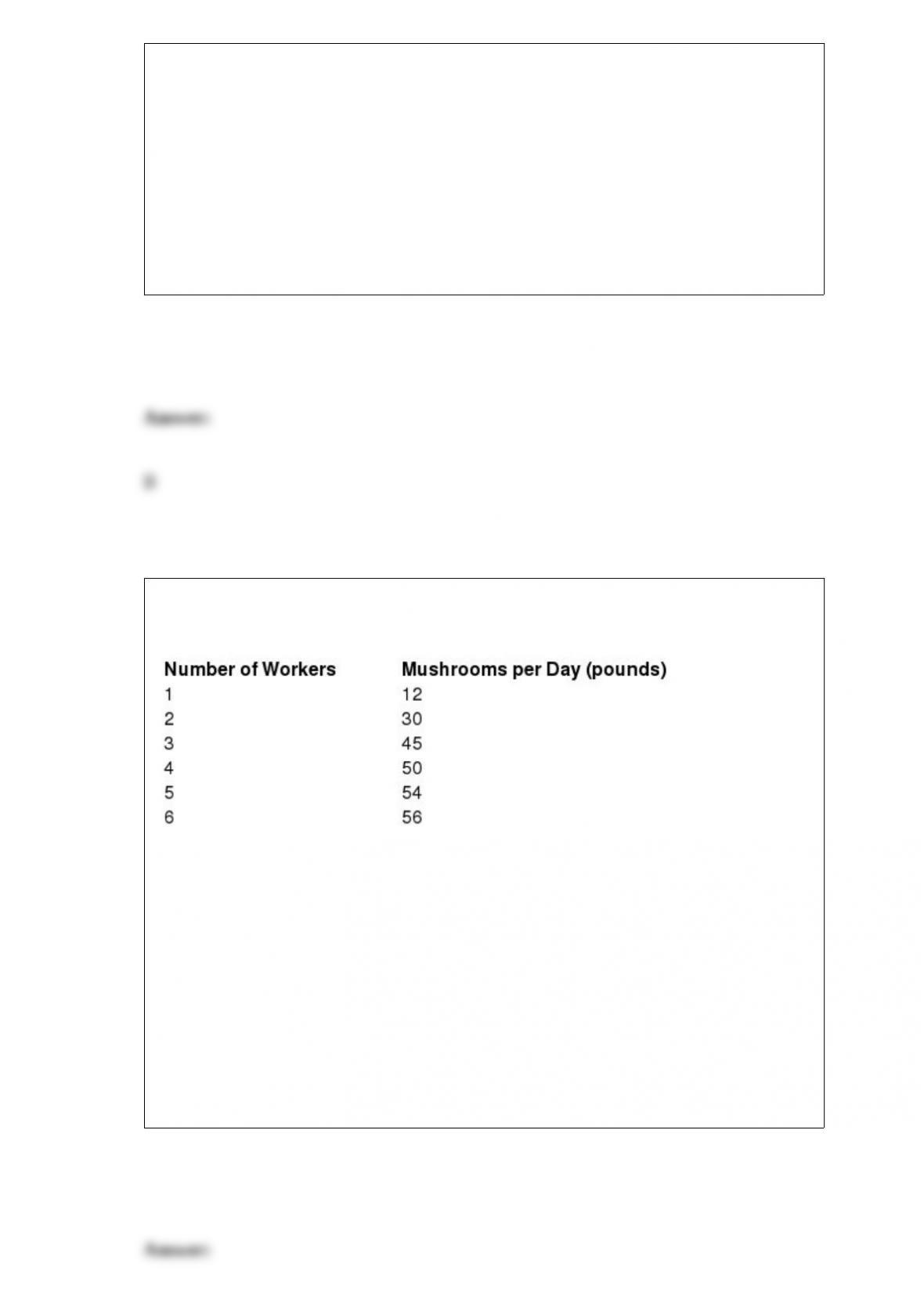
Table 11-1
Table 11-1 shows the technology of production at the Matsuko’s Mushroom Farm for
the month of May.
Refer to Table 11-1. What is the marginal product of the 4th worker?
A) 137 pounds
B) 50 pounds
C) 12.5 pounds
D) 5 pounds

Governments grant patents to
A) compensate firms for research and development costs.
B) encourage competition.
C) encourage low prices.
D) encourage firms to reveal secret production techniques.
Making optimal decisions “at the margin” requires
A) making decisions according to one’s whims and fancies.
B) making consistently irrational decisions.
C) weighing the costs and benefits of a decision before deciding if it should be pursued.
D) making borderline decisions.
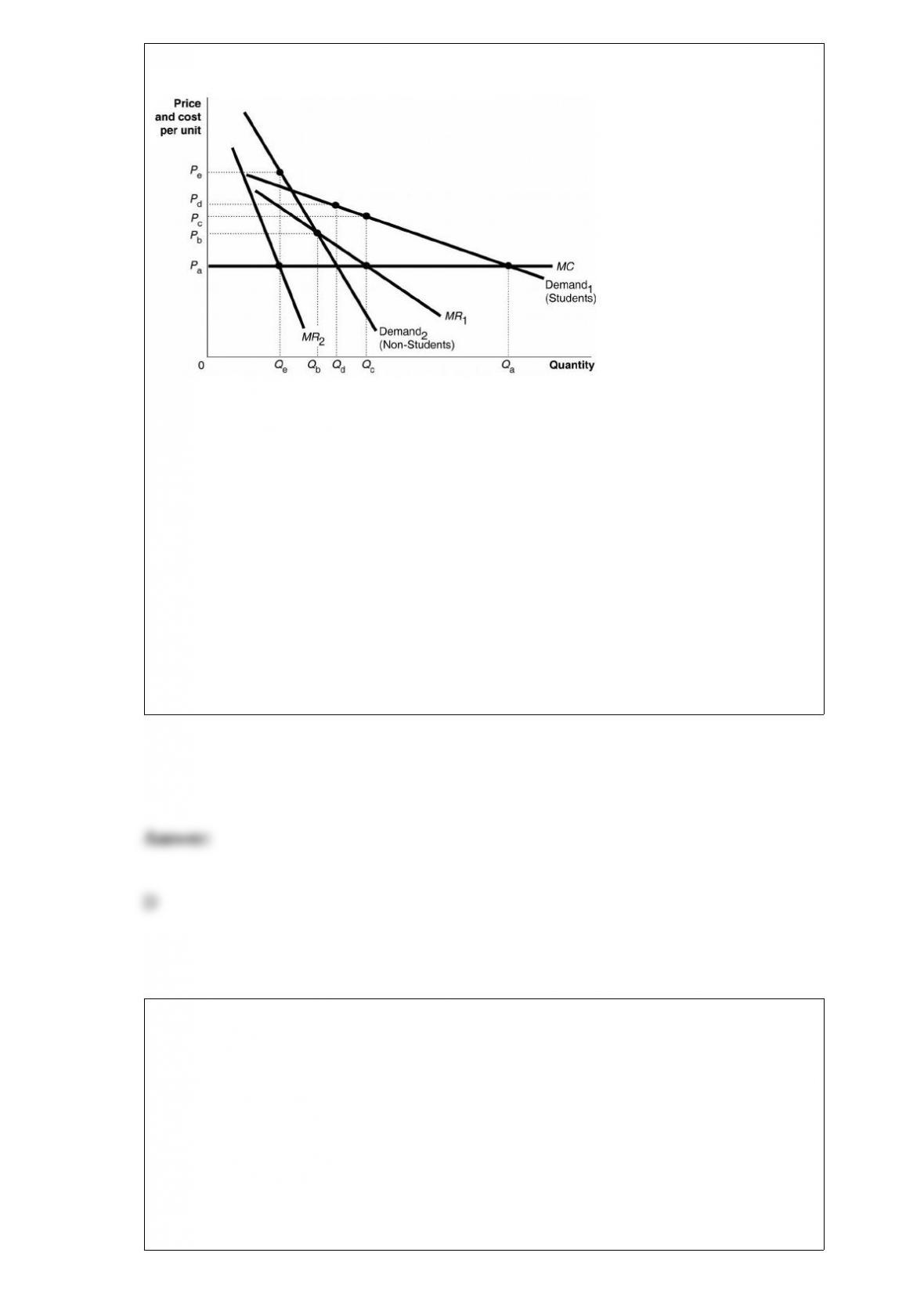
Figure 16-2
Plato Playhouse, a theatre company in the university town of Wegg, caters to two
groups of customers: students and the non-student population. Figure 16-2 shows the
demand curves for the two groups of customers.
Refer to Figure 16-2. What is the price charged in the two markets?
A) price in the student market = price in the non-student market = Pa
B) price in the student market = price in the non-student market = Pb
C) price in the student market = Pd;price in the non-student market = Pe
D) price in the student market = Pc;price in the non-student market = Pe
The revenue received from the sale of ________ of a product is a marginal benefit to
the firm.
A) an additional unit
B) the total number of units
C) no units
D) only profitable units

What is the voting paradox?
A) the observation that less than 60 percent of those eligible to vote actually vote
B) the observation that majority voting may not always result in consistent choices
C) the idea that wealthy corporations are able to sway politicians to act in ways contrary
to the desires of the majority
D) people are aware that their votes will not change the political outcome since these
outcomes are predetermined by a group of influential politicians
If the Apple iPhone and the Samsung Galaxy are considered substitutes, then, other
things equal, an increase in the price of the iPhone will
A) decrease the demand for the iPhone.
B) increase the demand for the Galaxy.
C) increase the quantity demanded for the Galaxy.
D) increase the quantity demanded for the iPhone.
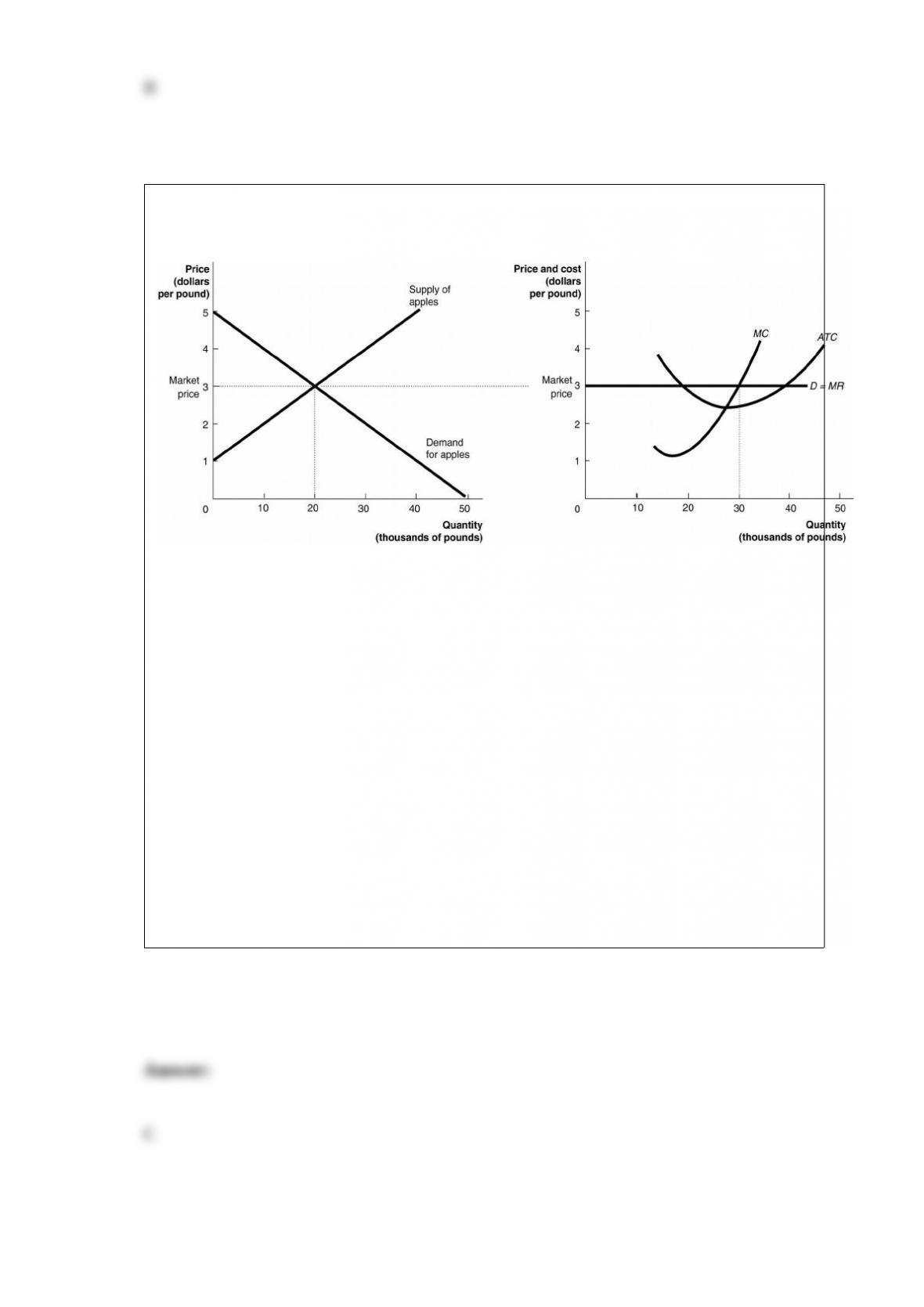
Figure 12-17
The graphs in Figure 12-17 represent the perfectly competitive market demand and
supply curves for the apple industry and demand and cost curves for a typical firm in
the industry.
Refer to Figure 12-17. Which of the following statements is true?
A) The current market price is $3 but the firm will be able to increase the price in the
future.
B) The current market price is $3 but the price will fall in the long-run as a result of a
decrease in demand.
C) The current market price is $3 but the price will fall in the long-run as new firms
enter the market.
D) The current market price is $3 but the price will increase in the future as the market
demand increases.

The Sarbanes-Oxley Act of 2002 was passed in response to what event?
A) a series of accounting scandals
B) unexpected increases in dividend payments to stockholders at various corporations
C) volatility in NASDAQ indexes
D) historically low bond prices
What happens to the absolute value of marginal rate of substitution as you move down a
convex (bowed toward the origin) indifference curve?
A) increases
B) decreases
C) remains constant
D) could increase or decrease
The justification for occupational licensing laws is that they protect the public from
incompetent practitioners (for example, lawyers and medical doctors), but the laws also
result in
A) higher prices and restrictions on the number of people who can enter the professions
affected by the laws.

B) economies of scale.
C) ownership of a key input.
D) an increase in the amount of output required to achieve minimum efficient scale.
Typically, the higher the level of income per person in a country, the higher the level of
spending per person on health care. This relationship between income and spending
indicates that health care is a
A) normal good.
B) inferior good.
C) luxury.
D) necessity.
Which of the following would shift the supply curve for MP3 players to the left?
A) an increase in the price of an input used to produce MP3 players
B) a decrease in consumer tastes for MP3 players
C) an increase in the number of firms that produce MP3 players
D) an increase in the productivity of the workers who produce MP3 players
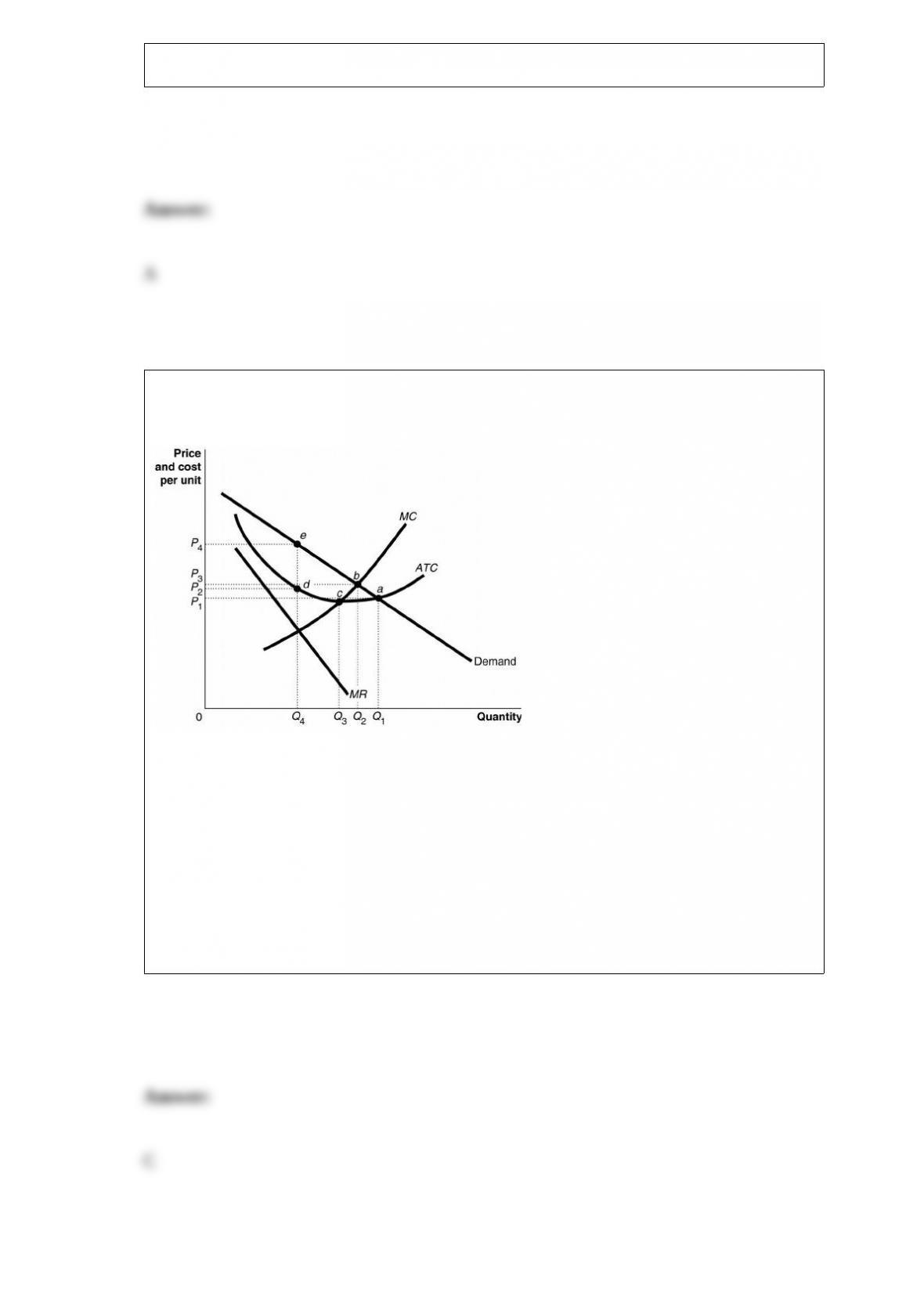
Figure 13-13
Refer to Figure 13-13. Economies of scale are exhausted at which output level?
A) Q1 units
B) Q2 units
C) Q3 units
D) more than Q1units
A monopoly firm’s demand curve
A) is the same as the market demand curve.
B) is perfectly inelastic.
C) is more inelastic than the demand curve for the product.
D) is inelastic at high prices and elastic at lower prices.
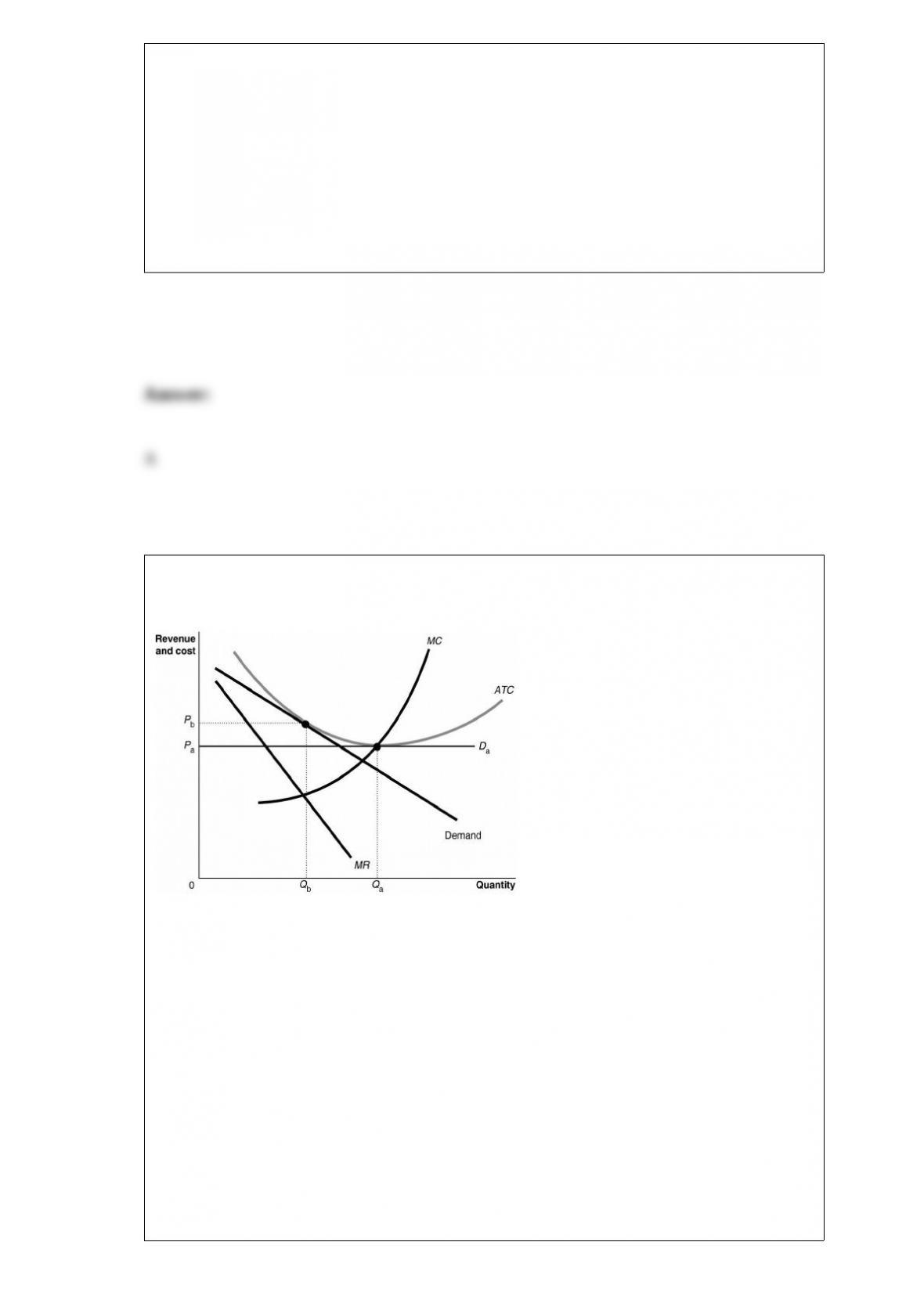
Figure 13-18
Refer to Figure 13-18. The diagram demonstrates that
A) in the short run, the monopolistic competitor produces an output Qb but in the long
run after it adjusts its capacity, it will produce the allocatively efficient output, Qa.
B) it is not possible for a monopolistic competitor to produce the productively efficient
output level, Qa, because of product differentiation.
C) it is possible for a monopolistic competitor to produce the productively efficient
output level, Qa, if it is willing to lower its price from Pbto Pa.
D) in the long run, the monopolistic competitor produces the minimum-cost output
level, Qa, but in the short run its output of Qbis not cost minimizing.

The French Bakery ran a special which decreased the price of its croissants from $1.50
to $1.00. Although her money income had not changed, Toni decided to buy 2
croissants instead of her usual 1 bagel and 1 croissant. Toni’s actions are explained by
which of the following?
A) income effect only or substitution effect only but not both effects
B) income and substitution effects
C) price effect
D) consumption effect
Which of the following products comes closest to having a perfectly inelastic demand?
A) gasoline
B) cholesterol medication in general
C) iPhones
D) bus rides

Assume price exceeds average variable cost over the relevant range of demand. If a
monopolistically competitive firm is producing at an output where marginal revenue is
$23 and marginal cost is $19, then to maximize profits the firm should
A) continue to produce the same quantity.
B) increase output.
C) decrease output.
D) shutdown.
The ability of a firm to charge a price greater than marginal cost is called
A) monopoly power.
B) price-making power.
C) cost-plus pricing.
D) market power.

According to a study of the U.S. demand for alcoholic beverages, the price elasticity of
demand for beer is -0.30. Which of the following could explain why the price elasticity
of demand for beer is low?
A) Beer is an inferior alcoholic beverage.
B) More and more people are switching to wine and cocktails rather than beer.
C) The price of beer is relatively low and for many people it is a habit forming product.
D) There are only a few major suppliers of beer.
The demand curve for a public good is also called the
A) total welfare curve.
B) marginal social benefit curve.
C) total social benefit curve.
D) total willingness-to-pay curve.
In the United States, taxpayers are allowed to exclude from taxation a certain amount of
income, called
A) the personal income exclusion.

B) the income allowance.
C) the income tax credit.
D) the personal exemption.
Workers who dislike risk
A) prefer to be paid monthly rather than weekly or daily.
B) prefer a piece-rate compensation system to a salary system.
C) prefer a salary system to a commission compensation system.
D) prefer to be paid a salary rather than a wage.
In the city of Alvarez, with the exception of guide dogs for blind people, all dogs are
banned from its three public parks, regardless of whether the animals are leashed. Many
residents are pushing for a change in policy. Canine lover Sara Northridge observed,
“There are 800 or more homes here. There are three parks within 10 minutes, and
almost everyone has a dog, but we can’t take our dogs there.” Others fear that allowing
dogs would detract from their enjoyment of the parks. Tim Cortis retorted, “We’re not
preventing dog lovers from enjoying the park, just come without your dog.” Which of
the following is a way of dealing with the problem by assigning property rights to a
particular group?
A) impose a two-tier entry fee system – a lower fee for non dog owners and a higher fee
for dog owners
B) impose a fee only for dog-owners to use the public parks; non dog owners do not
pay a fee
C) dedicate some parks, or at least one park, exclusively for the use of visitors bringing
dogs to the park
D) allow dog owners to bring their dogs to the park but insist that they keep watch over
their dogs
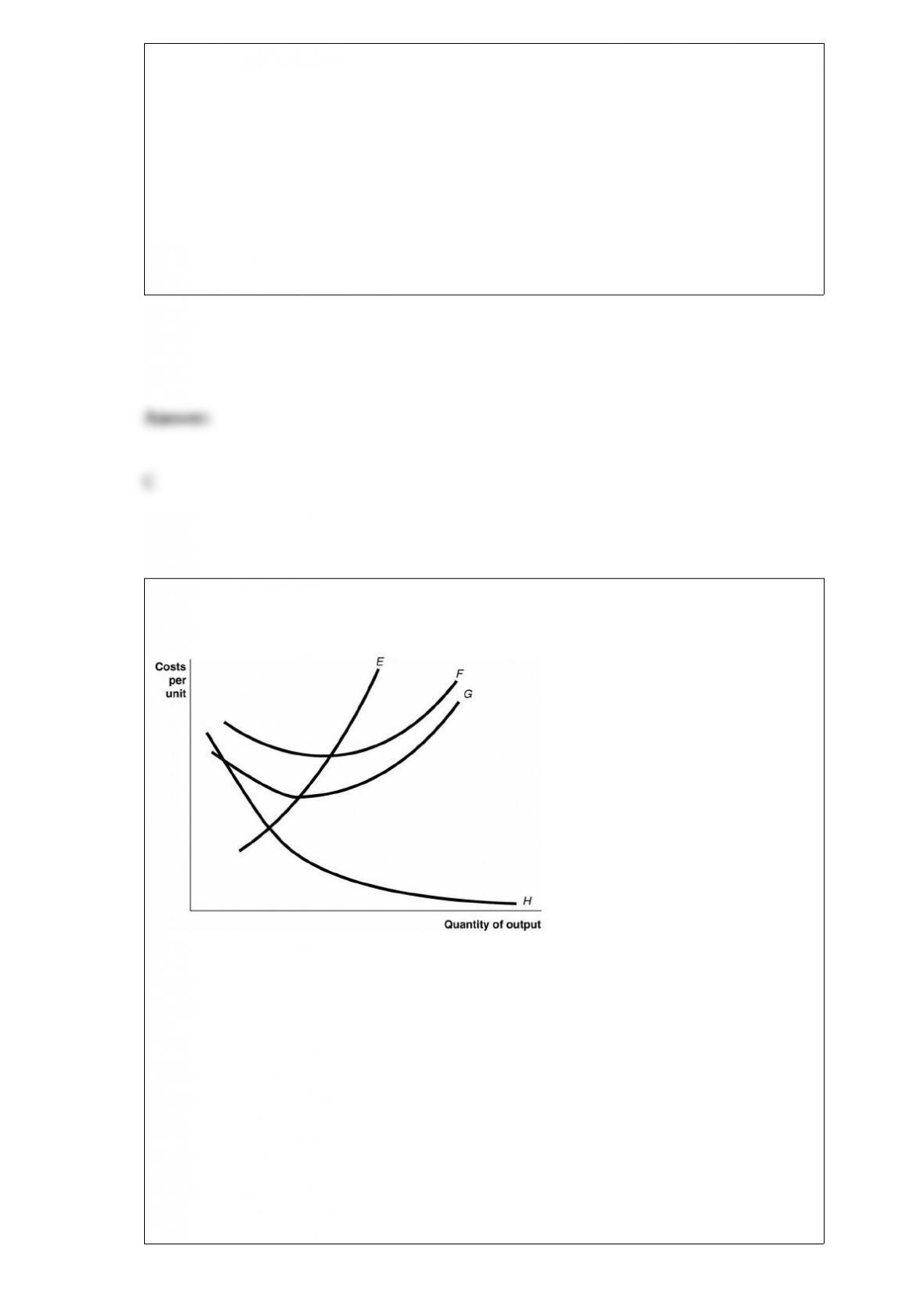
Figure 11-5
Refer to Figure 11-5. Identify the curves in the diagram.
A) E = average fixed cost curve; F = variable cost curve; G = total cost curve, H =
marginal cost curve
B) E = marginal cost curve; F = total cost curve; G = variable cost curve, H = average
fixed cost curve
C) E = average fixed cost curve; F = average total cost curve; G = average variable cost
curve, H = marginal cost curve
D) E = marginal cost curve; F = average total cost curve; G = average variable cost
curve; H = average fixed cost curve.

Which of the following is a characteristic of stock?
A) Stock represents a promise to repay a fixed amount of funds.
B) The face value or principal plus interest is repaid at a specified period of time.
C) The length of coupon payments is fixed by the stated maturity period.
D) Stock represents ownership in a firm
At a product’s equilibrium price
A) the product’s demand curve is the same as the product’s supply curve.
B) the quantity of the product demanded is greater than the quantity of the product
supplied.
C) the quantity of the product demanded is less than the quantity of the product
supplied.
D) the product’s demand curve crosses the product’s supply curve.