
Consider the market for pilots. What is likely to happen to the equilibrium wage and
quantity of pilots if the government enforces a lower mandatory retirement age, say
from age 65 to age 62?
A) The equilibrium wage and the equilibrium quantity of pilots rise.
B) The equilibrium wage and the equilibrium quantity of pilots fall.
C) The equilibrium wage falls and the equilibrium quantity of pilots rises.
D) The equilibrium wage rises and the equilibrium quantity of pilots falls.
Where do economic agents such as individuals, firms and nations, interact with each
other?
A) in public locations monitored by the government
B) in any arena that brings together buyers and sellers
C) in any physical location people where people can physically get together for selling
goods, such as shopping malls
D) in any location where transactions can be monitored by consumer groups and taxed
by the government
Figure 16-1

Refer to Figure 16-1. What is the price charged under perfect price discrimination?
A) P3
B) P4
C) a range of prices corresponding to the demand curve from P3 and above
D) a range of prices corresponding to the demand curve from P4 and above
Figure 13-15
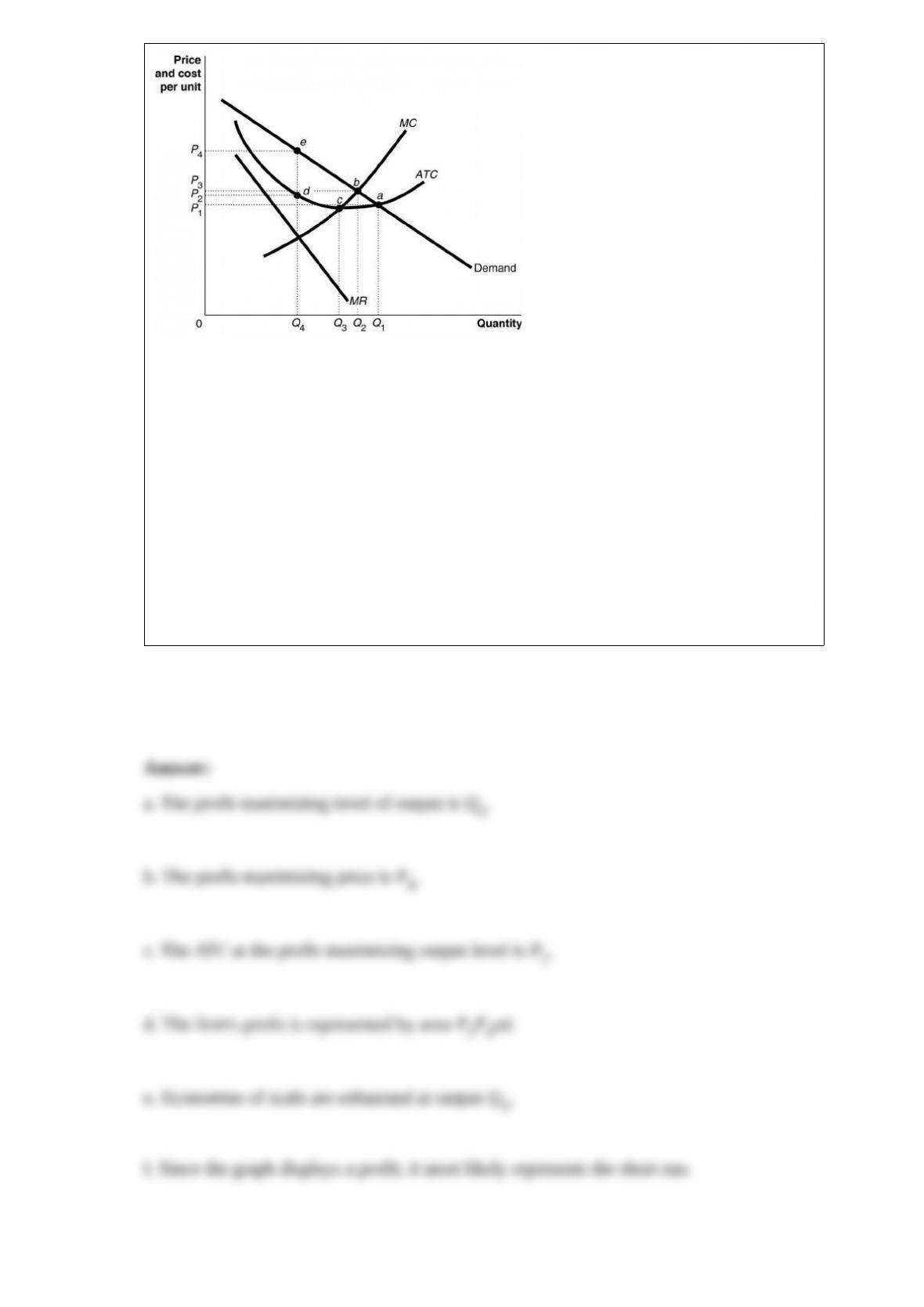
Refer to Figure 13-15 to answer the following questions.
a. What is the profit-maximizing output level?
b. What is the profit-maximizing price?
c. What is the average total cost at the profit-maximizing output level?
d. What area represents the firm’s profit?
e. At which output level are economies of scale exhausted?
f. Does this graph most likely represent the long run or the short run? Why?

________ is the trend toward greater economic, cultural, political, and technological
interdependence among national institutions and economies.
A) Privatization
B) Heterogenization
C) Globalization
D) Decentralization
If, in the market for oranges, the supply has increased then
A) the supply curve for oranges has shifted to the right.
B) the supply curve for oranges has shifted to the left.
C) there has been a movement upwards along the supply curve for oranges.
D) there has been a movement downwards along the supply curve for oranges.
Table 9-2

Sarita and Gabriel own S&G Bakery. Table 9-2 lists the number of pies and cakes Sarita
and Gabriel can each bake in one day.
Refer to Table 9-2. Select the statement that accurately interprets the data in the table.
A) Sarita has a comparative advantage in baking pies.
B) Gabriel has a comparative advantage in baking cakes.
C) Sarita has a comparative advantage in baking pies and baking cakes.
D) Sarita has a comparative advantage in baking cakes.
Ted’s Pancake Kitchen suffers a short-run loss. When should Ted decide to shut down
rather than continue to produce?
A) if his Kitchen’s revenue is less than its variable costs
B) if his Kitchen’s revenue is less than its fixed costs
C) if his Kitchen’s revenue is less than its explicit costs
D) if his Kitchen’s revenue is less than its total costs
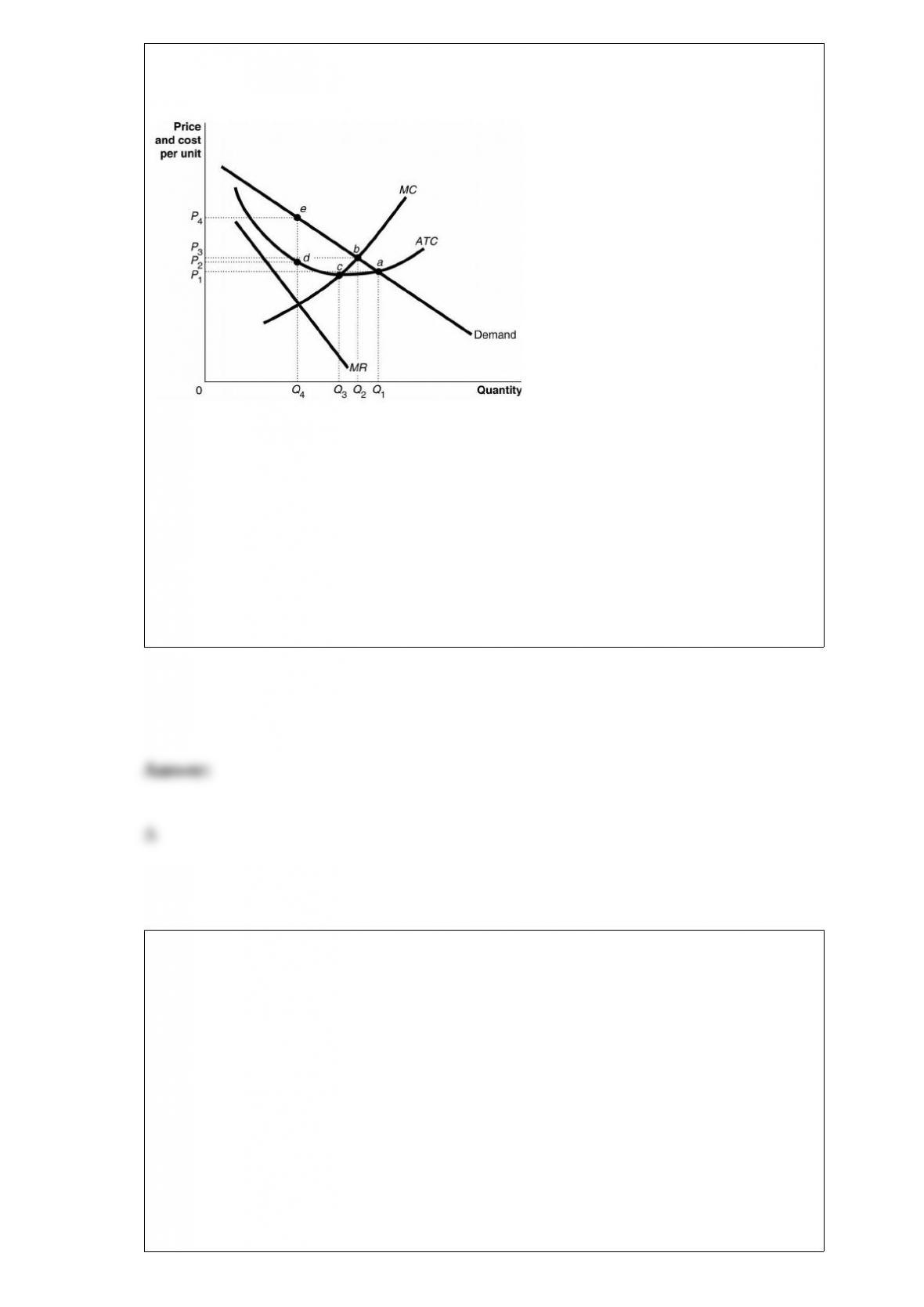
Figure 13-13
Refer to Figure 13-13. What is the output price?
A) P4
B) P3
C) P2
D) P1
The prices college students and faculty members pay for Apple computers are lower
than the prices Apple charges on its Website and in retail stores. Apple charges lower
prices to college students and faculty members because
A) college students and faculty members have a more elastic demand for computers
than the general public.
B) Apple can deduct from its federal taxes some of the costs of the computers it sells to
college students and faculty members.
C) college students and faculty members have a more inelastic demand for computers
than the general public.

D) college students and faculty members typically buy more supplies from Apple (print
cartridges, paper, etc.,) than the general public.
Which of the following displays rivalry and excludability in consumption?
A) public goods
B) private goods
C) quasi-public goods
D) common resources
Harry attended a baseball card show in New York City where he bought a number of
rookie cards of Pittsburgh Pirates baseball players from the 1950s and 1960s. Harry
then sold the cards in Pittsburgh, Harry’s hometown, where he knew the cards sold for
higher prices. The profits Harry earned from these transactions are called
A) arbitrage profits.
B) normal profits.
C) accounting profits.
D) implicit profits.
In an oligopoly, firms can increase their market power by
A) selling to buyers who have market power.
B) pursuing dominant strategies.
C) colluding to set prices.
D) undertaking heavy advertising expenditure.
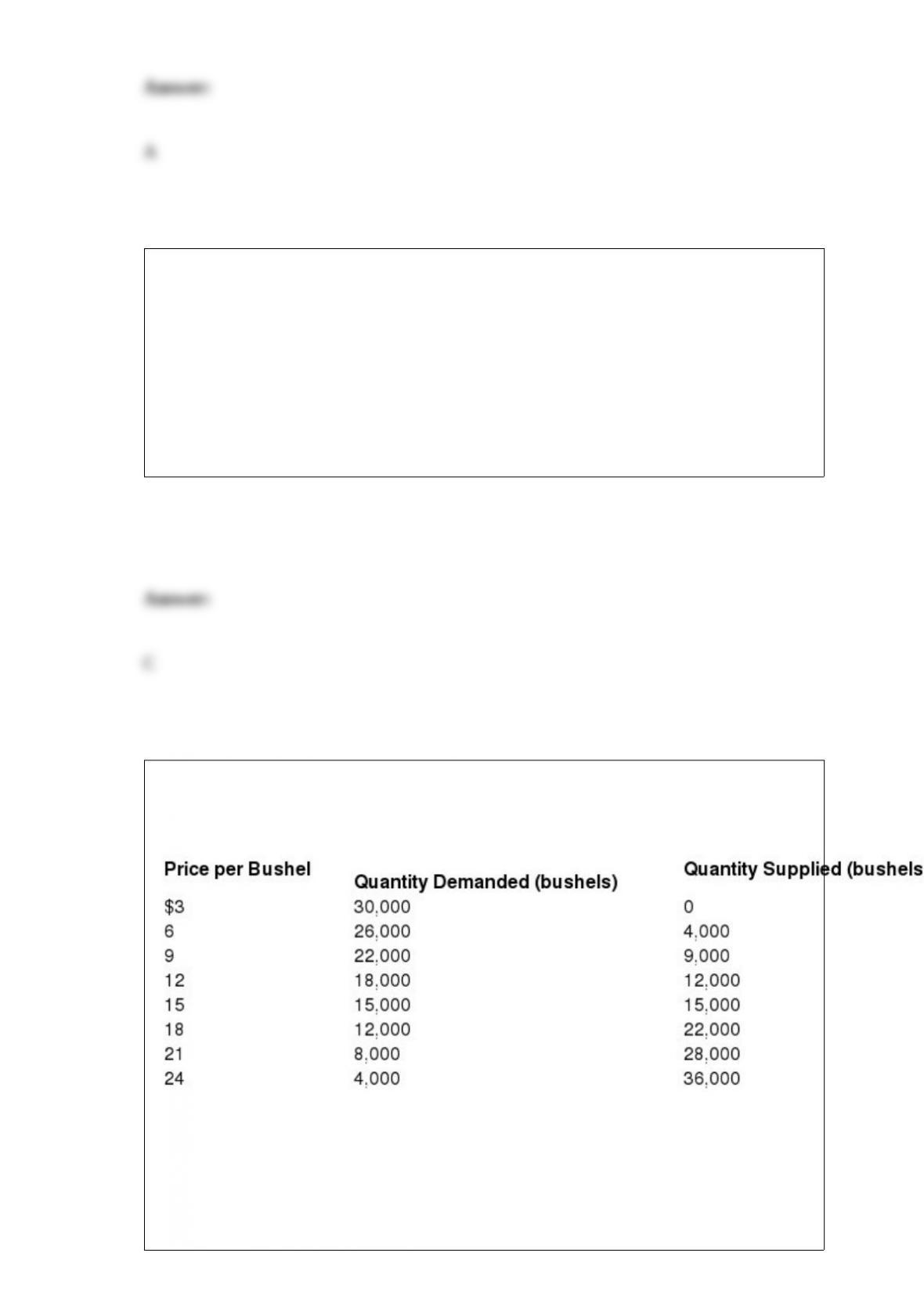
Table 3-3
Refer to Table 3-3. The table contains information about the corn market. Use the table
to answer the following questions.
a. What are the equilibrium price and quantity of corn?
b. Suppose the prevailing price is $9 per bushel. Is there a shortage or a surplus in the

market?
c. What is the quantity of the shortage or surplus?
d. How many bushels will be sold if the market price is $9 per bushel?
e. If the market price is $9 per bushel, what must happen to restore equilibrium in the
market?
f. At what price will suppliers be able to sell 22,000 bushels of corn?
g. Suppose the market price is $21 per bushel. Is there a shortage or a surplus in the
market?
h. What is the quantity of the shortage or surplus?
i. How many bushels will be sold if the market price is $21 per bushel?
j. If the market price is $21 per bushel, what must happen to restore equilibrium in the
market?

Table 4-3
Refer to Table 4-3. The table above lists the marginal cost of cowboy hats by The Waco
Kid, a firm that specializes in producing western wear. If the price of cowboy hats
decreases from $38 to $30
A) consumer surplus will rise by $6.
B) the marginal cost of producing the third cowboy hat will fall to $30.
C) producer surplus will fall from $22 to $6.
D) producer surplus will rise from $8 to $24.
If the marginal benefit of reducing emissions of some air pollutant is less than the
marginal cost
A) further reductions will make society better off.
B) further reduction will make society worse off.
C) pollution taxes should be imposed on producers to pay for further reductions.
D) economic efficiency will be increased if further reductions are made.

Which of the following is not an assumption of perfectly competitive markets?
A) There are many sellers and many buyers, all of which are small relative to the
market.
B) Each firm produces a similar but not identical product.
C) There are no barriers to new firms entering the market.
D) The products sold by all firms in the market are identical.
A perfectly competitive firm’s marginal revenue
A) is greater than price.
B) is less than price because a firm must lower its price to sell more.
C) is equal to price.
D) may be either greater or less than price, depending on the quantity sold.

Income inequality in the United States has increased somewhat over the past 25 years.
Two factors that appear to have contributed to this are
A) tax cuts on high income individuals and large increases in prices of stocks.
B) strong economic growth and low inflation.
C) rapid technological change and expanding international trade.
D) outsourcing of jobs by U.S. firms and cuts in taxes on capital gains.
As a consumer consumes more and more of a product in a particular time period,
eventually marginal utility
A) rises.
B) is constant.
C) declines.
D) fluctuates.
A large majority of the personal computers (PCs) in the United States use an operating
system purchased from Microsoft. Microsoft’s relationship with PC manufacturers is an
example of which of Porter’s competitive forces?
A) the threat from new entrants

B) the bargaining power of suppliers
C) the bargaining power of buyers
D) competition from substitute goods or services
A(n) ________ is represented by a leftward shift of the demand curve while a(n)
________ is represented by a movement along a given demand curve.
A) decrease in demand; increase in demand
B) decrease in demand; increase in quantity demanded
C) increase in demand; decrease in quantity demanded
D) decrease in quantity demanded; decrease in demand
Marginal cost is calculated for a particular increase in output by
A) multiplying the total cost by the change in output.
B) multiplying the change in total cost by the change in output.
C) dividing the total cost by the change in output.
D) dividing the change in total cost by the change in output.

The Internet has created a new category in the book selling market, namely, the “barely
used” book. How does the availability of barely used books affect the market for new
books?
A) The demand curve for new books shifts to the right.
B) The demand curve for new books shifts to the left.
C) The supply curve for new books shifts to the right.
D) The supply curve for new books shifts to the left.
If an increase in income leads to in an increase in the demand for peanut butter, then
peanut butter is
A) a neutral good.
B) a normal good.
C) a necessity.
D) a complement.

The president of Toyota’s Georgetown plant was quoted as saying, “Demand for high
volumes saps your energy. Over a period of time, it eroded our focus [and] thinned out
the expertise and knowledge we painstakingly built up over the years.” Based on this
quote, what must be true of the plant’s average cost of production curve?
A) It is upward-sloping.
B) It is downward-sloping.
C) It is a ray from the origin.
D) It is U-shaped.
In Porter’s Five Competitive Forces model, “competition from substitute goods or
services” refers to
A) substitute products that come from outside the industry.
B) substitute products that come from domestic competitors in the same industry.
C) substitute products that come from foreign competitors in the same industry.
D) competition from producers of substitutes who outsource their production.

Joan Jillson owns a coffee shop. Assume that the marginal product of the labor Joan
employs (MPL)equals 500 cups per week and the marginal product of her shop’s capital
(MPK) equals 1,000. Assume also that the wage (w) Joan pays her workers equals $250
per week and the rental price (r) of her capital – her coffee machines – equals $500 per
week. Which of the following correctly analyzes whether Joan is minimizing her costs?
A) No, Joan is not minimizing her costs because MPK is greater than MPL and r is
greater than w.
B) Yes, Joan is minimizing her costs because MPK/r equals MPL/w.
C) No, Joan is not minimizing her costs because MPLw is less than MPKr.
D) Yes, Joan is minimizing her costs because the she is a price-taker in the markets for
labor and capital.
Assume that the demand curve for MP3 players shifts to the right and the supply curve
for MP3 players shift to the left, but the supply curve shifts more than the demand
curve. As a result
A) both the equilibrium price and quantity of MP3 players will decrease.
B) the equilibrium price of MP3 players will decrease; the equilibrium quantity will
increase.
C) the equilibrium price of MP3 players may increase or decrease; the equilibrium
quantity will decrease.
D) the equilibrium price of MP3 players will increase; the equilibrium quantity will
decrease.

From an economic perspective, price discrimination is desirable because
A) the increase in profits is more than offset by the loss in consumer surplus, resulting
in a net increase in economic surplus.
B) it enables firms to increase profits with no loss in economic surplus, and in turn, this
could provide firms with incentives to engage in beneficial product innovation.
C) the increase in profits results in higher corporate tax revenues received by the
government which could be used to subsidize consumption for low-income individuals.
D) it redistributes wealth from wealthy consumers to highly innovative firms.
Many economists do not believe that network externalities lock consumers into the use
of products that have technology inferior to other, similar products. These economists
believe that
A) consumers are always rational.
B) in practice, the gains from using a superior technology exceed the losses consumers
incur from switching costs.
C) there is no good evidence that switching costs exist.
D) the government will prevent products with inferior technology from being sold to
consumers.

Paul goes to Sportsmart to buy a new tennis racquet. He is willing to pay $200 for a
new racquet, but buys one on sale for $125. Paul’s consumer surplus from the purchase
is
A) $325.
B) $200.
C) $125.
D) $75.