
Price discrimination
A) is the practice of charging different prices to different customers based on a seller’s
personal preferences and prejudices.
B) is the practice of charging different prices to different customers based on the
different costs of supplying the product to different customers.
C) is the practice of charging different prices to different customers when the price
differences cannot be attributed to variations in cost.
D) is the practice of giving preferential treatment to certain groups of customers based
on their long-standing relationship to the producer.
The slope of a demand curve is not used to measure the price elasticity of demand
because
A) the slope of a linear demand curve is not constant.
B) the slope of a line cannot have a negative value.
C) the measurement of slope is sensitive to the units chosen for price and quantity.
D) the slope of the demand curve does not tell us how much quantity changes as price
changes.
Prisoner’s dilemma games imply that cooperative behavior between two people or two

firms always breaks down. But reality teaches us that people and firms often cooperate
successfully to achieve their goals. Why do the results from prisoner’s dilemma games
fail to predict real world results?
A) Prisoner’s dilemma games do not permit people or firms from reneging on
agreements, which often occurs in real word situations.
B) The prisoner’s dilemma does not apply to most business situations that are repeated
over and over.
C) Prisoner’s dilemma games predict the behavior of people and firms that engage in
illegal activity; most people and firms do not resort to illegal activity.
D) Most real world situations involve more than two people or firms; the prisoner’s
dilemma is only applicable to situations that involve two parties.
In the 1970s and 1980s, the United States lost its comparative advantage in consumer
electronics goods to Japan. What factor was most responsible for the development of
Japan’s comparative advantage in consumer electronics goods?
A) Japanese firms benefited from external economies.
B) Japan has abundant supplies of labor.
C) Japanese firms excelled in process technology.
D) Japan has abundant supplies of natural resources needed to produce electronics
goods.

Sole proprietorships are ________ type of business.
A) the most profitable
B) the least common
C) the most common
D) the least risky
If the cross-price elasticity of demand between beer and wine is 0.31, then beer and
wine are
A) complements.
B) price inelastic goods.
C) substitutes.
D) necessities.
Jake sells Star Wars memorabilia on eBay. His annual revenue is $42,000 per year, the
explicit costs of his business are $10,000, and the opportunity costs of his business are
$18,000 per year. What are the implicit costs of his business?
A) $8,000

B) $18,000
C) $24,000
D) $32,000
Which of the following individuals is most likely to purchase a life insurance policy
that pays out an annual income beginning at a certain age until the individual’s death?
A) Ian, who expects to have a short life expectancy because of an illness
B) Bradley who has six young children
C) Avril, a tax attorney who wants to avoid adverse selection
D) Alma, who expects to live a long life, based on her family history
All of the following contributed to the downfall of the Soviet Union in 1991 except
A) public dissatisfaction with low living standards and political repression.
B) an inability to produce low-cost consumer goods that households wanted.
C) lack of high-quality goods and services.
D) lack of a strong dictator who can coordinate economic activities.
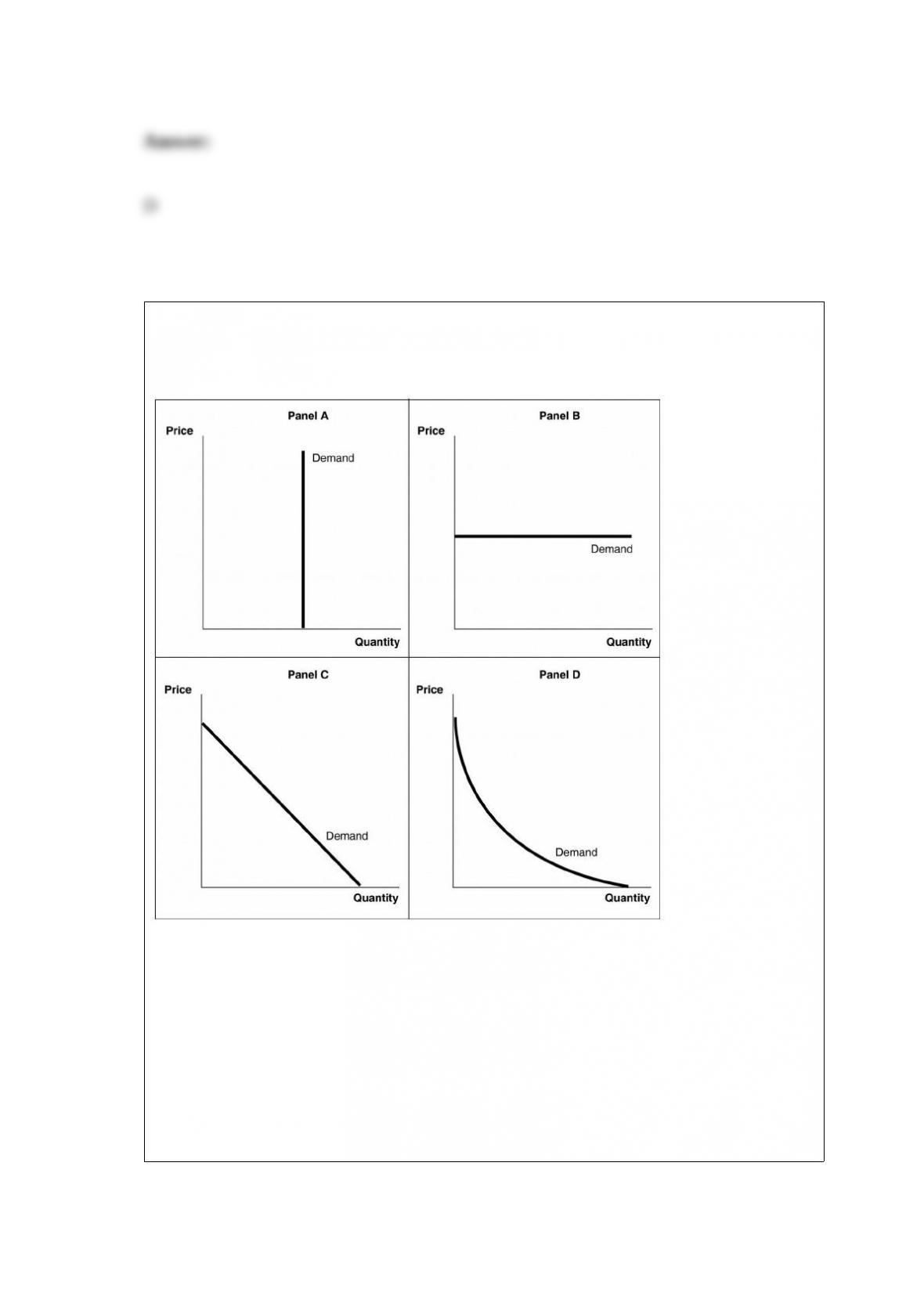
Figure 6-1
Refer to Figure 6-1. The demand curve on which elasticity changes at every point is
given in
A) Panel A.
B) Panel B.
C) Panel C.
D) none of the above graphs.

Health Clubs typically experience an increase in one-year memberships in January, but
many new customers cancel their memberships before the end of the year. Which of the
following is the best explanation for this behavior?
A) Some health club members suffer minor injuries that prevent them from working
out.
B) Some people are overly optimistic about their future behavior.
C) Some people fail to treat their membership fees as sunk costs.
D) Some members receive utility from activities they believe are popular.
Patents, tariffs and quotas are all examples of
A) government-imposed barriers.
B) economic regulations that increase efficiency.
C) entry barriers that improve a country’s standard of living.
D) entry barriers that protect consumers.

Making “how much” decisions involve
A) calculating the total benefits of the activity and determining if you are satisfied with
that amount.
B) calculating the total costs of the activity and determining if you can afford to incur
that expenditure.
C) calculating the average benefit and the average cost of an activity to determine if it is
worthwhile undertaking that activity.
D) determining the additional benefits and the additional costs of that activity.
The marginal revenue of a monopolistically competitive firm
A) cannot be negative because the price the firm charges will always be greater than
zero.
B) can be negative if the firm charges a high price.
C) can be negative if the firm charges a low price.
D) will equal average revenue.
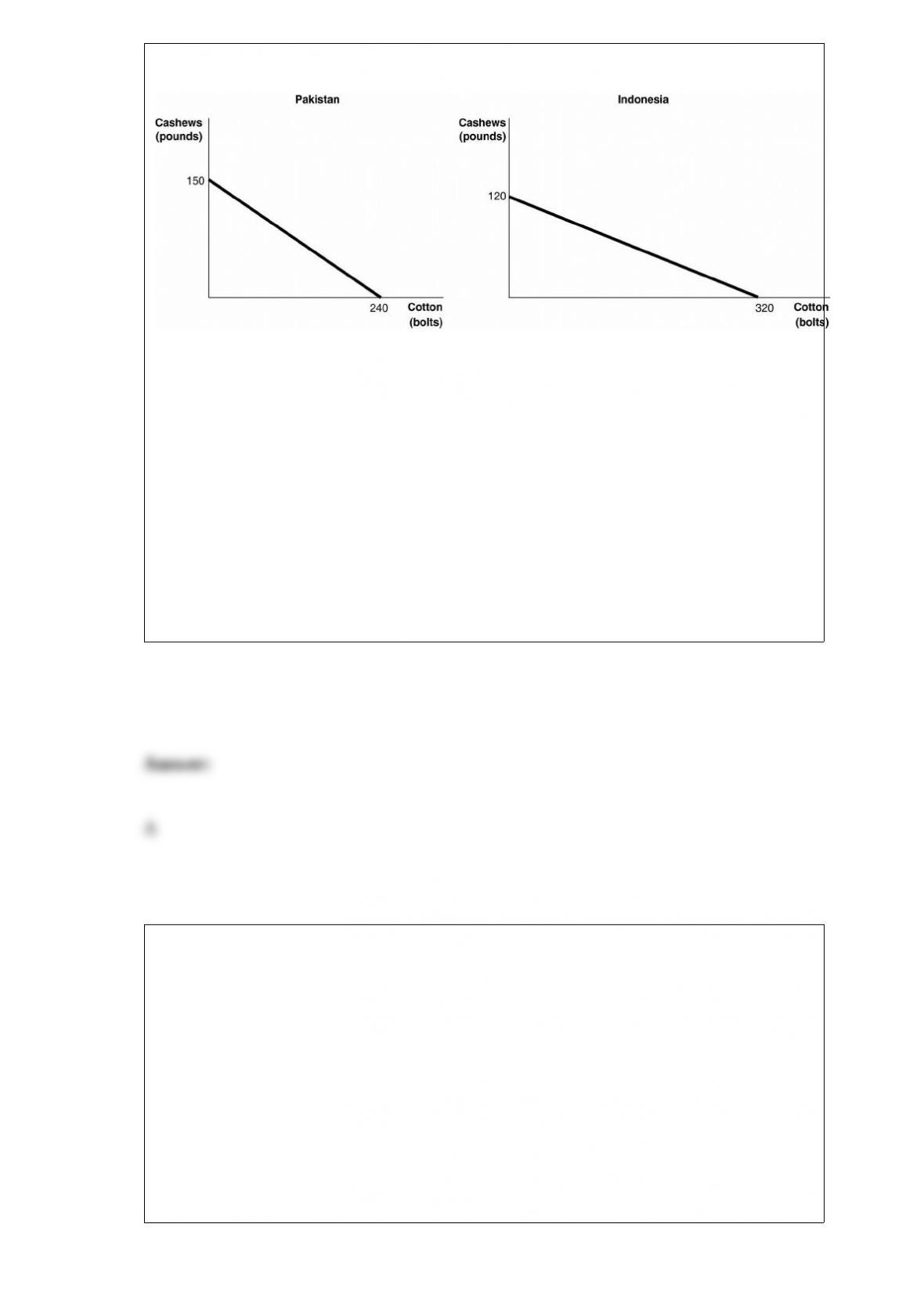
Figure 2-9
Figure 2-9 shows the production possibilities frontiers for Pakistan and Indonesia. Each
country produces two goods, cotton and cashews.
Refer to Figure 2-9. Which country has a comparative advantage in the production of
cotton?
A) Indonesia
B) They have equal productive abilities.
C) Pakistan
D) neither country
Which of the following is the best example of a tariff?
A) a subsidy from the U.S. government to domestic manufacturers of residential air
conditioners to enable them to compete more effectively with foreign producers
B) a limit on the quantity of residential air conditioners that can be imported from a
foreign country
C) a $150 fee imposed on all imported residential air conditioners
D) a tax placed on all residential air conditioners sold in the domestic market to help
offset the impact of emissions on the environment
Larry and Mike are equally skilled construction workers employed by the Brown and
Root Company. Larry’s job is riskier because he typically works on a scaffold 1,000 feet
above ground. Larry’s higher wage rate is the result of
A) economic discrimination.
B) a compensating differential.
C) a negative feedback loop.
D) a higher marginal revenue product.
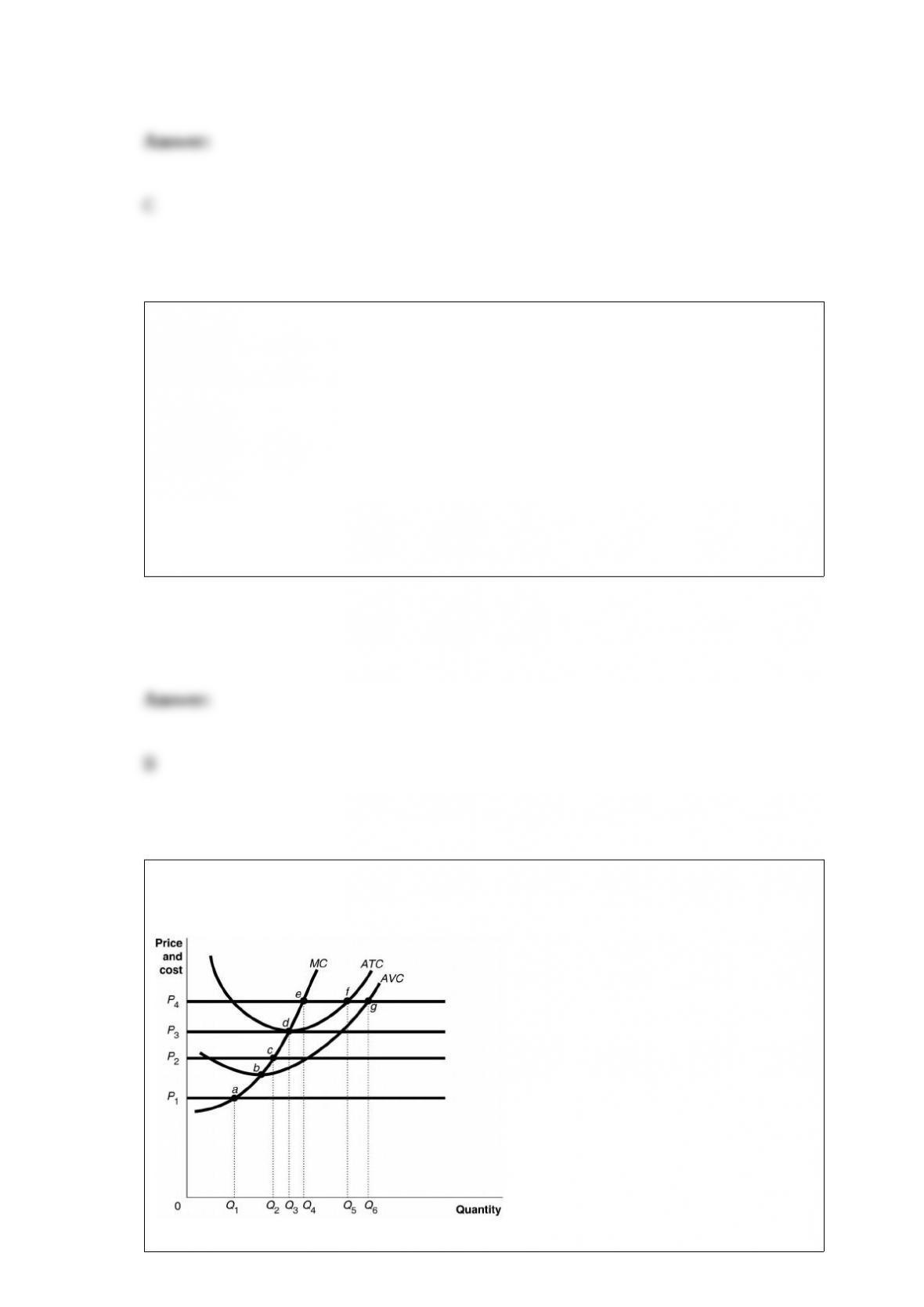
Figure 12-9

Figure 12-9 shows cost and demand curves facing a profit-maximizing, perfectly
competitive firm.
Refer to Figure 12-9. At priceP1, the firm would
A) lose an amount equal to its fixed cost.
B) lose an amount more than fixed cost.
C) lose an amount less than fixed cost.
D) break even.
An oligopolist’s demand curve is
A) identical to that of a perfect competitive firm.
B) identical to that of a monopolistically competitive firm.
C) vertical on a price quantity diagram.
D) unknown because a response of firms to price changes by rivals is uncertain.
The price elasticity of demand for beef is estimated to be 0.60 (in absolute value). This
means that a 20 percent increase in the price of beef, holding every thing else constant,
will cause the quantity of beef demanded to
A) decrease by 12 percent.

B) decrease by 26 percent.
C) decrease by 32 percent.
D) decrease by 60 percent.
Consider two oligopolistic industries selling the same product in different locations. In
the first industry, firms always match price changes by any other firm in the industry. In
the second industry, firms always ignore price changes by any other firm. which of the
following statements is true about these two industries, holding everything else
constant?
A) Market prices are likely to be higher in the first industry in which firms always
match price changes by rival firms than in the second where firms ignore their rivals’
price changes.
B) Market prices are likely to be lower in the first industry where firms always match
price changes by rival firms than in the second where firms ignore their rivals’ price
changes.
C) Market prices are likely to be the same in both markets because they are both
oligopolistic markets.
D) No conclusions can be drawn about the pricing behavior under these very different
firm behaviors.
Today, Walt Disney World charges different customers different prices for admission.
This pricing strategy is called
A) arbitrage.
B) odd pricing.
C) cost-price pricing.
D) price discrimination.
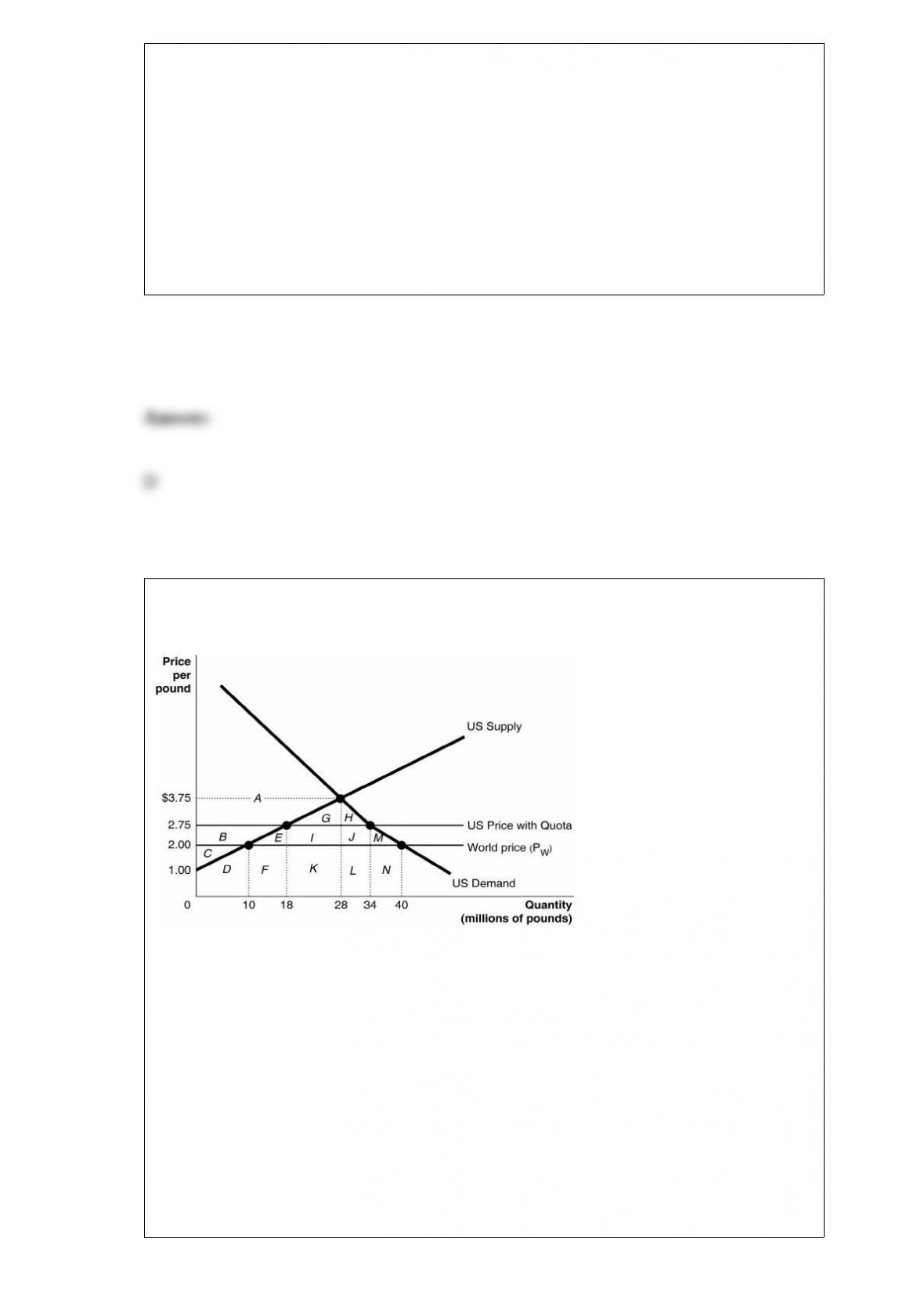
Figure 9-3
Since 1953 the United States has imposed a quota to limit the imports of peanuts.
Figure 9-3 illustrates the impact of the quota.
Refer to Figure 9-3. What is the area that represents the deadweight loss as a result of
the quota?
A) G + H
B) G + H + I + J
C) E + I + J + M
D) E + M
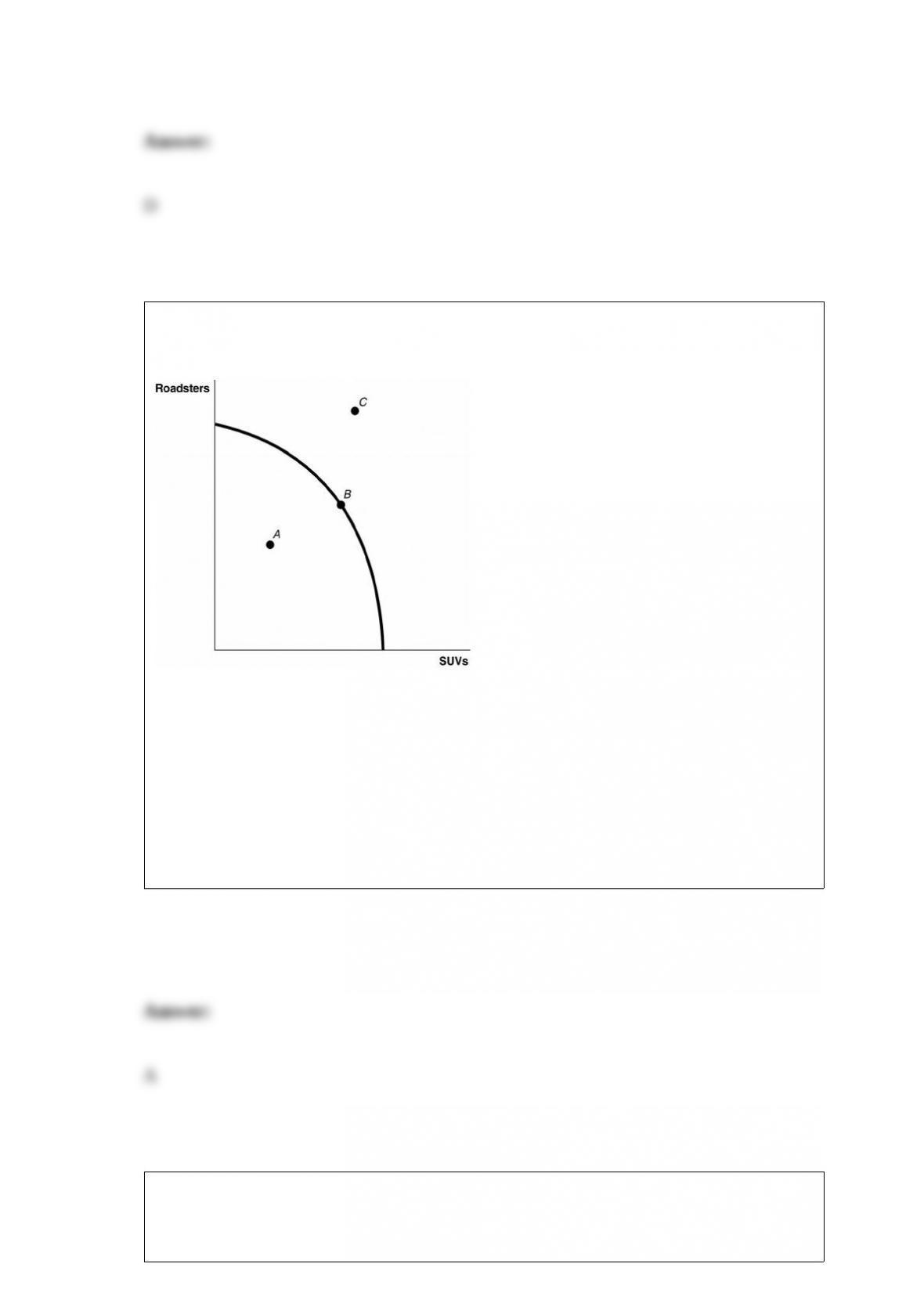
Figure 2-1
Refer to Figure 2-1. Point B is
A) technically efficient.
B) unattainable with current resources.
C) inefficient in that not all resources are being used.
D) the equilibrium output combination.
Which of the following is the best example of a firm that competes in a
monopolistically competitive market?
A) the U.S. Postal Service
B) Microsoft
C) a movie theater
D) an automobile manufacturer
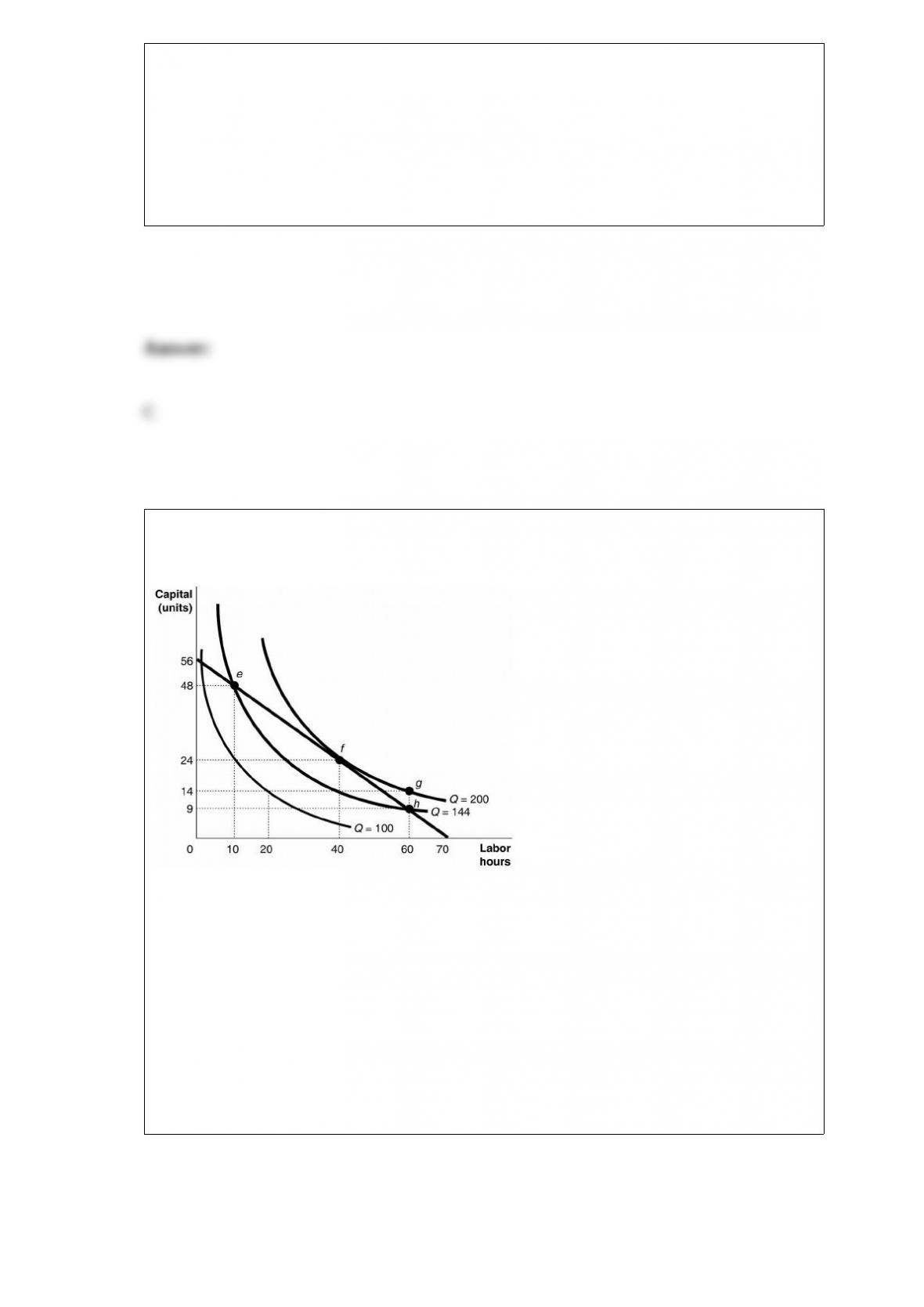
Figure 11-15
Refer to Figure 11-15. Suppose Hilda produces 100 gooseberry pies. What is the
marginal rate of technical substitution of labor for capital when labor is increased from
10 to 20 hours?
A) 1 unit of capital
B) 10 units of capital
C) 14 units of capital
D) 24 units of capital
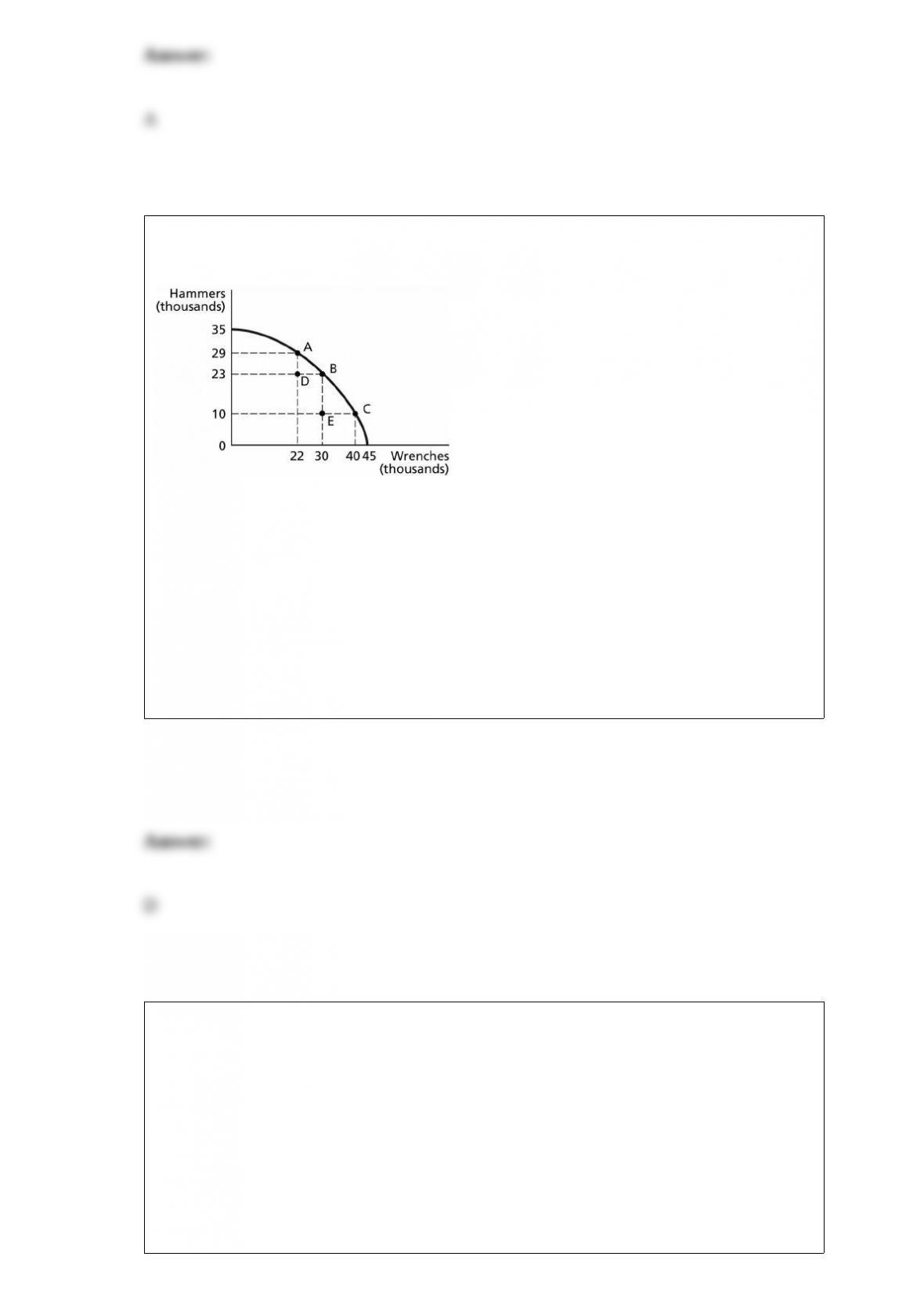
Figure 2-6
Refer to Figure 2-6. If the economy is currently producing at point E, what is the
opportunity cost of moving to point B?
A) 13 thousand hammers
B) 10 thousand hammers
C) 30 thousand wrenches
D) 0 wrenches
Consumer surplus in a market for a product would be equal to ________ if the market
price was zero.
A) zero
B) the area between the supply curve and the demand curve
C) the area above the supply curve
D) the area under the demand curve
Tomas increased his consumption of potato chips when the price of pistachios
increased. For Tomas, potato chips and pistachios are
A) substitutes in consumption.
B) both inferior goods.
C) complements in consumption.
D) both luxury goods.
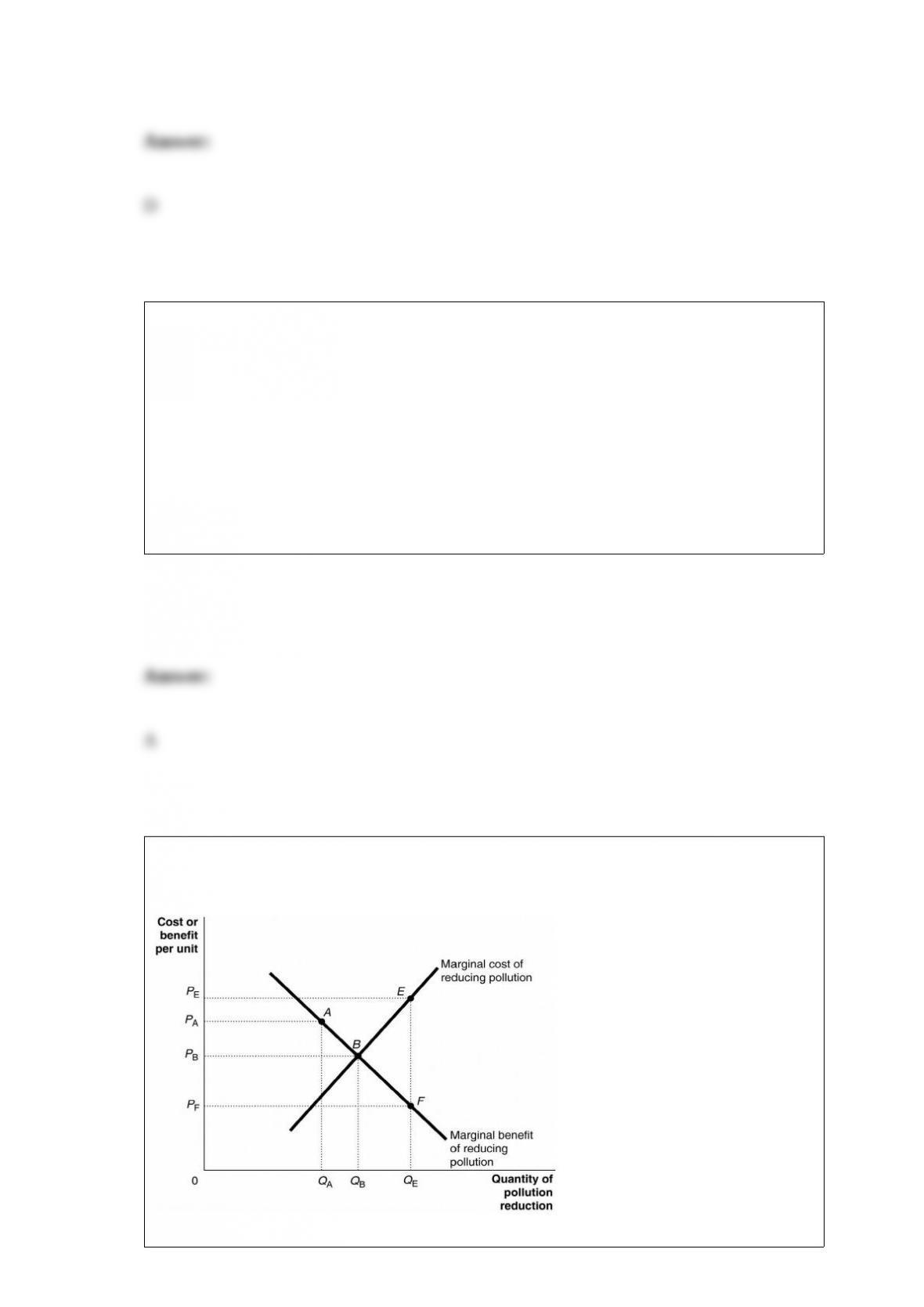
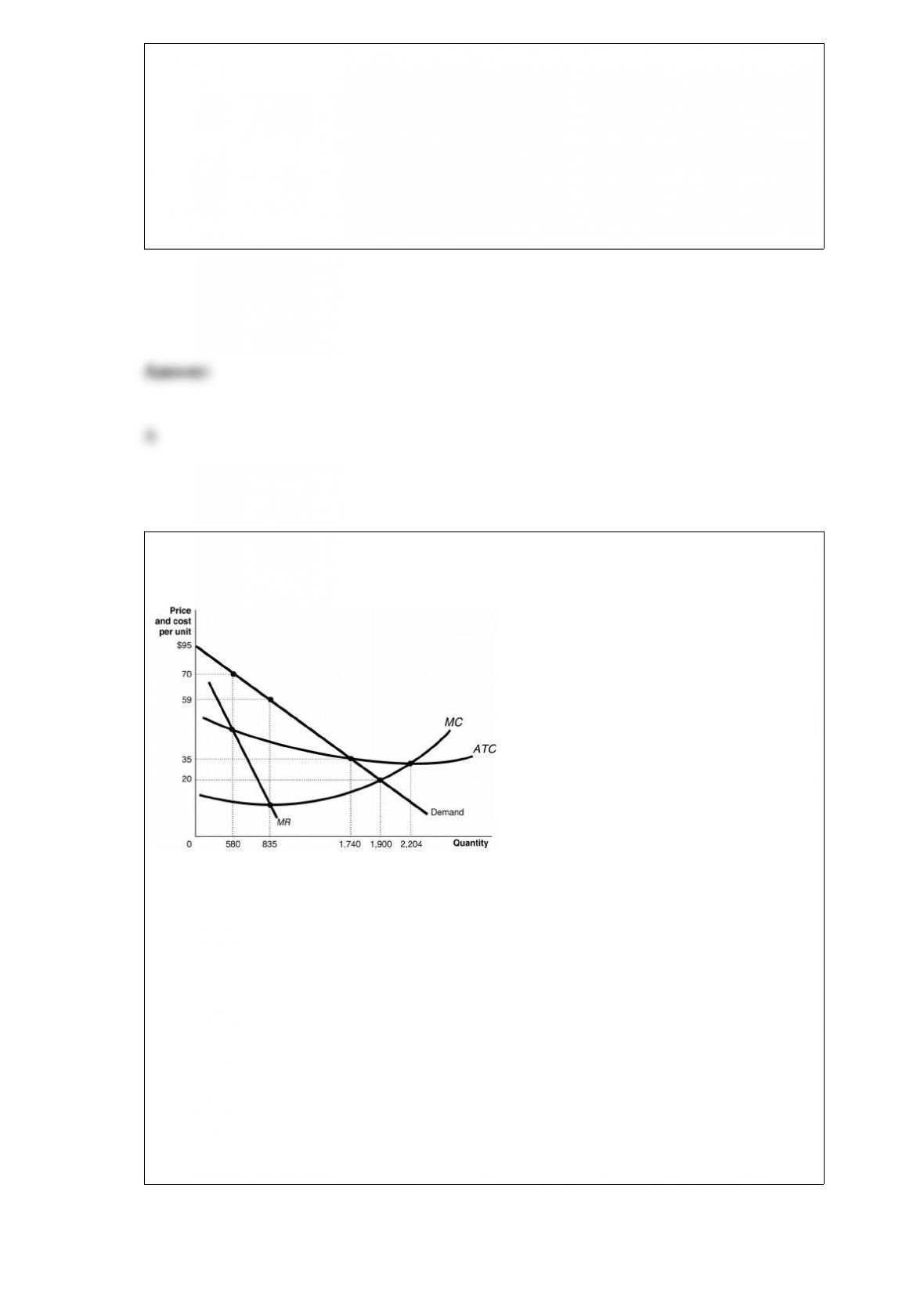
Figure 5-7
Refer to Figure 5-7. The marginal cost of reducing pollution curve is the same curve as
A) the supply of pollution reduction curve.
B) the demand for pollution reduction curve.
C) the negative externality curve.
D) the value of pollution reduction curve.
Figure 15-1
Refer to Figure 15-1. Which of the following statements about the firm depicted in the
diagram is true?
A) The fact that this firm is a natural monopoly is shown by the continually declining
long-run average total cost as output rises.
B) The fact that this firm is a natural monopoly is shown by the continually declining
market demand curve as output rises.
C) The fact that this firm is a natural monopoly is shown by the continually declining
marginal revenue curve as output rises.
D) The fact that this firm is a natural monopoly is shown by the fact that marginal cost
lies below the long-run average total cost where the firm maximizes its profits.