
All Gini coefficients must lie between 0 and 1. The lower the value
A) the more unequal the income distribution.
B) the closer the income distribution is to being equal.
C) the greater the degree of poverty.
D) the lower the degree of poverty according to the federal government’s definition of
poverty.
If the demand for a steak is unit-elastic, then
A) the percentage change in quantity demanded is 1 percent greater than the percentage
change in price.
B) the percentage change in quantity demanded is equal to the percentage change in
price.
C) the percentage change in quantity demanded is 100 percent greater than the
percentage change in price (in absolute value).
D) quantity demanded does not respond to changes in price.
Vipsana’s Gyros House sells gyros. The cost of ingredients (pita, meat, spices, etc.) to
make a gyro is $2.00. Vipsana pays her employees $60 per day. She also incurs a fixed
cost of $120 per day. What is Vipsana’s total cost per day when she does not produce

any gyros and does not hire any workers?
A) $0
B) $2
C) $60
D) $120
An advantage of imposing a tax on the producer that generates pollution is that
A) it forces the polluting producer to internalize the external cost of the pollution.
B) the government can keep tabs on exactly what is produced in an industry.
C) it will eliminate pollution.
D) a producer can pass the cost of the pollution to consumers.
If a firm has excess capacity, it means
A) that the firm expends too much of its resources on advertising its product without
seeing an appreciable increase in sales.
B) that the firm is not producing its minimum efficient scale of output.
C) that the firm’s long-run average cost of producing a given quantity exceeds its
short-run cost of producing that same quantity.
D) that the firm’s quantity supplied exceeds its quantity demanded.
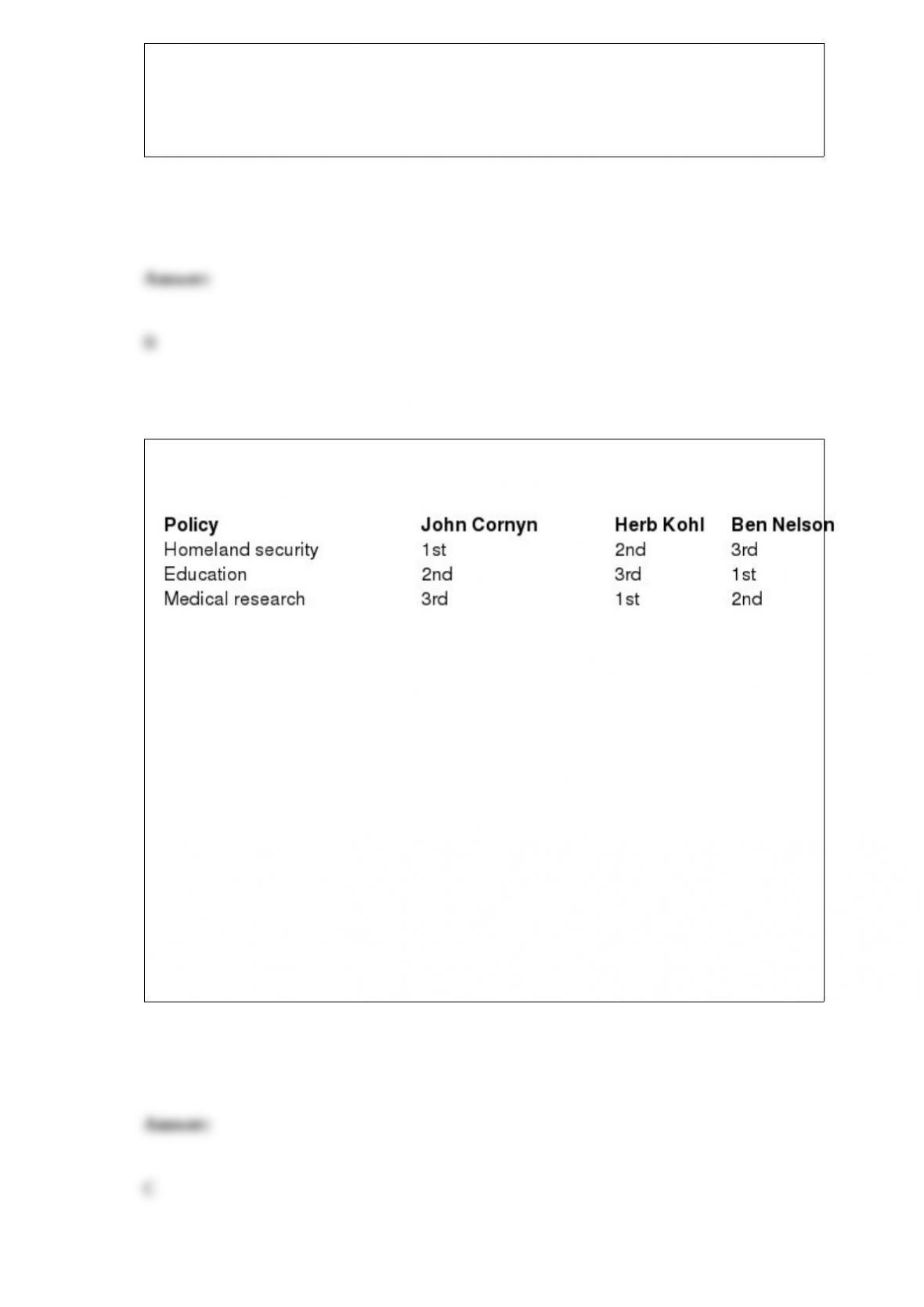
Table 18-2
Refer to Table 18-2. The table above lists three policy alternatives that the U.S. Senate
will vote on, along with the ranking of these alternates. The Senate must decide which
of these alternatives should receive an additional $1 billion of funding, and there is
enough money in the federal budget for only one of these alternatives. If a series of
votes is taken in which each pair of alternatives is considered (homeland security and
education; homeland security and medical research; education and medical research)
which of the following will result from these votes?
A) When the vote is between homeland security and education, the Senators will vote
for education to receive funding.
B) The Senators’ votes will demonstrate transitivity.
C) The results will illustrate the voting paradox.
D) The results from the voting will illustrate the median voter theorem.

An oligopolistic industry is characterized by all of the following except
A) existence of entry barriers.
B) the possibility of reaping long run economic profits.
C) firms pursuing aggressive business strategies, independent of rivals’ strategies.
D) production of standardized products.
If buyers of a monopolistically competitive product feel the products of different sellers
are strongly differentiated, then the demand for each seller’s product is
A) perfectly inelastic.
B) perfectly elastic.
C) relatively inelastic.
D) relatively elastic.
What does limited liability mean?
A) The owners of the business are personally responsible for paying expenses incurred
by the business.
B) Only employees can have a claim on the assets of the business.

C) The personal assets of the owners cannot be claimed if the business is bankrupt.
D) Anybody with a liability against a firm can claim only what their liability refers to.
Political candidates often hold fund raisers by charging “per plate” for dinner. Wendy
purchased four tickets to a $1,000 per plate dinner for a local city council candidate. Is
this transaction economically efficient?
A) No, political candidates should never be allowed to overcharge for a fund raising
dinner.
B) Yes, it was a voluntary exchange that benefited both parties.
C) No, Wendy paid too much for four dinners.
D) Yes, it is efficient only from the perspective of the candidate but not from the
perspective of Wendy.
Average fixed cost can be calculated using any of the formulas below except
A) TFC/Q.
B) (TC – VC)/Q.
C) Δ(TC – VC)/ΔQ.
D) (TC/Q) – AVC.
Willingness to pay measures
A) the maximum price a buyer is willing to pay for a product minus the amount the
buyer actually pays for it.
B) the amount a seller actually receives for a good minus the minimum amount the
seller is willing to accept for the good.
C) the maximum price that a buyer is willing to pay for a good.
D) the maximum price a buyer is willing to pay minus the minimum price a seller is
willing to accept.
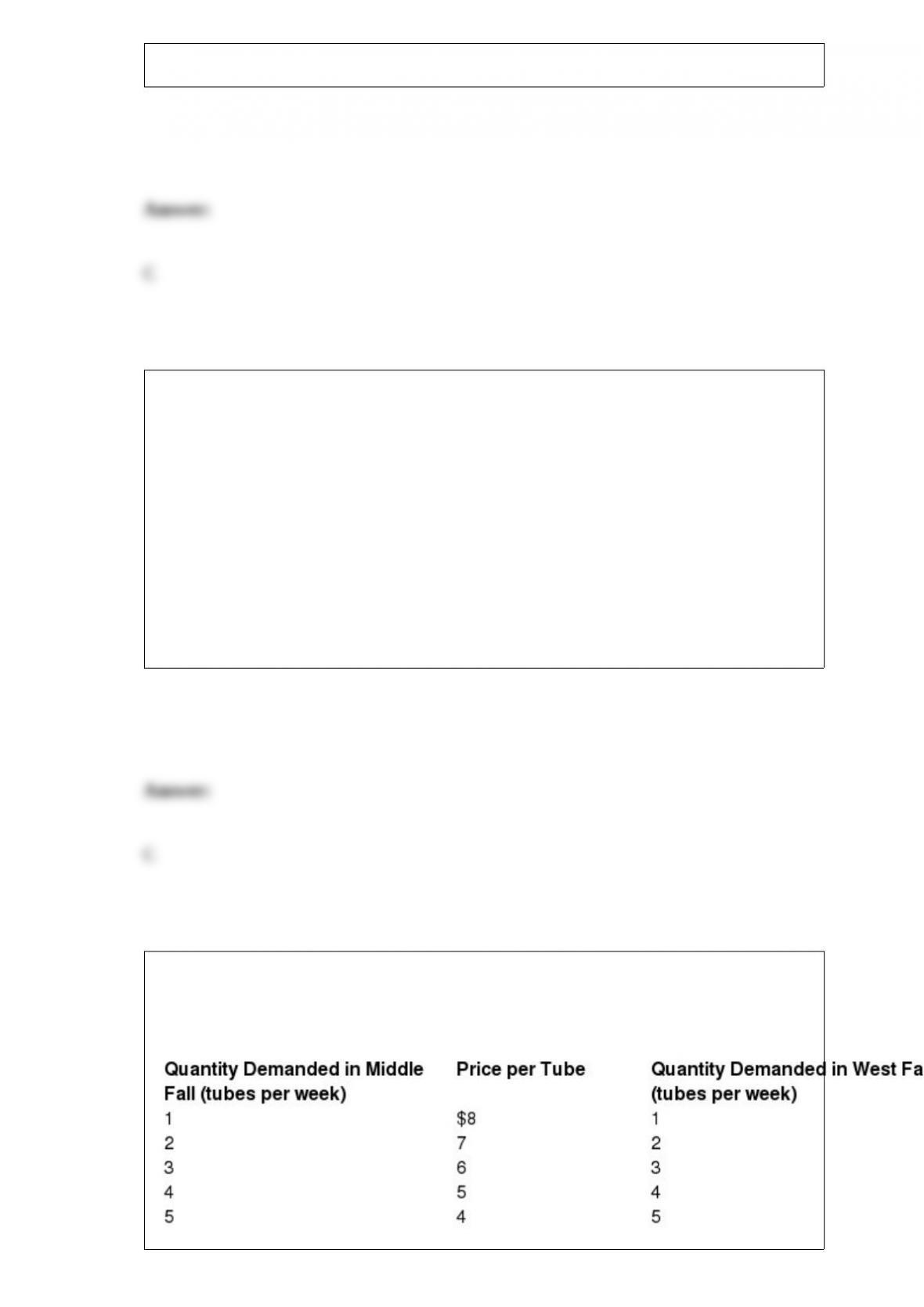
Table 16-2

Neem Products sells its Ayurvedic Neem toothpaste in two completely isolated markets
with demand schedules as shown in Table 16-2. The average cost of production is
constant at $2 per tube.
Refer to Table 16-2. How many tubes of toothpaste will Neem sell in West Fall and at
what price?
A) Q = 2 units; P = $4.50
B) Q = 3 units; P = $4
C) Q = 4 units; P = $3.50
D) Q = 5 units; P = $3
Facing stiff competition, Hendrix College, a small liberal arts institution in Conway,
Ark., decided two years ago to bolster its academic offerings, promising students at
least three hands-on experiences outside the classroom, including research, internships
and service projects. Although it raised tuition and fees by 29 percent, enrollment in the
freshman class rose by 37 percent.
Source: Jonathan D. Glater and Alan Finder, “In New Twist on Tuition Game,
Popularity Rises With the Price,” New York Times, December 12, 2006
Based on the information above, the demand for Hendrix College education is
A) unit-elastic.
B) perfectly elastic.
C) relatively inelastic.
D) More information is needed to answer the question.

In a natural monopoly, throughout the range of market demand
A) marginal cost is above average total cost and pulls average total cost upward.
B) average total cost is above marginal cost and pulls marginal cost upward.
C) marginal cost is below average total cost and pulls average total cost downward.
D) there are diseconomies of scale.
A situation in which a country does not trade with other countries is called
A) autarky.
B) self-actualization.
C) autonomy.
D) independence.
If, in a competitive market, marginal benefit is less than marginal cost
A) the net benefit to consumers from participating in the market is less than the net
benefit to producers.
B) the government must force producers to raise prices in order to achieve economic
efficiency.
C) the quantity sold is greater than the equilibrium quantity.
D) the quantity sold is less than the equilibrium quantity.
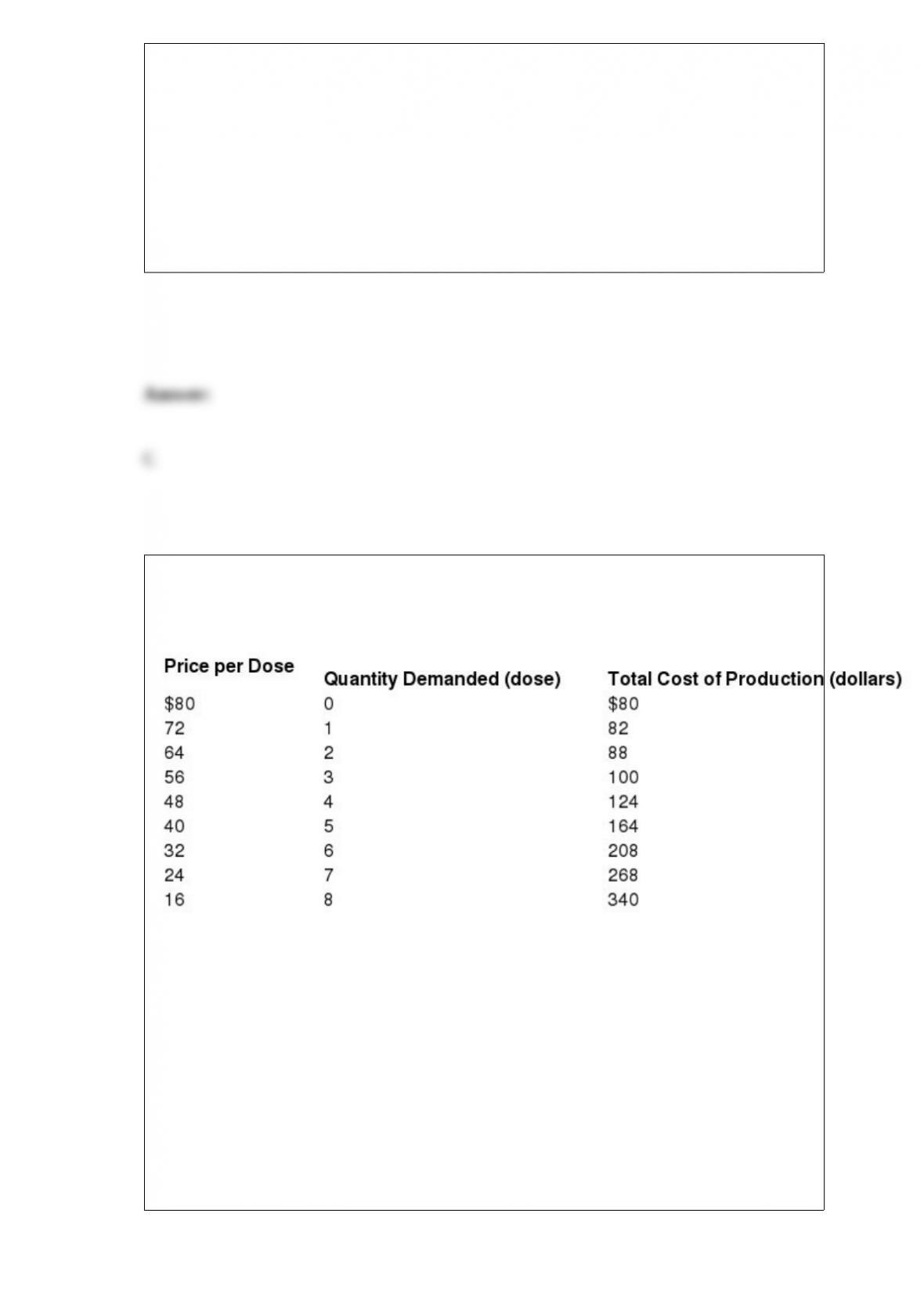
Table 15-4
Shakti Inc. has been granted a patent for its Arnica toothache balm. Table 15-4 shows
the demand and the total cost schedule for the firm.
Refer to Table 15-4. What is Shakti’s profit-maximizing output?
A) 4 units
B) 5 units
C) 6 units
D) 7 units

The demand curve for labor is also
A) the demand curve for the output produced with labor since the demand for labor is a
derived demand.
B) the marginal product of labor curve.
C) the marginal revenue product of labor curve.
D) the supply curve for the output labor is used to produce.
Which of the following is an example of the U.S. government’s use of a “command and
control” approach to reducing pollution?
A) In 1990 Congress approved measures designed to reduce sulfur dioxide emissions to
8.5 million tons annually by 2010.
B) The U.S. government imposed a tax on electric utilities to reduce damages from acid
rain.
C) The government issued electric utilities tradable emissions allowances in other to
reduce emissions of nitrogen oxide.
D) In the 1980s the U.S. government required the installation of catalytic converters to
reduce emissions from all new automobiles.
Suppose a restaurant is trying to determine how much to charge for a bowl of chili, and
decides to run an experiment to see how much its customers are willing to pay by
allowing them to set their own price for this menu item.
a. Is charging a customer the price he or she is willing to pay for the bowl of chili an
example of price discrimination? Briefly explain.
b. What is it called when a firm knows every consumer’s willingness to pay, and can
charge every consumer a different price? What happens to consumer surplus in this
situation?
In the United States, health care spending on people over age 65 is ________ on people
aged 18 to 24.
A) one third as much as
B) twice as much as
C) six times greater than
D) forty times greater than
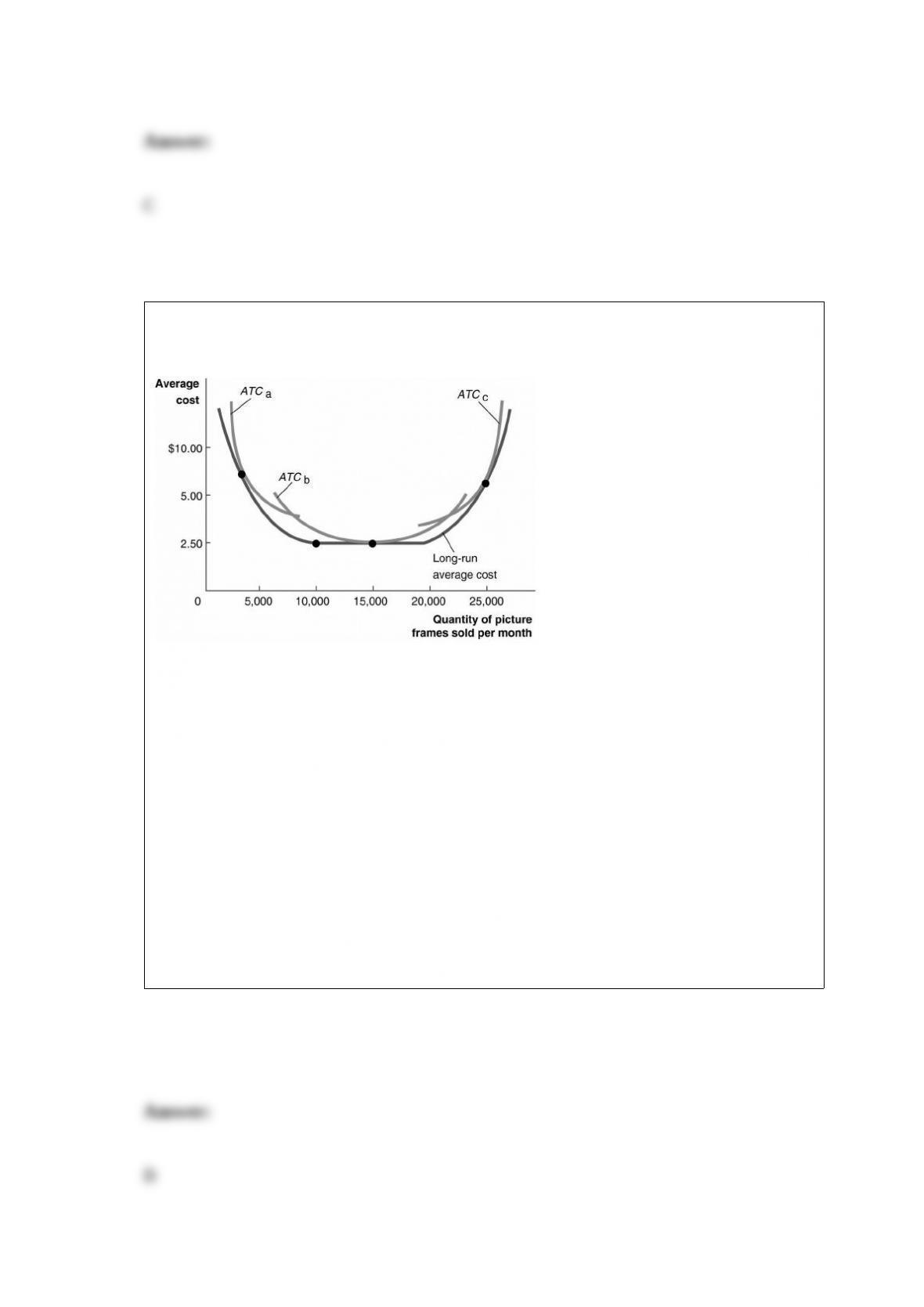
Figure 11-11
Figure 11-11 illustrates the long-run average cost curve for a firm that produces picture
frames. The graph also includes short-run average cost curves for three firm sizes:
ATCa, ATCb and ATCc.
Refer to Figure 11-11. If the firm chooses to produce and sell 25,000 frames per month
by operating in the short run with a scale operation represented by ATCc
A) the firm will not be operating efficiently.
B) the firm will be operating efficiently.
C) the firm would lower its average costs by reducing its scale of operation.
D) the firm will not be able to earn a profit.

Consider the market for nurses in a given city. In each of the following cases, explain
what happens to the equilibrium wage rate and the quantity of nurses hired.
a. One of the major hospitals in the city closes.
b. A record number of students graduate with bachelor’s degrees in nursing.
c. Traditionally, nursing is a field that attracts women. However, changes in access to
education and to the labor force participation rate by women have led to a greater
demand for the services of women in a wide range of occupations. The demand for
nurses, however, does not change.
d. Advances in medical technology reduce the amount of time physicians must spend
with patients in intensive care and increase the time that nurses spend with patients.
If the price of automobiles was to increase, then
A) the demand for gasoline would decrease.
B) the demand for gasoline would increase.
C) the supply of gasoline would increase.
D) the quantity demanded of gasoline would decrease.

A narrow definition of monopoly is that a firm is a monopoly if it can ignore
A) government antitrust laws.
B) the pricing decisions of its suppliers.
C) the pricing decisions of firms that produce complementary products.
D) the actions of all other firms.
A personal exemption refers to
A) the tax rate that applies to a particular tax bracket.
B) the tax bracket that represents basic living expenses.
C) an amount representing basic living expenses that can be subtracted from income.
D) a dispensation that allows certain qualifying individuals not to pay federal taxes.

How do a sole proprietorship and a corporation differ?
A) Proprietorships have unlimited liability while corporations have limited liability.
B) Corporations can issue stocks and bonds, while proprietorships cannot.
C) Corporations face more taxes than do proprietorships.
D) All of these are differences between the two types of businesses.
Clarissa Kessler operates a store that sells recorded music. Her business suffered
tremendously when a giant discount store chain opened a store in the area and is able to
sell its products for less than Clarissa’s wholesale cost. Is this evidence of illegal price
discrimination on the part of the discount store chain?
A) Yes, it is clearly a violation of the Robinson-Patman Act.
B) No, because it can be argued that the discount store chain is justified in charging
lower prices because it is a large-volume buyer and is able to purchase recorded music
at a lower wholesale price than Clarissa.
C) Yes, the discount store chain is engaging in predatory pricing.
D) No, even if the price discrimination is based on differences in cost, the law states
that it is not illegal.
When the government makes a firm the exclusive legal provider of a good or service, it

grants the firm
A) a copyright.
B) a network externality.
C) a quota.
D) a public franchise.
Women typically earn less than men, even in the same occupation. Which of the
following is an explanation for this discrepancy?
A) Women do not work as hard as men because of cultural influences.
B) Women have, on average, less workforce experience than men of the same age.
C) Women are, on average, less motivated than men and therefore tend to avoid taking
on more responsibilities.
D) Women tend to take riskier jobs and earn compensating wage differentials.
In the United States, barriers to entry in professional team sports (for example, football
and baseball) result from
A) the draft of college players, which grants teams exclusive signing rights to
individual players.
B) long-term leases teams sign for stadiums and ballparks in major cities.
C) television contracts, which give networks the exclusive rights to broadcast games.
D) the reserve clause, which is a provision in contracts of professional athletes that
require them to play for specific teams over the length of their contracts.