Which of the following is the best example of a perfectly competitive industry?
A) wheat production
B) steel production
C) electricity production
D) airplane production
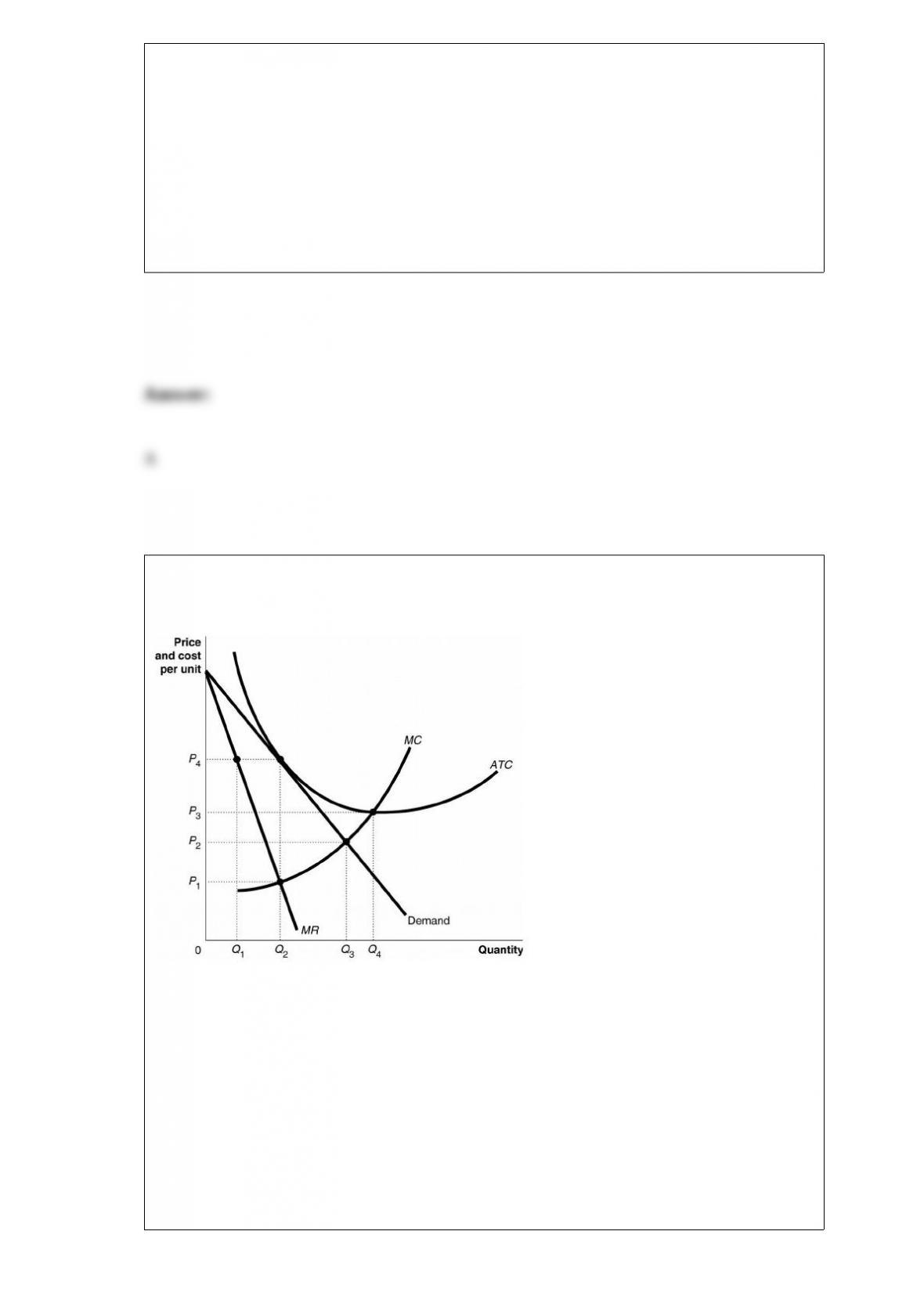
Figure 13-11
Refer to Figure 13-11. What is the monopolistic competitor’s profit maximizing
output?
A) Q1 units
B) Q2 units
C) Q3 units
D) Q4 units

The marginal productivity theory of income states that a person’s total income is
determined by
A) the amount and productivity of factors of production the individual owns.
B) how much the individual works.
C) how profitable the firm the individual works for is.
D) how much the individual has inherited.
Figure 12-12
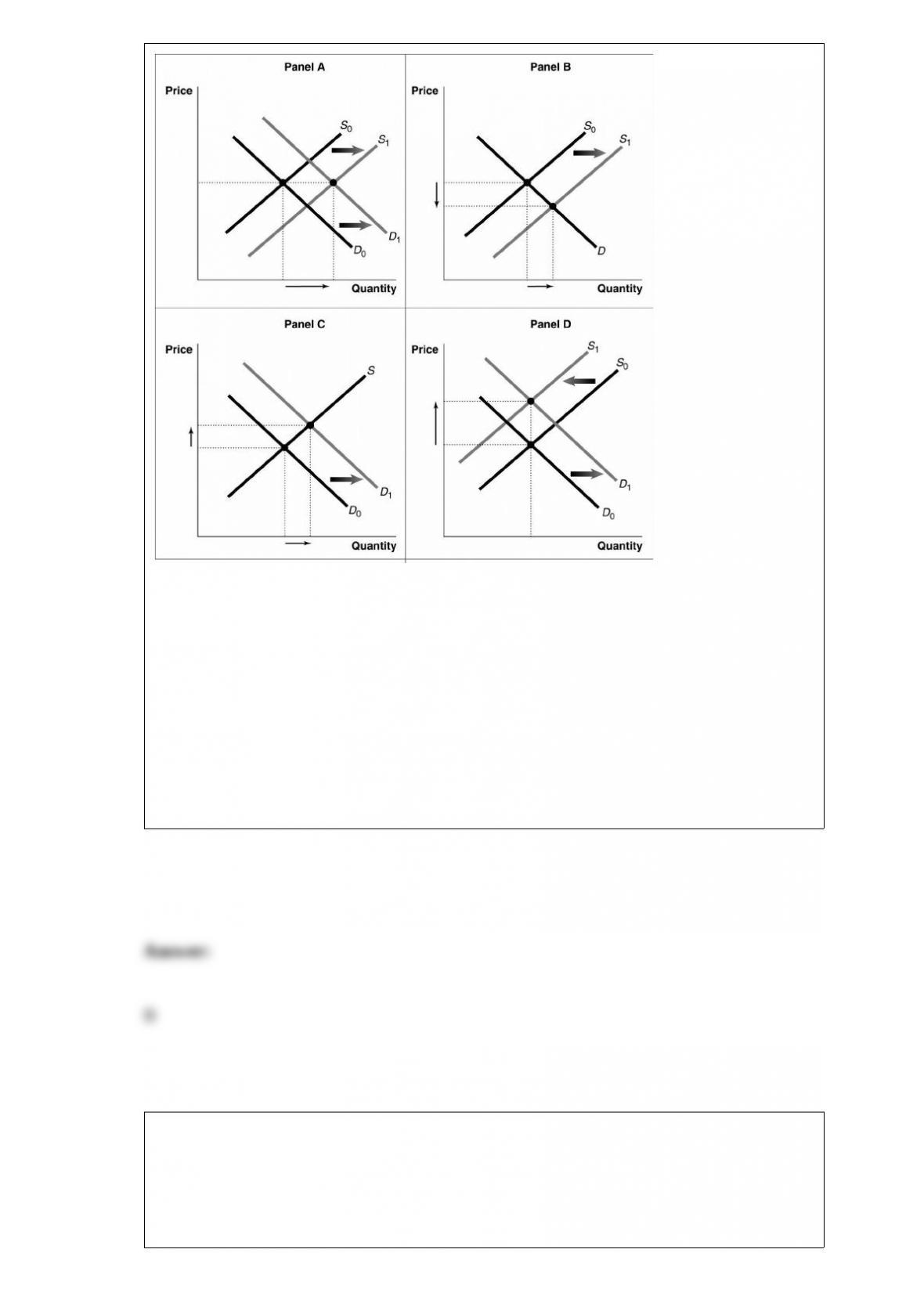
Refer to Figure 12-12. Consider a typical firm in a perfectly competitive industry that
makes short-run profits. Which of the diagrams in the figure shows the effect on the
industry as it transitions to a long-run equilibrium?
A) Panel A
B) PanelB
C) PanelC
D) PanelD
Red Stone Creamery currently hires 5 workers. When it added a 6th worker, its output
actually fell. Which of the following statements is true?
A) The marginal product of the sixth worker must be negative.

B) The average product of the sixth worker is negative.
C) The sixth worker is not as skilled as the fifth worker.
D) The total product becomes negative.
Perfect competition is characterized by all of the following except
A) heavy advertising by individual sellers.
B) homogeneous products.
C) sellers are price takers.
D) a horizontal demand curve for individual sellers.
In a modern mixed economy, who decides what goods and services will be produced?
A) only the producers
B) only consumers
C) only the government
D) all of the above

One difference between the labor market and markets for goods and services is
A) the demand in the labor market is inelastic; the demand for goods and services may
be elastic or inelastic.
B) the supply of labor is perfectly inelastic because the quantity supplied is constant.
The elasticity of supply for goods and services is different in different markets.
C) concepts of fairness arise more frequently in labor markets than in the markets for
goods and services.
D) in the labor market, firms are suppliers while households are demanders.
How does the construction of a market demand curve for a private good differ from that
for a public good?
A) There is no difference; in both cases the demand curve is determined by adding up
the price each consumer is willing to pay for each quantity of the good.
B) There is no difference; in both cases the demand curve is determined by adding up
the quantities demanded by each consumer at each price.
C) The market demand curve for a private good is determined by adding up the
quantities demanded by each consumer at each price but the market demand curve for a
public good is determined by adding up the price each consumer is willing to pay for
each quantity of the good.
D) The market demand curve for a private good is determined by adding up the price
each consumer is willing to pay for each quantity of the good but the market demand
curve for a public good is determined by adding up the quantities demanded by each

consumer at each price.
Suppose that when the price of hamburgers decreases, the Landry family decreases their
purchases of chicken nuggets. To the Landry family
A) hamburgers and chicken nuggets are complements.
B) hamburgers and chicken nuggets are inferior goods.
C) hamburgers and chicken nuggets are normal goods.
D) hamburgers and chicken nuggets are substitutes.
How much is a bond that pays $50 in coupon payments for 3 years and $1,000 at the
end of the third year worth if the interest rate is 10%?
A) $876
B) $952
C) $1,045
D) $1,150

Firms such as Caribou Coffee and Diedrich Coffee operate hundreds of coffeehouses
nationwide while firms such as Dunn Brothers Coffee operate only in four states. How
would you characterize these stores?
A) Caribou Coffee and Diedrich Coffee are oligopolists while Dunn Brothers is a
monopolistic competitor.
B) Caribou Coffee and Diedrich Coffee are duopolists while Dunn Brothers is a
monopolistic competitor.
C) Caribou Coffee and Diedrich Coffee are duopolists while Dunn Brothers is an
oligopolist
D) They are all monopolistic competitors.
A business that has direct investments (in the form of marketing or manufacturing
subsidiaries) abroad in several countries is called a ________.
A) dummy corporation
B) shell corporation
C) multinational corporation
D) domestic corporation

If Molly Bee increases her work hours when her wage increases, then
A) the income effect of the wage increase outweighs the substitution effect.
B) the substitution effect of the wage increase outweighs the income effect.
C) leisure is an inferior good to Molly.
D) Molly is spending beyond her means.
Cost-plus pricing may be a reasonable way to determine price when
A) marginal cost and average fixed cost are roughly equal.
B) marginal cost and average cost are about the same.
C) marginal cost differs significantly from average cost.
D) marginal cost is very low.
Table 13-3
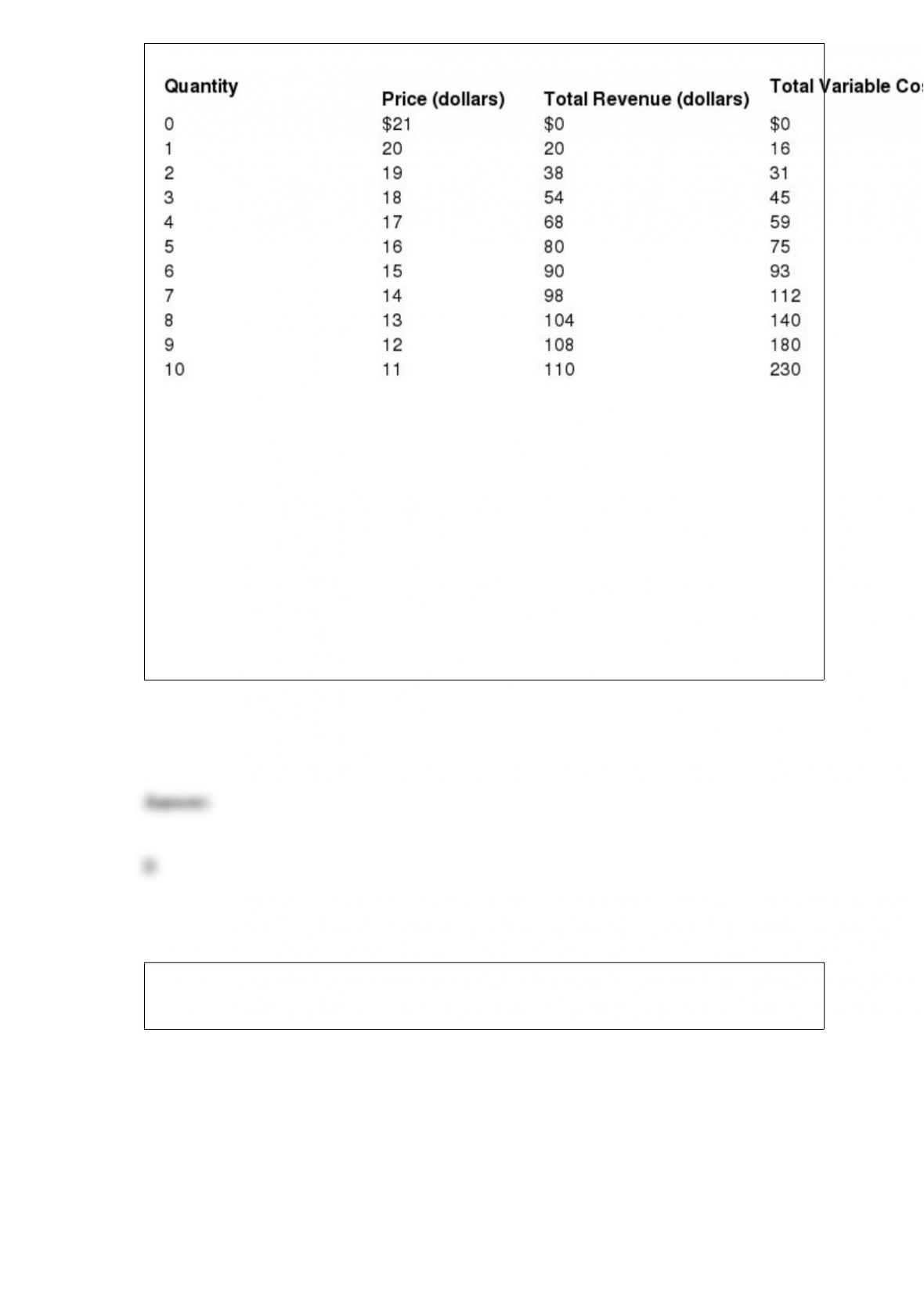
Table 13-3 shows the demand and cost schedules for a monopolistically competitive
firm.
Refer to Table 13-3. What is the best course of action for the firm in the short run?
A) It should shut down.
B) It should stay in business because it covers some of its fixed cost.
C) It should increase its sales by lowering its price.
D) It should not cut its price but it should increase its sales by advertising.
Figure 4-8

Figure 4-8 shows the market for beer. The government plans to impose a unit tax in this
market.
Refer to Figure 4-8. What is the size of the unit tax?
A) $2
B) $5
C) $7
D) $12
A monopolistically competitive firm earning profits in the short run will find the
demand for its product decreasing and becoming more elastic in the long run as new
firms move into the industry until
A) the original firm is driven into bankruptcy.
B) the firm’s demand curve is perfectly elastic.
C) the firm’s demand curve is tangent to its average total cost curve.
D) the firm exits the market.
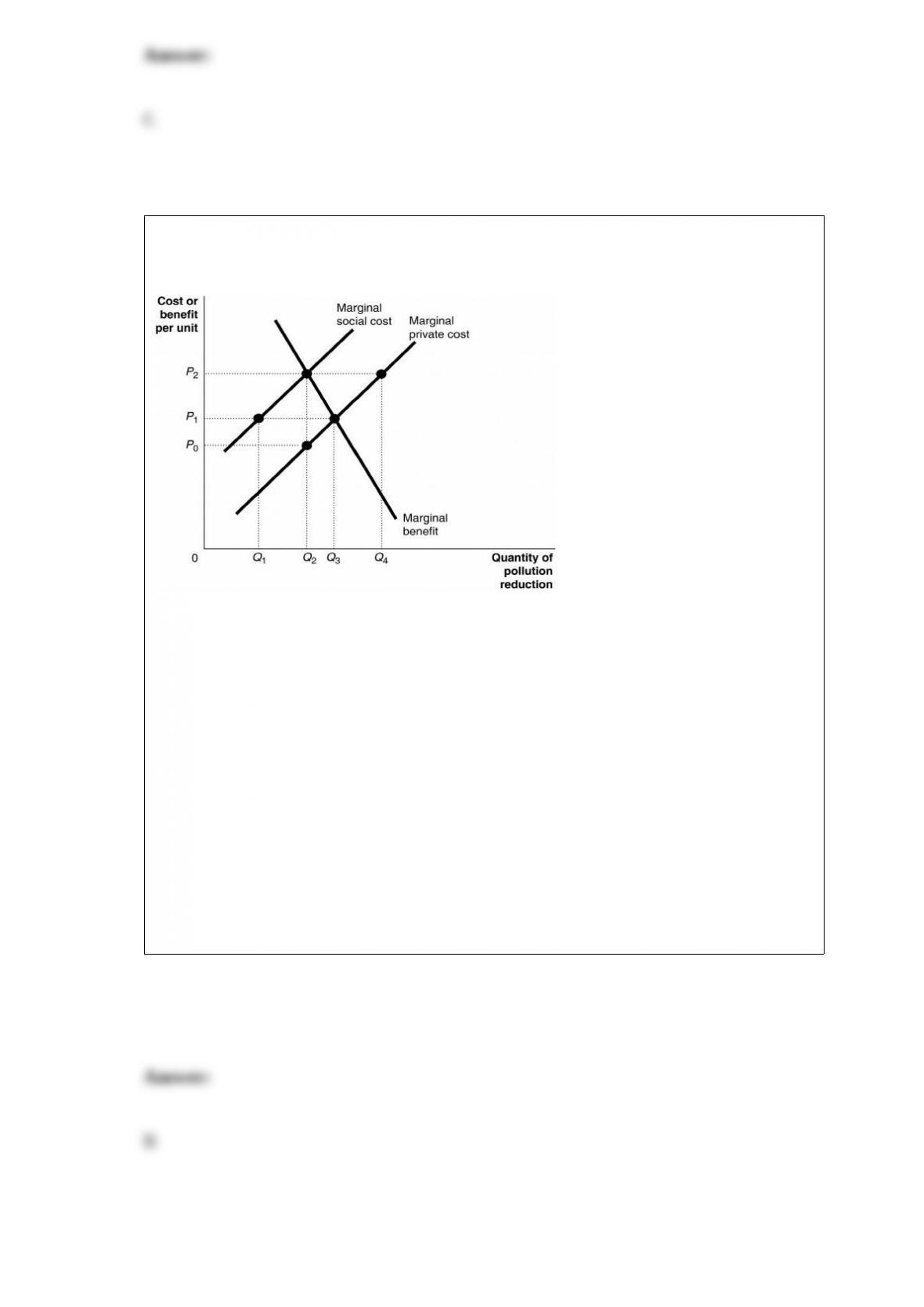
Figure 5-9
Companies producing toilet paper bleach the paper to make it white. The bleach is
discharged into rivers and lakes and causes substantial environmental damage. Figure
5-9 illustrates the situation in the toilet paper market.
Refer to Figure 5-9. Suppose the government wants to use a Pigovian tax to bring
about the efficient level of production. What should the value of the tax be?
A) (P2-P1) per ton of output
B) (P2-P0) per ton of output
C) (P1-P0) per ton of output
D) P1 per ton of output

Marv Pilson has $50 worth of groceries in a shopping cart at his local Shop ‘n Save.
Assume that the marginal utility per dollar of the liter bottles of soft drink in Marv’s cart
equals 50. The marginal utility per dollar of the boxes of cereal in Marv’s cart equals 20.
Marv has only $50 to spend, but has not yet paid for his groceries. How can Marv
increase his total utility without spending more than $50?
A) Marv should substitute his favorite soft drink or the cereal in his cart for generic
brands that have lower prices.
B) Marv should buy more boxes of cereal and fewer bottles of soft drink.
C) Marv should buy fewer boxes of cereal and more bottles of soft drink.
D) Marv should buy fewer boxes of cereal and fewer bottles of soft drink. He can then
spend more on other items.
If the price of lattes, a normal good you enjoy, falls
A) the income and substitution effects offset each other but the price effect leads you to
buy more lattes.
B) both the income and substitution effects lead you to buy more lattes.
C) the income effect which causes you to increase your latte consumption outweighs
the substitution effect which causes you to reduce your latte consumption, resulting in
more latte purchased.
D) the substitution effect which causes you to increase your latte consumption
outweighs the income effect which causes you to reduce your latte consumption,
resulting in more latte purchased.

Table 9-2
Sarita and Gabriel own S&G Bakery. Table 9-2 lists the number of pies and cakes Sarita
and Gabriel can each bake in one day.
Refer to Table 9-2. Select the statement that accurately interprets the data in the table.
A) Sarita has an absolute advantage in baking cakes and Gabriel has an absolute
advantage in baking pies.
B) Sarita has an absolute advantage in baking pies and Gabriel has an absolute
advantage in baking cakes.
C) Sarita has an absolute advantage in baking pies and cakes.
D) Gabriel has an absolute advantage in baking pies and cakes.
Traditionally, Wall Street investment banks had been organized as partnerships, but by
2000 they had converted to being publicly traded corporations. As partnerships, the
principle-agent problem is ________, but as publicly traded corporations, the
principal-agent problem is often ________.
A) increased; more severe
B) increased; less severe
C) reduced; more severe
D) reduced; less severe
Which of the following is not true for a firm in perfect competition?
A) Profit equals total revenue minus total cost.
B) Price equals average revenue.
C) Average revenue is greater than marginal revenue.
D) Marginal revenue equals the change in total revenue from selling one more unit.
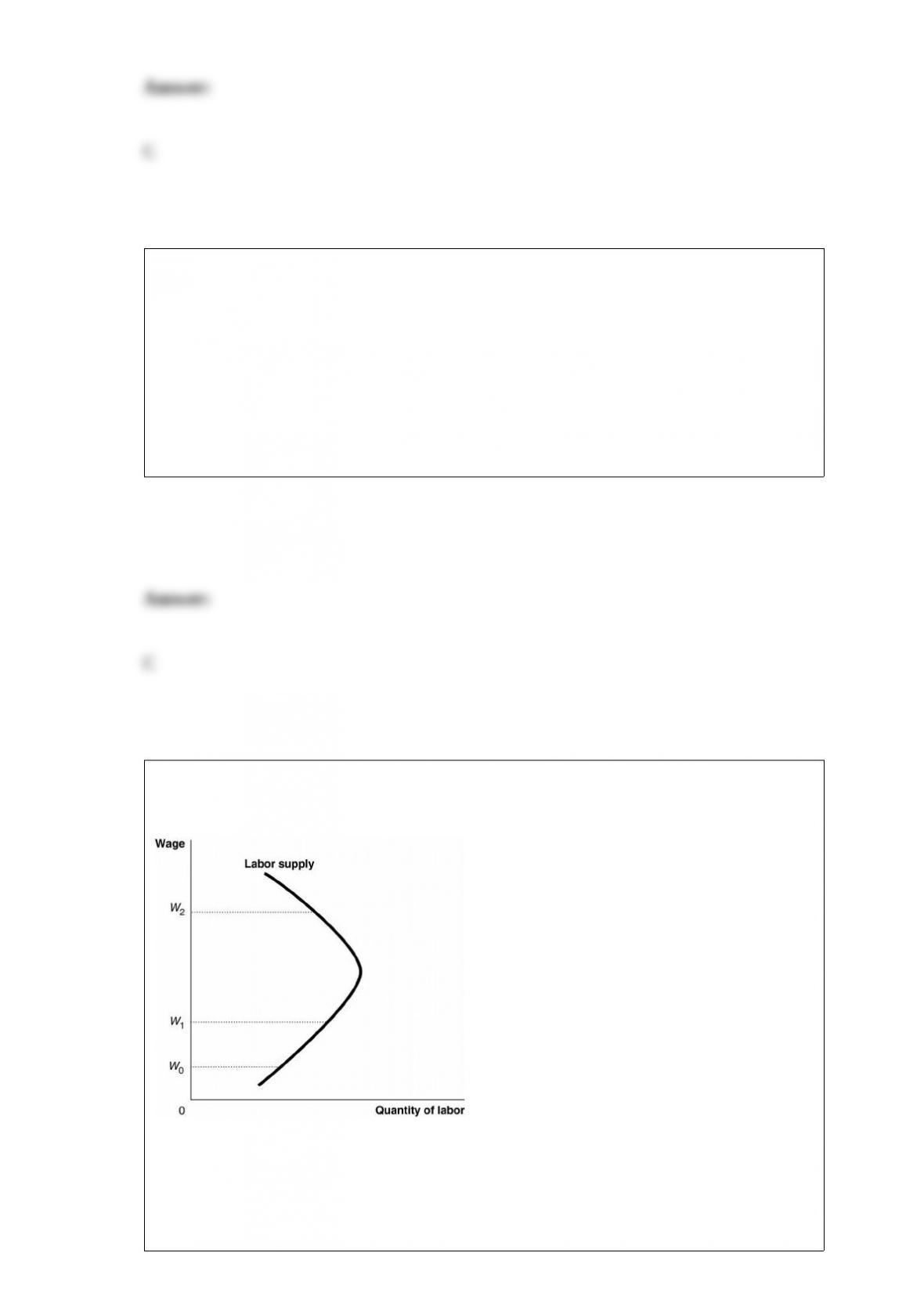
Figure 17-4
Refer to Figure 17-4. Which of the following is true at W2?
A) The income effect is larger than the substitution effect.
B) The substitution effect is larger than the income effect.

C) The income effect and the substitution effect are equal.
D) The supply curve is positively sloped.
Scenario 17-1
In academia, professors in some disciplines receive higher salaries than others. For
example, professors teaching in business schools receive higher salaries than professors
in the English department. Suppose at Unity College, assistant professors in the
business school earn $80,000 while assistant professors in the English department earn
$50,000. Now suppose the government passes comparable worth legislation that
requires academic institutions to pay all faculty the same salaries.
Refer to Scenario 17-1. Following the passage of comparable worth legislation, Unity
College responds by placing salaries for all assistant professors at $80,000. Which of
the following is the result of the legislation?
A) The supply of English professors increases; the market for business professors is not
affected.
B) The demand for English professors decreases; the market for business professors is
not affected.
C) There will be a surplus in the market for English professors and a shortage in the
market for business professors.
D) There will be a surplus in the market for English professors and the market for
business professors will not be affected.

Figure 2-14
Refer to Figure 2-14. Which two arrows in the diagram depict the following
transaction: Dorian Gray hires “Wild Oscar,” a professional portrait artist, to paint his
picture.
A) J and M
B) K and G
C) K and M
D) J and G
A positive externality causes
A) the marginal social benefit to be equal to the marginal private cost of the last unit
produced.
B) the marginal social benefit to be less than the marginal private cost of the last unit
produced.
C) the marginal social benefit to exceed the marginal private cost of the last unit
produced.

D) the marginal private benefit to exceed the marginal social cost of the last unit
produced.
Total utility is maximized in the consumption of two goods by
A) equating the marginal utility for each good consumed.
B) equating the marginal utility per dollar for each good consumed.
C) equating the total utility of each good divided by its price.
D) maximizing expenditure on each good.
Figure 18-3
Refer to Figure 18-3. The figure above shows a demand curve and two supply curves,
one more elastic than the other. Use Figure 18-3 to answer the following questions.
a. Suppose the government imposes an excise tax of $1.00 on every unit sold. Use the
graph to illustrate the impact of this tax.
b. If the government imposes an excise tax of $1.00 on every unit sold, will the
consumer pay more of the tax if the supply curve is S1 or S2? Refer to the graphs in
your answer.
c. If an excise tax of $1.00 on every unit sold is imposed, will the revenue collected by
the government be greater if the supply curve is S1 or S2?
d. If the government imposes an excise tax of $1.00 on every unit sold, will the
deadweight loss be greater if the supply curve is S1 or S2?

Many airlines have not reduced or eliminated fuel surcharges despite the price of oil
dropping. A logical reason for this is that the decline in fuel prices ________ the supply
of airline tickets while at the same time the demand for airline tickets ________, so
airline ticket prices still increased.
A) decreased; increased
B) decreased; decreased
C) increased; increased
D) increased; decreased