Archives: Solution Manual
Economics Chapter 6 Homework Why do you think macroeconomists focus on just a few
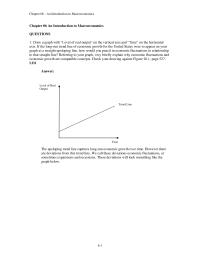
Chapter 06 – An Introduction to Macroeconomics 6-1 Chapter 06 An Introduction to Macroeconomics QUESTIONS 1. Draw a graph with “Level of real output” on the vertical axis and “Time” on the horizontal axis. If the long-run trend line of […]
Economics Chapter 5 Homework A public good is one where consumption in non-rival and non-excludable. Private goods are not profitable because of the free rider problem
Chapter 05 – Market Failures: Public Goods and Externalities 5-1 Chapter 05 Market Failures: Public Goods and Externalities QUESTIONS 1. Explain the two causes of market failures. Given their definitions, could a market be affected by both types of market […]
Economics Chapter 4 Homework Price elasticity of demand is determined by comparing
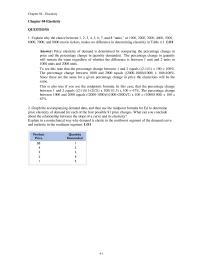
Chapter 04 – Elasticity 4-1 Chapter 04 Elasticity QUESTIONS 1. Explain why the choice between 1, 2, 3, 4, 5, 6, 7, and 8 “units,” or 1000, 2000, 3000, 4000, 5000, 6000, 7000, and 8000 movie tickets, makes no difference […]
Economics Chapter 3 Homework Preset prices, rather than responding to demand conditions, attempt to predict the level of demand that will produce an equilibrium quantity
incorrect, there will be an imbalance between the quantity supplied and the quantity demanded. Preset prices often apply to one-time-only events, versus something like gasoline that is sold regularly and repeatedly. Sellers can learn from experience how to adjust prices […]
Economics Chapter 3 Homework How will each of the following changes in demand and/or supply
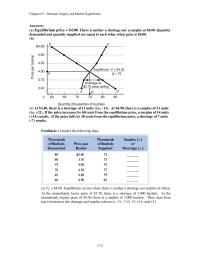
Chapter 03 – Demand, Supply and Market Equilibrium 3-12 Answers: (a) Equilibrium price = $4.00. There is neither a shortage nor a surplus at $4.00. Quantity Feedback: Consider the following data. (a) Pe = $4.00. Equilibrium occurs where there is […]
Economics Chapter 3 Homework The fundamental determinant of demand is the price of
Chapter 03 – Demand, Supply and Market Equilibrium 3-1 Chapter 03 Demand, Supply and Market Equilibrium Questions 1. Explain the law of demand. Why does a demand curve slope downward? How is a market demand curve derived from individual demand […]
Economics Chapter 2 Homework A market system allows for the private ownership of resources
workers choose the job with the best wages, fringe benefits and working conditions. Consumers apportion their expenditures to maximize their utility, while seeking the lowest possible prices. As individuals express their free choice, the economy is directed to produce the […]
Economics Chapter 1 Homework Cite three examples of recent decisions that you made in which you
skip breakfast to get a few extra minutes of sleep, to attend college, or to make a purchase. Marginal benefits of attending class may include the acquisition of knowledge, participation in discussion, and better preparation for an upcoming examination. Marginal […]
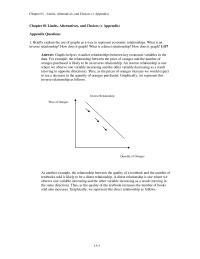
Economics Chapter 1 Homework Graphs help us visualize relationships between key economic variables
Chapter 01 – Limits, Alternatives, and Choices (+ Appendix) 1A-1 Chapter 01 Limits, Alternatives, and Choices (+ Appendix) Appendix Questions 1. Briefly explain the use of graphs as a way to represent economic relationships. What is an inverse relationship? How […]
Management Chapter 14s Homework The goal of a maintenance program is to minimize the total cost of keeping facilities and equipment in good working order
Excel Templates to accompany Operations Management, Eleventh Edition created by Lee Tangedahl Copyright © 2012 by The McGraw Hill Companies, Inc. All rights reserved. Supplement to Chapter Fourteen – Maintenance Templates: Expected Number of Breakdowns (B) (B) – includes Basic […]
Management Chapter 14s Homework Preventive maintenance may result from inspections that reveal the need for preventive maintenance, according to calendar
basis), lost production, disrupted schedules, parts, possible damage to product, equipment, and facilities, possible injuries, late deliveries, and loss of morale. preventive maintenance just prior to that time. Generally, such predictions are made on the basis of historical breakdown and […]
Management Chapter 10s Homework The two basic factors in choosing between single and multiple sampling are the cost per sample and the cost per observation
Copyright © 2012 by The McGraw Hill Companies, Inc. All rights reserved. Supplement to Chapter Ten – Acceptance Sampling Templates: Acceptance Sampling (B) Lecture Suggestions (B) – includes Basic template Examples: Example 1 Example 2 Solved Problems: Solved Problem 2 […]
Management Chapter 10s Homework There are three points in the production process where monitoring takes place: before production, during production, and after production
failing a lot of previously produced items. Lot control usually requires larger samples because order of production is not known for inspected items. acceptance given a sampling plan; it indicates how well a given sampling plan discriminates between lots of […]
Management Chapter 8s Homework The MODI method is a way to determine if a solution to a transportation problem is optimal. It differs from the stepping-stone approach
Excel Templates to accompany Operations Management, Eleventh Edition created by Lee Tangedahl Copyright © 2012 by The McGraw Hill Companies, Inc. All rights reserved. Supplement to Chapter Eight – The Transportation Model Templates: Transportation Model (Basic) Lecture Suggestions Examples: Example […]
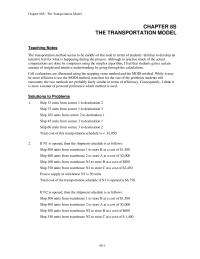
Management Chapter 8s Homework The transportation method seems to be middle-of-the-road in terms of students’ abilities to develop an intuitive feel for what is happening during the process
Cell evaluations are illustrated using the stepping-stone method and the MODI method. While it may be more efficient to use the MODI method, note that for the size of the problems students will encounter, the two methods are probably fairly […]
Management Chapter 7s Homework Collect more data from company and other dealerships before concluding average time of 4 hours is appropriate
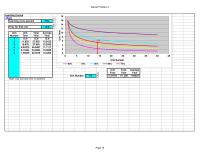
Solved Problem 2 Learning Curves <Back Learning curve percent 75% Time for first unit 15.9 Unit Unit Total Average Number Time Time Time 1 15.9 15.9 15.9 2 11.925 27.825 13.9125 14 0 14 5.31754 Unit Total Average Time Time […]
Management Chapter 7s Homework The case has numerous possible dimensions that students can explore. When I have used this in class, I found much interest among students
Excel Templates to accompany Operations Management, Eleventh Edition created by Lee Tangedahl Copyright © 2012 by The McGraw Hill Companies, Inc. All rights reserved. Supplement to Chapter Seven – Learning Curves Templates: Learning Curves Solved Problems: Solved Problem 1 Solved […]
Management Chapter 7s Homework At a certain point during the learning process, the employee will reach a steady state. This indicates the completion of the learning based on
be a straight line. It is important to know the shape of the curve before assuming a certain shape and making predictions using that learning curve. Therefore, during the earlier stages of the process, the decision-maker must carefully study the […]
Management Chapter 5s Homework Sub optimization occurs as a result of different departments, each attempting to reach a solution that is optimum for that department but may not be optimum
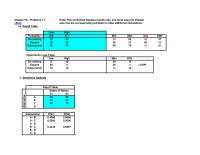
Chapter 5S – Problems 1-7 Note: This worksheet displays results only, you must copy the shaded <Back area into the corresponding template to make additional calculations. 1,2. Payoff Table Low High Probability = 0.3 0.7 Min Max Avg EMV Opportunity […]
Management Chapter 5s Homework The presentation should emphasize that decision trees are developed for multi-phase decision-making where several interrelated decisions and states of nature are considered
Excel Templates to accompany Operations Management, Eleventh Edition created by Lee Tangedahl Copyright © 2012 by The McGraw Hill Companies, Inc. All rights reserved. Supplement to Chapter Five – Decision Theory Templates: Payoff Table (B) Solved Problems: Solved Problem 1,3,4a […]
Management Chapter 5s Homework This chapter supplement lays the foundation for much of the remainder of the text, which is oriented towards problem solving and decision-making
(e.g., EOQ), or to suggest that such and such a model is not realistic. Of course, some of the models presented in operations simply serve as points of departure, or as an easy way to introduce more complex models. Even […]
Management Chapter 4s Homework Reliability is a measure of the ability of a product or service to perform its intended function under a prescribed set of conditions
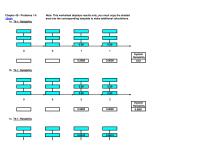
Chapter 4S – Problems 1-6 Note: This worksheet displays results only, you must copy the shaded <Back area into the corresponding template to make additional calculations. 1a. T4-1: Reliability 1b. T4-1: Reliability 0.90 0.90 0.90 0.90 0 0 2 2 […]
Management Chapter 4s Homework The normal distribution should be included because it paves the way for later use of inventory management and quality control sampling theory
Excel Templates to accompany Operations Management, Eleventh Edition created by Lee Tangedahl Copyright © 2012 by The McGraw Hill Companies, Inc. All rights reserved. Supplement to Chapter Four – Reliability Templates: Reliability Solved Problems Solved Problem 2 MTBF – Exponential […]
Management Chapter 4s Homework for most products, failure rates change over time. As can be observed from Figure 4S–1, the failure rates tend to be high during the infant mortality phase
because its reliability is a function of the products of the individual reliabilities. For example, if a product has 20 parts, each with a reliability of .99, and all must operate, the overall product reliability will only be about .9920 […]
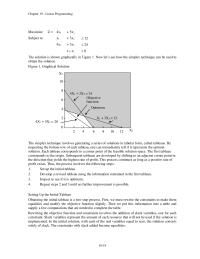
Management Chapter 19 Homework The simplex technique involves generating a series of solutions in tabular form, called tableaus. By inspecting the bottom row of each tableau
Chapter 19 – Linear Programming 19–19 Maximize Z = 4×1 + 5×2 The solution is shown graphically in Figure 1. Now let’s see how the simplex technique can be used to obtain the solution. Figure 1. Graphical Solution X1 Objective […]
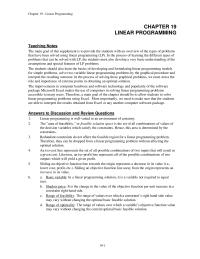
Management Chapter 19 Homework To determine if the changes are within the range for multiple changes, we first compute the ratio of the amount of each change to the end of the range in the same direction
Chapter 19 – Linear Programming 19-1 CHAPTER 19 LINEAR PROGRAMMING Teaching Notes The main goal of this supplement is to provide the students with an overview of the types of problems that have been solved using linear programming (LP). In […]
Management Chapter 19 Homework Mass customization may be applied at the Eat Now restaurant by streamlining and standardizing the operations such that it becomes more efficient and faster to
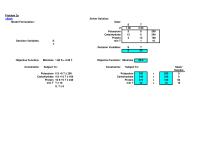
Problem 2a <Back Solver Solution: Model Formulation: Data: S T Z 1.80 2.20 Potassium 5 8 200 Carbohydrate 15 6240 Protein 4 12 180 Decision Variables: S min T 1 10 T Decision Variables: S T 820 Objective Function: Minimize […]
Management Chapter 19 Homework This template is designed to demonstrate the graphical solution for this particular problem only. See the Linear Programming ScreenCam Tutorial for a demonstration of this template
Excel Templates to accompany Operations Management, Eleventh Edition created by Lee Tangedahl Copyright © 2012 by The McGraw Hill Companies, Inc. All rights reserved. Chapter Nineteen – Linear Programming These templates are each designed to demonstrate the solution for one […]
Management Chapter 18 Homework The technology has had a profound impact on analyzing waiting line systems. First of all, through the use of computers and simulation studies
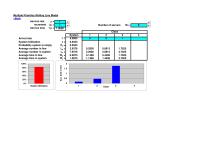
Multiple Priorities Waiting Line Model <Back Service rate m = 1 Increment Dm = 1 Number of servers M = 6 Service time 1/m = 1.0000 Class System 1 2 3 4 Arrival rate l = 5.0000 2 2 1 […]
Management Chapter 18 Homework In assessing the cost of customer waiting for service involving the general public, the customers themselves, marketing, finance and operations managers or representatives from those
Excel Templates to accompany Operations Management, Eleventh Edition created by Lee Tangedahl Copyright © 2012 by The McGraw Hill Companies, Inc. All rights reserved. Chapter Eighteen – Management of Waiting Lines Templates: Single Channel Waiting Line Model (B) Example 3 […]
Management Chapter 18 Homework The multiple priority approach is appropriate whenever the cost or criticalness of waiting for service differs significantly for different customer
average time they wait, in either the line or the system. In addition, system utilization and total cost are important. 4. The effective system capacity would increase. Consequently, the system could tolerate a higher arrival rate without experiencing a disproportionate […]
Management Chapter 17 Homework To begin with, firms must recognize the potential problems, and then set up a mechanism to deal with them before they are full-blossomed
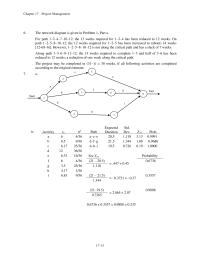
Chapter 17 – Project Management 17–15 6. The network diagram is given in Problem 1, Part a. For path 1–2–4–7–10–12, the 13 weeks required for 1–2–4 has been reduced to 12 weeks. On path 1–2–5–8–10–12, the 12 weeks required for […]
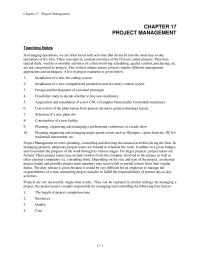
Management Chapter 17 Homework Project Management involves planning, controlling and directing the unusual activities facing the firm. In managing projects, temporary project teams
Chapter 17 – Project Management 17-1 CHAPTER 17 PROJECT MANAGEMENT Teaching Notes In managing operations, we are often faced with activities that do not fit into the usual day-to-day operations of the firm. These non-typical, unusual activities of the firm […]
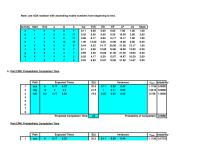
Management Chapter 17 Homework Revising the schedule based on changes in order status of jobs, material and/or capacity availability and various other reasons
Note: use AOA notation with ascending nodes numbers from beginning to end. Activity Start End a m b Var E(T) ES EF LF LS Slack a 1 2 5 6 7 0.11 6.00 0.00 6.00 7.00 1.00 1.00 b 1 […]
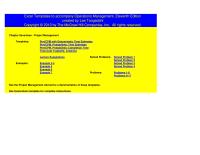
Management Chapter 17 Homework Problems Example use AOA notation with ascending nodes numbers from beginning to end. Use Paste Special/Values to paste into shaded are
Excel Templates to accompany Operations Management, Eleventh Edition created by Lee Tangedahl Copyright © 2012 by The McGraw Hill Companies, Inc. All rights reserved. Chapter Seventeen – Project Management Templates: Pert/CPM with Deterministic Time Estimates Pert/CPM, Probabilistic Time Estimates Pert/CPM, […]
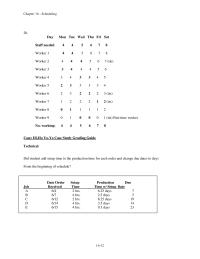
Management Chapter 16 Homework Did student add setup time to the production time for each order and change due dates to days From the beginning of schedule
Chapter 16 – Scheduling 16–32 26. Day Mon Tue Wed Thu Fri Sat Staff needed 4 4 5 6 7 8 Worker 1 4 4 5 6 7 8 Worker 2 4 4 4 5 6 7 (tie) Worker 3 […]
Management Chapter 16 Homework There are several ways to show this. One is to calculate the ratio of average flow time to average number of jobs for each rule
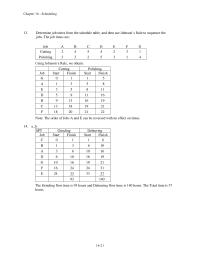
Chapter 16 – Scheduling 16–21 13. Determine job times from the schedule table, and then use Johnson’s Rule to sequence the jobs. The job times are: Job A B C D E F G Cutting 2 4 5 4 2 […]
Management Chapter 16 Homework Scheduling techniques are designed to disaggregate the master production schedule into time-phased daily or hourly activities
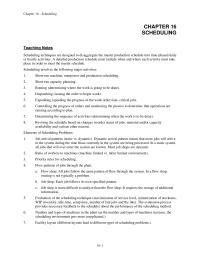
Chapter 16 – Scheduling 16-1 CHAPTER 16 SCHEDULING Teaching Notes Scheduling techniques are designed to disaggregate the master production schedule into time-phased daily or hourly activities. A detailed production schedule must include when and where each activity must take place […]
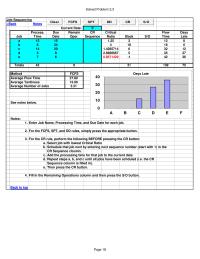
Management Chapter 16 Homework Enter Job Name, Processing Time, and Due Date for each job. Select job with lowest Critical Ratiob. Schedule that job next by entering next sequence number (start with 1) in the
Solved Problem 2,3 Job Sequencing <Back Notes Current Date: 0 Process. Due Remain CR Critical Flow Days Job Time Date Oper. Sequence Ratio Slack S/O Time Late a12 15 1.25 312 0 b 6 24 418 18 0 Totals 42 […]
Management Chapter 16 Homework Enter the costs to assign each worker/machine to each job in the middle of the matrix For the FCFS, SPT, and DD rules, simply press the appropriate button
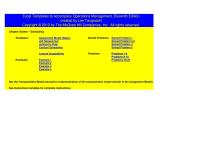
Excel Templates to accompany Operations Management, Eleventh Edition created by Lee Tangedahl Copyright © 2012 by The McGraw Hill Companies, Inc. All rights reserved. Chapter Sixteen – Scheduling Templates: Assignment Model (Basic) Solved Problems: Solved Problem 1 Job Sequencing Solved […]
Management Chapter 15 Homework The importance of Supply Chain Management can not be underestimated because it ensures that the right materials are at the right place
3. Emphasis in reduced order cycles and reduced lead times. distribution processes. Students need to understand the trade offs involved in supply chain function related to JIT, inventory management purchasing and delivery lead times and quality. In addition, supply chain […]
Management Chapter 14 Homework Cross train workers so they can help when bottlenecks occur or other workers are absent. Train workers to handle equipment adjustments and minor repairs
Excel Templates to accompany Operations Management, Eleventh Edition created by Lee Tangedahl Copyright © 2012 by The McGraw Hill Companies, Inc. All rights reserved. Chapter Fourteen – JIT and Lean Operations Templates: Level Capacity Loading Lecture Suggestions Examples: Example 2a […]
Management Chapter 14 Homework JIT seems to be one of the most popular subjects for the students. Some are a bit skeptical at first, but most are fascinated by this Japanese
Use preventive maintenance on key equipment to reduce breakdowns and downtime: Utilization of preventive maintenance can reduce breakdowns and downtime. Even though preventive maintenance is also part of traditional manufacturing systems, the manufacturing systems utilizing JIT will spend more money […]
Management Chapter 13 Homework If we buy additional amounts of a particular good to take advantage of quantity discounts, then we will save money on a per unit purchasing cost of the item
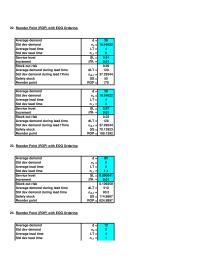
22. Reorder Point (ROP) with EOQ Ordering Average demand d = 30 Std dev demand sd = 18.64622 Average demand d = 30 Std dev demand sd = 18.64622 Average lead time LT = 4 Std dev lead time sLT […]
Management Chapter 13 Homework Safety stock is inventory held in excess of expected demand to reduce the risk of stockout presented by variability in either lead time or demand rates
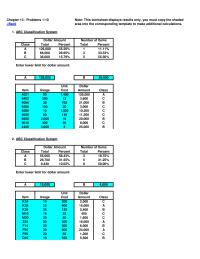
Chapter 13 – Problems 1-10 Note: This worksheet displays results only, you must copy the shaded <Back area into the corresponding template to make additional calculations. 1. ABC Classification System Dollar Amount Number of Items Class Total Percent Total Percent […]
Management Chapter 13 Homework It may be inappropriate to compare the inventory turnover ratios of companies in different industries because the production process
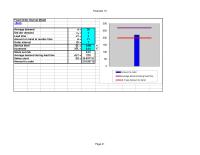
Example 13 Fixed Order Interval Model <Back Average demand d = 30 Std dev demand sd = 3 Stock out risk 0.01 199 270 #N/A #N/A Average demand during lead time dLT = 270 199 270 219.93713 #N/A Safety stock […]
Management Chapter 13 Homework Carrying or holding costs include interest, security, warehousing, obsolescence, and so on. Procurement costs relate to determining
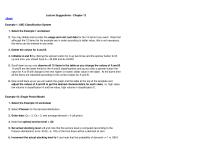
Lecture Suggestions – Chapter 12 <Back Example 1: ABC Classification System 1. Select the Example 1 worksheet 2. You may delete and re-enter the usage and unit cost data for the 12 items if you want. Note that 3. Delete […]
Management Chapter 13 Homework Inventories are crucial not only to Farmers Restaurant, but to businesses in general. Customer satisfaction and customer return is contingent upon proper inventory management
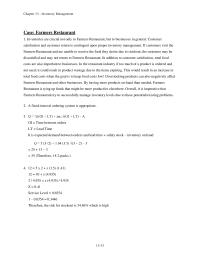
Chapter 13 – Inventory Management 13-33 Case: Farmers Restaurant 1. Inventories are crucial not only to Farmers Restaurant, but to businesses in general. Customer satisfaction and customer return is contingent upon proper inventory management. If customers visit the Farmers Restaurant […]
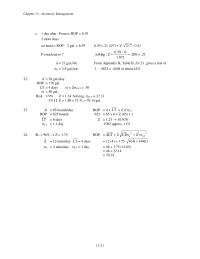
Management Chapter 13 Homework The total annual savings as a result of switching from six-week FOI to EOQ are relatively small and switching to the optimal order quantity may not be warranted
Chapter 13 – Inventory Management 13-21 P (stockout) = ? 21.208. 871.1 639.6 Z,solving = − = d = 21 gal./wk. From Appendix B, Table B, Z=.21 gives a risk of d = 3.5 gal./wk. 1 – .5832 = .4168 […]
Management Chapter 13 Homework EOQ models answer the question of how much to order. Variations of the basic EOQ model include the quantity discount model and the economic run size model.
Chapter 13 – Inventory Management 13-1 CHAPTER 13 INVENTORY MANAGEMENT Teaching Notes This is a fairly long and important chapter. Important points are: 2. The key issues are when to order and how much to order. 3. Because all items […]