
Chapter 14 – JIT and Lean Operations
14-1
CHAPTER 14
JIT AND LEAN OPERATIONS
Teaching Notes
JIT seems to be one of the most popular subjects for the students. Some are a bit skeptical at first, but most
are fascinated by this Japanese approach to repetitive production.
It has been said by some Japanese that the system has its roots in Henry Ford’s assembly line. In fact, some
interesting parallels and comparisons can be made between JIT systems and production lines.
Answers to Discussion and Review Questions
1. Reduce downtime due to changeovers by reducing changeover time: JIT concentrates on reduction
on setup times so that the lot size can be reduced. Of course, reduction of the lot size will result in
reduction of the inventories and also increase productive time as a result of less time being
allocated to changeovers. This approach is different than the traditional manufacturing approach
where the main goal is to balance the trade-off between the changeover (setup) cost and cost of
carrying inventory.
Chapter 14 – JIT and Lean Operations
14-2
Cross train workers so they can help when bottlenecks occur or other workers are absent. Train
workers to handle equipment adjustments and minor repairs: The name of the game is flexibility.
Cross-training workers to handle different tasks will improve the flexibility of the system. The
Use many small units of capacity. Many small cells make it easier to shift capacity temporarily
and to add or subtract capacity than a few units of large capacity: Utilization of small units of
capacity adds more flexibility to the system and reduces the chance of wasted capacity in the form
of idle time. Remember, the goal of JIT is to reduce any form of waste. If the capacity comes in
large chunks, there is a greater probability of the machines and equipment not being used if the
Use off-line buffer: Store infrequently-used safety stock away from production areas to decrease
congestion and to avoid continually turning it over. In JIT systems, this is also consistent with the
elimination of waste.
Reserve capacity for important customers: Since in a JIT system it is promoted to add capacity in
small chunks, there may be a greater chance of running out of capacity than the traditional
manufacturing system. Therefore, it is critical to reserve capacity for important customers to
2. The ultimate goals of JIT are to improve customer service and to improve operational efficiency
through improved balanced flow through the workstations. In order to achieve these goals, JIT has
3. The JIT philosophy is to emphasize continual effort to remove waste and inefficiency in a
production process through small lot sizes, low inventories, high quality, and teamwork.
Chapter 14 – JIT and Lean Operations
14-3
5. a. Vendors can play a significant role in the success of just–in-time systems. Converting to, and
operating under, a just-in–time system requires close cooperation between vendors and buyers.
In such systems, vendors become “team” members. Vendors are expected to be flexible in
delivery schedules, ship in small lot sizes, be reliable, have consistently high quality, and
assist in problem solving. Without good vendor relations, much of this will not materialize.
b.
Factor
Traditional
JIT
Importance of price
major factor, high emphasis
one of several factors
Length of relationship
often short
long-term
Number of suppliers
many
few
Attitude towards
adversarial
partner
Location
low importance
nearness highly important
c. Vendors may be hesitant about JIT buyers for a number of reasons: The need to be flexible, to
deliver in small lot sizes, to be closely tied to the needs of the buyer, cost, time, resistance of
employees, etc.
6. Both assembly lines and just–in-time systems have little inventory as work moves from one
7. A kanban is a signal used in some JIT systems to authorize movement of materials or to authorize
8. In a push system, as work is finished at a workstation, it is pushed on to the next station; the
governing factor is the station completing the work. In a pull system, each station pulls work to it
9. The main benefits of a lean system are:
a. Reduced levels of work-in-process inventories, purchased goods and finished goods.
Chapter 14 – JIT and Lean Operations
14-4
Taking Stock
1. Shifting from a traditional operations system to a lean manufacturing system requires the change
of mind set on the part of the managers implementing this change. JIT/Lean systems will require
smaller batch sizes, quick changeovers, reduction of work–in–process inventories, quick and
flexible response time in deliveries from suppliers and fairly predictable demand for the end
product. If the demand for the end product is highly variable or difficult to predict, then it becomes
2. The change from a traditional system to a JIT/Lean system encompasses the entire firm. Therefore,
3. The technology has had a profound affect on the implementation of JIT/Lean systems. The
improvement in machine designs resulted in better performance of machines, which in turn

Chapter 14 – JIT and Lean Operations
14-5
Critical Thinking Exercise
1. If there is one key factor to successful implementation of JIT/Lean systems, it involves the
adaptation of holistic thinking. The holistic approach will not only assist in transforming the
technical aspects of the firm, but also the company’s “culture” and subsequently, its management
2. Student answers will vary
Chapter 14 – JIT and Lean Operations
14-6
Solutions
1.
N = ?
N =
DT(1 + X)
D = 80 pieces per hour
C
T = 75 min. = 1.25 hr.
=
80(1.25) (1.35)
= 3
C = 45
45
X = .35
3.
N = ?
N =
DT(1 + X)
D = 200 lb. per day
C
200(.250) (1.08)
C = 120 lb.
4. The smallest daily quantity evenly divisible into all four quantities is 3. Therefore, use three cycles.
Product
Daily quantity
Units per cycle
5.
a. Cycle 1 2 3 4
A 6 6 5 5
b. Cycle 1 2
A 11 11
D = 100 pieces per hr.
C
100(1.75) (1.20)
C = 72
Chapter 14 – JIT and Lean Operations
14-7
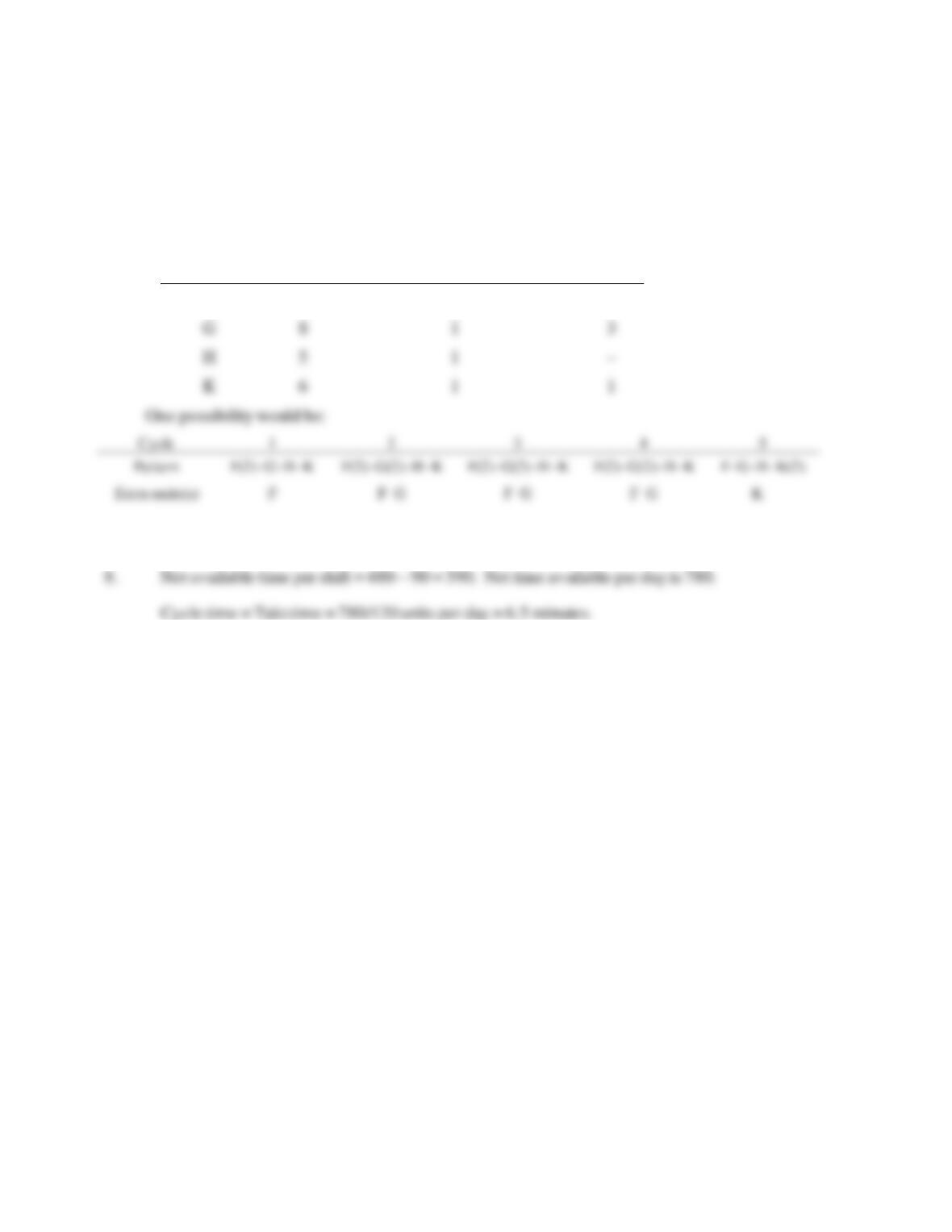
6. The smallest daily quantity is 5. None of the other daily quantities are divisible by 5, however.
Using five cycles and producing one unit of each product per cycle would leave some products, as
shown in the following table. Hence, if five cycles are used, some extra units will have to be made
in some cycles.
Product
Daily
quantity
Nearest multiple of 4 without
exceeding daily quantity
Units
short
F
9
1
4
7. Net available time = 480 – 75 = 405. Takt time = 405/300 units per day = 1.35 minutes.
9. Net time available = 440 – 20 – 60 = 360 minutes. Takt time = 360/90 = 4 minutes.
Chapter 14 – JIT and Lean Operations
14-8
Case: Level Operations
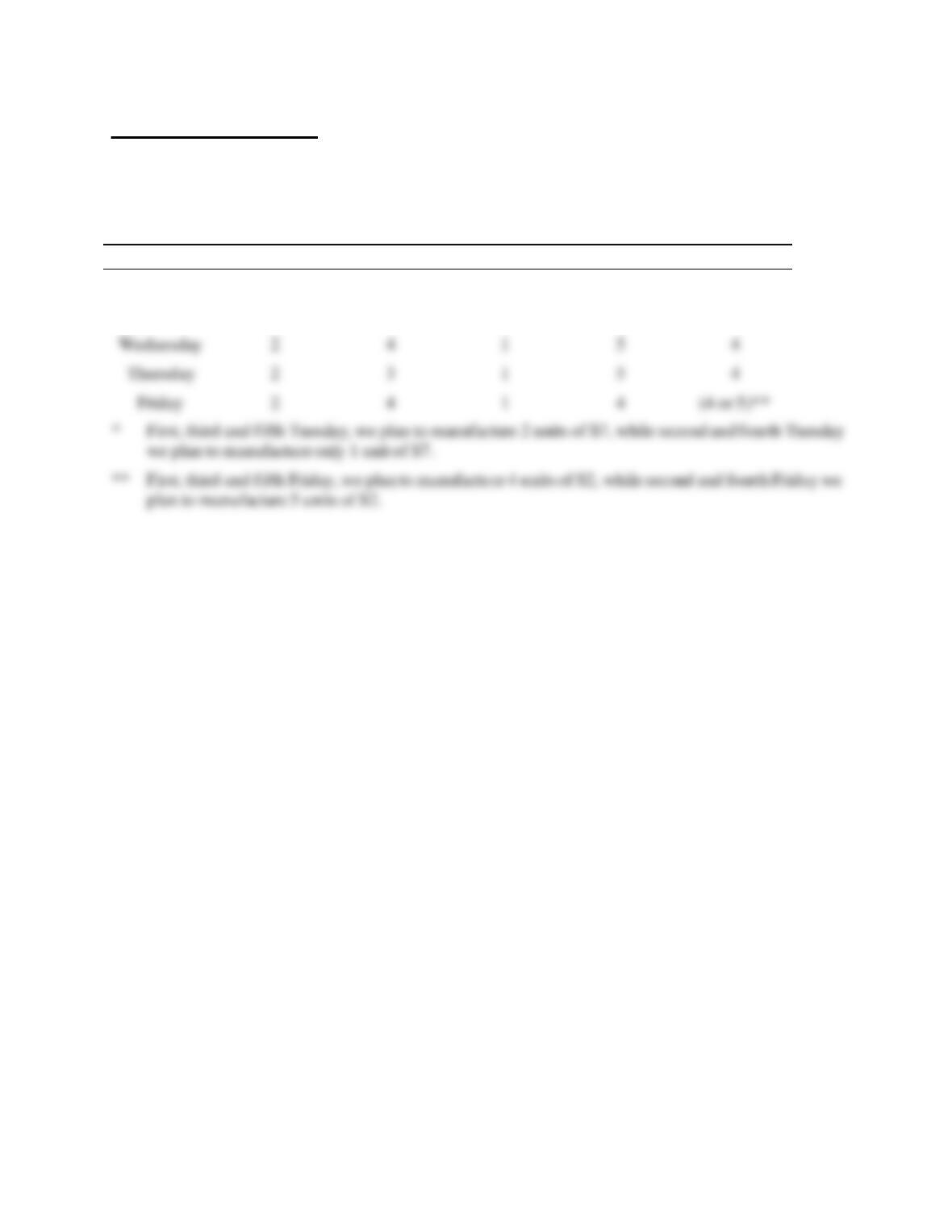
Assuming a five-day work week, the following weekly schedule should level the load across five weeks.
Each row is arranged according to the sequence in which the products would be produced.
Weekly Production Schedule
Model
Day
S7
S8
S9
S1
S2
Monday
2
4
1
5
4
Tuesday
(2 or 1)*
3
1
5
4
2
4
1
5
4