Chapter 15 – Supply Chain Management
15-1
CHAPTER 15
SUPPLY CHAIN MANAGEMENT
Teaching Notes
It is important to emphasize that Supply Chain Management involves the entire range of production and
Supply Chain Management requires a broad view of the entire flow from purchasing to final delivery to
the customer. Supply Chain Management is becoming increasingly more important due to the following
factors:
2. Emphasis in reduction in inventories.
4. Continuous and rapid change in products and product designs (shorter product life cycles).
5. Shorter product introduction and product development times.
The importance of Supply Chain Management can not be underestimated because it ensures that the right
materials are at the right place at the right time at a minimal cost and maximum quantity.
relationship between suppliers and their customers.
The term supply chain management has emerged in the mid-1980s and gained popularity in the 1990s. In
the new millennium, it is continuing to gain interest at a rapid rate. Even though the term, supply chain
management (SCM) is fairly new, the concepts and problems involved in SCM are not. However, many
of these problems and their solutions are integrated within and between firms in the context of managing
the flow of products and related information. Thus, supply chain management involves efficient
integration of suppliers, manufacturers, distributors and customers in the production and distribution of
goods and services.
Chapter 15 – Supply Chain Management
15-2
In order to eliminate confusion, it is a good idea to let the students know that there are alternative names
used in the area of purchasing. Depending on the environment and the relative position of the firm on the
Reading: E-Procurement at IBM
1. IBM was able to reduce its procurement costs by sending purchase orders, receiving invoices and
2. The speed and ease of using the Internet allowed IBM to form partnerships with small suppliers
3. In addition to cost reduction, IBM’s other main reason for switching to Web-based procurement
was forming strong long-term supplier partnerships. The Internet allows IBM to collaborate with
its suppliers over issues related to scheduling, inventories and forecasting.
5. IBM developed a Web-based portal to provide a single entry point to the company Web site
instead of having suppliers connect to the needed areas with separate URLs based on their
Chapter 15 – Supply Chain Management
15-3
Reading: Rise of the 3PL:
1. The larger companies are more likely to outsource than their smaller counterparts because they
are in a better position to afford the outsourcing and they have the staff and the system necessary
2. The technology is very important to the 3PL decision because the companies that utilize the third
Answers to Discussion and Review Questions
1. Supply chain is a sequence of organizations, their facilities, functions and activities that are
2. The factors that make it desirable to manage a supply chain include increasing:
a. Need to improve operations
b. Levels of outsourcing
The potential benefits of effective management of a supply chain include lower inventories,
higher profits, improved customer loyalty, shorter manufacturing and production lead times,
higher productivity and improved ability to respond to fluctuations in demand.
3. Elements of supply chain management consist of customers, forecasting, design, processing,
inventory, purchasing, suppliers, location and logistics.
4. Strategic issues in supply chain management include determining the number, location and
capacity of facilities, deciding whether to make or buy a product.
Chapter 15 – Supply Chain Management
15-4
5. Bullwhip effect is the increase of inventories on a supply chain starting at the end of a supply
chain with the final customer and working backwards towards the initial supplier (supplier of raw
materials). The main reason for the occurrence of this phenomenon is the lumpiness and
6. The purchasing function is becoming more important in supply chain management because of the
following factors:
a. As a result of increased outsourcing, the cost of materials is higher than cost of labor for
many end items.
7. Inventory velocity refers to the rate at which the inventory (material) goes through the system.
The faster the inventory moves through the system, the better it is because the quick movement of
8. Strategic partnering involves two or more business organizations with complimentary products or
9. E-commerce had a profound and a dramatic effect on supply chain management. The reasons for
this influence include buying on the Internet, both B to C (business-to-consumer) and B to B
10. See Table 16–2 for a comprehensive list of advantages of e-business.
11. See Table 16–5 for a comprehensive list of problems and the associated trade-offs in designing
and managing a supply chain.
12. Reverse logistics refers to the management of returned merchandise. It usually involves
Chapter 15 – Supply Chain Management
15-5
13. Supply chain visibility involves a major trading partner to connect any part of a company’s
supply chain to access data in real time on inventory levels, shipment status and similar key
information. This type of information sharing allows companies to prepare for future actions of
14. Purchasing managers plan, coordinate and direct negotiation of purchase contracts, supplier
selection, supplier certification, supplier partnerships, outsourcing, interface between purchasing
and other functions, value analysis, monitoring the placement, progress and reception of orders.
15. Purchasing is closely integrated with many of the other business functions. For example, when
parts or materials are purchased, Purchasing is responsible to notify Accounting so that
Accounting can process the payment. Accounting is also responsible for many of the record
17. Organizational placement of the purchasing function as well as the level of centralization is a
strategic decision.
Centralized Purchasing: A single purchasing department handles all purchasing and related
functions.
Advantages of centralization include:
a. The ability to obtain quantity discounts due to large volume generated.
Decentralized Purchasing: Individual departments are responsible for their own purchasing
requirements.
Advantages of decentralization include:
Chapter 15 – Supply Chain Management
15-6
18. Vendor Analysis: Studying various key characteristics of potential suppliers in order to select
19. Supplier Certification: It is the process of approving suppliers in order to place them on a firm’s
“certified” list. It involves site visits, contacting the supplier’s other customers for information
20. Suppliers should be viewed as outside partners who can contribute to the long-term success of the
firm rather than as adversaries. The strategy of single sourcing (purchasing all parts of a given
21. Crossdocking avoids the costs associated with warehousing, including moving goods in and out
of the warehouse, plus holding costs. It also gets goods to customers more quickly.
Taking Stock
1. When information is shared with other organizations on the supply chain, it allows companies to
better plan their manufacturing, inventories and promotions. However, sharing information with
2. The manager of supply chain operations, vice president of Logistics, transportation, purchasing,
3. Three different ways the technology has improved the ability of the firm to manage supply
chains:
a. The ability to integrate the databases of different firms to allow faster and easier access to
information by trading partners.
Chapter 15 – Supply Chain Management
15-7
Critical Thinking Exercise
1. There are many factors critical for a successful supply chain operation. In the following section,
we will explain why certain factors are very important in the implementation of successful supply
chain operations.
Integrated Technology: As the technology becomes more integrated it becomes easier for trading
partners on the supply chain to share information.
Trust among trading partners: It is essential for trading partners to trust each other and feel
confident that partners share similar goals and that they will take actions that are mutually
beneficial. Without a good, trusting relationship between trading partners all of the systems
(inventory, purchasing, accounting, manufacturing, etc.) cannot function effectively. The
interpersonal relationships are vital in developing trust between organizations. Openness with the
Real time information availability: If the information is not available on a real time basis,
transactions and communications between companies on the supply chain will be very slow and
will result in a decrease in the firm’s ability to develop, manufacture and distribute products. The
quick exchange of information on the supply chain is vital because IT infrastructures are quite
Event management capability: Event management is the ability to detect and respond to
unplanned events such as a delayed shipment or stockout of certain inventory items. This is
crucial in supply chain management because more than likely, things will go wrong on the supply
chain and corrective actions must be taken. If there is no process for dealing with situations that
deviate from the original plan, the company will either take too long to get organized to respond
or there will be chaos in trying to resolve the problem.
Purchasing: Purchasing is responsible for obtaining materials, parts, supplies and services needed
Chapter 15 – Supply Chain Management
15-8
2. Doing so would reasonably involve becoming well versed in many different operations. Getting
up to speed would require time, new people, training, adding resources, and adding new
3. On the plus side, it reduces or removes any environmental issues caused by the outsourced
4. Student answers will vary.
Memo Writing Exercises
1. Consolidated Delivery and Logistics Inc. is one of the major competitors in the delivery and
distribution industry. The firm’s Web site URL is http://www.cdl.net
The main services of the company include ground services, air services and technological
2. The Operations Management Center provides a few magazines and journals with many
appropriate articles dealing with Supply Chain Management. These journals are provided under
3. After reading this chapter, students should be able to understand the importance of purchasing in
the context of the entire business organization. They should also be able to appreciate the
4. Outsourcing has recently increased because it allows the companies to take advantage of an
outside supplier to provide materials, parts or services better, cheaper and more efficiently. The
5. Strategic partnering generally offers benefits to both partners. For example, strategic partnering
Chapter 15 – Supply Chain Management
15-9
Solutions
1. H = $10 per item per year (2,000 item) = $20,000 per year.
2. H = .30(80 boxes)($200 per box) = $4,800
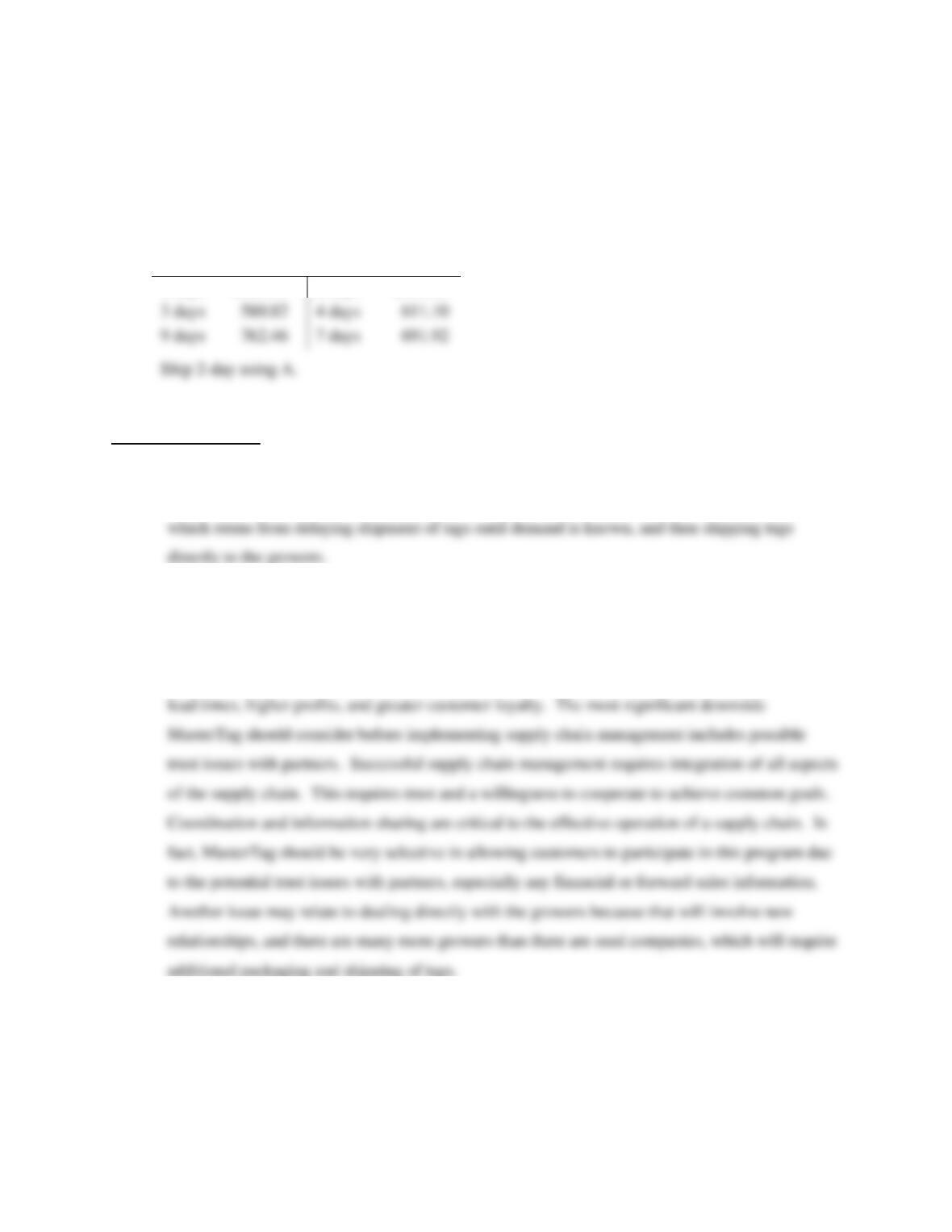
2-day analysis:
d = 1 day
Savings = $40
Incremental holding cost = H
365
d
6-day analysis
d = 5 days
Savings = $120
Chapter 15 – Supply Chain Management
15-10
3. H = .35 (300 boxes) ($140 per box) (1/365 days) = $40.274
Cost = FC + dH
A
B
Option
Cost
Option
Cost
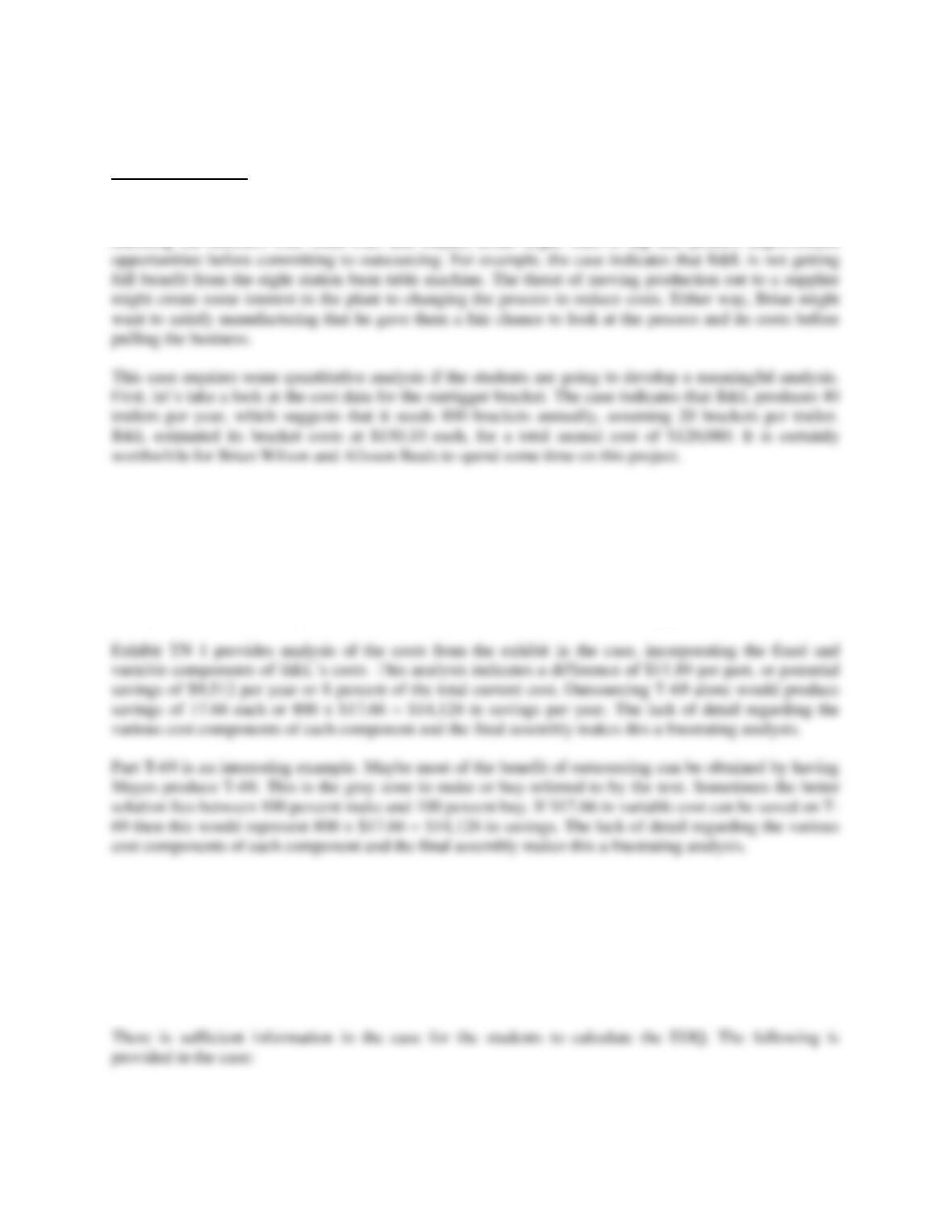
2 days
$580.55
2 days
$605.55
Case: MasterTag
1. The key benefit relates to customer satisfaction by more closely matching supply with demand
2. When MasterTag considers implementing their supply chain management plan, the potential
benefits they hope to gain are most likely to be greater customer satisfaction, advantages over the
competition, reduced lead times and “leaner” operations. Benefits of effective supply chain
management include lower inventories, lower costs, higher productivity, greater agility, shorter
Chapter 15 – Supply Chain Management
15-11
Case: B&L Inc.
There is a solid opportunity here for Brian Wilson, assuming that the numbers from Mike Carr and Mayes
are accurate. However, this does not mean that B&L should outsource the bracket, at least not away. After
checking the numbers with Mike Carr and Mayes, Brian might want to dig into process improvement
Exhibit 1 in the case provides the data from the controller, Mike Carr, and the detail from the quote from
Mayes. Note the inconsistencies between the prices from Mayes and B&L’s costs. Which raises the issue
of the accuracy of the prices/costs. It suggests that either B&L doesn’t have a good handle on its costs or
Mayes has made some mistakes in their bid. It would be worthwhile to follow-up on this issue with the
controller, Mike Carr, and with Mayes. Students should be prepared to show how they intend to reconcile
the inconsistencies. It would be useful to get more information, such as material and direct labor costs.
Likely the material costs represent the bulk of the costs for the four subassembly parts.
Lot Sizing and Inventory
The case infers that B&L’s manufacturing and assembly operations do a pretty good job synchronizing
their inventories and B&L carries very little finished inventory as a result. However, the case also
suggests that Brian Wilson had to establish a lot size quantity in the event that Mayes was chosen as the
source for the bracket. In any event, it would appear that finished component inventories for the outrigger
bracket would be increasing.
Chapter 15 – Supply Chain Management
15-12
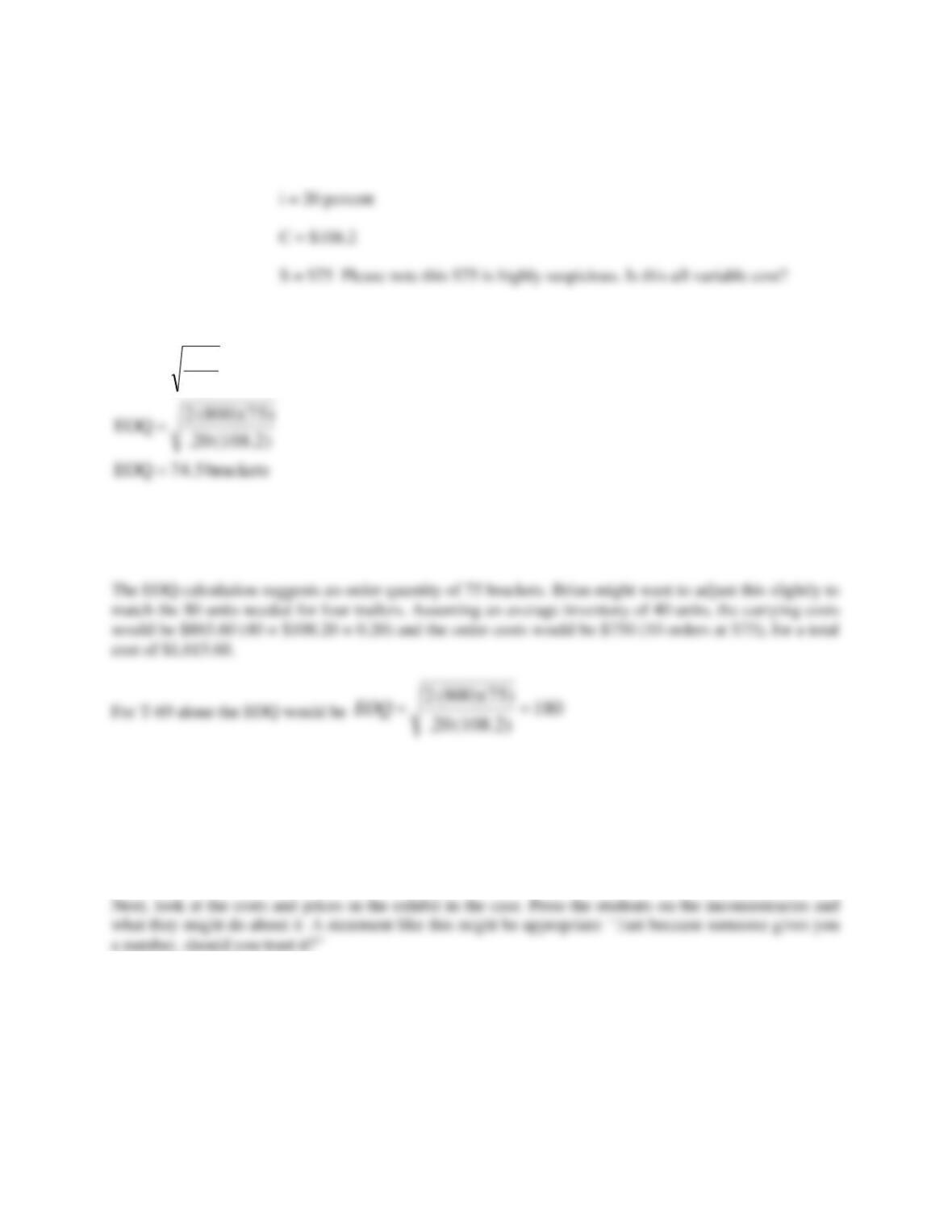
D = 800
iC
2DS
EOQ
=
Before going any further, it must be made clear this situation breaks at least one of the underlying
assumptions of the EOQ formula, constant demand. However, the EOQ formula is fairly robust and
should provide a reasonable estimate of the appropriate order quantity.
TEACHING STRATEGY
The class can start with a discussion of the motivation for the outsourcing. Touch on the annual costs of
the bracket and what might be a reasonable cost savings to justify moving production to Mayes. For
example, would you move it for a savings of 1 percent? How about 10 percent?