Chapter 04S – Reliability
4S-1
CHAPTER 04S
RELIABILITY
Teaching Notes
The main topics of this chapter are:
2. Availability
3. Improving Reliability
Reliability is a measure of the ability of a product, part, or system to perform its intended function
under a prescribed set of conditions. There are three important aspects of reliability: (1) reliability as a
probability; (2) definition of failure; and (3) prescribed set of operating conditions.
Answers to Discussion and Review Questions
2. If a product is composed of a large number of parts, it can conceivably have a low reliability
3. Redundancy refers to backup parts or systems built into a product (or service). Their purpose
is to increase reliability by taking over in the event that a primary part or system fails.
Chapter 04S – Reliability
Solutions
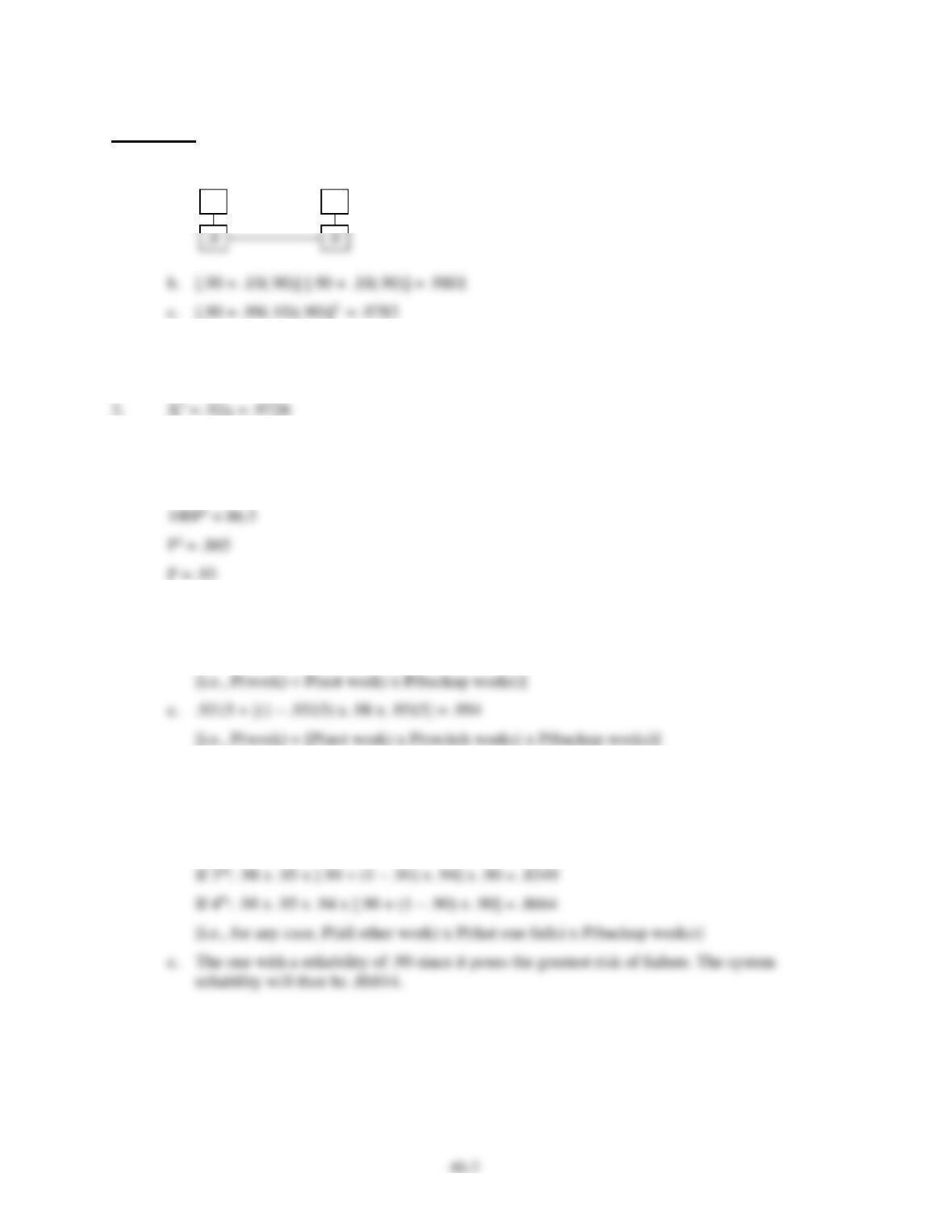
1. a. P(operate) = .92 = .81
2. .96 x .96 x .99 x .99 = .9033
4. C = (10P) 2 per component
2 (10P) 2 = 173
5. a. 97 x .97 x .99 = .9315
b. .9315 + (1 – .9315) x .9315 = .9953
6. a. .98 x .95 x .94 x .90 = .7876
b. If 1st: [.98 + (1 – .98) x .98] x .95 x .94 x .90 = .8034
If 2nd: .98 x [.95 + (1 – .95) x .95] x .94 x .90 = .8270
.9
.9
.9
.9
.99
.93
4S-3
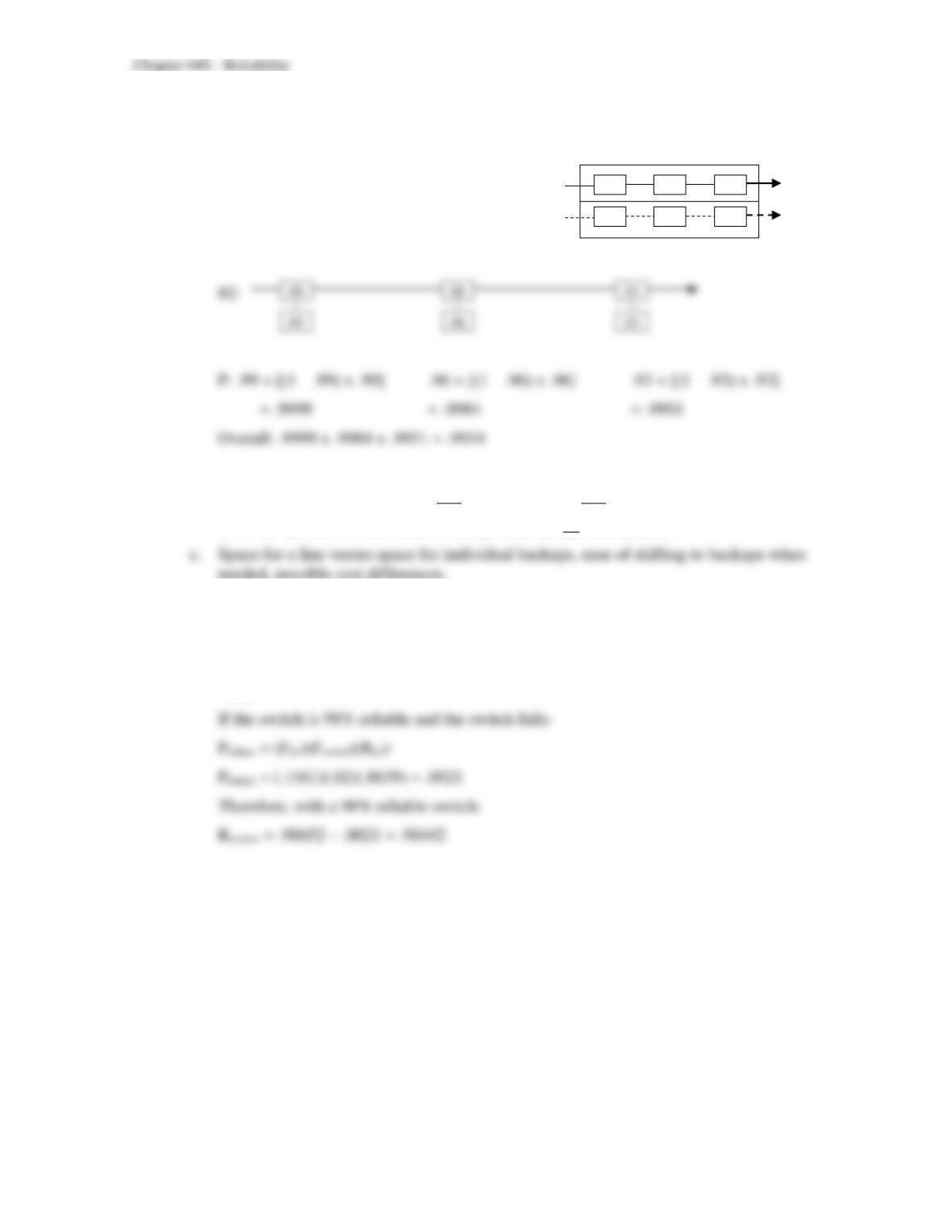
7. a. #1: Pline = .99 x .96 x .93 = .8839
P(line works) + P(line fails) x P(backup works)
= .8839 + [(1 – .8839) x (.8839)] = .9865
b. In #1 the system will fail if any one original and any one backup fails.
In #2 the system will fail only if a component and its backup fails.
8. a. RL1 = .8839 RL2 = .8839
FL1 = .1161 FL2 = .1161
If the switch is 100% reliable:
Rsystem = 1 – (.1162)2 = .98652
.99
.96
.93
.99
.96
.93
Chapter 04S – Reliability
4S-4
The decrease in reliability is .0021
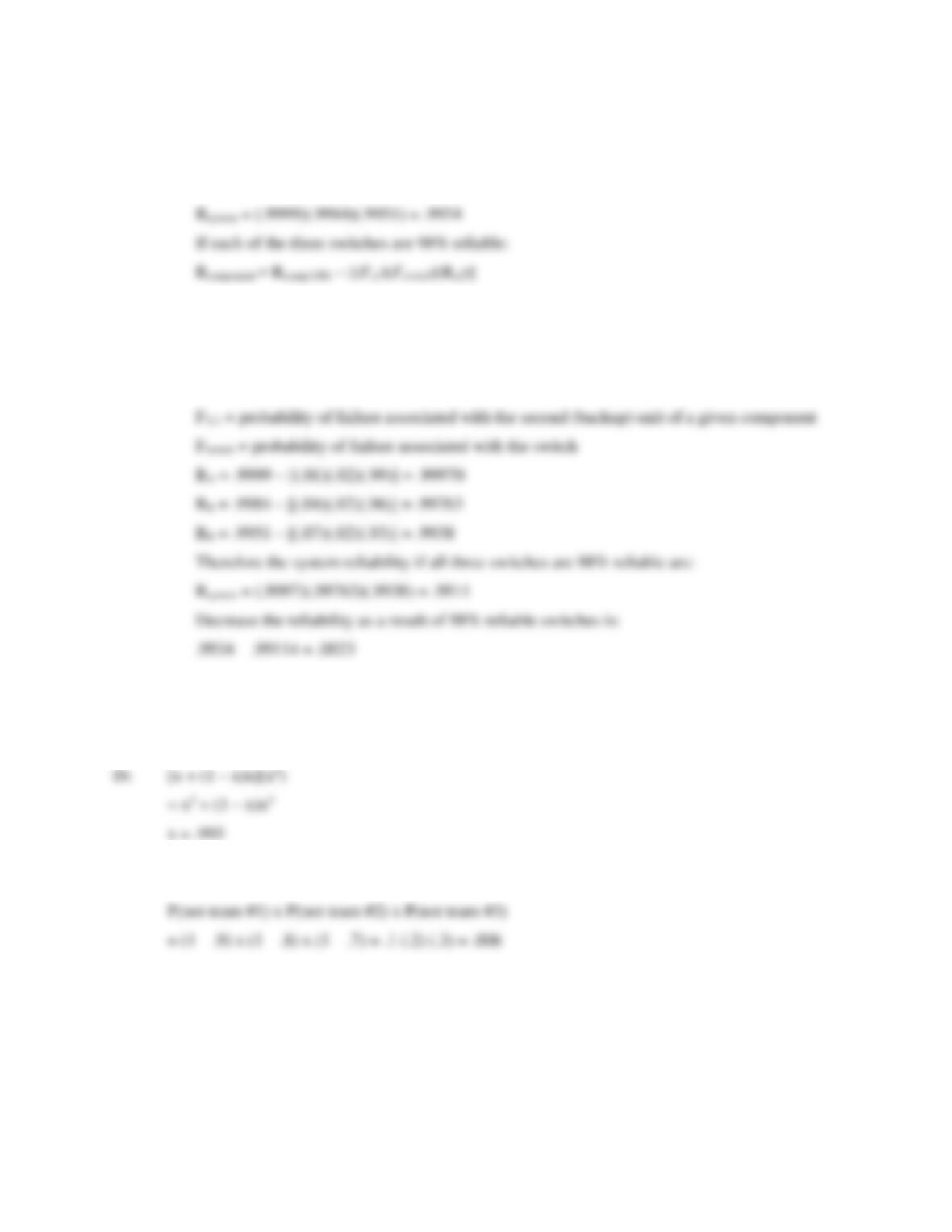
b. RA = .9999 RB = .9984 RC = .9951
If the reliability of all three switches are 100%:
where:
Rcomponent = reliability of the component with 98% reliable switch
Rcomp(100) = reliability of the component with 100% reliable switch
FC1 = probability of failure associated with the first unit of a given component
9. x = reliability
x5 = .98; x = .996 [trial and error]
11. Not completed in time means no team completes in time:
Chapter 04S – Reliability
4S-5
12. a. T T/MTBF e–T/MTBF [Table 5–2]
(2) 48 1.6 .2019
(2) 15 .5 1 – .6065 = .3935
(1) 50% .7 21 mo.
(3) 95% 3.0 90
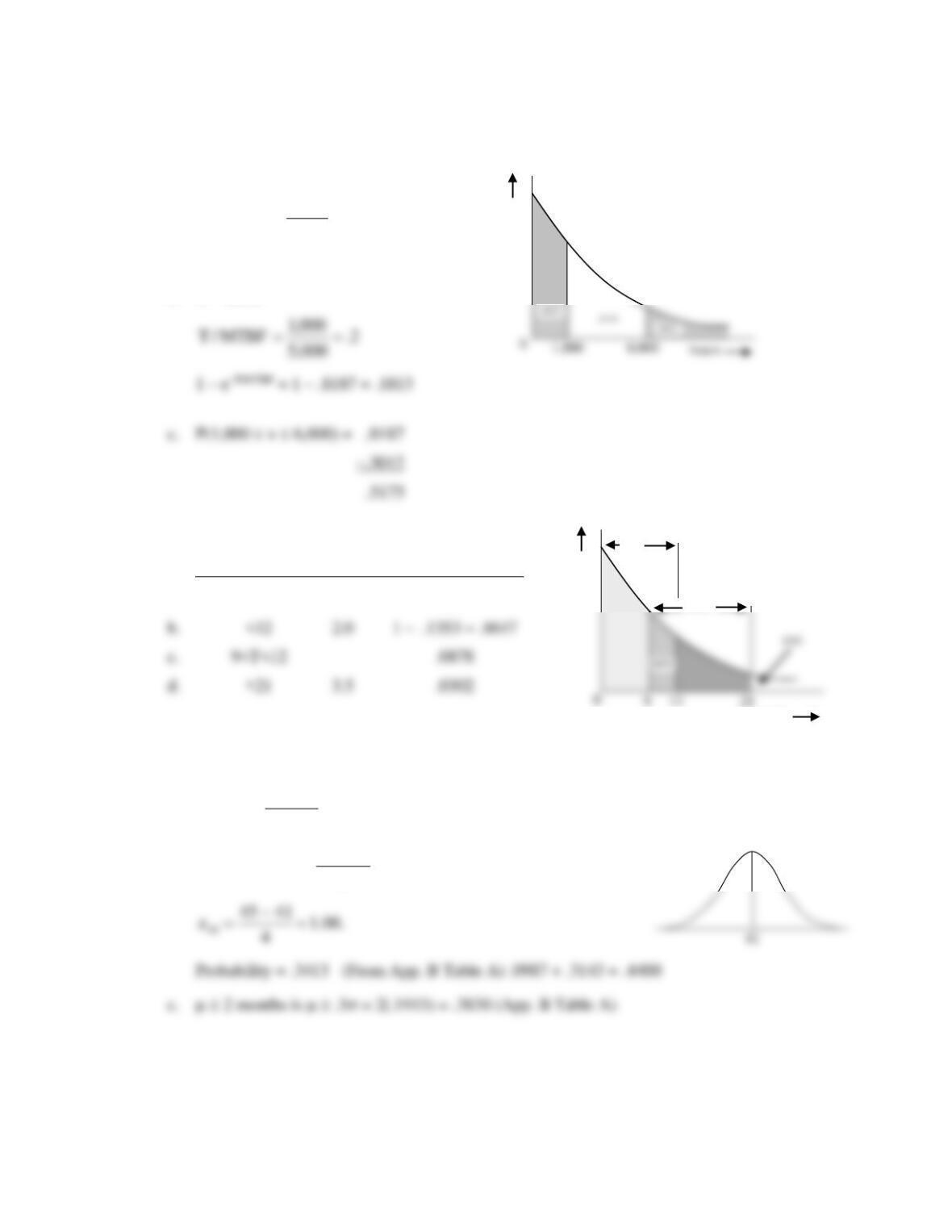
13. MTBF = 30 months
a. T = 30 months
0.1
30
MTBF/T ==
Chapter 04S – Reliability
4S-6
14. MTBF = 5,000 hours
a. T = 6,000
2.1
000,5
000,6
MTBF/T ==
e–T/MTBF = .3012
b. T = 1,000
0
9
15. MTBF = 6 years
T T/MTBF e–T/MTBF
a. >9 1.5 .2231
16. = 41 mo.
= 4 mo.
a.
.75.
4
4138
z:38 −=
−
=
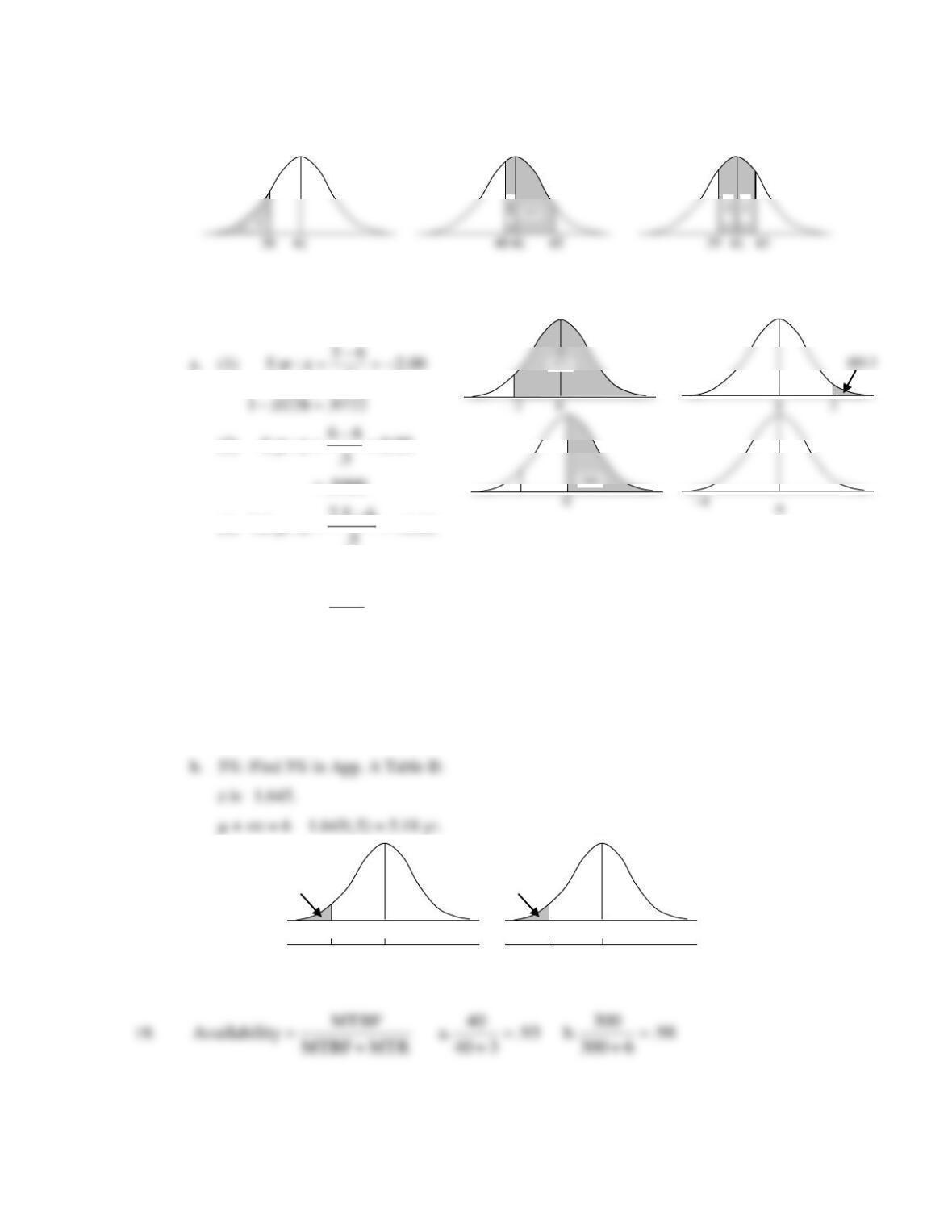
Probability = .2266 (From App. B Table B)
b.
.25.
4
4140
z:45T40 −=
−
=
Probability = .0987 (From App. B Table A)
F (T)
F (T)
years
.8647
.2231
0
1,000
6,000
hours
38
41
41
40
45
41
39
43
Chapter 04S – Reliability
4S-7
a.
17. = 6 years
= .5 years
5.
0
0
3
(2)
00.0
z:yr 6 =
=
5000.=
(3)
00.3
65.7
z:yr .57 +=
−
=
0013.9987.1 =−
b.
00.4
5.
64
z:yr 4 −=
−
=
Therefore, approximately zero.
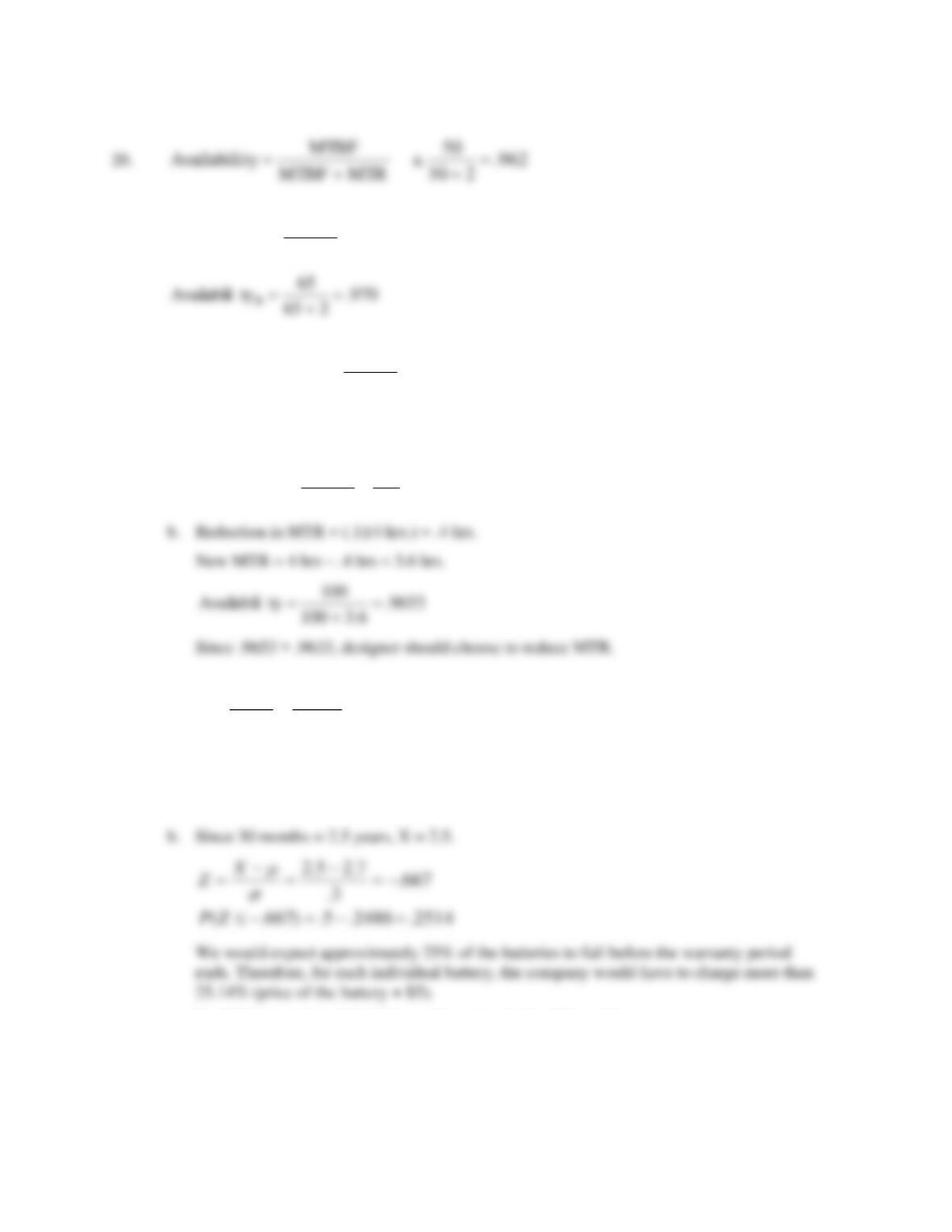
18. a. 2%: Find 2% in App. A Table B:
z is –2.055.
+ z = 6 – 2.055(.5) = 4.97 yr.
b.
c.
0
0
–2.055
2%
z–scale
6
4.97
yr–scale
0
–1.645
5%
z–scale
6
5.18
yr–scale
.0013
Chapter 04S – Reliability
4S-8
21.
.953
7142
142
tyAvailabili A=
+
=
22.
100
Current Availability .962
105 4
==
+
a. Increase in MTBF = (.05)(100) = 5 hrs.
New MTBF = 100 + 5 = 105 hrs.
9633.
109
105
4100
105
tyAvailabili ==
+
=
23. a.
33.2
3.
7.22 −=
−
=
−
=X
Z
0099.4901.5.)33.2( =−=−ZP
We would expect approximately 1% of the batteries to fail before the warranty period
ends.
c. In addition to price of the battery, the company should consider:
1. Possible lost future sales of this type of battery as well as lost sales of other products
manufactured and sold by the company due to a high volume of replaced batteries;
Chapter 04S – Reliability
4S-9
3. The capacity to handle the additional load of battery production and battery exchanges
due to failures;
4. The amount of additional business generated as a result of adding the premium
battery. (In other words, the company must consider the trade-off between the
additional business generated from the premium battery vs. the cannibalization of the
current base and the existing batteries.)
Enrichment Module: Measurement of Reliability
In practice, there are two basic ways of measuring reliability. The most common measure of reliability
is called the failure rate. The failure rate is defined as the number of failures for a given time period
and is generally denoted by the Greek letter (lambda).
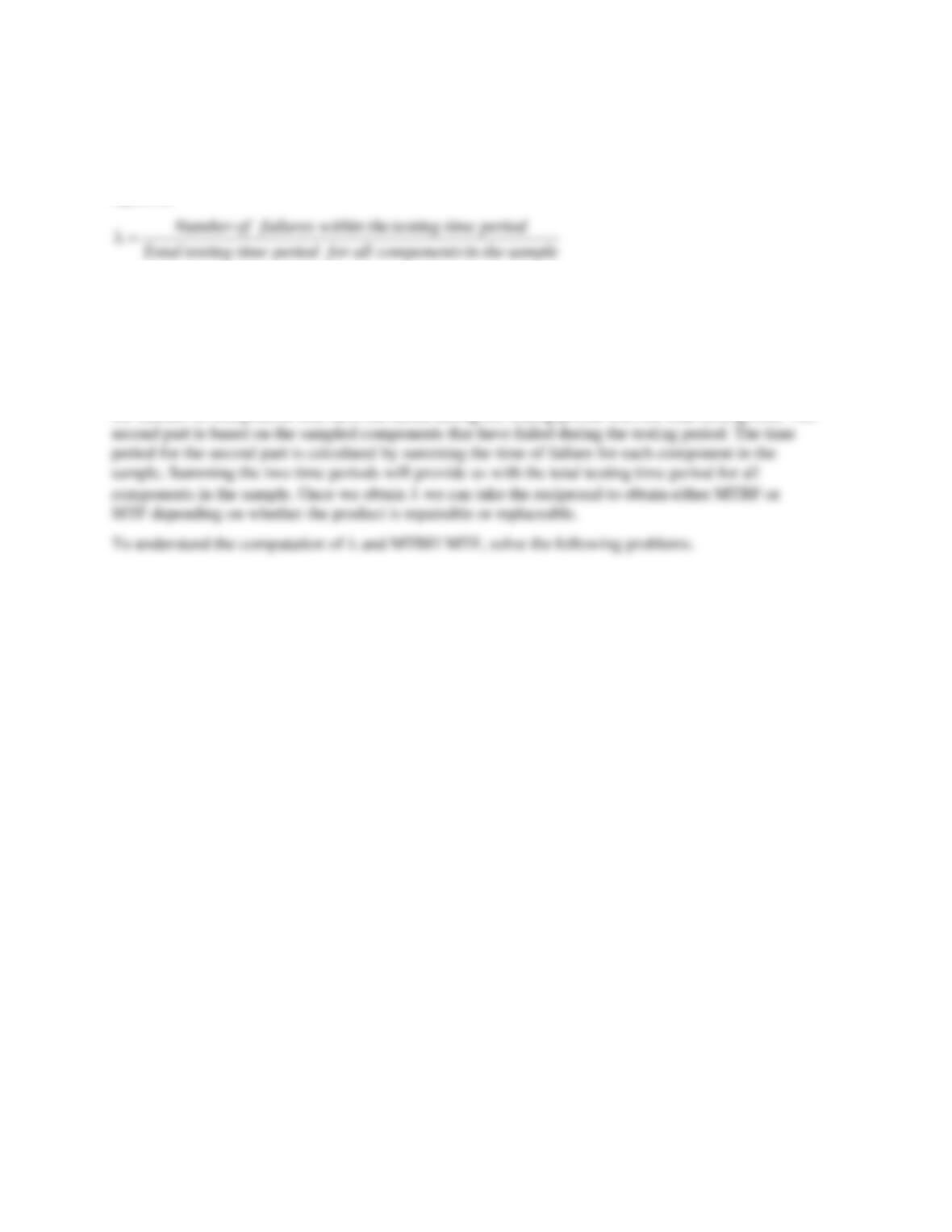
For most products, failure rates change over time. As can be observed from Figure 4S–1, the failure
rates tend to be high during the infant mortality phase (early stages of the product life cycle) due to
defective parts and lack of testing. There are fewer failures in the middle stage of the product life
cycle, while there are high failure rates late in the product life cycle due to worn out components and
Failure Rate as a Function of Time
Chapter 04S – Reliability
4S–10
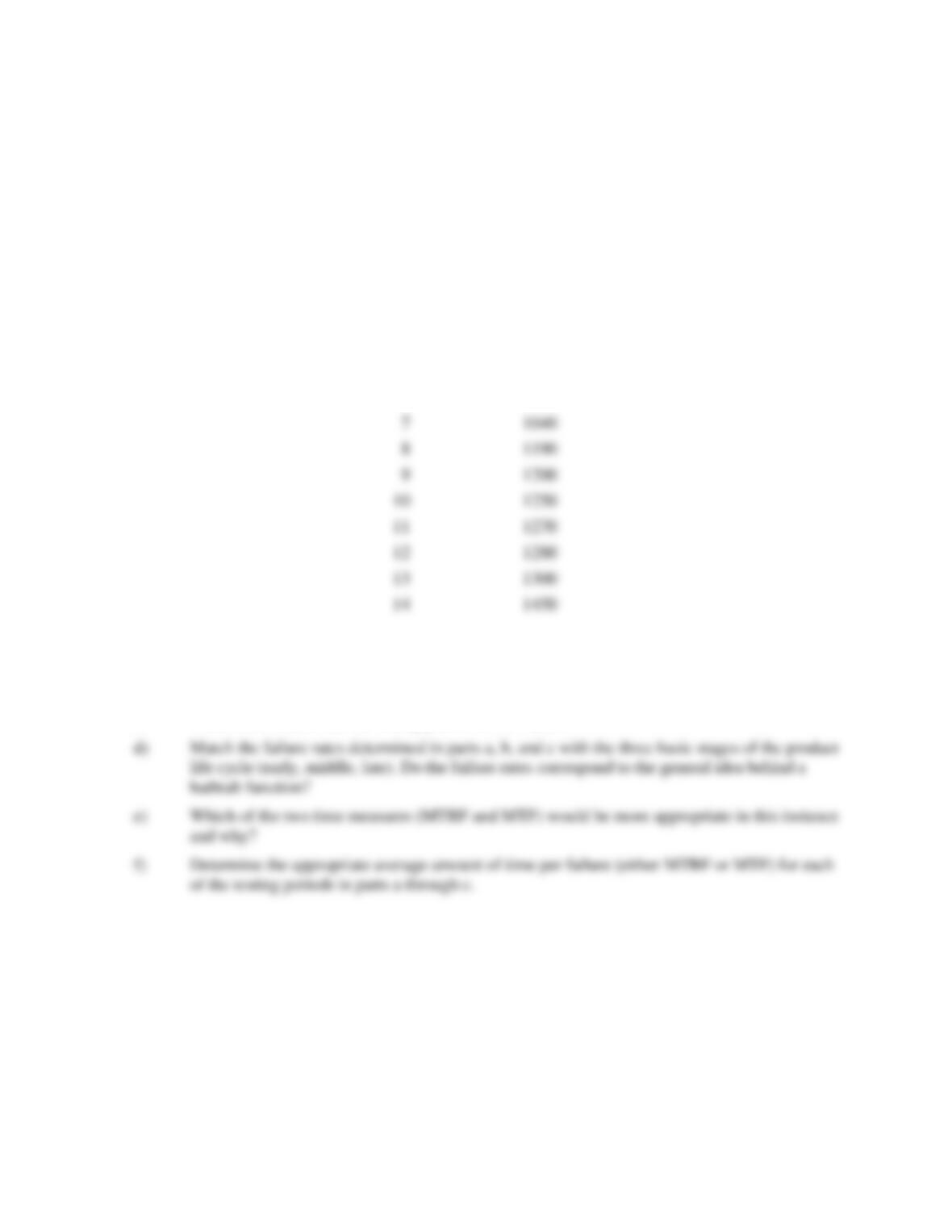
In order to determine the failure rate, we collect a random sample of components and determine the
time of failure for each component and determine the estimated failure rate using the following
equation:
According to the above equation, we would expect the (failure rate) to be fairly high during the
infant mortality phase, lower during the middle phase and higher during the late phase of the product
life cycle.
The denominator of the above equation (total testing time) is divided into two parts. Summing the two
parts will provide us with the total testing time. The first part is based on the sampled components that
have not failed during the testing period. The time period for the first part is calculated by multiplying
the number of components that have not failed during the testing period with the total testing time. The
Chapter 04S – Reliability
4S–11
Problem 1
In an attempt to measure the reliability of a new brand of light bulbs, the manufacturer selected a
random sample of 14 light bulbs. The time of failure for these light bulbs is organized from lowest to
highest and is presented in the following table.
Sample
Hours of operation
before Failure
1
35
2
90
3
100
4
150
5
700
6
1010
a) What is the failure rate for testing period of 450 hours?
b) What is the failure rate for testing period of 900 hours?
c) What is the failure rate for testing period of 1350 hours?
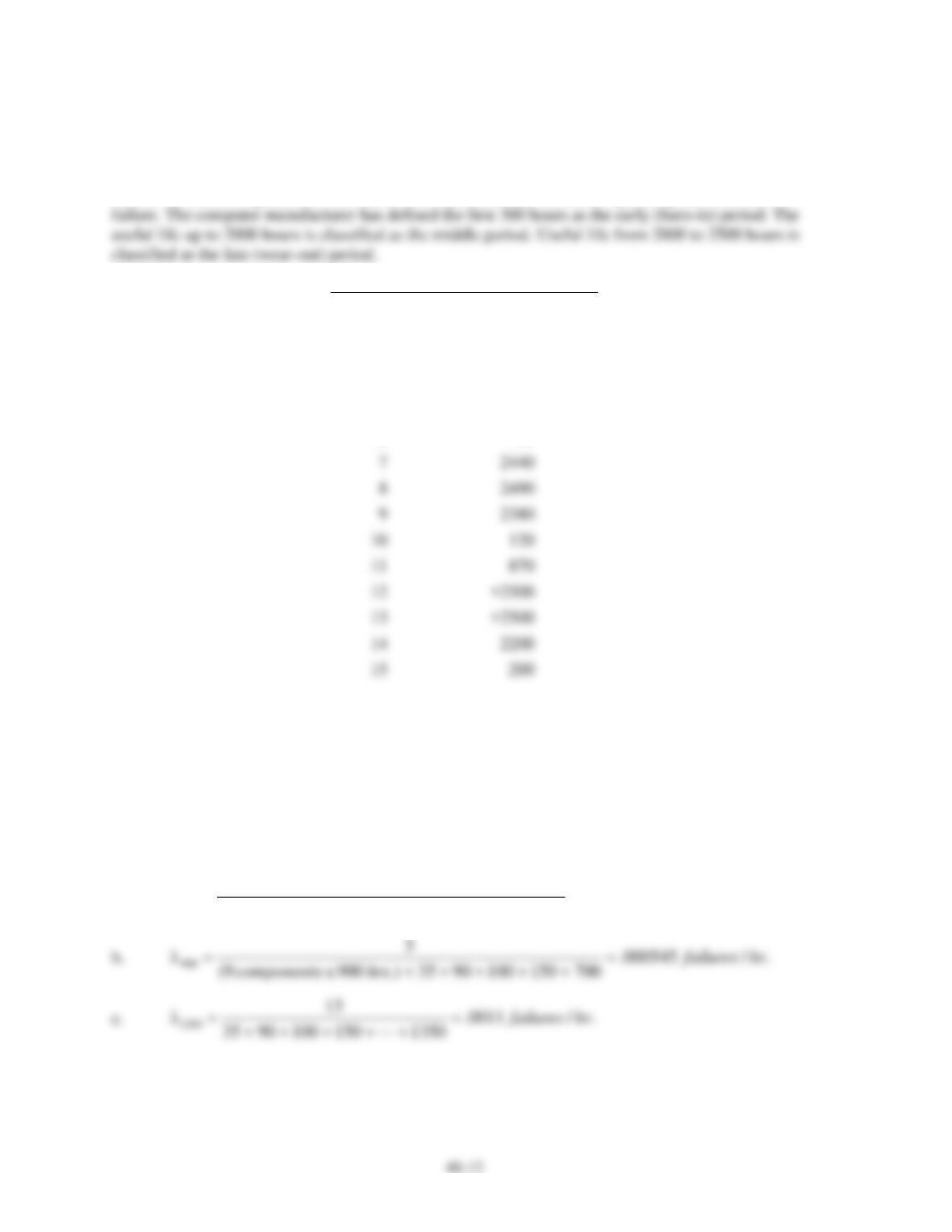
7
1040
8
1190
9
1250
1270
1280
1450
Chapter 04S – Reliability
Problem 2
In a test of reliability of a computer component for an airplane, the reliability engineer collected a
random sample of 15 components. The following table provides a summary of the results on the
number of hours of operation. The values in the table indicate the useful operating hours before
Sample
Hours of Operation
1
28
2
2350
3
2370
4
1450
5
2200
6
97
7
2440
8
2490
9
2380
2200
a. Compute the failure rates for 300 hours, 2000 hours, and 2500 hours. Are your results
consistent with the concept of higher failure rates during burn-in and wear-out periods as
compared to the middle period?
b. Determine the MTBF for each of the three testing periods.
Solution to Problem 1
a.
./000821.
1501009035.)450x10(
4
450 hrfailures
hrs components =
++++
=
Chapter 04S – Reliability
4S–13
d. Testing time = 450 hrs. → infant mortality period
e. MTF is the appropriate measure because light bulb is not a repairable product.
f.
=1
MTF
.hrs 218,1
000821.
1
MTF
450
==
Solution to Problem 2
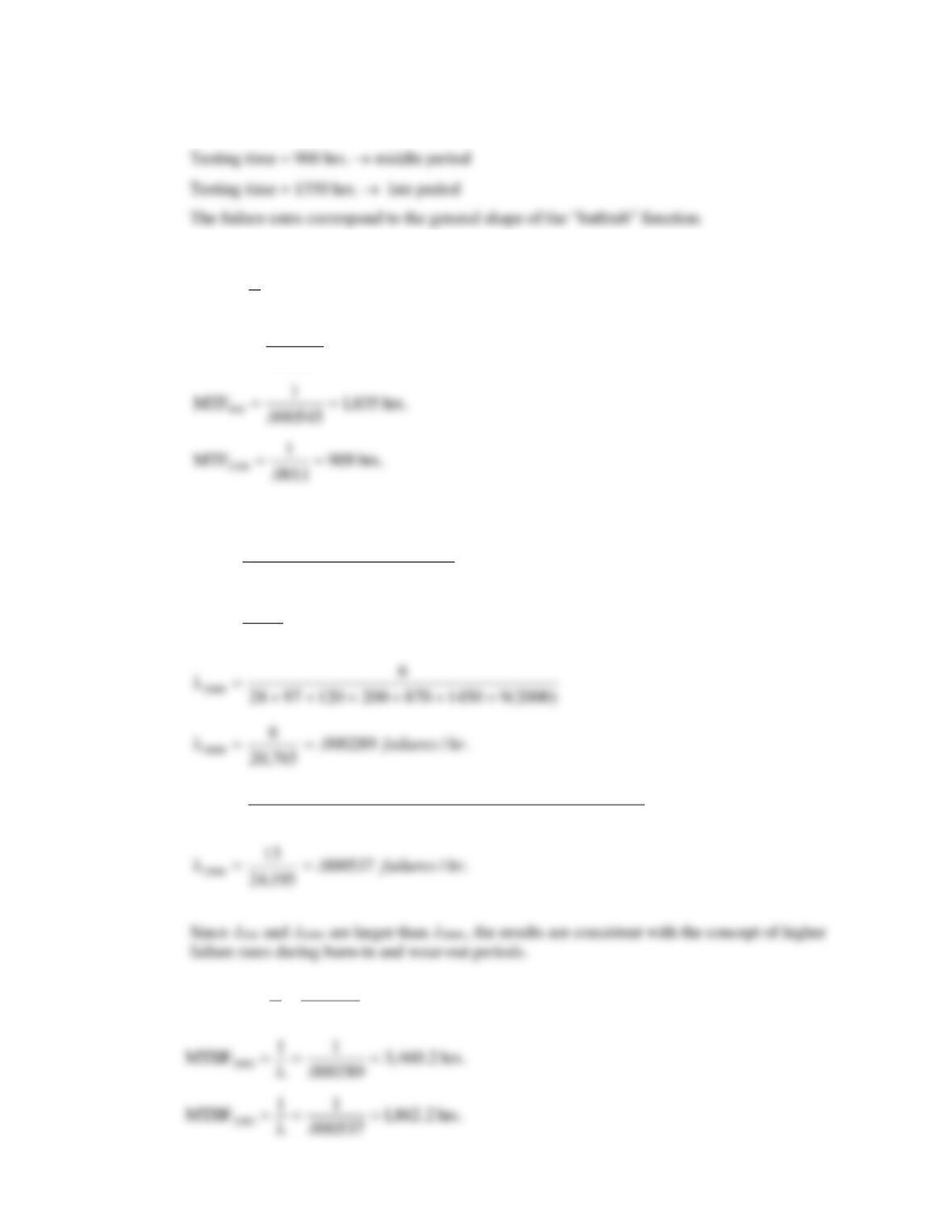
a.
b.
)2500(2220014508702001209728
13
./001068.
745,3
4
)300(112001209728
4
2500
300
300
hrfailures
++++++++
=
==
++++
=
.hrs 4.936
001068.
11
MTBF
300
==
=