Chapter 06 – An Introduction to Macroeconomics
6-1
Chapter 06 An Introduction to Macroeconomics
QUESTIONS
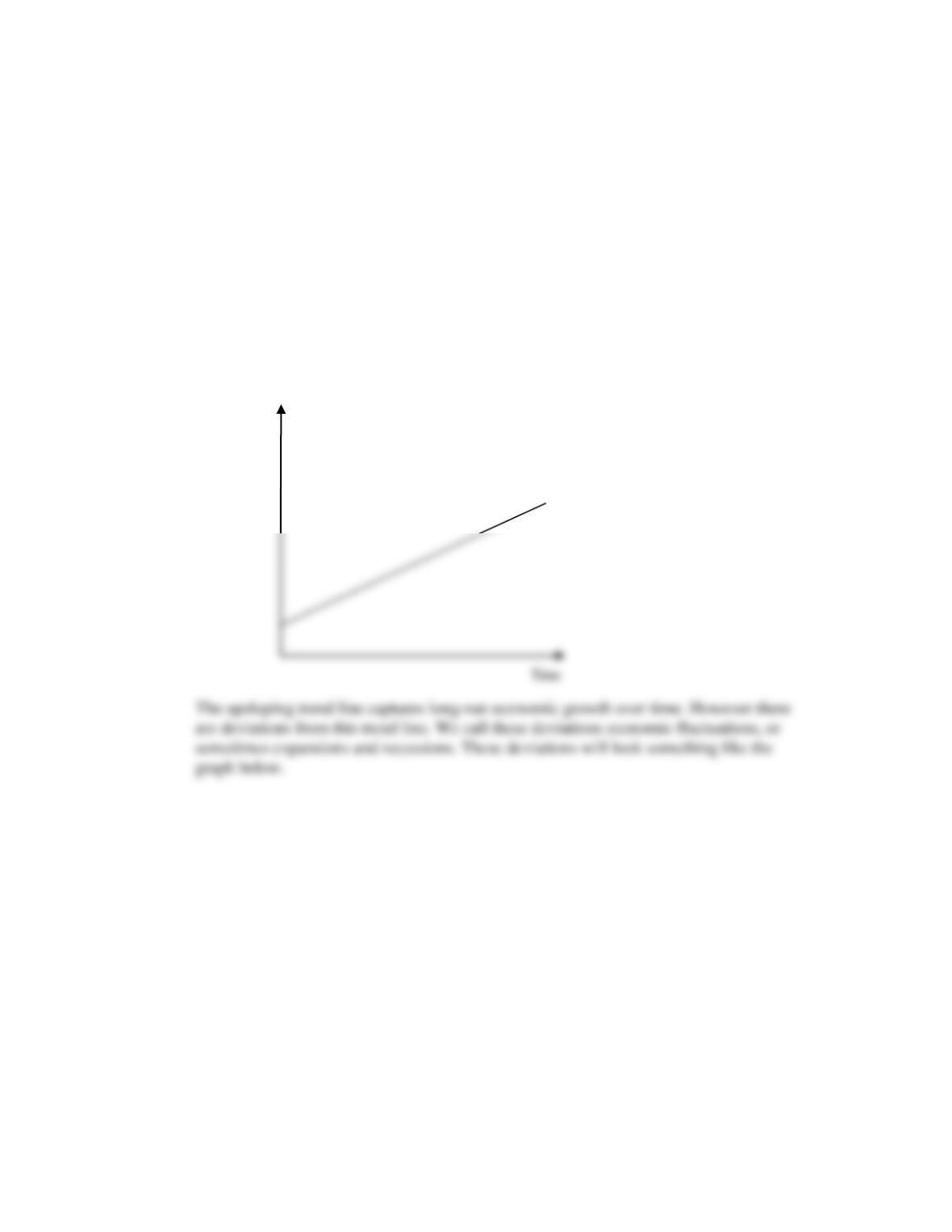
1. Draw a graph with “Level of real output” on the vertical axis and “Time” on the horizontal
axis. If the long-run trend line of economic growth for the United States were to appear on your
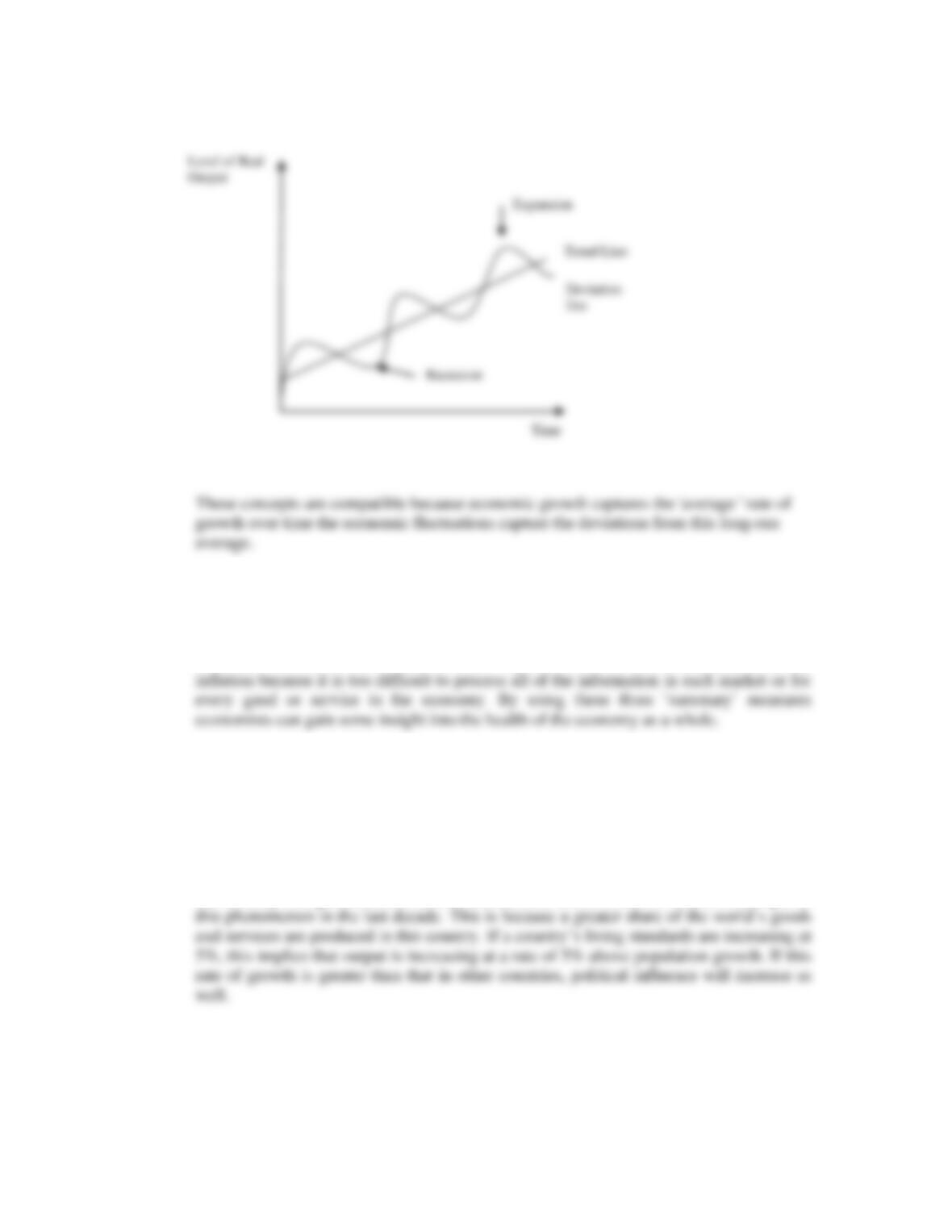
graph as a straight upsloping line, how would you pencil in economic fluctuations in relationship
to that straight line? Referring to your graph, very briefly explain why economic fluctuations and
economic growth are compatible concepts. Check your drawing against Figure 26.1, page 527.
LO1
Answer:
Level of Real
Output
Trend Line
Chapter 06 – An Introduction to Macroeconomics
6-2
2. Why do you think macroeconomists focus on just a few key statistics when trying to
understand the health and trajectory of an economy? Would it be better to try to make examine all
possible data? LO2
Answer: Macroeconomists focus on a few key statistics, real GDP, unemployment, and
3. Consider a nation in which the volume of goods and services is growing by 5 percent per year.
What is the likely impact of this high rate of growth on the power and influence of its government
relative to other countries experiencing slower rates of growth? What about the effect of this 5
percent growth on the nation’s living standards? Will these also necessarily grow by 5 percent per
year, given population growth? Why or why not? LO2
Answer: If a country’s economic size is growing faster than the rest of the world then
this country will gain influence in the international sector. China is a classic example of
4. Did economic output start growing faster than population from the beginning of the human
inhabitation of the earth? When did modern economic growth begin? Have all of the world’s
nations experienced the same extent of modern economic growth? LO3
Chapter 06 – An Introduction to Macroeconomics
6-3
Answer: No, rapid and sustained economic growth is a modern phenomenon. Before the
Industrial Revolution began in the late 1700s in England, standards of living showed
5. Why is there a trade-off between the amount of consumption that people can enjoy today and
the amount of consumption that they can enjoy in the future? Why can’t people enjoy more of
both? How does saving relate to investment and thus to economic growth? What role do banks
and other financial institutions play in aiding the growth process? LO4
Answer: To increase consumption in the future households must save so that firms can
undertake investment projects that will produce the goods and services of the future. In
other words, without savings and investment the resources will not be in place to produce
6. How does investment as defined by economists differ from investment as defined by the
general public? What would happen to the amount of economic investment made today if firms
expected the future returns to such investment to be very low? What if firms expected future
returns to be very high? LO4
Answer: Economic Investment refers to the purchase of machinery, tools, etc… that can
be used to produce goods and services in the future. This investment is undertaken by
7. Why, in general, do shocks force people to make changes? Give at least two examples from
your own experience. LO5
Chapter 06 – An Introduction to Macroeconomics
6-4
Answer: Shocks to the economy force people to make changes in expectations and actual
behavior. For example, you believe your annual income once you graduate will be
8. Catalogue companies are committed to selling at the prices printed in their catalogues. If a
catalogue company finds its inventory of sweaters rising, what does that tell you about the
demand for sweaters? Was it unexpectedly high, unexpectedly low, or as expected? If the
company could change the price of sweaters, would it raise the price, lower the price, or keep the
price the same? Given that the company cannot change the price of sweaters, consider the number
of sweaters it orders each month from the company that makes its sweaters. If inventories become
very high, will the catalogue company increase, decrease, or keep orders the same? Given what
the catalogue company does with its orders, what is likely to happen to employment and output at
the sweater manufacturer? LO5
Answer: If the inventories are rising for sweaters then we know that demand for sweaters
must be falling. This is because prices are fixed, so this implies that people are buying
9. LAST WORD Why do some economists believe that better inventory control software and
systems may help to reduce the frequency and severity of recessions caused by mild demand
shocks? How could those same inventory systems quickly transmit large demand shocks directly
to sudden, deep recessions?
Answer: The basic logic is as follows. Prior to the time of computers inventories were
counted a few times each year. This was because the firm had to employ workers to count
Chapter 06 – An Introduction to Macroeconomics
6-5
PROBLEMS
1. Suppose that the annual rates of growth of real GDP of Econoland over a five-year period were
sequentially as follows: 3 percent, 1 percent, -2 percent, 4 percent, and 5 percent. What was the
average of these growth rates in Econoland over these 5 years? What term would economists use
to describe what happened in year 3? If the growth rate in year 3 had been a positive 2 percent
rather than a negative 2 percent, what would have been the average growth rate? LO1
Answers: 2.2 percent; recession; 3 percent.
Feedback: Consider the following example. Suppose that the annual rates of growth of
real GDP of Econoland over a five-year period were sequentially as follows: 3 percent, 1
(= (3 + 1 + 2 + 4 + 5) / 5).
2. Suppose that Glitter Gulch, a gold mining firm, increased its sales revenues on newly mined
gold from $100 million to $200 million between one year and the next. Assuming that the price of
gold increased by 100 percent over the same period, by what numerical amount did Glitter
Gulch’s real output change? If the price of gold had not changed, what would have been the
change in Glitter Gulch’s real output? LO2
Answers: 0; $100 million.
Feedback: Consider the following example. Suppose that Glitter Gulch, a gold mining
firm, increased its sales revenues on newly mined gold from $100 million to $200 million
Chapter 06 – An Introduction to Macroeconomics
6-6
3. A mathematical approximation called the rule of 70 tells us that the number of years that it will
take something that is growing to double in size is approximately equal to the number 70 divided
by its percentage rate of growth. Thus, if Mexico’s real GDP per person is growing at 7 percent
per year, it will take about 10 years (= 70/ 7) to double. Apply the rule of 70 to solve the
following problem. Real GDP per person in Mexico in 2005 was about $11,000 per person, while
it was about $44,000 per person in the United States. If real GDP per person in Mexico grows at
the rate of 5 percent per year, about how long will it take Mexico’s real GDP per person to reach
the level that the United States was at in 2005? (Hint: How many times would Mexico’s 2005 real
GDP per person have to double to reach the United States’ 2005 real GDP per person?) LO3
Answer: 28 years
Feedback: Consider the following example. Apply the rule of 70 to solve the following
problem. Real GDP per person in Mexico in 2005 was about $11,000 per person, while it
was about $44,000 per person in the United States. If real GDP per person in Mexico
4. Assume that a national restaurant firm called BBQ builds 10 new restaurants at a cost of $1
million per restaurant. It outfits each restaurant with an additional $200,000 of equipment and
furnishings. To help partially defray the cost of this expansion, BBQ issues and sells 200,000
shares of stock at $30 per share. What is the amount of economic investment that has resulted
from BBQ’s actions? How much purely financial investment took place? LO4
Chapter 06 – An Introduction to Macroeconomics
6-7
Feedback: Consider the following example. Assume that a national restaurant firm called
BBQ builds 10 new restaurants at a cost of $1 million per restaurant. It outfits each
restaurant with an additional $200,000 of equipment and furnishings. To help partially
defray the cost of this expansion, BBQ issues and sells 200,000 shares of stock at $30 per
share. What is the amount of economic investment that has resulted from BBQ’s actions?
How much purely financial investment took place?
5. Refer to Figure 23.1b and assume that price is fixed at $37,000 and that Buzzer Auto needs 5
workers for every 1 automobile produced. If demand is DM and Buzzer wants to perfectly match
its output and sales, how many cars will Buzzer produce and how many workers will it hire? If
instead, demand unexpectedly falls from DM to DL, how many fewer cars will Buzzer sell? How
many fewer workers will it need if it decides to match production to these lower sales? LO5
Feedback: Consider the following example. Refer to Figure 23.1b and assume that price
is fixed at $37,000 and that Buzzer Auto needs 5 workers for every 1 automobile
produced. If demand is DM and Buzzer wants to perfectly match its output and sales,
how many cars will Buzzer produce and how many workers will it hire? If instead,
demand unexpectedly falls from DM to DL, how many fewer cars will Buzzer sell? How
many fewer workers will it need if it decides to match production to these lower sales?