Chapter 05S – Decision Theory
5S-1
CHAPTER 05S
DECISION THEORY
Teaching Notes
This chapter supplement lays the foundation for much of the remainder of the text, which is oriented
towards problem solving and decision-making.
The chapter supplement begins with a discussion of the use of models in decision-making. I feel it is
necessary to remind students when covering later chapters of the advantages and limitations of
models. For example, it is not unusual for a student to question the validity of a model’s assumptions
The presentation should emphasize that decision trees are developed for multi-phase decision-making
where several interrelated decisions and states of nature are considered. The decisions are dependent
on each other and the states of nature. The nature of interdependence and the sequence of decisions
must be specified by the decision-maker. The decision tree analysis forces the decision-maker to
study the states of nature (conditions) carefully because probabilities must be assigned to each state of
nature. The decision tree analysis provides the decision-maker with:
a. structure for complex multi-phase decisions.
Answers to Discussion and Review Questions
1. The chief role of the operations manager is that of decision-maker.
2. Decision-making consists of the following steps:
(4) Select the best alternative.
(5) Implement the chosen alternative.
(6) Monitor the results.
4. Suboptimization occurs as a result of different departments, each attempting to reach a
solution that is optimum for that department but may not be optimum for the organization as a
whole.
Chapter 05S – Decision Theory
5. Poor decisions can be due to bounded rationality, which refers to limits on decision-making in
terms of cost, technology, human abilities and availability of information; managerial style
6. A payoff table shows the expected payoffs for each alternative in every possible state of
nature.
7. Sensitivity analysis refers to examining how sensitive a given solution is to a change in one or
more parameters of a problem. High sensitivity indicates to decision-makers that a parameter
8. Maximax is an optimistic approach that calls for selection of the alternative that has the best
9. The expected monetary value approach implies a linear utility for payoff (e.g., a payoff of $2
has twice the utility of a payoff of $1). When multiple decisions are to be made, the expected
10. a. The Laplace criterion is an approach to decision-making under uncertainty. It treats the
states of nature as equally likely.
b. Minimax regret is an approach to decision-making under uncertainty. It seeks to minimize
the opportunity loss, or regret, associated with choosing a decision.
11. In order to use an expected value approach to decision-making, a decision-maker must have
state of nature probabilities (in addition to a list of alternatives, a list of states of nature, and a
12. At that point, a manager would want to refer to any qualitative information that might be
available to see if that would tip the scale in favor of one or the other. Possible mistake in
Chapter 05S – Decision Theory
5S-3
13. Satisficing could be an ethical issue. Another ethical issue could be choosing an
alternative based solely on the expected return without assessing the impact on
employees and consumers.
Solutions
1.
a.
Maximax:
Expand [$80 is the highest payoff]
b.
Maximin:
Worst payoffs:
d.
Minimax Regret
Low
High
Worst
Do Nothing
0
20
20
Expand
30
0
30
Subcontract
10
10
10
[best of worst]
2.
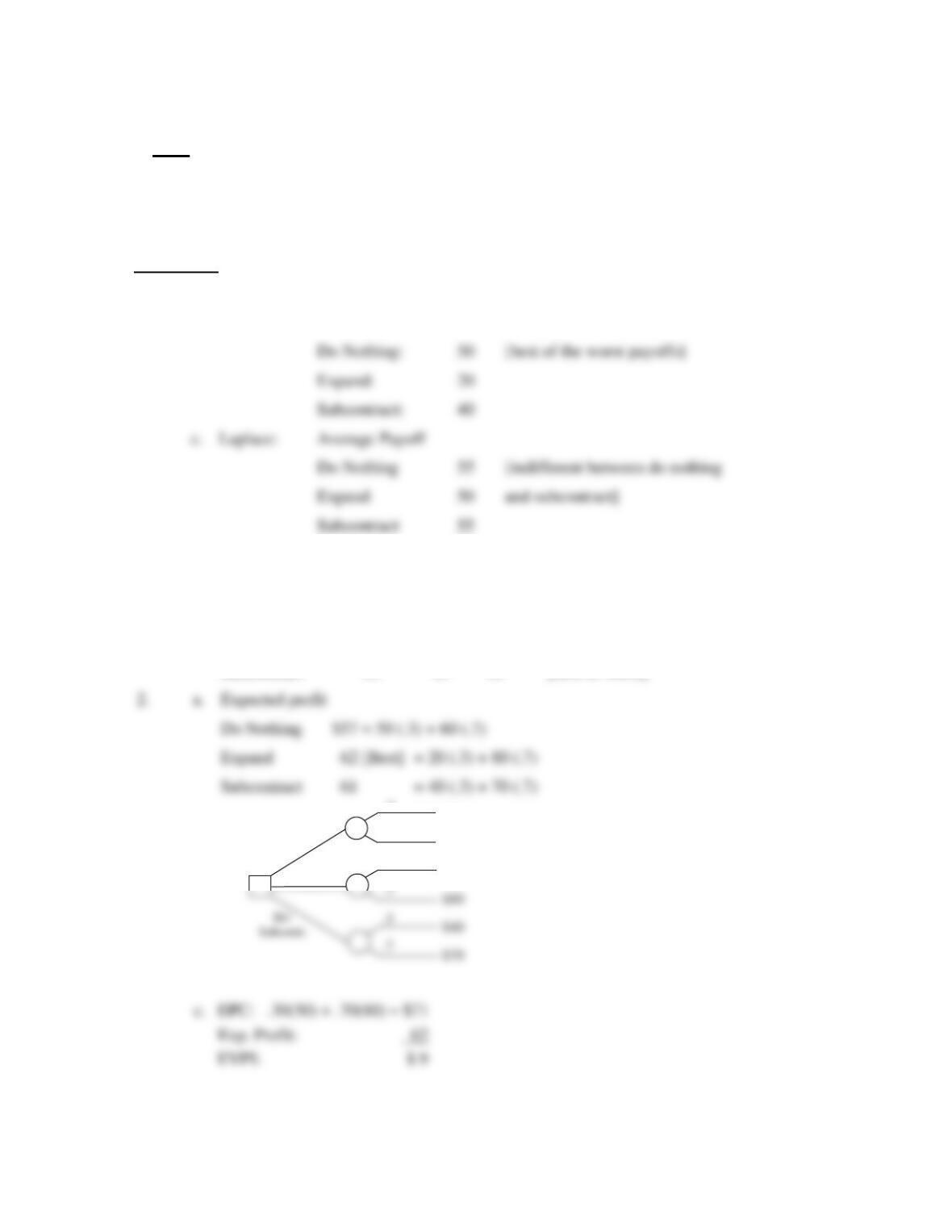
Expected profit
Do Nothing
Expand
62 [Best] = 20 (.3) + 80 (.7)
Subcontract
61 = 40 (.3) + 70 (.7)
.7
b.
.3
.7
.3
$50
$60
$20
$62
Expand
$57
Do Nothing
Do Nothing:
50
Expand:
20
Subcontract:
40
c.
Laplace:
Average Payoff
Do Nothing
55
Expand
50
Subcontract
55
20
Subcontract
Chapter 05S – Decision Theory
5S-4
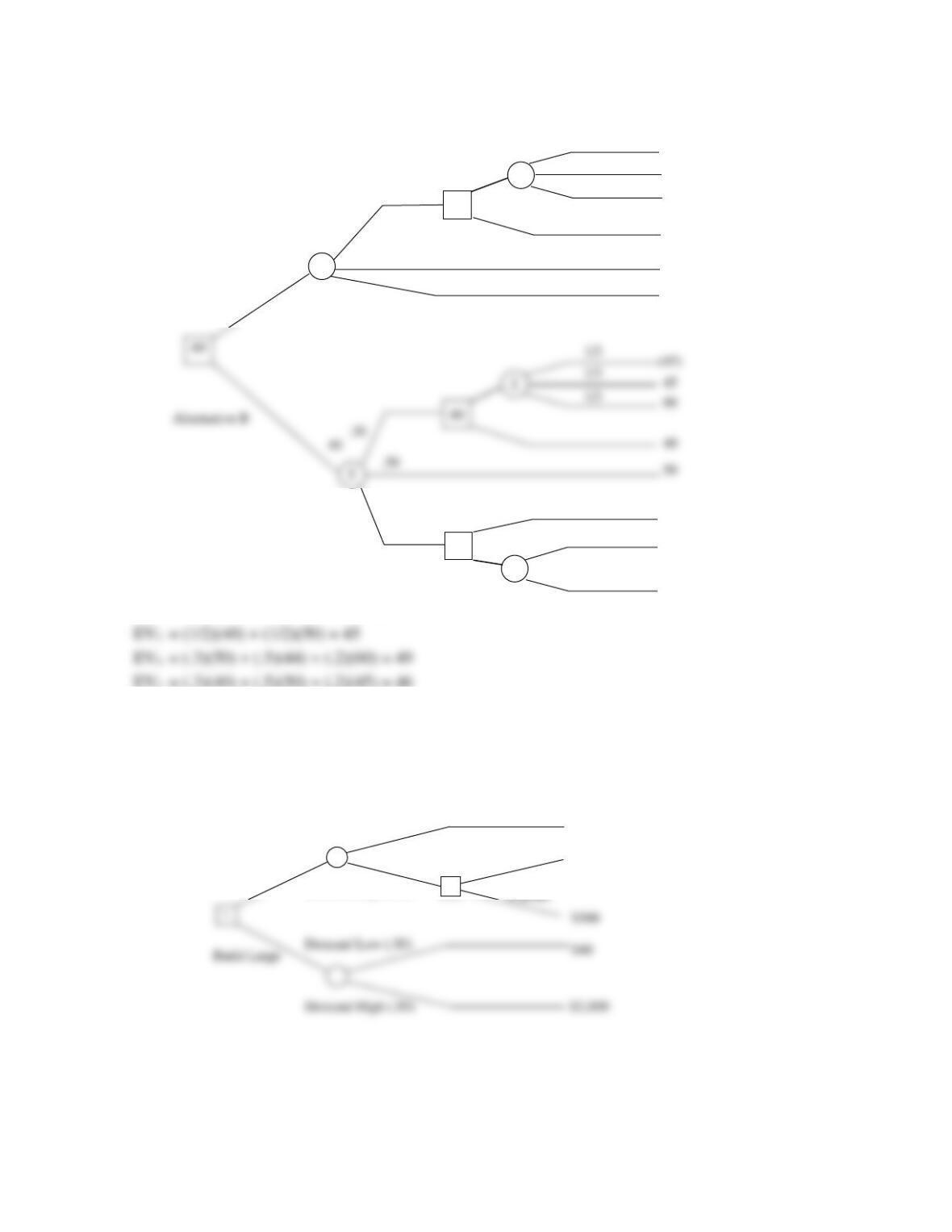
3. Equations:
Do Nothing: 50 + 10P
Expand: 20 + 60P
Subcontract: 40 + 30P
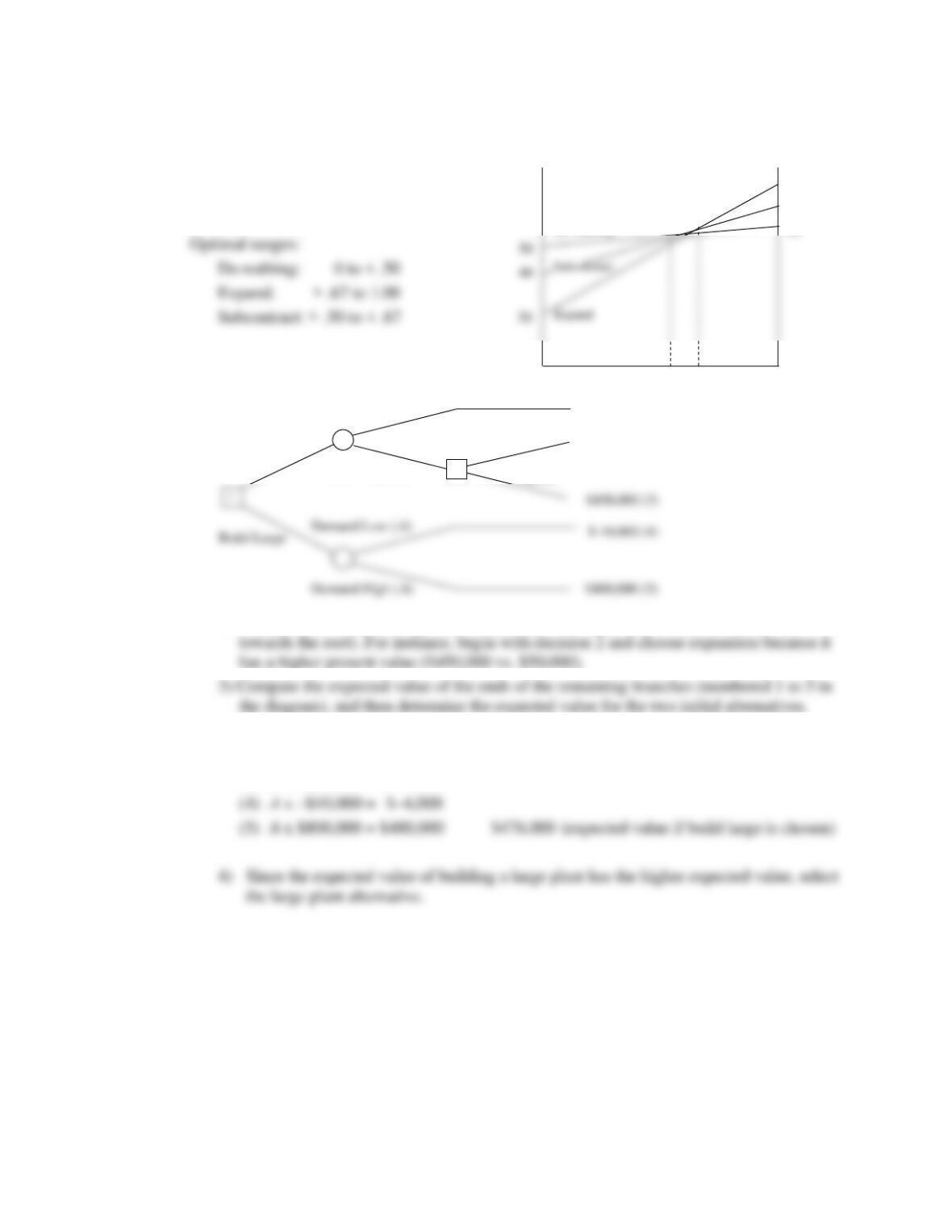
4. a. 1) Draw the tree diagram:
2) Analyze decisions from right to left (i.e., work backwards from the end of the tree
(1) .4 x $400,000 = $160,000
(2) (eliminated) $430,000 (expected value if build small is chosen)
(3) .6 x $450,000 = $270,000
$400,000 (1)
$50,000 (2)
Demand Low (.4)
Demand High (.6)
Build Large
Demand Low (.4)
Demand High (.6)
Maintain
Expand
Build Small
2
Do Nothing
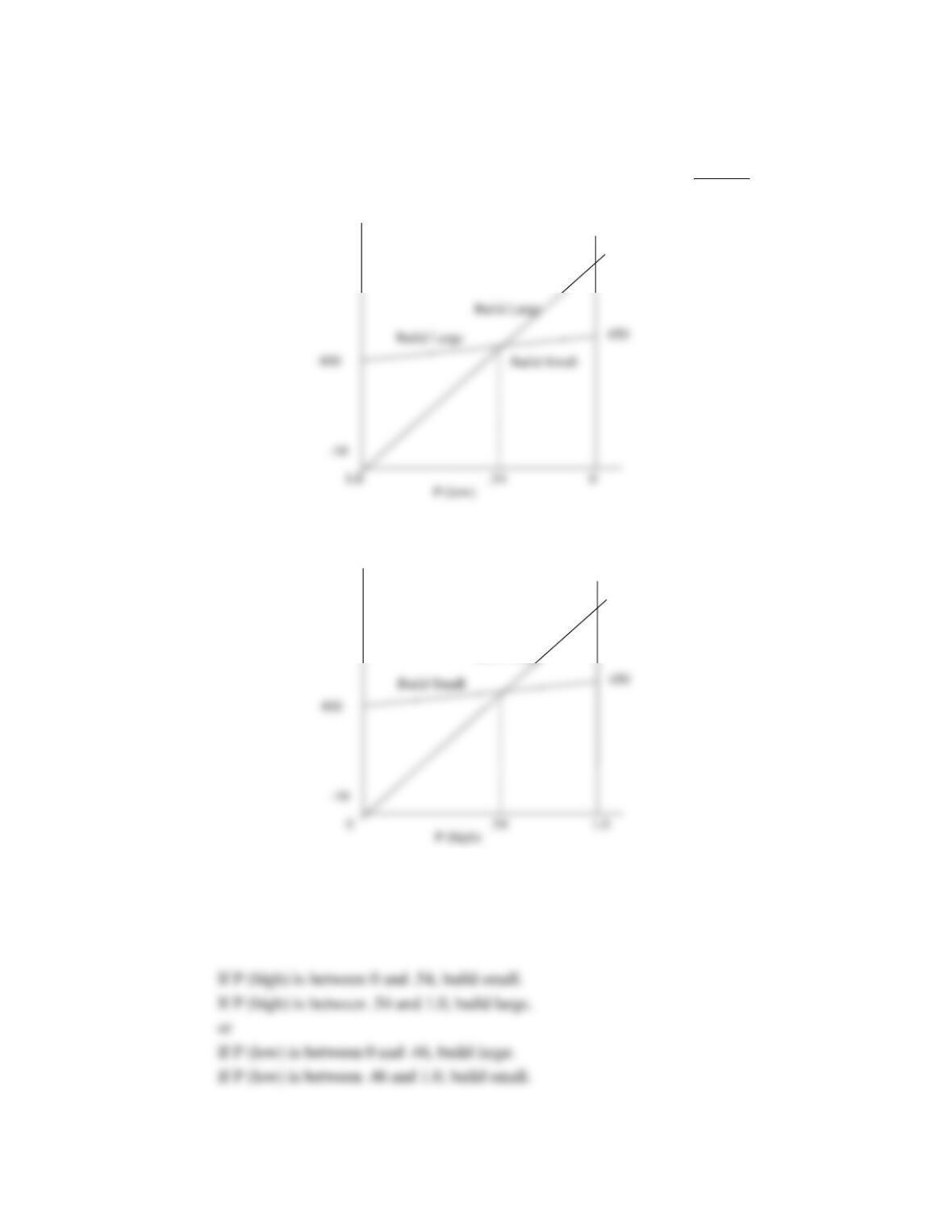
0 .50 .67 1.0
80
70
60
Low
Payoff
High
Payoff
Chapter 05S – Decision Theory
5S-5
b. Expected payoff under certainty: .4(400,000) + .6 (800,000) = $640,000
Expected payoff under risk: 476,000
Expected value of perfect information: $164,000
c.
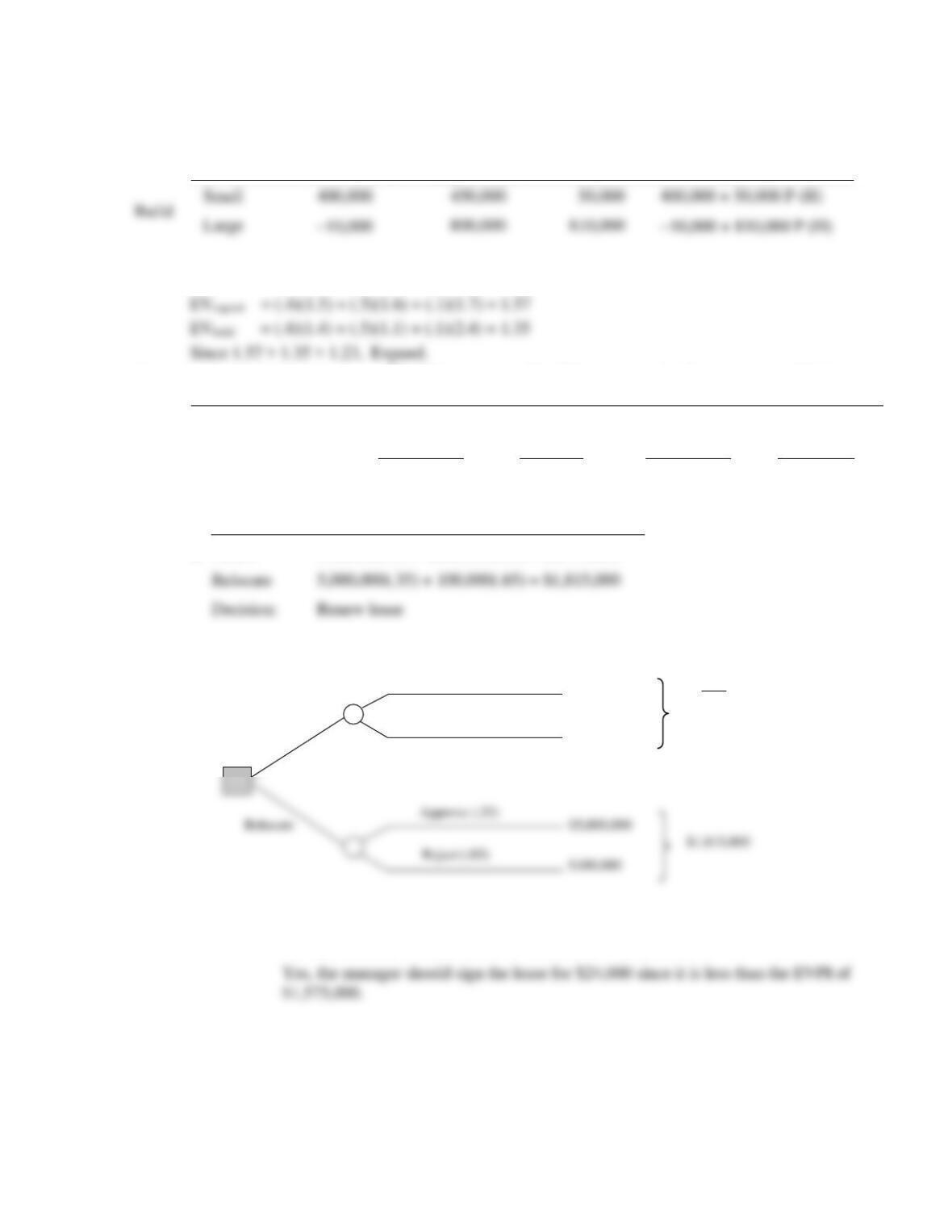
400,000 + 50,000 P (H) = −10,000 + 810,000 P (H)
760,000 P (H) = 410,000
P(High) = .54
450
400
1.0
.54
0
Build Large
800
High
Payoff
Low
800
High
Payoff
Low
Payoff
Build Large
450
400
0
.54
1.0
Chapter 05S – Decision Theory
5S-6
Low Demand
High Demand
Slope
Equation
5. EVsubcontract= (.4)(1.0) + (.5)(1.3) + (.1)(1.8) = 1.23
6.
MaxiMax
MaxiMin
Laplace
Minimax
Alternative
(a)
Max. Payoff
(b)
Min. Payoff
(c)
Average
(d)
Regret
Renew
$4,000,000
$500,000*
$2,250,000
$4,500,000
Relocate
$5,000,000*
$100,000
$2,550,000*
$3,900,000*
Decision:
Relocate
Renew
Relocate
Relocate
7.
Alternative
Expected Value
a.
Renew
500,000(.35) + 4,000,000(.65) = $2,775,000*
Relocate
5,000,000(.35) + 100,000(.65) = $1,815,000
Decision:
Renew lease
Approve (.35)
Reject (.65)
$5,000,000
$100,000
$1,815,000
b.
c.
EVPI
= EPC – EMV
= .35(5,000,000) + .65(4,000,000) – 2,775,000 = $1,575,000
$1,575,000.
$500,000
$4,000,000
Approve (.35)
Reject (.65)
$2,775,000*
E.V.
Renew
Small
400,000 + 50,000 P (H)
D = $1,476,923
$4,000,000 – $1,476,923 = $2,523,077
Range is $2,523,077 or more.
8.
a., b.
Let P (application is approved) = x. Then P (application rejected) = 1 – x.
From 7(a)
500,000x + 4,000,000(1 – x) = 4,000,000 – 3,500,000x
and 5,000,000x + 100,000(1 – x) = 100,000 + 4,900,000x
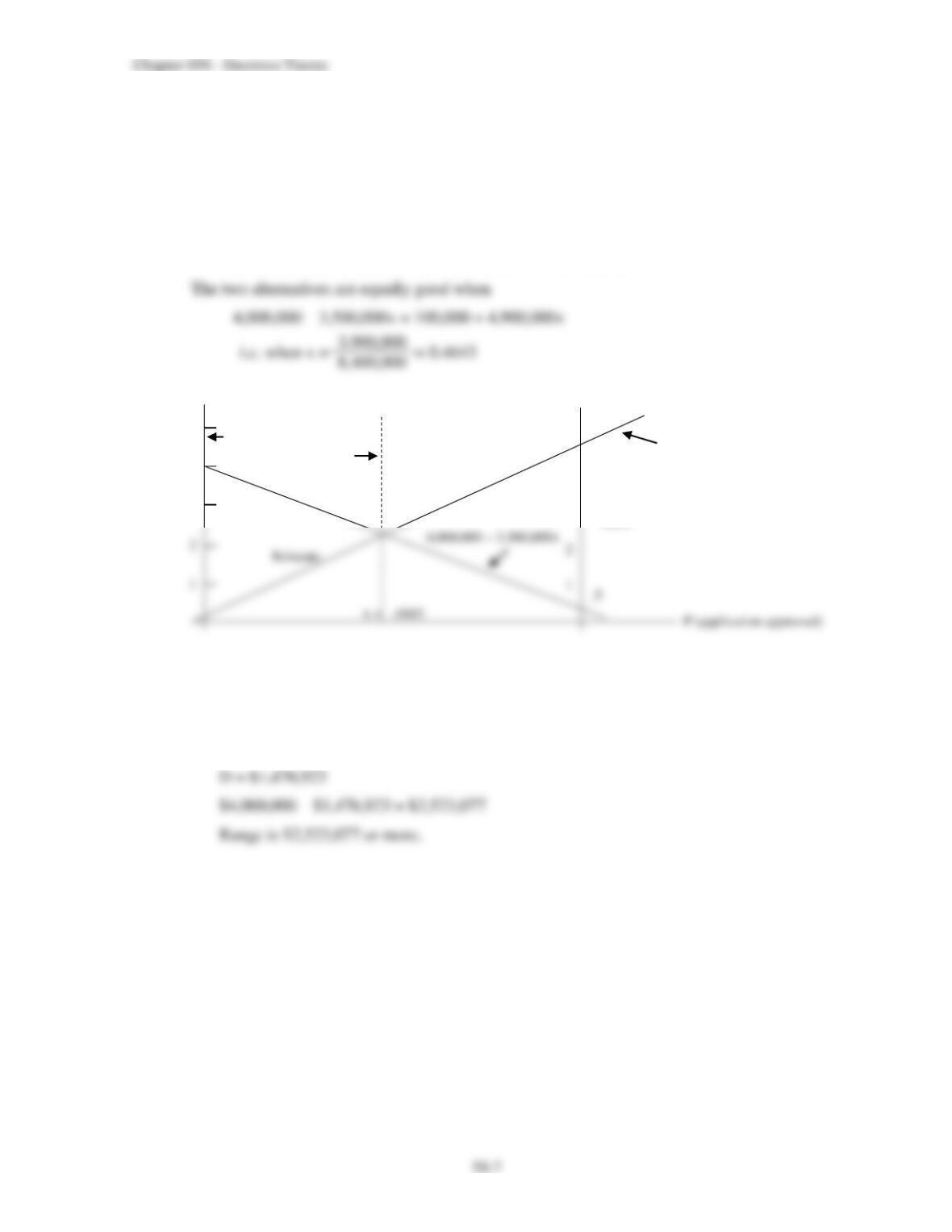
The two alternatives are equally good when
4,000,000 – 3,500,000x = 100,000 + 4,900,000x
4,000,000 – 3,500,000x
c.
D = amount of decrease in $4,000,000 in order that EVrenew = EVreloc.
EVrenew – EVreloc. = $2,775,000 – $1,815,000 = $960,000
$960,000 = .65D
Renewal better than
(millions)
Relocation
For 8(a) and 8(b) the decision
should be to renew the 10 year
lease.
Exp.
Value
Renew
Relocate
100,000 + 4,900,000x
5
4
3
5
4
3
Chapter 05S – Decision Theory
5S-8
a.
Decision: Build a large facility.
b.
Max (42;22;–20) = $42 million.
Decision: Build a small facility.
c.
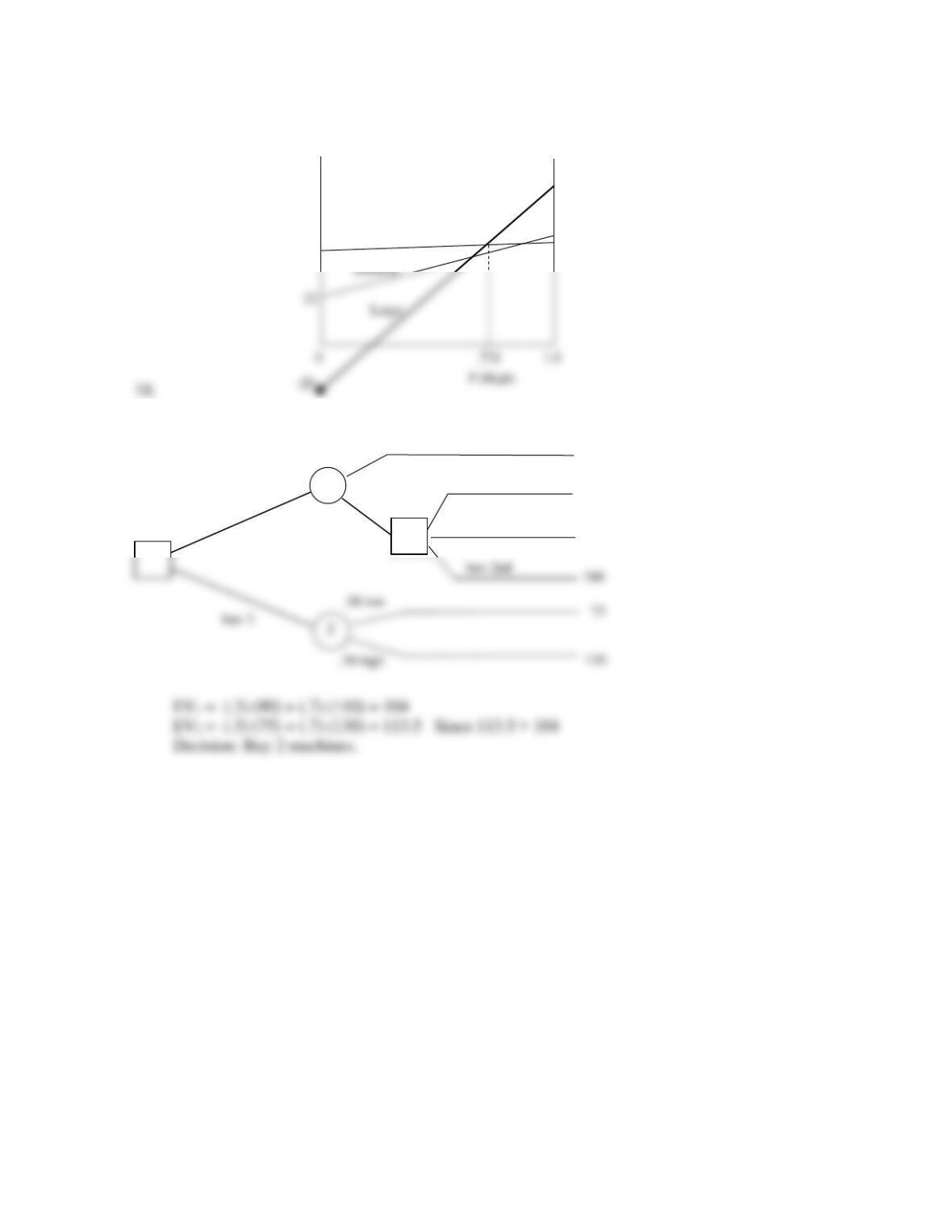
EPC = 42(.2) + 72(.8) = 8.4 + 57.6 = $66.0
EVPI = EPC – EMV = 66 – 53.6=$12.4
d.
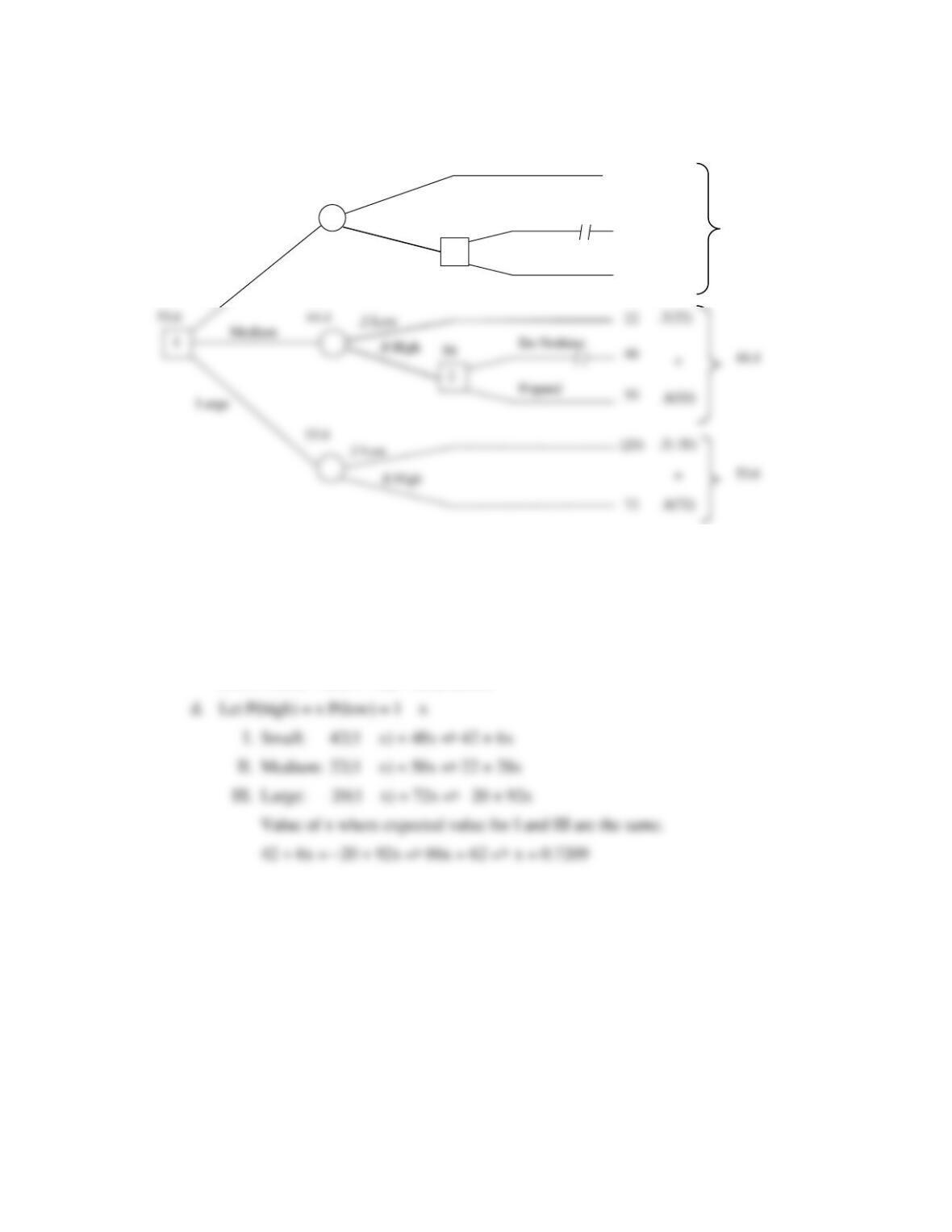
Let P(high) = x P(low) = 1 – x
Small: 42(1 – x) + 48x => 42 + 6x
Medium: 22(1 – x) + 50x => 22 + 28x
Large: –20(1 – x) + 72x => –20 + 92x
Value of x where expected value for I and III are the same.
42 + 6x = –20 + 92x => 86x = 62 => x = 0.7209
.2 Low
.8 High
Subcontract
Expand Greatly
2
$ 42
42
48
46.8
.2(42)
+
.8(48)
Small
9.
46.8
48
.2 Low
.2 Low
Do Nothing
Expand
.8 High
46
50
.2(22)
+
.8(50)
.2(-20)
+
.8(72)
Medium
1
53.6
44.4
53.6
Chapter 05S – Decision Theory
5S-9
72
50
48
42
Small
buy 1
buy 2
100
75
130
.30 low
$90
90
110
.30 low
subcontract
do nothing
2
1
.7 high
Large
Chapter 05S – Decision Theory
5S–10
11.
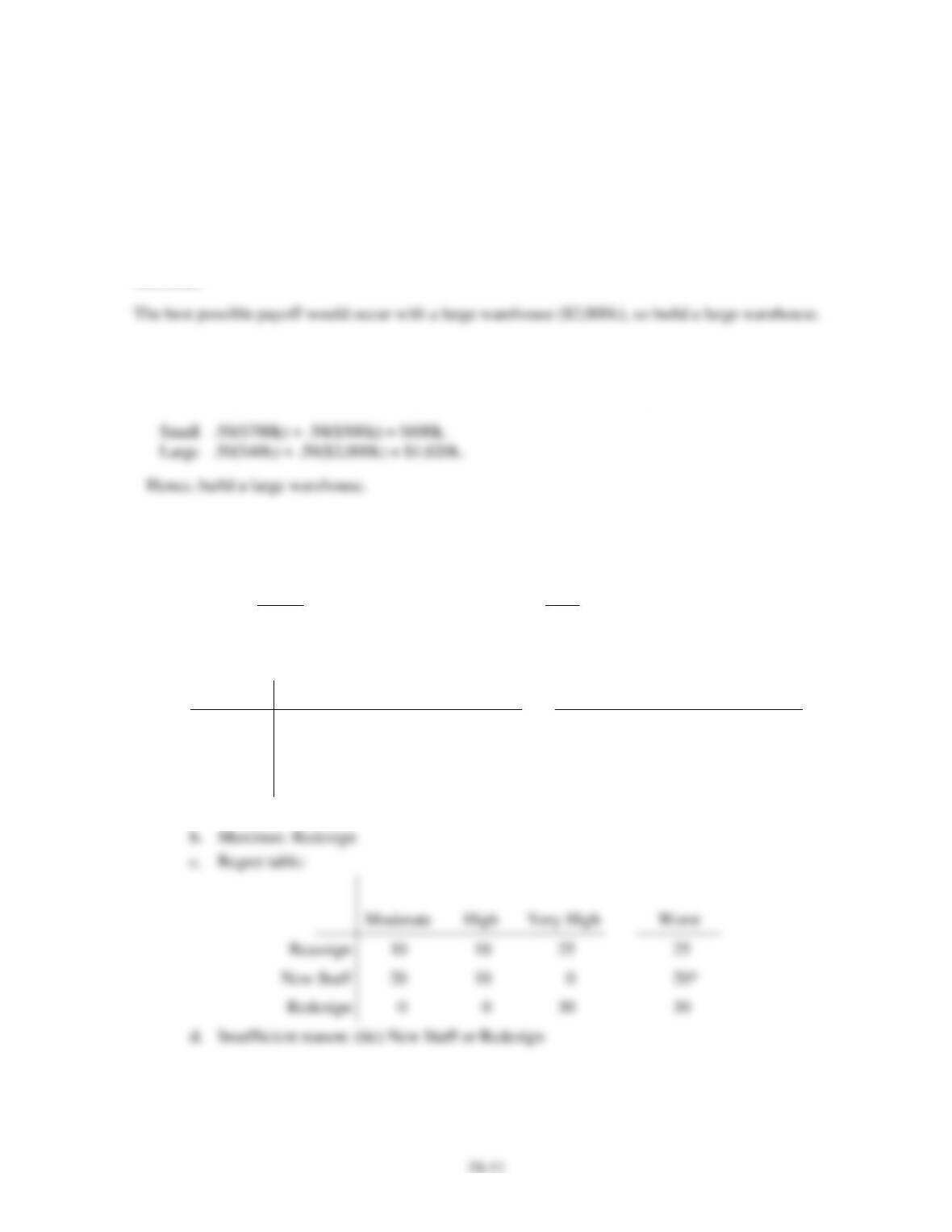
EV1 = (1/3)(0) + (1/3)(60) + (1/3)(90) = 50
EV2 = (1/3)(–45) + (1/3)(45) + (1/3)(99) = 33
EV5 = (.3)(40) + (.5)(50) + (.2)(45) = 46
Since 49 > 46, choose alternative A.
12. 1) Draw the tree diagram:
.30
.50
60
40
Alternative A
.20
50
0
90
60
1
1/3
44
45
.20
3
50
1/2
4
1/3
1/3
30
1/2
40
$700
$100
Demand Low (.50)
Demand High (.50)
Build Large
Demand Low (.50)
Demand High (.50)
Lease
Expand
Build Small
2
49
99
49
40
2
1/3
1/3
.50
50
5
40
45
Chapter 05S – Decision Theory
Maximin:
The worst possible payoff for small would occur with expanding under high demand: $500k. The
worst possible payoff for large would be $40k for low demand. Hence, build a small warehouse.
Maximax:
Laplace:
Assume the probabilities of low and high demand to be .50 each. The expected payoffs would be:
Minimax regret:
Small: Large:
Large = $2,000k Small = $700k
Small = $500k Large = $40k
$1,500k $660k
Hence, build a large warehouse.
13.
Moderate
High
Very High
Worst
Best
Average
Reassign
50
60
85
85
50
65
New Staff
60
60
60
60*
60
60
(tie)
Redesign
40
50
90
90
40*
60
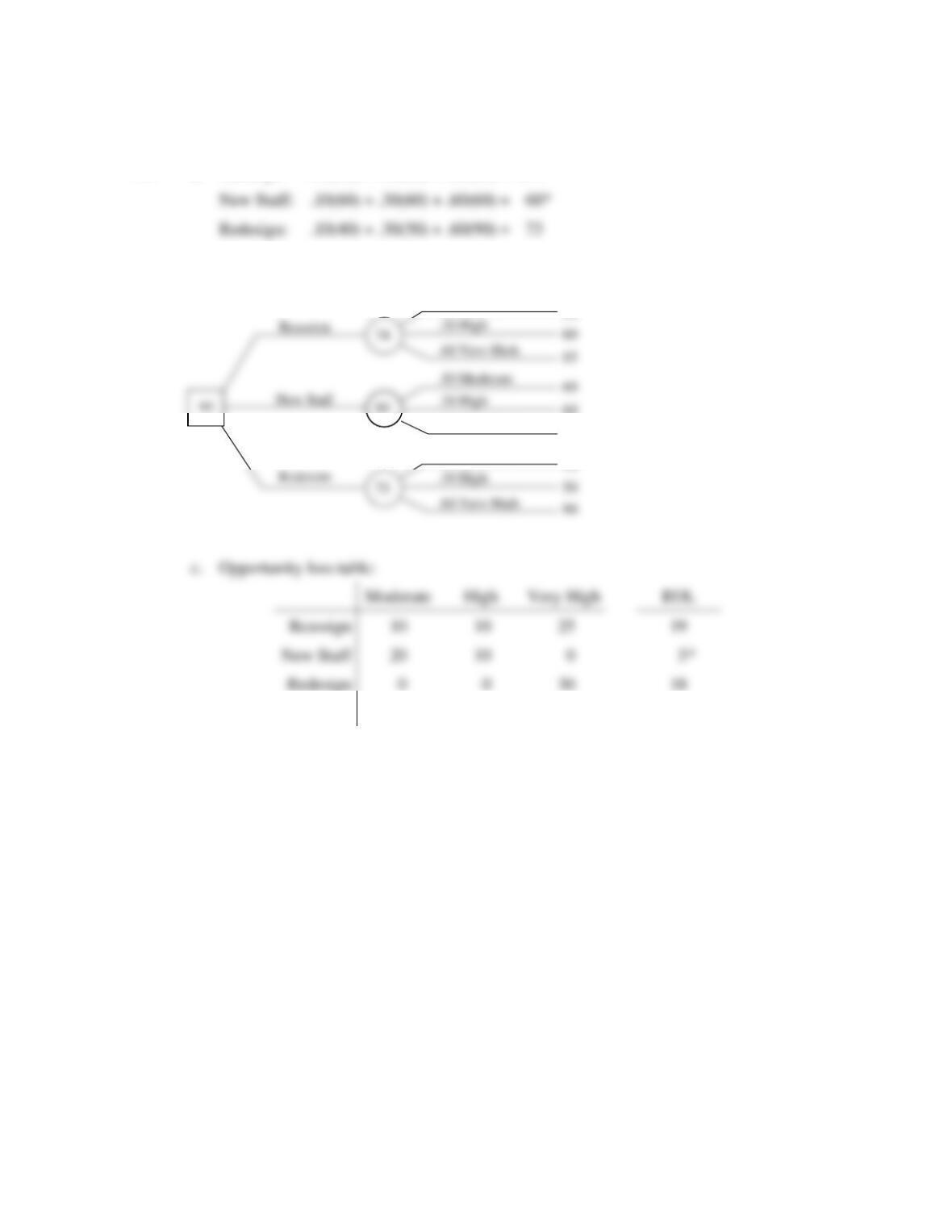
a. Maximin: New staff
Worst
10
10
25
25
20
10
0
20*
0
0
30
30
Chapter 05S – Decision Theory
5S–12
14.
a.
Reassign:
.10(50) + .30(60) + .60(85) =
$74
b.
c.
Opportunity loss table:
10
10
25
20
10
0
0
0
30
40
50
90
(.1)
(.3)
(.6)
60
85
60
.10 Moderate
50
60
60
.10 Moderate
.60 Very High
.10 Moderate
New Staff:
.10(60) + .30(60) + .60(60) =
60*
Redesign:
.10(40) + .30(50) + .60(90) =
73
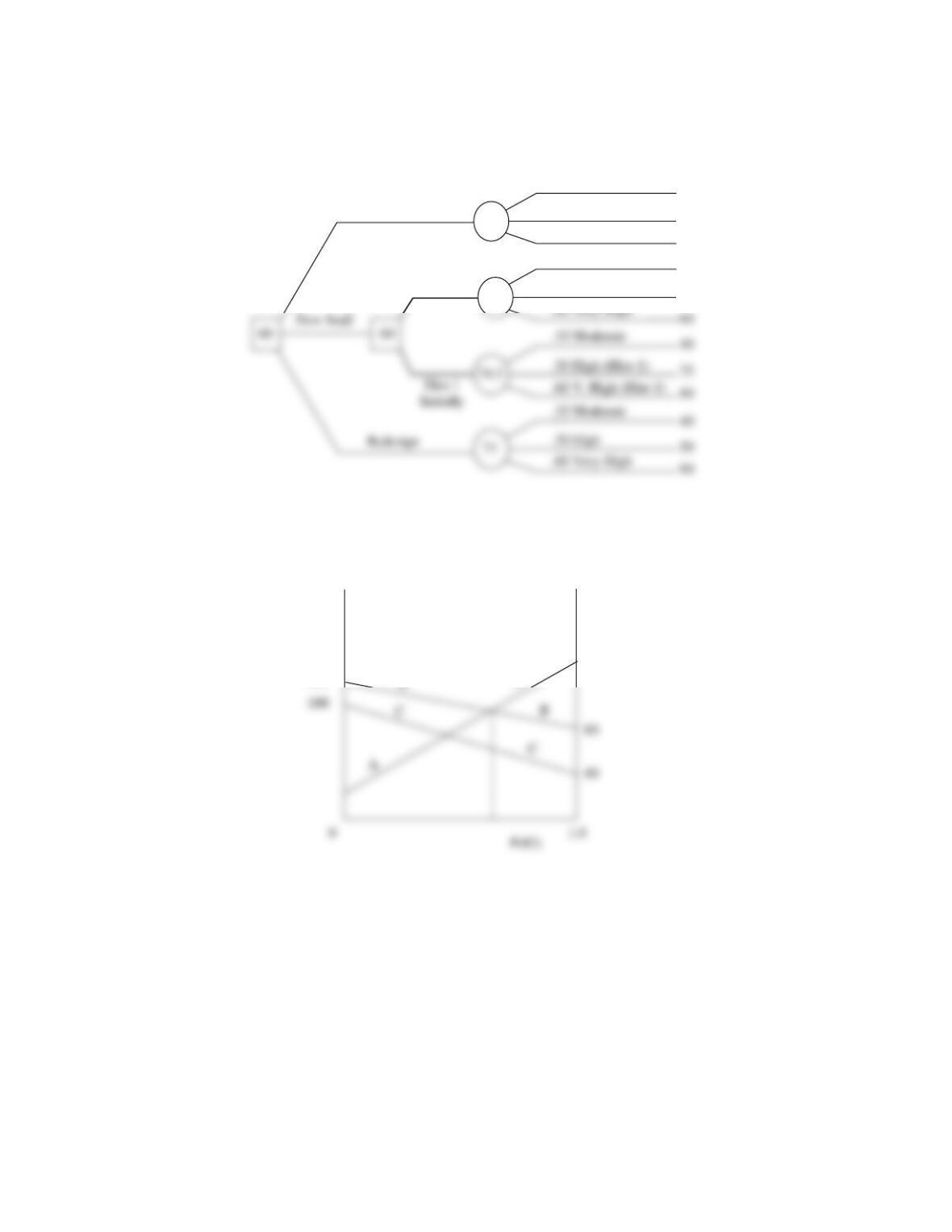
100
B
A
Chapter 05S – Decision Theory
5S–13
At an expected cost of $60, the director should hire and train 2 additional staff members.
Payoff
#2
140
120
Payoff
#1
B
A
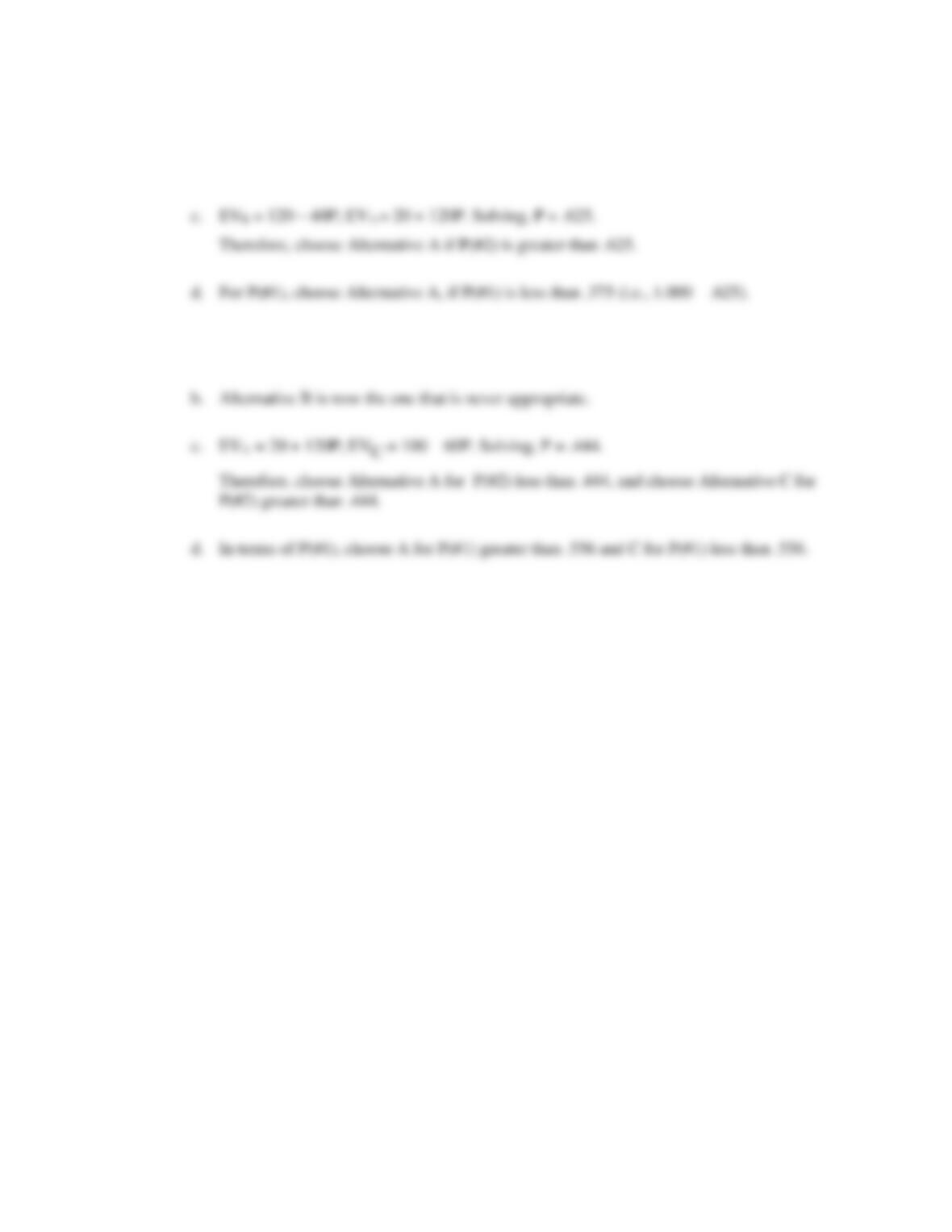
16. a.
50
60
85
60
60
.10 Moderate
.30 High
.60 Very High
.10 Moderate
.30 High
74
Hire 2
Initially
Reassign
60
15.
80
40
.60 Very High
.60 V. High (Hire 1)
Hire 1
Initially
73
60
60
Chapter 05S – Decision Theory
5S–14
b.
Alternative C is lower than Alternative B for all values of P(#2), so it would never be
appropriate.
17.
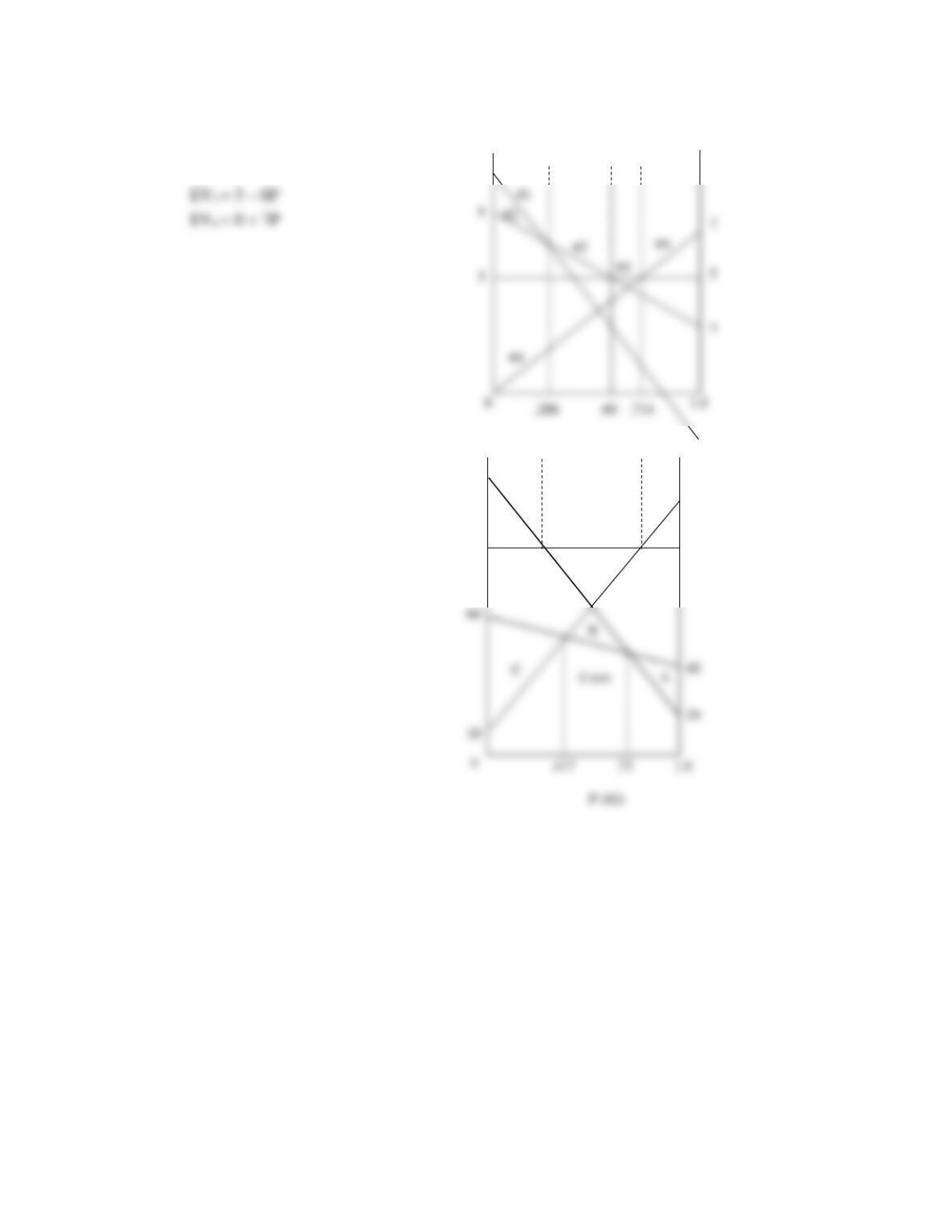
a. [Refer to the diagram in the previous solution]
Therefore, choose Alternative A for P(#2) less than .444, and choose Alternative C for
P(#2) greater than .444.
Therefore, choose Alternative A if P(#2) is greater than .625.
Chapter 05S – Decision Theory
5S–15
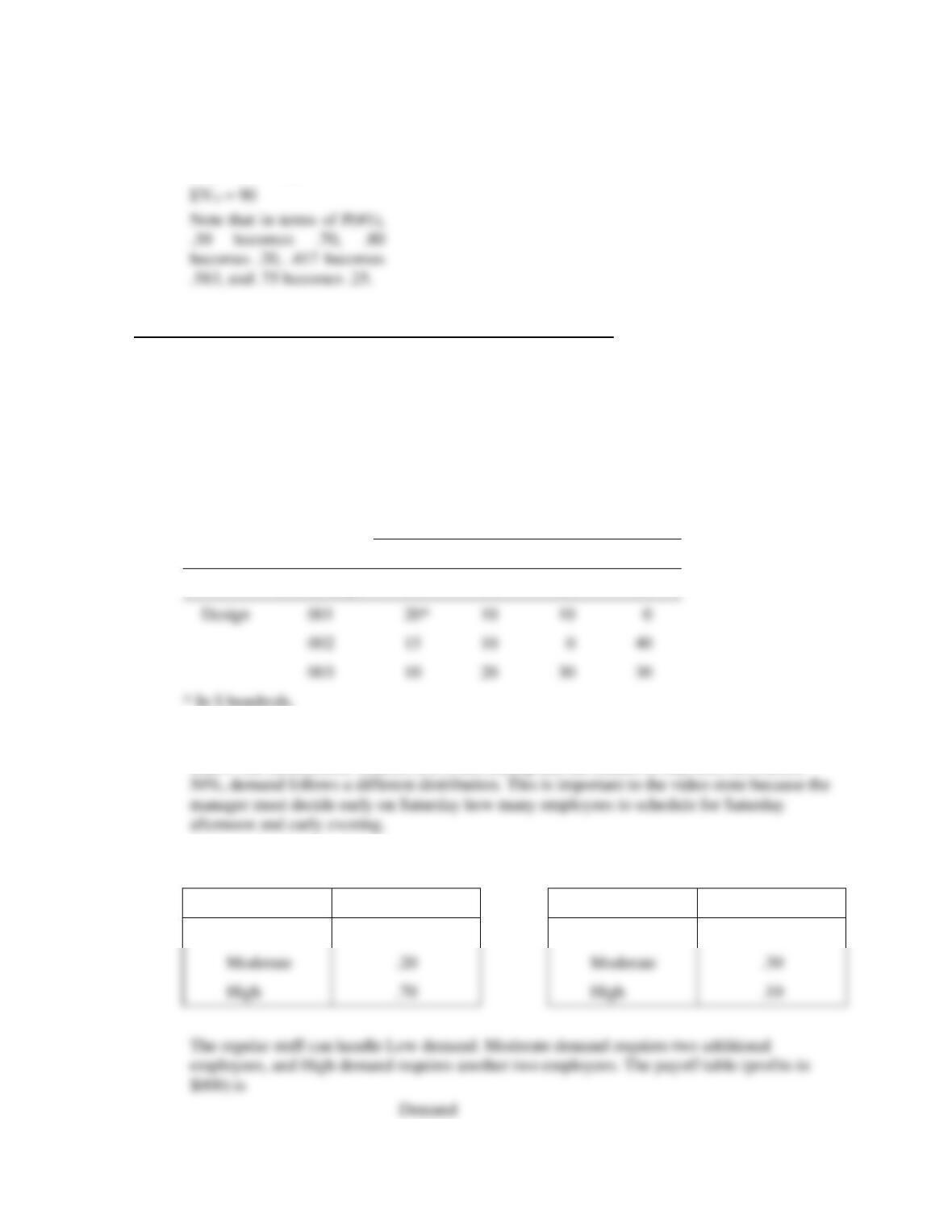
18. EV1 = 10 – 12P
EV2 = 8 – 5P
10
Payoff for
no contract
-2
Payoff for
contract
Payof
f
#2
Payof
f
#1
.30
.80
120
90
60
10
20
40
B
A
C
90
110
A
D
C
Profit
s
5
0
1.0
Chapter 05S – Decision Theory
5S–16
19. EVA = 120 – 100P
EVB = 60 – 20P
EVC = 10 + 100P
Enrichment Model: Advanced Decision Tree Problems
In this section two additional decision tree problems are presented
1. Space engineers have three alternative designs for the configuration of a component for an
unmanned space shuttle. The space vehicle is likely to encounter one of four different
conditions, which have probabilities of occurrence as listed in the following payoff table with
the payoffs for each combination of design and state of nature. Additional data from previous
flights are available but will require additional expenditures to analyze. However, the project
director is confident that analysis of the data will clearly indicate which state of nature will be
encountered. What amount would be justified for the data analysis?
States of Nature
A
B
C
D
Probability:
.3
.4
.2
.1
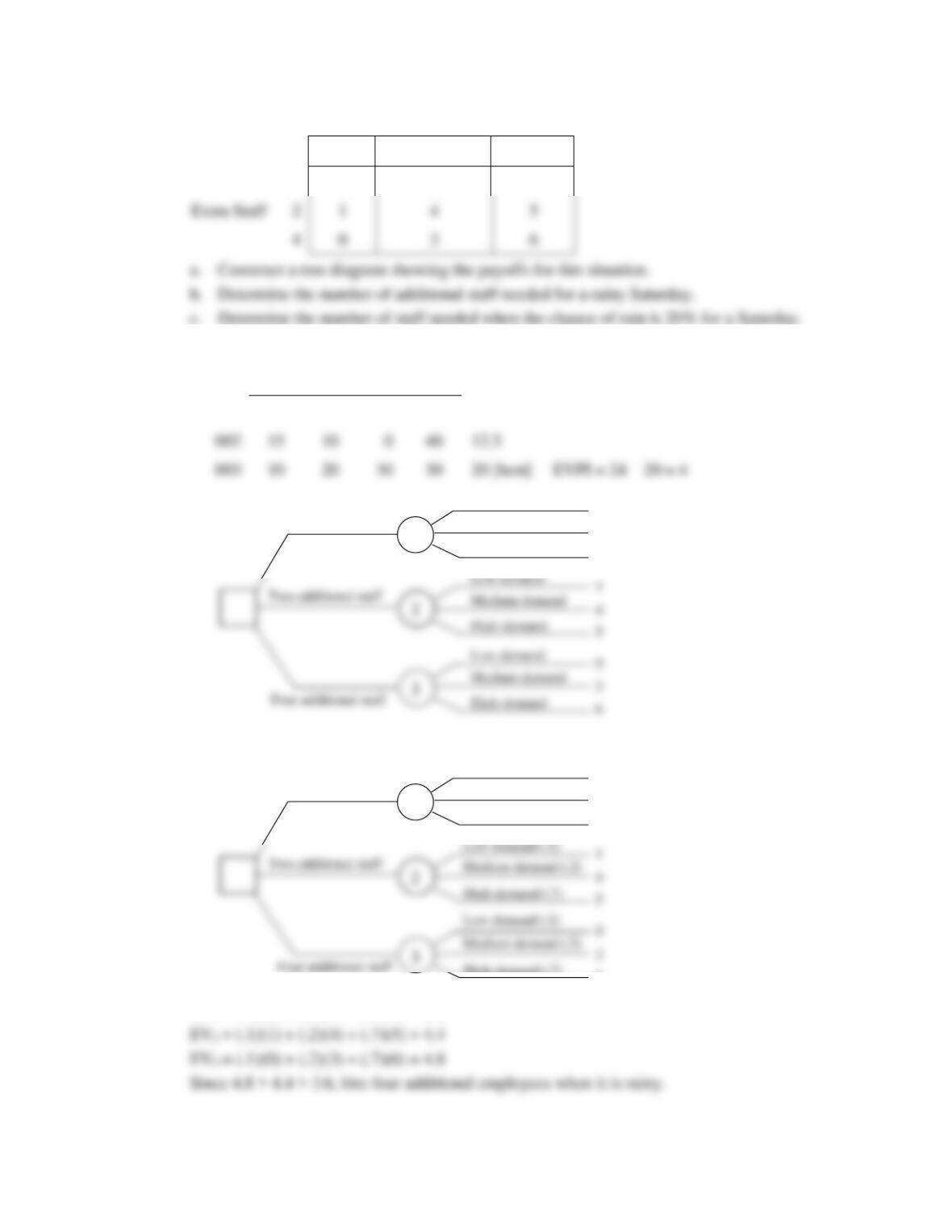
2. Demand for movie rentals at a video store on Saturdays during summer months is related to
the weather. If it is raining, or if the chance of rain is greater than 50%, demand tends to
follow one distribution, whereas if it is not raining and the chance of rain does not exceed
The two distributions are:
P(Rain) > 50% P(Rain) 50%
Demand
Probability
Demand
Probability
Low
.10
Low
.60
Moderate
High
Chapter 05S – Decision Theory
5S–17
Low
Moderate
High
0
2
3
4
1.
A
B
C
D
Designs
.3
.4
.2
.1
EMV EPC: .3(20) + .4(20) + .2(30) + .1(40) = 24
001
20
10
10
0
12
1
4
5
0
3
6
Medium demand
High demand
Low demand
Medium demand
High demand
Low demand
2
1
4
5
0
3
Low demand (.1)
2
3
2. a.
EV1 = (.1)(2) + (.2)(3) + (.7)(4) = 3.6
No additional staff
2
3
4
Medium demand
High demand
Low demand
1
No additional staff
our additional staff
2
3
4
6
Medium demand (.2)
High demand (.7)
Low demand (.1)
ma
d
(.2)
High demand (.7)
1
b.
Chapter 05S – Decision Theory
5S–18
c.
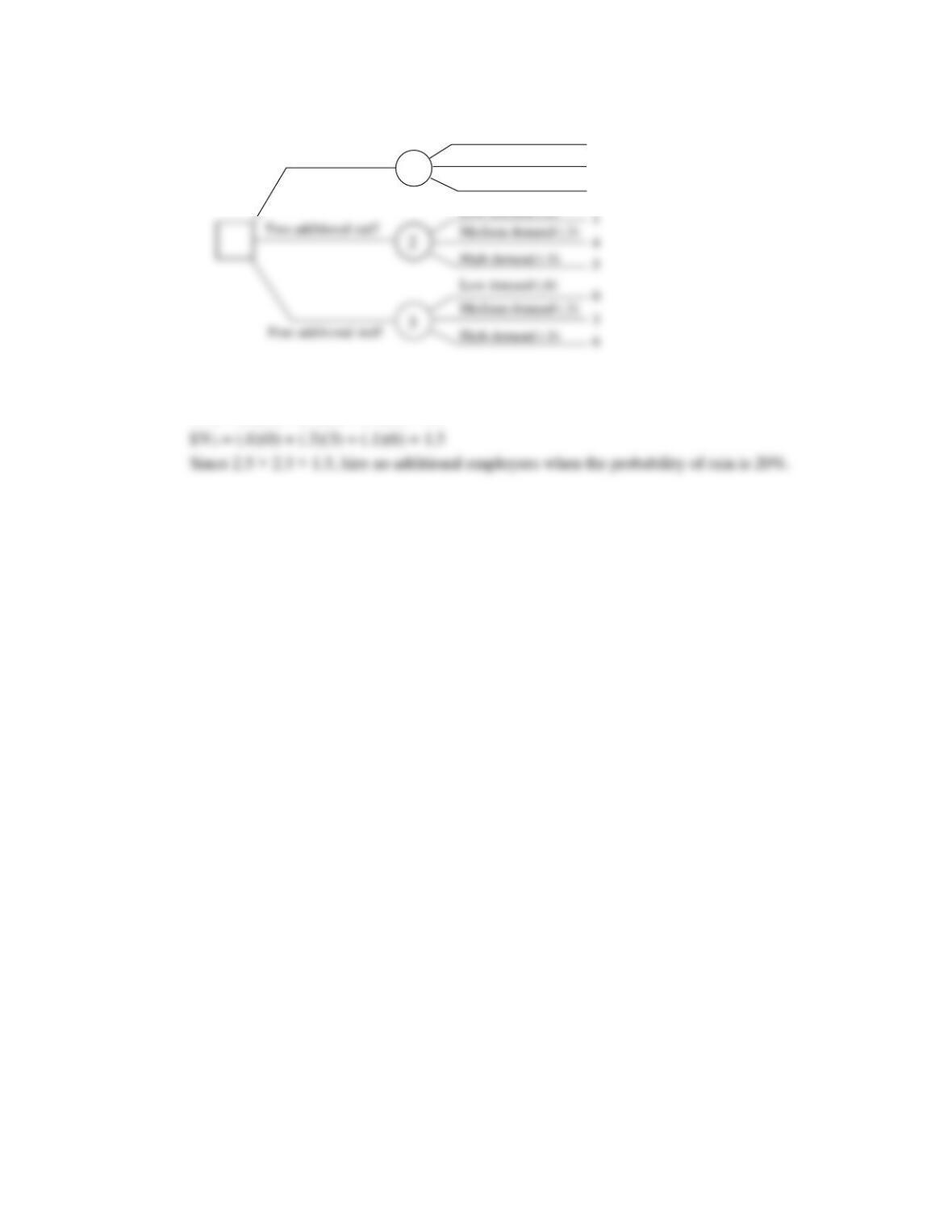
EV1 = (.6)(2) + (.3)(3) + (.1)(4) = 2.5
EV2 = (.6)(1) + (.3)(4) + (.1)(5) = 2.3
No additional staff
2
3
4
Medium demand (.3)
High demand (.1)
Low demand (.6)
1
1
4
5
0
3
6
Low demand (.6)
High demand (.1)
2
3