Chapter 05 – Market Failures: Public Goods and Externalities
5-1
Chapter 05 Market Failures: Public Goods and Externalities
QUESTIONS
1. Explain the two causes of market failures. Given their definitions, could a market be affected
by both types of market failures simultaneously? LO1
Answer: A public good is one where consumption in non-rival and non-excludable.
Private goods are not profitable because of the free rider problem. If we want to set off
fireworks and charge for the event, we probably wouldn’t generate much revenue. We
Chapter 05 – Market Failures: Public Goods and Externalities
5-2
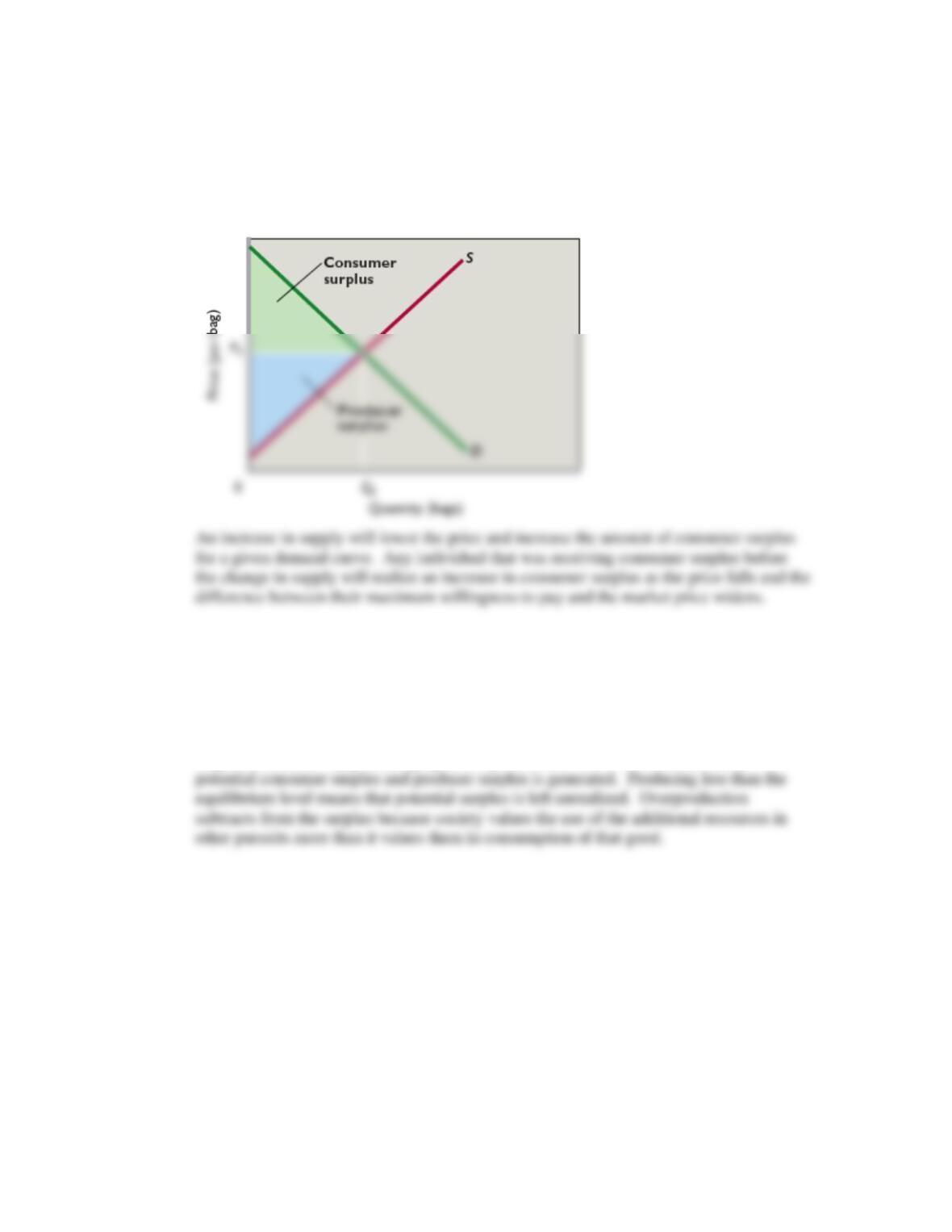
2. Draw a supply and demand graph and identify the areas of consumer surplus and producer
surplus. Given the demand curve, what impact will an increase in supply have on the amount of
consumer surplus shown in your diagram? Explain why. LO2
Answer:
3. Use the ideas of consumer surplus and producer surplus to explain why economists say
competitive markets are efficient. Why are below- or above-equilibrium levels of output
inefficient, according to these two sets of ideas? LO2
Answer: When the consumers’ utility exceeds the price paid, consumer surplus is
generated. Likewise, when producers receive a price greater than marginal cost, producer
surplus is created. By producing up to the point where MB = MC, the maximum
Chapter 05 – Market Failures: Public Goods and Externalities
5-3
4. What are the two characteristics of public goods? Explain the significance of each for public
provision as opposed to private provision. What is the free-rider problem as it relates to public
goods? Is U.S. border patrol a public good or a private good? Why? How about satellite TV?
Explain. LO3
Answer: Public goods are nonrival (one person’s consumption does not prevent
consumption by another) and nonexcludable (once the goods are produced nobody—
including free riders—can be excluded from the goods’ benefits). If goods are nonrival,
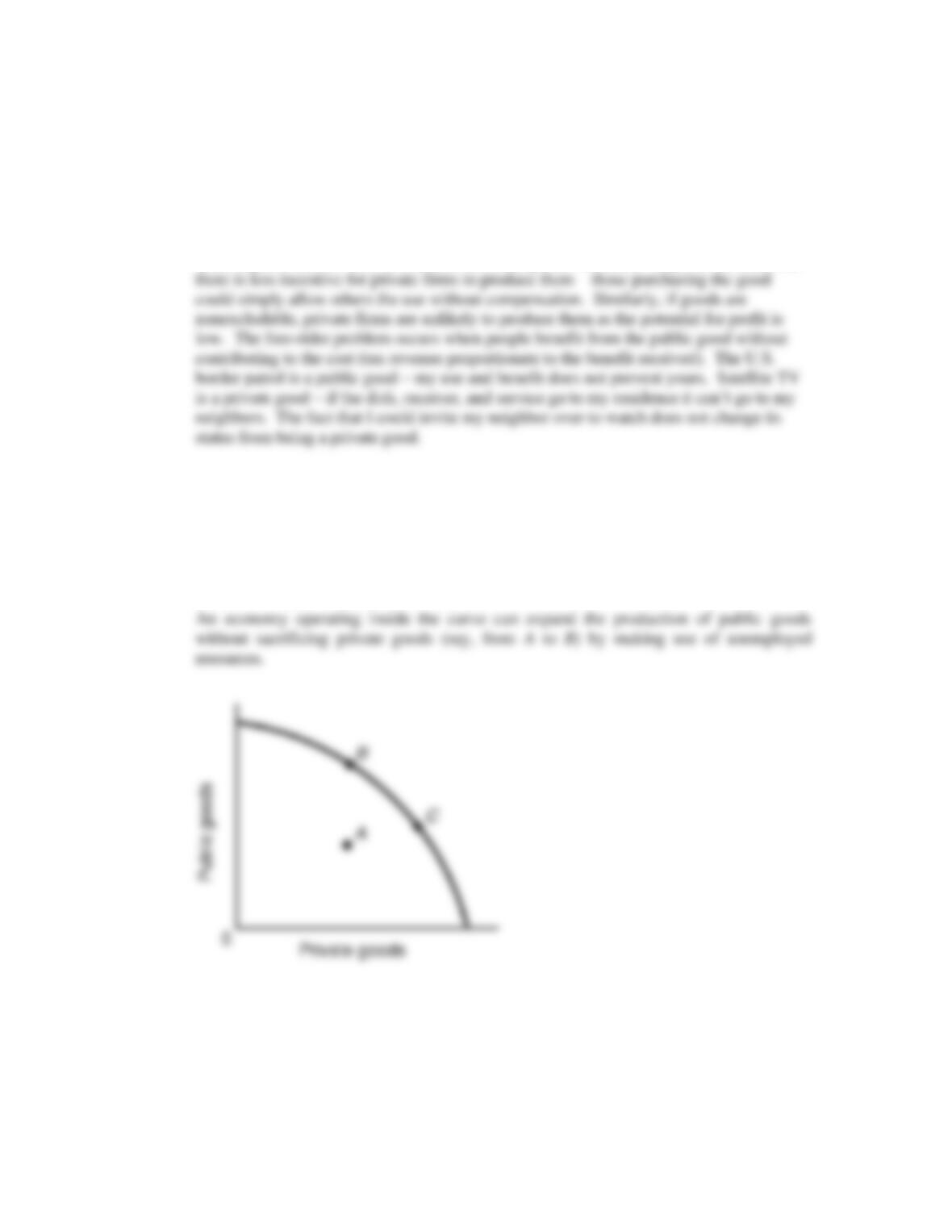
5. Draw a production possibilities curve with public goods on the vertical axis and private goods
on the horizontal axis. Assuming the economy is initially operating on the curve, indicate how the
production of public goods might be increased. How might the output of public goods be
increased if the economy is initially operating at a point inside the curve? LO3
Answer: On the curve, the only way to obtain more public goods is to reduce the
production of private goods (from C to B).
Chapter 05 – Market Failures: Public Goods and Externalities
5-4
6. Use the distinction between the characteristics of private and public goods to determine
whether the following should be produced through the market system or provided by government:
(a) French fries, (b) airport screening, (c) court systems, (d) mail delivery, and (e) medical care.
State why you answered as you did in each case. LO3
Answers:
(a) French fries—market system (rival and excludable)
7. What divergences arise between equilibrium output and efficient output when (a) negative
externalities and (b) positive externalities are present? How might government correct these
divergences? Cite an example (other than the text examples) of an external cost and an external
benefit. LO4
Answers:
(a) When negative externalities are present, the equilibrium output will be greater than
the efficient output. This is because the producer, who is not bearing the full cost of
production, will be able to produce more at a lower price than the efficient level,
Chapter 05 – Market Failures: Public Goods and Externalities
5-5
8. Why are spillover costs and spillover benefits also called negative and positive externalities?
Show graphically how a tax can correct for a negative externality and how a subsidy to producers
can correct for a positive externality. How does a subsidy to consumers differ from a subsidy to
producers in correcting for a positive externality? LO4
Answers: Spillover costs are called negative externalities because they are external to the
participants in the transaction and reduce the utility of affected third parties (thus
9. An apple grower’s orchard provides nectar to a neighbor’s bees, while the beekeeper’s bees
help the apple grower by pollinating his apple blossoms. Use Figure 5.6b to explain why this
situation of dual positive externalities might lead to an underallocation of resources to both apple
growing and beekeeping. How might this underallocation get resolved via the means suggested
by the Coase theorem? LO4
Answers: Using Figure 5.6b in the text the following can be said: The market demand
curves for apples and honey, Da and Dh, would not include the spillover benefits
10. The Lojack car recovery system allows the police to track stolen cars. As a result, they not
only recover 90% of Lojack-equipped cars that are stolen but also arrest many auto thieves and
shut down many “chop shops” that take apart stolen vehicles to get at their used parts. Thus,
Lojack provides both private benefits and positive externalities. Should the government consider
subsidizing Lojack purchases? LO4
Answers: If the government were to subsidize Lojack purchases, this would reduce the
private cost of the anti-theft devices. This reduction in the private cost would, in-turn,
Chapter 05 – Market Failures: Public Goods and Externalities
5-6
11. Explain the following statement, using the MB curve in Figure 5.9 to illustrate: “The optimal
amount of pollution abatement for some substances, say, dirty water from storm drains, is very
low; the optimal amount of abatement for other substances, say, cyanide poison, is close to 100
percent.” LO5
Answers: Reducing water flow from storm drains has a low marginal benefit, meaning
the MB curve would be located far to the left of where it is in the text diagram. It will
12. Explain why zoning laws, which allow certain land uses only in specific locations, might be
justified in dealing with a problem of negative externalities. Explain why in areas where buildings
sit close together tax breaks to property owners for installing extra fire prevention equipment
might be justified in view of positive externalities. Explain why excise taxes on beer might be
justified in dealing with a problem of external costs. LO5
Answers: Zoning could force businesses producing negative externalities to locate in
regions where these costs would not spill over onto third parties, or where such costs
would at least be reduced. Businesses wanting to locate in regions where external costs
Chapter 05 – Market Failures: Public Goods and Externalities
5-7
13. LAST WORD Distinguish between a carbon-tax and a cap-and-trade strategy for reducing
carbon dioxide and other so-called greenhouse gases (that are believed by many scientists to be
causing global warming). Which of the two strategies do you think would have the most political
support in an election in your home state? Explain your thinking.
Answers: Scientific evidence suggests that carbon dioxide and other gas emissions are
accumulating and causing the average temperature of the atmosphere to increase. In the
PROBLEMS
1. Refer to Table 5.1. If the six people listed in the table are the only consumers in the market and
the equilibrium price is $11 (not the $8 shown), how much consumer surplus will the market
generate? LO2
Feedback: Consider the following table as an example:
Using the values above, and assuming an equilibrium price of $11 (not the $8 shown), we
Chapter 05 – Market Failures: Public Goods and Externalities
5-8
2. Refer to Table 5.2. If the six people listed in the table are the only producers in the market and
the equilibrium price is $6 (not the $8 shown), how much producer surplus will the market
generate? LO2
Feedback: Consider the following table as an example:
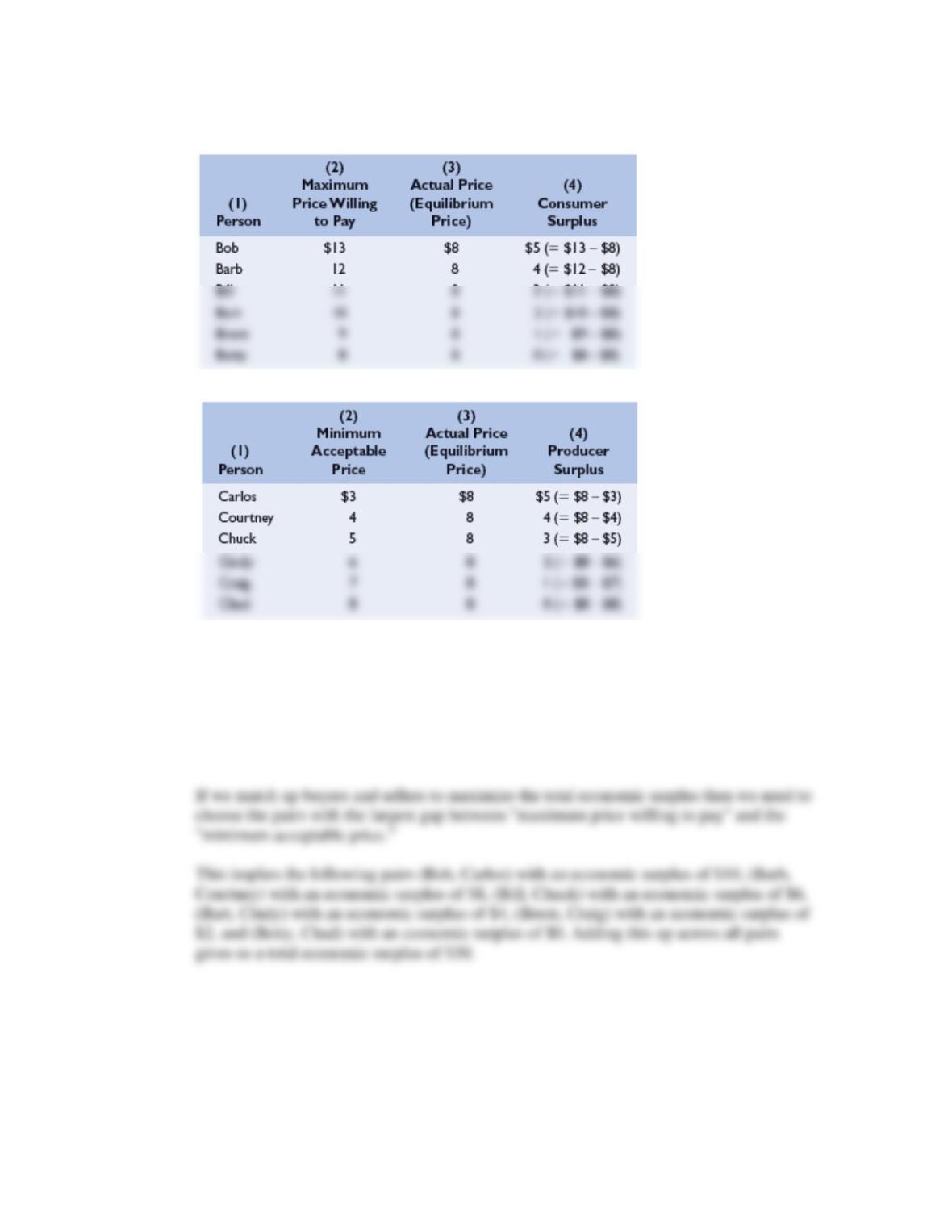
3. Look at Tables 5.1 and 5.2 together. What is the total surplus if Bob buys a unit from Carlos? If
Barb buys a unit from Courtney? If Bob buys a unit from Chad? If you match up pairs of buyers
and sellers so as to maximize the total surplus of all transactions, what is the largest total surplus
that can be achieved? LO2
Chapter 05 – Market Failures: Public Goods and Externalities
5-9
Feedback: Consider the following tables as an example:
If Bob buys a unit of the good from Carlos, then the economic surplus is the difference
between Bob’s “maximum price willing to pay” and Carlos’s the “minimum acceptable
price.” The economic surplus is $10 (= $13- $3)
If Barb buys a unit form Courtney, then the economic surplus equals $8 (= $12 – $4).
If Bob buys a unit form Chad, then the economic surplus is $5 (= $13 – $8).
Chapter 05 – Market Failures: Public Goods and Externalities
5-10
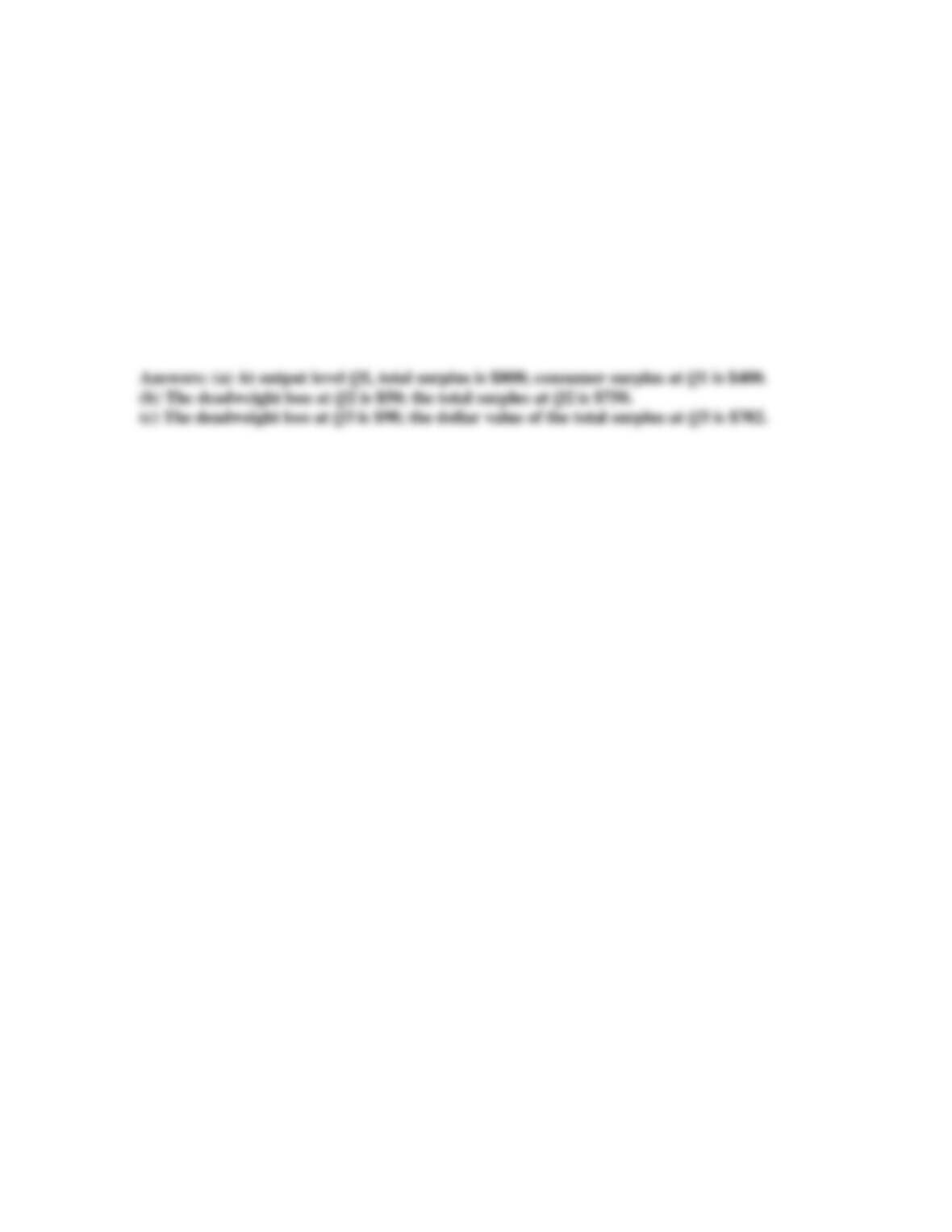
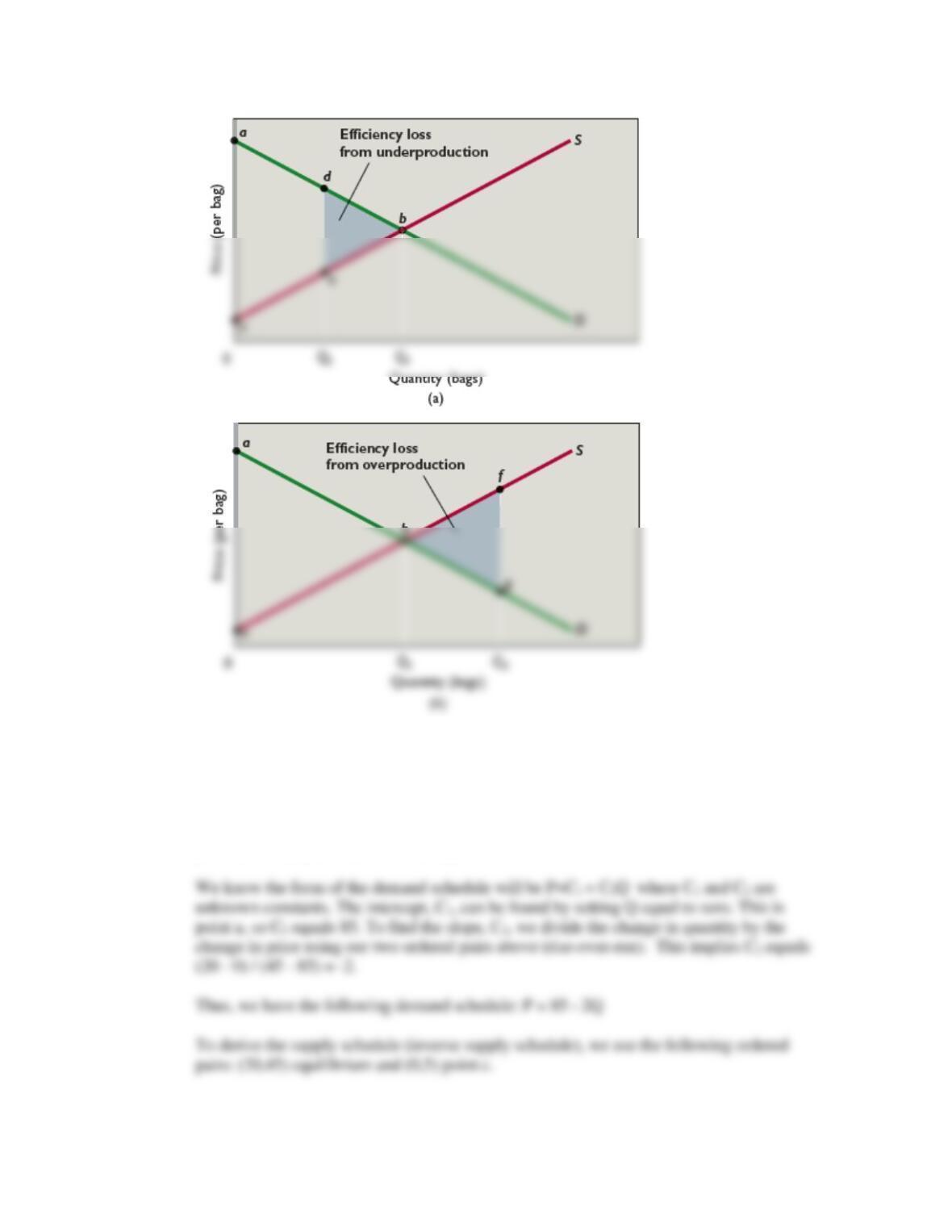
4. ADVANCED ANALYSIS Assume the following values for Figures 5.4a and 5.4b. Q1 = 20
bags. Q2 = 15 bags. Q3 = 27 bags. The market equilibrium price is $45 per bag. The price at a is
$85 per bag. The price at c is $5 per bag. The price at f is $59 per bag. The price at g is $31 per
bag. Apply the formula for the area of a triangle (Area = ½ x Base x Height) to answer the
following questions. LO2
a. What is the dollar value of the total surplus (producer surplus plus consumer surplus) when the
allocatively efficient output level is being produced? How large is the dollar value of the
consumer surplus at that output level?
b. What is the dollar value of the deadweight loss when output level Q2 is being produced? What
is the total surplus when output level Q2 is being produced?
c. What is the dollar value of the deadweight loss when output level Q3 is produced? What is the
dollar value of the total surplus when output level Q3 is produced?
Feedback: To answer this question, let us first find the mathematical representation of
the supply and demand schedules. To help us accomplish this objective we us the
following figures.
Chapter 05 – Market Failures: Public Goods and Externalities
5-11
Now consider the following values as an example. Assume the following values for
Figures 5.4a and 5.4b: The equilibrium quantity Q1 = 20, the market equilibrium price is
$45 per bag, the price at a is $85 per bag, the price at c is $5 per bag.
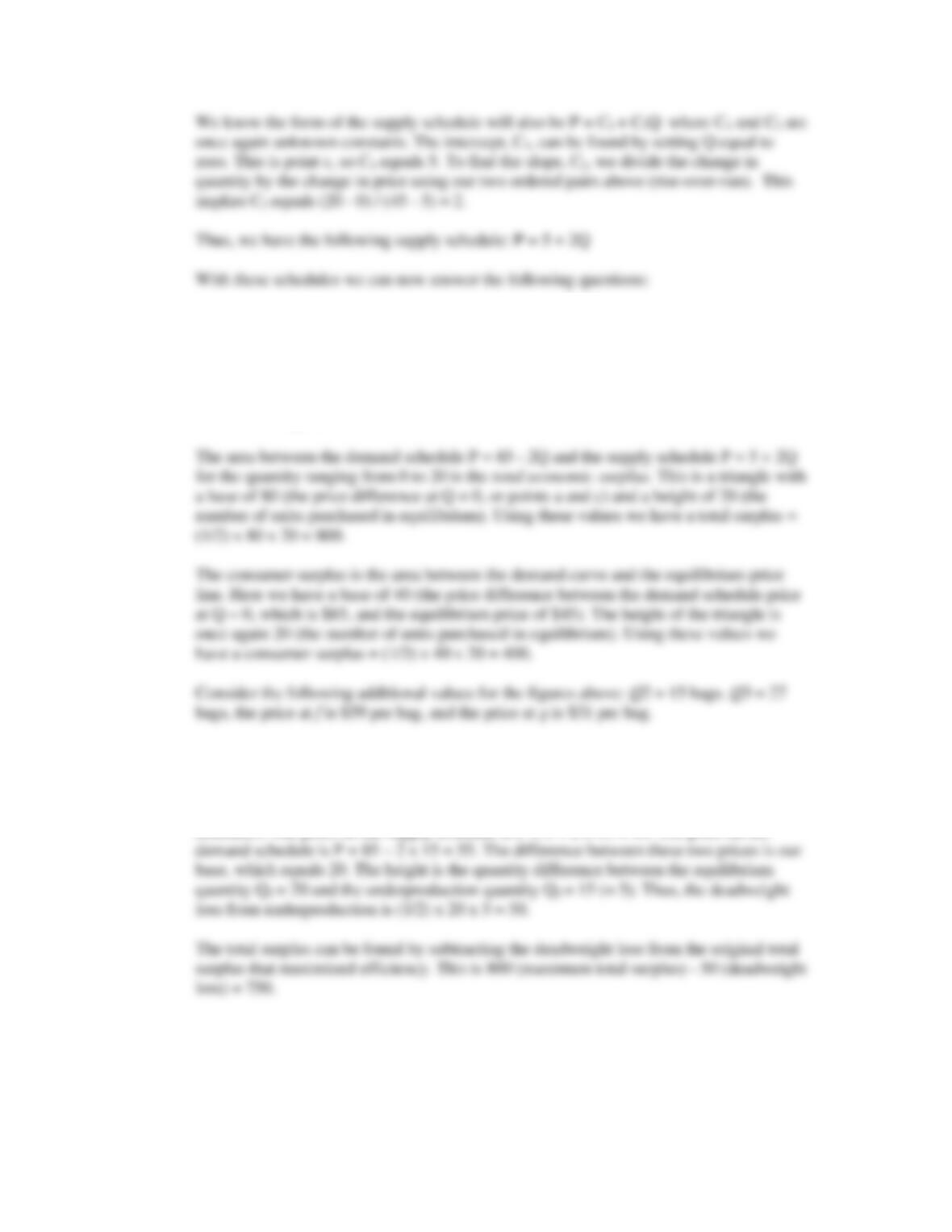
To derive the demand schedule (inverse demand schedule), we use the following ordered
pairs: (20,45) equilibrium and (0,85) point a.
Chapter 05 – Market Failures: Public Goods and Externalities
5-12
Part (a): What is the dollar value of the total surplus (producer surplus plus consumer
surplus) when the allocatively efficient output level is being produced? How large is the
dollar value of the consumer surplus at that output level?
To calculate total surplus we use the following formula for the area of a triangle (Area =
½ (Base x Height)).
Part (b): What is the dollar value of the deadweight loss when output level Q2 is being
produced? What is the total surplus when output level Q2 is being produced?
The first thing we need to do is calculate the price at Q2 = 15 for the supply and demand
schedules. The price on the supply schedule is P = 5 + 2 x 15 = 35. The price on the
Part (c): What is the dollar value of the deadweight loss when output level Q3 is
produced? What is the dollar value of the total surplus when output level Q3 is produced?
Chapter 05 – Market Failures: Public Goods and Externalities
5-13
Here we follow the same procedure. We are given the price at point f is $59 and the price
at point g is $31 (we do not need to calculate these prices using the demand and supply
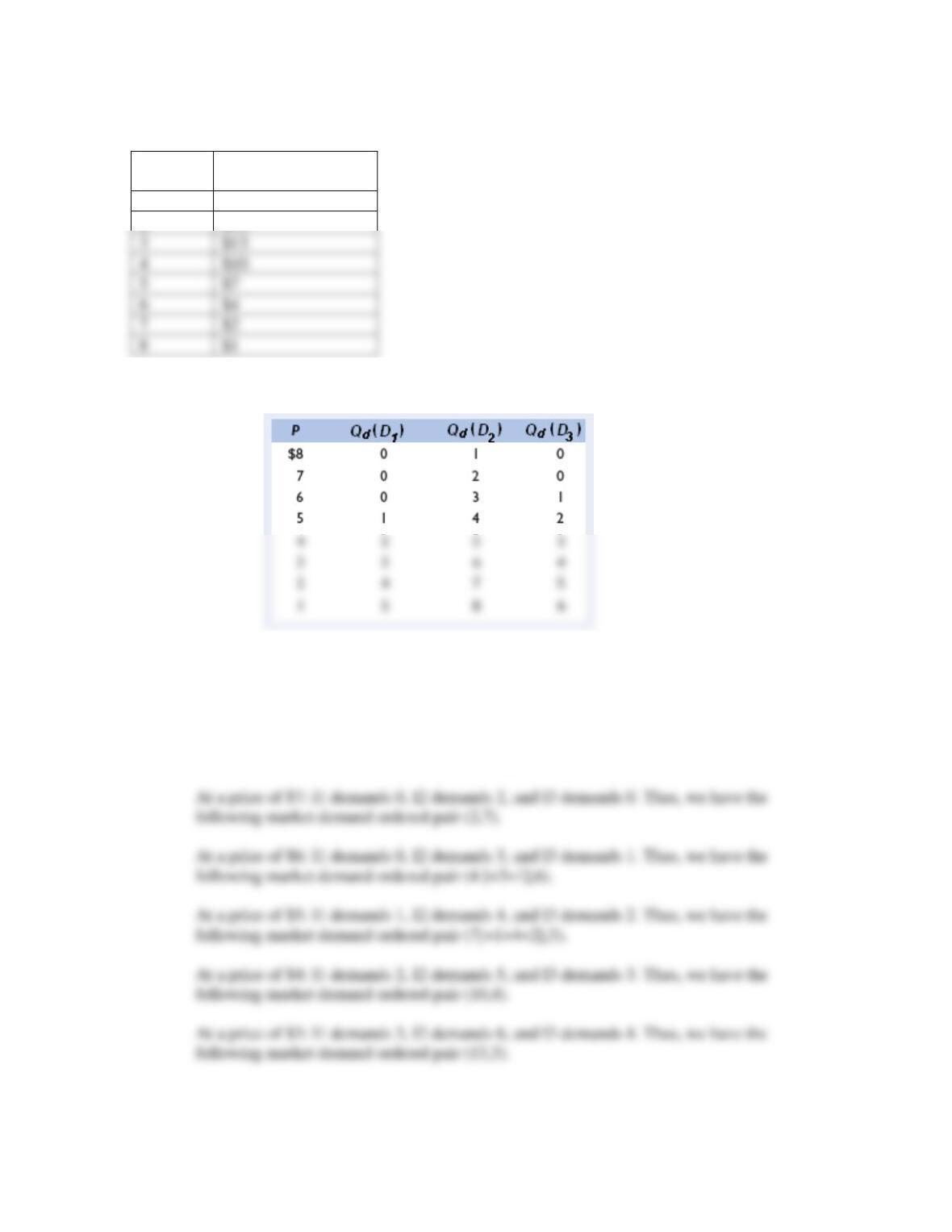
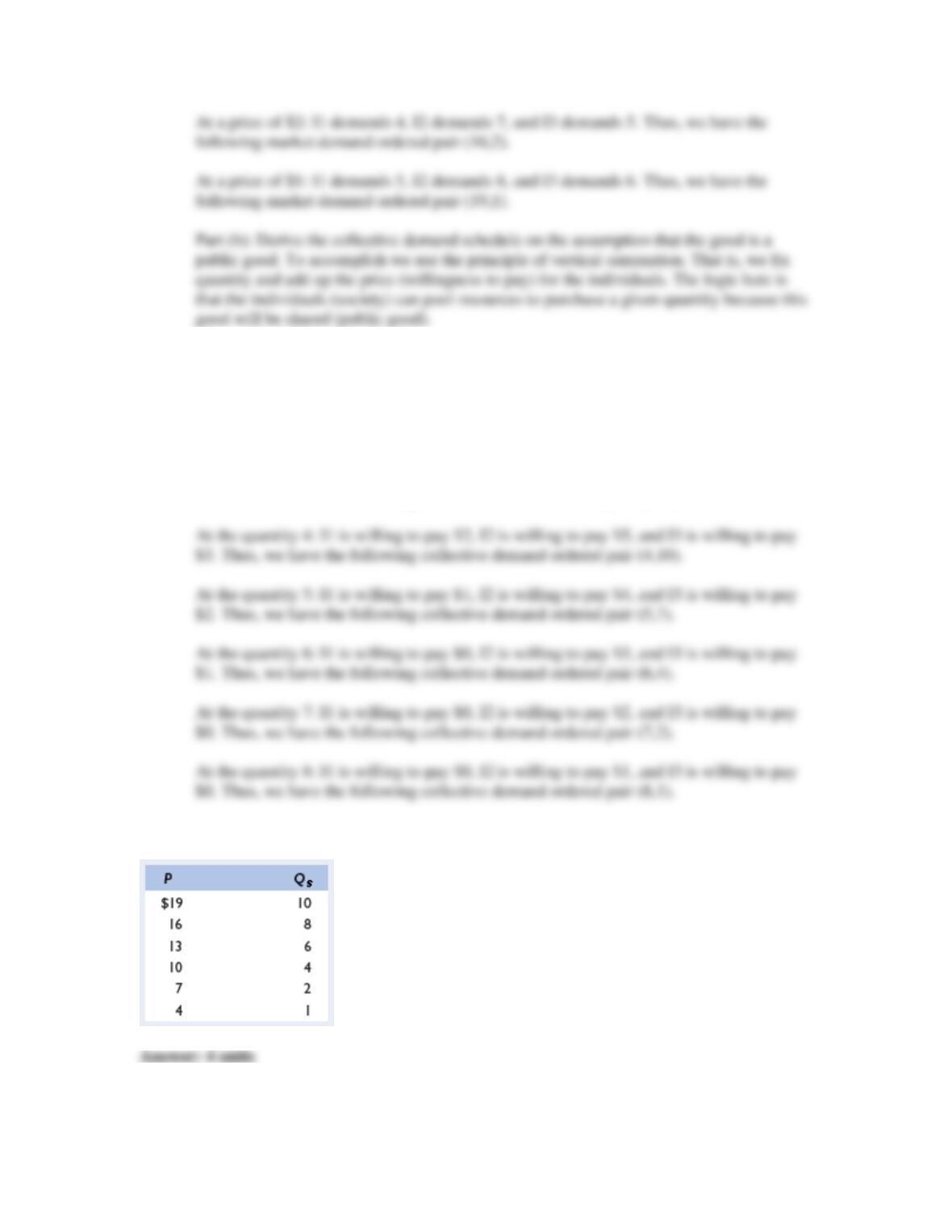
5. On the basis of the three individual demand schedules below, and assuming these three people
are the only ones in the society, determine (a) the market demand schedule on the assumption that
the good is a private good and (b) the collective demand schedule on the assumption that the good
is a public good. LO3
Answers: (a) Market demand schedule
Quantity Demanded
Price
1
$8
2
$7
4
$6
7
$5
10
$4
13
$3
16
$2
19
$1
Chapter 05 – Market Failures: Public Goods and Externalities
5-14
(b) Collective demand schedule
Quantity
Amount Society is
Willing to Pay
1
$19
2
$16
Feedback: Consider the following table:
Part (a): Derive the market demand schedule on the assumption that the good is a private
good. To accomplish we use the principle of horizontal summation. That is, we fix price
and add up the quantities demanded by the individuals.
At a price of $8: individual 1 (I1) demands 0, individual 2 (I2) demands 1, and individual
3 (I3) demands 0. Thus, we have the following market demand ordered pair (1,8).
4
$10
6
$4
8
$1
Chapter 05 – Market Failures: Public Goods and Externalities
5-15
At the quantity 1: I1 is willing to pay $5, I2 is willing to pay $8, and I3 is willing to pay
$6. Thus, we have the following collective demand ordered pair (1,19=5+8+6).
At the quantity 2: I1 is willing to pay $4, I2 is willing to pay $7, and I3 is willing to pay
$5. Thus, we have the following collective demand ordered pair (2,16).
At the quantity 3: I1 is willing to pay $3, I2 is willing to pay $6, and I3 is willing to pay
$4. Thus, we have the following collective demand ordered pair (3,13).
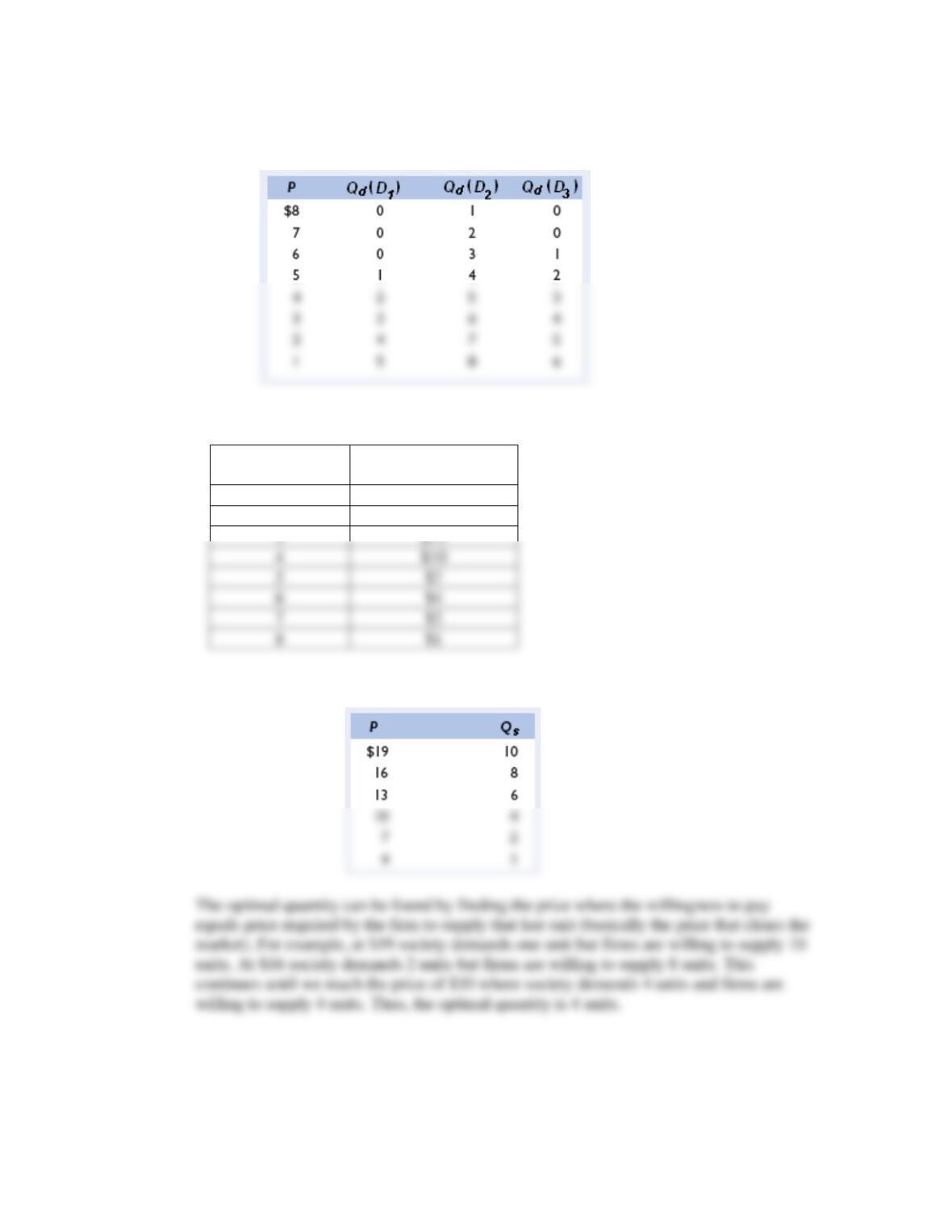
6. Use your demand schedule for a public good, determined in problem 5, and the following
supply schedule to ascertain the optimal quantity of this public good. LO3
Chapter 05 – Market Failures: Public Goods and Externalities
5-16
Feedback: From the example table in problem 5, we calculated the collective demand
schedule from the individual demand schedules:
Collective Demand Schedule:
Quantity
Price Society is
Willing to Pay
1
$19
2
$16
3
$13
4
$10
5
6
7
8
Combining this collective demand schedule with the following supply schedule, we can
determine the optimal provision (quantity) of the public good.
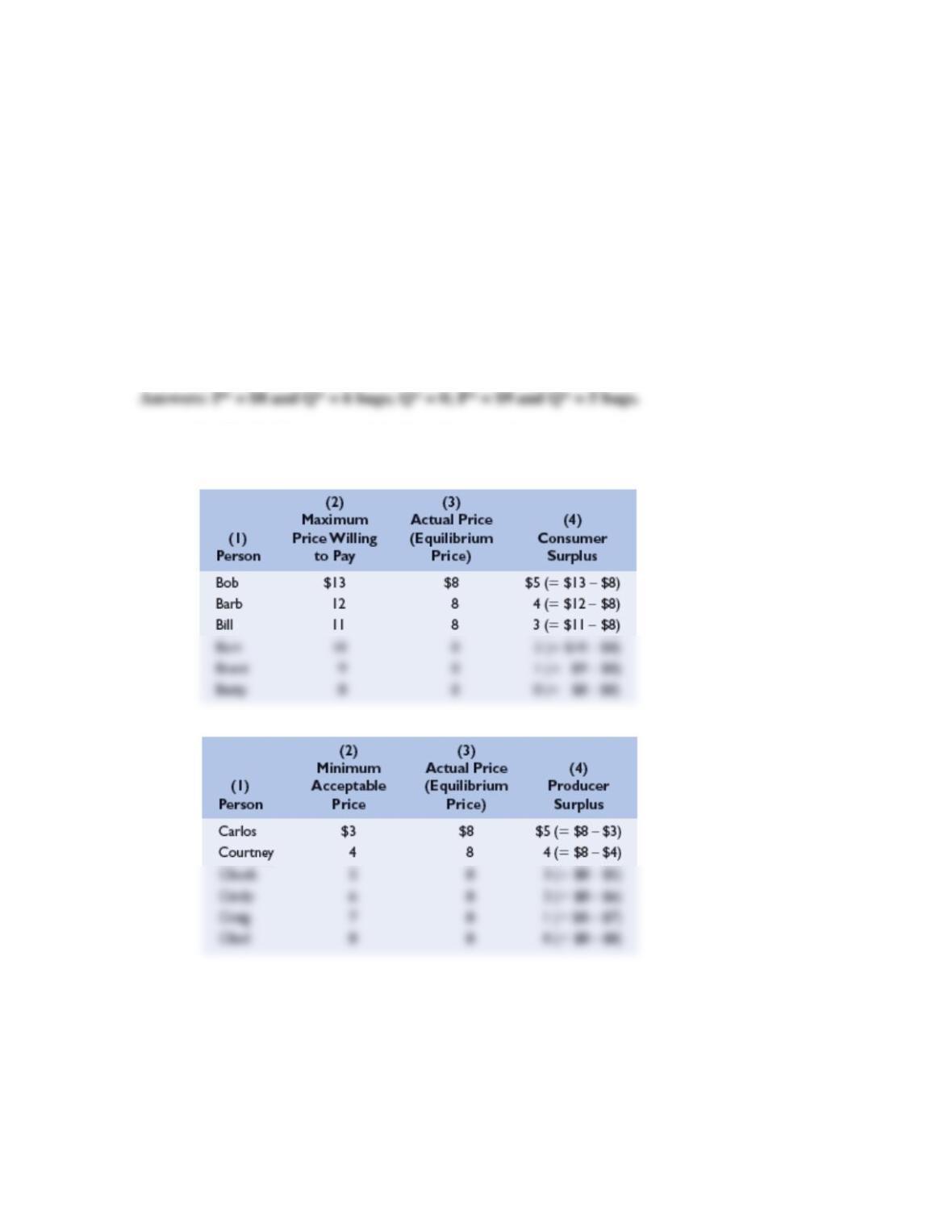
Chapter 05 – Market Failures: Public Goods and Externalities
5-17
7. Look at Tables 5.1 and 5.2, which show, respectively, the willingness to pay and willingness to
accept of buyers and seller of bags of oranges. For the following questions, assume that the
equilibrium price and quantity will depend on the indicated changes in supply and demand.
Assume that the only market participants are those listed by name in the two tables. LO4
a. What is the equilibrium price and quantity for the data displayed in the two tables?
b. What if instead of bags of oranges, the data in the two tables dealt with a public good like
fireworks displays. If all the buyers free ride, what will be the quantity supplied by private
sellers?
c. Assume that we are back to talking about bags of oranges (a private good), but that the
government has decided that tossed orange peels impose a negative externality on the public that
must be rectified by imposing a $2-per-bag tax on sellers. What is the new equilibrium price and
quantity? If the new equilibrium quantity is the optimal quantity, by how many bags were oranges
being overproduced before?
Chapter 05 – Market Failures: Public Goods and Externalities
5-18
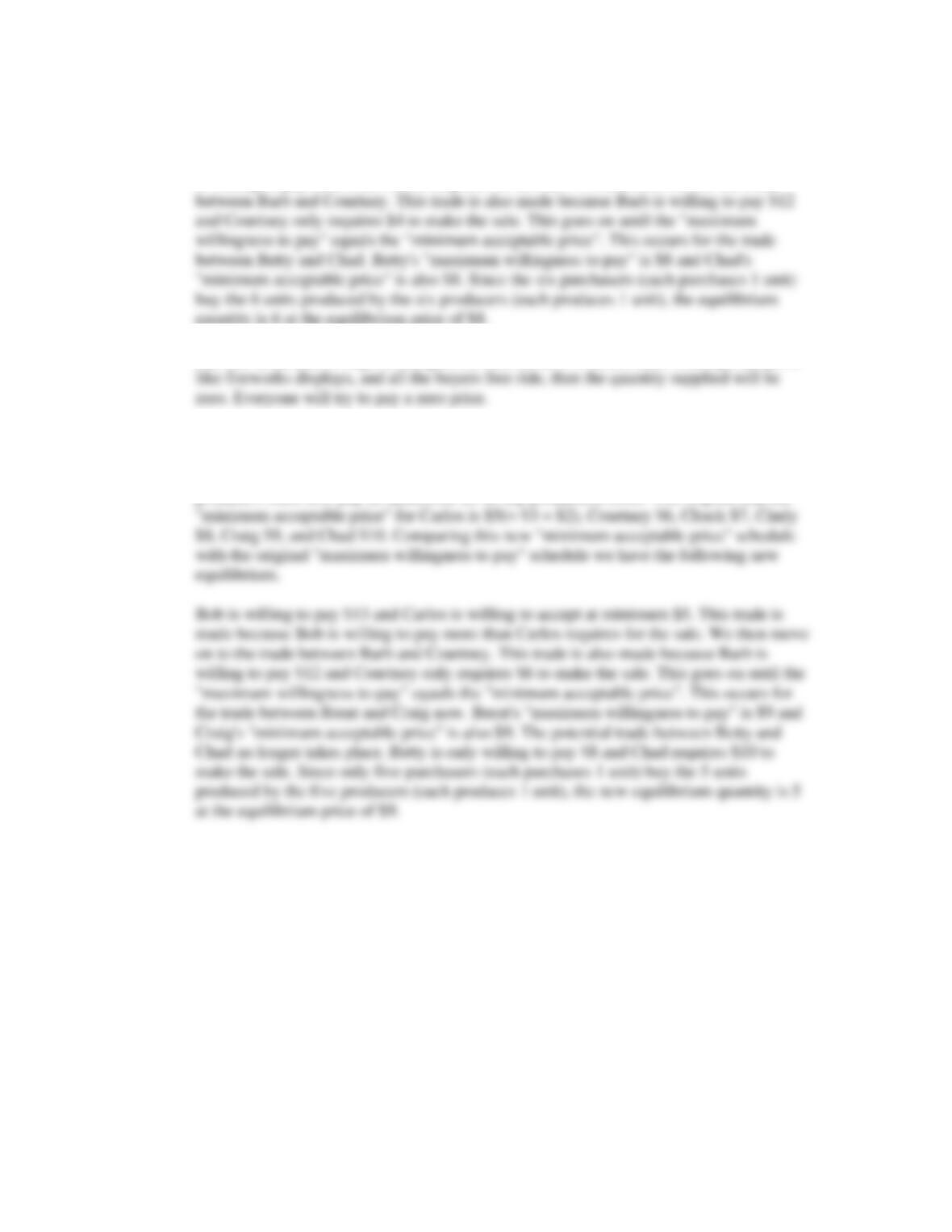
Part (a): To determine the equilibrium price of oranges, we begin by comparing the
highest willingness to pay with the lowest minimum acceptable price. Bob is willing to
pay $13 and Carlos is willing to accept at minimum $3. This trade is made because Bob
is willing to pay more than Carlos requires for the sale. We then move on to the trade
quantity is 6 at the equilibrium price of $8.
Part (b): If instead of bags of oranges, the data in the two tables dealt with a public good
Part (c): If the government decides that tossed orange peels impose a negative externality
on the public that must be rectified by imposing a $2-per-bag tax on sellers, then the
“minimum acceptable price” will increase by the amount of the tax. The reason is that the
producers must now pay an additional $2 on top production costs. This implies that the
If this is the optimal quantity, then the market was overproducing by 1 unit before the tax
was imposed on orange producers.