Archives
BUA 147
Effective teams have people in task-specialist roles exclusively. a. True b. False Most adults operate at level_____of personal moral development. a. one b. two c. three d. four Answer: b Most adults operate at level two of moral development, and […]
BUA 347 Quiz 1
According to the eight-stage model of planned organizational change, a change process includes: a. creating a stable envirornnent. b. focusing on long-term goals rather than short-term accomplishments. c. communicating financial statements to an organization’s stakeholders. d. building a strong coalition […]
BUA 435 Quiz 3
Moral leadership is about: a. distinguishing right from wrong. b. taking away from others to enhance oneself. c. rewarding unethical conduct. d. nonconformity. Which of the following statements is true of the art and science of leadership? a. Leadership is […]
BUA 483 Test
Managing up involves: a. giving advice on handling specific organizational situations and dealing with organizational politics. b. directing and controlling behavior and judging individual performance. c. telling a person exactly what needs to be done. d. consciously developing a mutually-respectful […]
BUA 517 Homework
A fully engaged employee is one who care deeply about the organization and actively seeks to serve the mission. a. True b. False Which of the following is a difference between strategies and execution? a. Strategies specify “What do we […]
BUA 607
A leader who is visionary, empowering, and committed to serving others is operating at the post conventional or principled level of personal moral development. a. True b. False Forces driving the need for organizational change leadership include: a. nationalization. b. […]
BUA 687 Test
A leader can be a better leader when: a. they take entire credit for accomplishments. b. followers are submissive and passive. c. followers compliment the leader and thank him or her for behavior. d. followers idealize them. An unspoken notion […]
BUA 793 Quiz 2
Five elements must be in place before employees can be empowered to perform their jobs: information, knowledge, discretion, meaning, and rewards. a. True b. False To think independently means: a. thinking of solutions based on pre-established routines or categories. b. […]
BUA 814
Which of the following will help leaders to develop open-mindedness? a. They have to allow their subordinates do the thinking for them. b. They have to maintain strong preconceptions and suspend beliefs and opinions. c. They have to forget many […]
BUA 871 Test 1
Network building does not impact followers’ perceptions of a leader’s abilities. a. True b. False Leaders sometimes use slogans to express key corporate values but avoid using written public statements. a. True b. False Answer: False Leaders sometimes use slogans […]
BUS 142 Final
__________is the process by which a person learns the values, norms, perspectives, and expected behaviors to participate in an organization. a. Negotiation b. Adaptation c. Selection d. Socialization Theory Y reflects the assumption that people are basically lazy and not […]
BUS 178 Quiz
According to the path-goal theory of leadership, the personal characteristics of followers, which is a situational contingency, includes factors such as . a. the degree of task structure b. the work group c. motivation d. formality Victoria heads an electronics […]
BUS 270 Final
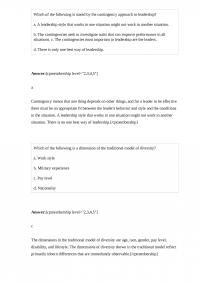
Which of the following is stated by the contingency approach to leadership? a. A leadership style that works in one situation might not work in another situation. b. The contingencies seek to investigate traits that can improve performance in all […]
BUS 314 Homework
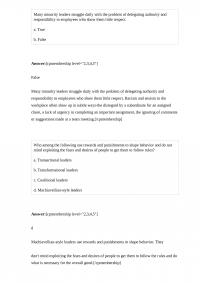
Many minority leaders struggle daily with the problem of delegating authority and responsibility to employees who show them little respect. a. True b. False Who among the following use rewards and punishments to shape behavior and do not mind exploiting […]
BUS 557 Quiz 1
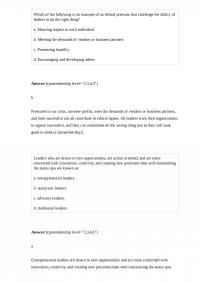
Which of the following is an example of an ethical pressure that challenge the ability of leaders to do the right thing? a. Showing respect to each individual b. Meeting the demands of vendors or business partners c. Possessing humility […]
BUS 723 Final
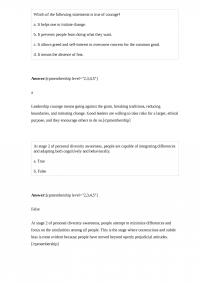
Which of the following statements is true of courage? a. It helps one to initiate change. b. It prevents people from doing what they want. c. It allows greed and self-interest to overcome concern for the common good. d. It […]
Chapter 1 Derailed managers are people who reached a plateau, were fired
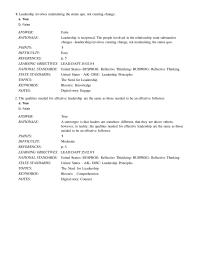
1. Leadership involves maintaining the status quo, not creating change. a. True b. False 2. The qualities needed for effective leadership are the same as those needed to be an effective follower. a. True b. False ANSWER: RATIONALE: POINTS: DIFFICULTY: […]
Chapter 1 States Bus prog Analytic united States Ak Disc Leadership
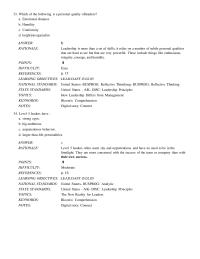
33. Which of the following is a personal quality ofleaders? a. Emotional distance b. Humility c. Conformity d. Insight int o organizaJion 34. Level 5 leaders have : a. strong egos. b. big ambitions. c. unpretentious behavior. d. larger-than-life personalities. […]
Chapter 10 Members on small teams have more disagreements and tend to form
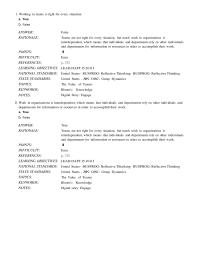
1. Working in teams is right for every situation. a. True b. False 2. Work in organizations is interdependent, which means that individuals and departments rely on other individuals and departments for information or resources in order to accomplish their […]
Chapter 10 Virtual teams are sometimes also global teams
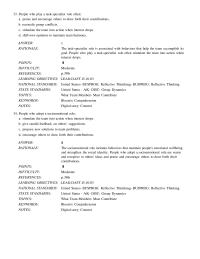
33. People who play a task-specialist role often: a. praise and encourage others to draw forth their contributions. b. reconcile group conflicts. c. stimulate the team into action when interest drops. d. shift own opinions to maintain team harmony. 34. […]
Chapter 11 The glass ceiling is an invisible barrier that separates
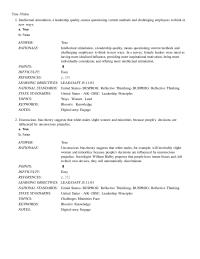
True I False I. Intellectual stimulation, a leadership quality, means questioning current methods and challenging employees to think in new ways. a. True b. False 2. Unconscious bias theory suggests that white males slight women and minorities because people’s decisions […]
Chapter 11 Which of the following statements is true of diversity?
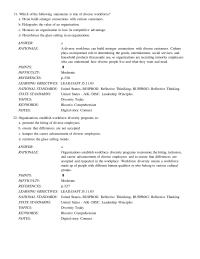
31. Which of the following statements is true of diverse workforce? a. It can build stronger connections with various customers. b. It degrades the value of an organization. c. It causes an organization to lose its competitive advantage. d. It […]
Chapter 12 Influence is the capacity to cause a change in a person
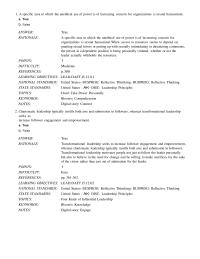
1. A specific area in which the unethical use of power is of increasing concern for organizations is sexual harassment. a. True b. False 2. Charismatic leadership typically instills both awe and submission in followers, whereas transformational leadership seeks to […]
Chapter 12 They will obey orders and carry out instructions
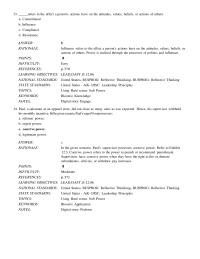
33. refers to the effect a person’s actions have on the attitudes, values, beliefs, or actions of others. a. Commitment b. Influence c. Compliance d. Resistance 34. Paul, a salesman at an apparel store, did not close as many sales […]
Chapter 13 Many people are inspired by the opportunity to fmd
31. Which of the following statements is true of mission? a. It is an ambitious desire for the future. b. It tends to grow and change in the face of environmental shifts. c. It defines the company’s core values and […]
Chapter 13 Mission statements tend to grow and change in the face of changing technologies
1. A leader who is all action and little vision is actually uninvolved. a. True b. False 2. The complexity of the envirornnent and the uncertainty of the future can overwhehn a leader. a. True b. False ANSWER: RATIONALE: POINTS: […]
Chapter 14 Connect 18 Culture Helps Employees Develop Collective Identity
1. At its most basic, culture is a pattern of shared assumptions and beliefs about how things are done in an organization. a. True b. False 2. External adaptation, a function of culture in organizations, means that culture helps organizational […]
Chapter 14 The finn is highly efficient and lays emphasis on being economical
33. If widespread consensus exists among employees of an organization about the importance of specific values and ways of doing things, the culture is said to be: a. autocratic. b. prejudiced. c. fragmented. d. strong. 34. Iota Inc. has a […]
Chapter 15 The destiny stage of appreciative inquiry is about imagining “what could be”
1. Rapidly changing technologies, globalization, and changing markets are some of the envirornnental forces creating a greater need for change leadership within organizations. a. True b. False 2. Leaders who accomplish successful change projects define themselves as people who want […]
Chapter 15 This Stage About discovering The Unique Qualities The
33. One approach to immersion is to: a. think outside the box. b. focus on the internal aspects of a situation or problem. c. hold a single perspective toward a product or process. d. prohibit unusual manipulation of product or […]
Chapter 2 Numerous Surveys Indicate That Optimism The Single
1. The contingency approach to leadership sought to identify the traits leaders possessed that distinguished them from people who were not leaders. a. True b. False 2. A few traits typically considered highly important for leadership are optimism, self-confidence, honesty […]
Chapter 2 The dyadic view focuses on the concept of exchange
33. Which of the following is an example of task-oriented leader behavior? a. Giving time and encouragement b. Showing acceptance and compassion c. Acknowledging accomplishments d. Checking the progress and quality of work 34. Which of the following statements is […]
Chapter 3 According to the path-goal theory of leadership, when a subordinate is
35. According to the path-goal theory ofleadership, which of the following leadership styles involves consulting with subordinates about decisions? a. Directive leadership b. Supportive leadership c. Achievement-oriented leadership d. Participative leadership ANSWER: RATIONALE: POINTS: DIFFICULTY: REFERENCES: d According to the […]
Chapter 3 The Leader can Guide Followers Development And Act
1. The contingency approaches explain the relationship between leadership styles and effectiveness in specific situations. a. True b. False 2. The contingencies most important to leadership are the situation and followers. a. True b. False ANSWER: RATIONALE: POINTS: DIFFICULTY: REFERENCES: […]
Chapter 4 People with a high internal locus of control typically
1. Organizational leadership is exclusively an individual phenomenon. a. True b. False 2. Leaders who are constantly trying to please everyone often make poor decisions because they cannot tolerate even a mild degree of conflict. a. True b. False ANSWER: […]
Chapter 4 Stereotyping is the tendency to assign an individual
31. When evaluating others, many people underestimate the influence of external factors and overestimate the influence of internal factors. This tendency is known as . a. stereotyping b. the halo effect c. perceptual defense d. the fundamental attribution error 32. […]
Chapter 5 It is important for leaders to regard their assumptions as
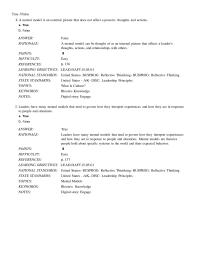
True I False I. A mental model is an external picture that does not affect a person’s thoughts and actions. a. True b. False 2. Leaders have many mental models that tend to govern how they interpret experiences and how […]
Chapter 5 Principles developing Leaders Mind blooms Knowledge includes Arousing Followers Thoughts
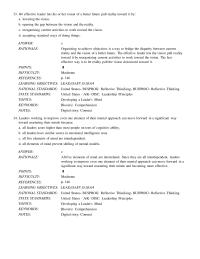
33. An effective leader lets his or her vision of a better future pull reality toward it by: a. lowering the vision. b. opening the gap between the vision and the reality. c. reorganizing current activities to work toward the […]
Chapter 6 Pressures to Cut Costs Increase Profits Meet The
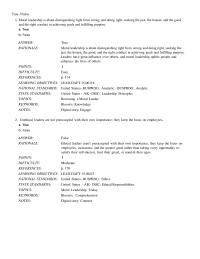
True I False I. Moral leadership is about distinguishing right from wrong and doing right, seeking the just, the honest, and the good , and the right conduct in achieving goals and fulfilling purpose. a. True b. False 2. Unethical […]
Chapter 6 Thus, the janitors feel that they are part of the
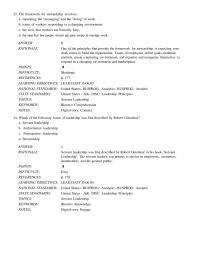
33. The framework for stewardship involves: a. separating the “managing “ and the “doing” of work. b. teams of workers responding to a changing envirornnent. c. the view that workers are basically lazy. d. the idea that few people should […]
Chapter 7 Aleader must be worthy of trust, envision the future of the
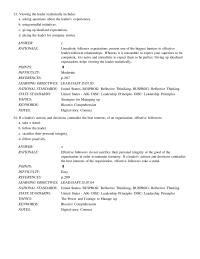
33. Viewing the leader realistically includes: a. asking questions about the leader’s experiences. b. using mindful initiatives. c. giving up idealized expectations. d. plying the leader for company stories. 34. If a leader’s actions and decisions contradict the best interests […]
Chapter 7 Effective followers are characterized by both mindfulness and
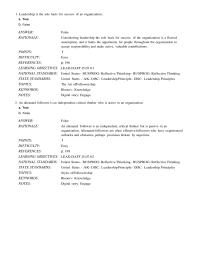
1. Leadership is the sole basis for success of an organization. a. True b. False 2. An alienated follower is an independent, critical thinker who is active in an organization. a. True b. False ANSWER: RATIONALE: POINTS: DIFFICULTY: REFERENCES: False […]
Chapter 8 According to equity theory, if people perceive their rewards as equal
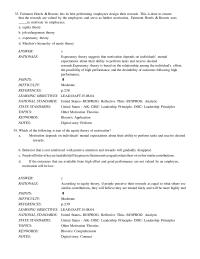
33. Fairmont Hotels & Resorts lets its best performing employees design their rewards. This is done to ensure that the rewards are valued by the employees and serve as further motivation. Fairmont Hotels & Resorts uses to motivate its employees. […]
Chapter 8 Extinction is the administration of a pleasant and rewarding
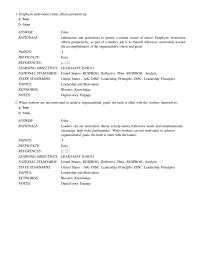
1. Employee motivation rarely affects productivity. a. True b. False 2. When workers are not motivated to achieve organizational goals, the fault is often with the workers themselves. a. True b. False ANSWER: RATIONALE: POINTS: DIFFICULTY: REFERENCES: False Leaders can […]
Chapter 9 A discussion’s focus is to reveal feelings and builds
1. Leaders communicate to inspire and motivate people to strive toward a vision. a. True b. False 2. The key elements of the communication process include encoding, transmitting the message through a channel, and decoding. a. True b. False ANSWER: […]
Chapter 9 Messages transmitted through actions, behavior, facial expressions
33. Routine messages typically concern issues: a. of change, conflict, or complexity. b. 1hat are characterize d by time pressure an d surprise. c. that people already understand and agree on. d. that have great potential for misunderstanding. 34. Elec1mnicmelhod […]
EMBA 562 Quiz 3
Task-oriented leadership behaviors include giving time and encouragement. a. True b. False People at the conventional level of personal moral development: a. act in their own interest. b. follow internalized universal principles of justice and right. c. follow authority with […]
EMBA 602
In the leader-member exchange research study on individualized leadership, leaders were trained to offer the opportunity for a high-quality relationship to all group members. Accorrding to this concept which of the following is1rne of followers? a. The followers were treated […]
EMBA 704 Quiz
Clarity of mind, clarity of objectives, and organizing to achieve objectives are the components of . a. personal mastery b. stereotyping c. emotional intelligence d. systems thinking Which of the following is an example of people-oriented leader behavior? a. Planning […]
Management 253
The__________-of handling conflict in a team reflects both a high degree of assertiveness and cooperativeness. a. collaborating style b. avoiding style c. accommodating style d. competing style A person’s values cannot change throughout life as they are fairly well established […]
Management 543 Test 2
Briefly describe courage. It becomes easier for people to see their own opportunities for leadership when they: a. start seeing leaders as individuals who are above others. b. understand that the concept of leadership cannot continue to develop. c. stop […]
Management 622 Homework
A key component ofleadership is: a. accepting the standard way of doing things. b. employing fear-based motivation. c. regarding assumptions as fixed truths. d. being emotionally connected to others. In the context of the principles for leader influence, means using […]
Management 704 Homework
According to the trait approach to leadership, which of the following is categorized as a social characteristic of leaders? a. Optimism b. Knowledge c. Cooperativeness d. Humility _________is a form of adversarial negotiation in which conflicting parties compete to win […]
Management 880 Quiz 1
Conscientiousness refers to the degree to which a person is responsible, dependable, persistent, and . a. compassionate b. achievement oriented c. emotionally stable d. adaptable The tendency of people to not voice their true thoughts because they want to please […]
Management Chapter 1 Homework Inability Promote Themselves Failure Defensive Inability Engage
3535 35 c. It entails organizing a structure to accomplish a plan and staffing the structure with employees. d. It provides learning opportunities so people can expand their minds and abilities. Which of the following statements is true of leadership? […]
Management Chapter 1 Homework Level Leader Described The Text Describe Their
11 1 CHAPTER 1 What Does It Mean to Be a Leader? Chapter Outline The Need for Leadership The New Reality for Leaders How Leadership Differs from Management Evolving Theories of Leadership Leadership Can Be Learned Mastering the Art and […]
Management Chapter 1 Homework Marshall Anything You Could Learn From This
© 2015 Cengage Learning. All Rights Reserved. May not be scanned, copied or duplicated, or posted to a publicly accessible website, in whole or in part. 21 2. What do you consider your own strengths and weaknesses for leadership? Discuss […]
Management Chapter 10 Homework Hugh Part Team That Selects Its Own
Which of the following statements is true of a high performing team? a. Its leader should have complete authority over how goals are met. b. Its team members must belong to similar ethnic or cultural backgrounds. c. It requires a […]
Management Chapter 10 Homework Skills And Unambiguous Roles Streamlined Team Size
CHAPTER 10 Leading Teams Chapter Outline The Value of Teams The Dilemma for Team Members Leading a Team to High Performance Team Processes What Team Members Must Contribute Leading a Virtual Team Handling Team Conflict In the Lead Tony Brown […]
Management Chapter 10 Homework Teaching Tools And Exercises Leaders Bookshelf Great
Two basic types of conflict that occur in teams are task conflict and relationship conflict: • Task conflict refers to disagreements among people about the goals to be achieved or the content of the tasks to be performed. • Relationship […]
Management Chapter 11 Homework Europeans Are More Technically Advanced Persons Belief
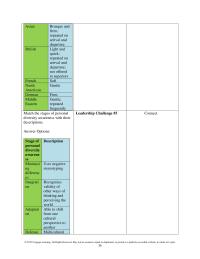
Asian Brusque and firm; repeated on arrival and departure British Light and quick; repeated on arrival and departure; not offered to superiors French Soft North American Gentle German Firm Middle Eastern Gentle; repeated frequently Match the stages of personal diversity […]
Management Chapter 11 Homework Mbas Went Women Among 25 year-olds Percent
CHAPTER 11 Developing Leadership Diversity Chapter Outline Leading People Who Aren’t Like You Diversity Today Challenges Minorities Face Ways Women Lead Global Diversity Becoming an Inclusive Leader Ways to Encourage the Advancement of Women and Minorities In the Lead Secret […]
Management Chapter 11 Homework Some Leading Organizations Are Finding Ways Shatter
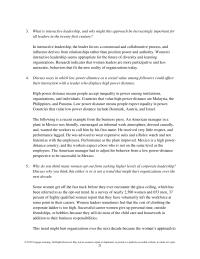
3. What is interactive leadership, and why might this approach be increasingly important for all leaders in the twenty-first century? In interactive leadership, the leader favors a consensual and collaborative process, and influence derives from relationships rather than position power […]
Management Chapter 12 Homework The Next Time They Went Target She
CHAPTER 12 Leadership Power and Influence Chapter outline Four Kinds of Influential Leadership Using Hard versus Soft Power Increasing Power through Political Activity Don’t Take Power Personally In the Lead Helen Dragas and Teresa Sullivan, University of Virginia The Evans […]
Management Chapter 12 Homework The Significance This Particular Meetingand Now Watching
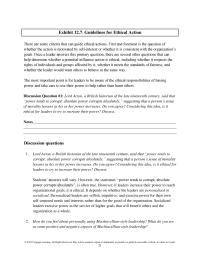
Exhibit 12.7: Guidelines for Ethical Action There are some criteria that can guide ethical actions. First and foremost is the question of whether the action is motivated by self-interest or whether it is consistent with the organization’s goals. Once a […]
Management Chapter 12 Homework Which The Following Statements True Transformational Leadership
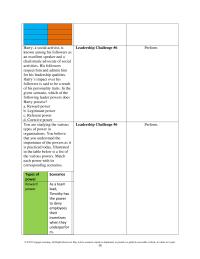
Harry, a social activist, is known among his followers as an excellent speaker and a charismatic advocate of social activities. His followers respect him and admire him for his leadership qualities. Harry’s impact over his followers is said to be […]
Management Chapter 13 Homework Leaders Sharing The Vision Perform Connect 2015
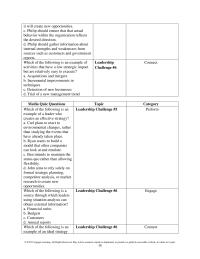
it will create new opportunities. c. Philip should ensure that that actual behavior within the organization reflects the desired direction. d. Philip should gather information about internal strengths and weaknesses from sources such as customers and government reports. Which of […]
Management Chapter 13 Homework Vice President David Deacon Was The Transformation
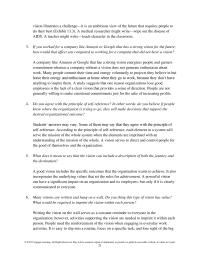
vision illustrates a challenge—it is an ambitious view of the future that requires people to do their best (Exhibit 13.3). A medical researcher might write—wipe out the disease of AIDS. A teacher might write—teach character in the classroom. 3. If […]
Management Chapter 13 Homework Vision Defines The Destination And The Journey
CHAPTER 13 Creating Vision and Strategic Direction Chapter Outline The Leader’s Job: Looking Forward Leadership Vision Mission The Leader as Strategist-in-Chief In the Lead John Riccitiello, Electronic Arts Ari Weinzweig and Paul Saginaw, Zingerman’s Community of Businesses TeamBank, Volksbanken Raiffeisenbanken […]
Management Chapter 14 Homework An involvement culture has an internal focus on the involvement
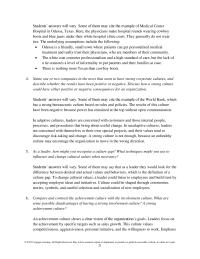
Students’ answers will vary. Some of them may cite the example of Medical Center Hospital in Odessa, Texas. Here, the physicians make hospital rounds wearing cowboy boots and blue jeans under their white hospital clinic coats. They generally do not […]
Management Chapter 14 Homework Explain Notes Leadership Challenge 4
CHAPTER 14 Shaping Culture and Values Chapter Outline Organizational Culture Culture Strength, Responsiveness, and Performance Cultural Leadership The Competing Values Approach to Shaping Culture Ethical Values in Organizations Values-Based Leadership In the Lead Flint Lane, Billtrust Menlo Innovations Aaron Levie, […]
Management Chapter 14 Homework Leadership Challenge Encourage Can
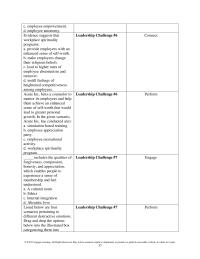
c. employee empowerment. d. employee autonomy. Evidence suggests that workplace spirituality programs: a. provide employees with an enhanced sense of self-worth. b. make employees change their religious beliefs. c. lead to higher rates of employee absenteeism and turnover. d. instill […]
Management Chapter 15 Homework Dream Steps Ai Students Answers May Vary
• What actually happened? • What accounts for the difference? • What can we learn? 6. How would you suggest a leader overcome resistance to a change that is going to cause some people to lose their jobs? Employees resist […]
Management Chapter 15 Homework Kevin The Ceo Leadership Challenge Megavision Inc
would save energy as well as increase the company’s efficiency. Posters of drought-hit regions are stuck throughout the company’s washrooms to remind employees of the importance of conserving water/ The management at Octagon Inc., an automaker, has made it compulsory […]
Management Chapter 15 Homework One Popular Approach Provide Idea Incubator Idea
CHAPTER 15 Leading Change Chapter Outline Leadership Means Leading Change A Framework for Change Using Appreciative Inquiry Leading Creativity for Change Implementing Change In the Lead Michelle Rhee, Washington, D.C., Public School System The Red Team Dr. Dean Ornish, University […]
Management Chapter 2 Homework How Might Understanding Individualized Leadership Theory Useful
task-oriented behavior? Students’ answers will vary. Some of them may say that the subordinates who rate the leader highly would have developed close relationships with the leader and often become assistants who play key roles in the functioning of the […]
Management Chapter 2 Homework The Groups With Autocratic Leaders Performed Highly
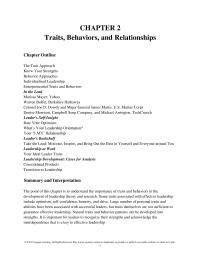
CHAPTER 2 Traits, Behaviors, and Relationships Chapter Outline The Trait Approach Know Your Strengths Behavior Approaches Individualized Leadership Entrepreneurial Traits and Behaviors In the Lead Marissa Mayer, Yahoo Warren Buffet, Berkshire Hathaway Colonel Joe D. Dowdy and Major General James […]
Management Chapter 2 Homework This Implies That Olivier An Leader
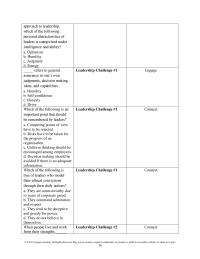
approach to leadership, which of the following personal characteristics of leaders is categorized under intelligence and ability? a. Optimism b. Humility c. Judgment d. Energy _____ refers to general assurance in one’s own judgments, decision making, ideas, and capabilities. a. […]
Management Chapter 3 Homework Case Questions And Answers How Would You
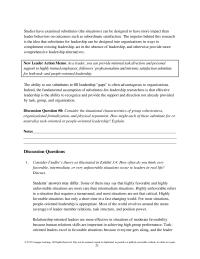
Studies have examined substitutes (the situations) can be designed to have more impact than leader behaviors on outcomes such as subordinate satisfaction. The impetus behind this research is the idea that substitutes for leadership can be designed into organizations in […]
Management Chapter 3 Homework Discuss Notes Many Studies Have
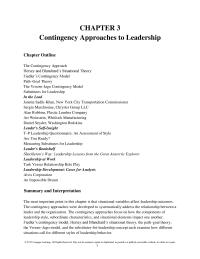
CHAPTER 3 Contingency Approaches to Leadership Chapter Outline The Contingency Approach Hersey and Blanchard’s Situational Theory Fiedler’s Contingency Model Path–Goal Theory The Vroom–Jago Contingency Model Substitutes for Leadership In the Lead Janette Sadik-Khan, New York City Transportation Commissioner Sergio Marchionne, […]
Management Chapter 3 Homework Perform Engage Connect 2015 Cengage Learning All
According to the substitutes-for-leadership concept, which of the following variables neutralizes people-oriented leadership? a. Group cohesiveness b. Formalization c. Low position power d. Inflexibility Leadership Challenge #6 Connect Media Quiz Questions Topic Category According to Fiedler’s model of leadership, which […]
Management Chapter 4 Homework Authoritarianism The Belief That Power And Status
CHAPTER 4 The Leader as an Individual Chapter Outline The Secret Ingredient for Leadership Success Personality and Leadership Values and Attitudes Social Perception and Attribution Theory Cognitive Differences Working with Different Personality Types In the Lead Rick Williams and John […]
Management Chapter 4 Homework Big Five Leadership Challenge Personality Dimensions Which
complicated calculations only to male employees. According to Herrmann’s whole brain concept, which of the following statements is true of people who have a quadrant-A dominance? a. They are imaginative and curious and enjoy experimentation and playfulness. b. They like […]
Management Chapter 4 Homework Just Being Nice Employees Will Not Considered
The MBTI™ has helped leaders understand how easily misunderstandings can occur between people with different preferences. For example, a leader might receive an e-mail message that he considers to be confrontational, whereas the person who sent it might simply be […]
Management Chapter 5 Homework Leadership Challenge 5 Exercise Emotional Intelligence Including
CHAPTER 5 Leadership Mind and Emotion Chapter Outline Leading with Head and Heart Mental Models Developing a Leader’s Mind Emotional Intelligence Leading with Love versus Leading with Fear In the Lead Hollywood Studios John Harbaugh, Baltimore Ravens, and Jim Harbaugh, […]
Management Chapter 5 Homework The Trident Crews Are The Cream The
© 2015 Cengage Learning. All Rights Reserved. May not be scanned, copied or duplicated, or posted to a publicly accessible website, in whole or in part. 18 interpret their experiences and the actions they take in response to people and […]
Management Chapter 6 Homework Brandon Does Everything Can Order Look Successful
Identify the appropriate statement regarding courage. a. Courage is to ask what one wants and say what one thinks. b. Courage means to stay within one’s comfort zone to avoid trouble. c. Courage is not synonymous with nonconformity. d. Courage […]
Management Chapter 6 Homework Give Decision making Power And The Authority Act
CHAPTER 6 Courage and Moral Leadership Chapter Outline Moral Leadership Today Acting Like a Moral Leader Becoming a Moral Leader Servant Leadership Leading with Courage In the Lead Denise Ramos and Jennifer Schiavone, ITT Adam Grant, Wharton School of the […]
Management Chapter 6 Homework They Loved Each Other The Boy Had
Students’ answers will vary. Some of them may say that it isn’t a legitimate argument from an ethical standpoint. When a firm is a success, all employees have has a contribution in it, not just the leaders. Similarly, when firms […]
Management Chapter 7 Homework Bussard’s Expectations Followers Demand Clarity Direction Lack
that you most prefer. Explain. Building bonds with superiors and higher level managers is just as important as managing subordinates and lower level employees. In order to harness the potential of lower level employees to the fullest, a leader must […]
Management Chapter 7 Homework Help The Leader Good Leader 2015 Cengage
CHAPTER 7 Followership Chapter Outline The Art of Followership What Your Leader Wants from You Styles of Followership Strategies for Managing Up The Power and Courage to Manage Up What Followers Want from Leaders In the Lead Irvin D. Yalom […]
Management Chapter 7 Homework Judging Their Performance You Understand The Difference
judging their performance. You understand the difference in the mindset and behavior required for managing versus coaching. Mentioned below are various aspects of each. Drag and drop the answer options into their corresponding columns illustrated in the table below. Answer […]
Management Chapter 8 Homework Anna Manager Has Been Working The Same
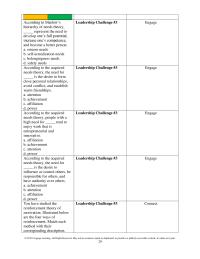
According to Maslow’s hierarchy of needs theory, _____ represent the need to develop one’s full potential, increase one’s competence, and become a better person. a. esteem needs b. self-actualization needs c. belongingness needs d. safety needs Leadership Challenge #3 Engage […]
Management Chapter 8 Homework Need For Power the Desire Influence Control Others
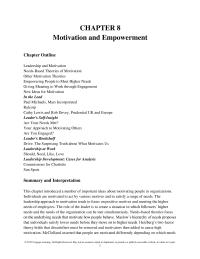
CHAPTER 8 Motivation and Empowerment Chapter Outline Leadership and Motivation Needs-Based Theories of Motivation Other Motivation Theories Empowering People to Meet Higher Needs Giving Meaning to Work through Engagement New Ideas for Motivation In the Lead Paul Michaels, Mars Incorporated […]
Management Chapter 8 Homework Thats Powerful Gain Competitive Advantage That Any
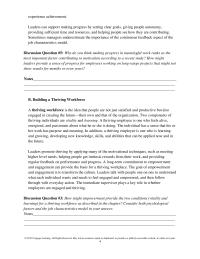
experience achievement. Leaders can support making progress by setting clear goals, giving people autonomy, providing sufficient time and resources, and helping people see how they are contributing. Sometimes managers underestimate the importance of the continuous feedback aspect of the job […]
Management Chapter 9 Homework Communication Process Which Information And Understanding Are
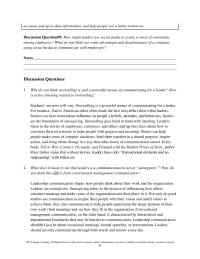
accurate and up-to-date information, and help people see a better tomorrow. Discussion Question#9: How might leaders use social media to create a sense of community among employees? What do you think are some advantages and disadvantages of a company using […]
Management Chapter 9 Homework New Leader Action Memo Leader You Can
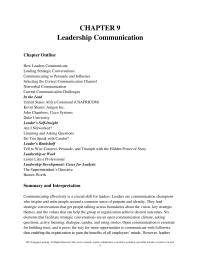
CHAPTER 9 Leadership Communication Chapter Outline How Leaders Communicate Leading Strategic Conversations Communicating to Persuade and Influence Selecting the Correct Communication Channel Nonverbal Communication Current Communication Challenges In the Lead United States Africa Command (USAFRICOM) Kevin Sharer, Amgen Inc. John […]
Management Chapter 9 Homework Perform Leadership Challenge Connect 2015 Cengage Learning
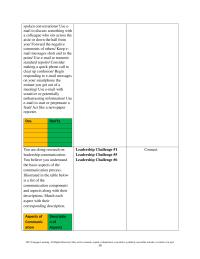
spoken conversations/ Use e- mail to discuss something with a colleague who sits across the aisle or down the hall from you/ Forward the negative comments of others/ Keep e- mail messages short and to the point/ Use e-mail to […]
MGMT 155 Quiz 3
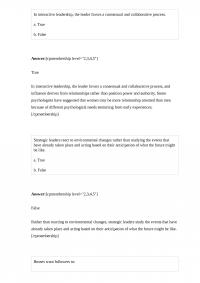
In interactive leadership, the leader favors a consensual and collaborative process. a. True b. False Strategic leaders react to environmental changes rather than studying the events that have already taken place and acting based on their anticipation of what the […]
MGMT 449 Quiz 1
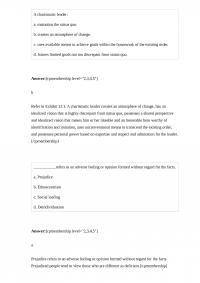
A charismatic leader: a. maintains the status quo. b. creates an atmosphere of change. c. uses available means to achieve goals within the framework of the existing order. d. frames limited goals not too discrepant from status quo. ___________refers to […]
MGMT 622
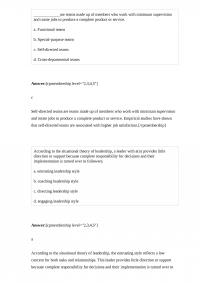
_____________are teams made up of members who work with minimum supervision and rotate jobs to produce a complete product or service. a. Functional teams b. Special-purpose teams c. Self-directed teams d. Cross-departmental teams According to the situational theory of leadership, […]
MGT 391 Midterm
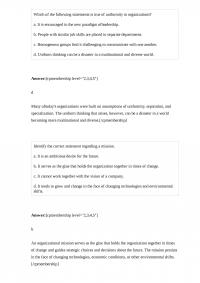
Which of the following statements is true of uniformity in organizations? a. It is encouraged in the new paradigm ofleadership. b. People with similar job skills are placed in separate departments. c. Homogenous groups fmd it challenging to communicate with […]
MGT 627 Midterm
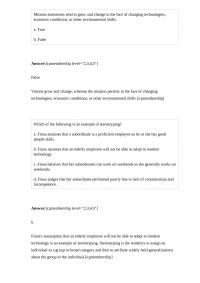
Mission statements tend to grow and change in the face of changing technologies, economic conditions, or other environmental shifts. a. True b. False Which of the following is an example of stereotyping? a. Fiona assumes that a subordinate is a […]
MGT 865 Test 2
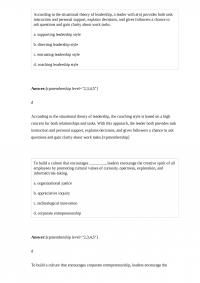
According to the situational theory of leadership, a leader with a(n) provides both task instruction and personal support, explains decisions, and gives followers a chance to ask questions and gain clarity about work tasks. a. supporting leadership style b. directing […]
MGT 886 Midterm
A specific area in which the unethical use of power is of increasing concern for organizations is sexual harassment. a. True b. False In the communication process, the sender (such as a leader) initiates a communication by __________a thought or […]
MHR 157
Companies with heroism as the basis of noble purpose often: a. reflect almost an obsession with winning. b. emphasize serving others. c. experience the joy of an entrepreneurial spirit. d. inspire others to find or create something new. Authoritarian management […]
MHR 244 Quiz 2
The right hemisphere of the brain is associated with: a. analytical thinking. b. a linear approach to problem solving. c. intuitive thought processes. d. routine processes. People who play a task-specialist role often: a. praise and encourage others to draw […]
MHR 249
Persuasion is a valuable communication process that individuals can use to lead others to a shared solution or commitment. a. True b. False Active follower behavior refers to: a. being reactive. b. requiring constant supervision. c. initiating problem solving. d. […]
MHR 528 Test 2
Effective followers have the courage to initiate change and put themselves at risk or in conflict with others. a. True b. False Employees learn what is valued most in a company by watching what attitudes and behaviors their leaders pay […]
MHR 859 Stewardship leaders guide
Stewardship leaders guide the organization without dominating it and facilitate followers without controlling them. a. True b. False The key elements of the communication process include encoding, transmitting the message through a channel, and decoding. a. True b. False Answer: […]
OBHR 393 Quiz
The qualities needed for effective leadership are the same as those needed to be an effective follower. a. True b. False _____is the withdrawal of a positive reward, meaning that behavior is no longer reinforced and hence is less likely […]
OBHR 788
According to Herzberg’s two-factor theory, hygiene factors include: a. recognition. b. interpersonal relationships. c. the work itself. d. personal growth Which of the following characteristics was explored by the studies evaluating the characteristics of the leader member exchange relationship? a. […]
PRST 301
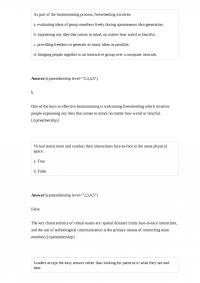
As part of the brainstorming process, freewheeling involves: a. evaluating ideas of group members freely during spontaneous idea generation. b. expressing any idea that comes to mind, no matter how weird or fanciful. c. providing freedom to generate as many […]
PRST 480
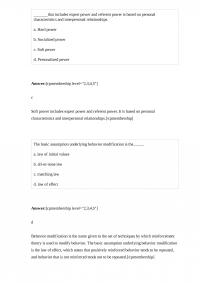
_______that includes expert power and referent power is based on personal characteristics and interpersonal relationships. a. Hard power b. Socialized power c. Soft power d. Personalized power The basic assumption underlying behavior modification is the_____. a. law of initial values […]
PRST 703 Final
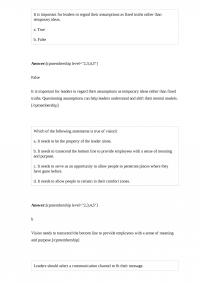
It is important for leaders to regard their assumptions as fixed truths rather than temporary ideas. a. True b. False Which of the following statements is true of vision? a. It needs to be the property of the leader alone. […]