task-oriented behavior?
Students’ answers will vary. Some of them may say that the subordinates who rate the
leader highly would have developed close relationships with the leader and often become
7. Does it make sense to you that a leader should develop an individualized relationship with
each follower? Explain advantages and disadvantages to this approach.
Students’ answers may vary. Some of them may say that a leader should develop an
8. Why would subordinates under a democratic leader perform better in the leader’s absence
than would subordinates under an autocratic leader?
The democratic leader shares in decision making and values the opinions of subordinates.
Therefore, in his absence, the subordinates have already engaged in decision-making and
9. Why is an entrepreneurial leader important to an organization? How is this role different
from other leader roles?
Entrepreneurial leaders are important to an organization because they take risks to create
novel solutions to competitive challenges confronting a business, especially the

10. Pick three traits from the list in Exhibit 2.1 that you think would be most valuable for a
leader in an operational role. Pick three that you think would be most valuable for a
leader in a collaborative role. Explain your choices.
Students’ answers will vary. Some of them may choose the following roles:
Operational Role:
According to Exhibit 2.1, work-related characteristics include drive, desire to excel;
dependability; fair-mindedness; and perseverance and tenacity. These traits are valuable for
operational leaders who fill vertical management positions in a business. Operational
leaders fill traditional line and general management positions in a business, for example.
Collaborative Role:
According to Exhibit 2.1, social characteristics include sociability, interpersonal skills;
cooperativeness; ability to enlist cooperation; and tact and diplomacy. Leaders in
Teaching Tools and Exercises
1. Leader’s Bookshelf: Take the Lead: Motivate, Inspire, and Bring Out the Best in Yourself
and Everyone around You by Betsy Myers.
In her first book, Take the Lead, Betsy Myers, senior advisor to Presidents Barack Obama
It’s Not Magic
The two presidents Myers has worked with are known for their charisma, but Myers insists
Practical Advice for New Leaders
Take the Lead doesn’t claim to have a “secret sauce” for leadership, but it does describe
2. On the Web: Go to Leadership501 at www.leadership501.com/ and read Five Most
3. Discuss the Following Leader: Napoleon Bonaparte
His brain is among the most perfect that has ever been. His ever ready attention seizes
indefatigably upon facts and ideas, which his memory registers and classifies. His
imagination plays with them freely, and a state of incessant secret tension enables it
Source: Pieter Geyl, Napoleon For and Against (New Haven: Yale University Press,
1968), 422-423.
• Using Exhibit 2.1, Personal Characteristics of Leaders, identify the leadership
characteristics of Napoleon.
• Napoleon had the ability to rally the French army. Researchers have shown that
effective leaders were often identified with exceptional follower performance. What
traits made Napoleon’s followers support him?
4. Read and discuss: Ronald Heifetz, Alexander Grashow, and Marty Linsky, “Leadership in
a (Permanent) Crisis,” Harvard Business Review (July- August 2009).
5. Leadership Styles in Action
Divide the class into two groups. One group works for a leader who has a “consideration”
leadership style while the other works for a leader who has an “initiating-structure” style.
Each group has ten minutes to defend its leader by giving reasons and examples.
• Group I: Consideration describes the extent to which a leader is sensitive to
subordinates, respects their ideas and feelings, and establishes mutual trust (e.g.,
6. Leadership at Work: Your Ideal Leader Traits
Spend some time thinking about someone you believe is an ideal leader. For the first part
of the exercise, select an ideal leader you have heard about whom you don’t personally
know. It could be someone like Mother Teresa, Martin Luther King, Abraham Lincoln, or
any national or international figure that you admire. Write the person’s name. Next, write
down three things you admire about the person, such as what he or she did or the qualities
that person possesses.
Leadership Development: Cases for Analysis
I. Consolidated Products
Synopsis
Consolidated Products is a medium-sized manufacturer of consumer products. Ben Samuels was
a plant manager who was well liked by employees. They were grateful for the fitness center,
picnics, and holiday parties. Ben believed it was important to treat employees properly so they
Case questions and answers
1. Compare the leadership traits and behaviors of Ben Samuels and Phil Jones.
Ben Samuels is an employee-centered or people-oriented boss. Ben shows more interest in
people. Employee-centered leaders display a focus on the human needs of their
2. Which leader do you think is more effective? Why? Which leader would you prefer to work
for?
Students’ answers will vary. Some may say that Ben’s leadership style would be more
effective in the long run and they would prefer working with a leader like Ben. Ben is more
3. If you were Phil Jones’ boss, what would you do now?
Students’ answers will vary. Some may say that Phil’s boss should encourage him to
change his leadership behavior and become a “high-high” leader. A 9,9 team management
II. Transition to Leadership
Synopsis
Michael Collins who joined as Southwest Regional Manager of Creighton Auto Parts, saw the
transition period before and immediately following his appointment as an exciting new
opportunity. During the initial stages of this period he received inputs on the company’s
He also found himself hostage to those who wanted to rant on and on about workplace issues,
their training, their bosses, even their customers. Michael also spent time with the marketing
Case questions and answers
1. What do you see as Michael Collins’s leadership traits? Which of these traits do you
consider a strength? A weakness? Explain.
Students’ answers will vary. Some may say that Michael Collins has self-confidence, the
2. What do you think of Michael Collins’s approach to leading the region? How would you
characterize his people-oriented versus task-oriented style? Why?
Michael is seen to be spending a lot of time with the employees, understanding their goals,
ideas, opinions, and complaints. He finds himself hostage to those who wanted to rant on
3. How might an understanding of individualized leadership theory be useful to Collins with
respect to his relationship with marketing versus store personnel?
Students’ answers may vary. Some may say that Michael knows that he needs to build
good relationships with the team to initiate the transition process. In individualized
leadership, a leader develops a unique relationship with each subordinate or group
Digital Homework Grid
Case Assessment Questions
Topic
Category
Peter heads the
communications department
of Xenon Inc. He shows
concern for the personal
needs of his followers and
Leadership Challenge #5
Perform

helps them with work
wherever required. He
inspires his employees to
work with enthusiasm and
assigns projects with
reasonable timelines. He also
defines job responsibilities,
sets targets, and inspects
quality of work on a regular
basis. This behavior of Peter
implies that he is most likely
to be a(n) _____ leader.
a. autocratic
George is the president of
Colaco Inc. He has a high
level of determination and
energy. While working on
projects, he does not take
breaks until he completes
them. He also coordinates
tasks by assigning projects
and evaluating performance
of his followers. He
examines work progress and
ensures that employees
achieve goals on time. This
behavior of George indicates
that he is most likely to be a
_____ leader.
a. democratic
Leadership Challenge #5
Perform
Dorothy works as the sales
manager of Cole Pvt. Ltd.
She maintains good relations
with her employees. She
excuses employees when
Leadership Challenge #5
Perform
they do not meet targets if
they have valid reasons. She
also extends help when an
employee is unable to
complete work on time due
to personal issues. This
behavior of Dorothy explains
that she is most likely to be a
_____ leader.
a. task-oriented
Homework Questions
Topic
Catego
ry
According to the trait approach to leadership, which of the following
characteristics of leaders is categorized under social background?
a. Humility
Leadershi
p
Challenge
Engage
Which of the following statements is true of effective leaders?
Leadershi
Connec
Which of the following statements is true of successful leaders?
a. Successful leaders have been found to be extremely pessimistic.
b. Successful leaders are advocators of uniform thinking in
organizations.
Leadershi
p
Challenge
Connec
t
Leaders with drive:
a. lack energy and tenacity.
Leadershi
p
Connec
t
Which of the following statements is true of leaders with drive?
a. They encourage uniform thinking among employees.
Leadershi
p
#1
Connec
t
d. They are always perceived as dishonest individuals.
Many leaders fail to recognize their strengths and apply them
because they are hampered by the idea that:
a. they require executive coaching.
Leadershi
p
Challenge
Connec
t
Which of the following statements is true of strengths?
a. They enable individuals to be dependent on others.
Leadershi
p
Connec
t
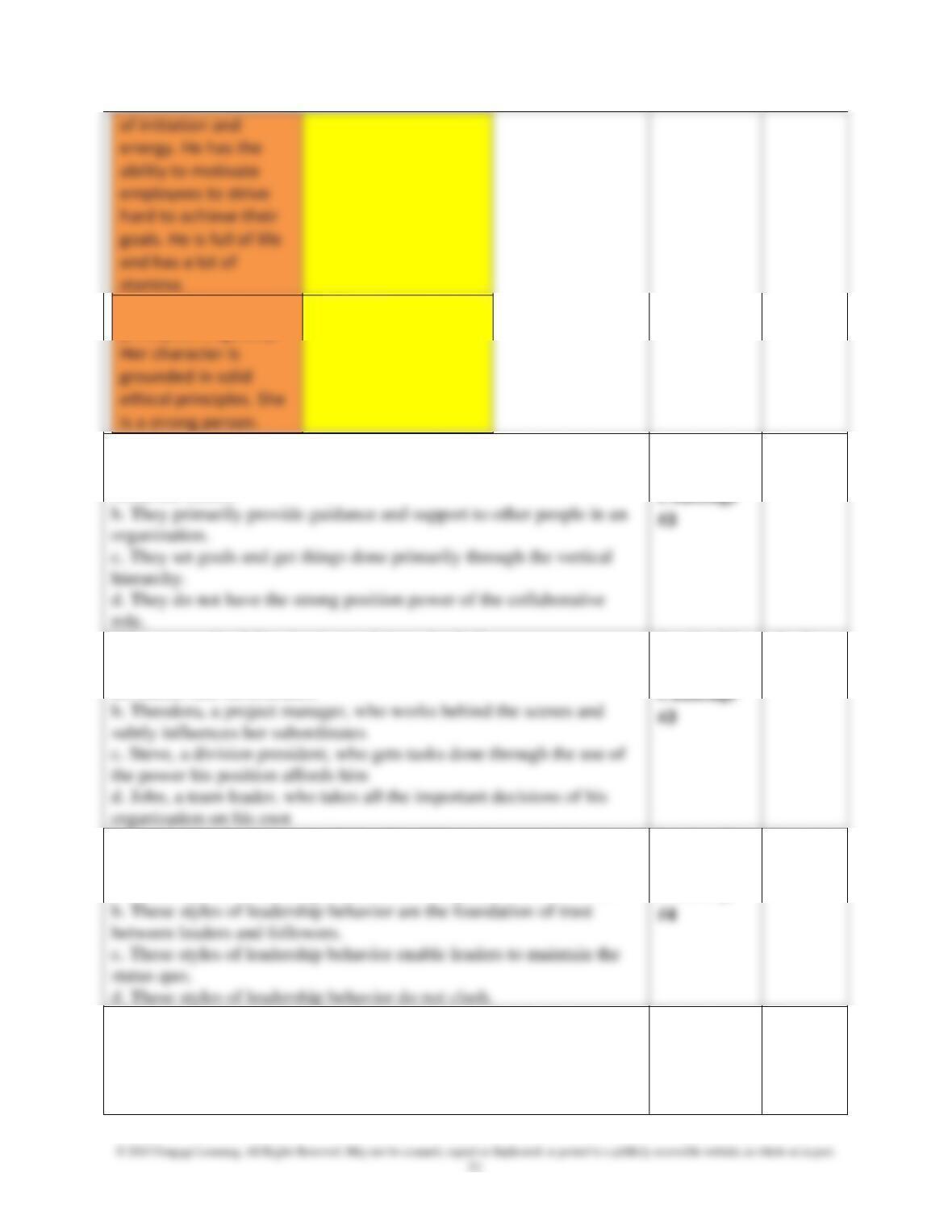
You are aware that different leaders have distinguishing personal
characteristics. Listed below are a few traits typically considered
highly important for leadership. Match each scenario with its
corresponding trait.
SCENARIOS
TRAITS
Diana, a team lead,
sees every situation
positively. She avoids
Integrity
Kelly heads the
operations team of a
media company. She
Drive
Harry is the
production manager
of Magnify Inc. He
works with high levels
Honesty
Leadershi
p
Challenge
#2
Connec
t
Natalie follows her
principles religiously.
Optimism
Which of the following statements is true of operational leaders?
a. They often work behind the scenes, using their personal power to
influence others.
Leadershi
p
Connec
t
Who among the following is an advisory leader?
a. Edward, a senior legal associate, who provides guidance and aid to
his clients and subordinates
Leadershi
p
Perfor
m
In terms of leader behavior, which of the following statements is true
of consideration and initiating structure?
a. These styles of leadership behavior are independent of each other.
Leadershi
p
Challenge
Connec
t
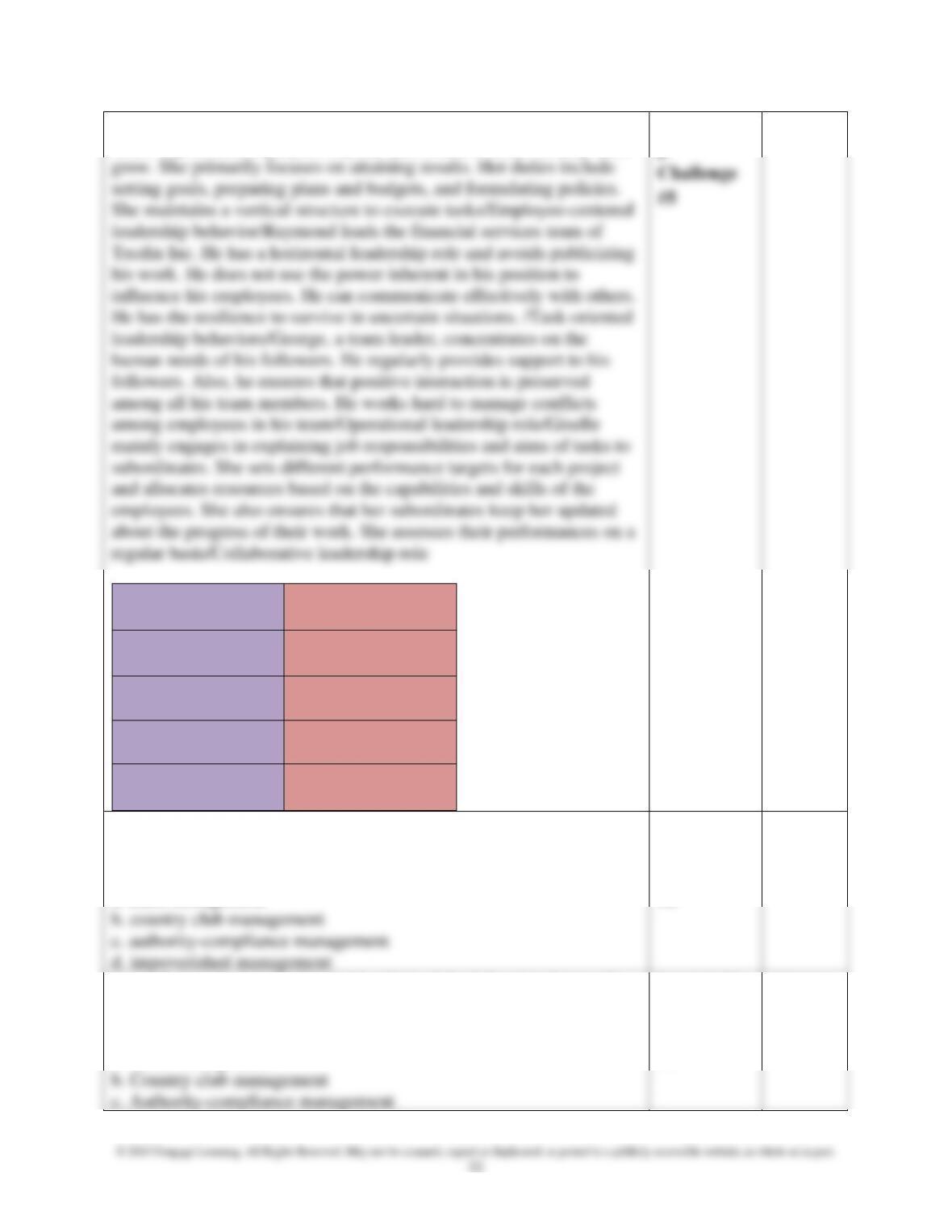
Listed below are a couple of scenarios relating to some leadership
behaviors and a set of behavior approaches. Drag and drop the options
below into the illustrated box categorizing them accurately.
Answer Options: Katie heads the divisional branch of Pisces
Leadershi
p
Challenge
#3
Connec
t
Networks Inc. She has good critical thinking and analytical skills. She
tends to push her employees beyond their comfort zones to help them
SCENARIOS
CONCEPTS
Leadershi
p
According to the Leadership Grid, _____ refers to the absence of a
leadership philosophy wherein leaders exert little effort toward
interpersonal relationships or work accomplishment.
a. team management
Leadershi
p
Challenge
#4
Engage
According to the Leadership Grid, which of the following forms of
management occurs when efficiency in operations is the dominant
orientation?
a. Team management
Leadershi
p
Challenge
#4
Engage
In terms of leader behavior, which of the following is an example of
consideration behavior?
a. Directing tasks
Leadershi
p
Challenge
Connec
t
Which of the following is an example of initiating structure style of
leader behavior?
a. Showing appreciation
Leadershi
p
Challenge
Connec
t
The findings about two underlying dimensions of people-oriented
and task-oriented leadership behaviors raise three questions to think
about. One of the questions is whether:
a. people orientation and task orientation can result in “high–high”
leadership.
Leadershi
p
Challenge
#5
Connec
t
Which of the following is an example of employee-centered
leadership behavior?
a. Directing activities toward scheduling
Leadershi
p
Challenge
Connec
t
Which of the following is a difference between leader behavior
toward in-group subordinates versus out-group subordinates?
a. Leaders treat mistakes made by in-group subordinates as
opportunities for developing, whereas leaders criticize out-group
subordinates when they make mistakes.
Leadershi
p
Challenge
#6
Connec
t
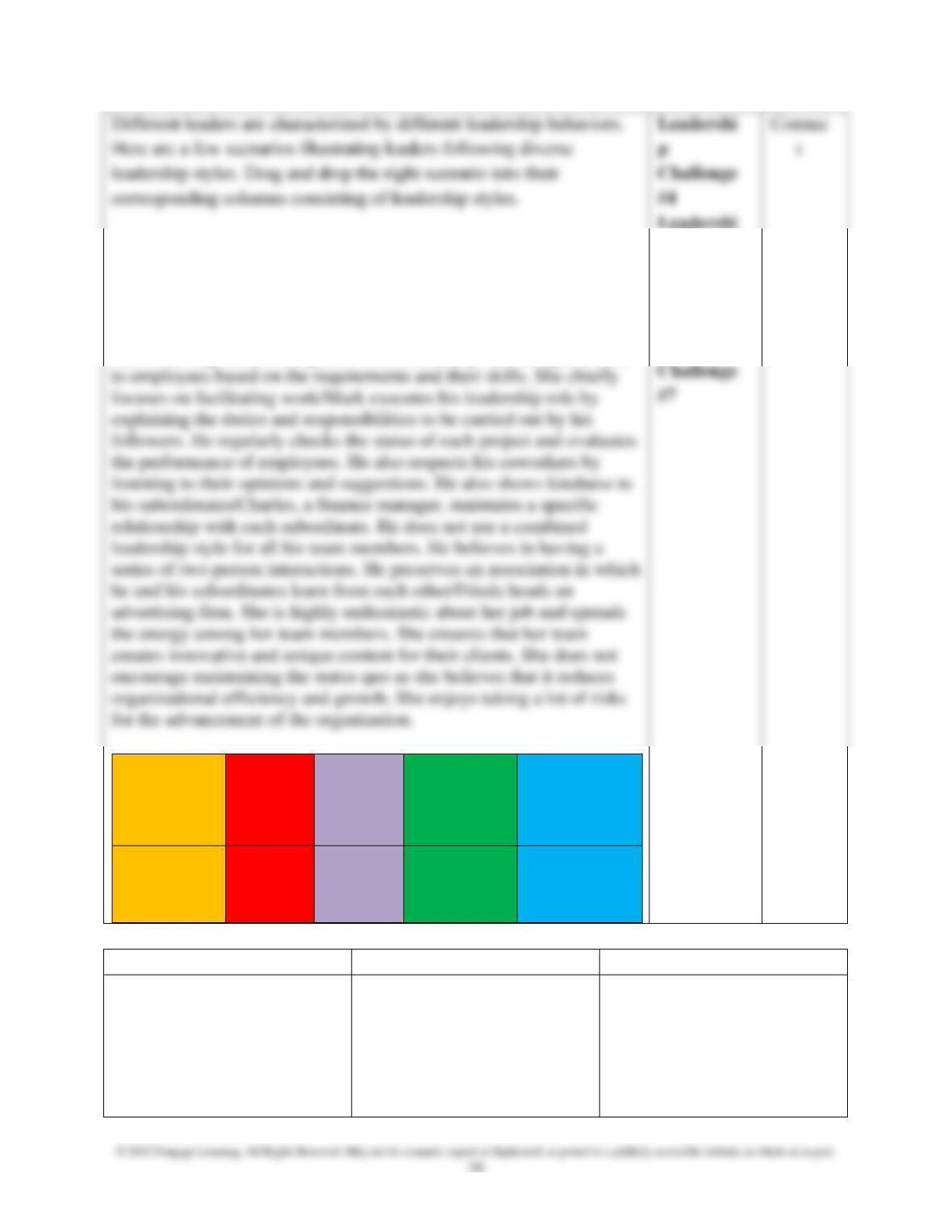
Answer Options: Ricky leads his team members by paying attention to
their needs and respecting their opinions and suggestions. He admires
and appreciates his subordinates when they perform well and make
improvements. He also listens to the challenges faced by his followers
and provides solutions/Louisa, a project manager, creates schedules,
sets work targets, and completes tasks efficiently. She delegates tasks
Considerati
on
leadership
behavior
Job-
centered
leadershi
p style
“High–
high”
leadershi
p style
Individualiz
ed
leadership
Entrepreneuri
al leadership
Leadershi
p
Challenge
#6
Leadershi
p
Media Quiz Questions
Topic
Category
Which of the following can
leaders apply to maintain
good networking skills with
others?
a. Leaders can develop
arrogance and pride rather
Leadership Challenge #1
Connect
than know themselves.
A democratic leader:
a. tends to centralize authority
in an organization.
Leadership Challenge #4
Connect
Which of the following
statements is true of
collaborative leaders?
a. They fill traditional line and
general management positions
in an organization.
Leadership Challenge #4
Connect
Pre-Test Questions
Topic
Category
According to the trait
Leadership Challenge #1
Engage