Archives
Chapter 1 Homework The Flexural Rigidity The Beam
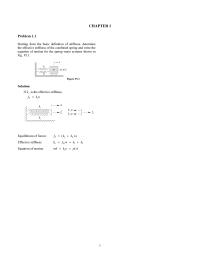
1 CHAPTER 1 Problem 1.1 Starting from the basic definition of stiffness, determine the effective stiffness of the combined spring and write the equation of motion for the spring–mass systems shown in Fig. P1.1. Figure P1.1 Solution: If k e […]
Chapter 10 Homework The mass and stiffness matrices were determined in
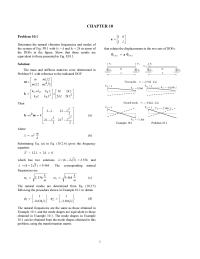
1 CHAPTER 10 Problem 10.1 Determine the natural vibration frequencies and modes of the system of Fig. P9.1 with k1 = k and k2 = 2k in terms of Solution: The mass and stiffness matrices were determined in Problem 9.1 […]
Chapter 10 Homework The Roots The Above Equation Are 12
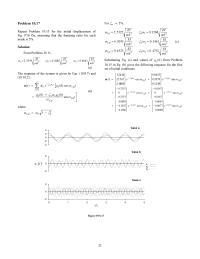
21 Problem 10.17 Repeat Problem 10.15 for the initial displacement of Fig. P10.15a, assuming that the damping ratio for each 132333 mh mh mh (a) 10.15 in Eq. (b) gives the following response for the first set of initial […]
Chapter 11 Homework Evaluate Substituting And Eq A Gives
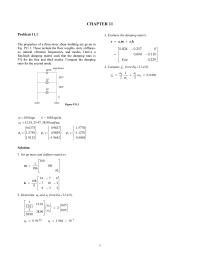
1 CHAPTER 11 Problem 11.1 The properties of a three-story shear building are given in ratio for the second mode. Figure P11.1 12 3 100 kips = 168 kips/in. 12.01, 25.47, 38.90 rad sec 0.6375 0.9827 1.5778 1.2750 , 0.9829 […]
Chapter 12 Homework Problem 121 Where From Problem 106
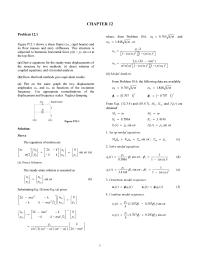
1 CHAPTER 12 Problem 12.1 Figure P12.1 shows a shear frame (i.e., rigid beams) and coupled equations; and (ii) modal analysis. (b) Show that both methods give equivalent results. (c) Plot on the same graph the two displacement amplitudes u1o […]
Chapter 12 Homework The Modes Are Normalized Such That 1
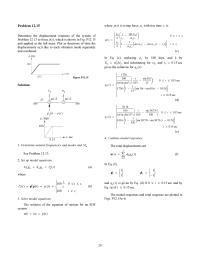
20 Problem 12.15 and combined. Figure P12.15 KM nnn 2, and substituting for n and t r 015. sec gives the solutions for q t n(): ttt 100 1736 10 . sin F R | […]
Chapter 13 Homework At The Base Torque Due The Nth
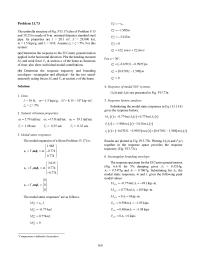
Problem 13.73 The umbrella structure of Fig. P13.17 (also of Problem 9.13 and 10.23) is made of 6-in. nominal diameter standard steel pipe. Its properties are I = 28.1 in4, E = 29,000 ksi, m = 1.5 kips/g, and L […]
Chapter 13 Homework Compare the preceding results with the response of the
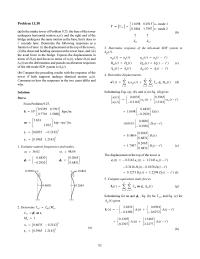
92 Problem 13.38 function of time: (i) the displacement at the top of the tower, (ii) the shear and bending moment at the tower base, and (iii) the axial force in the bridge. Express the displacements in terms of Dn(t) […]
Chapter 13 Homework Compare the preceding results with the response of the
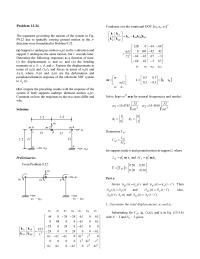
Problem 13.34 The equations governing the motion of the system in Fig. P9.22 due to spatially varying ground motion in the x– direction were formulated in Problem 9.22. (a) Support a undergoes motion ug(t) in the x-direction and support b […]
Chapter 13 Homework Computed similarly, these quantities for the second and
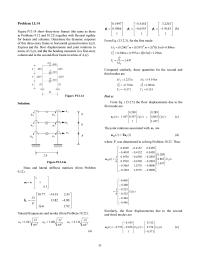
31 Problem 13.14 for beams and columns. Determine the dynamic response of this three-story frame to horizontal ground motion ݑሷ g(t). Express (a) the floor displacements and joint rotations in terms of Dn(t), and (b) the bending moments in a […]
Chapter 13 Homework expand the effective earthquake forces in terms of their
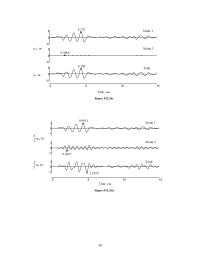
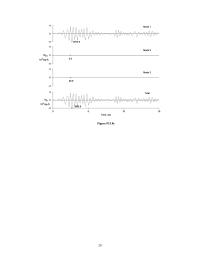
58 0 5 4.132 -5 Time, sec Mode 1 0 5 10 15 Fig. P13.26c -5 0 uy, in. 5 4.182 Total -1 0 1 0.9931 Mode 1 -1 0 1 Mode 3 2 in. 0.6027 0 5 10 […]
Chapter 13 Homework Figure P135 Solution The Modal Expansion Shown
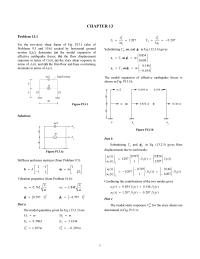
1 CHAPTER 13 Problems 9.5 and 10.6) excited by horizontal ground motion ݑሷ g(t), determine (a) the modal expansion of effective earthquake forces, (b) the floor displacement response in terms of Dn(t), (c) the story shear response in terms of […]
Chapter 13 Homework Modes 1 and 2 are strongly correlated with each
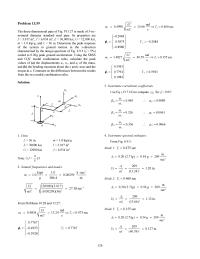
126 Problem 13.59 The three-dimensional pipe of Fig. P13.27 is made of 3-in.– Solution: 1 12 12 2 1 13 13 3 2 23 23 3 0.969 0.9089 0.326 0.0061 0.336 0.0066 […]
Chapter 13 Homework The CQC estimate of the peak response is close
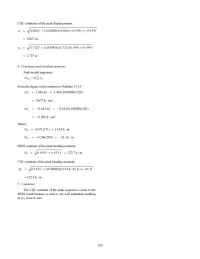
109 CQC estimates of the peak displacements: 6. Determine peak bending moments. Peak modal responses: n st bnbn AMM From the figure in the solution to Problem 13.15: 1 2 2 2 0.672 k sec 0.443 0.443 (0.00388) (120) […]
Chapter 13 Homework The effective modal masses and effective modal heights
Figure P13.8e 20 21 Problem 13.9 SDF systems for the modes. Verify that Eqs. (13.2.14) and (13.2.17) are satisfied. Solution: The floor masses, and the height of each floor above the base are mm 1 mm 2 mm 32 […]
Chapter 13 Homework The Modal Static Responses U3stn Are Available
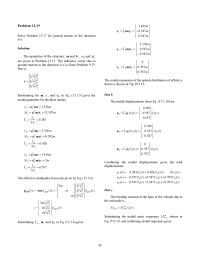
44 Problem 13.19 Solution: The properties of the structure, mand k , n and n are given in Problem 13.17. The influence vector due to ground motion in the direction b-d is (from Problem 9.13, Part c). […]
Chapter 13 Homework The two values of obtained correspond to the
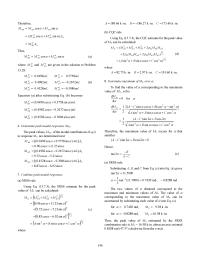
Therefore, ynxnn MMM sincos 189.66 k in. 186.27 k in. 173.46 k in. AB C n n AM Thus, sincos st yn st xn st nMMM (a) 2 […]
Chapter 14 Homework the damping matrix corresponding to given modal
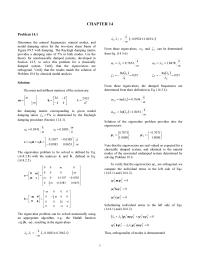
1 CHAPTER 14 modal damping ratios for the two-story shear frame of Figure P9.5 with damping. The Rayleigh damping matrix provides a damping ratio of 5% in both modes. Use the theory for nonclassically damped systems, developed in Section 14.5, […]
Chapter 15 Homework Determine The Natural Modes
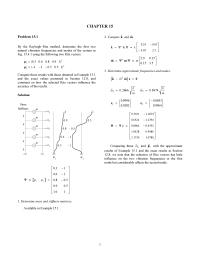
1 CHAPTER 15 Problem 15.1 By the Rayleigh–Ritz method, determine the first two natural vibration frequencies and modes of the system in Fig. 15.4.1 using the following two Ritz vectors: Compare these results with those obtained in Example 15.1 and […]
Chapter 16 Homework Problem 168 Solve The Problem Example 162
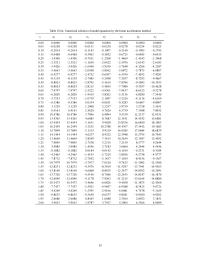
Table 16.6a: Numerical solution of modal equations by the linear acceleration method i t 1 q 2 q 1 u 2 u 3 u 4 u 5 u 0.00 0.0000 0.0000 0.0000 0.0000 0.0000 0.0000 0.0000 0.05 –0.0258 –0.0258 –0.0151 […]
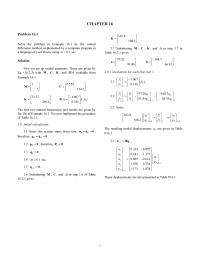
Chapter 16 Homework The first two natural frequencies and modes are given by
1 CHAPTER 16 Problem 16.1 Solve the problem in Example 16.1 by the central difference method, implemented by a computer program in a language of your choice using ∆t = 0.1 sec. First we set up modal equations. These are […]
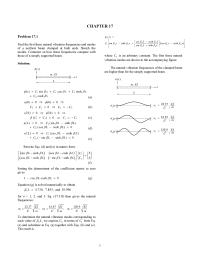
Chapter 17 Homework The first two modes, with zero natural frequencies
1 CHAPTER 17 Problem 17.1 Solution: x L 12 3 ( ) sin cos sinh x CxC xC x x m, EI (x) L m, EI (x) Cx 4cosh (a) (0) 0 […]
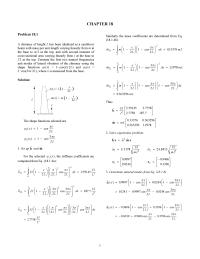
Chapter 18 Homework Using A The Consistent mass Matrix And
1 CHAPTER 18 Problem 18.1 A chimney of height L has been idealized as a cantilever beam with mass per unit length varying linearly from m at the base to m/2 at the top, and with second moment of cross-sectional […]
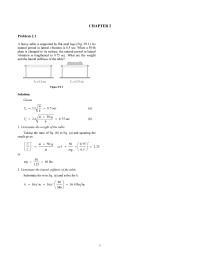
Chapter 2 Homework A heavy table is supported by flat steel legs
1 CHAPTER 2 Problem 2.1 A heavy table is supported by flat steel legs (Fig. P2.1). Its natural period in lateral vibration is 0.5 sec. When a 50-lb plate is clamped to its surface, the natural period in lateral vibration […]
Chapter 3 Homework An SDF system is excited by a sinusoidal force
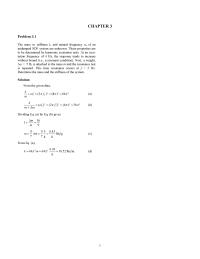
1 CHAPTER 3 Problem 3.1 The mass m, stiffness k, and natural frequency ωn of an undamped SDF system are unknown. These properties are to be determined by harmonic excitation tests. At an exci- tation frequency of 4 Hz, the […]
Chapter 3 Homework Problem 314 Determine The Speed The Automobile
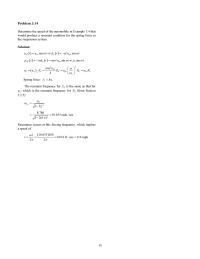
14 Problem 3.14 Determine the speed of the automobile in Example 3.4 that would produce a resonant condition for the spring force in the suspension system. Solution: 2 sin sin ggoggo ut u t ut u […]
Chapter 4 Homework Derive equations describing u(t) during the forced
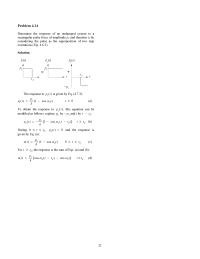
21 Problem 4.14 Determine the response of an undamped system to a rectangular pulse force of amplitude po and duration td by considering the pulse as the superposition of two step excitations (Fig. 4.6.2). Solution: p t( ) t( ) […]
Chapter 4 Homework The Complimentary And Particular Solutions Are
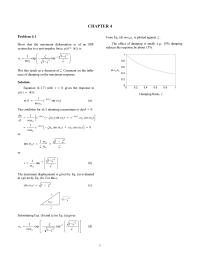
1 CHAPTER 4 Problem 4.1 Show that the maximum deformation u0 of an SDF system due to a unit impulse force, p(t) = δ(t), is n Plot this result as a function of ζ. Comment on the influ- ence […]
Chapter 5 Homework Specialize the recurrence formulas for the following
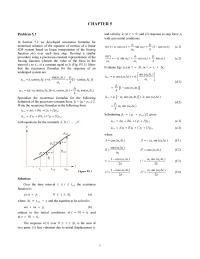
1 CHAPTER 5 Problem 5.1 In Section 5.2 we developed recurrence formulas for interval ti to ti+1 is a constant equal to ᷉᷉pi (Fig. P5.1). Show that the recurrence formulas for the response of an undamped system are )]cos(–1[ ~ […]
Chapter 6 Homework A Full Water Tank Supported
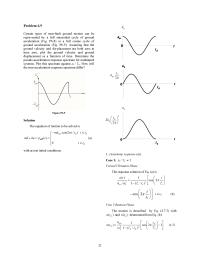
21 Problem 6.9 Certain types of near-fault ground motion can be displacement as a function of time. Determine the pseudo-acceleration response spectrum for undamped systems. Plot this spectrum against td / Tn. How will the true-acceleration response spectrum differ? Figure […]
Chapter 6 Homework Determine The Overall Maximum Response From Eqs
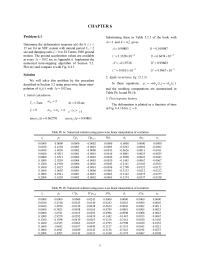
1 CHAPTER 6 Problem 6.1 Determine the deformation response u(t) for 0 ≤ t ≤ 15 sec for an SDF system with natural period Tn = 2 Solution We will solve this problem by the procedure described in Section 5.2 […]
Chapter 6 Homework The Ash Hopper Fig P620
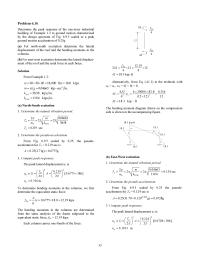
33 Problem 6.16 by the design spectrum of Fig. 6.9.5 scaled to a peak ground motion acceleration of 0.25g. (a) For north-south excitation determine the lateral displacement of the roof and the bending moments in the columns. (b) For east-west […]
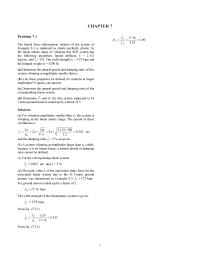
Chapter 7 Homework And Reproduced Figs P76a And
1 CHAPTER 7 Problem 7.1 The lateral force–deformation relation of the system of Example 6.3 is idealized as elastic–perfectly plastic. In the linear elastic range of vibration this SDF system has the following properties: lateral stiffness, k = 2.112 kips/in., […]
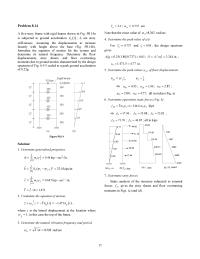
Chapter 8 Homework Solve Problem 8.14 using the shape function given by de-flections
17 Problem 8.14 is subjected to ground acceleration g ut ; kj are story stiff-nesses. Assuming the displacements to increase linearly with height above the base (Fig. P8.14b), formulate the equation of motion for the system and […]
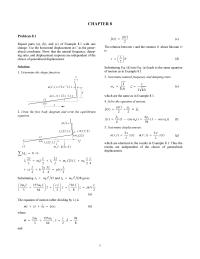
Chapter 8 Homework Solve Problem 87 Asssuming That
1 CHAPTER 8 Repeat parts (a), (b), and (c) of Example 8.1 with one change: Use the horizontal displacement at C as the gener- alized coordinate. Show that the natural frequency, damp- ing ratio, and displacement response are independent of […]
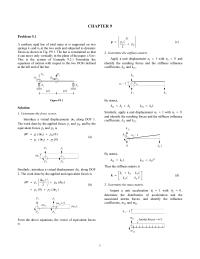
Chapter 9 Homework A uniform rigid bar of total mass m is supported on two
1 CHAPTER 9 Problem 9.1 springs k1 and k2 at the two ends and subjected to dynamic forces as shown in Fig. P9.1. The bar is constrained so that it can move only vertically in the plane of the paper. […]
Chapter 9 Homework Formulate the equations of motion for the system shown in Fig
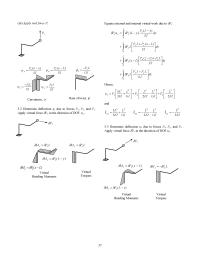
37 (iii) Apply real force Pz EI L P GJ L EI L P GJ L […]
Chapter 9 Homework Formulate the equations of motion governing the DOFs
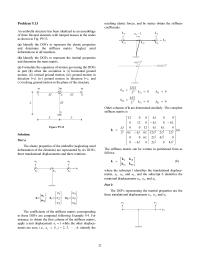
21 Problem 9.13 An umbrella structure has been idealized as an assemblage of three flexural elements with lumped masses at the nodes and determine the mass matrix. (c) Formulate the equations of motion governing the DOFs in part (b) when […]