31
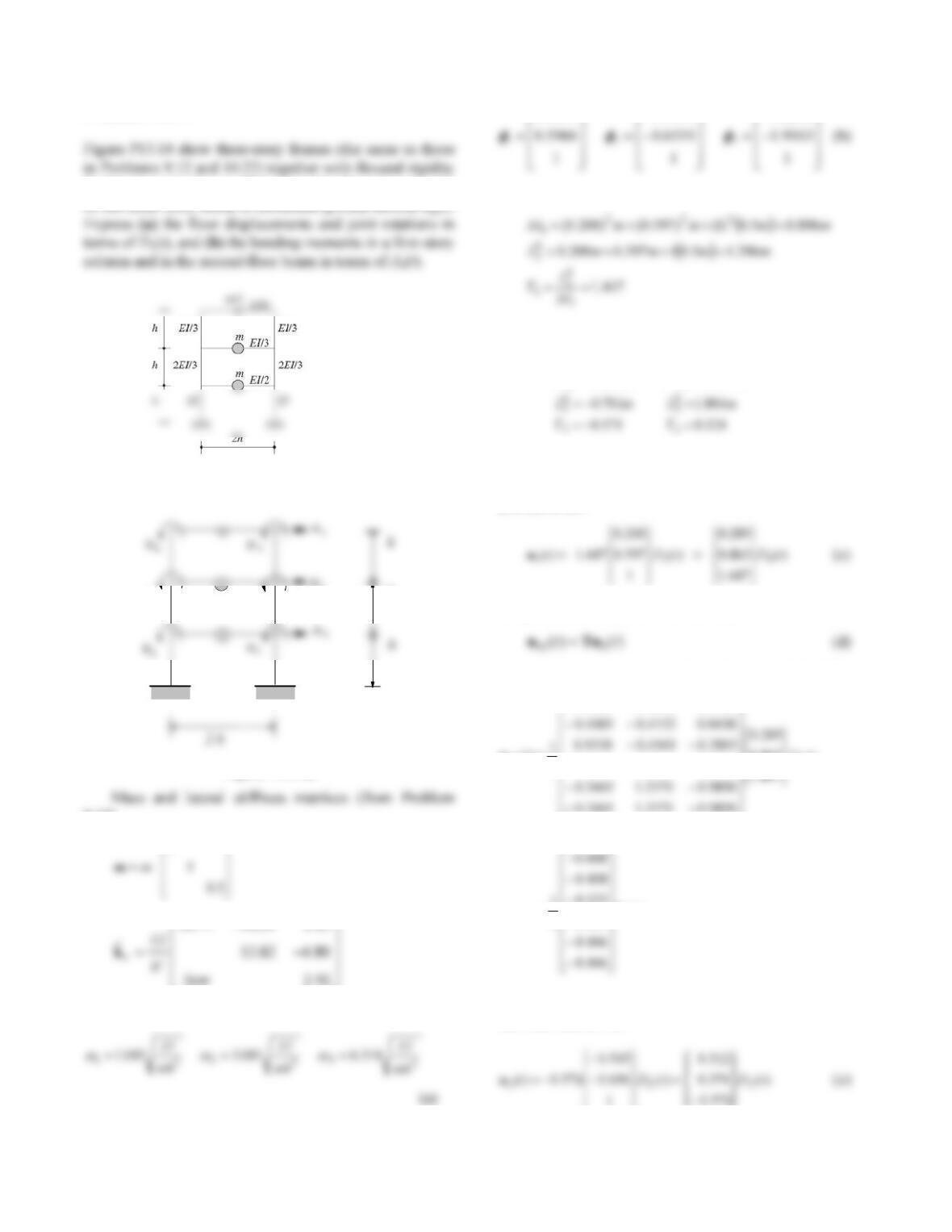
Problem 13.14
for beams and columns. Determine the dynamic response
of this three-story frame to horizontal ground motion ݑሷ g(t).
Figure P13.14
Solution:
u
2
u
7
u 6
h
Figure P13.14a
9.12)
1
30.77 14.01 2.43
Natural frequencies and modes (from Problem 10.22):
0.1997
0.5454
3.2201
From Eq. (13.2.3), for the first mode:
Computed similarly, these quantities for the second and
third modes are
227.1
2
mM
541.14
3
mM
Part a:
From Eq. (13.2.5) the floor displacements due to the
first mode are:
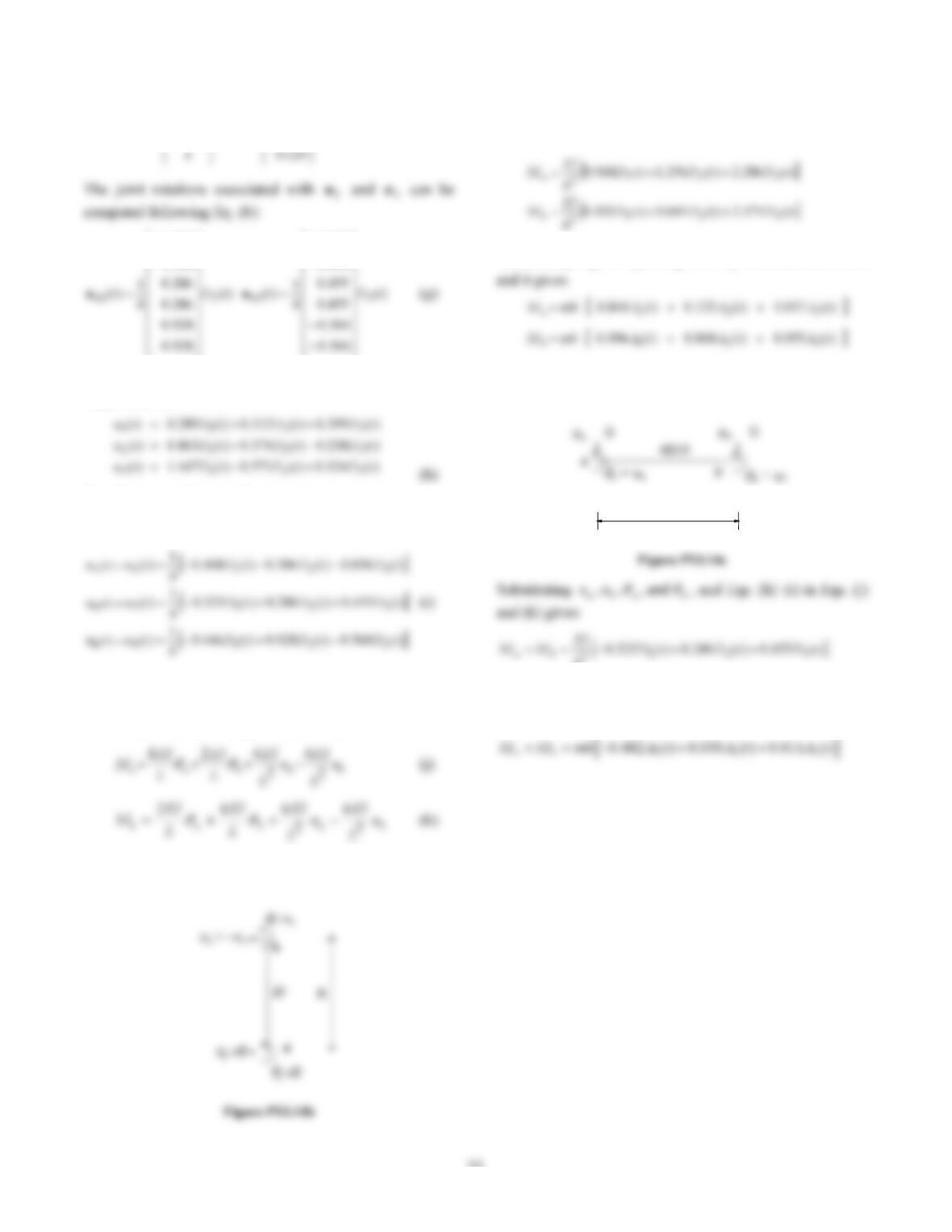
The joint rotations associated with u1 are
where T was determined in solving Problem 10.22. Thus:
)(
101
863.0
2803.04569.09530.0
0458.04152.04005.0
)( tD
h
t
u
)(
525.0
525.0
1
1tD
h
Similarly, the floor displacements due to the second
and third modes are
32
)(
238.0
399.0
)(
916.1
220.3
124.0)( 333 tDtDt
u (f)
306.0
306.0
056.0
056.0
Combining modal responses gives the total floor
displacements:
Combining modal contributions to joint rotations gives
uu u u
0010203
() () () ()tttt
Part b
The bending moments at the ends of a flexural element
are related to the nodal displacements by:
For a first story column,
L
h and the nodal displace-
ments are shown in Fig. P13.14b:
Substituting uu
ab a b
,, ,
and , and Eqs. (h)–(i) in Eqs. (j)
and (k) gives:
Substituting Dt At
nnn
() ()/
2 and
n in terms of E, I, m,
For the second floor beam,
L
h2 and the nodal
displacements are shown in Fig. P13.14c:
2h
h
Substituting Dt At
nnn
() ()/
2 and
n in terms of E, I, m,
and h gives
33
Problem 13.15
L
Part a
downward, the influence vector is:
111
7.397
T
M
mm
22 1.431
222
5.048
T
M
mm
The effective earthquake forces are given by Eq. (13.1.2):
Substituting
n, m, and n
in Eq. (13.1.6) gives
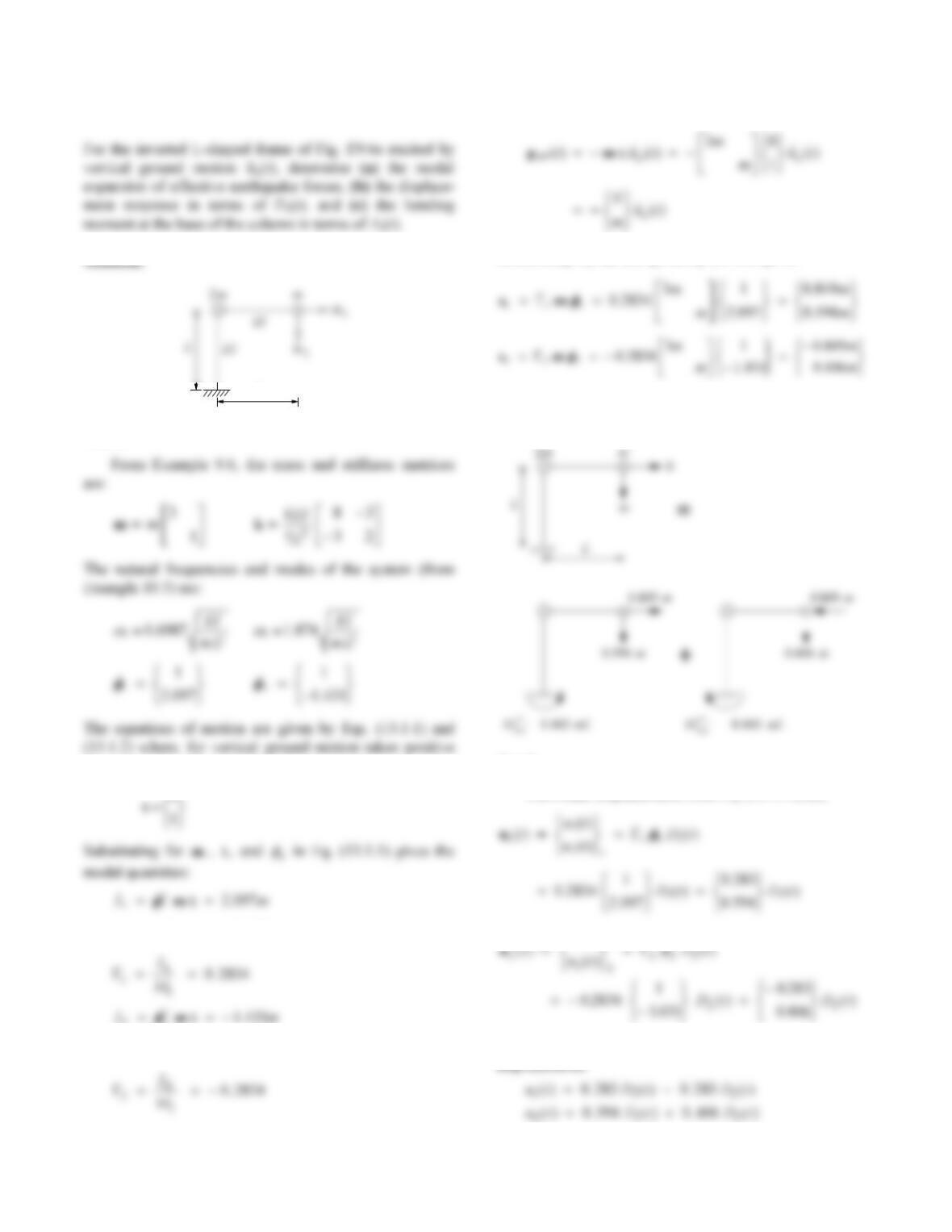
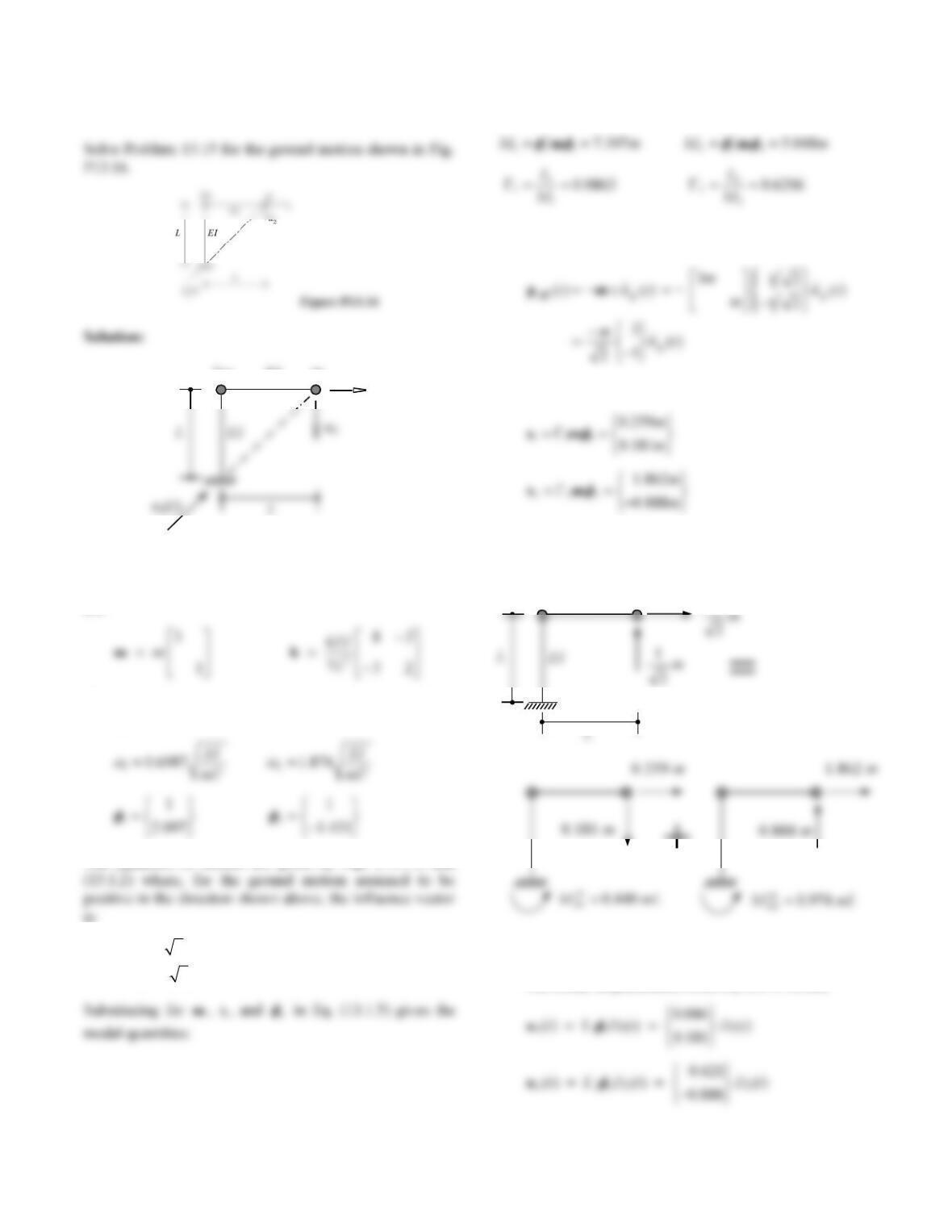
The modal expansion of effective forces is shown in the
following figure.
Part b
The modal displacements from Eq. (13.1.10) are
1
U
Combining the modal displacements gives the total
displacements:
34
Part c
Using Mbn
st shown in the figure, the modal responses
for
M
b are
M
t
M
t
M
t
35
Problem 13.16
Part a
From Example 9.6, the mass and stiffness matrices
are:
The natural frequencies and modes of the system (from
Example 10.3) are:
The equations of motion are given by Eqs. (13.1.1) and
1/ 2
1/ 2
11
0.639
T
Lm
m
22
3.133
T
Lm
m
The effective earthquake forces are given by Eq. (13.1.2):
Substituting n
, m, and n
in Eq. (13.1.6) gives:
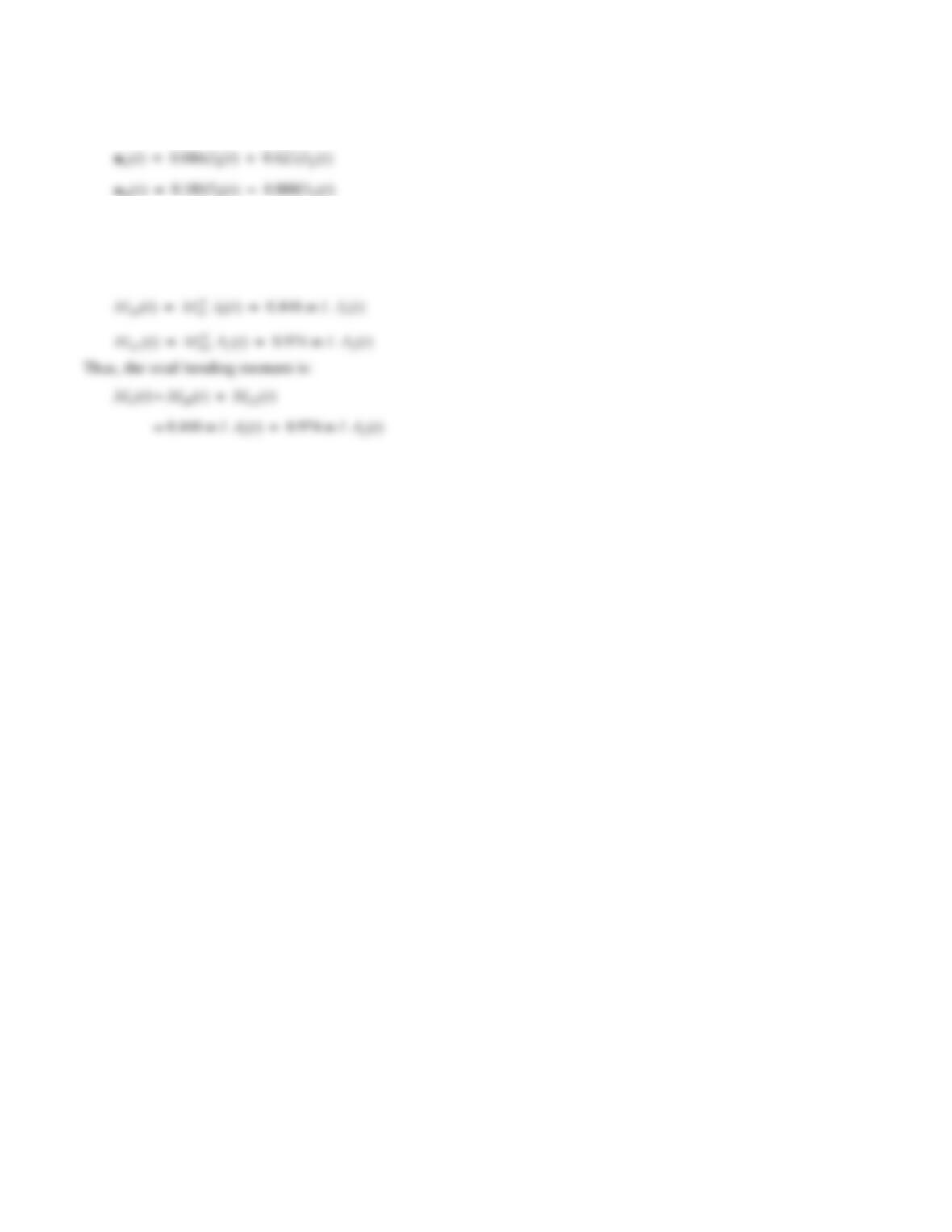
The modal expansion of the spatial distribution m
of the
effective forces is shown in the following figure.
Part b
The modal displacements from Eq. (13.1.10) are:
2m m
EI
u1
2mm
EI
3
36
Combining the modal displacements gives the total
displacements:
21
2
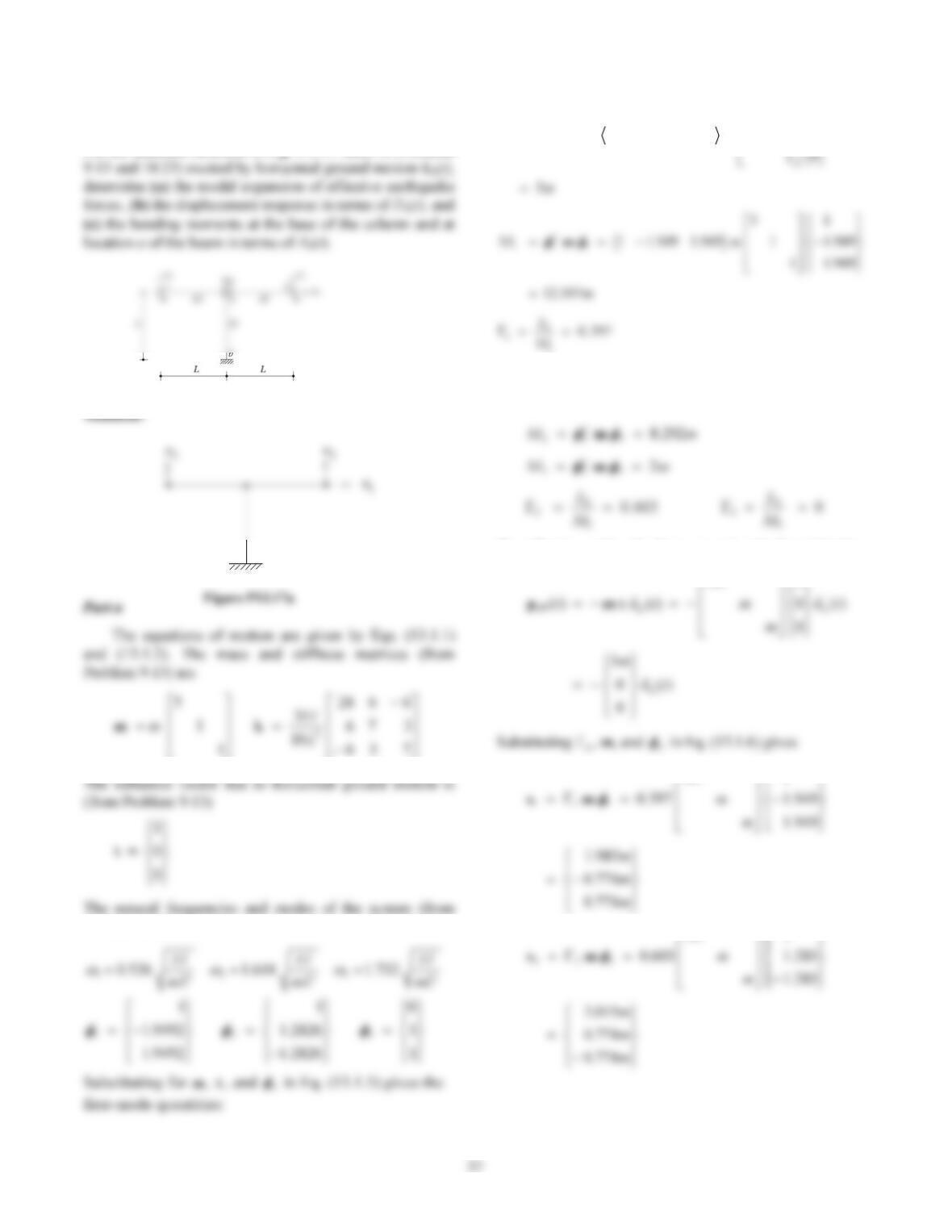
Part c
Using st
bn
M shown in the figure above, the modal
responses for b
M are:
Problem 13.17
For the umbrella structure of Fig. P13.17 (also of Problems
Figure P13.17
N
Q
N
Q
Problem 10.23) are
11
51
1 1.949 1.949 1 0
T
Lm
m
Similar calculations for the second and third modes gives:
22 5
T
Lm
m
33 0
T
Lm
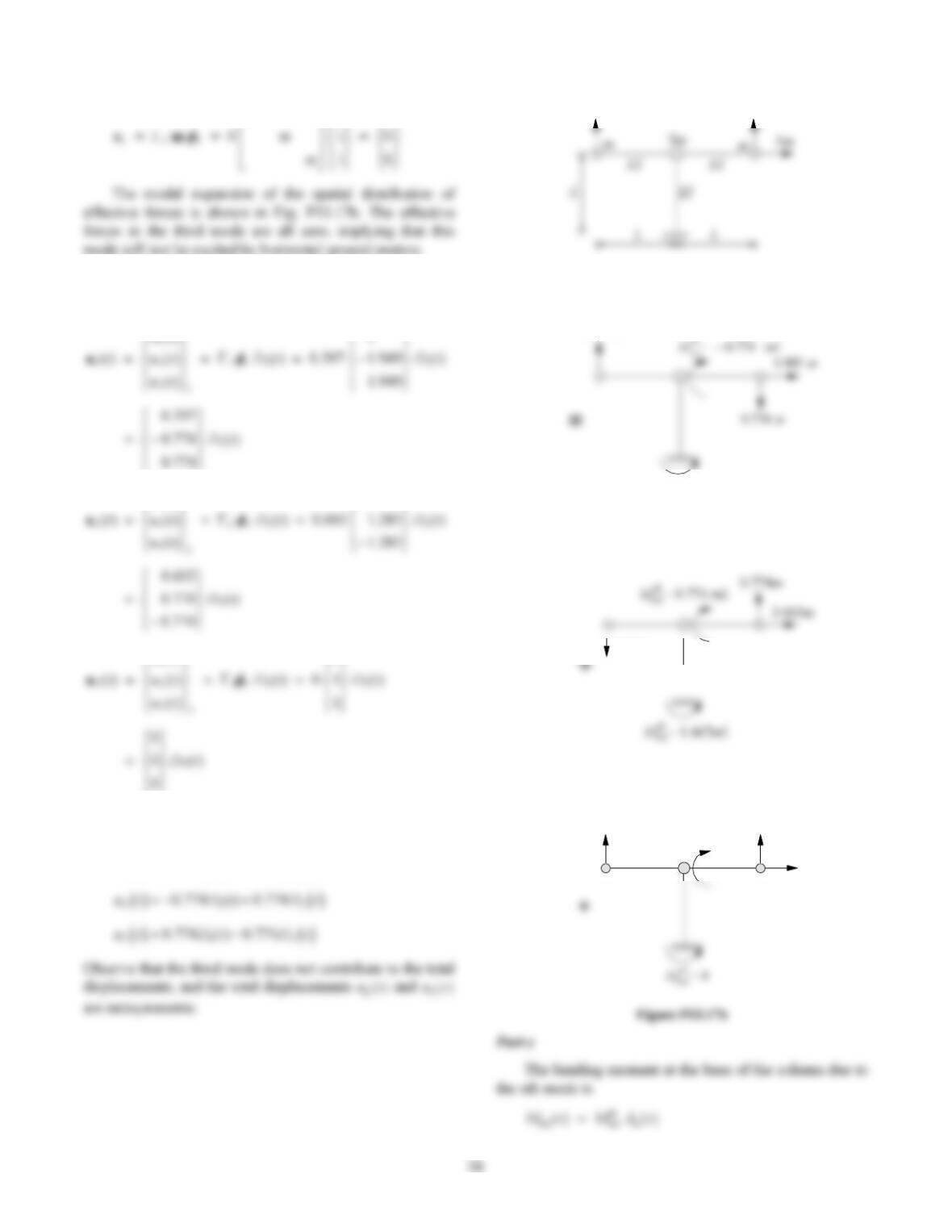
The effective earthquake forces are given by Eq. (13.1.4):
51
m
51
m
51
m
500
m
mode will not be excited by horizontal ground motion.
Part b
The modal displacements from Eq. (13.1.10) are
() 1
ut
1
() 1
ut
1
() 0
ut
Combining the modal displacements gives the total
displacements:
112
0.397 ( ) 0.603
ut Dt Dt
M = 3.533 mL
b1
0.774 m
st
0
00
M = 0
a3
st
0
0
0.774m
39
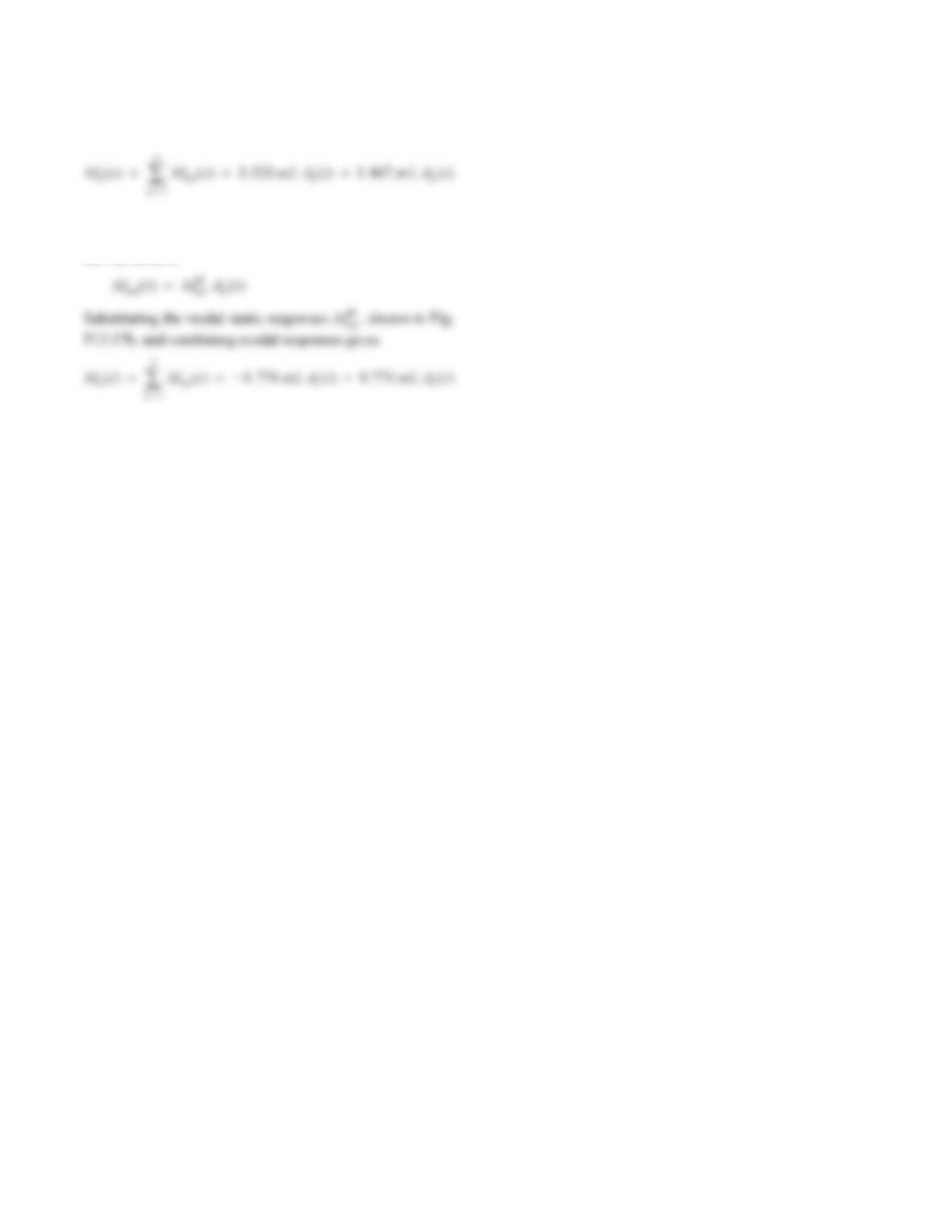
Substituting the modal static responses Mbn
st , shown in Fig.
P13.17b, and combining modal responses gives
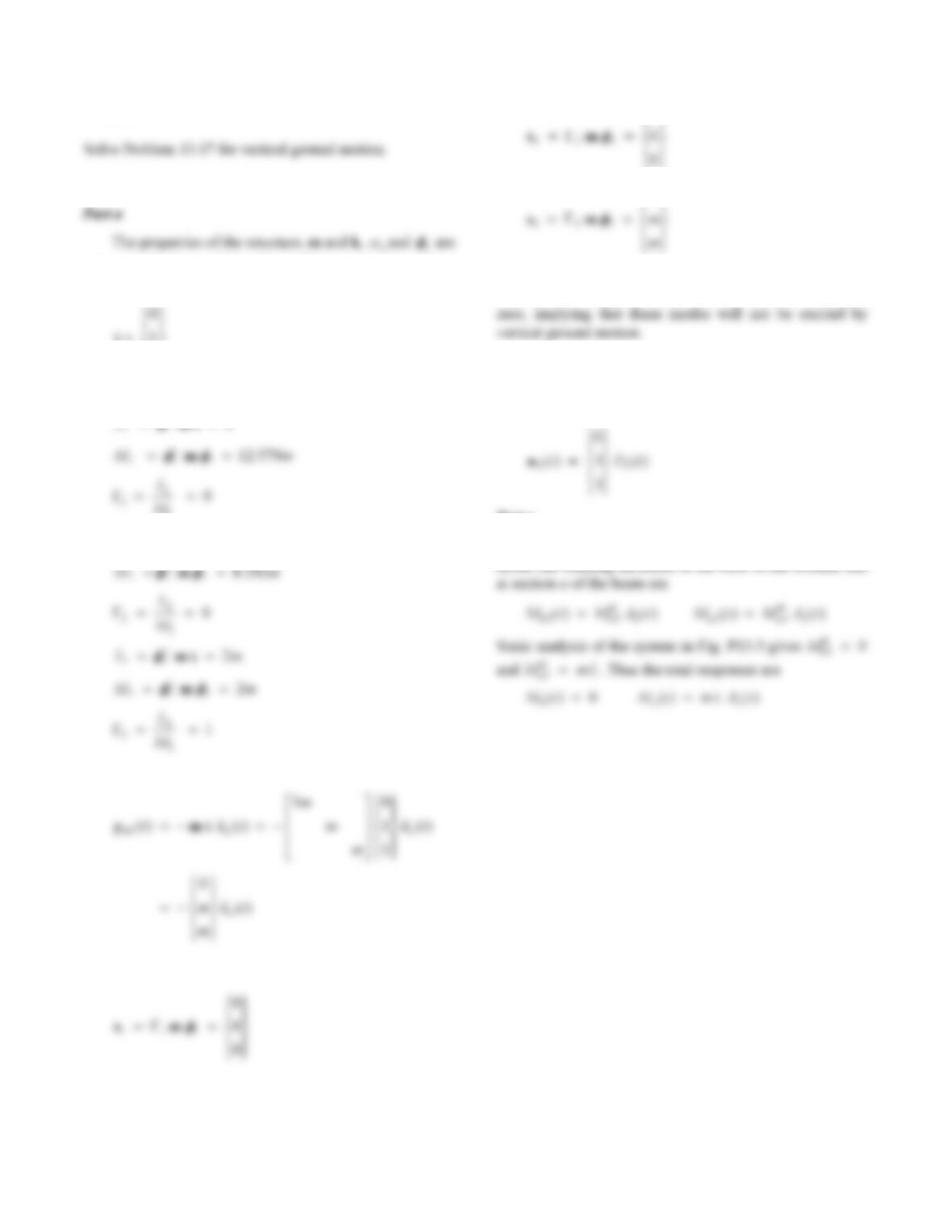
The bending moment at location a of the beam due to
the nth mode is
40
Problem 13.18
Solution:
given in Problem 13.17. The influence vector is (from
Problem 9.13):
1
1
The modal quantities, given by Eq. (13.1.5), are:
T
1
M
22 0
T
Lm
The effective forces, Eq. (13.1.4), are
Substituting n, m, and n
in Eq. (13.1.6) gives
0
0
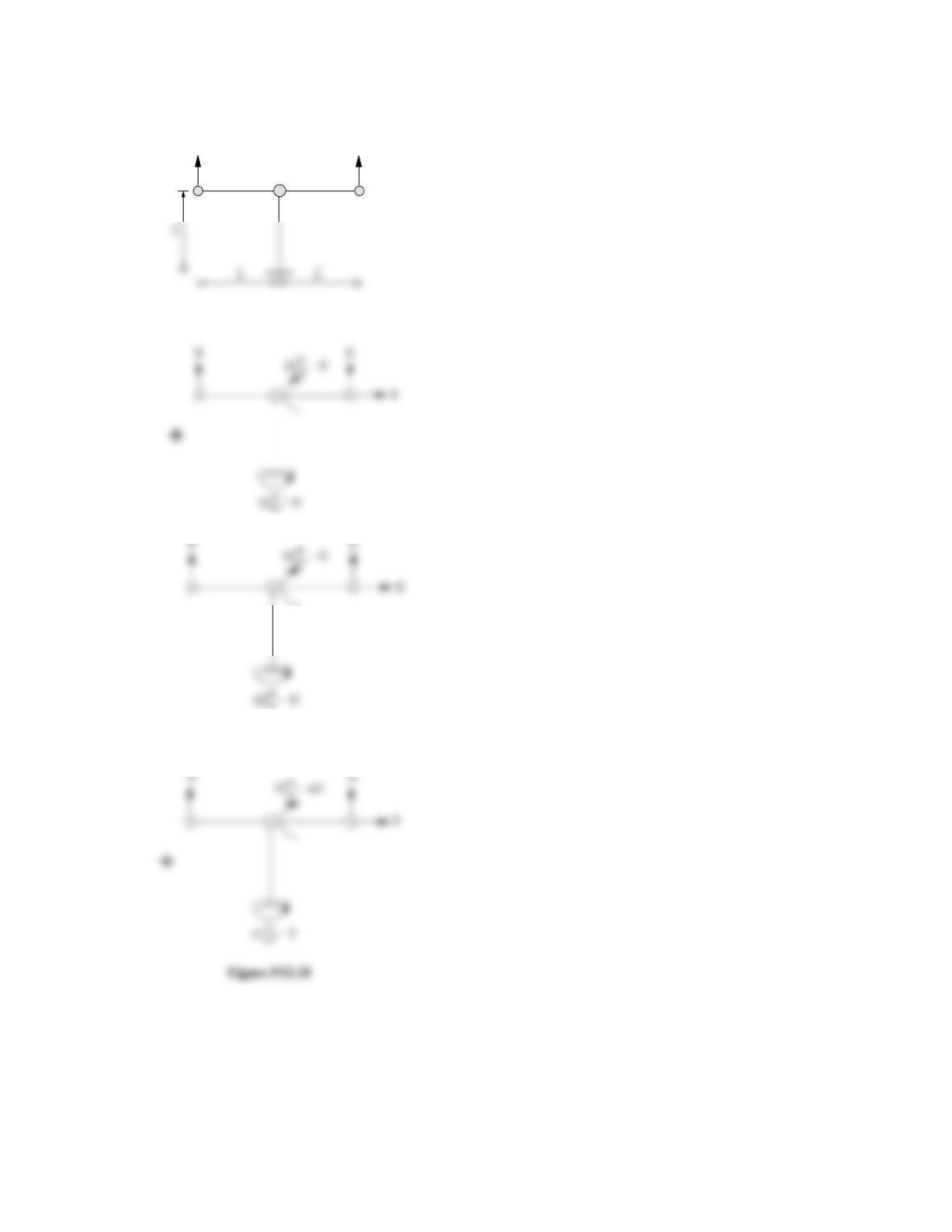
The modal expansion of effective forces is shown in Fig.
P13.18. The effective forces in the first two modes are
Part b
The response is only due to the third mode; from Eq.
(13.1.10):
Part c
The first two modes are not excited. Due to the third
mode, the bending moments at the base of the column and
41
mm
3m
m
m
=